lights SKODA RAPID 2013 1.G Workshop Manual
[x] Cancel search | Manufacturer: SKODA, Model Year: 2013, Model line: RAPID, Model: SKODA RAPID 2013 1.GPages: 226, PDF Size: 15.16 MB
Page 175 of 226
WARNING■It is prohibited to work with naked flames or lights.■It is prohibited to smoke or carry out any activities that produce sparks.■
Never use a damaged vehicle battery – risk of explosion!
■
Never charge a frozen or thawed vehicle battery – risk of explosion and
chemical burns!
■
Replace a frozen vehicle battery.
■
Never jump-start vehicle batteries with insufficient acid levels – risk of ex-
plosion and chemical burns.
WARNING■ When you charge a battery, hydrogen is released, and a highly explosive gas
mixture is also produced. An explosion can be caused through sparkling over during unclamping or loosening of the cable plug while the ignition is on.■
Creating a bridge between the poles on the battery (e.g. with a metal object
or cable) creates a short circuit - risk of melting the lead bars, and risk of ex-
plosion, battery fire and acid splashes.
■
Avoid creating sparks when working with cables and electrical devices.
Strong sparking represents a risk of injury.
■
Before carrying out any work on the electrical system, switch off the engine,
the ignition and all electrical components and disconnect the negative termi-
nal (-) on the battery.
CAUTION
Improper handling of the battery can lead to damage. We recommend having all
work on the vehicle battery carried out by a specialist garage.
CAUTION
■ The vehicle battery must only be disconnected if the ignition is switched off,
otherwise the vehicle's electrical system (electronic components) can be dam-
aged. When disconnecting the battery from the electrical system, first of all dis-
connect the negative terminal (-) of the battery, followed by the positive terminal
(+).■
When connecting the battery to the electrical system, first of all connect the
positive terminal (+) of the battery, followed by the negative terminal (-). Under no
circumstances must the battery cables be connected incorrectly – risk of a cable fire.
■ Ensure that battery acid does not come into contact with the bodywork – risk of
damage to the paintwork.■
Do not place the battery in direct daylight in order to protect the vehicle battery
housing from the effects of ultra-violet light.
■
If the vehicle has not been driven for more than 3 to 4 weeks, the battery will
discharge. This is because certain electrical components consume electricity (e. g.
control units) also in idle state. Prevent the battery from discharging by discon- necting the battery's negative terminal (-) or continuously charging the battery
with a very low charging current.
■
If the vehicle is frequently used for making short trips, the vehicle battery will
not have time to charge up sufficiently and may discharge.
For the sake of the environment
A vehicle battery that has been removed is a special type of hazardous waste.
These must be disposed of in accordance with national legal regulations.
Note
You should replace batteries older than 5 years.
Opening the cover
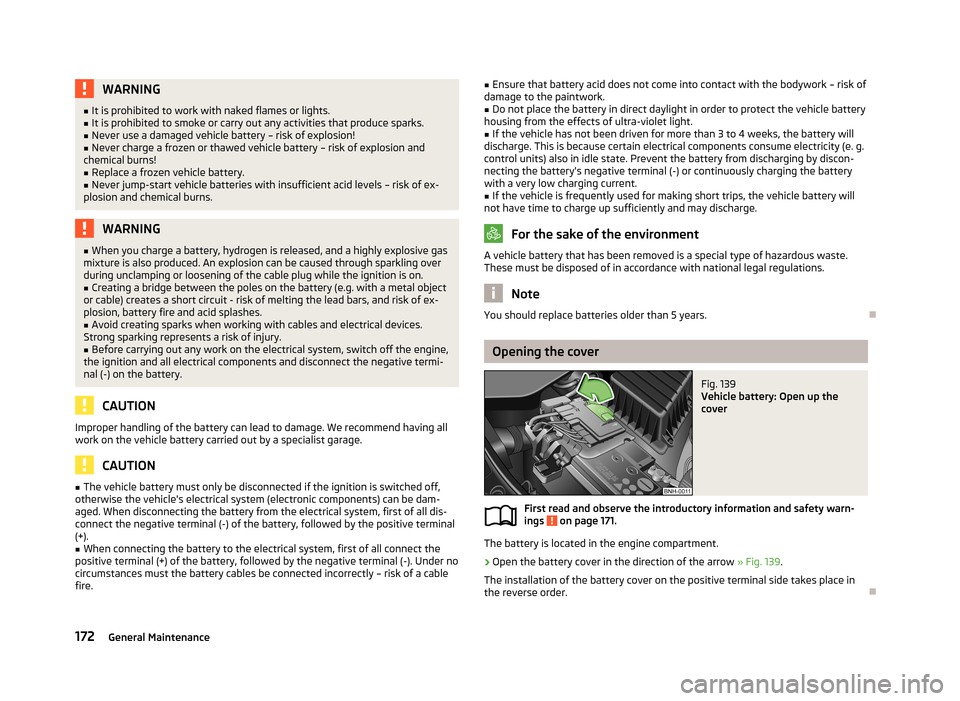
Fig. 139
Vehicle battery: Open up the
cover
First read and observe the introductory information and safety warn- ings on page 171.
The battery is located in the engine compartment.
›
Open the battery cover in the direction of the arrow » Fig. 139.
The installation of the battery cover on the positive terminal side takes place in the reverse order.
172General Maintenance
Page 177 of 226
WARNING“Quick-charging” the vehicle battery is dangerous and requires a special
charger and specialist knowledge.
CAUTION
On vehicles with the START/STOP system, the pole terminal of the charger must
not be connected directly to the negative terminal of the vehicle battery, but only
to the engine earth » page 191, Jump-starting in vehicles with the START-STOP
system .
Note
We therefore recommend that vehicle batteries be rapid charged by a specialist
garage.
Replacing
First read and observe the introductory information and safety warn-
ings
on page 171.
When replacing a battery, the new vehicle battery must have the same capacity,
voltage, amperage and be the same size. Suitable vehicle battery types can be
purchased from a specialist garage.
We recommend having the battery replaced by a specialist garage, where the
new vehicle battery will be installed properly and the original battery will be dis-
posed of in accordance with national regulations.
Disconnecting and reconnecting
First read and observe the introductory information and safety warn-
ings
on page 171.
On disconnecting and reconnecting the vehicle battery, the following functions
are initially deactivated or are no longer able to operate fault-free:
OperationOperating measureEnter the radio/navigation system code num-
ber» User manual of the radio
or » user manual of the naviga-
tion systemSetting the clock» page 13Data in the multifunction display are deleted.» page 25
Note
We recommend having the vehicle checked by a specialist garage in order to en-
sure full functionality of all electrical systems.
Automatic load deactivation
First read and observe the introductory information and safety warn-ings
on page 171.
The vehicle voltage control unit automatically prevents the battery from discharg-
ing when the battery is put under high levels of strain. This manifests itself by the
following.
› The idling speed is raised to allow the generator to deliver more electricity to
the electrical system.
› Where necessary, large convenience consumers such as seat heaters and rear
window heaters have their power limited or are shut off completely in the event
of an emergency.
CAUTION
■ Despite such intervention by the vehicle electric system management, the vehi-
cle battery may be drained. For example, when the ignition is switched on a long
time with the engine turned off or the side or parking lights are turned on during longer parking.■
Consumers that are supplied via a 12-V power socket can cause the vehicle bat-
tery to discharge when the ignition is switched off.
Note
Driving comfort is not impaired by consumers being deactivated. The driver is of-
ten not aware of it having taken place.
174General Maintenance
Page 181 of 226
545 kg
615 kg
630 kg
650 kg
690 kg
Speed symbol
This indicates the maximum permissible vehicle speed with fitted tyres in each
category.
170 km/h
180 km/h
190 km/h
200 km/h
210 km/h
240 km/h
270 km/h
CAUTION
The information about the load index and the speed symbol is listed in your vehi-
cle documents.
Unidirectional tyres
First read and observe the introductory information and safety warn-
ings
on page 175.
The direction of rotation of the tyres is marked by arrows on the wall of the tyre.
The indicated direction of rotation must be adhered to in order to ensure the op- timal characteristics of these tyres.
These characteristics mainly relate to the following: › Increased driving stability.
› Reduced risk of aquaplaning.
› Reduced tyre noise and tyre wear.
8791929395RSTUHVWTyre pressure monitorFig. 143
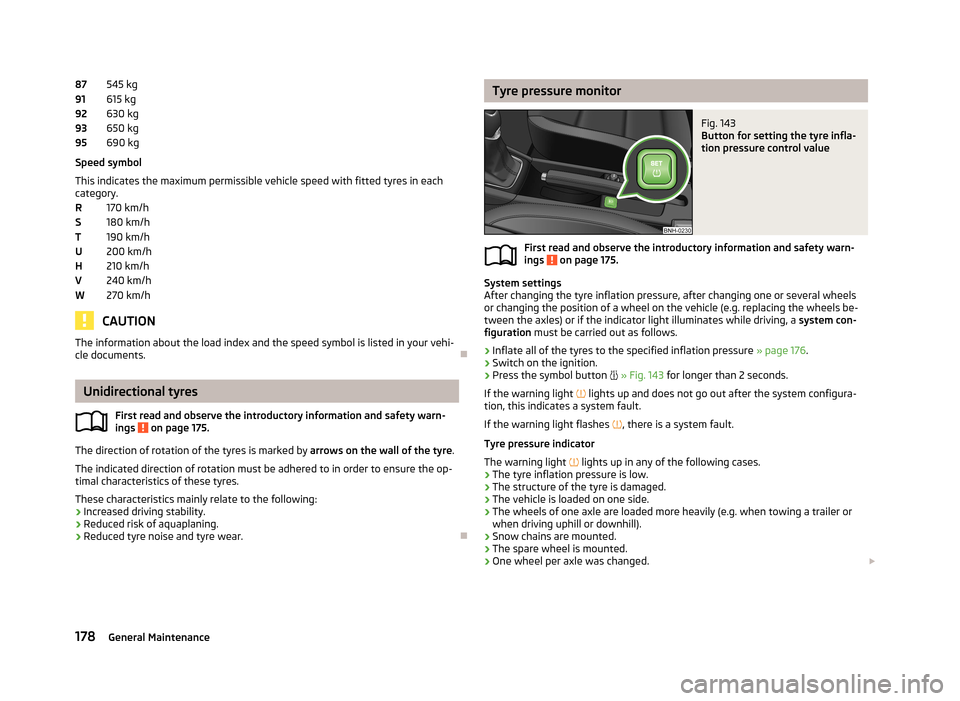
Button for setting the tyre infla-
tion pressure control value
First read and observe the introductory information and safety warn-
ings on page 175.
System settings
After changing the tyre inflation pressure, after changing one or several wheels or changing the position of a wheel on the vehicle (e.g. replacing the wheels be- tween the axles) or if the indicator light illuminates while driving, a system con-
figuration must be carried out as follows.
›
Inflate all of the tyres to the specified inflation pressure » page 176.
›
Switch on the ignition.
›
Press the symbol button
» Fig. 143 for longer than 2 seconds.
If the warning light
lights up and does not go out after the system configura-
tion, this indicates a system fault.
If the warning light flashes
, there is a system fault.
Tyre pressure indicator
The warning light
lights up in any of the following cases.
› The tyre inflation pressure is low.
› The structure of the tyre is damaged.
› The vehicle is loaded on one side.
› The wheels of one axle are loaded more heavily (e.g. when towing a trailer or
when driving uphill or downhill).
› Snow chains are mounted.
› The spare wheel is mounted.
› One wheel per axle was changed.
178General Maintenance
Page 194 of 226
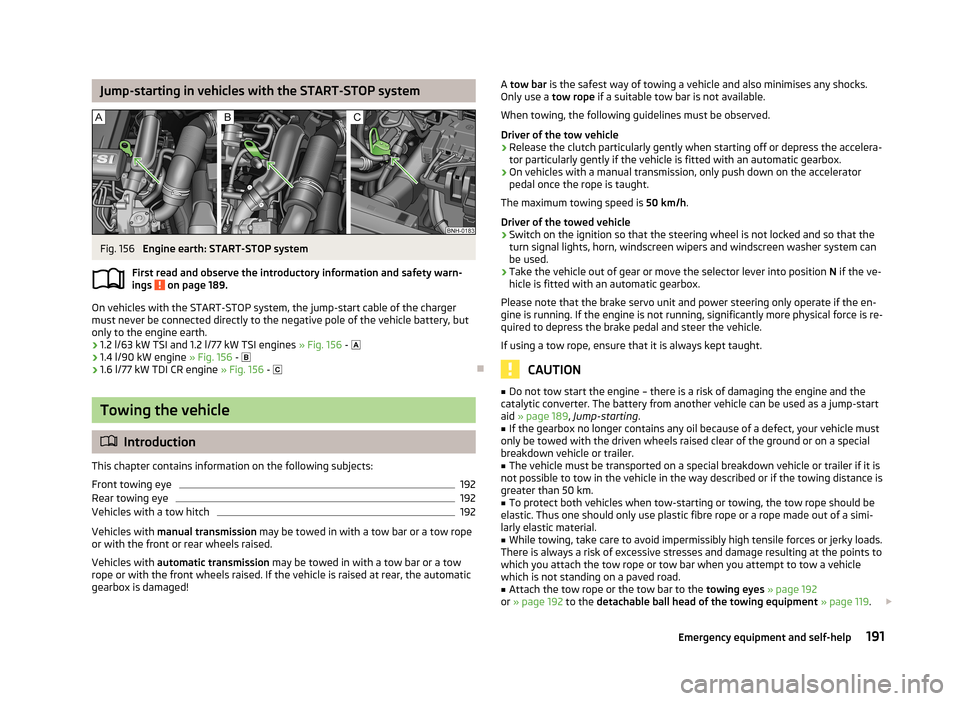
Jump-starting in vehicles with the START-STOP systemFig. 156
Engine earth: START-STOP system
First read and observe the introductory information and safety warn- ings
on page 189.
On vehicles with the START-STOP system, the jump-start cable of the charger must never be connected directly to the negative pole of the vehicle battery, but
only to the engine earth.
› 1.2 l/63 kW TSI and 1.2 l/77 kW TSI engines
» Fig. 156 -
› 1.4 l/90 kW engine
» Fig. 156 -
› 1.6 l/77 kW TDI CR engine
» Fig. 156 -
Towing the vehicle
Introduction
This chapter contains information on the following subjects:
Front towing eye
192
Rear towing eye
192
Vehicles with a tow hitch
192
Vehicles with manual transmission may be towed in with a tow bar or a tow rope
or with the front or rear wheels raised.
Vehicles with automatic transmission may be towed in with a tow bar or a tow
rope or with the front wheels raised. If the vehicle is raised at rear, the automatic
gearbox is damaged!
A tow bar is the safest way of towing a vehicle and also minimises any shocks.
Only use a tow rope if a suitable tow bar is not available.
When towing, the following guidelines must be observed.
Driver of the tow vehicle›
Release the clutch particularly gently when starting off or depress the accelera-
tor particularly gently if the vehicle is fitted with an automatic gearbox.
›
On vehicles with a manual transmission, only push down on the accelerator pedal once the rope is taught.
The maximum towing speed is 50 km/h.
Driver of the towed vehicle
›
Switch on the ignition so that the steering wheel is not locked and so that the turn signal lights, horn, windscreen wipers and windscreen washer system can
be used.
›
Take the vehicle out of gear or move the selector lever into position N if the ve-
hicle is fitted with an automatic gearbox.
Please note that the brake servo unit and power steering only operate if the en-
gine is running. If the engine is not running, significantly more physical force is re- quired to depress the brake pedal and steer the vehicle.
If using a tow rope, ensure that it is always kept taught.
CAUTION
■ Do not tow start the engine – there is a risk of damaging the engine and the
catalytic converter. The battery from another vehicle can be used as a jump-start
aid » page 189 , Jump-starting .■
If the gearbox no longer contains any oil because of a defect, your vehicle must
only be towed with the driven wheels raised clear of the ground or on a special
breakdown vehicle or trailer.
■
The vehicle must be transported on a special breakdown vehicle or trailer if it is
not possible to tow in the vehicle in the way described or if the towing distance is
greater than 50 km.
■
To protect both vehicles when tow-starting or towing, the tow rope should be
elastic. Thus one should only use plastic fibre rope or a rope made out of a simi-
larly elastic material.
■
While towing, take care to avoid impermissibly high tensile forces or jerky loads.
There is always a risk of excessive stresses and damage resulting at the points to
which you attach the tow rope or tow bar when you attempt to tow a vehicle
which is not standing on a paved road.
■
Attach the tow rope or the tow bar to the towing eyes » page 192
or » page 192 to the detachable ball head of the towing equipment » page 119 .
191Emergency equipment and self-help
Page 201 of 226
›Reinsert the cover into the dash panel in the opposite direction to the arrow
such that the guide pins are guided into the dash panel openings.
Carefully push the cover in.
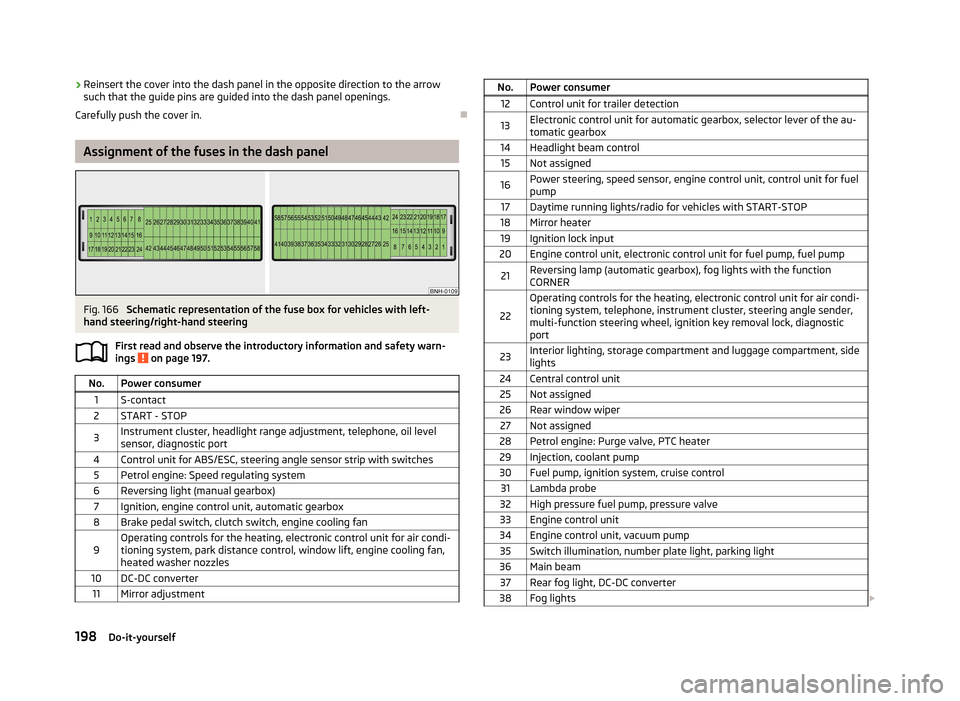
Assignment of the fuses in the dash panel
Fig. 166
Schematic representation of the fuse box for vehicles with left-
hand steering/right-hand steering
First read and observe the introductory information and safety warn-ings
on page 197.
No.Power consumer1S-contact2START - STOP3Instrument cluster, headlight range adjustment, telephone, oil level
sensor, diagnostic port4Control unit for ABS/ESC, steering angle sensor strip with switches5Petrol engine: Speed regulating system6Reversing light (manual gearbox)7Ignition, engine control unit, automatic gearbox8Brake pedal switch, clutch switch, engine cooling fan9Operating controls for the heating, electronic control unit for air condi-
tioning system, park distance control, window lift, engine cooling fan, heated washer nozzles10DC-DC converter11Mirror adjustmentNo.Power consumer12Control unit for trailer detection13Electronic control unit for automatic gearbox, selector lever of the au-tomatic gearbox14Headlight beam control15Not assigned16Power steering, speed sensor, engine control unit, control unit for fuel
pump17Daytime running lights/radio for vehicles with START-STOP18Mirror heater19Ignition lock input20Engine control unit, electronic control unit for fuel pump, fuel pump21Reversing lamp (automatic gearbox), fog lights with the function
CORNER
22
Operating controls for the heating, electronic control unit for air condi- tioning system, telephone, instrument cluster, steering angle sender,
multi-function steering wheel, ignition key removal lock, diagnostic
port23Interior lighting, storage compartment and luggage compartment, side
lights24Central control unit25Not assigned26Rear window wiper27Not assigned28Petrol engine: Purge valve, PTC heater29Injection, coolant pump30Fuel pump, ignition system, cruise control31Lambda probe32High pressure fuel pump, pressure valve33Engine control unit34Engine control unit, vacuum pump35Switch illumination, number plate light, parking light36Main beam37Rear fog light, DC-DC converter38Fog lights 198Do-it-yourself
Page 202 of 226
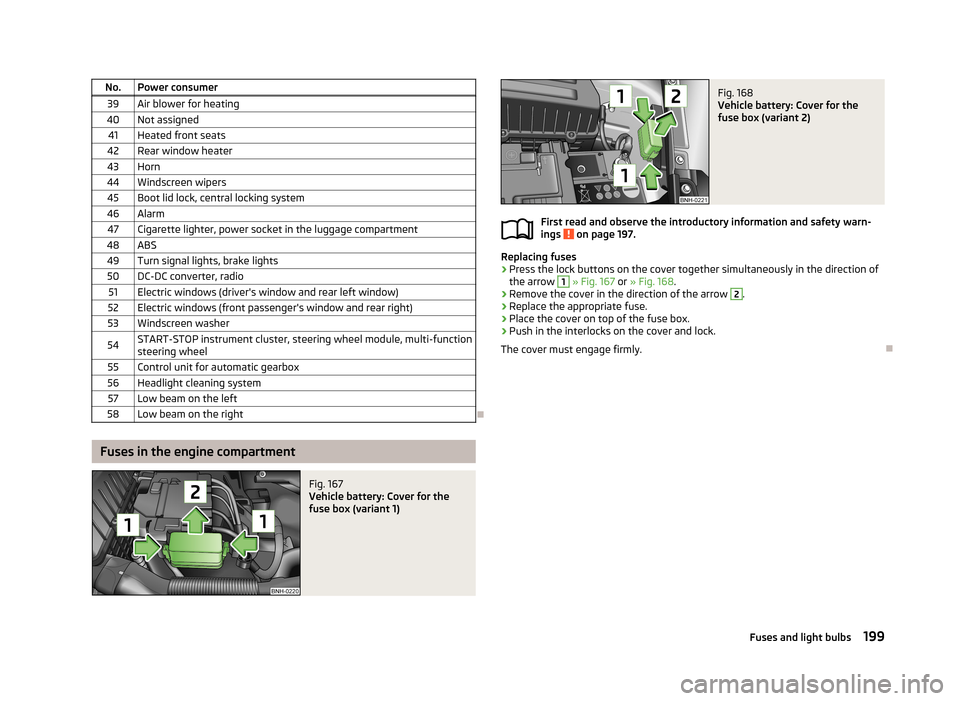
No.Power consumer39Air blower for heating40Not assigned41Heated front seats42Rear window heater43Horn44Windscreen wipers45Boot lid lock, central locking system46Alarm47Cigarette lighter, power socket in the luggage compartment48ABS49Turn signal lights, brake lights50DC-DC converter, radio51Electric windows (driver's window and rear left window)52Electric windows (front passenger's window and rear right)53Windscreen washer54START-STOP instrument cluster, steering wheel module, multi-function
steering wheel55Control unit for automatic gearbox56Headlight cleaning system57Low beam on the left58Low beam on the right
Fuses in the engine compartment
Fig. 167
Vehicle battery: Cover for the
fuse box (variant 1)
Fig. 168
Vehicle battery: Cover for the
fuse box (variant 2)
First read and observe the introductory information and safety warn-
ings on page 197.
Replacing fuses
›
Press the lock buttons on the cover together simultaneously in the direction of
the arrow
1
» Fig. 167 or » Fig. 168 .
›
Remove the cover in the direction of the arrow
2
.
›
Replace the appropriate fuse.
›
Place the cover on top of the fuse box.
›
Push in the interlocks on the cover and lock.
The cover must engage firmly.
199Fuses and light bulbs
Page 203 of 226
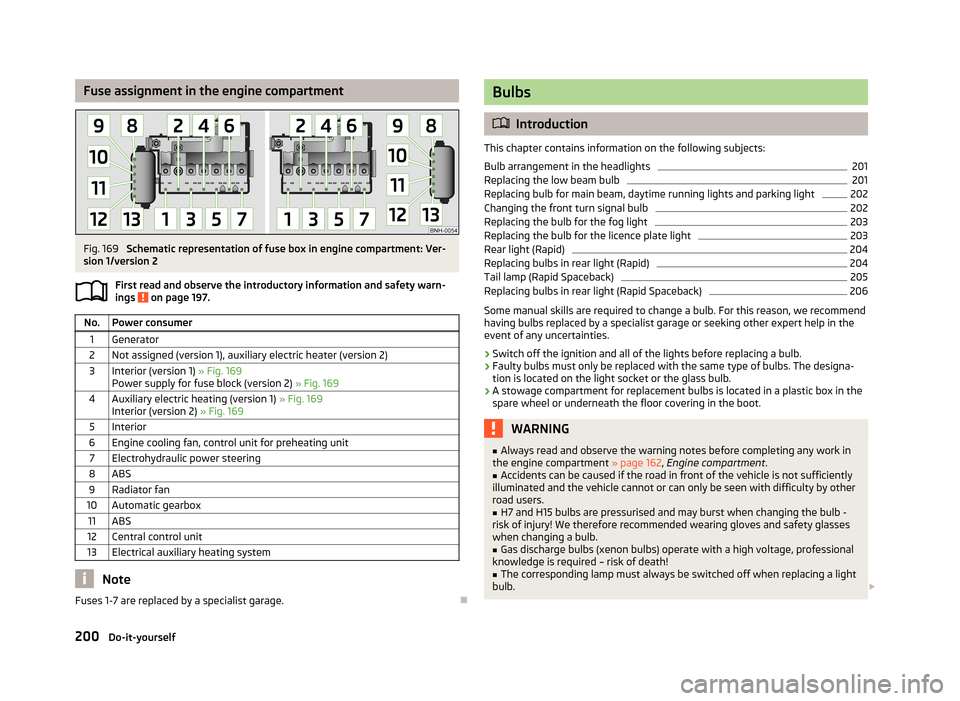
Fuse assignment in the engine compartmentFig. 169
Schematic representation of fuse box in engine compartment: Ver-
sion 1/version 2
First read and observe the introductory information and safety warn-
ings
on page 197.
No.Power consumer1Generator2Not assigned (version 1), auxiliary electric heater (version 2)3Interior (version 1) » Fig. 169
Power supply for fuse block (version 2) » Fig. 1694Auxiliary electric heating (version 1) » Fig. 169
Interior (version 2) » Fig. 1695Interior6Engine cooling fan, control unit for preheating unit7Electrohydraulic power steering8ABS9Radiator fan10Automatic gearbox11ABS12Central control unit13Electrical auxiliary heating system
Note
Fuses 1-7 are replaced by a specialist garage.
Bulbs
Introduction
This chapter contains information on the following subjects:
Bulb arrangement in the headlights
201
Replacing the low beam bulb
201
Replacing bulb for main beam, daytime running lights and parking light
202
Changing the front turn signal bulb
202
Replacing the bulb for the fog light
203
Replacing the bulb for the licence plate light
203
Rear light (Rapid)
204
Replacing bulbs in rear light (Rapid)
204
Tail lamp (Rapid Spaceback)
205
Replacing bulbs in rear light (Rapid Spaceback)
206
Some manual skills are required to change a bulb. For this reason, we recommend
having bulbs replaced by a specialist garage or seeking other expert help in the
event of any uncertainties.
› Switch off the ignition and all of the lights before replacing a bulb.
› Faulty bulbs must only be replaced with the same type of bulbs. The designa-
tion is located on the light socket or the glass bulb.
› A stowage compartment for replacement bulbs is located in a plastic box in the
spare wheel or underneath the floor covering in the boot.
WARNING■ Always read and observe the warning notes before completing any work in
the engine compartment » page 162, Engine compartment .■
Accidents can be caused if the road in front of the vehicle is not sufficiently
illuminated and the vehicle cannot or can only be seen with difficulty by other
road users.
■
H7 and H15 bulbs are pressurised and may burst when changing the bulb -
risk of injury! We therefore recommended wearing gloves and safety glasses
when changing a bulb.
■
Gas discharge bulbs (xenon bulbs) operate with a high voltage, professional
knowledge is required – risk of death!
■
The corresponding lamp must always be switched off when replacing a light
bulb.
200Do-it-yourself
Page 204 of 226
CAUTIONDo not take hold of the glass bulb with naked fingers (even the smallest amountof dirt reduces the working life of the light bulb). Use a clean cloth, napkin, or sim-
ilar.
Note
■ This Owner's Manual only describes the replacement of bulbs where it is possi-
ble to replace the bulbs on your own without any complications arising. Other bulbs must be replaced by a specialist garage.■
We recommend that a box of replacement bulbs always be carried in the vehi-
cle. Replacement bulbs can be purchased from ŠKODAOriginal Accessories.
■
We recommend having the headlight settings checked by a specialist garage af-
ter replacing a bulb in the main, low or fog beam.
■
Consult a specialist garage in the event of a failure in a xenon gas discharge
lamp.
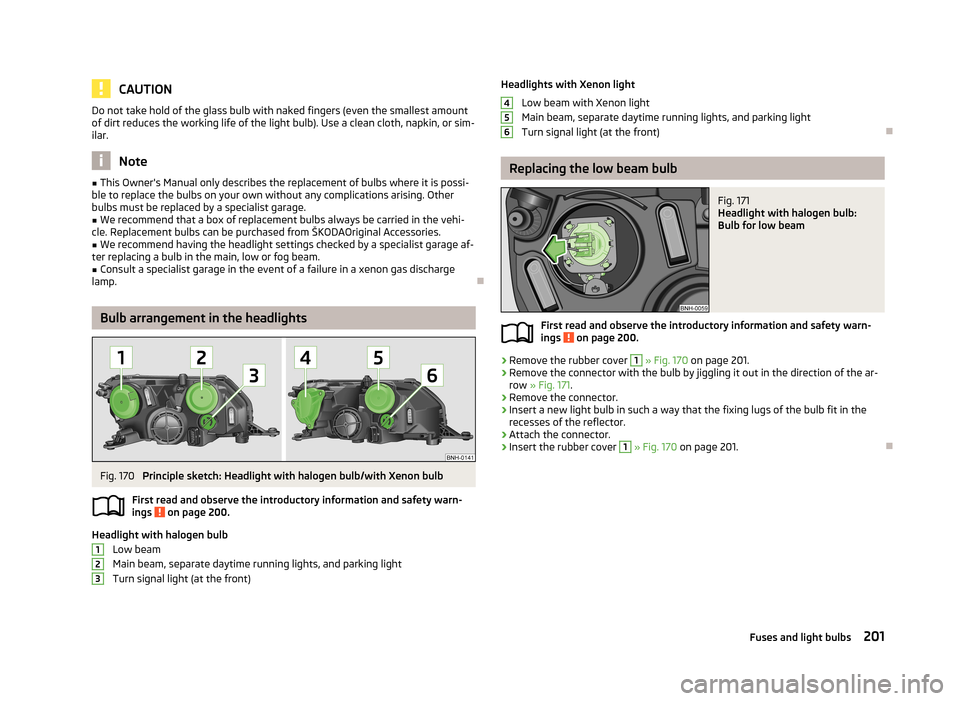
Bulb arrangement in the headlights
Fig. 170
Principle sketch: Headlight with halogen bulb/with Xenon bulb
First read and observe the introductory information and safety warn- ings
on page 200.
Headlight with halogen bulb
Low beam
Main beam, separate daytime running lights, and parking light
Turn signal light (at the front)
123Headlights with Xenon light
Low beam with Xenon light
Main beam, separate daytime running lights, and parking light
Turn signal light (at the front)
Replacing the low beam bulb
Fig. 171
Headlight with halogen bulb:
Bulb for low beam
First read and observe the introductory information and safety warn- ings on page 200.
›
Remove the rubber cover
1
» Fig. 170 on page 201.
›
Remove the connector with the bulb by jiggling it out in the direction of the ar-
row » Fig. 171 .
›
Remove the connector.
›
Insert a new light bulb in such a way that the fixing lugs of the bulb fit in the
recesses of the reflector.
›
Attach the connector.
›
Insert the rubber cover
1
» Fig. 170 on page 201.
456201Fuses and light bulbs
Page 205 of 226
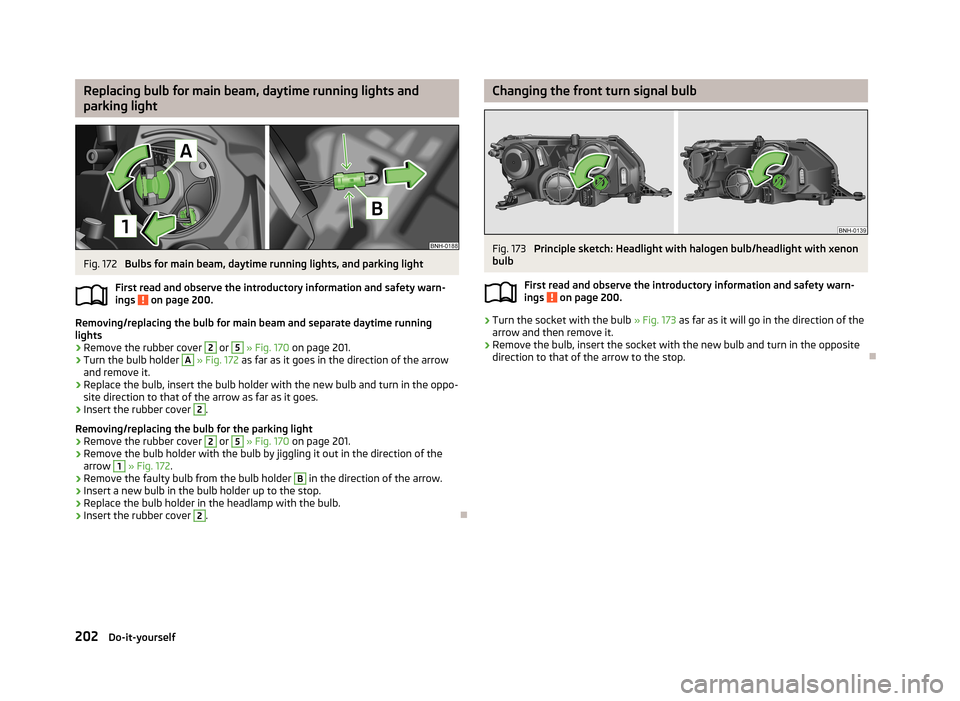
Replacing bulb for main beam, daytime running lights and
parking lightFig. 172
Bulbs for main beam, daytime running lights, and parking light
First read and observe the introductory information and safety warn-
ings
on page 200.
Removing/replacing the bulb for main beam and separate daytime running
lights
›
Remove the rubber cover
2
or
5
» Fig. 170 on page 201.
›
Turn the bulb holder
A
» Fig. 172 as far as it goes in the direction of the arrow
and remove it.
›
Replace the bulb, insert the bulb holder with the new bulb and turn in the oppo-
site direction to that of the arrow as far as it goes.
›
Insert the rubber cover
2
.
Removing/replacing the bulb for the parking light
›
Remove the rubber cover
2
or
5
» Fig. 170 on page 201.
›
Remove the bulb holder with the bulb by jiggling it out in the direction of the
arrow
1
» Fig. 172 .
›
Remove the faulty bulb from the bulb holder
B
in the direction of the arrow.
›
Insert a new bulb in the bulb holder up to the stop.
›
Replace the bulb holder in the headlamp with the bulb.
›
Insert the rubber cover
2
.
Changing the front turn signal bulbFig. 173
Principle sketch: Headlight with halogen bulb/headlight with xenon
bulb
First read and observe the introductory information and safety warn-ings
on page 200.
›
Turn the socket with the bulb » Fig. 173 as far as it will go in the direction of the
arrow and then remove it.
›
Remove the bulb, insert the socket with the new bulb and turn in the opposite direction to that of the arrow to the stop.
202Do-it-yourself
Page 206 of 226
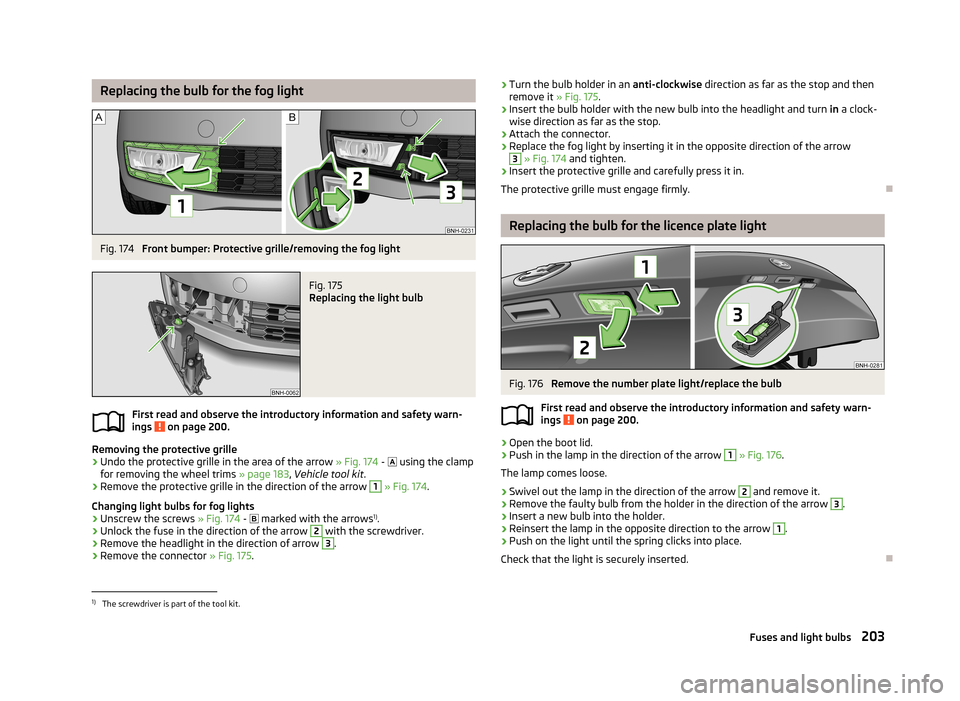
Replacing the bulb for the fog lightFig. 174
Front bumper: Protective grille/removing the fog light
Fig. 175
Replacing the light bulb
First read and observe the introductory information and safety warn-
ings on page 200.
Removing the protective grille
›
Undo the protective grille in the area of the arrow » Fig. 174 -
using the clamp
for removing the wheel trims » page 183, Vehicle tool kit .
›
Remove the protective grille in the direction of the arrow
1
» Fig. 174 .
Changing light bulbs for fog lights
›
Unscrew the screws » Fig. 174 -
marked with the arrows 1)
.
›
Unlock the fuse in the direction of the arrow
2
with the screwdriver.
›
Remove the headlight in the direction of arrow
3
.
›
Remove the connector » Fig. 175.
›Turn the bulb holder in an
anti-clockwise direction as far as the stop and then
remove it » Fig. 175.›
Insert the bulb holder with the new bulb into the headlight and turn in a clock-
wise direction as far as the stop.
›
Attach the connector.
›
Replace the fog light by inserting it in the opposite direction of the arrow
3
» Fig. 174 and tighten.
›
Insert the protective grille and carefully press it in.
The protective grille must engage firmly.
Replacing the bulb for the licence plate light
Fig. 176
Remove the number plate light/replace the bulb
First read and observe the introductory information and safety warn-
ings
on page 200.
›
Open the boot lid.
›
Push in the lamp in the direction of the arrow
1
» Fig. 176 .
The lamp comes loose.
›
Swivel out the lamp in the direction of the arrow
2
and remove it.
›
Remove the faulty bulb from the holder in the direction of the arrow
3
.
›
Insert a new bulb into the holder.
›
Reinsert the lamp in the opposite direction to the arrow
1
.
›
Push on the light until the spring clicks into place.
Check that the light is securely inserted.
1)
The screwdriver is part of the tool kit.
203Fuses and light bulbs