wheel SKODA RAPID SPACEBACK 2013 1.G Workshop Manual
[x] Cancel search | Manufacturer: SKODA, Model Year: 2013, Model line: RAPID SPACEBACK, Model: SKODA RAPID SPACEBACK 2013 1.GPages: 193, PDF Size: 14.8 MB
Page 160 of 193

Jump-starting using the battery from another vehicleFig. 144
Jump-starting: A – flat battery, B
– battery providing current
Read and observe and on page 157 first.
The starting process using the battery of another vehicle requires the use of
jumper cables.
The jump-start cables must be attached in the following sequence.
›
Attach clamp
1
to the positive terminal of the discharged battery
A
» Fig. 144 .
›
Attach clamp
2
to the positive terminal of the battery supplying power
B
.
›
Attach clamp
3
to the negative terminal of the battery supplying power
B
.
›
Attach the clamp
4
to a solid metal component firmly connected to the en-
gine block or to the engine block itself.
Starting engine
›
Start the engine on the vehicle providing the power and allow it to idle.
›
Start the engine of the vehicle with the discharged battery.
›
If the engine does not start, halt the attempt to start the engine after 10 sec-
onds and wait for thirty seconds before repeating the process.
›
Disconnect the cables in exactly the reverse order to the one described
above.
Both batteries must have a rated voltage of 12 V. The capacity (Ah) of the bat-
tery supplying the power must not be significantly less than the capacity of
the discharged battery in your vehicle.
Jump-start cables
Only use jump-start cables which have an adequately large cross-section and
insulated terminal clamps. Observe the instructions of the jumper lead manu-
facturer.
Positive cable – colour coding in the majority of cases is red.
Negative cable – colour coding in the majority of cases is black.
Jump-starting in vehicles with the START-STOP system
Fig. 145
Engine earth: START-STOP system
Read and observe
and on page 157 first.
On vehicles with the START-STOP system, the jump-start cable of the charger
must never be connected directly to the negative pole of the vehicle battery,
but only to the engine earth.
› 1.2 l./63 kW TSI and 1.2 l./77 kW TSI engines
» Fig. 145 -
› 1.4 l./90 kW engine
» Fig. 145 -
› 1.6 l./77 kW TDI CR engine
» Fig. 145 -
Towing the vehicle
Introduction
This chapter contains information on the following subjects:
Front towing eye
159
Rear towing eye
160
Vehicles with a tow hitch
160
Vehicles with manual transmission may be towed in with a tow bar or a tow
rope or with the front or rear wheels raised.
Vehicles with automatic transmission may be towed in with a tow bar or a tow
rope or with the front wheels raised. If the vehicle is raised at the rear, the au-
tomatic gearbox will be damaged!
When towing, the following guidelines must be observed.
158Do-it-yourself
Page 161 of 193

Driver of the tow vehicle›Engage the clutch gently when starting off or depress the accelerator partic-
ularly gently if the vehicle is fitted with an automatic gearbox.›
Only then, approach correctly when the rope is taut.
The maximum towing speed is 50 km/h.
Driver of the towed vehicle
›
Switch on the ignition so that the steering wheel is not locked and so that
the turn signal lights, horn, windscreen wipers and windscreen washer sys-
tem can be used.
›
Take the vehicle out of gear or move the selector lever into position N if the
vehicle is fitted with an automatic gearbox.
Please note that the brake servo unit and power steering only operate if the
engine is running. If the engine is not running, significantly more physical force
is required to depress the brake pedal and steer the vehicle.
If using a tow rope, ensure that it is always kept taught.
Towing another vehicle requires a certain amount of practice. Both drivers
should be familiar with the particular points about towing a vehicle. Unskilled
drivers should not attempt to tow another vehicle or to be towed in one.
The vehicle must be transported on a special breakdown vehicle or trailer if it
is not possible to tow the vehicle in the way described or if the towing dis-
tance is greater than 50 km.
Attach the tow rope or the tow bar to the towing eyes » page 159
or » page 160 to the detachable ball head of the towing equip-
ment » page 112 .
WARNING■
The tow rope must not be twisted as it may in certain circumstances re-
sult in the front towing eye becoming unscrewed from your vehicle.■
Do not use one-sided twisted tow rope, because the towing eye could
become unscrewed on the vehicle under certain circumstances.
■
When towing, respect the national legal provisions, especially those
which relate to the identification of the towing vehicle and the vehicle be- ing towed.
CAUTION■ Do not start the engine by towing – there is a risk of damaging the engine
and the catalytic converter! The battery from another vehicle can be used as a
jump-start aid » page 157, Jump-starting .■
If the gearbox no longer contains any oil because of a defect, your vehicle
must only be towed with the drive wheels raised clear of the ground or on a
special breakdown vehicle or trailer.
■
To protect both vehicles when tow-starting or towing, the tow rope should
be elastic. Thus only plastic fibre rope or a rope made out of a similarly elastic
material should be used.
■
There is always a risk of excessive stresses and damage resulting at the
points to which you attach the tow rope or tow bar when you attempt to tow a
vehicle which is not standing on a paved road.
Note
We recommend using a tow rope from ŠKODA Original Accessories, which is
available from a ŠKODA Partner.
Front towing eye
Fig. 146
Removing the cap/installing the towing eye
Read and observe
and on page 159 first.
Removing/installing the cap
›
Press on the cap in the area
A
» Fig. 146 .
›
Remove the cap in the direction of the arrow
1
.
›
After unscrewing the cap of the towing eye
B
, insert the cap in area
A
and
then press the opposite side of the cap.
The cap must engage firmly.
159Emergency equipment and self-help
Page 162 of 193

Removing/installing the towing eye›Manually screw the towing eye as far as it will go in the direction of the ar-
row 2
» Fig. 146 » .
For tightening purposes, we recommend, for example, using the wheel
wrench, towing eye from another vehicle or a similar object that can be pushed through the eye.
›
Unscrew the towing eye against the direction of the arrow
2
.
WARNINGThe towing eye must always be screwed in fully and firmly tightened, oth-
erwise the towing eye can tear when towing or tow-starting.
Rear towing eye
Fig. 147
Rear towing eye
Read and observe and on page 159 first.
The rear towing eye is located below the bumper on the right.
Remove the protective cap before using the towing eye. » Fig. 147. Replace the
protective cap after using the towing eye.
Vehicles with a tow hitch
Read and observe
and on page 159 first.
For vehicles with a factory-fitted towing device, the pre-installed detachable
tow-bar may be used » page 112, Hitch .
Towing the vehicle using the towing device is a viable alternative solution to using the towing eye.
CAUTIONThe detachable ball rod and/or the vehicle can be damaged if an unsuitable
tow bar is used.
Note
The detachable ball rod must always be in the vehicle so that it can be used for
towing, if necessary.
Remote control
Introduction
This chapter contains information on the following subjects:
Replacing the battery in the remote control key
161
Synchronising the remote control
161
CAUTION
■ The replacement battery must have the same specification as the original
battery.■
We recommend having faulty rechargeable batteries replaced by a ŠKODA
service partner.
■
Pay attention to the correct polarity when changing the battery.
For the sake of the environment
Dispose of the used battery in accordance with national legal provisions.160Do-it-yourself
Page 167 of 193
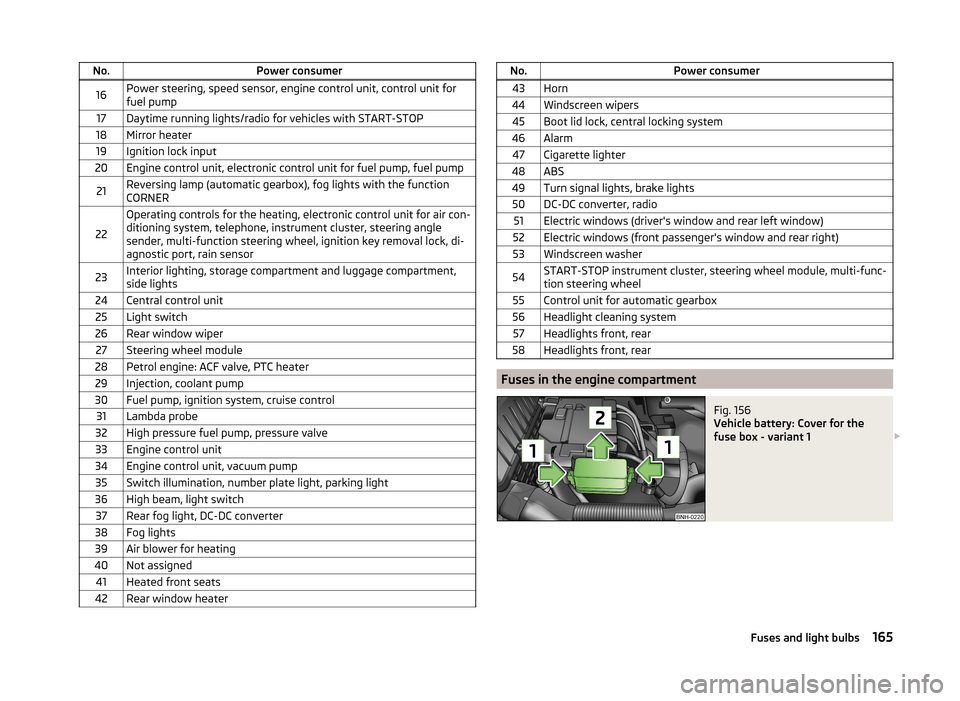
No.Power consumer16Power steering, speed sensor, engine control unit, control unit for
fuel pump17Daytime running lights/radio for vehicles with START-STOP18Mirror heater19Ignition lock input20Engine control unit, electronic control unit for fuel pump, fuel pump21Reversing lamp (automatic gearbox), fog lights with the function
CORNER
22
Operating controls for the heating, electronic control unit for air con-
ditioning system, telephone, instrument cluster, steering angle
sender, multi-function steering wheel, ignition key removal lock, di-
agnostic port, rain sensor23Interior lighting, storage compartment and luggage compartment,
side lights24Central control unit25Light switch26Rear window wiper27Steering wheel module28Petrol engine: ACF valve, PTC heater29Injection, coolant pump30Fuel pump, ignition system, cruise control31Lambda probe32High pressure fuel pump, pressure valve33Engine control unit34Engine control unit, vacuum pump35Switch illumination, number plate light, parking light36High beam, light switch37Rear fog light, DC-DC converter38Fog lights39Air blower for heating40Not assigned41Heated front seats42Rear window heaterNo.Power consumer43Horn44Windscreen wipers45Boot lid lock, central locking system46Alarm47Cigarette lighter48ABS49Turn signal lights, brake lights50DC-DC converter, radio51Electric windows (driver's window and rear left window)52Electric windows (front passenger's window and rear right)53Windscreen washer54START-STOP instrument cluster, steering wheel module, multi-func-
tion steering wheel55Control unit for automatic gearbox56Headlight cleaning system57Headlights front, rear58Headlights front, rear
Fuses in the engine compartment
Fig. 156
Vehicle battery: Cover for the
fuse box - variant 1
165Fuses and light bulbs
Page 169 of 193
›Switch off the ignition and all of the lights before replacing a bulb.
› Faulty bulbs must only be replaced with the same type of bulbs. The designa-
tion is located on the light socket or the glass bulb.
› A stowage compartment for replacement bulbs is located in a plastic box in
the spare wheel or underneath the floor covering in the boot.WARNING■ Always read and observe the warning notes before completing any work
in the engine compartment » page 131, Engine compartment .■
Accidents can be caused if the road in front of the vehicle is not suffi-
ciently illuminated and the vehicle cannot be seen or can only be seen with
difficulty by other road users.
■
H7 and H15 bulbs are pressurised and may burst when changing the bulb -
risk of injury! We therefore recommended wearing gloves and safety
glasses when changing a bulb.
■
Gas discharge bulbs (xenon bulbs) operate with a high voltage, professio-
nal knowledge is required – risk of death!
■
Switch off the respective vehicle light when changing the bulb.
CAUTION
Do not take hold of the glass bulb with naked fingers (even the smallest
amount of dirt reduces the working life of the light bulb). Use a clean cloth,
napkin, or similar.
Note
■ This Owner's Manual only describes the replacement of bulbs where it is pos-
sible to replace the bulbs on your own without any complications arising. Other
bulbs must be replaced by a specialist garage.■
We recommend that a box of replacement bulbs always be carried in the ve-
hicle. Replacement bulbs can be purchased from ŠKODAOriginal Accessories.
■
We recommend having the headlight settings checked by a specialist garage
after replacing a bulb in the main, low or fog beam.
■
In case of failure of a xenon gas discharge lamp or an LED diode, visit a spe-
cialist garage.
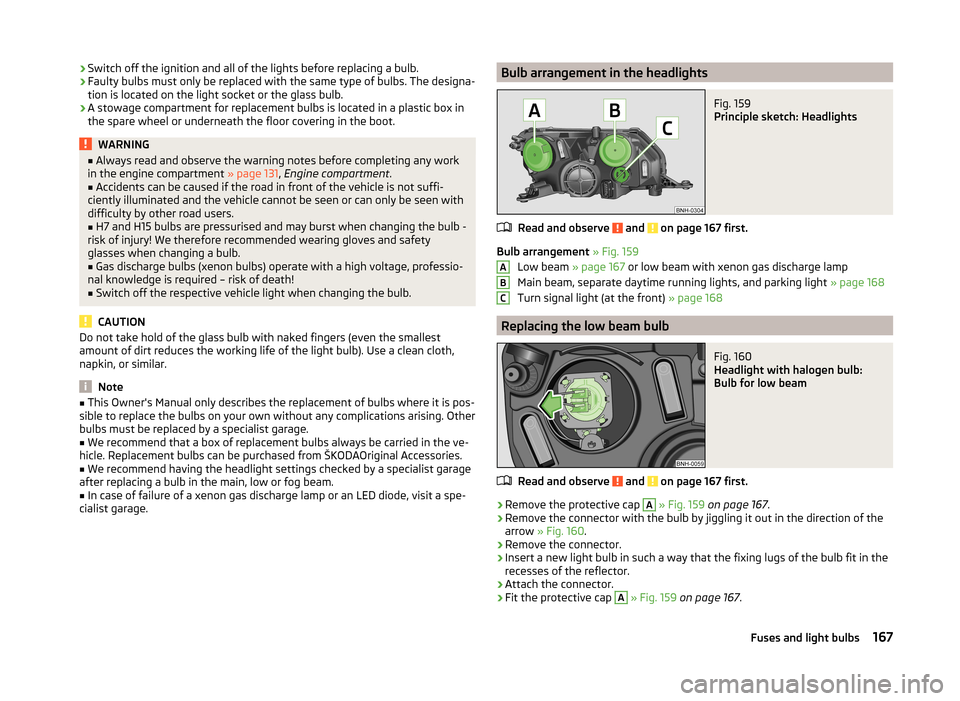
Bulb arrangement in the headlightsFig. 159
Principle sketch: Headlights
Read and observe and on page 167 first.
Bulb arrangement » Fig. 159
Low beam » page 167 or low beam with xenon gas discharge lamp
Main beam, separate daytime running lights, and parking light » page 168
Turn signal light (at the front) » page 168
Replacing the low beam bulb
Fig. 160
Headlight with halogen bulb:
Bulb for low beam
Read and observe and on page 167 first.
›
Remove the protective cap
A
» Fig. 159 on page 167 .
›
Remove the connector with the bulb by jiggling it out in the direction of the
arrow » Fig. 160 .
›
Remove the connector.
›
Insert a new light bulb in such a way that the fixing lugs of the bulb fit in the
recesses of the reflector.
›
Attach the connector.
›
Fit the protective cap
A
» Fig. 159 on page 167 .
ABC167Fuses and light bulbs
Page 171 of 193

Fig. 164
Replacing the light bulb
Read and observe and on page 167 first.
Removing the protective grille
›
Undo the protective grille in the area of the arrow » Fig. 163 -
using the
clamp for removing the wheel trims » page 150, Vehicle tool kit .
›
Remove the protective grille in the direction of the arrow
1
» Fig. 163 .
Changing light bulbs for fog lights
›
Unscrew the screws » Fig. 163 -
marked with the arrows 1)
.
›
Unlock the fuse in the direction of the arrow
2
with the screwdriver.
›
Remove the headlight in the direction of arrow
3
.
›
Remove the connector » Fig. 164.
›
Turn the lamp socket in the direction of arrow
4
» Fig. 164 and pull it out.
›
Insert the bulb holder with the new bulb into the headlight and turn counter
to the direction of arrow
4
.
›
Attach the connector.
›
Replace the fog light by inserting it in the opposite direction of the arrow
3
» Fig. 163 and tighten.
›
Insert the protective grille and carefully press it in.
The protective grille must engage firmly.
Replacing the bulb for the licence plate lightFig. 165
Remove the number plate light/replace the bulb
Read and observe
and on page 167 first.
›
Open the boot lid.
›
Push in the lamp in the direction of the arrow
1
» Fig. 165 .
The lamp comes loose.
›
Swivel out the lamp in the direction of the arrow
2
and remove it.
›
Remove the faulty bulb from the holder in the direction of the arrow
3
.
›
Insert a new bulb into the holder.
›
Reinsert the lamp in the opposite direction to the arrow
1
.
›
Push on the light until the spring clicks into place.
Check that the light is securely inserted.
1)
The screwdriver is part of the tool kit.
169Fuses and light bulbs
Page 172 of 193

Rear lampFig. 166
Remove cover/light
Fig. 167
Installing the lamp connector/lamp
Read and observe
and on page 167 first.
Removing
›
Open the boot lid.
›
Insert the clamp for removing the wheel trims » page 150, Vehicle tool kit
into the hole at the position indicated by the arrow » Fig. 166 -
.
›
Remove the cover in the direction of the arrow
1
-
» Fig. 166 .
›
Use the screwdriver from the tool kit to unscrew the lamp » Fig. 166 -
.
›
Grasp the light and carefully remove with shaky movements in the direction
of arrow
2
.
›
Carefully remove the connector from the tail lamp » Fig. 167 -
.
Installing
›
Insert the connector into the lamp and lock it securely.
›
Insert the lamp into the mounts in the body » Fig. 167 -
.
›Carefully press the tail lamp into the body so that the bolts 2
» Fig. 168 on
page 170 on the lamp engage into the mounts in the body » .
Ensure that the cable bundle does not become pinched between the body and
the lamp.›
Screw the tail lamp into place and install the cover.
The cover must engage securely.
CAUTION
■ Ensure that the cable bundle does not become pinched between the body
and the lamp when it is being refitted – risk of damage to the electrical instal-
lation and risk of water ingress.■
If you are not sure whether the cable bundle has become pinched, we recom-
mend that you have the light connection checked by a specialist garage.
■
Ensure that the vehicle paintwork and the tail lamp are not damaged when
removing and installing the tail lamp.
Replacing bulbs in rear light
Fig. 168
Outer part of the lamp/inner part of the lamp
Read and observe
and on page 167 first.
Outer part of the lamp
›
Turn the bulb holder
1
» Fig. 168 in an anti-clockwise direction and remove
it from the lamp housing.
›
Replace the bulb, reinsert the holder with the bulb into the lamp housing and
turn to the stop in a clockwise direction.
Inner parts of the lamp
›
Unlock the bulb holder using the locking latches marked with ar-
rows » Fig. 168 -
and remove the bulb holder from the tail lamp.
170Do-it-yourself
Page 174 of 193

Technical data
Technical data
Vehicle data
Introduction
This chapter contains information on the following subjects:
Vehicle characteristics
172
Operating weight and payload
172
Measurement of fuel consumption and CO 2 emissions according to ECE
Regulations and EU Directives
173
Dimensions
174
Angle
175
Vehicle-specific details per engine type
176
The details given in the vehicle's technical documentation always take prece-
dence over the details in the Owner's Manual.
The listed performance values were determined without performance-reduc- ing equipment, e.g. air conditioning system.
Vehicle characteristics
Fig. 169
Vehicle data sticker/type plate
Vehicle data sticker
The vehicle data sticker » Fig. 169 -
is located on the base of the luggage
compartment and is also stuck into the service schedule.
The vehicle data sticker contains the following data.
Vehicle identification number (VIN)
Vehicle type
Gearbox code/paint number/interior equipment/engine output/engine
code
Partial vehicle description
Type plate
The type plate » Fig. 169 -
is located at the bottom of the B-pillar on the
driver's side.
The type plate contains the following data. Vehicle identification number (VIN)
Maximum permissible gross weight
Maximum permissible towed weight (towing vehicle and trailer)
Maximum permissible front axle load
Maximum permissible rear axle load
Vehicle identification number (VIN)
The vehicle identification number - VIN (vehicle body number) is stamped into
the engine compartment on the right hand suspension strut dome. This num-
ber is also located on a sign on the lower left hand edge below the windscreen
(together with a VIN bar code), and on the type plate.
Engine number
The engine number (three-digit identifier and serial number) is stamped on the engine block.WARNINGDo not exceed the specified maximum permissible weights – risk of acci-
dent and damage!
Operating weight and payload
Operating weight
This value represents the minimum operating weight without additional
weight-increasing equipment such as air conditioning system, spare wheel, or
trailer hitch.
The specified operating weight is for orientation purposes only.
123456789172Technical data
Page 176 of 193

DimensionsFig. 170
Principle sketch: Vehicle dimensions
Vehicle dimensions (mm)
» Fig. 170SpecificationValueAHeightBasic dimension1459/1471 a)Vehicles with a rough road package.1472/1484 a)B
Front track
Basic dimension1457For vehicles fitted with the 1.2 l/55 kW MPI and 1.2 l/63 kW TSI engines and 14"
wheel rims.1463CWidth1706D
Rear track
Basic dimension1494For vehicles fitted with the 1.2 l/55 kW MPI and 1.2 l/63 kW TSI engines and 14"
wheel rims.1500EWidth including exterior mirror1940FClearanceBasic dimension134Vehicles with a rough road package.141GWheel base2602HLength4304a)
Valid for vehicles with the Amundsen+ navigation system.
174Technical data
Page 182 of 193
Index
A
abroad lead-free petrol
130
Abroad Headlights
58
ABS Function
106
Warning light33
Acceptance and recycling of used vehicles121
Accessories119
Adjusting Belt height
13
Exterior mirror63
head restraints65
Interior mirror62
Seat64
Steering wheel8
Adjusting the seats7
Adjustment Beam range
53
Air-conditioning system Air outlet vents
85
Airbag14
Deactivating18
Deactivating the front passenger airbag18
Deployment14
Front airbag15
Head airbag17
Indicator light35
Modifications and damage to the airbag system 121
Side airbag
16
Airbag system14
Air conditioning84
Air distribution control85
Climatronic87
manual air conditioning86
Air distribution control85
Air outlet vents85
Alarm Switching off
49
Triggering49
Alcantara cleaning
128
Anti-lock Braking System106
Anti-theft alarm system Activating/deactivating
50
Trailer117
Armrest Front
67
Rear67
artificial leather128
Ashtray71
ASR Warning light
33
Assist system ABS
106
Assist systems106
ABS33
ASR33
Cruise Control System108
EDL107
ESC32, 106
HBA107
HHC107
Parking aid107
START-STOP109
TCS106
Auto Check Control29
Automatic driving lamp control55
Automatic gearbox101
Manual shifting of gears103
Selector lever-emergency unlocking162
Selector lever lock102
Starting-off and driving103
Tiptronic103
Using the selector lever102
Automatic gearbox modes102
Automatic load deactivation141
automatic transmission selector lever lock defect
103
Automatic transmission Kickdown
103
Selector lever lock103
AUX96
B
Ball head Check fitting
114
Fitting113
Ready position113
Removing115
Battery In the remote control key
161
Belts10
Belt tensioners13
Bonnet Closing
132
Opening132
Boot Class N1 vehicles
79
Double-sided floor covering79
Hooks77
See Boot lid51
Storage compartments in the boot78
Boot cover Parking position
78
Boot lid automatic locking
51
Closing51
Opening51
Brake Warning light
31
Brake booster99
brake fluid specification
138
180Index