technical data SKODA ROOMSTER 2006 1.G Owner's Manual
[x] Cancel search | Manufacturer: SKODA, Model Year: 2006, Model line: ROOMSTER, Model: SKODA ROOMSTER 2006 1.GPages: 274, PDF Size: 48.64 MB
Page 202 of 274
Taking care of your vehicle and cleaning the vehicle 201
Using the systemSafetyDriving TipsGeneral MaintenanceBreakdown assistanceTechnical Data
The headlight lenses
Please do not use any aggressive cleaning or chemical solvent products
- risk of damage to the plastic lenses Please use soap and clean warm
water.
Caution
Never wipe the headlights dry and do not use any sharp objects for
cleaning the plastic lenses, this may result in damage to the protective
paintwork and consequently in formation of cracks on the headlight
lenses, e.g through effect of chemical products.
Door and window seals
The rubber seals on the doors, boot lid, bonnet and windows remain
supple and last longer if you treat them from time to time with a rubber
care product (e.g. silicone spray). You also avoid premature wear of the
seals and prevent leakages in this way. It is also easier to open the doors.
Rubber seals which are well cared for also do not stick together in cold
winter weather.
Locks
We recommend that you use the spray from Škoda original accessories
with regreasing and anticorrosive effect for de-icing locks.
Note
When washing your vehicle, ensure that as little water as possible gets
into the locks.
Wheels
Steel wheels
You should also thoroughly wash the wheels and wheel trims when giving
your vehicle its regular wash. This prevents any brake dust, dirt and road
salt from sticking to the wheel hubs. You can remove stubborn brake abra-
sion adhering to the wheels with an industrial cleaner. Touch up any
damage to the paintwork on the wheels before rust is able to form.
Light alloy wheels
Regular care of light alloy wheels is necessary in order to retain their deco-
rative appearance over long periods. It is particularly important to remove
any road salt and brake abrasion from light alloy wheels every two weeks,
otherwise the surface will suffer. Wash thoroughly and then treat the
wheels with a protective product for light alloy wheels which does not
contain any acidic components. You should provide the wheel hubs with a
hard wax layer every three months. You must not use any products which
cause abrasion when treating the wheel hubs. Any damage to the paint
layer on the wheel hubs must be touched up immediately.
We recommend using a preservative from Škoda genuine accessories
offered by your Škoda dealer.
WARNING
One should remember when cleaning the wheels that moisture, ice
and road salt may adversely affect braking efficiency - risk of an
accident!
Note
Severe layers of dirt on the wheels can also result in wheel imbalance.
This may show itself in the form of a wheel vibration which is transmitted
to the steering wheel which, in certain circumstances, can cause prema-
ture wear of the steering. This means it is necessary to remove the dirt.
NKO 20 A05.book Page 201 Wednesday, June 21, 2006 1:42 PM
Page 204 of 274
Taking care of your vehicle and cleaning the vehicle 203
Using the systemSafetyDriving TipsGeneral MaintenanceBreakdown assistanceTechnical Data
garage or at a fueling station (when these are fitted with the required
equipment).
Care of the interior of vehicle
Plastic parts, artificial leather and cloths
You can clean plastic parts and artificial leather with a moist cloth. You
should only treat such parts with special
solvent-free plastic cleaning
and care products it does prove to be adequate.
Upholstery cloth and cloth trim on the doors, luggage compartment cover,
headliner etc. are best treated with special cleaning products, using if
necessary a dry foam and a soft sponge or brush.
We recommend using a cleaning product from Škoda genuine accesso-
ries offered by your Škoda dealer.
Caution
Solvent-free cleaners attack the material and can damage it.
Fabric covers of electrically heated seats
Do not clean the seat covers moist as this may result in damage to the
seat heating system.
Clean such covers using special agents, for example dry foam.
Natural leather
Natural leather requires quite particular care and attention.
Leather should be treated from time to time according the
following guidelines depending on how much it is used.
Normal cleaning
– Clean soiled areas of the leather with slightly moistened cotton or woollen cloth.
Severe soiling
– Clean severely soiled areas with a cloth dipped in a mild soapy solution (2 spoonfuls of natural soap to 1 litre of water).
– Ensure that the leather is not soaked through at any point and that no water gets into the stitching of the seams.
– Dry off the leather with a soft, dry cloth.
Removing stains
– Remove fresh stains which are water-based (e.g. coffee, tea,
juices, blood etc.) with an absorbent cloth or household paper
or use the cleaner from the care set for a stain which has
already dried in.
– Remove fresh stains on a fat base (e.g. butter, mayonnaise,
chocolate etc.) with an absorbent cloth or household cleaning
paper or with the cleaner from the care set if the stain has not
yet penetrated into the surface.
– Use a grease dissolver for grease stains which have dried
in .
NKO 20 A05.book Page 203 Wednesday, June 21, 2006 1:42 PM
Page 206 of 274
Fuel205
Using the systemSafetyDriving TipsGeneral MaintenanceBreakdown assistanceTechnical Data
Fuel
Petrol
Grades of petrol
There are various grades of petrol. Please read the brochure “Technical
Data” in order to know which grade of petrol your vehicle requires. You will
also find the same information affixed to the inside of the fuel filler flap of
your vehicle ⇒page 207, fig. 152 .
A distinction is made between unleaded and leaded petrol. All Škoda vehi-
cles with petrol engines are equipped with a catalytic converter and must
therefore be only driven with unleaded petrol. Unleaded petrol complies
with the standard DIN EN 228 .
The individual grades of petrol are distinguished by their octane number
(RON). Please adopt the following procedure if the grade of petrol which
you normally use is not be available in exceptional circumstances:
•Engines which need unleaded premium petrol 95 RON can also be
run on unleaded regular petrol 91 RON. This does, however, result in a
slight loss in performance.
•Engines which need unleaded premium plus petrol 98 RON can
also be run on unleaded regular petrol 95 RON. This does, however, result
in a slight loss in performance. You can in exceptional circumstances
also use unleaded regular petrol of 91 RON in the event that neither
unleaded premium petrol of 98 RON nor 95 RON is available. Refuel as
soon as possible with unleaded premium plus of 98 RON or unleaded
premium petrol of 95 RON.
If, in an emergency, the only fuel available is one which has a lower octane
number than that required by the engine then only drive at medium engine
speeds and lower engine loadings. You can make unlimited use of fuel which has a higher octane number
than that required by the engine. There will, however, be no advantages
gained by this in terms of engine performance and fuel consumption!
The handling, performance and life of your engine are determined to a
significant extent by the quality of the fuel. Do not use any petrol additives.
Use a fuel complying with the standard.
You can find further information on refuelling
⇒page 207.
Caution
•Filling the tank even only once with leaded petrol will result in the cata-
lytic converter being destroyed.
•Operating the engine with petrol of a low octane number than that
required can result in engine damage at high revolutions or severe engine
loading.
Diesel
Grades of diesel
Grades of diesel fuel
Your vehicle can be driven with the following grades of diesel fuel:
„Diesel fuel with a cetane number of at least CN 49 (the cetane number
CN is a measure of the ignition performance of the diesel fuel). Diesel fuel
must comply with the DIN EN 590.
NKO 20 A05.book Page 205 Wednesday, June 21, 2006 1:42 PM
Page 208 of 274
Fuel207
Using the systemSafetyDriving TipsGeneral MaintenanceBreakdown assistanceTechnical Data
Operation in winter
Winter-grade diesel fuel
A different grade of diesel fuel is available at filling stations in winter than
during the summer. Using “summer-grade diesel fuel” at temperatures
below 0°C can result in operational problems because the diesel becomes
viscous as a result of paraffin separation.
It is therefore the case that DIN EN 590 prescribes diesel fuel class for
certain periods of the year which can also be purchased at the corre-
sponding time during the year. “Winter-grade diesel fuel” will still operate
properly even at a temperature of -20°C.
It is often the case in countries with different climatic conditions that diesel
fuels available have a different temperature characteristic. Škoda Service
Partners and filling stations in the country concerned will be able to
provide you with information regarding the diesel fuels available.
Prewarming fuel
The vehicle is fitted with a fuel filter prewarming system. This secures
operation of a vehicle using diesel fuel down to an environmental temper-
ature of -25°C.
Biofuel
We recommend refuelling with diesel fuel at temperatures below -10°C.
Caution
It is not permitted to add the various fuel additives on the market, including
petrol, to diesel fuel in order to improve its flow properties.
Refuelling
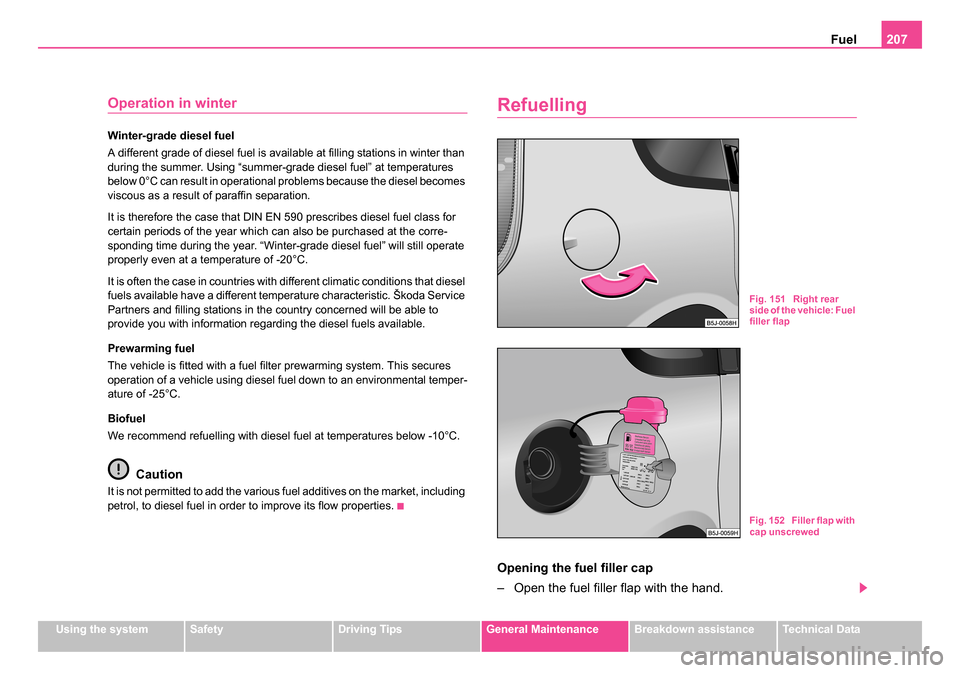
Opening the fuel filler cap
– Open the fuel filler flap with the hand.
Fig. 151 Right rear
side of the vehicle: Fuel
filler flap
Fig. 152 Filler flap with
cap unscrewed
NKO 20 A05.book Page 207 Wednesday, June 21, 2006 1:42 PM
Page 210 of 274
Inspecting and Replenishing209
Using the systemSafetyDriving TipsGeneral MaintenanceBreakdown assistanceTechnical Data
Inspecting and Replenishing
Engine compartment
Bonnet remote release
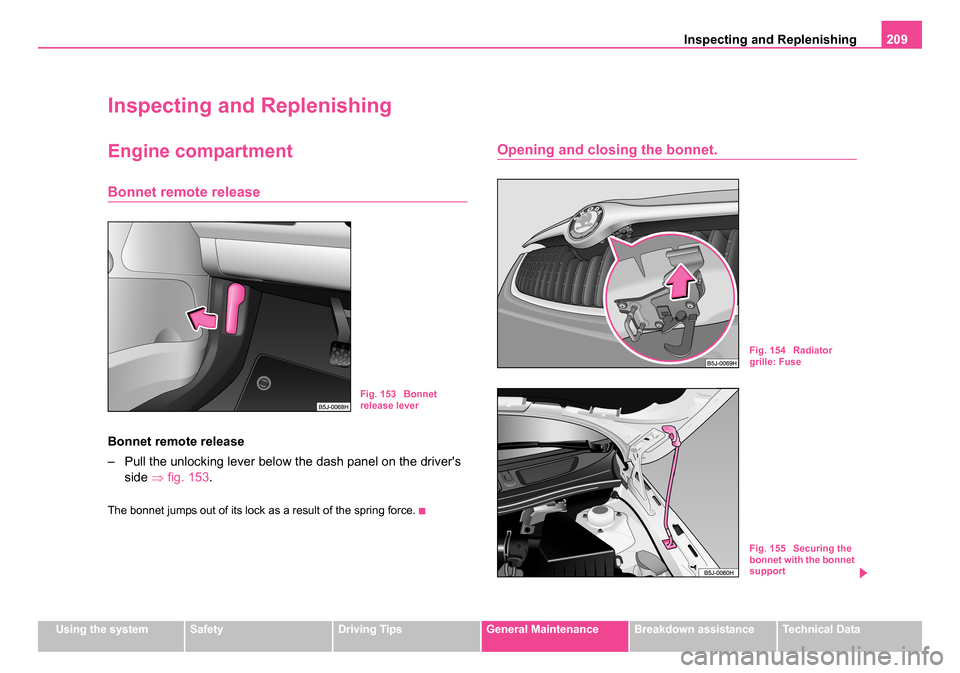
Bonnet remote release
– Pull the unlocking lever below the dash panel on the driver's
side ⇒fig. 153 .
The bonnet jumps out of its lock as a result of the spring force.
Opening and closing the bonnet.
Fig. 153 Bonnet
release lever
Fig. 154 Radiator
grille: Fuse
Fig. 155 Securing the
bonnet with the bonnet
support
NKO 20 A05.book Page 209 Wednesday, June 21, 2006 1:42 PM
Page 212 of 274
Inspecting and Replenishing211
Using the systemSafetyDriving TipsGeneral MaintenanceBreakdown assistanceTechnical Data
•Never spill oil and other fluids over the hot engine. Such fluids
(e.g. the antifreeze contained in the coolant) may ignite!
•Avoid short circuits in the electrical system - particularly on the
battery.
•Never place your hand into the radiator fan as long as the
engine is still warm. The fan might suddenly start running!
•Never open the cap of the coolant expansion bottle as long as
the engine is still warm. The cooling system is pressurized!
•Cover over the cap of the coolant expansion reservoir with a
large cloth when opening it as protection for your face, hands and
arms from hot steam or hot coolant.
•Do not let objects, such as e.g cleaning cloth or tools lie in the
engine compartment.
•If you wish to work under the vehicle, you must secure the
vehicle from rolling away and support it with suitable supporting
blocks: the car jack is not sufficient for this - risk of injury!
•In cases where it be necessary to carry out inspection work
when the engine is running there is an additional risk from rotating
parts (e.g. the V-ribbed belt, alternator, radiator fan) and from the
high-voltage ignition system. Please observe in addition the
following:
−Never touch the electrical cables of the ignition system.
− Absolutely avoid any jewellery, loose items of clothing or
long hair from getting into the rotating parts of the engine -
Hazard! Therefore remove any jewellery beforehand, tie up your
hair and wear tight fitting clothing.
•Please also comply with the warning instructions stated below
when carrying out any essential work on the fuel system or on the
electrical system:
−Always separate the car battery from the electrical system. −
Do not smoke.
− Never carry out any work close to naked flames.
− Always keep a working fi re extinguisher at hand.
Caution
When replenishing fluids in the engine, always ensure that the fluids are
on no account mixed up. This may result in major operating problems and
also vehicle damage!
WARNING (continued)WARNING (continued)
NKO 20 A05.book Page 211 Wednesday, June 21, 2006 1:42 PM
Page 214 of 274
Inspecting and Replenishing213
Using the systemSafetyDriving TipsGeneral MaintenanceBreakdown assistanceTechnical Data
Engine oil specifications for models with flexible service intervals
(QG1)
Caution
Only the above-mentioned oils may be used on vehicles with flexible
service intervals (QG1). We recommend always refilling with oil of the
same specification since this will maintain the properties of the oil. In
exceptional cases, you must top up only once engine oil complying with
Specification VW 502 00 (only for petrol engines) or Specification VW 505
01 (only for diesel engines) to maximum 0.5 litres. You must not use other
engine oils - risk of engine damage!
Note
•Before a long drive we recommend that you purchase and carry with
you engine oil which complies with the specification for your vehicle.
Consequently, you will always have the correct engine oil for refilling.
•We recommend using a preservative from the Škoda original accesso-
ries offered by your Škoda dealer.
•For further information - see Service shedule.
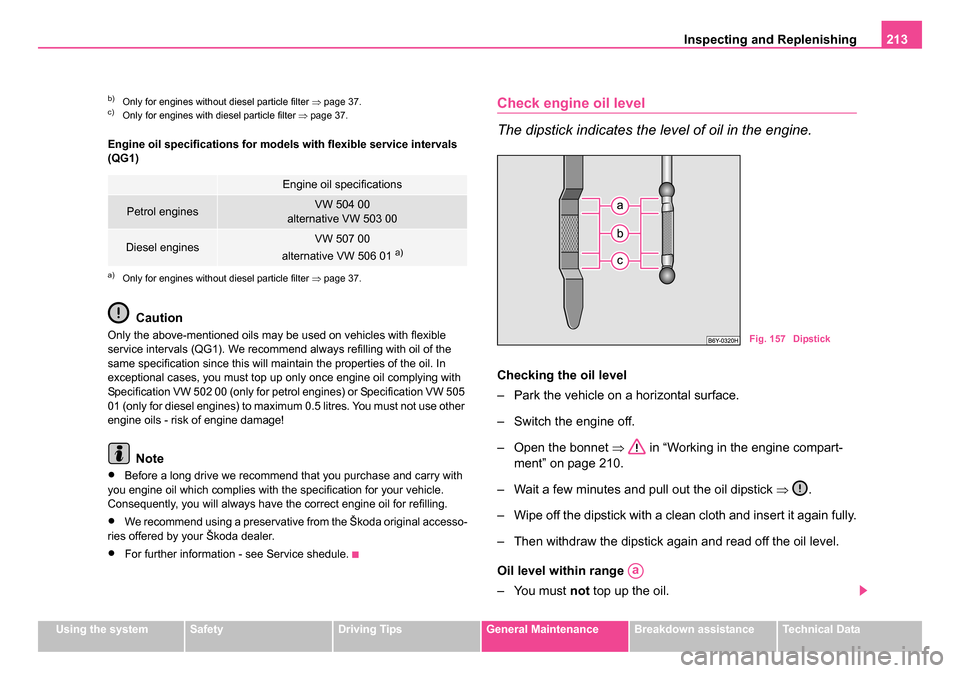
Check engine oil level
The dipstick indicates the level of oil in the engine.
Checking the oil level
– Park the vehicle on a horizontal surface.
– Switch the engine off.
– Open the bonnet ⇒ in “Working in the engine compart-
ment” on page 210.
– Wait a few minutes and pull out the oil dipstick ⇒.
– Wipe off the dipstick with a clean cloth and insert it again fully.
– Then withdraw the dipstick again and read off the oil level.
Oil level within range
– You must not top up the oil.
b)Only for engines without diesel particle filter ⇒page 37.c)Only for engines with diesel particle filter ⇒page 37.
Engine oil specifications
Petrol enginesVW 504 00
alternative VW 503 00
Diesel enginesVW 507 00
alternative VW 506 01 a)
a)Only for engines without diesel particle filter ⇒page 37.
Fig. 157 Dipstick
Aa
NKO 20 A05.book Page 213 Wednesday, June 21, 2006 1:42 PM
Page 216 of 274
Inspecting and Replenishing215
Using the systemSafetyDriving TipsGeneral MaintenanceBreakdown assistanceTechnical Data
For the sake of the environment
The oil level must on no account be above the range ⇒page 213. Oil
will otherwise be drawn in through the crankcase ventilation and may pass
through the exhaust system to atmosphere. The oil may combust in the
catalytic converter and damage it.
Changing engine oil
The engine oil must be changed at the intervals stated in the Service
schedule or according to the service interval indicator ⇒page 16.
WARNING
•Only carry out the engine oil change, if you have the required
professional knowledge!
•Read and observe the warning notes ⇒page 210, “Working in
the engine compartment” before working in the engine compart-
ment.
•Let the engine cool down - risk of burning from hot oil.
•Wear an eye protection - risk of caustic burns due to oil
splashes.
•Oil is toxic! Store old oil in a safe place out of the reach of chil-
dren and unauthorized persons until you dispose of it properly.
Caution
You must not pour any additives into the engine oil - risk of engine
damage! Damage, which results from such product, are excluded from the
warranty.
For the sake of the environment
•You must on no account pour oil into the ground or into the sewage
system.
•In view of the problems involved in properly disposing of old oil, the
material, equipment and the knowledge required for such work, we recom-
mend that you have the oil and oil filter change carried out by your Škoda
Service Partner.
Note
After your skin has come in contact with the oil, you must thoroughly wash
your skin.
Cooling system
Coolant
The job of the coolant is to cool the engine.
The cooling system does not require any maintenance under normal oper-
ating conditions. The coolant consists of water with a concentration of
coolant additive of 40 %. This mixture not only provides antifreeze protec-
tion down to -25°C but also protects the cooling and heating system from
corrosion. It also prevents the formation of scale and significantly
increases the boiling point of the coolant.
You must therefore not reduce the concentration of antifreeze agent in the
coolant by adding water, also not during the summer months or in coun-
tries with a warm climate. The concentration of coolant additive in the
coolant must be at least 40%.
Aa
NKO 20 A05.book Page 215 Wednesday, June 21, 2006 1:42 PM
Page 218 of 274
Inspecting and Replenishing217
Using the systemSafetyDriving TipsGeneral MaintenanceBreakdown assistanceTechnical Data
recommend inspecting the coolant level directly at the reservoir from time
to time.
Loss of coolant
A loss of coolant is first and foremost an
indication of a leak in the
system. You should not merely top up the coolant in the reservoir. It is also
important to have the cooling system inspected without delay by a
specialist garage.
Losses can only occur through the pressure relief in the cap of the coolant
expansion bottle which is completely free of leaks if the coolant boils as a
result of overheating and is forced out of the cooling system.
WARNING
Read and observe the warning notes ⇒page 210, “Working in the
engine compartment” before working in the engine compartment.
Caution
One should contact a specialist garage as soon as possible if the source
of overheating itself cannot be determined and removed, since there may
be grave damage to the engine.
Replenishing the coolant
– Switch the engine off.
– Allow the engine to cool down.
– Place a cloth over the cap of the coolant expansion reservoir ⇒page 216, fig. 158 and unscrew the cap carefully by
turning it to the left ⇒. – Top up the coolant.
– Screw the cap tight until it is heard to lock.
The coolant which you use for replenishing the system, must comply with
one specific specification
⇒page 215, “Coolant”. Do not use an alterna-
tive additive if the coolant additive G12 PLUS is not available in excep-
tional cases. Just top up the system with water and as soon as possible
arrange adjustment to correct the mixing ratio of water and coolant addi-
tive again by a specialist garage.
Only use fresh coolant for topping up the system.
Do not fill up over the “MAX” marking! Excess coolant which is heated up
is forced out of the cooling system through the pressure relief valve in the
cap of the coolant compensation bottle.
Wait until the engine has cooled down for a system which has suffered a
major loss of coolant before pouring in coolant. This is necessary to avoid
engine damage.
WARNING
•The cooling system is pressurized! Do not open the cap of the
coolant expansion bottle if the engine is still hot - risk of scalding!
•The coolant additive and thus all of the coolant is harmful to
your health. Avoid contact with the coolant. Coolant vapours are
also harmful to the he alth. It is important, therefore, to always
safely store any coolant additive in its original container out of the
reach of children - risk of poisoning!
•If any splashes of coolant get into your eyes, rinse out your eyes
immediately with clear water and contact a doctor as soon as
possible.
•You should also consult a doctor without delay if you have inad-
vertently swallowed coolant.
NKO 20 A05.book Page 217 Wednesday, June 21, 2006 1:42 PM
Page 220 of 274
Inspecting and Replenishing219
Using the systemSafetyDriving TipsGeneral MaintenanceBreakdown assistanceTechnical Data
A slight drop in the fluid level results when driving due to normal wear-and-
tear and automatic adjustment of the brake pads, and is perfectly normal.
There may be an indication of a leak in the brake system, however, if the
fluid level drops significantly within a short time or if it drops below the
“MIN” marking. A situation where the brake fluid level is too low is indi-
cated by the warning light
lighting up in the instrument cluster
⇒ page 36. In this case stop the car immediately and do not drive any
further! Contact a Škoda Dealer to obtain professional assistance.
WARNING
•Read and observe the warning notes ⇒page 210, “Working in
the engine compartment” before working in the engine compart-
ment.
•If the fluid level has dropped below the MIN marking, do not
drive any further - risk of accident! Contact a Škoda dealer to obtain
professional assistance.
Replacing brake fluid
Brake fluid absorbs moisture. This causes the fluid to absorb moisture
from the surrounding air over a period of time. Excessive water in the
brake fluid may be the cause of corrosion in the brake system. The water
content also lowers the boiling point of the brake fluid. This is why brake
fluid must be replaced every two years.
One may only use new genuine brake fluid from Škoda Auto a.s. The
specification for the brake fluid is “FMVSS 116 DOT 4”.
We recommend that you have the brake fluid replaced by a Škoda
Service Partner as part of an Inspection Service.
WARNING
•Using old brake fluid can result in severe stress on the brakes
because of the formation of vapour bubbles in the brake system.
This greatly impairs the braking efficiency and thus also the safety
of your vehicle.
•Brake fluid is toxic! It must therefore be kept safely in closed
original containers and well away from children and unauthorized
persons.
Caution
Brake fluid damages the paintwork of the vehicle.
For the sake of the environment
In view of the problems involved with proper disposal of brake fluid, the
special tools and the professional knowledge required, we recommend
you have the brake fluid replaced by a Škoda Service Partner.
NKO 20 A05.book Page 219 Wednesday, June 21, 2006 1:42 PM