inflation pressure SKODA ROOMSTER 2006 1.G Owner's Manual
[x] Cancel search | Manufacturer: SKODA, Model Year: 2006, Model line: ROOMSTER, Model: SKODA ROOMSTER 2006 1.GPages: 274, PDF Size: 48.64 MB
Page 7 of 274
Contents
6
Airbag system. . . . . . . . . . . . . . . . . . . . . . . . .
Description of the airbag system . . . . . . . . . .
Front airbags . . . . . . . . . . . . . . . . . . . . . . . . .
Side airbags* . . . . . . . . . . . . . . . . . . . . . . . . .
Head airbags* . . . . . . . . . . . . . . . . . . . . . . . .
Deactivating an airbag . . . . . . . . . . . . . . . . . .
Transporting children safely. . . . . . . . . . . . .
What you should know about transporting
children! . . . . . . . . . . . . . . . . . . . . . . . . . . . . .
Child seat . . . . . . . . . . . . . . . . . . . . . . . . . . . .
Attaching a child seat using the “ISOFIX”
system* . . . . . . . . . . . . . . . . . . . . . . . . . . . . .
Attaching child seat using the “Top Tether”
system . . . . . . . . . . . . . . . . . . . . . . . . . . . . . .
Driving Tips . . . . . . . . . . . . . . . . . . . . . .
Intelligent Technology . . . . . . . . . . . . . . . . . .
Electronic stability programme (ESP)* . . . . . .
Brakes . . . . . . . . . . . . . . . . . . . . . . . . . . . . . .
Brake booster . . . . . . . . . . . . . . . . . . . . . . . .
Antilock brake system (ABS)* . . . . . . . . . . . .
Brake Assist* . . . . . . . . . . . . . . . . . . . . . . . . .
Power steering* . . . . . . . . . . . . . . . . . . . . . . .
Tyre inflation pressure-control system* . . . . .
Driving and the Environment. . . . . . . . . . . .
The first 1 500 kilometres and then afterwards
Catalytic converter . . . . . . . . . . . . . . . . . . . . .
Driving in an economical and environmentally
conscious manner . . . . . . . . . . . . . . . . . . . . .
Environmental compatibility . . . . . . . . . . . . . .
Motoring abroad . . . . . . . . . . . . . . . . . . . . . . .
Avoiding damage to your vehicle . . . . . . . . . .
Towing a trailer . . . . . . . . . . . . . . . . . . . . . . . .
Towing a trailer . . . . . . . . . . . . . . . . . . . . . . . .
General Maintenance. . . . . . . . . .
Taking care of your vehicle and cleaning the
vehicle . . . . . . . . . . . . . . . . . . . . . . . . . . . . . . .
General . . . . . . . . . . . . . . . . . . . . . . . . . . . . .
Care of the exterior of vehicle . . . . . . . . . . . .
Care of the interior of vehicle . . . . . . . . . . . . .
Fuel. . . . . . . . . . . . . . . . . . . . . . . . . . . . . . . . . .
Petrol . . . . . . . . . . . . . . . . . . . . . . . . . . . . . . .
Diesel . . . . . . . . . . . . . . . . . . . . . . . . . . . . . .
Refuelling . . . . . . . . . . . . . . . . . . . . . . . . . . .
Inspecting and Replenishing. . . . . . . . . . . .
Engine compartment . . . . . . . . . . . . . . . . . . . . . . . . . . . . . . . . . . . . . . . . . . . . . . . . . . . . . .
Cooling system . . . . . . . . . . . . . . . . . . . . . . .
Brake fluid . . . . . . . . . . . . . . . . . . . . . . . . . . .
Battery . . . . . . . . . . . . . . . . . . . . . . . . . . . . . .
Windshield washer system . . . . . . . . . . . . . .
Wheels and Tyres . . . . . . . . . . . . . . . . . . . . .
Wheels . . . . . . . . . . . . . . . . . . . . . . . . . . . . .
Accessories, changes and replacement of
parts . . . . . . . . . . . . . . . . . . . . . . . . . . . . . . . . .
Accessories and replacement parts . . . . . . .
Technical changes . . . . . . . . . . . . . . . . . . . . .
Breakdown assistance . . . . . . . .
Breakdown assistance . . . . . . . . . . . . . . . . .
First-aid box* and Warning triangle* . . . . . . .
Fire extinguisher* . . . . . . . . . . . . . . . . . . . . . .
Vehicle tool kit . . . . . . . . . . . . . . . . . . . . . . . .
Tyre repair kit* . . . . . . . . . . . . . . . . . . . . . . . .
Spare wheel* . . . . . . . . . . . . . . . . . . . . . . . . .
Changing a wheel . . . . . . . . . . . . . . . . . . . . .
Jump-starting . . . . . . . . . . . . . . . . . . . . . . . . .
Tow-starting and towing vehicle . . . . . . . . . . .
Fuses and light bulbs . . . . . . . . . . . . . . . . . .
Electric fuses . . . . . . . . . . . . . . . . . . . . . . . . .
Bulbs . . . . . . . . . . . . . . . . . . . . . . . . . . . . . . .
Te c h n i c a l D a ta . . . . . . . . . . . . . . . . . .
General . . . . . . . . . . . . . . . . . . . . . . . . . . . . . .
Identification data . . . . . . . . . . . . . . . . . . . . .
Index . . . . . . . . . . . . . . . . . . . . . . . . . . . . . .
154
154
156
159
161
163
166
166
170
174
175
177
177
177
180
181
181
182
183
183
185
185
186
187
191
192
192
193
193 197
197
197
197
203
205
205
205
207
209
209
212
215
218
220
224
225
225
232
232
232
235
235
235
235
236
236
237
237
243
245249
249
254
263
263
263
265
NKO 20 A05.book Page 6 Wednesday, June 21, 2006 1:42 PM
Page 35 of 274

Instruments and Indicator/Warning Lights
34
The following text will be displayed in the information display*:
EXHAUST WORKSHOP!
Traction control system (TCS)
The warning light comes on for a few seconds when the ignition is
switched on.
The warning light comes on when driving when a control cycle is acti-
vated.
The warning light will come on and remains on if the TCS is switched off
or if there is a fault in the system.
The fact that the TCS system operates together with the ABS means that
the TCS warning light will also come on if the ABS system is not operating
properly.
If the warning light
comes on immediately after starting the engine, the
TCS system can be switched off for technical reasons. In this case, the
TCS system can be switched on again by switching the ignition on and off.
If the warning light goes out, the TCS system is fully functional again.
Further information about the TCS ⇒page 178.
Note
If the battery has been disconnected and reconnected, the warning light comes on after switching on the ignition. The warning light must go out
after driving a short distance.
Tyre inflation pressure*
The warning light lights up, if there is a substantial drop in inflation
pressure in one of the tyres. Reduce the speed and check or correct as
soon as possible the inflation pressure in the tyres ⇒page 226.
A peep sounds as an additional warning signal.
If the warning light flashes, there is a system fault. Visit the nearest
specialist garage and have the fault rectified.
Further information about tyre pressure-control system ⇒page 183.
WARNING
•When the warning light lights up, immediately reduce the
speed and avoid sudden steering and brake manoeuvres. Please
stop the vehicle without delay at the nearest possible stop and
inspect the tyres and their inflation pressures.
•Under certain circumstances (e.g. sporty style of driving, wintry
or unpaved roads) the warning light can be delayed or does not
light up at all.
•The tyre inflation pressure-control system does not take away
the responsability from the driver for the correct tyre inflation pres-
sure.
Note
If the battery has been disconnected, the warning light comes on after
switching on the ignition. The warning light must go out after driving a
short distance.
NKO 20 A05.book Page 34 Wednesday, June 21, 2006 1:42 PM
Page 143 of 274
Passive Safety
142
For this reason you will be provided with information on why this equip-
ment is very important, how it protects you and the occupants, what
should be observed when using the equipment and how you and the
people travelling with you can make full use of the existing safety equip-
ment. This Owner's Manual contains important warning notes, which you
and those travelling with you should pay attention to in order to reduce a
risk of injury.
Safety concerns everybody!
Before setting off
The driver is always fully responsible for his occupants
and for the operating safety of the vehicle.
For your own safety and the safety of the people travelling with you,
please pay attention to the following points before setting off.
•Ensure that the lighting and the turn signal system are functioning
properly.
•Inspect the tyre inflation pressure.
•Ensure that all the windows offer a good visibility to the outside.
•Safely attach the items of luggage ⇒page 77, “Loading the luggage
compartment”.
•Ensure that no objects can obstruct the pedal.
•Adjust the mirror, the front seat and the head restraint to match your
body size.
•Point out to your occupants that the head restraints must be adjusted
to match their body size.
•Protect the children in suitable child seats with correctly fastened seat
belts ⇒page 166, “Transporting children safely”.
•Adopt the correct seated position. Also inform your occupants to adopt
the correct seated position.
•Fasten the seat belt correctly. Also inform your occupants to properly
fasten the seat belts ⇒page 150, “How are seat belts correctly
fastened?”.
What influences the driving safety?
The driving safety is primarily determined by the style of
driving and the personal behaviour of all the occupants.
The driver is fully responsible for himself and his occupants. If your driving
safety is effected, you place yourself and the oncoming traffic at risk.
Please refer to the following guidelines.
•Do not get distracted from concentrating on the traffic situation, e.g. by
your occupants or mobile phone calls.
•Never drive when your driving ability is impaired, e.g. through medica-
tion, alcohol, drugs.
•Keep to the traffic regulations and the permissible speed limit.
•Adjust the driving speed at all times to the road condition as well as to
the traffic and weather conditions.
•Take regular breaks on long journeys - at the latest every two hours.
NKO 20 A05.book Page 142 Wednesday, June 21, 2006 1:42 PM
Page 184 of 274
Intelligent Technology183
Using the systemSafetyDriving TipsGeneral MaintenanceBreakdown assistanceTechnical Data
•The increased safety offered by the Brake Assist must not tempt
you to take a greater safety risk than otherwise.
Power steering*
The power steering enables you to steer the vehicle with less physical
force.
The steering characteristics can be changed by a specialist garage.
You will place great stresses on the power steering system if the steering
is turned to full lock when the vehicle is stationary. Turning the steering to
full lock in such a situation will be accompanied by noises.
It is still possible to fully steer the vehicle if the power steering fails or if the
engine is not running (vehicle being towed in). The only difference is that
greater physical effort is required.
It is possible that the hydraulic pump of the power steering will not run due
to the low vehicle network voltage if the battery has gone flat and the
engine must started with the help off jump leads. This condition will be
indicated by lighting up of the warning light.
The power steering operates again if the battery is charged to a specific
range when engine is running. It also operates again, if the engine can be
started with its own battery.
Caution
Do not leave the steering at full lock for more than 15 seconds when the
engine is running - risk of damaging the power steering!
Note
Have the steering inspected as soon as possible by a specialist garage if
there is a leak or fault in the system.
Tyre inflation pressure-control system*
The tyre inflation pressure-control system compares with the aid of the
ABS sensors the speed and also the roll ing circumference of the individual
wheels. If the inflation pressure and therefore the rolling circumference of
a wheel has changed significantly, the warning light
lights up in the
dash panel ⇒page 34. The tyre inflation pressure-control system func-
tions late or too sensitively if:
•the structure of the tyre is damaged,
•the vehicle is loaded to one side or with a load on the roof,
WARNING (continued)
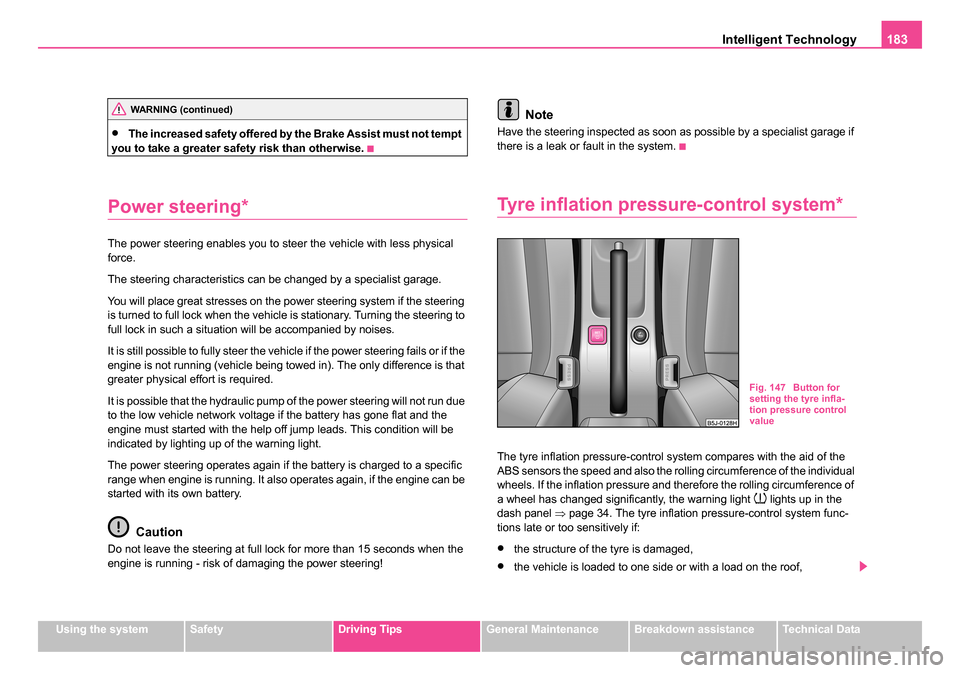
Fig. 147 Button for
setting the tyre infla-
tion pressure control
value
NKO 20 A05.book Page 183 Wednesday, June 21, 2006 1:42 PM
Page 185 of 274
Intelligent Technology
184
•the wheels of an axle are loaded heavily (e.g. when towing a trailer or
when driving uphill or downhill),
•the vehicle is operated in unfavourable winter conditions or on an
unfirm ground,
•snow chains or emergency wheel are mounted,
•the driver has a sporty style of driving (with sharp acceleration and
high speed when cornering).
Basic setting of tyre inflation pressure-control system
After changing the tyre inflation pressures or after changing one or several
wheels, the button for the tyre inflation pressure-control system must be
pressed long enough until an acknowledegment tone sounds when the
ignition is switched on.
•Inflate all tyres to the specified inflation pressure ⇒page 226.
•Switch on the ignition.
•Press the button ⇒ page 183, fig. 147 long enough, until an
acknowledgment tone sounds, which confirms the storage of the basic
values. As long as the button
is pressed, the warning light lights
up in the instrument .
Function description
After the basic setting of the system the “adaptation” of the tyre inflation
pressures and then the tyre pressure control in the individual tyres are
performed.
Warning light
lights up
If the tyre inflation pressure of at least one wheel is insufficiently inflated
in comparison to the stored basic value, the warning light
⇒ lights
up. Warning light
lights up and after pressing the button SET it does
not go out.
If the warning light lights up and does not go out after pressing the button
SET there is a fault in the system. Have the vehicle inspected by your
nearest specialist garage.
WARNING
•When the warning light lights up, immediately reduce the
speed and avoid sudden steering and brake manoeuvres. Please
stop the vehicle without delay at the nearest possible stop and
inspect the tyres and their inflation pressures.
•The driver is responsible for the correct tyre inflation pressures.
For this reason, the tyre inflation pressures must be checked regu-
larly.
•Under certain circumstances (e.g. sporty style of driving, wintry
or unpaved roads) the warning light can be delayed or does not
light up at all.
•The tyre inflation pressure-control system does not take away
the responsability from the driver for the correct tyre inflation pres-
sure.
Note
The tyre inflation pressure-control system:
•does not replace the regular tyre inflation pressure control, because
the system cannot detect an even pressure loss,
•cannot warn in case of very rapid tyre inflation pressure loss, e.g. in
case of sudden tyre damage. In this case carefully bring the vehicle to a
standstill without sudden steering movements and without sharp
braking.
NKO 20 A05.book Page 184 Wednesday, June 21, 2006 1:42 PM
Page 191 of 274
Driving and the Environment
190
Avoid driving short distances
Short distances result in an above-average high fuel
consumption.
– Avoid driving a distance of no more than 4 km if the engine is
cold.
The engine and catalytic converter must first have reached their optimal
operating temperature in order to effectively reduce fuel consumption
and pollutant emissions.
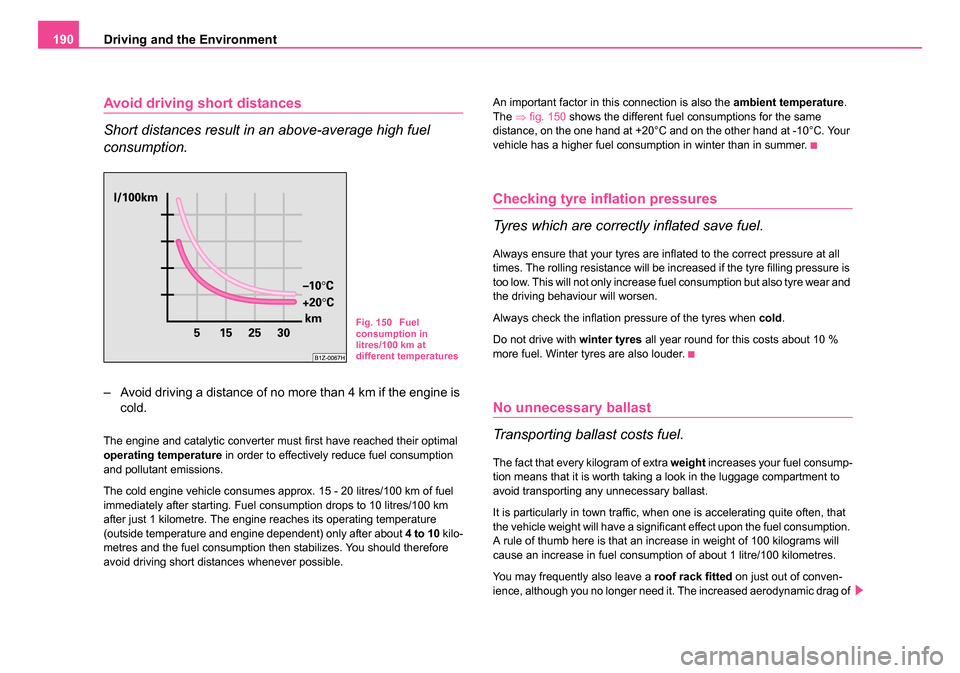
The cold engine vehicle consumes approx. 15 - 20 litres/100 km of fuel
immediately after starting. Fuel consumption drops to 10 litres/100 km
after just 1 kilometre. The engine reaches its operating temperature
(outside temperature and engine dependent) only after about 4 to 10 kilo-
metres and the fuel consumption then stabilizes. You should therefore
avoid driving short distances whenever possible. An important factor in this connection is also the
ambient temperature.
The ⇒fig. 150 shows the different fuel consumptions for the same
distance, on the one hand at +20°C and on the other hand at -10°C. Your
vehicle has a higher fuel consumption in winter than in summer.
Checking tyre inflation pressures
Tyres which are correctly inflated save fuel.
Always ensure that your tyres are inflated to the correct pressure at all
times. The rolling resistance will be increased if the tyre filling pressure is
too low. This will not only increase fuel consumption but also tyre wear and
the driving behaviour will worsen.
Always check the inflation pressure of the tyres when cold.
Do not drive with winter tyres all year round for this costs about 10 %
more fuel. Winter tyres are also louder.
No unnecessary ballast
Transporting ballast costs fuel.
The fact that every kilogram of extra weight increases your fuel consump-
tion means that it is worth taking a look in the luggage compartment to
avoid transporting any unnecessary ballast.
It is particularly in town traffic, when one is accelerating quite often, that
the vehicle weight will have a significant effect upon the fuel consumption.
A rule of thumb here is that an increase in weight of 100 kilograms will
cause an increase in fuel consumption of about 1 litre/100 kilometres.
You may frequently also leave a roof rack fitted on just out of conven-
ience, although you no longer need it. The increased aerodynamic drag of
Fig. 150 Fuel
consumption in
litres/100 km at
different temperatures
NKO 20 A05.book Page 190 Wednesday, June 21, 2006 1:42 PM
Page 195 of 274
Towing a trailer
194
be found in your vehicle registration documents or in the brochure -
Technical Data .
Distribution of the load
Distribute the load in the trailer in such a way that any heavy items are
located as close as possible to the axle. Secure the items to prevent them
slipping.
Tyre pressure
Correct the tyre inflation pressure on your vehicle for that of “fully laden”,
⇒ page 226. The inflation pressure of the tyres fitted to the trailer adjust
in accordance with the manufacturer's recommendation.
Exterior mirrors
You have to have additional exterior mirrors fitted if you are not able to see
the traffic behind the trailer with the standard rear-view mirrors. Both exte-
rior mirrors should be attached to folding arms. Adjust the mirrors so that
they provide you with an adequate field of view to the rear.
Headlights
Before starting off with a hitched trailer, also check the setting of the head-
lights. Alter the setting as necessary with the aid of the headlight beam
adjuster ⇒page 58.
Detachable ball head
The ball rod is detachable on vehicles with towing device and suppliable
from Škoda original accessories. It is stowed together with separate fitting
instructions in the spare wheel well in the luggage compartment of the
vehicle.
Note
•We recommend that you also have your vehicle inspected between
service intervals if you tow a trailer frequently.
•The handbrake on the towing vehicle must be put on when coupling
and decoupling the trailer.
Driving Tips
Particular caution is required when towing a trailer.
– Do not, as far as possible, drive with your vehicle unladen and the trailer laden.
– Do not make full use of the legal maximum speeds. This applies in particular to downhill sections.
– Apply the brakes in good time.
– Keep a check on the coolant temperature gauge if the outside temperature is high.
Distribution of weight
The distribution of the weight is very poor if your vehicle is unladen and
the trailer is laden. Maintain a particularly low speed if you cannot avoid
driving with this combination.
Driving speed
Do not drive faster than 80 km/hour for safety reasons. This also applies
for countries in which higher speeds are allowed.
The fact that the driving stability of the vehicle + trailer combination
reduces with increasing speed means that the legally allowed speed
should not be used when there are unfavourable road, weather or wind
conditions, particularly near accident black spots.
NKO 20 A05.book Page 194 Wednesday, June 21, 2006 1:42 PM
Page 227 of 274
Wheels and Tyres
226
Tyre life
The life of your tyres very much depends on the following points:
Tyre pressure
The working life of tyres will be shortened considerably if the tyres are
insufficiently or over-inflated and this will have an adverse effect on the
handling of your vehicle.
Correctly inflated tyres are of particular importance when travelling at high
speeds . It is therefore good to check the pressure at least once a month
and also before setting off on a long trip. Please do not forget the spare
wheel when checking the tyres.
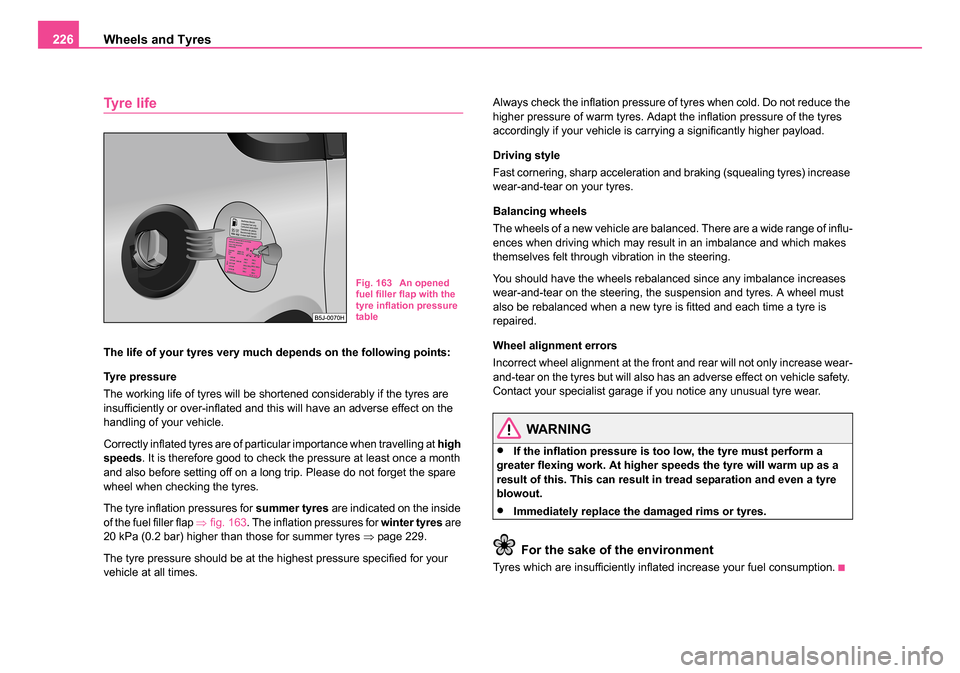
The tyre inflation pressures for summer tyres are indicated on the inside
of the fuel filler flap ⇒fig. 163 . The inflation pressures for winter tyres are
20 kPa (0.2 bar) higher than those for summer tyres ⇒page 229.
The tyre pressure should be at the highest pressure specified for your
vehicle at all times. Always check the inflation pressure of tyres when cold. Do not reduce the
higher pressure of warm tyres. Adapt the inflation pressure of the tyres
accordingly if your vehicle is carrying a significantly higher payload.
Driving style
Fast cornering, sharp acceleration and braking (squealing tyres) increase
wear-and-tear on your tyres.
Balancing wheels
The wheels of a new vehicle are balanced. There are a wide range of influ-
ences when driving which may result in an imbalance and which makes
themselves felt through vibration in the steering.
You should have the wheels rebalanced since any imbalance increases
wear-and-tear on the steering, the suspension and tyres. A wheel must
also be rebalanced when a new tyre is fitted and each time a tyre is
repaired.
Wheel alignment errors
Incorrect wheel alignment at the front and rear will not only increase wear-
and-tear on the tyres but will also has an adverse effect on vehicle safety.
Contact your specialist garage if you notice any unusual tyre wear.
WARNING
•If the inflation pressu
re is too low, the tyre must perform a
greater flexing work. At higher sp eeds the tyre will warm up as a
result of this. This can result in tread separation and even a tyre
blowout.
•Immediately replace the damaged rims or tyres.
For the sake of the environment
Tyres which are insufficiently inflated increase your fuel consumption.
Fig. 163 An opened
fuel filler flap with the
tyre inflation pressure
table
NKO 20 A05.book Page 226 Wednesday, June 21, 2006 1:42 PM
Page 238 of 274
Breakdown assistance237
Using the systemSafetyDriving TipsGeneral MaintenanceBreakdown assistanceTechnical Data
Spare wheel*
The spare wheel is stowed in the spare wheel well in the
luggage compartment below the floor covering.
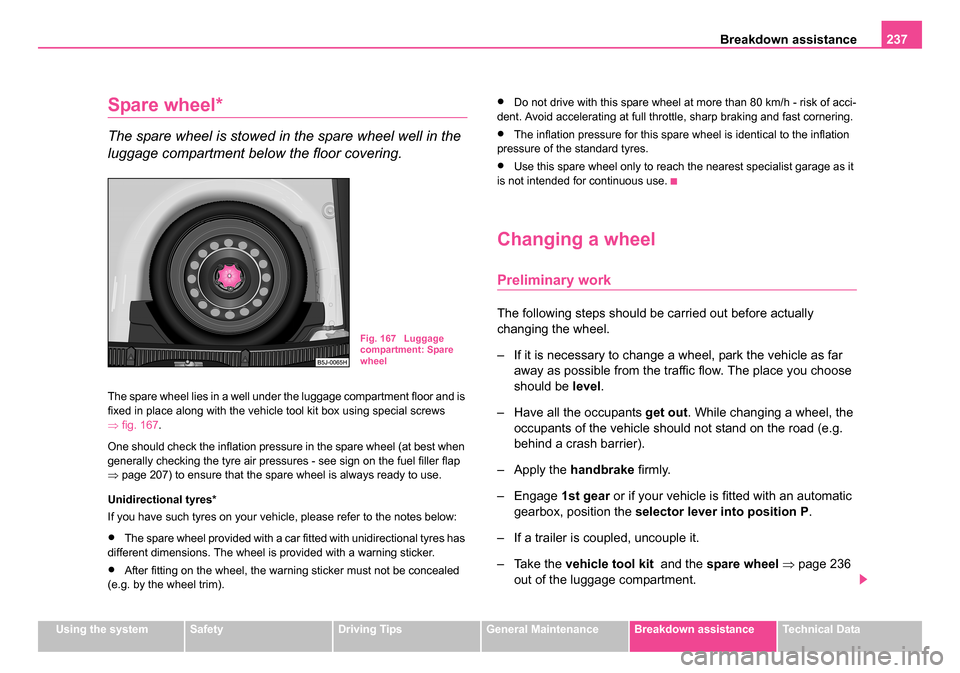
The spare wheel lies in a well under the luggage compartment floor and is
fixed in place along with the vehicle tool kit box using special screws
⇒fig. 167 .
One should check the inflation pressure in the spare wheel (at best when
generally checking the tyre air pressures - see sign on the fuel filler flap
⇒ page 207) to ensure that the spare wheel is always ready to use.
Unidirectional tyres*
If you have such tyres on your vehicle, please refer to the notes below:
•The spare wheel provided with a car fitted with unidirectional tyres has
different dimensions. The wheel is provided with a warning sticker.
•After fitting on the wheel, the warning sticker must not be concealed
(e.g. by the wheel trim).
•Do not drive with this spare wheel at more than 80 km/h - risk of acci-
dent. Avoid accelerating at full throttle, sharp braking and fast cornering.
•The inflation pressure for this spare wheel is identical to the inflation
pressure of the standard tyres.
•Use this spare wheel only to reach the nearest specialist garage as it
is not intended for continuous use.
Changing a wheel
Preliminary work
The following steps should be carried out before actually
changing the wheel.
– If it is necessary to change a wheel, park the vehicle as far away as possible from the traffic flow. The place you choose
should be level.
– Have all the occupants get out. While changing a wheel, the
occupants of the vehicle should not stand on the road (e.g.
behind a crash barrier).
– Apply the handbrake firmly.
– Engage 1st gear or if your vehicle is fitted with an automatic
gearbox, position the selector lever into position P .
– If a trailer is coupled, uncouple it.
– Take the vehicle tool kit and the spare wheel ⇒ page 236
out of the luggage compartment.
Fig. 167 Luggage
compartment: Spare
wheel
NKO 20 A05.book Page 237 Wednesday, June 21, 2006 1:42 PM
Page 271 of 274
Index
270
Thickness of brake pads
Warning light . . . . . . . . . . . . . . . . . . . . . . 33
Tiptronic . . . . . . . . . . . . . . . . . . . . . . . . . . . 119
Tool . . . . . . . . . . . . . . . . . . . . . . . . . . . . . . . 236
Towing a trailer . . . . . . . . . . . . . . . . . . . . . . 193
Towing eye front . . . . . . . . . . . . . . . . . . . . . . . . . . . . 246
rear . . . . . . . . . . . . . . . . . . . . . . . . . . . . 247
Towing protection . . . . . . . . . . . . . . . . . . . . . 50
towing vehicle . . . . . . . . . . . . . . . . . . . . . . . 245
Tow-starting . . . . . . . . . . . . . . . . . . . . . . . . 245
Tow-starting and towing vehicle Automatic gearbox . . . . . . . . . . . . . . . . 125
Traction control system (TCS) . . . . . . . . . . 178 Warning light . . . . . . . . . . . . . . . . . . . . . . 34
Trailer . . . . . . . . . . . . . . . . . . . . . . . . . . . . . 193 General Maintenance . . . . . . . . . . . . . . 193
Transporting children safely . . . . . . . . . . . . 166
Tread depth . . . . . . . . . . . . . . . . . . . . . . . . 227
Turn signal light . . . . . . . . . . . . . . . . . . . . . 256
Turn signal lights . . . . . . . . . . . . . . . . . . . . . . 59 Warning light . . . . . . . . . . . . . . . . . . . . . . 29
Turn signal system for vehicles towing a trailer Warning light . . . . . . . . . . . . . . . . . . . . . . 31
Two-way radio systems . . . . . . . . . . . . . . . 138
Type plate . . . . . . . . . . . . . . . . . . . . . . . . . . 263
Tyre . . . . . . . . . . . . . . . . . . . . . . . . . . . . . . . 226
Tyre inflation pressure Warning light . . . . . . . . . . . . . . . . . . . . . . 34
Tyre repair kit . . . . . . . . . . . . . . . . . . . . . . . 236 Tyres
Winter tyres . . . . . . . . . . . . . . . . . . . . . . 229
U
Underbody protection . . . . . . . . . . . . . . . . . 202
Unidirectional tyres . . . . . . . . . . . . . . . . . . . 230
Unlocking . . . . . . . . . . . . . . . . . . . . . . . . . . . 42Remote control . . . . . . . . . . . . . . . . . . . . 48
V
Vanity mirror . . . . . . . . . . . . . . . . . . . . . . . . . 62
Vehicle data sticker . . . . . . . . . . . . . . . . . . . 263
Vehicle identification data . . . . . . . . . . . . . . 263
Vehicle tool kit . . . . . . . . . . . . . . . . . . . . . . . 236
Visors . . . . . . . . . . . . . . . . . . . . . . . . . . . . . . 62
W
Warning lights . . . . . . . . . . . . . . . . . . . . . . . . 27
Warning symbols . . . . . . . . . . . . . . . . . . . . . 27
Warning triangle . . . . . . . . . . . . . . . . . . . . . 235
Washing . . . . . . . . . . . . . . . . . . . . . . . . . . . 198with a high-pressure cleaner . . . . . . . . . 199
Washing the vehicle . . . . . . . . . . . . . . . . . . 197
Washing vehicle by hand . . . . . . . . . . . . . . 198
Wax treatment . . . . . . . . . . . . . . . . . . . . . . . 199
Wheel Changing . . . . . . . . . . . . . . . . . . . . . . . . 237
Spare . . . . . . . . . . . . . . . . . . . . . . . . . . . 237 Wheel bolts . . . . . . . . . . . . . . . . . . . . . . . . . 229
Safety . . . . . . . . . . . . . . . . . . . . . . . . . . . 242
slackening and tightening . . . . . . . . . . . 241
Wheel bolts lock . . . . . . . . . . . . . . . . . . . . . 242
Wheel trim . . . . . . . . . . . . . . . . . . . . . . 225, 239
Wheels . . . . . . . . . . . . . . . . . . . . . . . . . . . . 225
Window . . . . . . . . . . . . . . . . . . . . . . . . . . . . . 51
Windows de-icing . . . . . . . . . . . . . . . . . . . . . . . . . 200
Windscreen washer nozzles . . . . . . . . . . . . . 63
Windscreen Wiper and Washer System Warning light . . . . . . . . . . . . . . . . . . . . . . 33
Windshield washer fluid reservoir . . . . . . . . 224 Warning light . . . . . . . . . . . . . . . . . . . . . . 33
Windshield washer system . . . . . . . . . . . . . 224
Windshield wiper . . . . . . . . . . . . . . . . . . . . . . 63
Winter tyres . . . . . . . . . . . . . . . . . . . . . . . . . 229
Wiper blades Replacing the wiper blades . . . . . . . . . . . 65
NKO 20 A05.book Page 270 Wednesday, June 21, 2006 1:42 PM