check engine SKODA ROOMSTER 2011 1.G Owner's Guide
[x] Cancel search | Manufacturer: SKODA, Model Year: 2011, Model line: ROOMSTER, Model: SKODA ROOMSTER 2011 1.GPages: 212, PDF Size: 3.3 MB
Page 156 of 212
When refilling, we only recommend you use the same antifreeze described on the
antifreeze expansion tank.
Please contact an authorised
ŠKODA Service Partner if you have any questions re-
garding the coolant or if you wish to fill up with a different coolant.
An authorised ŠKODA Service Partner can also supply you with the correct coolant
additives.
Coolant capacity Petrol engines Capacities (in litres)
1.2 l/51 kW - EU5/EU2 DDK 5,5
1.2 l/63 kW TSI - EU5 7,7
1.2 l/77 kW TSI - EU5 7,7
1.4 l/63 kW - EU5 5,5
1.6 l/77 kW - EU4/EU2 DDK 5,5
Diesel engines Capacities (in litres)
1.2 l/55 kW TDI CR DPF - EU5 6,6
1.6 l/66 kW TDI CR DPF - EU5 8,4
1.6 l/77 kW TDI CR DPF - EU5 8,4
CAUTION
● Other coolant additives may cause operational problems which, in particular,
involves significantly reducing the anticorrosion effect.
● Any faults or problems resulting from corrosion may cause a loss of coolant
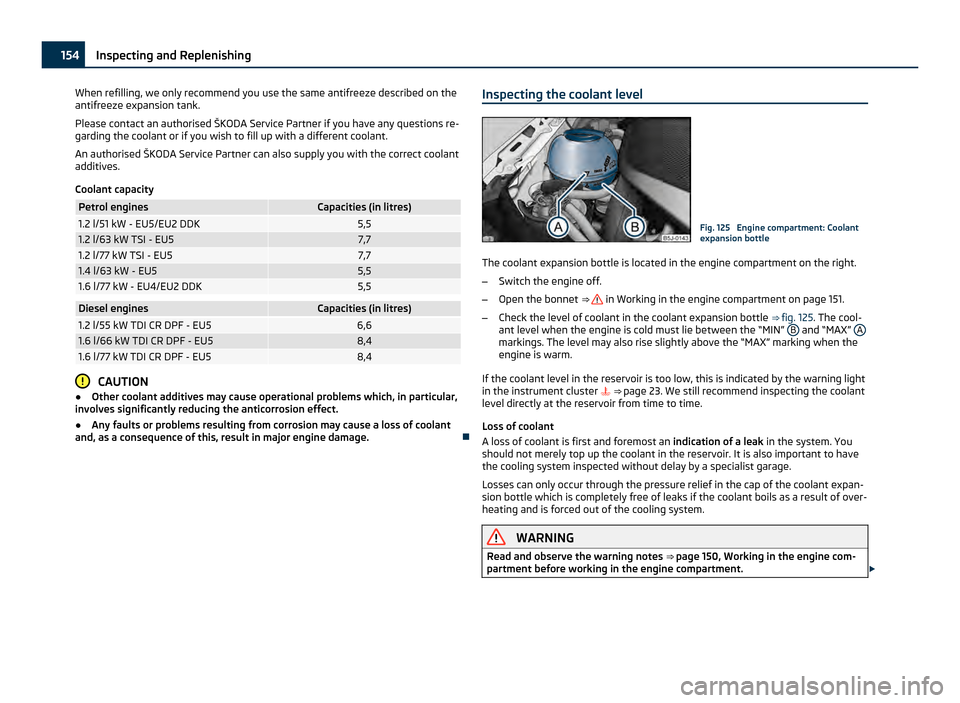
and, as a consequence of this, result in major engine damage. Inspecting the coolant level Fig. 125 Engine compartment: Coolant
expansion bottle
The coolant expansion bottle is located in the engine compartment on the right.
– Switch the engine off.
– Open the bonnet ⇒ in Working in the engine compartment on page 151.
– Check the level of coolant in the coolant expansion bottle ⇒ fig. 125 . The cool-
ant level when the engine is cold must lie between the
“MIN” B and “MAX”
A markings. The level may also rise slightly above the “MAX” marking when the
engine is warm.
If the coolant level in the reservoir is too low, this is indicated by the warning light
in the instrument cluster
⇒ page 23. We still recommend inspecting the coolant
level directly at the reservoir from time to time.
Loss of coolant
A loss of coolant is first and foremost an indication of a leak in the system. You
should not merely top up the coolant in the reservoir. It is also important to have
the cooling system inspected without delay by a specialist garage.
Losses can only occur through the pressure relief in the cap of the coolant expan-
sion bottle which is completely free of leaks if the coolant boils as a result of over-
heating and is forced out of the cooling system. WARNING
Read and observe the warning notes ⇒ page 150
, Working in the engine com-
partment before working in the engine compartment. £154
Inspecting and Replenishing
Page 160 of 212
Battery cover
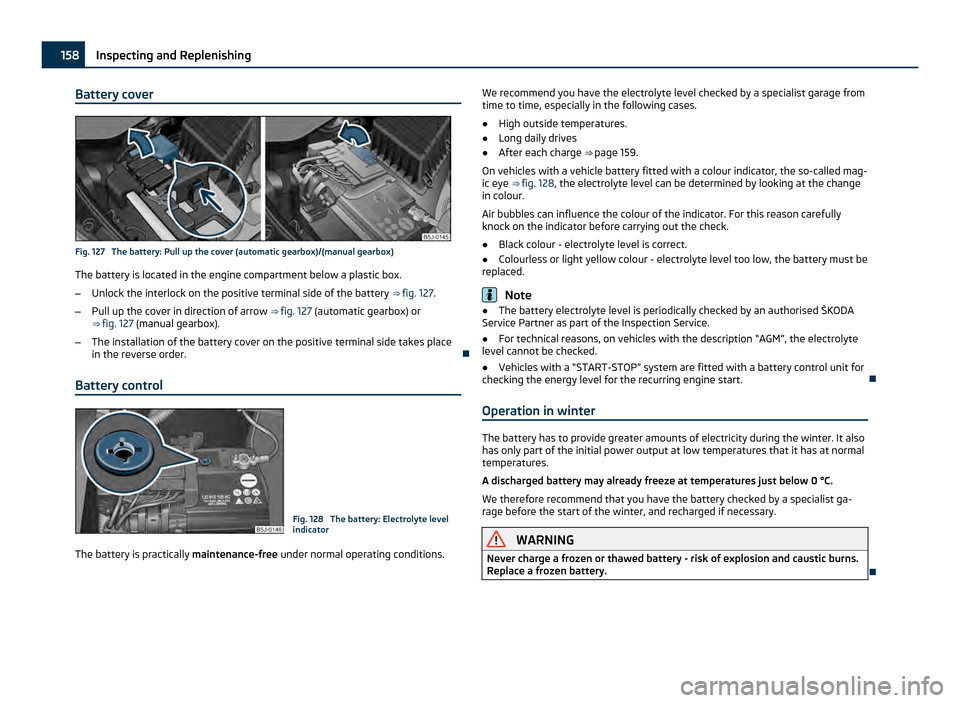
Fig. 127 The battery: Pull up the cover (automatic gearbox)/(manual gearbox)
The battery is located in the engine compartment below a plastic box.
– Unlock the interlock on the positive terminal side of the battery ⇒ fig. 127.
– Pull up the cover in direction of arrow ⇒ fig. 127 (automatic gearbox) or
⇒ fig. 127 (manual gearbox).
– The installation of the battery cover on the positive terminal side takes place
in the reverse order.
Battery control Fig. 128 The battery: Electrolyte level
indicator
The battery is practically maintenance-free under normal operating conditions. We recommend you have the electrolyte level checked by a specialist garage from
time to time, especially in the following cases.
● High outside temperatures.
● Long daily drives
● After each charge ⇒
page 159.
On vehicles with a vehicle battery fitted with a colour indicator, the so-called mag-
ic eye ⇒ fig. 128 , the electrolyte level can be determined by looking at the change
in colour.
Air bubbles can influence the colour of the indicator. For this reason carefully
knock on the indicator before carrying out the check.
● Black colour - electrolyte level is correct.
● Colourless or light yellow colour - electrolyte level too low, the battery must be
replaced. Note
● The battery electrolyte level is periodically checked by an authorised
ŠKODA
Service Partner as part of the Inspection Service.
● For technical reasons, on vehicles with the description “AGM”, the electrolyte
level cannot be checked.
● Vehicles with a “START-STOP” system are fitted with a battery control unit for
checking the energy level for the recurring engine start.
Operation in winter The battery has to provide greater amounts of electricity during the winter. It also
has only part of the initial power output at low temperatures that it has at normal
temperatures.
A discharged battery may already freeze at temperatures just below 0 °C.
We therefore recommend that you have the battery checked by a specialist ga-
rage before the start of the winter, and recharged if necessary. WARNING
Never charge a frozen or thawed battery - risk of explosion and caustic burns.
Replace a frozen battery. 158
Inspecting and Replenishing
Page 161 of 212
Charging the battery
A properly charged battery is essential for reliably starting the en-
gine.
– Read the warning notes ⇒ in General information on page 157 and
⇒ .
– Switch the ignition and all electrical components off.
– Only for “quick-charging”: Disconnect both battery cables (first of all “nega-
tive
”, then “positive”).
– Carefully attach the terminal clamps of the charger to the battery terminals
(red = “positive
”, black = “negative”).
– You can now plug the mains cable of the charger into the power socket and
switch on the charger.
– When charging is completed: switch the charger off and unplug the mains ca-
ble from the power socket.
– Only then should you disconnect the terminal clamps of the charger.
– Reconnect the cables to the battery (first of all “positive”, then “negative”).
It is not normally necessary to disconnect the cables of the battery if you recharge
the battery using low amperages (as for example from a mini-charger). Please al-
so refer to the instructions from the charger manufacturer.
A charging current of 0.1 of the total battery capacity (or lower) is that which
should be used until full charging is achieved.
It is, however, necessary to disconnect both cables before charging the battery
with high amperages, so-called
“quick-charging ”.
“Quick-charging” a battery is dangerous ⇒ in General information on page 157.
It requires a special charger and specialist knowledge. We recommend having the
quick charging of vehicle batteries undertaken by a specialist garage.
A discharged battery may already freeze at temperatures just below 0
°C ⇒ . We
recommend that you no longer use a battery which has thawed out because the
casing of the battery may be cracked through the formation of ice and this would
allow battery electrolyte to flow out.
The vent plugs of the battery should not be opened for charging. WARNING
● Never charge a frozen or thawed battery - risk of explosion and caustic
burns. Replace a frozen battery.
● Never charge a battery which has a too low electrolyte level - risk of explo-
sion and caustic burns. CAUTION
On vehicles with the “START/STOP” system, the pole terminal of the charger must
not be connected directly to the negative terminal of the vehicle battery, but only
to the engine earth ⇒ fig. 143.
Disconnecting and reconnecting the battery On disconnecting and reconnecting the battery the following functions are initially
deactivated or are no longer able to operate fault-free.
Operation Operating measure
Electrical power window (operational faults) ⇒ page 38
Enter the car stereo/radio navigation system
code number see operating instructions for the
car stereo/radio navigation sys-
tem
Setting the clock ⇒ page 13
Data in the multi-functional indicator are de-
leted. ⇒ page 14
We recommend having the vehicle checked by an authorised ŠKODA Service Part-
ner to ensure full functionality of all electrical systems.
Replacing the battery When replacing a battery, the new new battery must have the same capacity,
voltage (12
V), amperage and be the same size. Suitable types of vehicle battery
are available from an authorised ŠKODA Service Partner.
We recommend you have a battery change carried out by an authorised ŠKODA
Service Partner, who will properly install the new battery and dispose of the origi-
nal one. £ 159
Inspecting and Replenishing Using the system Safety Driving Tips General Maintenance Breakdown assis-
tance Praktik Technical data
Page 162 of 212
CAUTION
Vehicles with a “START-STOP” system are fitted with a special battery type which
allows the battery control unit to check the energy level for recurring engine start.
This battery must only be replaced by a battery of the same type. For the sake of the environment
Batteries contain poisonous substances such as sulphuric acid and lead. For this
reason, it must be disposed of properly. Under no circumstances must it be dis-
posed of in the communal rubbish.
Automatic consumer shut-off Under heavy load on the vehicle battery, the vehicle electrical system manage-
ment automatically takes various measures to avoid draining the vehicle battery.
●
The idling speed is raised to allow the generator to deliver more electricity to
the electrical system.
● If necessary, some electrical consumers are limited in their performance or are
temporarily switched off completely. Note
Despite such intervention by the vehicle electric system management, the vehicle
battery may be drained. For example, when the ignition is switched on a long time
with the engine turned off or the side or parking lights are turned on during lon-
ger parking.
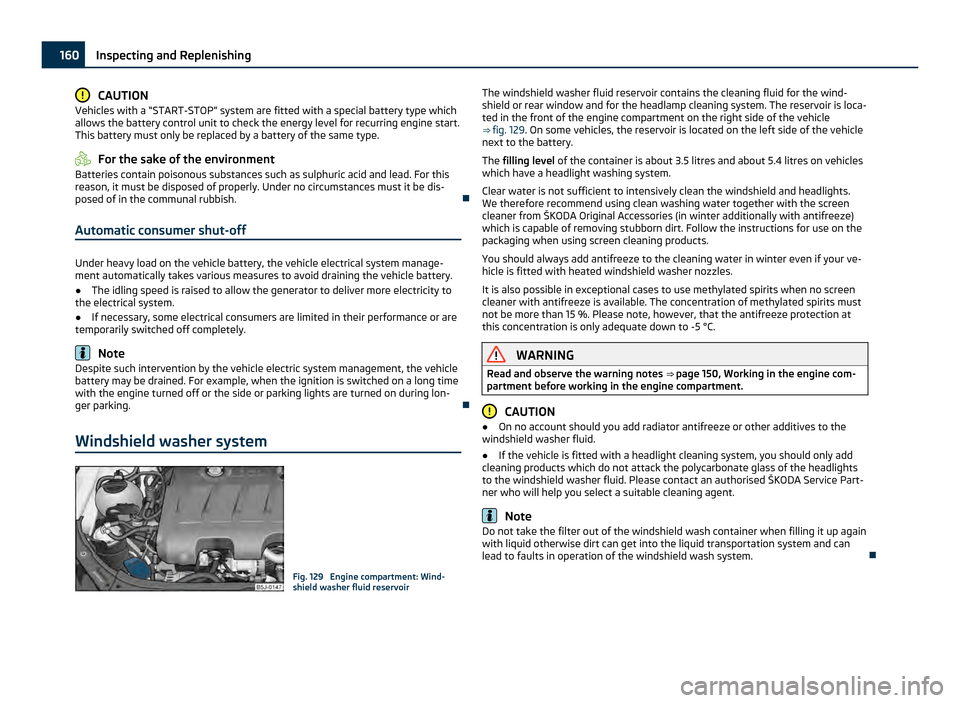
Windshield washer system Fig. 129 Engine compartment: Wind-
shield washer fluid reservoir The windshield washer fluid reservoir contains the cleaning fluid for the wind-
shield or rear window and for the headlamp cleaning system. The reservoir is loca-
ted in the front of the engine compartment on the right side of the vehicle
⇒ fig. 129
. On some vehicles, the reservoir is located on the left side of the vehicle
next to the battery.
The filling level of the container is about 3.5 litres and about 5.4 litres on vehicles
which have a headlight washing system.
Clear water is not sufficient to intensively clean the windshield and headlights.
We therefore recommend using clean washing water together with the screen
cleaner from
ŠKODA Original Accessories (in winter additionally with antifreeze)
which is capable of removing stubborn dirt. Follow the instructions for use on the
packaging when using screen cleaning products.
You should always add antifreeze to the cleaning water in winter even if your ve-
hicle is fitted with heated windshield washer nozzles.
It is also possible in exceptional cases to use methylated spirits when no screen
cleaner with antifreeze is available. The concentration of methylated spirits must
not be more than 15 %. Please note, however, that the antifreeze protection at
this concentration is only adequate down to -5 °C. WARNING
Read and observe the warning notes ⇒ page 150
, Working in the engine com-
partment before working in the engine compartment. CAUTION
● On no account should you add radiator antifreeze or other additives to the
windshield washer fluid.
● If the vehicle is fitted with a headlight cleaning system, you should only add
cleaning products which do not attack the polycarbonate glass of the headlights
to the windshield washer fluid. Please contact an authorised
ŠKODA Service Part-
ner who will help you select a suitable cleaning agent. Note
Do not take the filter out of the windshield wash container when filling it up again
with liquid otherwise dirt can get into the liquid transportation system and can
lead to faults in operation of the windshield wash system. 160
Inspecting and Replenishing
Page 164 of 212
Always check the inflation pressure of tyres when cold. Do not reduce the higher
pressure of warm tyres. Adapt the inflation pressure of the tyres accordingly if
your vehicle is carrying a significantly higher payload.
Tyre inflation pressure - Tyre size 185/55
R15
The same inflation pressure values apply to tyres of the tyre size 195/55 R15 as to
tyres of the tyre size 185/55 R15 which are intended to be used with snow chains,
see the inside of the fuel filler flap.
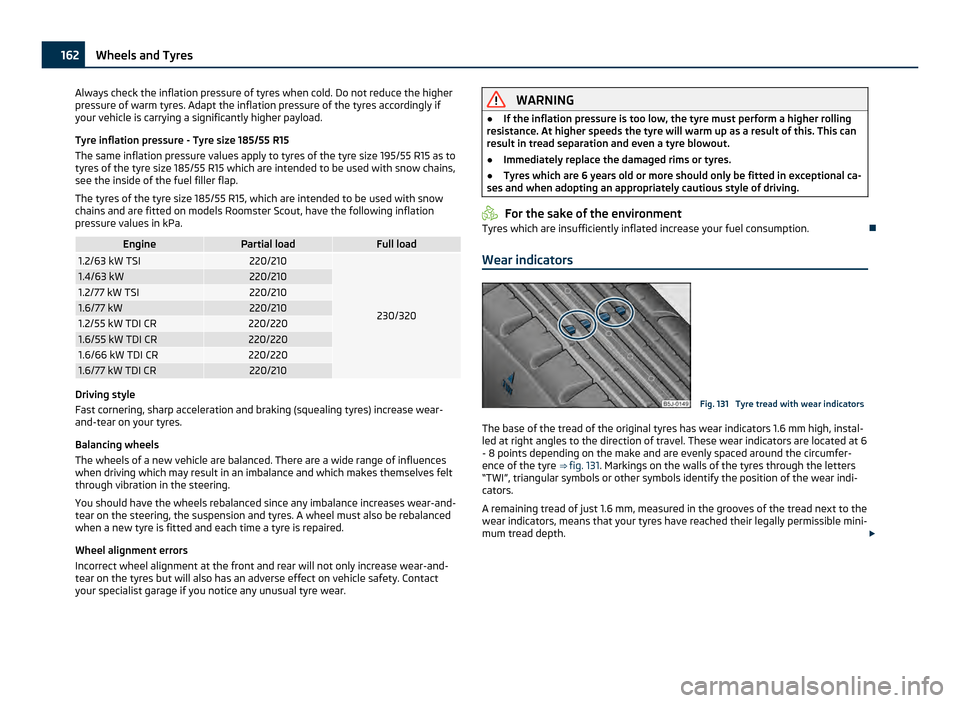
The tyres of the tyre size 185/55 R15, which are intended to be used with snow
chains and are fitted on models Roomster Scout, have the following inflation
pressure values in kPa. Engine Partial load Full load
1.2/63 kW TSI 220/210
230/3201.4/63 kW 220/210
1.2/77 kW TSI 220/210
1.6/77 kW 220/210
1.2/55 kW TDI CR 220/220
1.6/55 kW TDI CR 220/220
1.6/66 kW TDI CR 220/220
1.6/77 kW TDI CR 220/210
Driving style
Fast cornering, sharp acceleration and braking (squealing tyres) increase wear-
and-tear on your tyres.
Balancing wheels
The wheels of a new vehicle are balanced. There are a wide range of influences
when driving which may result in an imbalance and which makes themselves felt
through vibration in the steering.
You should have the wheels rebalanced since any imbalance increases wear-and-
tear on the steering, the suspension and tyres. A wheel must also be rebalanced
when a new tyre is fitted and each time a tyre is repaired.
Wheel alignment errors
Incorrect wheel alignment at the front and rear will not only increase wear-and-
tear on the tyres but will also has an adverse effect on vehicle safety. Contact
your specialist garage if you notice any unusual tyre wear. WARNING
● If the inflation pressure is too low, the tyre must perform a higher rolling
resistance. At higher speeds the tyre will warm up as a result of this. This can
result in tread separation and even a tyre blowout.
● Immediately replace the damaged rims or tyres.
● Tyres which are 6 years old or more should only be fitted in exceptional ca-
ses and when adopting an appropriately cautious style of driving. For the sake of the environment
Tyres which are insufficiently inflated increase your fuel consumption.
Wear indicators Fig. 131 Tyre tread with wear indicators
The base of the tread of the original tyres has wear indicators 1.6 mm high, instal-
led at right angles to the direction of travel. These wear indicators are located at 6
- 8 points depending on the make and are evenly spaced around the circumfer-
ence of the tyre ⇒ fig. 131. Markings on the walls of the tyres through the letters
“TWI”, triangular symbols or other symbols identify the position of the wear indi-
cators.
A remaining tread of just 1.6 mm, measured in the grooves of the tread next to the
wear indicators, means that your tyres have reached their legally permissible mini-
mum tread depth. £162
Wheels and Tyres
Page 171 of 212
WARNING
● If you find yourself in flowing traffic switch on the hazard warning lights
system and place the warning triangle on the side of the road at the prescri-
bed distance from your vehicle. Comply with the national legal regulations. In
this way you are protecting not only yourself but also other road users.
● Never start the engine with the vehicle sitting on the raised jack - danger
of suffering injury. CAUTION
If you have to change a wheel on a slope first block the opposite wheel with a
stone or similar object in order to secure the vehicle from unexpectedly rolling
away. Note
Comply with the national legal regulations.
Changing a wheel Always change a wheel on a level surface as far as possible.
–
Take off the full wheel trim ⇒ page 170 or the caps ⇒ page 170.
– Slacken the wheel bolts ⇒ page 170.
– Jack up the vehicle until the wheel to be changed is clear of the ground
⇒ page 171.
– Unscrew the wheel bolts and place them on a clean surface (cloth, paper, etc.).
– Take off the wheel.
– Fit on the spare wheel and tighten the wheel bolts slightly.
– Lower the car.
– Tighten the wheel bolts firmly, alternately and diagonally using the wrench
(crosswise) ⇒ page 170.
– Mount the full wheel trim/wheel trim cap or the caps. Note
● All bolts must be clean and must turn easily.
● You must never grease or oil the wheel bolts!
● When fitting on unidirectional tyres, ensure that the tyres rotate in the correct
direction ⇒ page 161
.
Subsequent steps After changing the wheel, you must perform the following steps.
–
Stow the vehicle tool kit in the space provided.
– Stow the replaced wheel in the luggage compartment.
– Check the tyre pressure on the spare wheel just mounted as soon as possible.
– Have the tightening torque of the wheel bolts checked with a torque wrench
as soon as possible. Steel and light alloy wheels must be tightened to a tight-
ening torque of 120
Nm.
– Change the damaged wheel or consult a specialist garage about possibilities
for getting repairs done. WARNING
It is necessary to observe the guidelines given on ⇒
page 163, New tyres and
wheels if the vehicle is subsequently fitted with tyres which are different to
those it was fitted with at the works. Note
● If you find, when changing the wheel, that the wheel bolts are corroded and
difficult to turn, the bolts must be replaced before checking the tightening torque.
● Drive cautiously and only at a moderate speed to a workshop where the tight-
ening torque can be checked. 169
Breakdown assistance Using the system Safety Driving Tips General Maintenance Breakdown assis-
tance Praktik Technical data
Page 176 of 212
–
Have all the occupants get out. While changing a tyre, the occupants of the
vehicle should not stand on the road (instead they should remain behind a
crash barrier, for example).
– Switch off the engine and engage 1st gear or if your vehicle is fitted with an
automatic gearbox, position the selector lever into position P .
– Apply the handbrake firmly.
– Check whether you can carry out the repairs with the tyre repair kit
⇒ page 172, General information.
– If a trailer is coupled, uncouple it.
– Remove the tyre repair kit from the luggage compartment.
– Stick the sticker 2
⇒
fig. 141 on the dash panel in view of the driver.
– Do not remove the foreign body, e.g. screw or nail, from the tyre.
– Unscrew the valve cap.
– Use the valve remover 1 to remove the valve core and place it down on a
clean surface.
Seal and inflate tyres Sealing tyres
–
Forcefully shake the tyre inflator bottle 10
⇒ fig. 141 several times.
– Firmly screw inflation hose 3 onto the tyre inflator bottle in a clockwise direc-
tion 10 . The film on the cap is pierced automatically.
– Remove the plug from the inflation hose 3 and plug the open end fully into
the tyre valve.
– Hold the bottle 10 with the floor facing upwards and fill the whole sealing
agent in the tyre inflator bottle into the tyres.
– Remove the empty tyre inflator bottle from the valve.
– Screw the valve core back into the tyre valve using the valve remover 1 .
Pumping up the tyres
– Screw the tyre inflation hose 5
⇒
fig. 141 of the air compressor firmly onto the
tyre valve.
– Check whether the air release valve 7 is closed.–
On vehicles fitted with a manual gearbox, move the gearshift lever into Neu-
tral.
– Start the engine and run it in idle.
– Plug the connector 9 into 12 Volt socket ⇒
page 64.
– Switch on the air compressor with the ON and OFF switch 8 .
– Allow the air compressor to run until reaching a pressure of 2.0 - 2.5 bar. Maxi-
mum run time of 8 minutes ⇒ !
– Switch off the air compressor with the ON and OFF switch.
– If you cannot reach an air pressure of 2.0 – 2.5 bar, unscrew the tyre inflation
hose 5 from the tyre valve.
– Drive the vehicle approx. 10 metres forwards or backwards to allow the sealing
agent to distribute in the tyre.
– Screw the tyre inflation hose of the air compressor 5 firmly back onto the
tyre valve and repeat the inflation procedure.
– If you cannot reach the required tyre inflation pressure here either, this means
the tyre has sustained too much damage. You cannot seal with tyre with the
breakdown kit ⇒ .
– Switch off the air compressor with the ON and OFF switch.
– Remove the tyre inflation hose 5 from the tyre valve.
After reaching a tyre inflation pressure of 2.0 – 2.5 bar, drive at a maximum speed
of 80 km/h (50
mph).
Check the tyre inflation pressure after driving 10 minutes ⇒ page 175, Check after
driving for 10 minutes. WARNING
● During inflation, the tyre inflation hose and air compressor may get hot-
risk of injury!
● Do not place hot tyre inflation hoses or hot air compressors on flammable
materials - risk of fire!
● If you cannot inflate the tyre to at least 2.0 bar, this means the damage
sustained was too serious. The sealing agent cannot be used to seal the tyre.
Do not drive the vehicle. Get professional assistance. £174
Breakdown assistance
Page 177 of 212
CAUTION
Switch off the air compressor after running 8 minutes at the latest - danger of
overheating! Allow the air compressor to cool a few moments before switching it
on again.
Check after driving for 10 minutes Check the tyre inflation pressure after driving 10 minutes.
If the tyre inflation pressure is 1.3 bar or less:
–
Do not drive the vehicle! You cannot properly seal with tyre with the break-
down kit.
– Contact a Škoda dealer to obtain professional assistance.
If the tyre inflation pressure is 1.3 bar or more:
– Adjust the tyre inflation pressure to the correct value (see inside of fuel filler
cap).
– Continue driving carefully to the nearest specialist garage at a maximum
speed of 80 km/h (50 mph).
Jump-starting Initial steps You can use the battery of another vehicle for jump-starting yours if the engine
does not start because the battery on your vehicle is flat. You will require jump-
start cables for this purpose.
Both batteries must have a rated voltage of 12 V. The capacity
(Ah) of the battery
supplying the power must not be significantly less than the capacity of the dis-
charged battery in your vehicle.
Jump-start cables
Only use jump-start cables which have an adequately large cross-section and in-
sulated terminal clamps. Please pay attention to the manufacturer's instructions.
Positive cable - colour coding in the majority of cases red.
Negative cable -
colour coding in the majority of cases black. WARNING
● A discharged battery may already freeze at temperatures just below 0 °C.
In case of frozen battery carry out no jump-starting - risk of explosion! Also af-
ter thawing of the battery there is a risk of caustic burns due to leaking acid.
Replace the frozen battery.
● Please pay attention to the warning instructions relating to working in the
engine compartment ⇒ page 150
. Note
● There must not be any contact between the two vehicles otherwise current
may flow as soon as the negative terminals are connected.
● The discharged battery must be properly connected to the system of the vehi-
cle.
● Switch off the car phone. Heed the advice concerning the use of mobile
phones in such a situation.
● We recommend you buy jump-start cables from a car battery specialist.
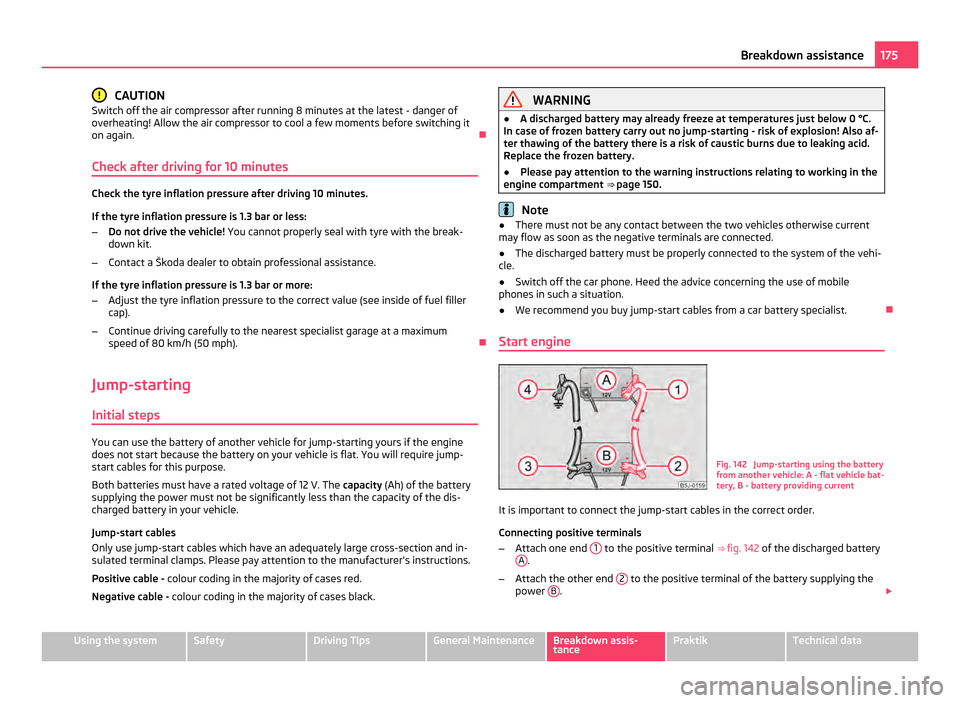
Start engine Fig. 142 Jump-starting using the battery
from another vehicle: A - flat vehicle bat-
tery, B - battery providing current
It is important to connect the jump-start cables in the correct order.
Connecting positive terminals
– Attach one end 1 to the positive terminal
⇒ fig. 142 of the discharged battery
A .
– Attach the other end 2 to the positive terminal of the battery supplying the
power B .
£ 175
Breakdown assistance Using the system Safety Driving Tips General Maintenance Breakdown assis-
tance Praktik Technical data
Page 181 of 212
Fuses and light bulbs
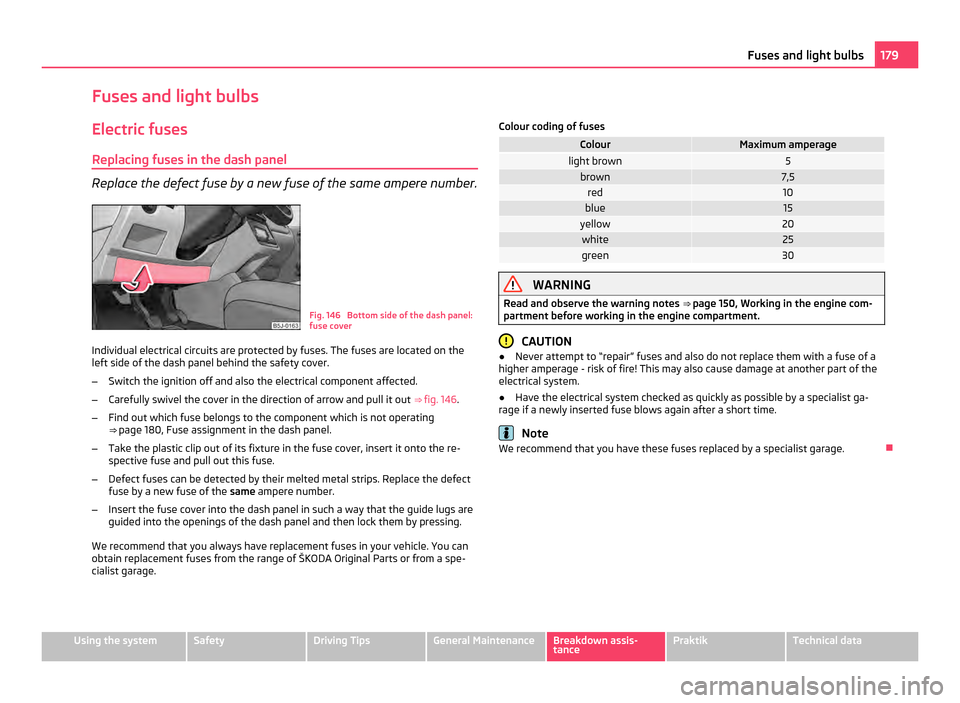
Electric fuses Replacing fuses in the dash panel Replace the defect fuse by a new fuse of the same ampere number.
Fig. 146 Bottom side of the dash panel:
fuse cover
Individual electrical circuits are protected by fuses. The fuses are located on the
left side of the dash panel behind the safety cover.
– Switch the ignition off and also the electrical component affected.
– Carefully swivel the cover in the direction of arrow and pull it out ⇒ fig. 146 .
– Find out which fuse belongs to the component which is not operating
⇒ page 180
, Fuse assignment in the dash panel.
– Take the plastic clip out of its fixture in the fuse cover, insert it onto the re-
spective fuse and pull out this fuse.
– Defect fuses can be detected by their melted metal strips. Replace the defect
fuse by a new fuse of the same ampere number.
– Insert the fuse cover into the dash panel in such a way that the guide lugs are
guided into the openings of the dash panel and then lock them by pressing.
We recommend that you always have replacement fuses in your vehicle. You can
obtain replacement fuses from the range of
ŠKODA Original Parts or from a spe-
cialist garage. Colour coding of fuses Colour Maximum amperage
light brown 5
brown 7,5
red 10
blue 15
yellow 20
white 25
green 30
WARNING
Read and observe the warning notes ⇒ page 150
, Working in the engine com-
partment before working in the engine compartment. CAUTION
● Never attempt to
“repair” fuses and also do not replace them with a fuse of a
higher amperage - risk of fire! This may also cause damage at another part of the
electrical system.
● Have the electrical system checked as quickly as possible by a specialist ga-
rage if a newly inserted fuse blows again after a short time. Note
We recommend that you have these fuses replaced by a specialist garage. 179
Fuses and light bulbs Using the system Safety Driving Tips General Maintenance Breakdown assis-
tance Praktik Technical data
Page 183 of 212
No. Power consumer
43 Horn
44 Front window wiper
45 Central control unit for convenience system
46 Engine control unit
Engine control unit
Fuel pump relay
Fuel pump control unit
47 Cigarette lighter, power socket in the luggage compartment
a)48 ABS, START-STOP - DC/DC converter ESP
49 Turn signal lights, brake lights
50 START-STOP - DC/DC converter infotainment
Radio
51 Electrical power window (front and rear) - left side
52 Electrical power window (front and rear) - right side
53 Parking light - left side
Electric sliding/tilting roof
54 START-STOP - instrument cluster
Anti-theft alarm system
55 Control unit for automatic gearbox DSG
56 Headlight cleaning system
Parking light - right side
57 Left low beam, headlight range adjustment
58 Low beam on the right
a)
If the engine is switched off already one electrical component which is connected can discharge the
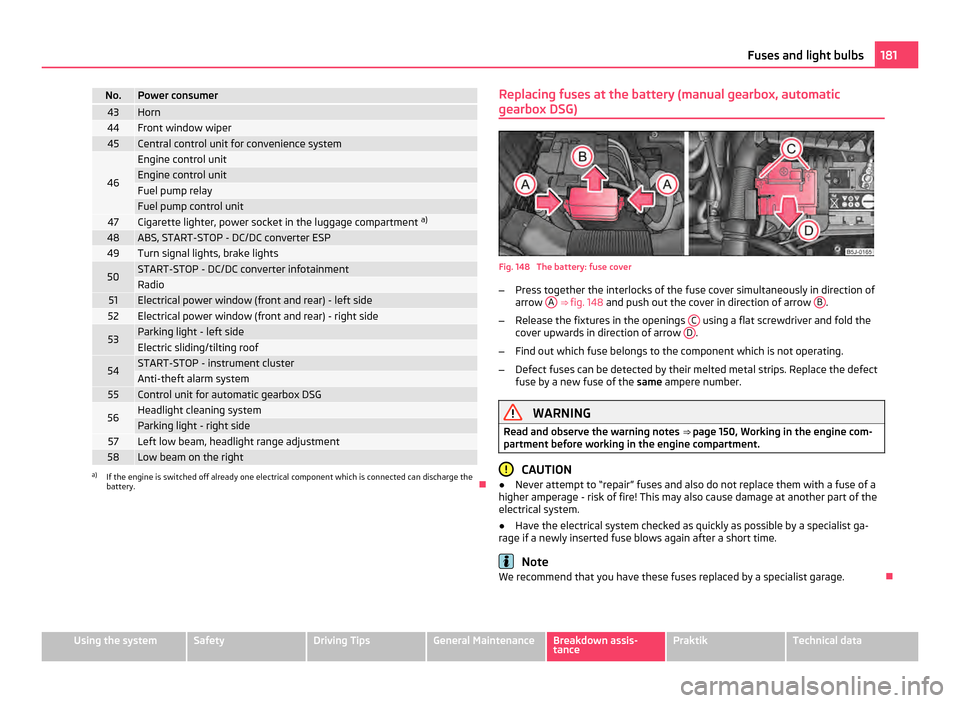
battery. Replacing fuses at the battery (manual gearbox, automatic
gearbox DSG) Fig. 148 The battery: fuse cover
– Press together the interlocks of the fuse cover simultaneously in direction of
arrow A
⇒ fig. 148 and push out the cover in direction of arrow B .
– Release the fixtures in the openings C using a flat screwdriver and fold the
cover upwards in direction of arrow D .
– Find out which fuse belongs to the component which is not operating.
– Defect fuses can be detected by their melted metal strips. Replace the defect
fuse by a new fuse of the same ampere number. WARNING
Read and observe the warning notes ⇒ page 150 , Working in the engine com-
partment before working in the engine compartment. CAUTION
● Never attempt to
“repair” fuses and also do not replace them with a fuse of a
higher amperage - risk of fire! This may also cause damage at another part of the
electrical system.
● Have the electrical system checked as quickly as possible by a specialist ga-
rage if a newly inserted fuse blows again after a short time. Note
We recommend that you have these fuses replaced by a specialist garage. 181
Fuses and light bulbs Using the system Safety Driving Tips General Maintenance Breakdown assis-
tance Praktik Technical data