child seat SKODA SUPERB 2005 1.G / (B5/3U) User Guide
[x] Cancel search | Manufacturer: SKODA, Model Year: 2005, Model line: SUPERB, Model: SKODA SUPERB 2005 1.G / (B5/3U)Pages: 281
Page 158 of 281

Seat belts157
Using the systemSafetyDriving TipsGeneral MaintenanceBreakdown assistanceTechnical Data
Important safety information regarding
the use of seat belts
The correct use of the seat belts considerably reduces the
risk of injury!
WARNING
•The belt webbing must not be jammed in-between at any point
or twisted, or chafe against any sharp edges.
•It is important that the belt webb ing is properly routed if the seat
belts are to offer their maximum protection ⇒page 158, “How are
seat belts correctly fastened?”.
•No two persons (also not children) should ever use a single seat
belt together.
•The maximum protection which seat belts can offer is only
achieved if you are correctly seated ⇒page 151, “Correct seated
position”.
•The belt webbing must not run across solid or fragile objects
(e.g. spectacles, ball-point pens, keys etc.) as this may be a cause
of injuries.
•Bulky, loose clothing (e.g. a winter coat over a jacket) does not
allow you to be correctly seated and impairs proper operation of
the seat belts.
•It is prohibited to use clamps or other objects to adjust seat
belts (e.g. for shortening the belts for smaller persons).
•The lock tongue should only be inserted into the lock which is
the correct one for your seat. Wrong use of the safety belt will
reduce its capacity to protect and the risk of injury increases.
•The backrests of the front seats must not be tilted too far to the
rear otherwise the seatbelts can lose their effectiveness.
•The belt webbing must always be kept clean. Soiled belt
webbing may impair proper operation of the inertia reel
⇒ page 213, “Seat belts”.
•The slot of the belt tongue must not be blocked by paper or
similar objects otherwise the belt tongue will not lock in place prop-
erly.
•Inspect the seat belts regularly to ensure they are in good condi-
tion. If you find seat belts which have damage to the seat belt
webbing, seat belt connections, to the inertia reels or to the lock,
the relevant safety belt must be replaced by a specialist garage.
•The seat belts must not be removed or changed in any way. Do
not make an attempt to repair the seat belts yourself.
•Damaged seat belts which have been subjected to stress in an
accident and were therefore stretched, must be replaced - this is
best done by a specialist garage. The anchorage points of the belts
must also be inspected. The anchorage points for the belts should
also be checked.
•In certain countries it is possible to use seat belts which differ
in terms of their operation from the seat belts which are described
on the pages which follow.
WARNING (continued)
s3ec.book Seite 157 Montag, 2. Mai 2005 3:42 15
Page 161 of 281

Seat belts
160
– Press the red button in the belt lock ⇒fig. 140. The spring
force causes the tongue of the lock to jump out.
– Guide the belt back with your hand to enable the inertia reel to wind up the belt webbing more easily.
A plastic knob in the belt webbing holds the belt tongue in a position which
is easy to get hold of.
Three-point safety belt for the middle rear seat
Your car is equipped as standard with the three-point seat belt in the
middle rear seat. It is used in the same way as the three-point seat belts
on the left and right (at front and rear). The three-point seat belt for the rear
middle seat must be put on first to allow the pelvic part of the belt to run
between the belt lock for the right three-point seat belt and the backrest,
while avoiding crossing the belt webbing of the right and middle seat belts.
WARNING
The three-point safety belt for the rear middle seat can only fulfil its
function reliably when the backrests are correctly locked into posi-
tion ⇒page 86.
Blocking seat belts
The three-point seat belts for the front passenger and for the rear seats
can be blocked for attaching a child safety seat ⇒page 181, “Attaching
child safety seat”. Blocking the belt in this way ensures that the child seat
is held firmly in position in the car.
WARNING
Never attach a child safety seat on the front passenger seat if the
child is seated with its back facing in direction of travel when the
front passenger airbag is still activated ⇒page 176, “Use of child
safety seats on the front passenger seat”. Risk of severe or even
fatal injuries!
Belt tensioners
Safety for the driver and passengers wearing their seat belts, is
enhanced by the belt tensioners fitted to the inertia reels of the front and
rear side three-point seat belts, in addition to the protection afforded by
the airbag system.
The fastened three-point seat belts are automatically tensioned in the
event of a frontal collision of a certain severity. The rear outside belt
tensioners are also deployed if the seat belt is not fastened.
The belt tensioner is deployed in the event of a frontal collision of major
severity. A powder charge is ignited in the inertia reels during deployment.
The belt webbing is pulled into the inertia reels by a mechanical system
and the belt is tensioned.
Belt tensioners are not activated in the event of minor frontal collisions,
side and rear-end collisions, in the case of a rollover and also not in acci-
dents in which no major forces are produced from the front.
WARNING
•The service life of seat belts and belt tensioners is 15 years from
the date of manufacture of the vehicle. It is then necessary to have
the seat belts replaced by a specialist garage.
s3ec.book Seite 160 Montag, 2. Mai 2005 3:42 15
Page 167 of 281

Airbag system
166
Important safety informat ion regarding the front
airbag system
Correct use of the airbag system considerably reduces the
risk of injury!
WARNING
•Never transport children on the front seat of a vehicle without
using a proper restraint system. If airbags are deployed in the event
of an accident, the child might suff er severe or even fatal injuries!
•For the driver and front passenger it is important to maintain a
distance of at least 25 cm from the steering wheel or dash panel
⇒ fig. 144 . Not maintaining this minimu m distance will mean that
the airbag system will not be able to properly protect you - hazard!
The front seats and the head restraints must always also be
correctly adjusted to match the body size of the occupant.
•It is essential to always switch off ⇒page 171, “Deactivating an
airbag” the front passenger airbag when attaching a child safety seat on the front passenger seat where the child is seated with its
back facing in direction of travel (in some countries also when the
child is facing the direction of travel). If this is not done, there is a
risk of the child suffering severe or
even fatal injuries if the front
passenger airbag is deployed. In certain countries national legal
provisions also require that the side or head passenger airbags be
deactivated. When transporting a child on the front passenger seat,
please comply with the appropriat e national regulations regarding
the use of child safety seats.
•There must not by any further persons, animals or objects posi-
tioned between the front seated occupants and the deployment
area of the airbag.
•The steering wheel and the surface of the airbag module in the
dash panel on the passenger side must not be stuck onto, covered
or modified in any other way. Th ese parts should only be cleaned
with a dry cloth or a cloth moistened with water. No objects such
as cup holders, mobile phone mounts, etc. may be attached to the
covers of the airbag modules or be located within the immediate
area.
•No modifications of any kind may be made to parts of the airbag
system. Any work on the airbag system including installing and
removing system components because of other repair work (e.g.
removing the steering wheel) must only be carried out by a
specialist garage.
•Never carry out changes on the front bumper or on the body.
•Never place any objects on the surface of the front passenger
airbag in the dash panel.
Fig. 144 Safe distance
to steering wheel
WARNING (continued)
s3ec.book Seite 166 Montag, 2. Mai 2005 3:42 15
Page 169 of 281

Airbag system
168
In certain accident situations both the front airbags as well as the head
and side airbags may be deployed together.
If an airbag is deployed, the airbag is filled with propellant gas. The
airbags inflate in fractions of a second and at a high speed in order to be
able to offer that additional protection in the event of an accident.
A grey white, non harmful gas is released when airbag is inflated. This is
perfectly normal and is not an indication of a fire in the vehicle.
The load of the occupants is cushioned when plunging into the fully
inflated airbag and the risk of injury to the entire upper body (chest,
stomach and pelvis) is reduced on the side facing the door.
Important safety information on the side airbag
Correct use of the airbag system considerably reduces the
risk of injury!
WARNING
•It is essential to always switch off ⇒page 171, “Deactivating an
airbag” the front passenger airbag when attaching a child safety
seat on the front passenger seat where the child is seated with its
back facing in direction of travel (in some countries also when the
child is facing the direction of travel). If this is not done, there is a
risk of the child suffering severe or even fatal injuries if the front
passenger airbag is deployed. In certain countries national legal
provisions also require that the side or head passenger airbags be
deactivated. When transporting a child on the front passenger seat,
please comply with the appropriate national regulations regarding
the use of child safety seats.
•Your head should never be positioned in the deployment area of
the side airbag. You might suffer severe injuries in the event of an accident. This applies in particular to children who are transported
without using a suitable child safety seat
⇒page 177, “Child safety
and side airbags”.
•If children adopt an incorrect seated position when travelling,
they may be exposed to an increased risk of injury in the event of
an accident. This can result in serious injuries ⇒page 174, “What
you should know about transporting children!”.
•There must not be any further persons, animals as well as
objects positioned between the occupants and the deployment
area of the airbag. There must also be no accessories such as cup
holders, attached to the doors to enable the side airbags to activate
properly.
•Only hang light items of clothing on the clothes hooks to the
vehicle. Never leave any heavy or sharp-edged objects in the
pockets of the items of clothing.
•Ensure that there are no excessive forces, such as violent
knocks, kicks etc., impact on the backrests of the seats otherwise
the system may be damaged. The side airbags would not be
deployed in such a case!
•Any seat or protective covers which you fit to the driver or front
passenger seats must only be of the type expressly authorized by
Škoda Auto. In view of the fact th at the airbag inflates out of the
backrest of the seat, use of non-approved seat or protective covers
would considerably impair the protective function of the side
airbag.
•Any damage to the original seat covers in the area of the side
airbag module must be repaired without delay by your specialist
garage.
•The airbag modules in the front seats must not display any
damage, cracks or deep scratches. It is not permissible to use force
in order to open the modules.
WARNING (continued)
s3ec.book Seite 168 Montag, 2. Mai 2005 3:42 15
Page 171 of 281
Airbag system
170
Function of the head airbags
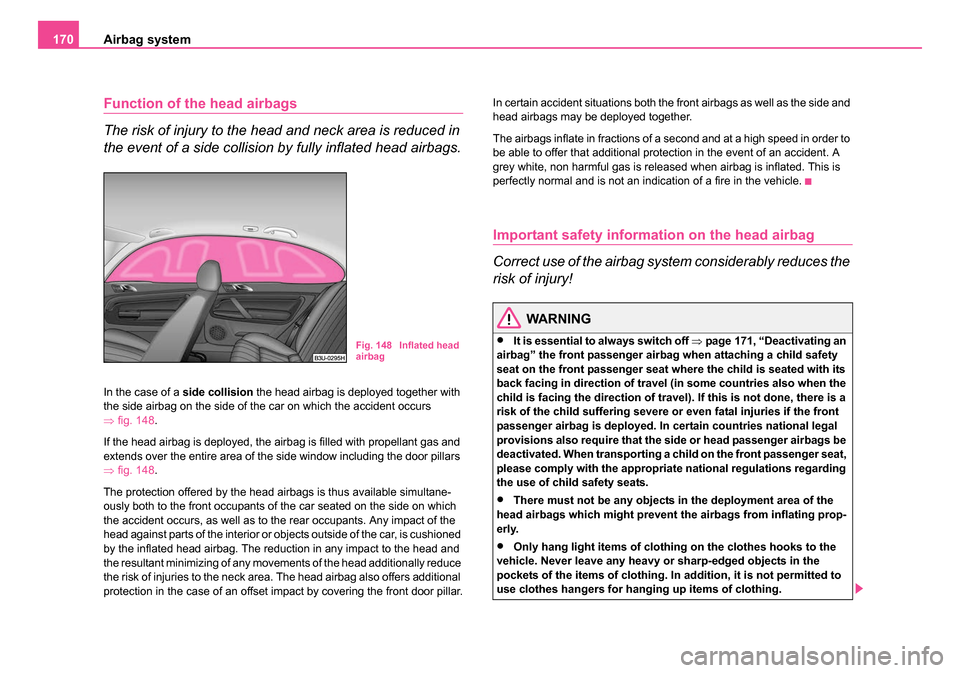
The risk of injury to the head and neck area is reduced in
the event of a side collision by fully inflated head airbags.
In the case of a side collision the head airbag is deployed together with
the side airbag on the side of the car on which the accident occurs
⇒ fig. 148 .
If the head airbag is deployed, the airbag is filled with propellant gas and
extends over the entire area of the side window including the door pillars
⇒ fig. 148 .
The protection offered by the head airbags is thus available simultane-
ously both to the front occupants of the car seated on the side on which
the accident occurs, as well as to the rear occupants. Any impact of the
head against parts of the interior or objects outside of the car, is cushioned
by the inflated head airbag. The reduction in any impact to the head and
the resultant minimizing of any movements of the head additionally reduce
the risk of injuries to the neck area. The head airbag also offers additional
protection in the case of an offset impact by covering the front door pillar. In certain accident situations both the front airbags as well as the side and
head airbags may be deployed together.
The airbags inflate in fractions of a second and at a high speed in order to
be able to offer that additional protection in the event of an accident. A
grey white, non harmful gas is released when airbag is inflated. This is
perfectly normal and is not an indication of a fire in the vehicle.
Important safety informat
ion on the head airbag
Correct use of the airbag system considerably reduces the
risk of injury!
WARNING
•It is essential to always switch off ⇒page 171, “Deactivating an
airbag” the front passenger airbag when attaching a child safety
seat on the front passenger seat where the child is seated with its
back facing in direction of travel (in some countries also when the
child is facing the direction of travel). If this is not done, there is a
risk of the child suffering severe or even fatal injuries if the front
passenger airbag is deployed. In certain countries national legal
provisions also require that the side or head passenger airbags be
deactivated. When transporting a child on the front passenger seat,
please comply with the appropriat e national regulations regarding
the use of child safety seats.
•There must not be any objects in the deployment area of the
head airbags which might prevent the airbags from inflating prop-
erly.
•Only hang light items of clothing on the clothes hooks to the
vehicle. Never leave any heavy or sharp-edged objects in the
pockets of the items of clothing. In addition, it is not permitted to
use clothes hangers for hanging up items of clothing.
Fig. 148 Inflated head
airbag
s3ec.book Seite 170 Montag, 2. Mai 2005 3:42 15
Page 172 of 281

Airbag system171
Using the systemSafetyDriving TipsGeneral MaintenanceBreakdown assistanceTechnical Data
•There must not be any other persons (e.g. children) or animals
between the car occupant and the deployment area of the head
airbag. In addition, none of the occupants should lean their head
out of the window when driving, or extend their arms and hands out
of the window.
•The sun visors must not be swivelled to the side windows into
the deployment area of the head airbags if any objects, such as
ball-point pens etc. are attached to them. This might result in inju-
ries to the occupants if the head airbag is deployed.
•Installing impermissible accessories in the area of the head
airbags may considerably impair the protection offered by the head
airbag in the event of it being deployed. When the deployed head
airbag is inflated, parts of the accessories fitted may in certain
circumstances be thrown into the interior of the car and cause inju-
ries to the occupants ⇒ page 243, “Accessories, changes and
replacement of parts”.
•Any work on the head airbag system including installing and
removing system components because of other repair work (e.g.
removing headliner) must only be carried out by a specialist
garage.
Deactivating an airbag
Deactivating airbags
If any airbags have been deactivated, switch them on
again as soon as possible so that they are able to again
provide their proper protection.
There is the technical means installed within your vehicle to switch off the
front, side or head airbag (take out of commission).
This is why you should have the deactivation of the airbags carried out by
a specialist garage.
On vehicles equipped with the switch for deactivation of the airbags, you
can deactivate the front and side passenger airbag by means of this
switch ⇒page 172.
Deactivation of airbags is envisaged only for particular instances,
such as if:
•you must in exceptional cases use a child seat on the front
passenger seat where the child has its back to the direction of travel of the
vehicle (in some countries this must be in the direction of travel due to
other legal regulations applying) ⇒page 174, “Important safety informa-
tion on using child safety seats”
•you are not able to maintain the distance of at least 25 cm between
middle of steering wheel and chest, despite the driver seat being correctly
adjusted,
•special attachments are required in the area of the steering wheel
because of a physical disability,
•you have installed other seats (e.g. orthopaedic seats without side
airbags).
WARNING (continued)
s3ec.book Seite 171 Montag, 2. Mai 2005 3:42 15
Page 175 of 281

Transporting children safely
174
Transporting children safely
What you should know about
transporting children!
An introduction to the subject
Accident statistics have revealed that children are gener-
ally more safely transported on the rear seats than on the
front passenger seat.
Children younger than 12 years of age should normally travel on the rear
seat of the vehicle (take note of any national legal provisions which differ
from this). They should be secured there by means of a child restraint
system or by using the existing seat belts depending on their age, body
size and weight. The child seat should be mounted behind the front
passenger seat for safety reasons.
The physical principle of an accident does, of course, also apply to chil-
dren ⇒page 156, “The physical principle of a frontal collision”. They differ
from adults in that their muscles and bone structure of children are not yet
fully developed. Thus children are exposed to increased risk of injury.
Children should be transported by using special child safety seats in order
to reduce this risk of injury.
Use only child safety seats which are officially approved and are suitable
for children and which comply with the ECE-R 44 Standard, which classi-
fies child safety seats into 5 groups ⇒page 178, “Classification of child
seats into groups”. Child restraint systems which have been tested for
conformity with ECE-R 44 have a non-detachable test seal (a large E
within a circle and below this the test number) attached to the seat. We recommend that you use child safety seats from the Škoda genuine
accessories. These child seats were developed and also tested for use in
Škoda vehicles. They fulfil the standard ECE-R 44.
WARNING
Always comply with national le
gal provisions and instructions
from the relevant child safety seat manufacturer when installing
and using a child seat ⇒ in “Important safety information on
using child safety seats”.
Note
Any national legal provisions which vary from the information contained in
this Owner's Manual take precedence over the information contained
herein.
Important safety informat ion on using child safety
seats
Correct use of child safety seats considerably reduces the
risk of injury!
WARNING
•All the occupants of the car - in particular children - must wear
a seat belt when the car is moving!
•Children less than 1.50 m in height or younger than 12 years
must not use a normal seat belt without a child restraint system
s3ec.book Seite 174 Montag, 2. Mai 2005 3:42 15
Page 176 of 281

Transporting children safely 175
Using the systemSafetyDriving TipsGeneral MaintenanceBreakdown assistanceTechnical Data
otherwise this may result in injuries to the stomach and neck areas.
Comply with the national legal requirements.
•One should never carry children, and also not babies! - on one's
lap.
•You can transport a child safely in a suitable child safety seat
⇒ page 178, “Child seat”!
•Only one child may be fastened with a seat belt into a child
safety seat.
•Never leave the child sitting unattended in the seat.
•Certain outside climatic conditions can cause life-threatening
temperatures in the vehicle.
•Never allow your child to be tran sported in a vehicle without the
use of a suitable restraint system.
•Children should also never stand up in a vehicle or kneel on the
seats when the vehicle is moving. In the event of an accident the
child will be thrown through the vehicle and may as a result suffer
fatal injuries, and also injure other occupants.
•Children are exposed to an increased risk of injury in the event
of an accident if they lean forward or adopt an incorrect seated
position when the vehicle is moving . This particularly applies to
children who are transported on the front passenger seat if the
airbag system deploys in the event of an accident. This can result
in severe or even fatal injuries.
•It is important that the belt webb ing is properly routed if the seat
belts are to offer their maximum protection ⇒page 158, “How are
seat belts correctly fastened?”. Pay particular attention to the
information provided by the manufacturer of the child safety seat
regarding correct routing of the belt. Seat belts which are not
correctly adjusted can themselves cause injuries even in minor
accidents.
•Safety belts must be checked to ensure that they are running
properly. One should also ensure that the belt is not damaged by
sharp-edged fittings.
•It is essential to always switch off ⇒page 171 the front
passenger airbag when attaching a child safety seat on the front
passenger seat where the child is seated with its back facing in
direction of travel (in some countries also when the child is facing
the direction of travel). If this is not done, there is a risk of the child
suffering severe or even fatal injuries if the front passenger airbag
is deployed. In certain countries national legal provisions also
require that the side or head passenger airbags be deactivated.
When transporting a child on the front passenger seat, please
comply with the appropriate national regulations regarding the use
of child safety seats.
WARNING (continued)WARNING (continued)
s3ec.book Seite 175 Montag, 2. Mai 2005 3:42 15
Page 177 of 281

Transporting children safely
176
Use of child safety seats on the front passenger seat
Child safety seats should always be attached to the rear
seats.
We recommend, for safety reasons, that you always mount a child
restraint systems on the rear seats whenever possible. If you still decide,
however, to use a child safety seat on the front passenger seat then you
must pay attention to the following warnings in connection with the use of
the airbag system on the front passenger seat.
WARNING
•Warning - particular hazard! Never use a child safety seat on the
front passenger seat in which the child is seated with its back
facing the direction of travel. This child safety seat is positioned in
the deployment area of the front passenger airbag. The airbag may
cause the child severe, or even fatal injuries, in the event of it being
deployed.
•This is also clearly stated on the sticker which is located on the
centre column of the body on the front passenger side ⇒page 176,
fig. 151 . The sticker is visible upon opening the front passenger
door. The next warning sticker is located on the windscreen near
the front passenger seat.
•It is essential to always switch off ⇒page 171, “Deactivating an
airbag” the front passenger airbag when attaching a child safety
seat on the front passenger seat where the child is seated with its
back facing in direction of travel (in some countries also when the
child is facing the direction of travel). If this is not done, there is a
risk of the child suffering severe or even fatal injuries if the front
passenger airbag is deployed. In certain countries national legal
provisions also require that the side or head passenger airbags be
deactivated. When transporting a child on the front passenger seat,
please comply with the appropriat e national regulations regarding
the use of child safety seats.
•If the front passenger airbag has been switched off by a
specialist garage using the vehicle system tester, the side and
head passenger airbag* remains switched on. In certain countries
national legal provisions require that besides the front passenger
airbag also the side or head passenger airbags are deactivated.
Please comply with any differ ing national legal regulations
regarding the use of child safety seats.
•If a child safety seat in which the child faces in the direction of
travel is used on the front passenger seat, the front passenger seat
must be moved back fully. For vehicles with height adjustable
front passenger seat, the seat must additionally be set to the
highest position.
•You should have the front passenger airbag (or airbags) reacti-
vated just as soon as you no longer use a child safety seat on the
front passenger seat.
Fig. 151 Sticker on the
centre column of the
body on the front
passenger side.
WARNING (continued)
s3ec.book Seite 176 Montag, 2. Mai 2005 3:42 15
Page 178 of 281

Transporting children safely 177
Using the systemSafetyDriving TipsGeneral MaintenanceBreakdown assistanceTechnical Data
Child safety and side airbags
Children must never be seated in the deployment area of
the side airbags and head airbags.In the event of a side collision, the side airbags offer the vehicle occupants
enhanced protection.
The side airbags are inflated in fractions of a second in order to be able to
provide this protection ⇒page 167, “Function of the side airbags”.
An airbag inflating develops such a strong force that an occupant who has
not adopted a correct seated position may suffer injuries. Also exposed
objects which are located within the area of the side airbag can cause inju-
ries.
This applies particularly to children if they are not transported in
accordance with legal requirements.
The child is protected when seated in a child safety seat matching its age.
Adequate room is available between the child and the deployment area of
the side airbag and head airbag. The airbag offers optimal protection.
WARNING
•It is essential to always switch off ⇒page 171 the front
passenger airbag when attaching a child safety seat on the front
passenger seat where the child is seated with its back facing in
direction of travel (in some countries also when the child is facing
the direction of travel). If this is not done, there is a risk of the child
suffering severe or even fatal injuries if the front passenger airbag
is deployed. In certain countries national legal provisions also
require that the side or head passenger airbags be deactivated.
When transporting a child on the front passenger seat, please
comply with the appropriate national regulations regarding the use
of child safety seats.
•When transporting a child on the front passenger seat, please
comply with the appropriate national regulations regarding the use
of child safety seats.
•Children must never be seated with their head in the deploy-
ment area of the side airbag - risk of injury!
Fig. 152 Seated posi-
tion of an unprotected
child at risk from side
airbag
Fig. 153 Child properly
protected by safety
seat
s3ec.book Seite 177 Montag, 2. Mai 2005 3:42 15