wheel SKODA SUPERB 2007 1.G / (B5/3U) Owner's Guide
[x] Cancel search | Manufacturer: SKODA, Model Year: 2007, Model line: SUPERB, Model: SKODA SUPERB 2007 1.G / (B5/3U)Pages: 259, PDF Size: 14.71 MB
Page 119 of 259
Communicating and Navigating
118
Note
•If the setting of the memory is changed, you must take the mobile phone out of
the adapter and insert it again in order to transmit the data from the newly set
memory into the information display.
•If you do not operate the mobile phone (do not scroll in the memory, do no call,
etc.) it switches automatically ov er to radio mode after 60 seconds.
•If you switch the ignition off and leave the mobile phone inserted in the adapter,
the system switches off automaticall y the mobile phone after 30 minutes.
•If you have stored in the phonebook name s with special characters (ticks, lines
etc.), the special characters will not alwa ys be correctly displayed on the informa-
tion display.
•The function of the convenience operating feature with the buttons on the
multifunction steering wheel is not available on all mobile phones and adapters.
Please contact your Škoda Service Partner, who will tell you which adapter and
which mobile phone you can use.
CD changer*
Take out and insert CD magazine
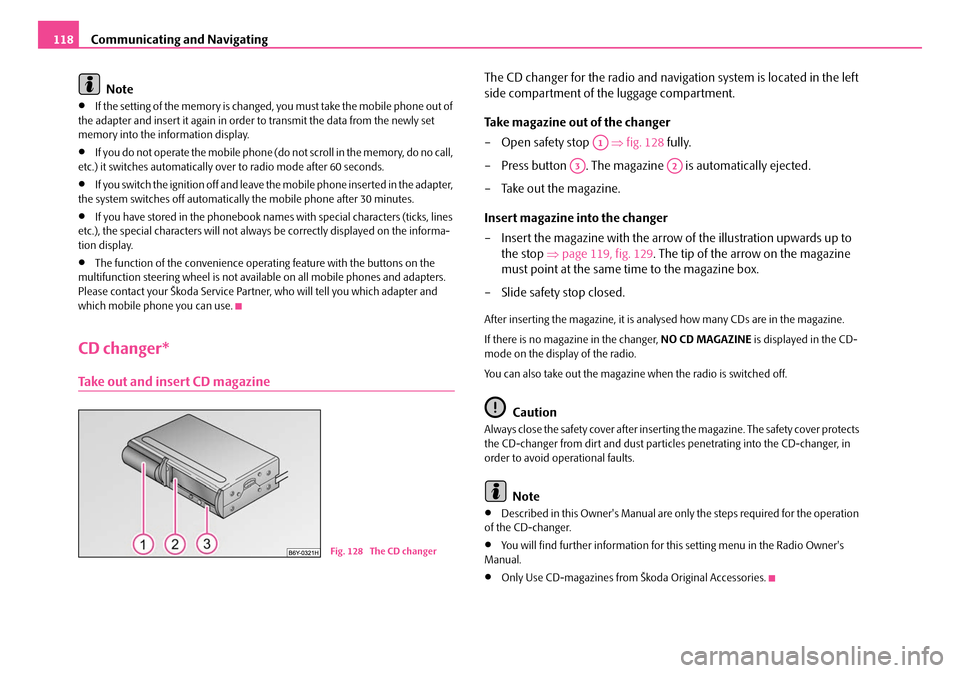
The CD changer for the radio and navigation system is located in the left
side compartment of the luggage compartment.
Take magazine out of the changer
– Open safety stop ⇒fig. 128 fully.
– Press button . The magazine is automatically ejected.
– Take out the magazine.
Insert magazine into the changer
– Insert the magazine with the arrow of the illustration upwards up to the stop ⇒page 119, fig. 129 . The tip of the arrow on the magazine
must point at the same time to the magazine box.
– Slide safety stop closed.
After inserting the magazine, it is analysed how many CDs are in the magazine.
If there is no magazine in the changer, NO CD MAGAZINE is displayed in the CD-
mode on the display of the radio.
You can also take out the magazine when the radio is switched off.
Caution
Always close the safety cover after insertin g the magazine. The safety cover protects
the CD-changer from dirt and dust partic les penetrating into the CD-changer, in
order to avoid operational faults.
Note
•Described in this Owner's Manual are only the steps required for the operation
of the CD-changer.
•You will find further information for this setting menu in the Radio Owner's
Manual.
•Only Use CD-magazines from Škoda Original Accessories.
Fig. 128 The CD changer
A1
A3A2
NKO B5 20.book Page 118 Friday, March 2, 2007 1:46 PM
Page 128 of 259
Passive Safety127
Using the systemSafetyDriving TipsGeneral MaintenanceBreakdown assistanceTechnical Data
Correct seated position
Correct seated position for the driver
Correct seated position for the driver is important for safe and
relaxed driving.
For your own safety and to reduce the risk of injury in the event of an accident, we
recommend the following setting.
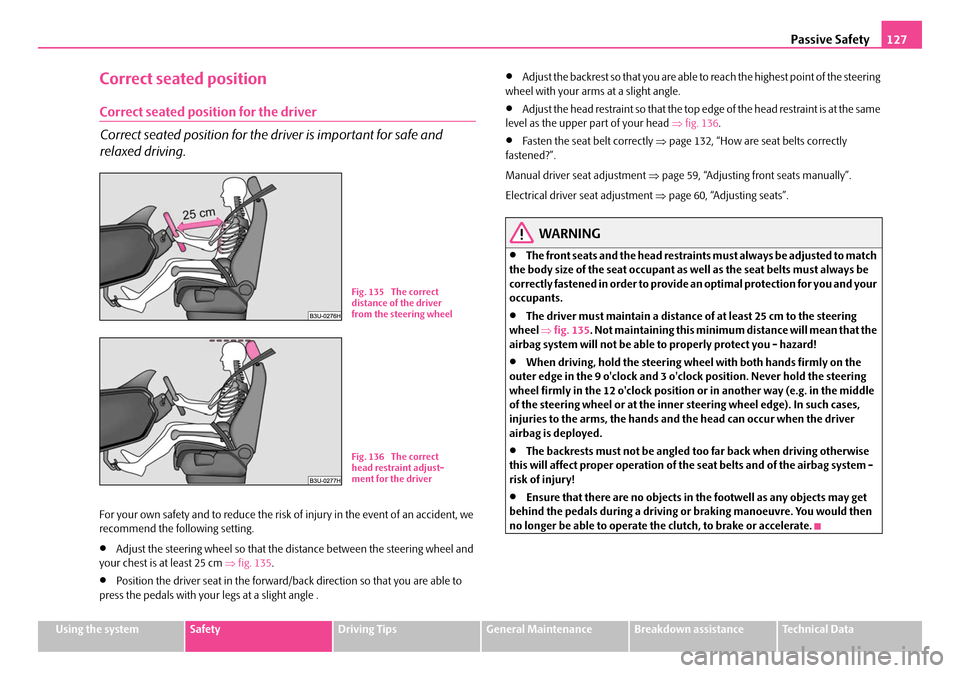
•Adjust the steering wheel so that the distance between the steering wheel and
your chest is at least 25 cm ⇒fig. 135 .
•Position the driver seat in the forward/back direction so that you are able to
press the pedals with your legs at a slight angle .
•Adjust the backrest so that you are able to reach the highest point of the steering
wheel with your arms at a slight angle.
•Adjust the head restraint so that the top edge of the head restraint is at the same
level as the upper part of your head ⇒ fig. 136.
•Fasten the seat belt correctly ⇒page 132, “How are seat belts correctly
fastened?”.
Manual driver seat adjustment ⇒page 59, “Adjusting front seats manually”.
Electrical driver seat adjustment ⇒ page 60, “Adjusting seats”.
WARNING
•The front seats and the head restraints must always be adjusted to match
the body size of the seat occupant as well as the seat belts must always be
correctly fastened in order to provide an optimal protection for you and your
occupants.
•The driver must maintain a distance of at least 25 cm to the steering
wheel ⇒fig. 135 . Not maintaining this minimum distance will mean that the
airbag system will not be able to properly protect you - hazard!
•When driving, hold the steering wheel with both hands firmly on the
outer edge in the 9 o'clock and 3 o'clock position. Never hold the steering
wheel firmly in the 12 o'clock position or in another way (e.g. in the middle
of the steering wheel or at the inner steering wheel edge). In such cases,
injuries to the arms, the hands and the head can occur when the driver
airbag is deployed.
•The backrests must not be angled to o far back when driving otherwise
this will affect proper operation of the seat belts and of the airbag system -
risk of injury!
•Ensure that there are no objects in the footwell as any objects may get
behind the pedals during a driving or braking manoeuvre. You would then
no longer be able to operate the clutch, to brake or accelerate.
Fig. 135 The correct
distance of the driver
from the steering wheel
Fig. 136 The correct
head restraint adjust-
ment for the driver
NKO B5 20.book Page 127 Friday, March 2, 2007 1:46 PM
Page 132 of 259

Seat belts131
Using the systemSafetyDriving TipsGeneral MaintenanceBreakdown assistanceTechnical Data
The physical principle of a frontal collision
The physical principle of a frontal a ccident can be explained quite simply:
Motion energy, so-called kinetic energy, is produced as soon as the vehicle is
moving, both for the vehicle and its occupants. The magnitude of this kinetic energy
depends essentially on the speed at which the vehicle is travelling and on the
weight of the vehicle and the occupants. The greater the speed and weight increase, the greater the amount of energy which has to be absorbed in the event of an acci-
dent.
The speed of the vehicle is, nevertheless,
the most important factor. Doubling the
speed of the vehicle from 25 km/h up to 50 km/h increases the kinetic energy four
times.
The common opinion that it is possible to support your body in a minor accident
with your hands, is incorrect. Even in a collision at only a low speed, the forces
acting on the body are such that it is no longer possible to support your body.
Even if you only drive at a speed within the range from 30 km/h to 50 km/h, the
forces which are produced on your body in the event of an accident can easily
exceed 10.000 N (Newton). This equals a weight of one tonne (1 000 kg).
In the event of a frontal collision, occupants of the car not wearing a seat belt, are
thrown forward and strike in an uncontrolle d way parts of the interior of the car,
such as steering wheel, dash panel, windscreen, ⇒fig. 138 . The occupants of a
vehicle who have not fastened their seat belts may even be thrown out of the
vehicle. This can resu lt in fatal injuries.
It is also important that rear seat occupants fasten their seat belts as they will other-
wise be thrown through the vehicle in an uncontrolled manner in the event of an
accident A rear seat passenger who has not fastened the seat belt is a danger not
only to himself but also fo r those seated at the front ⇒fig. 139 .
Important safety information regarding the use of
seat belts
The correct use of the seat belts considerably reduces the risk of
injury!
WARNING
•The belt webbing must not be jammed in-between at any point or
twisted, or chafe against any sharp edges.
•It is important that the belt webbing is properly routed if the seat belts
are to offer their maximum protection ⇒page 132, “How are seat belts
correctly fa stened?”.
Fig. 138 The driver is
thrown forward if not
wearing a belt
Fig. 139 The rear seat
occupant is thrown
forward if not wearing a
belt
NKO B5 20.book Page 131 Friday, March 2, 2007 1:46 PM
Page 139 of 259

Airbag system
138
Front airbag
Description of the front airbags
The airbag system is not a su bstitute for the seat belt!
The front airbag for the driver is housed in the steering wheel ⇒fig. 144 . The front
airbag for the front passenger is housed in the dash panel above the storage
compartment ⇒fig. 145 . The installation positions are each marked with the
“AIRBAG” logo. The front airbag system, in combination with three-point safety belts, offers addi-
tional protection for the head and chest ar
ea of the driver and front passenger in
the event of a frontal colli sion of major severity ⇒ in “Important safety informa-
tion regarding the front airbag system” on page 139.
The airbag is not a substitute for the seat belt, but is part of the complete passive
vehicle safety concept. Please note that an airbag can only offer you optimal
protection in combination with a seat belt which is fastened .
Apart from their normal protective function, a further task of the seat belts is to
also hold the driver and front passenger in a correct seated position in the event of
a frontal collision so as to enable the fr ont airbags to offer the maximum protection.
You should therefore always fasten the seat belts, not only because this is required
by law, but also for safety reasons and for your own protection ⇒page 130, “Why
seat belts?”.
Note
The dash panel must be replaced afte r the front passenger airbag has been
deployed.Fig. 144 Driver airbag in
the steering wheel
Fig. 145 Front passenger
airbag in the dash panel
NKO B5 20.book Page 138 Friday, March 2, 2007 1:46 PM
Page 140 of 259

Airbag system139
Using the systemSafetyDriving TipsGeneral MaintenanceBreakdown assistanceTechnical Data
Function of the front airbags
Risk of injury to the head and chest area is reduced by fully inflated
airbags.
The airbag system is designed in such a way that the driver and front passenger
airbag are deployed in the event of a frontal collision of major severity.
In certain accident situations both the front airbags as well as the head* and side
airbags may be deployed together.
If the airbags are deployed, the airbags are filled with a propellant gas and inflated
in front of the driver and front passenger ⇒fig. 146 . The airbags inflate in fractions
of a second and at a high speed in order to be able to offer that additional protec-
tion in the event of an accident. The forward movement of the driver and of the
front passenger is cushioned when they make contact with the fully inflated airbag
and the risk of injury to head and chest is thus reduced.
The specially developed airbag allows the gas to flow out of the inflated airbag in a
controlled manner (depending on the load of the particular car occupant) in order
to cushion head and chest areas. The airbag then deflates subsequently to such an
extent, after an accident, to again provide a clear view forward.
A grey white, non harmful gas is released when airbag is inflated. This is perfectly
normal and is not an indication of a fire in the vehicle. The airbag develops enormous forces when triggered, which can lead to injuries if
the sitting position or seated position is not correct
⇒ in “Important safety
information regarding the front airbag system”.
Important safety information r egarding the front airbag system
Correct use of the airbag system considerably reduces the risk of
injury!
WARNING
•Never transport children on the front seat of a vehicle without using a
proper restraint system. If airbags are deployed in the event of an accident,
the child might suffer severe or even fatal injuries!
•For the driver and front passenger it is important to maintain a distance
of at least 25 cm from the steering wheel or dash panel ⇒fig. 147 . Not main-
taining this minimum distance will mean that the airbag system will not be
able to properly protect you - hazard! The front seats and the head restraints
must always also be correctly adjusted to match the body size of the occu-
pant.
•It is essential to always switch off ⇒page 144, “Deactivating an airbag”
the front passenger airbag when attaching a child safety seat on the front
passenger seat where the child is seated with its back facing in direction of
travel (in some countries al so when the child is facing the direction of travel).
Fig. 146 Inflated airbagsFig. 147 Safe distance to
steering wheel
NKO B5 20.book Page 139 Friday, March 2, 2007 1:46 PM
Page 141 of 259

Airbag system
140
If this is not done, there is a risk of the child suffering severe or even fatal
injuries if the front passenger airbag is deployed. In certain countries
national legal provisions also requir e that the side or head passenger
airbags be deactivated. When transporting a child on the front passenger
seat, please comply with the appropri ate national regulations regarding the
use of child safety seats.
•There must not by any further persons, animals or objects positioned
between the front seated occupants and the deployment area of the airbag.
•The steering wheel and the surface of the airbag module in the dash
panel on the passenger side must not be stuck onto, covered or modified in
any other way. These parts should only be cleaned with a dry cloth or a cloth
moistened with water. No objects such as cup holders, mobile phone
mounts, etc. may be attached to the covers of the airbag modules or be
located within the immediate area.
•No modifications of any kind may be made to parts of the airbag system.
Any work on the airbag system including installing and removing system
components because of other repair work (e.g. removing the steering
wheel) must only be carried out by a specialist garage.
•Never carry out changes on the front bumper or on the body.
•Never place any objects on the surfac e of the front passenger airbag in
the dash panel.
Side airbag
Description of side airbags
The side airbag together with the head airbag offers enhanced occu-
pant protection in the ev ent of a side collision.
The side airbags are housed in the upholstery of the backrests of the front seats and
are marked ⇒fig. 148 with the lettering “AIRBAG” on the middle part.
The side airbag system in combination with the three-point seat belts, offers addi-
tional protection for the upper area of the body (chest, stomach and pelvis) of the
occupants of the car in the event of a side collision of major severity ⇒ in
“Important safety information on the side airbag” on page 141.
Apart from their normal protective function, a further task of the seat belts is to
also hold the driver and front passenger in a correct seated position in the event of
a side collision so as to enable the side airbags to offer the maximum protection.
You should therefore always fasten the seat belts, not only because this is required
by law, but also for safety reasons and for your own protection ⇒page 130, “Why
seat belts?”.
Each time the side airbag is deployed, the head airbag* on the relevant side is auto-
matically deployed at the same time in order to provide the occupant with
enhanced protection ⇒page 142.
WARNING (continued)
Fig. 148 Installation
position of side airbag in
driver seat
NKO B5 20.book Page 140 Friday, March 2, 2007 1:46 PM
Page 145 of 259

Airbag system
144
Deactivating an airbag
Deactivating airbags
If any airbags have been deactivated, switch them on again as soon
as possible so that they are able to again provide their proper protec-
tion.
There is the technical means installed within your vehicle to switch off the front,
side or head airbag (take out of commission).
This is why you should have the deactiva tion of the airbags carried out by a
specialist garage.
On vehicles equipped with the switch for deactivation of the airbags, you can deac-
tivate the front and side passenger airbag by means of this switch ⇒page 144.
Deactivation of airbags is envisaged only for particular instances, such as if:
•you must in exceptional cases use a child seat on the front passenger seat
where the child has its back to the directio n of travel of the vehicle (in some coun-
tries this must be in the direction of trav el due to other legal regulations applying)
⇒ page 146, “Important safety information regarding the use of child safety seats”
•you are not able to maintain the distance of at least 25 cm between middle of
steering wheel and chest, despite the driver seat being correctly adjusted,
•special attachments are required in the area of the steering wheel because of a
physical disability,
•you have installed other seats (e.g. orthopaedic seats without side airbags).
Monitoring the airbag system
The functionality of the airbag system is also monitored electronically, when one
airbag has been switched off
If the airbag was switched off using diagnostic equipment:
•The warning light for the airbag system lights up for 3 seconds after switching
on the ignition and then flashes for 12 seconds afterwards in 2 second intervals.
Front passenger airbags sw itched off using the switch for front passenger
airbags* in stowage compartmen t on the front passenger side:
•The airbag warning light comes on in th e instrument cluster for about 3 seconds
each time the ignition is switched on.
•Switching off airbags is indicated in the middle of the dash panel by the lighting
up of the indicator light ⇒ fig. 153 .
Note
Your Škoda Service Partner will be able to advise you whether national legislation in
your country allows airbags in your vehicle to be deactivated, and which ones.
Switch for the front seat passenger airbags*
Fig. 152 Storage
compartment: Switch for
the front seat passenger
airbags
Fig. 153 Indicator light
for a switched off front
seat passenger airbag
NKO B5 20.book Page 144 Friday, March 2, 2007 1:46 PM
Page 156 of 259

Intelligent Technology155
Using the systemSafetyDriving TipsGeneral MaintenanceBreakdown assistanceTechnical Data
Driving Tips
Intelligent Technology
Electronic stability programme (ESP)*
General
General
The ESP aids you maintain control of your vehicle in situations in borderline driving
situations such as when negotiating a curve too fast. The risk of skidding is reduced
and your car thus offers greater driving stability depending on the conditions of the
road surface. This occurs at all speeds.
The following systems are integrated into the electronic stability programme:
•Electronic Differential Lock (EDL),
•Traction control system (TCS),
•Antilock brake system ABS,
•Brake Assist. Operating principle
The ESP switches on automatically when the engine is started and then conducts a
self-test. The ESP control unit processes data from the individual systems. It also
processes additional measurement data which are supplied by highly sensitive
sensors: the rotational velocity of the vehi
cle about its vertical axis, the lateral accel-
eration of the vehicle, the brakin g pressure and the steering angle.
The direction which the driver wishes to ta ke is determined based on the steering
angle and the speed of the vehicle and is constantly compared with the actual
behaviour of the vehicle. If differences exis t, such as the car beginning to skid, the
ESP will automatically brake the appropriate wheel.
The car is stabilised again by the forces which take effect when the wheel is braked.
Intervention into the brake system takes place primarily on the outer front wheel of
a vehicle which tends to oversteer (tendency for the rear of the vehicle to break
away) while occurs this is on the inner re ar wheel of a vehicle which tends to under-
steer (tendency to shift out of the curve). This braking control cycle is accompanied
by noises.
The ESP operates in combination with the ABS ⇒page 159, “Antilock brake system
(ABS)”. If there is a fault in the ABS system, the ESP also does not operate.
The ESP warning light ⇒page 28 lights up in the instrument cluster when there is a
fault on the ESP.
Switching off
You can switch the ESP off and on again as you wish, by pressing the button
⇒ fig. 163 . The ESP warning light ⇒page 28 lights up in the instrument cluster
when the ESP is switched off.
The ESP should normally always be switched on. It may be good practice to switch
the system off only in particular exceptional situations if you desire wheel slip.
Examples:
•when driving with snow chains,
B1Z-0042HB1Z-0042HFig. 163 ESP switch
NKO B5 20.book Page 155 Friday, March 2, 2007 1:46 PM
Page 157 of 259

Intelligent Technology
156
•when driving in deep snow or on a loose surface,
•when it is necessary to rock a ca r free when it has become stuck.
then you should switch on the ESP again.
WARNING
It is also not possible for the ESP to overcome the physical limits of the
vehicle. Even if a vehicle fitted with ESP you should still always adapt your
style of driving to the condition of the road surface and the traffic situation.
This particularly applies when driving on slippery and wet roads. The
increased safety offered must not tempt you to take greater risks than other-
wise - risk of an accident!
Note
•All four wheels must be fitted with the same tyres in order to achieve problem-
free operation of the ESP. Differing rolling circumferences of the tyres can lead to an
undesirable reduction in the engine output.
•Changes to vehicle (e.g. on engine, on the brakes, on chassis or other assign-
ment of tyres and wheels) can influence the function of the ESP ⇒page 205.
Traction control system (TCS)*
The traction control system prevents the driven wheels from spinning
when accelerating.
General
The TCS makes it much easier, and sometimes at all possible, to start off, accelerate
and climb a steep hill when the conditions of the road surface are unfavourable.
Operating principle
The TCS switches on automatically when th e engine is started and then conducts a
self-test. The system monitors the speeds of the driven wheels with the aid of the
ABS sensors. If the wheels ar e spinning, the force transmitted to the road surface is
automatically adapted by reducing the engi ne speed. This occurs at all speeds.
The TCS operates in combination with the ABS ⇒page 159, “Antilock brake system
(ABS)”. The TCS will not function if a fault exists in the ABS system.
The TCS warning light ⇒page 28 lights up in the instrument cluster when there is a
fault on the TCS.
Switching off
You can switch the TCS off and on again as you wish by pressing the button
⇒ fig. 164 . The TCS warning light ⇒page 28 lights up in the instrument cluster
when the TCS is switched off.
B1Z-0042HB1Z-0042HFig. 164 TCS switch
NKO B5 20.book Page 156 Friday, March 2, 2007 1:46 PM
Page 158 of 259

Intelligent Technology157
Using the systemSafetyDriving TipsGeneral MaintenanceBreakdown assistanceTechnical Data
The TCS should normally always be switched
on. It may be good practice to switch
the system off only in particular exceptional situations if you desire wheel slip.
Examples:
•when driving with snow chains,
•when driving in deep snow or on a loose surface,
•when it is necessary to rock a car free when it has become stuck.
then you should switch on the TCS again.
The EDL ⇒page 157, “Electronic Differential Lock (EDL)” is a part of the TCS. THE
EDL operates independently of the TCS (a lso when the TCS has been switched off
using the TCS button).
WARNING
You should always adjust your style of driving to the conditions of the road
surface and the traffic situation. The increased safety offered must not tempt
you to take greater risks than otherwise - risk of an accident!
Note
•All four wheels must be fitted with the same tyres in order to achieve problem-
free operation of the TCS. Differing rollin g circumferences of the tyres can lead to
an undesirable reduction in the engine output.
•Changes to vehicle (e.g. on engine, on the brakes, on chassis or other assign-
ment of tyres and wheels) can influence the function of the TCS ⇒page 205,
“Accessories, changes and replacement of parts”.
Electronic Differential Lock (EDL)
The electronic differential lock pr events an individual wheel from
slipping.
General
The EDL makes it much easier, and sometimes at all possible, to start off, accelerate
and climb a steep hill when the conditio ns of the road surface are unfavourable. Operating principle
The EDL is activated automatically, that is without any action on the part of the
driver. It monitors the speeds of the driven wheels with the aid of the ABS sensors.
Should only
one drive wheel begin spinning on a sl ippery surface there will be an
appreciable difference in the speed of the driven wheels. The EDL function brakes
the slipping wheel and the differential transmits a greater driving force to the other
driven wheel. This control proce ss is also accompanied by noises.
Overheating of the brakes
The EDL switches off automatically if unus ually severe stresses exist in order to
avoid excessive heat generation in the disc brake on the wheel which is being
braked. The vehicle can continue to be driven and has the same characteristics as a
vehicle not fitted with EDL.
The EDL switches on again automatically as soon as the brake has cooled down.
WARNING
•Depress the accelerator carefully when accelerating on uniformly slip-
pery road surfaces, such as ice and sn ow. The driven wheels might still spin
despite the EDL and affect the stability of the vehicle - risk of an accident!
•You should always adapt your style of driving to the condition of road
surface and to the traffic situation even when your vehicle is fitted with EDL.
The increased safety offered must not tempt you to take greater risks than
otherwise - risk of an accident!
Note
•If the ABS warning light comes on, this may also indicate a fault in the EDL.
Please have the car inspec ted as soon as possible by a specialist garage.
•Changes to vehicle (e.g. on engine, on the brakes, on chassis or other assign-
ment of tyres and wheels) can in fluence the function of the EDL ⇒page 205,
“Accessories, changes and replacement of parts”.
NKO B5 20.book Page 157 Friday, March 2, 2007 1:46 PM