wheel SKODA SUPERB 2007 1.G / (B5/3U) Service Manual
[x] Cancel search | Manufacturer: SKODA, Model Year: 2007, Model line: SUPERB, Model: SKODA SUPERB 2007 1.G / (B5/3U)Pages: 259, PDF Size: 14.71 MB
Page 204 of 259

Wheels and Tyres203
Using the systemSafetyDriving TipsGeneral MaintenanceBreakdown assistanceTechnical Data
Note
It is not normally possible to fit wheels from other models of cars for technical
reasons. This may also apply in certain circumstances to the wheels of the same
type of vehicle.
Wheel bolts
Wheels and wheel bolts are matched to each other in terms of design. Each time
you fit other wheels - e.g. light alloy wheels or wheels with winter tyres - you must
therefore also use the matching wheel bolts of the correct length and shape of
spherical cap. This is essential to ensure that the wheels are tightly fitted and that
the brake system operates properly.
If you retrofit wheel trims (or have this done), please also ensure that an adequate
flow of air remains assured for cooling the brake system.
The Škoda Service Partners are instructed in the technical possibilities which exist
regarding converting or retrofitti ng wheels, tyres and wheel trim.
WARNING
•In case of incorrect treatment of the wheel bolts, the wheel can loosen
when the car is moving - risk of accident!
•The wheel bolts must be clean and must turn easily. However, they must
never be treated with grease or oil.
•If the wheel bolts are tightened to a too low tightening torque, the rim
can lossen when the car is moving - risk of accident! A tightening torque
which is too high can damage the bolts and threads and this can result in
permanent deformation of the contact surfaces on the rims.
Caution
The prescribed tightening torque of the wheel bolts for steel and light alloy wheels
is 120 Nm.
Winter tyres
The handling of your vehicle will be significantly improved when driving on wintry
roads if you fit winter tyres. Summer tyres do not offer the same grip on ice, snow
and at temperatures below 7 °C because of their construction (width, rubber blend,
tread pattern). This applies in particul ar to vehicles which are equipped with low-
profile tyres or high-speed tyres (code index V, W or Y on wall of tyre).
Winter tyres must be mounted on all four wheels to obtain the best handling char-
acteristics.
You must only fit those types of winter tyre which are approved for your vehicle. The
permissible sizes of winter tyres are stated in your vehicle documents. Approvals
may differ because of national legislation.
Please remember that the tyres should be inflated to 20 kPa (0.2 bar) more than is
the case for summer tyres ⇒page 200.
Winter tyres no longer offer the same winter performance once the tyre tread has
worn down to a depth of about 4 mm.
Ageing also causes winter tyres to lose most of their winter performance properties
- even in cases where the remaining tread depth is still clearly more than 4 mm.
Speed restrictions apply to winter tyres as well as to summer tyres ⇒page 201,
⇒ .
You can fit winter tyres of a lower speed ca tegory to your vehicle provided that you
also do not drive faster than the permissible maximum speed for such tyres, even
if the possible maximum speed of your vehicle is higher. The corresponding tyre
category can damage the tyres when exceeding the permissible maximum speed.
Please pay attention to the notes if you decide to fit winter tyres ⇒page 199.
You can also fit so-called “all-year tyres” instead of winter tyres.
Please contact your specialist garage if there are any points which are not clear who
will be able to provide you with information regarding the maximum speed for your
tyres.
NKO B5 20.book Page 203 Friday, March 2, 2007 1:46 PM
Page 205 of 259

Wheels and Tyres
204
WARNING
You must on no account drive your car at more than the permissible
maximum speed for your winter tyres - risk of an accident resulting from
tyre damage and loss of control over your car.
For the sake of the environment
Fit your summer tyres on again in good time since summer tyres offer you better
grip and handling on roads which are free of snow and ice as well as ar tempera-
tures below 7 °C - the braking distance is shorter, there is less tyre noise, tyre wear
is reduced and fuel consumption is reduced.
Note
Please observe the various differing legal requirements regarding tyres.
Unidirectional tyres*
The direction of rotation of the tyres is marked by arrows on the wall of the tyre .
This indicates the direction of rotation of th e tyre, and it is essential that the tyres
are fitted on to run in this direction. Only then are the tyres able to provide the
optimal properties in terms of grip, lo w noise, wear-and-tear and aquaplaning.
Should it be necessary to fit on a spare wheel in exceptional cases with a tyre not
dedicated to the running direction or in o pposite running direction, please adopt a
cautious style of driving as the tyre is no longer able to provide optimal grip and
handling in such a situation. This particul arly important on wet roads. Please refer
to the notes ⇒page 209, “Spare wheel”.
You should have the defective tyre replac ed as soon as possible and restore the
correct direction of rotation on all tyres
Snow chains
Snow chains can be used only for wheel sizes 6J x 16 ET 40 or 6J x 16 ET 37. Your
Škoda Service Partner can provide you with more detailed information. Snow chains must only be mounted on the front wheels.
When driving on wintry roads, snow chains
improve not only traction, but also the
braking performance.
Only use fine-link snow chains . They must not project more than 15 mm -
including the chain lock.
Remove the full wheel trims if you wish to fit snow chains to the wheels.
Observe the national legal requirements relating to the maximum vehicle speed
with snow chains.
WARNING
Please pay attention to the information in the supplied fitting instructions of
the snow chain manufacturer.
Caution
You must take the chains off as soon as you drive on roads which are free of snow.
They adversely affect the handling of your vehicle, damage the tyres and are rapidly
destroyed.
Note
We recommend that you use snow chains from the Škoda genuine accessories.
NKO B5 20.book Page 204 Friday, March 2, 2007 1:46 PM
Page 206 of 259

Accessories, changes and replacement of parts205
Using the systemSafetyDriving TipsGeneral MaintenanceBreakdown assistanceTechnical Data
Accessories, changes and replacement of parts
Accessories and replacement parts
Škoda vehicles have been built according to the latest discoveries in safety engi-
neering. Thus one should no t change the condition in which the vehicle was deliv-
ered from the manufacturer without some thought.
The following guidelines should be observed when a vehicle is to be retrofitted with
accessories, have technical ch anges made to it or a par t has to be replaced at some
time in the future.
•Advise should always be obtained from a Škoda Service Partner before buying
any accessories and before making any technical changes ⇒.
•This is particularly the case when acce ssories are bought in a foreign country.
•Škoda Genuine Accessories which have b een released for use and Skoda orig-
inal parts can be obtained from Škoda Se rvice Partners. They will install them
professionally and correctly.
•All Škoda original accessory which is listed in the catalogue such as tilting roofs,
spoilers, wheels etc. must have an official stamp of approval.
•Radios, aerials and other electrical access ories should only be installed by an
authorised workshop.
•The guidelines issued by Škoda Auto a.s. must be observed when making tech-
nical changes.
•This is to ensure that no technical damage occurs to the vehicle, that travelling
and operating safety are maintained and that the chnages are permissible. Škoda
Service Partners undertake this work professionally or refer it to an specialist
company in special cases.
Any damage which is done caused by technical changes made without
consulting a Skoda a.s. dealer is excluded from the guarantee.
WARNING
•We advise you, in your own interest, to only use Škoda Genuine Accesso-
ries and Škoda original parts which have been expressly approved for use on your Škoda. Reliability, safety and su
itabiliity have been established for
these Škoda original parts.
•We cannot guarantee suitability of installation into your vehicle of other
products despite keeping a constant ey e on market developments (also not
in the case where there is an attestation or permission can be produced).
Technical changes
Interference on the electronic components and their software can lead to opera-
tional faults. This interference can also impair not directly affected systems because
of the networking of the electronic co mponents. This means that the operating
safety of your vehicle can be considerably jeopardized, a greater wear of vehicle
parts can occur and finally the vehi cle registration documents expire.
We trust that you will understand that yo ur Škoda Service Partner cannot be liable
for damage resulting from unprofessional work.
We therefore recommend that you have a ll work carried out with Škoda original
parts at your authorised Škoda Service Partners.
WARNING
Work or modifications on your vehicle, which have been carried out unpro-
fessionally, can cause operational faults - risk of accident!
WARNING (continued)
NKO B5 20.book Page 205 Friday, March 2, 2007 1:46 PM
Page 209 of 259

Breakdown assistance
208
The fire extinguisher is located in the sheath below the driver's seat ⇒page 207,
fig. 189 (the installation position of the fire extinguisher differs on vehicles fitted
with electrically adjustable seats).
Please read carefully the instructions which are attached to the fire extin-
guisher.
The fire extinguisher must be checked by an authorised person or company annu-
ally (please observe the differing legal requirements).
WARNING
If the fire extinguisher is not correc tly attached, in case of sudden manoeu-
vres or an accident it can be “thrown” through the interior compartment and
cause injuries.
Note
•The fire extinguisher must comply with the relevant and valid legal require-
ments.
•Pay attention to the expiration date of the fire extinguisher. If the fire extin-
guisher is used after the expiration date, its proper function is no longer assured.
•The fire extinguisher is only supplied in certain countries within the scope of
delivery.
Vehicle tool kit
The car tool kit and the car jack are stowed in the left of the luggage compartment
⇒ fig. 190 below the floor covering.
The vehicle tool kit contains the following parts (depending on equipment fitted):
•Hook for pulling off a full wheel trim,
•Plastic clip for a wheel bolt cover,
•Wheel wrench,
•Assembly pin for changing wheel,
•Screwdriver with reversible blade,
•Adapter for the wheel bolts lock.
After using the lifting jack, screw in the arm of the lifting jack fully before placing it
back in its stowage area.
WARNING
•The hexagon socket in the handle of the screwdriver should only be used
to fit on the wheel bolts. Never use th e hexagon socket of the screwdriver for
tightening the wheel bolts because you will not be able to achieve the neces-
sary tightening torque with the hexagon socket - risk of accident!
B1Z-0042HB1Z-0042H
Fig. 190 Luggage
compartment: Compart-
ment for stowing the tool
kit
NKO B5 20.book Page 208 Friday, March 2, 2007 1:46 PM
Page 210 of 259
Breakdown assistance209
Using the systemSafetyDriving TipsGeneral MaintenanceBreakdown assistanceTechnical Data
•The factory-supplied lifting jack is only intended for your model of
vehicle. On no account attempt to lift a heavier vehicle or other loads - risk
of injury!
•Ensure that the vehicle tool kit is safely attached in the luggage
compartment.
Spare wheel
The spare wheel is stowed in the spare wheel well in the luggage
compartment below the floor covering.
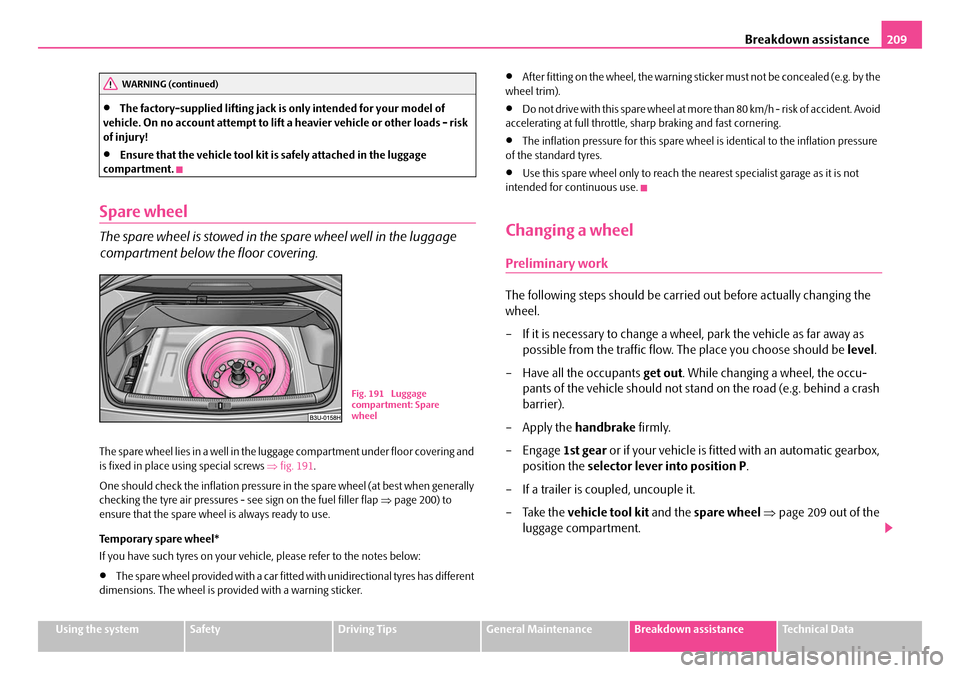
The spare wheel lies in a well in the luggage compartment under floor covering and
is fixed in place using special screws ⇒fig. 191 .
One should check the inflation pressure in the spare wheel (at best when generally
checking the tyre air pressures - see sign on the fuel filler flap ⇒page 200) to
ensure that the spare wheel is always ready to use.
Temporary spare wheel*
If you have such tyres on your vehicle, please refer to the notes below:
•The spare wheel provided with a car fitted with unidirectional tyres has different
dimensions. The wheel is provided with a warning sticker.
•After fitting on the wheel, the warning st icker must not be concealed (e.g. by the
wheel trim).
•D o n o t d r i v e w i t h th i s s p a re w h e e l a t m o re th a n 8 0 k m / h - ri s k o f a c c i d e n t. Av o i d
accelerating at full throttle, sharp braking and fast cornering.
•The inflation pressure for this spare wheel is identical to the inflation pressure
of the standard tyres.
•Use this spare wheel only to reach the nearest specialist garage as it is not
intended for continuous use.
Changing a wheel
Preliminary work
The following steps should be carried out before actually changing the
wheel.
– If it is necessary to change a wheel, park the vehicle as far away as possible from the traffic flow. The place you choose should be level.
– Have all the occupants get out. While changing a wheel, the occu-
pants of the vehicle should not stan d on the road (e.g. behind a crash
barrier).
– Apply the handbrake firmly.
–Engage 1st gear or if your vehicle is fitted with an automatic gearbox,
position the selector lever into position P.
– If a trailer is coupled, uncouple it.
– Take the vehicle tool kit and the spare wheel ⇒ page 209 out of the
luggage compartment.
WARNING (continued)
B1Z-0042HB1Z-0042H
Fig. 191 Luggage
compartment: Spare
wheel
NKO B5 20.book Page 209 Friday, March 2, 2007 1:46 PM
Page 211 of 259

Breakdown assistance
210
WARNING
•If you find yourself in flowing traffic switch on the hazard warning lights
system and place the warning triangle on the side of the road at the
prescribed distance from your vehicl e while observing all national legal
provisions. In this way you are protecting not only yourself but also other
road users.
•Never start the engine with the vehicle sitting on the raised jack - danger
of suffering injury!
Caution
If you have to change a wheel on a slope first block the opposite wheel with a stone
or similar object in order to secure th e vehicle from unexpectedly rolling away.
Note
Comply with the national legal regulations.
Changing a wheel
Always change a wheel on a level surface as far as possible.
– Take off the full wheel trim* ⇒page 211 or the caps ⇒page 211.
– In the case of light alloy wheels remove the wheel trim cap ⇒page 211.
– Slacken the wheel bolts ⇒page 212.
– Jack up the vehicle until the wheel to be changed is clear of the ground
⇒ page 213.
– Unscrew the wheel bolts and place them on a clean surface (cloth, paper etc.).
– Take off the wheel. – Fit on the spare wheel and tighten the wheel bolts slightly.
– Lower the car.
– Tighten the wheel bolts firmly, al
ternately and diagonally using the
wheel wrench ⇒page 212.
– Mount the full wheel trim/w heel trim cap or the caps.
Note
•All bolts must be clean and must turn easily.
•You must never grease or oil the wheel bolts!
•When fitting on unidirectional tyres, ensure that the tyres rotate in the correct
direction ⇒page 199.
Subsequent steps
After changing the wheel, you must perform the following steps.
– Stow and attach the replaced wheel in the spare wheel well.
– Stow the vehicle tool kit in the space provided.
– Check the tyre pressure on the spare wheel just mounted as soon as
possible.
– Have the tightening torque of the wheel bolts checked with a torque
wrench as soon as possible. The tightening torque for steel and light
alloy wheels must be 120 Nm.
– Have the defective tyre repaired as soon as possible.
WARNING
It is necessary to observe the guidelines given on ⇒page 201, “New tyres
and wheels” if the vehicle is subseq uently fitted with tyres which are
different to those it was fitted with at the works.
NKO B5 20.book Page 210 Friday, March 2, 2007 1:46 PM
Page 212 of 259

Breakdown assistance211
Using the systemSafetyDriving TipsGeneral MaintenanceBreakdown assistanceTechnical Data
Note
•If you find, when changing the wheel, that the wheel bolts are corroded and
difficult to turn, the bolts mu st be replaced before checking the tightening torque.
•Drive cautiously and only at a moderate speed to a workshop where the tight-
ening torque can be checked.
Full wheel trim*
Pulling off
– Hook the clamp (found in the vehicle toolkit) into the reinforced edge of the full wheel trim.
– Push the wheel key through the clamp, support the wheel key at the tyre and pull off the wheel trim.
Installing
– First press the full wheel trim onto the wheel at the valve opening provided. Then press the full wheel trim into the wheel in such a way
that its entire circumference locks correctly in place.
Caution
•Use the pressure of your hand, do not knock on the full wheel trim! Heavy
knocks mainly on the points where the full wheel trim has not been inserted into
the wheel, can result in damage to the guide and centering elements of the full
wheel trim.
•First check for yourself that the th eft-deterrent wheel bolt is located
⇒ page 214, “Securing wheels against being stolen” in the hole in the area of the
valve before fitting the full wheel trim onto a steel wheel which is attached with a
theft-deterrent wheel bolt.
Wheel trim caps*
Pulling off
– Carefully ⇒fig. 192 lever off the wheel trim cap using the removal
hook .
Wheel bolts with caps*
The caps are designed to protect the wheel bolts.
B1Z-0042HB1Z-0042H
Fig. 192 Changing a
wheel: Pulling off the
wheel trim cap
B1Z-0042HB1Z-0042HFig. 193 Changing a
wheel: Removing the cap
NKO B5 20.book Page 211 Friday, March 2, 2007 1:46 PM
Page 213 of 259
Breakdown assistance
212
Pulling off
– Insert the plastic clip (in the car tool kit) sufficiently far onto the cap
until the inner catches of the clip are positioned at the collar of the
cap.
– Pull the cap off with the plastic clip ⇒ page 211, fig. 193 .
Installing
– Insert the caps onto the bolts.
Slackening and tightening wheel bolts
Slacken the wheel bolts before jacking up the vehicle.
Slackening wheel bolts
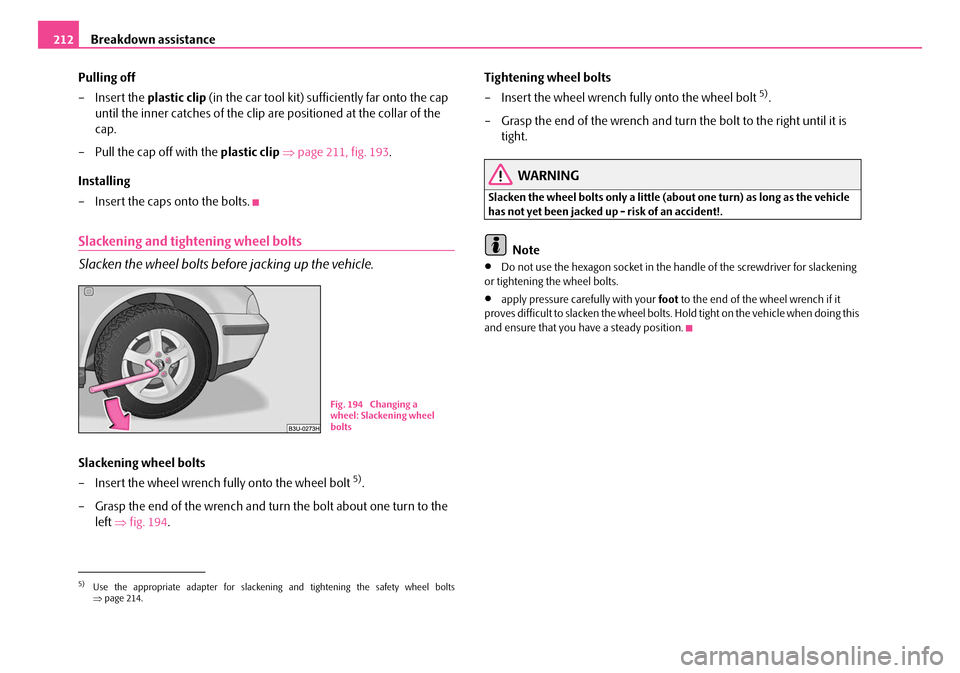
– Insert the wheel wrench fully onto the wheel bolt
5).
– Grasp the end of the wrench and turn the bolt about one turn to the left ⇒fig. 194 . Tightening wheel bolts
– Insert the wheel wrench fully onto the wheel bolt
5).
– Grasp the end of the wrench and turn the bolt to the right until it is tight.
WARNING
Slacken the wheel bolts only a little (about one turn) as long as the vehicle
has not yet been jacked up - risk of an accident!.
Note
•Do not use the hexagon socket in the ha ndle of the screwdriver for slackening
or tightening the wheel bolts.
•apply pressure carefully with your foot to the end of the wheel wrench if it
proves difficult to slacken the wheel bolts. Hold tight on the vehicle when doing this
and ensure that you have a steady position.
5)Use the appropriate adapter for slackening and tightening the safety wheel bolts
⇒ page 214.
Fig. 194 Changing a
wheel: Slackening wheel
bolts
NKO B5 20.book Page 212 Friday, March 2, 2007 1:46 PM
Page 214 of 259
Breakdown assistance213
Using the systemSafetyDriving TipsGeneral MaintenanceBreakdown assistanceTechnical Data
Raise vehicle
You have to raise the vehicle with a lifting jack in order to be able to
take off the wheel.
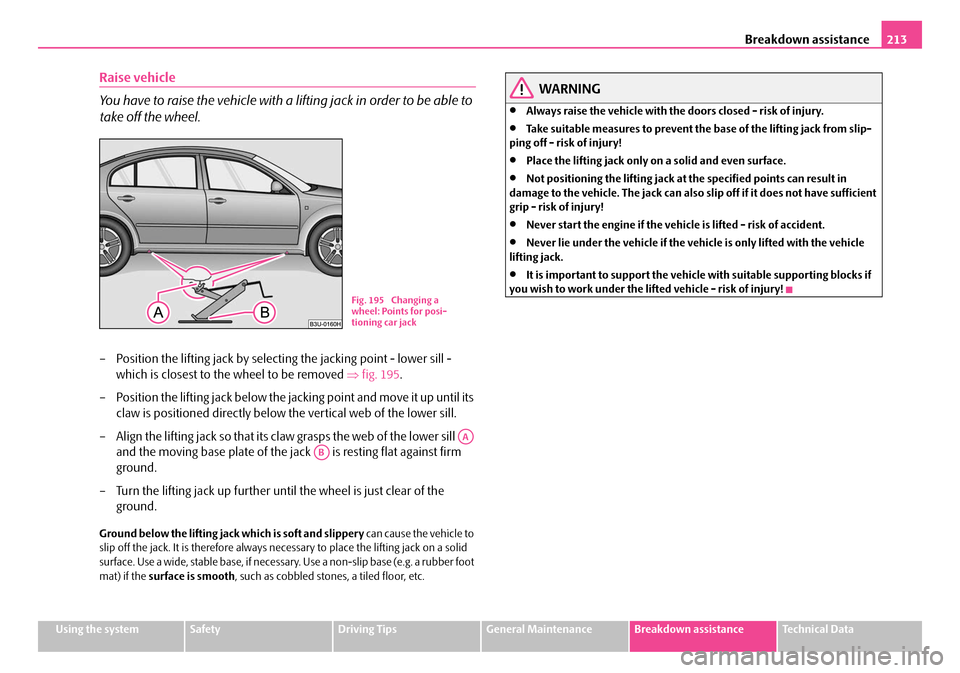
– Position the lifting jack by selecting the jacking point - lower sill -
which is closest to the wheel to be removed ⇒fig. 195 .
– Position the lifting jack below the jacking point and move it up until its claw is positioned directly below the vertical web of the lower sill.
– Align the lifting jack so that its claw grasps the web of the lower sill and the moving base plate of the ja ck is resting flat against firm
ground.
– Turn the lifting jack up further until the wheel is just clear of the ground.
Ground below the lifting jack which is soft and slippery can cause the vehicle to
slip off the jack. It is therefore always ne cessary to place the lifting jack on a solid
surface. Use a wide, stable base, if necessary. Use a non-slip base (e.g. a rubber foot
mat) if the surface is smooth , such as cobbled stones, a tiled floor, etc.
WARNING
•Always raise the vehicle with the doors closed - risk of injury.
•Take suitable measures to prevent the base of the lifting jack from slip-
ping off - risk of injury!
•Place the lifting ja ck only on a solid and even surface.
•Not positioning the lifting jack at the specified points can result in
damage to the vehicle. The jack can also sl ip off if it does not have sufficient
grip - risk of injury!
•Never start the engine if the vehicl e is lifted - risk of accident.
•Never lie under the vehicle if the vehicle is only lifted with the vehicle
lifting jack.
•It is important to support the vehicle with suitable supporting blocks if
you wish to work under the lifted vehicle - risk of injury!
Fig. 195 Changing a
wheel: Points for posi-
tioning car jack
AA
AB
NKO B5 20.book Page 213 Friday, March 2, 2007 1:46 PM
Page 215 of 259

Breakdown assistance
214
Taking off and fitting on wheel
After you have slackened the wheel bolts and have raised the car with the
car jack, replace the wheel as follows:
Changing a wheel
– Turn the wheel bolt which is farthest to the top fully out with the
hexagon socket in the screwdriver handle (car tool kit) and place the
bolt down on a clean surface ⇒fig. 196 .
– Screw the assembly pin (car t ool kit) into the vacant hole ⇒fig. 197 .
– Unscrew the remaining wheel bolts as described above. – Take off the wheel.
Fitting on wheel
– Push the spare wheel over the assembly pin.
– Screw in the wheel bolts and tighten them
slightly with the aid of the
hexagon socket.
– Unscrew the assembly pin and screw in the remaining wheel bolt also slightly.
The wheel bolts must be clean and must turn easily.
The hexagon socket in the handle of the sc rewdriver makes it simpler to fit on the
wheel bolts. The reversible blade should be pulled out for this step.
When fitting on unidirectional tyres, ensure that the tyres rotate in the correct
direction ⇒page 204.
Note
Do not use the hexagon socket in the hand le of the screwdriver for slackening or
tightening the wheel bolts.
Securing wheels against being stolen
You need a special adapter for slackening the safety wheel bolts.
B1Z-0042HB1Z-0042H
Fig. 196 Changing a
wheel: Remove bolts
with hexagon in screw-
driver
B1Z-0042HB1Z-0042HFig. 197 Changing a
wheel: assembly pin
Fig. 198 Safety wheel
bolt with adapter
NKO B5 20.book Page 214 Friday, March 2, 2007 1:46 PM