technical data SKODA SUPERB 2008 2.G / (B6/3T) Owners Manual
[x] Cancel search | Manufacturer: SKODA, Model Year: 2008, Model line: SUPERB, Model: SKODA SUPERB 2008 2.G / (B6/3T)Pages: 272, PDF Size: 18.25 MB
Page 188 of 272
Driving and the Environment189
Using the systemSafetyDriving TipsGeneral MaintenanceBreakdown assistanceTechnical Data
The fuel consumption can naturally also be
influenced by factors which are beyond
the driver's control. It is, for example, normal for the fu el consumption to increase
in winter and under worsened conditions such as poor road conditions, towing a
trailer, etc.
The technical requirements for low fuel usage and economic efficiency of the
vehicle have already been built into the ve hicle at the works. Special attention has
been given to minimising ne gative effects on the environment. It is necessary to
take note of the guidelines given in this chapter in order to make best use of these
characteristics and to maintain their effectiveness.
The optimal engine speed should be obtain ed when accelerating, in order to avoid
a high fuel consumption an d resonance of the vehicle.
Looking ahead when driving
A vehicle's highest fuel consumption occurs it accelerates.
Avoid accelerating and brakin g unnecessarily. If you drive with forsight you will not
need to brake so often and will also then not have to accelerate so much. Let your
vehicle coast to a stop, for example, if this is possible, when you see that the next
set of traffic lights is at red.
Shifting gears and saving energy
Shifting up early saves on fuel.
Manual gearbox
– Drive no more than about one length of your vehicle in first gear.
– Always shift up into the next higher gear at approx. 2 000 to 2 500 revs.
Automatic gearbox
– Depress the accelerator pedal slowly. Do not depress it beyond the
kickdown position, however.
An effective way of achieving good fuel economy is to shift up early. You will
consume more fuel if you drive at unnecessa rily high revolutions in any given gear.
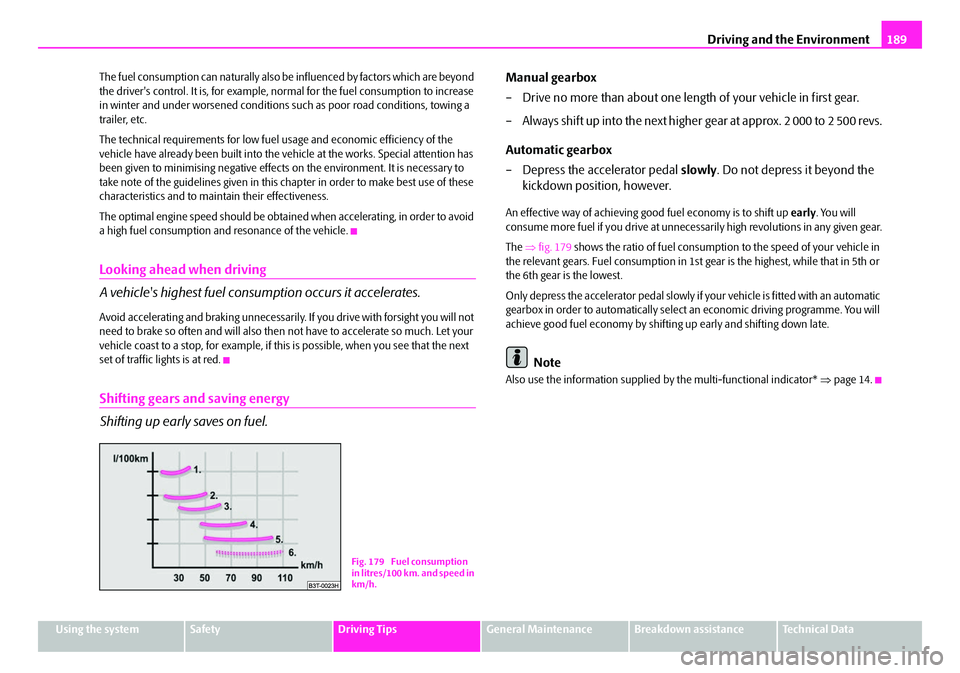
The ⇒fig. 179 shows the ratio of fuel consumption to the speed of your vehicle in
the relevant gears. Fuel consumption in 1st gear is the highest, while that in 5th or
the 6th gear is the lowest.
Only depress the accelerator pedal slowly if your vehicle is fitted with an automatic
gearbox in order to automatically select an economic driving programme. You will
achieve good fuel economy by shifting up early and shifting down late.
Note
Also use the information supplied by the multi-functional indicator* ⇒page 14.
Fig. 179 Fuel consumption
in litres/100 km. and speed in
km/h.
NKO B6 20.book Page 189 Wednesday, March 26, 2008 3:15 PM
Page 190 of 272
Driving and the Environment191
Using the systemSafetyDriving TipsGeneral MaintenanceBreakdown assistanceTechnical Data
Avoid driving short distances
Short distances result in an above-average high fuel consumption.
– Avoid driving a distance of no more than 4 km if the engine is cold.
The engine and catalytic converter mu st first have reached their optimal operating
temperature in order to effectively reduce fu el consumption and pollutant emis-
sions.
The cold engine vehicle consumes approx. 15 - 20 litres/100 km of fuel immediately
after starting. Fuel co nsumption drops to 10 litres/100 km after just 1 kilometre. The
engine reaches its operating temperat ure (outside temperature and engine
dependent) only after about 4 to 10 kilometres and the fuel consumption then
stabilizes. You should therefore avoid driving short distances whenever possible.
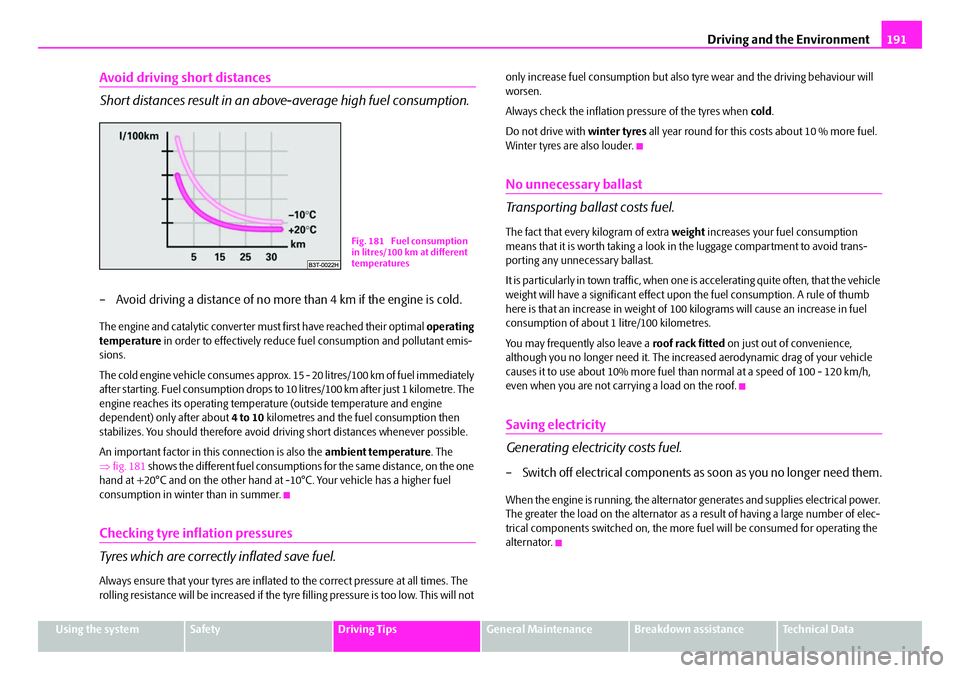
An important factor in this connection is also the ambient temperature. The
⇒ fig. 181 shows the different fuel consumptions for the same distance, on the one
hand at +20°C and on the other hand at -10°C. Your vehicle has a higher fuel
consumption in winter than in summer.
Checking tyre inflation pressures
Tyres which are correctly inflated save fuel.
Always ensure that your tyres are inflated to the correct pressure at all times. The
rolling resistance will be increased if the tyre filling pressure is too low. This will not only increase fuel consumption but also
tyre wear and the driving behaviour will
worsen.
Always check the inflation pressure of the tyres when cold.
Do not drive with winter tyres all year round for this costs about 10 % more fuel.
Winter tyres are also louder.
No unnecessary ballast
Transporting ballast costs fuel.
The fact that every kilogram of extra weight increases your fuel consumption
means that it is worth taking a look in the luggage compartment to avoid trans-
porting any unnecessary ballast.
It is particularly in town traffic, when one is accelerating quite often, that the vehicle
weight will have a significant effect upon the fuel consumption. A rule of thumb
here is that an increase in weight of 100 kilograms will cause an increase in fuel
consumption of about 1 litre/100 kilometres.
You may frequently also leave a roof rack fitted on just out of convenience,
although you no longer need it. The incr eased aerodynamic drag of your vehicle
causes it to use about 10% more fuel th an normal at a speed of 100 - 120 km/h,
even when you are not carr ying a load on the roof.
Saving electricity
Generating electricity costs fuel.
– Switch off electrical components as soon as you no longer need them.
When the engine is running, the alternator generates and supplies electrical power.
The greater the load on the alternator as a result of having a large number of elec-
trical components switched on, the more fuel will be consumed for operating the
alternator.
Fig. 181 Fuel consumption
in litres/100 km at different
temperatures
NKO B6 20.book Page 191 Wednesday, March 26, 2008 3:15 PM
Page 192 of 272
Driving and the Environment193
Using the systemSafetyDriving TipsGeneral MaintenanceBreakdown assistanceTechnical Data
The adaptation of the headlight with Xenon lights* (applies only to vehicles which
are designed for driving right and left) is performed in the menu
Automatic light
(Automat. Lights) in main menu of the Information Display* ⇒page 19.
Avoiding damage to your vehicle
When driving on poor roads and lanes or when driving over kerbstones, steep
ramps etc., you must pay particular attention to ensuring that any low-slung parts
of the vehicle, such as spoiler and ex haust, do not touch the ground and get
damaged.
This particularly applies to models with a lowered suspension (sport suspension)
and also when your vehicle is fully laden.
NKO B6 20.book Page 193 Wednesday, March 26, 2008 3:15 PM
Page 193 of 272

Towing a trailer
194
Towing a trailer
To w i n g a t r a i l e r
Technical requirements
The towing device must satisfy certain technical requirements.
Your vehicle is designed primarily for tr ansporting persons and luggage. It can,
however, also be used for towing a traile r - provided certain technical equipment is
fitted.
If your vehicle has already been supplied with a factory-fitted towing device then
everything that is necessary for towing a trailer in technical terms, and in terms of
the law, has already been taken into account.
Your vehicle is fitted with a 13-pin power socket for the electrical connection
between the vehicle and trailer. If th e trailer which you wish to tow has a 7-pin
connector, you can use a suitable adapter
14) from Škoda original accessories.
This work must be carried out in accordan ce with the manufacturer's specifications
if a towing device is retrofitted.
Škoda Service Partners are familiar with de tails relating to retrofitting a towing
device and for any necessary modi fications to the cooling system.
WARNING
We recommend that you have the towing device from Škoda original acces-
sories installed by a Škoda Service Partner. He is familiar with all the relevant
details relating to retrofitting such equi pment. There is a risk of an accident
if the towing device is not properly fitted!
General Maintenance
There are a number of points to pay attention to when towing a
trailer.
Trailer load
The permissible trailer load must on no account be exceeded.
You can negotiate appropriately steeper inclines and descents if you do not make
full use of the perm issible trailer load.
The trailer loads specified only apply for altitudes up to 1 000 metres above mean
sea level. The fact that the engine power ou tput drops with increasing height due to
a lowering of air pressure and thus the abil ity to climb, means that the towed weight
must be reduced by 10% for every further increase of 1 000 metres in height above
sea level. The towed weight is the weight of the (laden) vehicle and the (laden)
trailer together. One should take this into account before driving up to higher alti-
tudes.
The trailer and drawbar load information on the type plate of the towing
device are merely test data for the tow ing device The data relating to your
vehicle, which is often less than this test data, can be found in your vehicle
registration documents.
Distribution of the load
Distribute the load in the trailer in such a way that any heavy items are located as
close as possible to the axle. Secure the items to prevent them slipping.
Tyre inflation pressure
Select the tyre inflation pressure on your vehicle for that of “fully laden”,
⇒ page 222. The inflation pressure of the tyres fitted to the trailer adjust in accord-
ance with the manufacturer's recommendation.
Exterior mirrors
You have to have additional exterior mirrors fitted if you are not able to see the
traffic behind the trailer with the standard rear-view mirrors. Both exterior mirrors
14)In some countries the adapter is supplied with the towing device.
NKO B6 20.book Page 194 Wednesday, March 26, 2008 3:15 PM
Page 194 of 272

Towing a trailer195
Using the systemSafetyDriving TipsGeneral MaintenanceBreakdown assistanceTechnical Data
should be attached to folding arms. Adjust
the mirrors so that they provide you with
an adequate field of view to the rear.
Headlights
Before starting off with a hitched trailer, also check the setting of the headlights.
Alter the setting as necessary with th e aid of the headlight beam adjuster
⇒ page 59, “Headlamp range adjustment* ”.
Detachable ball head
The ball rod is detachable on vehicles which feature a factory-fitted towing device.
It is stowed together with separate fitting instructions in the spare wheel well in the
luggage compartment of the vehicle.
Further information on the towing device ⇒page 196.
Note
•We recommend that you also have yo ur vehicle inspected between service
intervals if you tow a trailer frequently.
•The handbrake on the towing vehicle must be put on when coupling and
decoupling the trailer.
Driving Tips
Particular caution is required when towing a trailer.
– Do not, as far as possible, drive with your vehicle unladen and the
trailer laden.
– Do not make full use of the legal maximum speeds. This applies in particular to downhill sections.
– Apply the brakes in good time.
– Keep a check on the coolant temperature gauge if the outside temper- ature is high.
Distribution of weight
The distribution of the weight is very poor if your vehicle is unladen and the trailer
is laden. Maintain a particularly low speed if you cannot avoid driving with this
combination.
Driving speed
Do not drive faster than 80 km/hour for safety reasons. This also applies for coun-
tries in which higher speeds are allowed.
The fact that the driving stability of the vehicle + trailer combination reduces with
increasing speed means that the legally allowed speed should not be used when
there are unfavourable road, weather or wind conditions, particularly near accident
black spots.
You must always reduce your speed immedi ately as soon as you detect even just
the slightest swaying of the trailer. On no account attempt to stop the trailer from
“swaying” by accelerating.
Apply the brakes in good time! If the trailer is fitted with a trailer brake, apply the
brakes gently at first and then brake firmly . This will avoid brake jolts resulting from
the trailer wheels locking. Shift down gears in good time before negotiating a down-
hill section to allow the engine to also act as a brake.
Engine overheating
Please keep a check on the coolant temperature gauge if you have to negotiate a
lengthy slope in a low gear at a high engine speed when the outside temperature is
very high ⇒page 11, “Coolant temperature gauge”.
If the needle of the coolant temperature gauge moves into the right-hand area or
even the red area of the scale, reduce yo ur speed immediately. Stop and switch off
the engine if the warning light
in the instrument cluste r begins flashing. Wait a
few minutes and check the level of coolant in the coolant expansion bottle
⇒ page 214, “Inspecting the coolant level”.
Please refer to the following guidelines ⇒page 31, “Coolant temperature/ Coolant
quantity ”.
The coolant temperature can be reduced by switching on the heating.
Any increase in the cooling effect of the coolant fan through shifting down a gear
and increasing the engine speed is not possible since the fan speed is independent
NKO B6 20.book Page 195 Wednesday, March 26, 2008 3:15 PM
Page 196 of 272

Taking care of your vehicle and cleaning the vehicle197
Using the systemSafetyDriving TipsGeneral MaintenanceBreakdown assistanceTechnical Data
General Maintenance
Taking care of your vehicle and cleaning the vehicle
General
Proper care retains the value of your vehicle.
Regular and proper care retains the value of your vehicle. It may also be one of the
requirements for the acceptance of warran ty claims relating to corrosion damage
and paint defects on the bodywork.
We recommend using a preservative from Škoda genuine accessories offered by
your Škoda dealer. Please follow the instructions for use on the package.
WARNING
•Care products may be harmful to your health if not used according to the
instructions.
•Always store care products in a safe place, out of the reach of children -
risk of poisoning!
For the sake of the environment
•Always select environmentally-friendly pr oducts when purchasing vehicle care
products.
•Do not dispose of the packages with re sidues of care products in domestic
waste.
Care of the exterior of vehicle
Washing the vehicle
Frequent washing protects your vehicle.
The best protection for your vehicle agai nst harmful environmental influences is
frequent washing and wax treatment. How of ten you should wash your vehicle
depends on a wide range of factors, such as:
•Frequency of use,
•The parking situation (garage, below trees etc.),
•Season of the year,
•Weather conditions,
•Environmental influences.
The longer insect residues, bird droppings, tree sap, road and industrial dust, tar,
soot particles, road salt and other aggressive deposits remain adhering to the paint-
work of your vehicle, the more detrimental their destructive effect can be. High
temperatures, such as those caused by in tensive sun's rays, accentuate this caustic
effect.
It may therefore be necessary, in certain circumstances, to wash the car once a
week . It may also be sufficient, however, to wash the car once a month followed
by appropriate wax treatment.
It is essential to also thoroughly wash the underside of your vehicle at the end of
the winter road salting and gritting period.
WARNING
When washing your vehicle in the wint er: Water and ice in the brake system
can affect the braking efficiency - risk of accident!
NKO B6 20.book Page 197 Wednesday, March 26, 2008 3:15 PM
Page 198 of 272

Taking care of your vehicle and cleaning the vehicle199
Using the systemSafetyDriving TipsGeneral MaintenanceBreakdown assistanceTechnical Data
WARNING
It is particularly important that you do not clean tyres with circular spray
jets. Visible but also invisible damage to tyres may occur even at a relatively
large spraying distance and if sprayed only for a short time - risk of accident!
Caution
The water containing wax must be no hott er than 60°C, otherwise the vehicle can
be damaged.
Wax treatment
Good wax treatment is an effective way of protecting the paintwork from harmful
environmental influences an d minor mechanical damage.
The vehicle must be treated with a high-qua lity hard wax polish at the latest, when
no more drops form on the clean paintwork.
A new layer of a high-quality hard wax polish can be applied to the clean bodywork
after it has dried thoroughly. Even if you use a wax preserver regularly we still
recommend that you treat the paintwork of the vehicle at least twice a year with
hard wax.
Caution
Never apply wax to the windows.
Polishing
Polishing is only necessary if the paintwor k of your vehicle has become unattractive
and if it is no longer possible to achieve a gloss with wax preservers.
You must treat the paintwork with a wax preserver if the polish you use does not
contain any preserving elements ⇒page 199.
We recommend using a preservative from Škoda genuine accessories offered by
your Škoda dealer.
Caution
•You must not treat mat painted parts or plastic with polishing products or hard
wax.
•Do not polish the paintwork of the vehicle in a dusty environment, otherwise
the paintwork can be scratched.
Chrome parts
First clean the chrome parts with a damp clotch and then polish them with a soft,
dry cloth. If it does not prove to be adequate, use a chrome care product from
Škoda original accessories.
Caution
Do not polish the chrome parts in a du sty environment, otherwise they can be
scratched.
Paint damage
Slight damage to paintwork such as scratche s, scuffs or traces of chip damage must
be touched up immediately with paint (Škoda painting pen) before any corrosion
can result. You can of course have this wo rk carried out by a Škoda Service Partner.
Škoda Service Partners have a range of matching touch-up pens or spray cans
available in the colo ur of your vehicle.
The paint number of the original paintwor k of your vehicle is indicated on the
vehicle data sticker ⇒page 255.
Any corrosion which has already have formed must be removed thoroughly. Apply
a corrosion protection primer and then the paint to the affected point. You can of
course have this work carried out by a Škoda Service Partner.
NKO B6 20.book Page 199 Wednesday, March 26, 2008 3:15 PM
Page 200 of 272

Taking care of your vehicle and cleaning the vehicle201
Using the systemSafetyDriving TipsGeneral MaintenanceBreakdown assistanceTechnical Data
Wheels
Steel wheels
You should also thoroughly wash the wheels and wheel trims when giving your
vehicle its regular wash. This prevents any brake dust, dirt and road salt from
sticking to the wheel hubs. You can remove stubborn brake abrasion adhering to
t h e w h e e l s w i t h a n i n d u s tr i a l c l e a n e r. To u c h u p a n y d a m a g e to t h e p a i n tw o r k o n th e
wheels before rust is able to form.
Light alloy wheels
Regular care of light alloy wheels is necessary in order to retain their decorative
appearance over long periods. It is partic ularly important to remove any road salt
and brake abrasion from light alloy wheels every two weeks, otherwise the surface
will suffer. Wash thoroughly and then treat the wheels with a protective product for
light alloy wheels which does not contain any acidic components. You should
provide the wheel hubs with a hard wax la yer every three months. You must not use
any products which cause abrasion when treating the wheel hubs. Any damage to
the paint layer on the wheel hubs must be touched up immediately.
We recommend using a preservative from Škoda genuine accessories offered by
your Škoda dealer.
WARNING
One should remember when cleaning th e wheels that moisture, ice and road
salt may adversely affect braking ef ficiency - risk of an accident!
Note
Severe layers of dirt on the wheels can also result in wheel imbalance. This may
show itself in the form of a wheel vibration which is transmitted to the steering
wheel which, in certain circumstances, ca n cause premature wear of the steering.
This means it is necessary to remove the dirt.
Underbody protection
The underside of your vehicl e is protected for life against chemical and mechanical
influences.
One cannot, however, completely rule out damage to the protective layer when
driving so we recommend that you inspect the protective layer on the underside of
your vehicle and on the chassis at certain in tervals - this is best done at the begin-
ning and end of the winter - and to touch up any damaged areas.
Škoda Service Partners have suitable spray products available as well as the neces-
sary equipment and are familiar with the instructions for use. It is therefore best to
have such touch-up work or additional corrosion protection measures carried out
by a Škoda Service Partner.
WARNING
Never use additional underbody protection or corrosion-protection agents
for the exhaust pipes, catalytic converte rs, diesel particle filter or heat
shields. When the engine reaches its operating temperature, these
substances might ignite - risk of fire!
Protection of hollow spaces
All the cavities of your vehicle which are at risk from corrosion are protected for life
by a layer of protective wax applied in the factory.
This wax protection does not require to be inspected or re-treated. Please remove
any small amount of wax which flows out of the cavities at high temperatures with
a plastic scraper and clean the spot using petroleum cleaner.
WARNING
Safety and environmental protection regulations should observed when
using petroleum cleaner to re move wax - a risk of fire!
NKO B6 20.book Page 201 Wednesday, March 26, 2008 3:15 PM
Page 202 of 272

Taking care of your vehicle and cleaning the vehicle203
Using the systemSafetyDriving TipsGeneral MaintenanceBreakdown assistanceTechnical Data
Severe soiling
– Clean severely soiled areas with a cloth dipped in a mild soapy solu-
tion (2 spoonfuls of natural soap to 1 litre of water).
– Ensure that the leather is not soaked through at any point and that no water gets into the stitching of the seams.
– Dry off the leather with a soft, dry cloth.
Removing stains
– Remove fresh stains which are water-based (e.g. coffee, tea, juices,
blood etc.) with an absorbent cloth or household paper or use the
cleaner from the care set for a stain which has already dried in.
– Remove fresh stains on a fat base (e.g. butter, mayonnaise, chocolate
etc.) with an absorbent cloth or household cleaning paper or with the
cleaner from the care set if the stain has not yet penetrated into the
surface.
– Use a grease dissolver for grease stains which have dried in .
–Eliminate special stains (e.g. ball-point pens, felt pen, nail varnish,
dispersion paint, shoe cream etc.) with a special stain remover suit-
able for leather.
Leather care
– Treat the leather every six months with the leather care product avail- able from Škoda Service Partners.
– Apply only a small amount of the care product.
– Dry the leather off with a soft cloth
It is best to consult your Škoda Service Partner if you have any questions regarding
cleaning and care of the leather interior.
Caution
•You must on no account treat the leathe r with solvents (e.g. gasoline, turpen-
tine), floor wax, shoe cream or such like.
•Avoid leaving your vehicle for lengthy periods in bright sunlight in order to
avoid bleaching the leather. If you leave yo ur vehicle parked in the open for lengthy
periods, protect the leather from the direct rays of the sun by covering it over.
•Sharp-edged objects on items of clothing such as zip fasteners, rivets, sharp-
edged belts may leave permanent scratches or signs of rubbing on the surface.
Note
•Use a care cream with light blocker and impregnation effect regularly and each
time after cleaning the leather. The cream no urishes the leather, allows it to breathe
and keeps it supple and also provides moisture. It also creates surface protection.
•Clean the leather every 2 to 3 months, remove fresh soiling each time this
occurs.
•Remove fresh stains such as those from ball-point pens, ink, lipstick, shoe
cream etc., as quickly as possible.
•Care also for the leather dye. Refreshen areas which have lost their colour with
a special coloured leather cream as required.
•The leather is a natural material with specific properties. During the use of the
vehicle, small optical changes can occur on the leather parts of the covers (e. g
wrinkles as a result of the stress of the covers).
Seat belts
– Keep the seat belts clean!
– Wash seat belts which have become soiled using a mild soapy solu-
tion.
– Inspect the seat belts regularly to ensure they are in good condition.
Belt webbing which has become severely so iled may prevent the inertia reel from
reeling up the belt properly.
NKO B6 20.book Page 203 Wednesday, March 26, 2008 3:15 PM
Page 204 of 272

Fuel205
Using the systemSafetyDriving TipsGeneral MaintenanceBreakdown assistanceTechnical Data
Fuel
Petrol
Grades of petrol
There are various grades of petrol. Please read ⇒page 255, “Technical Data” in
order to know which grade of petrol your vehicle requires. You will also find the
same information affixed to the inside of the fuel filler flap of your vehicle
⇒ page 206, fig. 184 .
A distinction is made between unleaded an d leaded petrol. All Škoda vehicles with
petrol engines are equipped with a catalyti c converter and must therefore be only
driven with unleaded petrol . Unleaded petrol complies with the standard
DINEN228 .
The individual grades of petr ol are distinguished by their octane number (RON).
Please adopt the following procedure if th e grade of petrol which you normally use
is not be available in exceptional circumstances.
•Engines which need unleaded premium petrol 95 RON can also be run on
unleaded regular petrol 91 RON. This does, however, result in a slight loss in
performance.
If, in an emergency, the only fuel availa ble is one which has a lower octane number
than that required by the engine then only drive at medium engine speeds and
lower engine loadings.
You can make unlimited use of fuel which has a higher octane number than that
required by the engine. There will, howeve r, be no advantages gained by this in
terms of engine performa nce and fuel consumption!
The handling, performance and life of your engine are determined to a significant
extent by the quality of the fuel. Do not use any petrol additives. Use a fuel
complying with the standard.
You can find further information on refuelling ⇒page 206, “Refuelling”.
Caution
•Filling the tank even only once with leaded petrol will result in the catalytic
converter being destroyed.
•Operating the engine with petrol of a low octane number can result in engine
damage at high revolutions or severe engine loading.
Diesel
Diesel fuel
Your vehicle can be operated with diesel fuel, which complies with the standard
DIN EN 590 .
Fuel additives
You must not use fuel additives, so-called “flow improvers” (petrol and similar
products) in diesel fuel.
If the quality of the diesel fuel is poor, it is then necessary to drain the fuel filter
more often than stated in the Service schedule.
You can find information on refuelling ⇒page 206, “Refuelling”.
Caution
•Use a fuel which complies with the standard DINEN590. Filling the tank even
only once, which does not comply with th e standard, can result in damage to the
fuel system.
•Water which has collected in the fuel fi lter can result in engine problems.
•Your vehicle is not adapted for use of biofuel (RME), therefore this fuel must not
be refuelled and driven. Using this fuel (RME) can lead to damage to the engine or
the fuel system.
NKO B6 20.book Page 205 Wednesday, March 26, 2008 3:15 PM