technical data SKODA SUPERB 2008 2.G / (B6/3T) User Guide
[x] Cancel search | Manufacturer: SKODA, Model Year: 2008, Model line: SUPERB, Model: SKODA SUPERB 2008 2.G / (B6/3T)Pages: 272, PDF Size: 18.25 MB
Page 28 of 272
Instruments and Indicator/Warning Lights27
Using the systemSafetyDriving TipsGeneral MaintenanceBreakdown assistanceTechnical Data
WARNING
•If you do not pay attention to the warning lights coming on and the corre-
sponding descriptions and warning notes, this may result in severe body
injuries or major vehicle damage.
•The engine compartment of your car is a hazardous area. There is a risk
of injuries, scalding, accidents and fire when working in the engine
compartment, e.g. inspecting and replenis hing oil and other fluids. It is also
essential to observe all warnings ⇒page 209, “Working in the engine
compartment”.
Note
•The arrangement of the indicator light is dependent on the model version. The
symbols shown in the following functional description are to be found as indicator
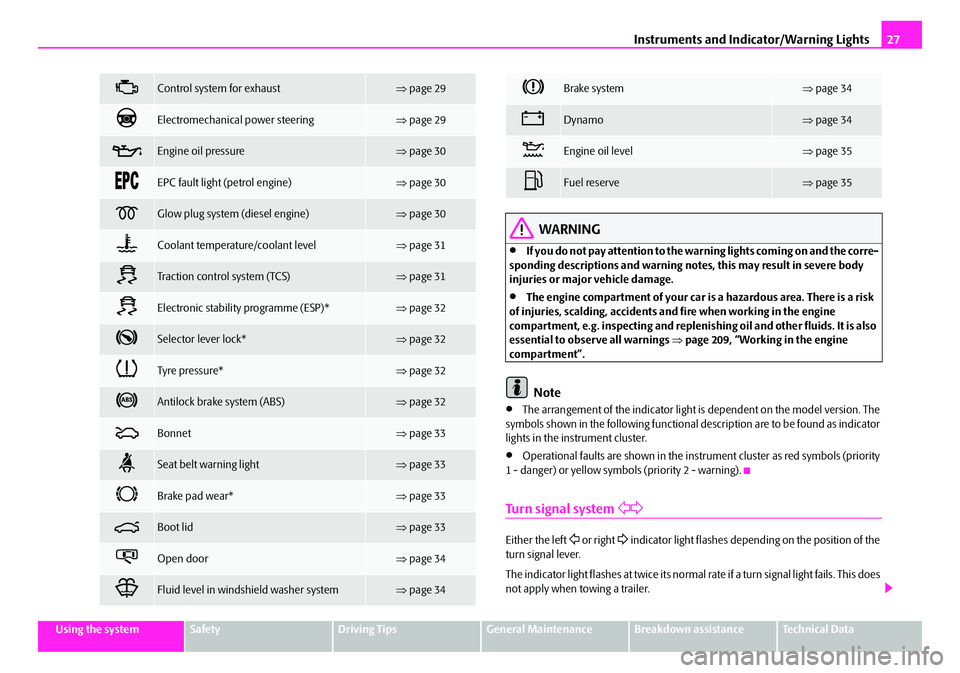
lights in the instrument cluster.
•Operational faults are shown in the instrument cluster as red symbols (priority
1 - danger) or yellow symbols (priority 2 - warning).
Turn signal system
Either the left or right indicator light flashes depending on the position of the
turn signal lever.
The indicator light flashes at twice its normal rate if a turn signal light fails. This does
not apply when towing a trailer.
Control system for exhaust⇒ page 29
Electromechanica l power steering⇒page 29
Engine oil pressure⇒page 30
EPC fault light (petrol engine)⇒page 30
Glow plug system (diesel engine)⇒page 30
Coolant temperature/coolant level⇒page 31
Tra c t i o n c o n t r o l s y s t e m ( TC S )⇒page 31
Electronic stability programme (ESP)*⇒page 32
Selector lever lock*⇒page 32
Tyre pressure*⇒page 32
Antilock brake system (ABS)⇒page 32
Bonnet⇒page 33
Seat belt warning light⇒page 33
Brake pad wear*⇒page 33
Boot lid⇒page 33
Open door⇒page 34
Fluid level in windshield washer system⇒page 34
Brake system⇒page 34
Dynamo⇒page 34
Engine oil level⇒page 35
Fuel reserve⇒page 35
NKO B6 20.book Page 27 Wednesday, March 26, 2008 3:15 PM
Page 30 of 272

Instruments and Indicator/Warning Lights29
Using the systemSafetyDriving TipsGeneral MaintenanceBreakdown assistanceTechnical Data
Have the vehicle inspected without
delay by your specialist garage.
WARNING
•If you do not pay attention to the warning light coming on and the corre-
sponding descriptions and warning notes, this may result in injuries or
major vehicle damage.
•Always adjust your speed to suit weather, road, region and traffic condi-
tions. The route indicated by the warning light must not tempt you to disre-
gard the national regulations for road traffic.
Caution
As long as the warning light lights up, one must take into account an increased
fuel consumption and in certain circumst ances a power reduction of the engine.
Note
Further information about diesel particle filter ⇒page 186.
Airbag system
Monitoring the airbag system
The warning light
comes on for a few seconds when the ignition is switched on.
There is a fault in the system if the warning light does not go out or flashes while
driving ⇒. This also applies if the warning light does not come on when the igni-
tion is switched on.
The following text will be displayed in the information display*:
Airbag fault!
The functionality of the airbag system is also monitored electronically, when one
airbag has been switched off
Front, side and head airbags or belt tensioner which have been switched off
using the vehicle system tester:
•The warning light lights up for 4 seconds after switching on the ignition and
then flashes again for 12 seconds afterwards in 2 second intervals.
The following text will be displayed in the information display*:
Airbag/belt tensioner deactivated!
Front passenger airbags switched off using the switch for front passenger
airbags* in stowage compartmen t on the front passenger side:
•The warning light comes on for 4 seconds after the ignition has been
switched on.
•Switching off airbags is indicated in the middle of the dash panel by the lighting
up of the warning light (airbag switched off) ⇒ page 169.
WARNING
Have the airbag system checked immediat ely by a specialist garage if a fault
exists. Otherwise, there is a risk of th e airbag not being activated in the event
of an accident.
Control system for exhaust
The warning light comes on after the ignition has been switched on.
If the warning light does not go out after starting the engine or it lights up when
driving, a fault exists in an exhaust rele vant component. The engine management
system selects an emergency programme which enables you to drive to the nearest
specialist garage by adopting a gentle style of driving.
Electromechanical power steering
The warning light comes on for a few seconds when the ignition is switched on.
If the warning light after switching on the ignition or when driving lights up contin-
uously, a fault exists in the el ectromechanical power steering.
•If the yellow warning light lights up, this indicates a partial failure of the power
steering and the steering forces can be greater.
NKO B6 20.book Page 29 Wednesday, March 26, 2008 3:15 PM
Page 32 of 272
Instruments and Indicator/Warning Lights31
Using the systemSafetyDriving TipsGeneral MaintenanceBreakdown assistanceTechnical Data
If the
warning light
begins to flash while driving, a fault exists in the engine
control. The engine management system selects an emergency programme which
enables you to drive to the nearest specialist garage by adopting a gentle style of
driving.
The following text will be displayed in the information display*:
Engine fault Workshop!
Coolant temperature/ Coolant quantity
The warning light comes on for a few seconds 4) w h e n th e i g ni t i o n i s s w i t c h e d o n .
The coolant temperature is too high or the coolant level too low if the warning light
does not go out or flashes while driving.
3 peeps sound as an additional warning signal.
In this case stop and switch the engine off and check the coolant level; top up the
coolant as necessary.
Do not continue your journey if for some reason it is not possible under the
conditions prevailing to top up with coolant. Keep the engine switched off and
obtain professional assistance from a specialist garage, otherwise it could lead to
severe engine damage.
If the coolant is within the specified range, the increased temperature may be
caused by an operating problem at the coolant fan. Check the fuse for the coolant
fan, replace it if necessary ⇒page 242, “Fuse assignment in engine compartment -
version 1” or ⇒ page 244, “Fuse assignment in en gine compartment - version 2”.
Do not continue driving if the warning light does not go off although the fluid is at
the correct level and also the fuse of the fa n is in proper order. Contact a specialist
garage to obtain assistance.
Please also refer to the additional instructions ⇒page 213, “Cooling system”. The following text will be displayed in the information display*:
Check coolant! Owner's manual
WARNING
•If you must stop for technical reasons, then park the vehicle at a safe
distance from the traffic and switch off the engine and switch on the hazard
warning light system ⇒ page 59.
•Take care when opening the coolant expansion bottle. If the engine is hot,
the cooling system is pressurized - risk of scalding! It is best to allow the
engine to cool down before removing the cap.
•Do not touch the coolant fan The coolant fan may switch on automati-
cally even if the ignition is off.
Traction control system (TCS)
The warning light comes on for a few seconds when the ignition is switched on.
The warning light comes on when driving when a control cycle is activated.
The warning light will come on and remains on if the TCS is switched off or if there
is a fault in the system.
The fact that the TCS system operates together with the ABS means that the TCS
warning light will also come on if the ABS system is not operating properly.
If the warning light
comes on immediately after starting the engine, the TCS
system can be switched off for technical reasons. In this case, the TCS system can
be switched on again by swit ching the ignition on and off. If the warning light goes
out, the TCS system is fully functional again.
Further information about the TCS ⇒page 181, “Traction control system (TCS)”.
Note
If the battery has been disconnected and reconnected, the warning light comes
on after switching on the ignition. The warn ing light must go out after driving a short
distance.4)The warning light on vehicles fitted with information display does not come on after
switching the ignition on, but only if the coolant temperature is too high or the coolant level
is too low.
NKO B6 20.book Page 31 Wednesday, March 26, 2008 3:15 PM
Page 34 of 272

Instruments and Indicator/Warning Lights33
Using the systemSafetyDriving TipsGeneral MaintenanceBreakdown assistanceTechnical Data
a specialist garage as quickly as possible and adjust your style of driving in the
meantime since you will not kn
ow how great the damage is.
Further information about ABS ⇒page 183, “Antilock brake system (ABS)”.
A fault in the entire brake system
If the ABS warning light
comes on together with the brake system warning light (handbrake must be released), there is a fault not only in the ABS but also in
another part of the brake system ⇒.
WARNING
•If the brake system warning light comes on together with the ABS
warning light stop the vehicle immediatel y and check the brake fluid
level in the reservoir ⇒page 215, “Brake fluid”. If the fluid level has dropped
below the MIN marking, do not drive any further - risk of accident! Contact
a Škoda dealer to obtain professional assistance.
•Pay attention to the following instructions ⇒page 209, “Working in the
engine compartment” before checking the brake fluid level and opening the
bonnet.
•If the brake fluid is at the correct level, the ABS control function has
failed. The rear wheels may then block very rapidly when braking. In certain
circumstances, this can result in the rear end of the car breaking away - risk
of skidding! Drive carefully to the ne arest specialist garage and have the
fault rectified.
Bonnet *
The warning light comes on if the bonnet is unl ocked. If the engine bonnet
unlocks while driving , the warning light lights up and an audible signal sounds.
The warning light comes on even when the ignition is switched off. The warning
light lights up for a maximum of 5 minutes.
On vehicles with information display* th is warning light is replaced by a vehicle
symbol ⇒page 21, fig. 14 .
Seat belt warning light
The warning light comes on after the ignition is switched on as a reminder for the
driver and front passenger to fasten the seat belt. The warning light only goes out if
the driver or front passenger has fastened his seat belt.
If the seat belt has not been fastened by the driver or front passenger, a permanent
warning signal sounds at vehicle speeds greater than 20 km/h and simultaneously
the warning light
flashes.
If the seat belt is not fastened by the dr iver or front passenger during the next 90
seconds, the warning signal is deactivated and the warning light
lights up perma-
nently.
Further information on the seat belts ⇒page 154, “Seat belts”.
Thickness of the brake pads *
The warning light comes on for a few seconds 5) when the ignition is switched
on.
If the warning light
comes on, contact a specialist garage immediately and have
the brake pads on all of the wheels inspected.
The following text will be displayed in the information display*:
Check brake pads!
Boot lid *
The warning light comes on when the ignition is switched on if the luggage
compartment door is open. If th e boot lid opens while driving , the warning light
lights up and an audible signal sounds.
An audible signal sounds as an additional warning signal.
5)The warning light on vehicles fitted with information display does not come on after
switching the ignition on, but only if a fault exists.
NKO B6 20.book Page 33 Wednesday, March 26, 2008 3:15 PM
Page 36 of 272
Instruments and Indicator/Warning Lights35
Using the systemSafetyDriving TipsGeneral MaintenanceBreakdown assistanceTechnical Data
Caution
If the warning light comes on when driving and in addition the warning light
(cooling system fault) also comes on in di splay, you must then stop the car imme-
diately and switch the engine off - risk of engine damage!
Engine oil level*
Warning light lights up
If the warning light
lights up, the quantity of oil in the engine is probably too low.
Check as soon as possible the oil level or top up ⇒page 212 with engine oil.
A peep sounds as an addi tional warning signal.
The following text will be displayed in the information display*: Check oil level!
The warning light will go out if the bonnet is left open for more than 30 seconds. If
no engine oil has been replenished, the warning light will come on again after
driving about 100 km.
Warning light
flashes
A fault on the engine oil level sensor is indicated additionally by an audible signal
and the warning light coming on several times after the ignition has been switched
on.
In this case have the engine inspected without delay by a specialist garage.
The following text will be displayed in the information display*:
Oil sensor Workshop!
Fuel reserve
The warning light comes on, if the fuel level is still below 9 litres.
An audible signal sounds as an additional warning signal. The following text will be displayed in the information display*:
Please refuel! Range...km
Note
The Text in the information display* goes out only after refuelling and driving a
short distance.
NKO B6 20.book Page 35 Wednesday, March 26, 2008 3:15 PM
Page 38 of 272

Unlocking and locking37
Using the systemSafetyDriving TipsGeneral MaintenanceBreakdown assistanceTechnical Data
the batteries of the key replaced by a Škoda Service Partner. You should,
however, proceed as follows if you wi sh to replace the battery yourself:
– Fold open the key.
– Use a thin screwdriver to carefully lever off the front part of the key
⇒ page 36, fig. 23 from the transmitter housing .
– Take off the cover of the transmitter housing ⇒page 36, fig. 24 in
direction of arrow.
– Take the used battery out of the housing cover.
– Insert the new battery. Ensure that the “+” symbol on the battery is facing downwards. The correct polarity is also shown on the cover of
the transmitter housing.
– Insert cover with battery in place at the rear of the transmitter housing and press both parts together.
– Insert the transmitter housing into th e front part of the key so that the
two parts lock into each other.
For the sake of the environment
Dispose of an old battery in accordance with environm ental regulations.
Note
•The replacement battery must have the same specification as the original
battery.
•If it is still not be possible to unlock or lock the vehicle with the remote control
even after replacing the battery this mean s that the system has to be synchronised
⇒ page 45.
Electronic immobiliser
The electronic immobiliser prevents the vehicle being operated by an
unauthorised person.
An electronic chip is integrated in the he ad of the key. The immobiliser is deacti-
vated with the aid of this chip when the key is inserted in the ignition lock. The elec-
tronic immobiliser is automatically activated when you withdraw the ignition key
from the lock.
Note
It is only possible to start the engine of your car with a Genuine Škoda key with the
matching code.
Child safety lock
The child safety lock prevents the rear door from being opened from
the inside.
The rear doors are equipped with a child safety lock. You can switch the
child safety lock on and off using the vehicle key.
AA
AB
Fig. 25 Child safety locks on
the rear doors
NKO B6 20.book Page 37 Wednesday, March 26, 2008 3:15 PM
Page 40 of 272

Unlocking and locking39
Using the systemSafetyDriving TipsGeneral MaintenanceBreakdown assistanceTechnical Data
Note
•In the event of an accident in which the airbags are deployed, the locked doors
are automatically unlocked in order to enable rescuers to gain access to the vehicle.
•Only the driver's door can be unlocked using the key if the central locking
system fails ⇒ page 40, “Emergency unlocking and locking of the driver's door”.
You can lock or unlock manually the other doors and the boot lid.
−Emergency locking of the door ⇒page 41.
− Emergency unlocking of the boot lid ⇒page 43.
Safe securing
The central locking system is equipped with a safe securing system. Locking the
vehicle from the outside causes the door lock s to be automatically blocked. It is not
possible to open the doors with the door ha ndle either from the inside or from the
outside. This acts as an effective deterrent for attempts to break into your vehicle.
You can deactivate the safe securing syst em by locking two times within 2 seconds.
If the safe securing system is not operating:
•the indicator light in the driver door flashes for about 2 seconds fast, goes out
and starts to flash slowly after about 30 seconds,
•is the filler flap locked.
The safe securing system is again activate d the next time the vehicle is unlocked and
locked again.
If the vehicle is locked and the safe secu ring system is deactivated, you can open
the vehicle from the inside by pulling on the handle.
WARNING
If the vehicle is locked from the outside and the safe securing system is acti-
vated, there must not be any person and animals in the vehicle as it is then
not possible to open either a door or a window from the inside. The locked
doors make it more difficult for rescuers to get into the vehicle in an emer-
gency - hazard!
Note
The anti-theft alarm system* is also acti vated with the deactivated safe securing
system when locking the vehicle. The inte rior monitor* is however not activated.
Buttons for the central locking system
If the vehicle was not locked from outside, you can also unlock and lock
it with the rocker switch on the hand le of the driver or front passenger
door even without the ignition switched on.
Locking all doors and the boot lid
– Press on the bottom part of the button ⇒fig. 26 . The symbol
in the
button comes on.
Unlocking all doors and the boot lid
– Press on the top part of the button ⇒fig. 26 . The symbol
goes out
in the button.
The following applies if you have locked your vehicle using the central locking
system:
Fig. 26 Central locking
switch
NKO B6 20.book Page 39 Wednesday, March 26, 2008 3:15 PM
Page 42 of 272

Unlocking and locking41
Using the systemSafetyDriving TipsGeneral MaintenanceBreakdown assistanceTechnical Data
Emergency locking of the doors
An emergency locking mechanism is located on the face side of the doors
which have no locking cylinder; it is only visible after opening the door.
Lock the doors using the vehicle key.
Locking
– Remove the panel ⇒fig. 28 .
– Guide the key into the slot and turn it to the outside.
– Re-insert the panel.
After closing the door, you can no longer op en it from outside. If the child safety
lock is not switched on, it is possible to op en the door from the inside by pulling on
the door handle. If the child safety lock is switched on, it is necesary to also open
the door from outside besides pulling on the inner door handle.
Twindoor - small boot lid
After unlocking the vehicle using the remote control or the key ⇒page 40
you can open the small boot lid ⇒fig. 30 .
Open small boot lid
– Press on the handle at the bottom side of the boot lid ⇒fig. 29 , the
boot lid lifts up automatically ⇒fig. 30 .
Close small boot lid
– Pull the boot lid down and close it with a slight swing ⇒. The
bonnet locks automatically.
Fig. 28 Rear door: Emer-
gency locking of the doorFig. 29 Handle of boot lid
Fig. 30 Boot lid
NKO B6 20.book Page 41 Wednesday, March 26, 2008 3:15 PM
Page 44 of 272

Unlocking and locking43
Using the systemSafetyDriving TipsGeneral MaintenanceBreakdown assistanceTechnical Data
Close large boot lid
– Pull the boot lid down and close it with a slight swing ⇒. The
bonnet locks automatically.
A handle which makes the clos ing easier is located on the inner paneling of the
boot lid.
WARNING
•Ensure that the lock is properly enga ged after closing the boot lid. Other-
wise, the boot lid might open suddenly wh en driving even if the boot lid lock
is closed - risk of accident!
•Never drive with the boot lid fully opened or slightly ajar otherwise
exhaust gases may get into the interior of the vehicle - risk of poisoning!
Note
•After closing the boot lid, it is automatically locked within 2 seconds and
the anti-theft alarm system* is activated. This applies only if the vehicle was
locked before closing the boot lid.
•The function of the hand grip on the bottom edge of the boot lid is deactivated
after starting off or as of a speed of more than 5 km/hour. The function of the hand
grip is acitvated again after stopping the vehicle and after opening the driver or
front passenger door or after pressing the button on the remote control
⇒ page 44.
Emergency unlocking of the boot lid
If there is a fault in the central locking, you can open the boot lid as
follows:
– Fold the rear seats forwards ⇒page 76.
– Guide the key into the slot in the trip panel as far as the stop ⇒fig. 33 .
– You can unlock the boot lid by the movement in the direction of arrow.
– Open the boot lid/luggage compartment door from outside.
Remote control
Description
You can use the remote control:
•to unlock and lock the car,
•unlock or open the boot lid,
•opening and closing window.
A1
Fig. 33 Emergency
unlocking of the boot lid
NKO B6 20.book Page 43 Wednesday, March 26, 2008 3:15 PM
Page 46 of 272

Unlocking and locking45
Using the systemSafetyDriving TipsGeneral MaintenanceBreakdown assistanceTechnical Data
Folding up of the key
– Press button and collapse the key bit in the housing.
The turn signal lights flash twice as confirmation that the vehicle has been
unlocked. The vehicle will lock again auto matically if you unlock the vehicle using
button but do not open a door or the boot lid within the next 30 seconds. This
function is intended to prevent th e car being unlocked unintentionally.
In addition, when the car is unlocked, the power seats and exterior mirrors* move
into the position assigned to this key. The stored setting of driver seat and exterior
mirrors is retrieved.
The interior lights and the lighting of th e entry area are automatically switched on
or off (if they have been set to operat e via door contact) when unlocking and
locking the vehicle.
Display of the locking
The turn signal lights flash once to co nfirm that the vehicle has been correctly
locked.
If the doors or the boot lid remain open after the vehicle has been locked, the turn
signal lights do not flash unt il they have been closed.
WARNING
If the vehicle is locked from the outside and the safe securing system is acti-
vated, there must not be any person in the vehicle as it is then not possible
to open either a door or a window from the inside. The locked doors make it
more difficult for rescuers to get into the vehicle in an emergency - hazard!
Note
•Operate the radio remote control only when the doors and boot lid are closed
and you have visual contact with the vehicle.
•Once in the car, you must not press the lock button of the radio remote
control before inserting the key into the igni tion lock in order to avoid the car being
inadvertently locked and, in addition, the anti-theft alarm system* being switched
on. Should this happen, press the unlock button
of the radio remote control.
Synchonisation of the remote control
If the vehicle cannot be unlock ed by actuating the remote control system then it is
possible that the code in the key and the control unit in the vehicle are no longer
synchronised. This can occur when the butt ons on the radio-operated key are actu-
ated a number of times outside of the operative range of the equipment or the
battery on the remote control was replaced.
This means it is necessary to synchronise the code as follows:
•Press any button on the remote control.
•after pressing the button, the door must be unlocked using the key within 1
minute ⇒ page 40, “Emergency unlocking and locking of the driver's door”.
Anti-theft alarm system*
Description
The anti-theft alarm system increases the level of protection against people seeking
to break into the vehicle. The system triggers audible and visual warning signals if
an attempt is made to break into the vehicle.
How is the alarm system activated?
The anti-theft alarm system is activated automatically when the vehicle is locked
with the key in the driver's door or by using the radio remote control ⇒page 40,
“Emergency unlocking and locking of the driver's door”. The door contact moni-
toring is activated approx. 15 seconds after the locking. The interior and the towing
protection monitoring are activated approx. 30 seconds after the locking. If a door
is opened during activation, the monito ring is only activated 5 seconds after
closing.
How is the alarm system deactivated?
The anti-theft alarm system is deactivate d by pressing the unlock button on the
remote control. The vehicle is automati cally locked again if the vehicle is not
opened within 30 seconds after reactivating the anti-theft alarm system.
A4
A1
NKO B6 20.book Page 45 Wednesday, March 26, 2008 3:15 PM