child lock SKODA SUPERB 2008 Owner´s Manual
[x] Cancel search | Manufacturer: SKODA, Model Year: 2008, Model line: SUPERB, Model: SKODA SUPERB 2008Pages: 252, PDF Size: 16.33 MB
Page 143 of 252
Vehicles with automatic transmission1)
The engine will not start if the brake pedal is not depressed.
The following message is shown in the instrument cluster display. Depress the brake to start.
BRAKE
CAUTION
■ If the engine does not start-up after a second attempt, one of the following
fuses may be defective. ■ Petrol engine - fuse for the electric fuel pump.
■ Diesel engine - fuse for the control unit for glow plugs or glow plug relay
and fuel pump.■
Check the fuse and replace if necessary » page 220, or seek assistance from
a specialist garage.
Stopping the engine
Read and observe
and on page 138 first.
Switch off the engine by turning the ignition key to position
1
» Fig. 134 on
page 139 .
For vehicles with automatic transmission, the ignition key can only be removed
if the selector lever is in position P.
Starting and stopping the engine - KESSY
Introduction
This chapter contains information on the following subjects:
Steering lock / unlock
141
Ignition on/off
141
Starting the engine
142
Switching off the engine
142
Emergency start-up of the engine
142
Emergency ignition shutoff system
143The KESSY system (Keyless Entry Exit System, hereinafter referred to only as
system) allows the switching on or switching off of the ignition and starting or
stopping of the engine without the active use of the key.
A key must be in the vehicle to unlock the steering, switch on the ignition and
start the vehicle. When travelling the key must be in the vehicle.
The engine running noises may louder at first be louder for a short time after starting the cold engine. This is quite normal and is not an operating problem.WARNING■ Never leave the key in the vehicle when you exit the vehicle. Unauthor-
ized persons, such as children, for example, could lock the car, turn on the
ignition or start the engine - there is a danger of injury and accidents!■
Never leave the vehicle unattended with the engine running - there is a
risk of theft etc!
■
Never switch off the engine before the vehicle is stationary – risk of acci-
dent!
WARNING■ Never leave the engine running in unventilated or closed rooms. The en-
gine's exhaust gases also contain the odourless and colourless carbon
monoxide, a poisonous gas – risk of death. ■ Carbon monoxide can cause unconsciousness and death.
CAUTION
■The system can recognize the valid key, even if it has been forgotten, for ex-
ample, in the front of the vehicle roof D » Fig. 34 on page 53 - There is danger
of loss or damage to the key! It is therefore not always necessary to know
where the key is.■
The starter must only be operated when the engine is not running and the
vehicle is at a standstill. The starter or engine may be damaged if the starter is
activated when the engine is running.
■
Do not tow start the engine – there is a risk of damaging the engine and the
catalytic converter. The battery from another vehicle can be used as a jump-
start aid » page 211 , Jump-starting .
1)
Applies to vehicles with START STOP system.
140Driving
Page 180 of 252
Automatic car wash systemsRead and observe
and on page 176 first.
The usual precautionary measures must be taken before washing the vehicle
in an automatic car wash system (e.g. closing the windows and the sliding/tilt-
ing roof etc.).
If your vehicle is fitted with any particular attached parts, such as a spoiler,
roof rack system, two-way radio aerial etc., it is best to consult the operator of
the car wash system beforehand.
After an automatic wash with wax treatment, the lips of the wipers should be
cleaned with cleaning agents specially designed for the purpose, and then de-
greased.
WARNINGFold in the exterior mirrors to prevent damage before washing the vehicle
in an automatic car wash system. Never manually fold in electric exterior
mirrors - always use the electric controls.
Washing with a high-pressure cleaner
Read and observe
and on page 176 first.
When washing the vehicle with a high-pressure cleaner, the instructions for
use of the equipment must be observed. This applies in particular to the pres-
sure used and to the spraying distance .
Maintain a sufficiently large distance to the parking aid sensors and soft mate-
rials such as rubber hoses or insulation material.
WARNINGNever use circular spray nozzles or dirt cutters!
CAUTION
■ If washing the vehicle in the winter using a hose or high-pressure cleaner,
ensure that the jet of water is not aimed directly at the locking cylinders or the
door/panel joints – risk of freezing!■
To avoid damaging the parking aid sensors while cleaning with high-pressure
cleaners or steam jets, the sensors must only be directly sprayed for short pe-
riods while a minimum distance of 10 cm must be observed.
■ The temperature of the water used for cleaning must not exceed 60 °C – risk
of damaging the vehicle.■
See also Washing cars with decorative films using a high-pressure clean-
er » page 179 .
Taking care of your vehicle exterior
Introduction
This chapter contains information on the following subjects:
Taking care of your vehicle's paintwork
178
Plastic parts
178
Rubber seals
178
Chrome parts
178
Decorative films
179
Windows and exterior mirrors
179
Headlight lenses
179
Door lock cylinders
179
Cavity protection
180
Jack
180
Wheels
180
Towing device and mounting recess
180
Underbody protection
180
We recommend using vehicle care products from ŠKODA Original Accessories.
These are available from ŠKODA Partners. The usage instructions on the pack-
age must be observed.
WARNING■ Vehicle care products may be harmful to your health if not used according
to the instructions.■
Always keep the vehicle care products safe from people who are not com-
pletely independent, e.g. children - there is a danger of poisoning!
■
Protect your hands and arms from sharp-edged metal parts when clean-
ing the underfloor, the inside of the wheel housings or the wheel trims –
risk of cuts!
177Car care
Page 190 of 252
WARNING (Continued)■Avoid short circuits in the electrical system - particularly on the vehicle's
battery.■
Always make sure that no jewellery, loose clothing or long hair can get
caught in rotating engine parts – risk to life! Always remove any jewellery,
tie back long hair and wear tight fitting clothing before completing any
work.
WARNINGInformation for working on the fuel system or the electrical system■Always disconnect the vehicle battery from the electrical system.■
Do not smoke.
■
Never work near open flames.
■
Always have a functioning fire extinguisher nearby.
WARNING■ Read and observe the information and warning instructions on the fluid
containers.■
Keep the working fluids in sealed original containers and safe from peo-
ple who are not completely independent, e.g. children.
■
If you intend to work underneath the vehicle, you must secure the vehicle
from rolling away and support it with suitable supporting blocks; the car
jack is not sufficient – risk of injury!
CAUTION
Always top up using the correct specification of fluids. This may result in major
operating problems and also vehicle damage!
For the sake of the environment
In view of the requirements for the environmentally friendly disposal of fluids and the special tools and knowledge required for such work, we recommend
that fluids be changed by a specialist garage.
Note
■ Please consult a specialist garage for any questions relating to fluids.■Fluids with the proper specifications can be purchased from the ŠKODA Origi-
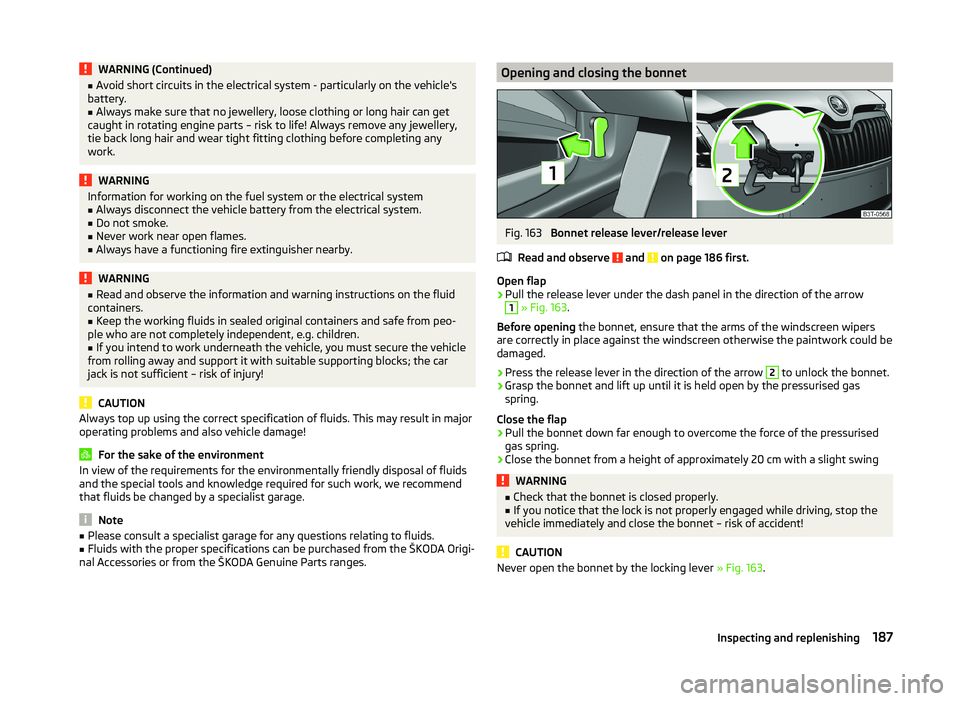
nal Accessories or from the ŠKODA Genuine Parts ranges.Opening and closing the bonnetFig. 163
Bonnet release lever/release lever
Read and observe
and on page 186 first.
Open flap
›
Pull the release lever under the dash panel in the direction of the arrow
1
» Fig. 163 .
Before opening the bonnet, ensure that the arms of the windscreen wipers
are correctly in place against the windscreen otherwise the paintwork could be
damaged.
›
Press the release lever in the direction of the arrow
2
to unlock the bonnet.
›
Grasp the bonnet and lift up until it is held open by the pressurised gas
spring.
Close the flap
›
Pull the bonnet down far enough to overcome the force of the pressurised
gas spring.
›
Close the bonnet from a height of approximately 20 cm with a slight swing
WARNING■ Check that the bonnet is closed properly.■If you notice that the lock is not properly engaged while driving, stop the
vehicle immediately and close the bonnet – risk of accident!
CAUTION
Never open the bonnet by the locking lever » Fig. 163.187Inspecting and replenishing
Page 240 of 252
BootAutomatic retraction (Superb Combi)101
Extending variable loading floor105
Folding hook99
Non-closable side pocket (Superb Combi)102
Removable Light (Superb Combi)103
Roll up boot cover (Superb Combi)101
Side compartment with battery102
Boot cover (Superb Combi)101
Boot lid57
automatic locking58
Warning light36
(Superb Combi)58
Brake booster144
Brake fluid192
Checking193
Information messages35
specification193
Brake linings warning light
41
Brakes Brake assist systems
154
Brake booster144
Brake fluid193
Handbrake144
Information messages35
Running in149
Warning light35
Braking Information on braking
143
Break recommendation See Fatigue detection
165
Button in the driver's door Electrical power windows
61
C
Car care
173
Jack180
Car computer See multifunction display
44
Car park ticket holder89
Carrier Roof rack
108
Cavity protection180
CD changer136
Central locking50
Central locking button55
Changing brake fluid
193
bulbs223
Wheels205
Changing a wheel Follow-up work
206
Preliminary work206
Remove and attaching a wheel206
Changing brake fluid
193
Charging a vehicle battery196
Check Fit ball head properly
168
Checking Battery electrolyte level
195
Brake fluid193
Coolant192
Engine oil190
Oil level190
Windscreen washer fluid188
Checks Statutory checks
173
Children and safety22
Child safety Side airbag
24
Child safety lock55
Child seat Classification
25
ISOFIX25
on the front passenger seat23
TOP TETHER27
Use of child seats25
Use of ISOFIX child seats26
Chrome parts refer to Taking care of your vehicle178
Cigarette lighter91
Cleaning Alcantara
182
Covers of electrically heated seats182
Fabrics182
Headlight lenses179
Natural leather181
Plastic parts178
Synthetic leather182
Wheels180
Cleaning the vehicle Towing device
180
Cleaning vehicle176
Climatronic115
Air recirculation117
automatic mode116
Control elements115
Controlling blower118
Cooling system116
Defrosting windscreen118
Setting the temperature116
Clothes hook94
Cockpit 12-Volt power outlet
92
Ashtray91
Cigarette lighter91
General view29
Lighting73
Practical features88
Storage compartments88
Comfort control window
63
COMING HOME72
Compartments88
Components of the puncture repair kits209
Computer See multifunction display
44
237Index
Page 241 of 252

Convenience operationsliding / tilting roof65
sliding / tilting roof (Superb Estate)67
Convenience turn signal70
Coolant191
Checking192
Messages36
Replenishing192
Temperature gauge31
Warning light36
CORNER See Fog lights with CORNER function
71
Correct seated position9
Driver9
Front passenger10
Instructions11
Rear seats11
Counter for distance driven32
Cruise control system Activating/deactivating
161
Changing the stored speed162
Storing and maintaining speed162
Switching off temporarily162
Warning light41
Cruise Control System161
Cup holders90
D
DAY LIGHT see Daylight running lights
69
Daylight running lights69
De-icing the windscreen and rear window75
Deactivating an airbag21
Decorative films179
Delayed locking of the boot lid see boot lid
58
Diesel refer to Fuel
185
diesel - particulate filter39
Diesel fuel Operation in winter
185
Diesel particulate filter warning light
39
Digital Clock Time
32
Dipstick190
Display31
Compass points48
Coolant temperature31
Fuel supply32
Gear changes43
Service intervals48
Display a low temperature43
Display of the second speed33
Distance driven32
Door Child safety lock
55
Closing52
Emergency locking217
Emergency locking the driver's door216
Opening52
Warning light for open door36
Door open Warning light
36
Driver Steering Recommendation (DSR)155
Driving Abroad
153
Driving through water on streets152
Emissions229
Fuel consumption229
Driving economically Economical gear changing
149
Driving through water152
DSR155
DVD-preinstallation136
E
Economical and environmentally friendly driv- ing
149
Economical driving Ballast
151
Driving at full throttle150
Idling150
Looking ahead149
Regular maintenance151
Saving energy151
Short distances150
Tyre pressure150
EDL Operation
155
Electrical power windows63
Button in the driver's door61, 62
Button in the rear doors63
Operational faults64
Electric boot lid Force limit
59
Manual operation59
Electric luggage compartment lid Acoustic signals
61
Adjusting the top lid position61
Deleting the top lid position61
Malfunctions61
Operating59
Electric sliding/tilting roof64
Electronic Differential Lock (EDL)155
Electronic immobilizer139
Electronic Stability Control (ESC)154
Emergency Activation of the sliding/tilting roof
218
Changing a wheel205
Hazard warning light system72
jump-starting211
Jump-starting211
Locking the door without a locking cylinder217
Locking the driver's door216
238Index
Page 246 of 252
S
SAFE see Safe securing
54
SAFELOCK see Safe securing
54
Safe securing54
Safety8
Child safety22
Child safety seats22
Correct seated position9
Head restraints83
ISOFIX25
TOP TETHER27
Saving electrical energy149
Screens see Sun screen in the rear doors
76
Seals Taking care of your vehicle
178
Seat belt warning light
35
Seat belts12
Belt tensioners15
Cleaning183
fastening and unfastening14
Height adjustment15
Inertia reels15
The physical principle of a frontal collision13
Seat features85
Seats Convenience features of passenger seat
87
Electric adjustment82
Front armrest87
Head restraints83
Heating85
Manually adjusting82
Rear armrest87
save84
Seat backrests87
Storing in memory of remote control key84
Ventilated front seats86
Seats and practical features81
Adjusting the seats81
see Automatic gearbox Manual gear shifting on the multifunction steering wheel
146
Selector lever Refer to Selector lever
145
Selector lever lock / starter (system KESSY) Warning light
41
Service174
Service interval display48
Setting32
Setting the32
Shelves88
Shifting gears Driving and saving energy
149
Side airbag19
Side compartment in boot with battery102
Side compartments in the luggage compart- ment
101
ski bag97
Sliding/tilting roof Close (Superb Combi)
66
Closing64
Closing the sun screen (Superb Combi)66
Electric sliding/tilting roof64
Emergency operation218
Opening/closing the sun screen (Superb Combi) 66
Opening and tilting
64
Opening and tilting (Superb Combi)66
Operation64
Operation (Superb Combi)66
Snow chains203
Spare wheel200
Speedometer31
See speedometer31
Speed symbol Refer to Wheels202
Spoiler175
Starting and stopping the engine - KESSY140
Starting and stopping the engine using the key 138
Starting engine Jump-starting
211
Starting the engine Jump-starting
211
Key139
see KESSY142
START STOP162
Information messages164
Jump-starting212
Manually deactivating/activating the system164
Operating conditions for the system163
operation in vehicles with automatic gearbox163
operation in vehicles with manual gearbox163
system related automatic start-up164
Steering lock / unlock see KESSY
141
Steering wheel10
Stopping the engine Key
140
Storage compartment in rear centre console95
Storage compartment on passenger side94
Storage compartments88
Storage compartment under passenger seat94
Storage pockets on the front seats95
Storing skis96
Sun screen76
Sun screen in the rear doors76
Sun visors76
Switch see Ignition
139
Switching off the engine see KESSY
142
Switch light on and off68
243Index
Page 247 of 252
Switch off ignitionRefer to KESSY141
Switch on ignition Refer to KESSY
141
Synchronous adjustment of the rear-view mir- ror
80
Synthetic leather182
T
Tailgate TwinDoor
58
Taking care of the vehicle Natural leather
181
Seat belts183
Taking care of your vehicle Automatic car wash system
177
Cavity protection180
Chrome parts178
Cleaning the wheels180
Decorative films179
Door lock cylinders179
Headlight lenses179
High-pressure cleaner177
Plastic parts178
Polishing the paintwork178
Rubber seals178
Taking care of the interior181
Taking care of your vehicle exterior177
Washing by hand176
Wash system177
Wax treatment178
Taking care of your vehicles Fabric covers
182
Technical data228
Telephone124, 126
Temporary spare wheel200
Tilting roof see Electric sliding/tilting roof
64
Tiptronic146
Tools205
TOP TETHER27
Towing213
Towing a trailer171
Towing device Description
167
Operation and maintenance180
Towing eye Front
214
Rear214
Towing protection56
Traction Control System (ASR)155
Trailer170
13-pin socket170
connection and disconnection170
Loading171
Safety eye170
Towing a trailer171
Trailer operation166
Trailer stabilisation172
Transport Luggage compartment
97
Roof rack108
Transporting children safely22
Triangle204
TSA172
Turn signal69
Turn signal system Warning light
41
Twindoor see boot lid
57
Two-way radio systems121
Tyre Explanation of the labelling
201
see wheels201
Tyre inflation pressure Warning light
40
Tyre load bearing capacity Refer to Wheels
201
Tyre pressure monitoring165
Save tyre pressure values166
Tyre repair Preparations
210
Pressure test211
Sealing and inflating the tyre210
Tyres197
Inflation pressure198
Sizes198
Tyre wear indicator198
Tyre size201
see wheels201
U
Umbrella Tray
95
Underbody protection180
Unleaded petrol153
Unlock Vehicle key
51
Unlocking Individual settings
54
KESSY53
Remote control52
Unlocking and locking50
Using the information system42
Using the selector lever145
V
Variable loading floor
104
Dividing the luggage compartment104
Remove104
slides off on aluminium rails105
Vehicle battery Automatic load deactivation
197
Charging196
Checking the battery electrolyte level195
Cover195
Disconnecting and reconnecting196
244Index