air condition SKODA SUPERB 2010 2.G / (B6/3T) Owner's Guide
[x] Cancel search | Manufacturer: SKODA, Model Year: 2010, Model line: SUPERB, Model: SKODA SUPERB 2010 2.G / (B6/3T)Pages: 287, PDF Size: 16.59 MB
Page 191 of 287
Intelligent Technology
190
been washed in an automatic vehicle wash , since the brake discs and brake pads may
be moist or even have a coatin g of ice on them in winter. Yo u s h o u l d d r y t h e b r a k e s a s
soon as possible by applying and releasing the brakes several times.
There also may be a certain delay before the full braking efficiency is available when
driving on roads which have been treated with road salt if you have not used the brakes
for some considerable time beforehand. The layer of salt on the brake discs and brake
pads must first be rubbed off when you apply the brakes.
Corrosion
Corrosion on the brake discs and dirt on th e bake pads occur if the vehicle has been
parked for a long period an d if you do not make much use of the braking system.
We recommend cleaning the brak e discs by firmly applying the brakes at a fairly high
speed if you do not make much use of the braking system or if surface corrosion is
present .
Faults in the brake surface
If you notice that the braking distance ha s suddenly become longer and that the brake
pedal can be depressed further, it is possible that a brake circuit of the dual-circuit
brake system has failed. Drive, in such cases, to the nearest specialist garage without
delay in order to have the problem rectified. Drive at a reduced speed while on your
way to the dealer and adapt your style of driving to the higher brake pedal pressure
required.
Low brake fluid level
An insufficient level of brake fluid may result in problems in the brake system. The level
of the brake fluid is monitored electronically page 35, “Brake system ”.
WARNING
Only apply the brakes for the purpose of drying and cleaning the brake discs
if the traffic conditions permit this. Do not place any other road users in jeop-
ardy.
When retrospectively mounting a front spoiler, solid wheel hubs etc. one
must ensure that the air supply to the front wheel brakes is not reduced other-
wise the braking system could run too hot.
Allow for the fact that new brake pads do not achieve their full braking effi-
ciency until approximately 200 kilometres. New brake pads must be first “run in” before they develop their optimal fric
tion force. You can, however, compen-
sate for this slightly reduced braking fo rce by increasing the pressure on the
brake pedal. This guideline also applie s to any new brake pads installed at a
future date.
Caution
Never allow the brakes to rub by applying sl ight pressure if you do not wish to brake
the vehicle. This causes the br akes to overheat and can also result in a longer braking
distance and excessive wear.
Before negotiating a steep downhill section, please reduce your speed, shift down
into the next lower gear (manual gearbox) or select a lower driving stage (automatic
gearbox). This enables you to make full us e of the braking power of the vehicle and
reduces the strain on the brakes. Any additional braking should be done intermittently,
not continuously.Note
The brake light flashes automatically in case of an emergency braking at speeds greater
than 60 km/h or with the intervention of th e ABS, which lasts longer than 1.5 seconds.
After the speed was reduced below 10 km/h or the vehicle was stopped, the brake light
stops flashing and the hazard warning light system switches on. The hazard warning
light system is switched of f automatically after accelerating or driving off again.Brake boosterThe brake booster boosts the pressure whic h you generate with the brake pedal. The
necessary pressure is only genera ted when the engine is running.
WARNING
Never switch off the engine befo re the vehicle is stationary.
The brake booster only operates when the engine is running. Greater phys-
ical effort for braking is required when en gine is switched off. Because if you do
not stop as normal, this can cause an accident and severe injuries.WARNING (continued)
s3fg.2.book Page 190 Friday, April 30, 2010 12:17 PM
Page 200 of 287

Driving and the Environment199
Using the system
Safety
Driving Tips
General Maintenance
Breakdown assistance
Technical Data
Checking tyre inflation pressures
Tyres which are correctly inflated save fuel.Always ensure that your tyres are inflated to the correct pressure at all times. The rolling
resistance will be increased if the tyre filling pressure is too low. This will not only
increase fuel consumption but also tyre we ar and the driving behaviour will worsen.
Always check the inflation pr essure of the tyres when cold.
Do not drive with winter tyres all year round for this costs about 10 % more fuel.
Winter tyres are also louder.No unnecessary ballast
Transporting ballast costs fuel.The fact that every kilogram of extra weight increases your fuel consumption means
that it is worth taking a look in the luggage compartment to avoid transporting any
unnecessary ballast.
It is particularly in town traffic, when one is accelerating quite often, that the vehicle
weight will have a significant effect upon the fuel consumption. A rule of thumb here
is that an increase in weight of 100 kilograms will cause an increase in fuel consump-
tion of about 1 litre/100 kilometres.
You may frequently also leave a roof rack fitted on just out of convenience, although
you no longer need it. The increased aerodyna mic drag of your vehicle causes it to use
about 10% more fuel than normal at a speed of 100 - 120 km/h, even when you are not
carrying a load on the roof.Saving electricity
Generating electricity costs fuel.– Switch off electrical components as soon as you no longer need them.
When the engine is running, the alternator generates and supplies electrical power.
The greater the load on the alternator as a result of having a large number of electrical
components switched on, the more fuel will be consumed for operating the
alternator.
Keeping a log of your fuel consumptionIf you really wish to keep a close check on your fuel consumption, it is best to enter
the figures in a logbook. This does not take much time but is a very worthwhile exer-
cise. It enables you to detect any change (p ositive and negative) at an early stage and
to take any appropriate action.
If you find that your fuel consumption is too high, you should reflect on how, where
and in what conditions you have driven the vehicle since you last refuelled.Environmental compatibilityEnvironmental protection has played a major role in the design, selection of materials
and manufacture of your new Škoda. Particular emphasis has been paid to a number
of aspects, including.
Design measures
joints designed to be easily detached,
simplified disassembly due to the modular structure system,
improved purity of different classes of materials,
Identification of all plastic parts in accordance with VDA Recommendation 260,
Reduced fuel consumption and exhaust emission CO
2,
Minimum fuel leakage during accidents,
Reduced noise.
Choice of materials
extensive use of recyclable material,
Air conditioning filled with CFC-free refrigerant,
no cadmium,
no asbestos,
Reduction in the “vaporisation” of plastics.
Manufacture
solvent-free cavity protection,
s3fg.2.book Page 199 Friday, April 30, 2010 12:17 PM
Page 202 of 287

Driving and the Environment201
Using the system
Safety
Driving Tips
General Maintenance
Breakdown assistance
Technical Data
Driving through bodies of water on roadsIn order to avoid damage to the vehicle wh en driving through bodies of water (e.g.
flooded roads), observe the following:
Determine the depth of the water when driv ing through bodies of water. The water
can reach at the maximum the web on the lower sill of the vehicle fig. 177 .
Drive no more than at walking speed. At a higher speed, a water wave can form in
front of the vehicle which can cause water to penetrate into the air induction system of
the engine or into other parts of the vehicle.
Never let the vehicle stand in the water, never drive backwards and do not switch
off the engine.
WARNING
Driving through water, mud, sludge etc. can reduce the braking power and
extend the braking distance - risk of accident!
Avoid sudden and severe braking manoeuvres immediately after driving
through bodies of water.
After driving through bodies of water, the brakes must be cleaned and dried
as soon as possible by intermittent braking. Only apply the brakes for the
purpose of drying and cleaning the brake discs if the traffic conditions permit
this. Do not place any other road users in jeopardy.
Caution
When driving through bodies of water, pa rts of the vehicle such as the engine,
gearbox, catalytic converter, chassis or electrics can be severely damaged.
Oncoming vehicles can generate water waves which can exceed the permissible
water level for your vehicle.
Potholes, mud or rocks can be hidden under the water making it difficult or impos-
sible to drive through the body of water.
Do not drive through salt water. The salt can lead to corrosion. Immediately rinse
all the parts of the vehicle, which came into contact with the salt water, with fresh
water.Note
After driving through a body of water, we recommend that the vehicle is checked by a
specialist garage.
Fig. 177 Web on the lower sill of the
vehicle
s3fg.2.book Page 201 Friday, April 30, 2010 12:17 PM
Page 251 of 287
Fuses and light bulbs
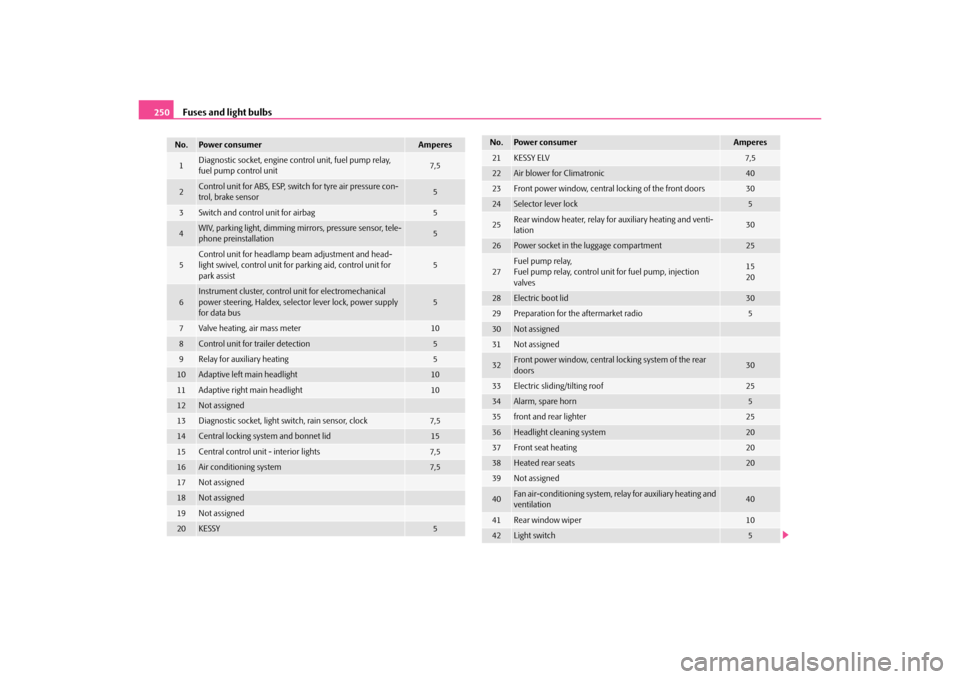
250No.
Power consumer
Amperes
1
Diagnostic socket, engine control unit, fuel pump relay,
fuel pump control unit
7,5
2
Control unit for ABS, ESP, switch for tyre air pressure con-
trol, brake sensor
5
3
Switch and control unit for airbag
5
4
WIV, parking light, dimming mirrors, pressure sensor, tele-
phone preinstallation
5
5
Control unit for headlamp beam adjustment and head-
light swivel, control unit for parking aid, control unit for
park assist
5
6
Instrument cluster, control unit for electromechanical
power steering, Haldex, selector lever lock, power supply
for data bus
5
7
Valve heating, air mass meter
10
8
Control unit for trailer detection
5
9
Relay for auxiliary heating
5
10
Adaptive left main headlight
10
11
Adaptive right main headlight
10
12
Not assigned
13
Diagnostic socket, light switch, rain sensor, clock
7,5
14
Central locking system and bonnet lid
15
15
Central control unit - interior lights
7,5
16
Air conditioning system
7,5
17
Not assigned
18
Not assigned
19
Not assigned
20
KESSY
5
21
KESSY ELV
7,5
22
Air blower for Climatronic
40
23
Front power window, central locking of the front doors
30
24
Selector lever lock
5
25
Rear window heater, relay for auxiliary heating and venti-
lation
30
26
Power socket in the luggage compartment
25
27
Fuel pump relay,
Fuel pump relay, control unit for fuel pump, injection
valves
15
20
28
Electric boot lid
30
29
Preparation for the aftermarket radio
5
30
Not assigned
31
Not assigned
32
Front power window, central locking system of the rear
doors
30
33
Electric sliding/tilting roof
25
34
Alarm, spare horn
5
35
front and rear lighter
25
36
Headlight cleaning system
20
37
Front seat heating
20
38
Heated rear seats
20
39
Not assigned
40
Fan air-conditioning system, re lay for auxiliary heating and
ventilation
40
41
Rear window wiper
10
42
Light switch
5
No.
Power consumer
Amperes
s3fg.2.book Page 250 Friday, April 30, 2010 12:17 PM
Page 258 of 287
Technical Data257
Using the system
Safety
Driving Tips
General Maintenance
Breakdown assistance
Technical Data
Te c h n i c a l D a t aTechnical DataGeneral informationThe details given in the official vehicle regi stration documents always take precedence
over the details in the Owner's Manual. Please refer to the official vehicle registration
documents or consult an authorised Škoda Service Partner concerning the engine with
which your vehicle is equipped.Used abbreviations
PerformancesThe listed performance values were de termined without performance-reducing
equipment, e.g. air conditioning system.WeightThe loading capacity is reduced in line with the range of the special equipment. The
unloaden weight contains a fuel tank topped up to 90%. A driver with a weight of 75
kg is also includ ed in the value.Identification detailsVehicle data sticker
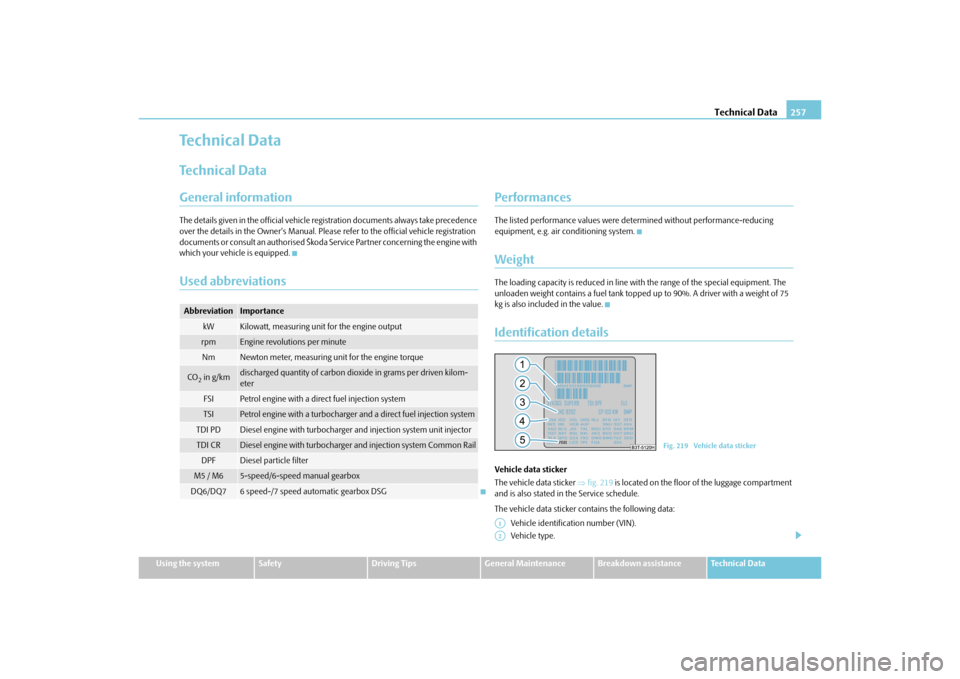
The vehicle data sticker fig. 219 is located on the floor of the luggage compartment
and is also stated in the Service schedule.
The vehicle data sticker co ntains the following data:
Vehicle identification number (VIN).
Vehicle type.
Abbreviation
Importance
kW
Kilowatt, measuring unit for the engine output
rpm
Engine revolutions per minute
Nm
Newton meter, measuring unit for the engine torque
CO2 in g/km
discharged quantity of carbon dioxide in grams per driven kilom-
eter
FSI
Petrol engine with a direct fuel injection system
TSI
Petrol engine with a turbocharger and a direct fuel injection system
TDI PD
Diesel engine with turbocharger and injection system unit injector
TDI CR
Diesel engine with turbocharger and injection system Common Rail
DPF
Diesel particle filter
M5 / M6
5-speed/6-speed manual gearbox
DQ6/DQ7
6 speed-/7 speed automatic gearbox DSG
Fig. 219 Vehicle data sticker
A1A2
s3fg.2.book Page 257 Friday, April 30, 2010 12:17 PM
Page 278 of 287
Index277
Using the system
Safety
Driving Tips
General Maintenance
Breakdown assistance
Technical Data
Index
AAbroad . . . . . . . . . . . . . . . . . . . . . . . . . . . . . . . . . . . . . . 200
ABS . . . . . . . . . . . . . . . . . . . . . . . . . . . . . . . . . . . . . . . . . 191
Warning light . . . . . . . . . . . . . . . . . . . . . . . . . . . . . 34
Accessories . . . . . . . . . . . . . . . . . . . . . . . . . . . . . . . . . . 234
Active driver-steering recommendation . . . . . . . 189
Adaptive headlights . . . . . . . . . . . . . . . . . . . . . . . . . . . 63 Warning light . . . . . . . . . . . . . . . . . . . . . . . . . . . . . 29
Adjusting seats . . . . . . . . . . . . . . . . . . . . . . . . . . 80, 162 electrically . . . . . . . . . . . . . . . . . . . . . . . . . . . . . . . . 81
Adjusting the steering wheel . . . . . . . . . . . . . . . . . . 121
AHL . . . . . . . . . . . . . . . . . . . . . . . . . . . . . . . . . . . . . . . . . . 63
Air conditioning system . . . . . . . . . . . . . . . . . . . . . . 111 Recirculated air mode . . . . . . . . . . . . . . . . . . . . 113
Airbag . . . . . . . . . . . . . . . . . . . . . . . . . . . . . . . . . . . . . . 170 Deployment . . . . . . . . . . . . . . . . . . . . . . . . . . . . . 171
Front airbag . . . . . . . . . . . . . . . . . . . . . . . . . . . . . . 171
Head airbag . . . . . . . . . . . . . . . . . . . . . . . . . . . . . . 176
Knee airbag . . . . . . . . . . . . . . . . . . . . . . . . . . . . . . 173
Side airbag . . . . . . . . . . . . . . . . . . . . . . . . . . . . . . . 174
Warning light . . . . . . . . . . . . . . . . . . . . . . . . . . . . . 30
Airbag system . . . . . . . . . . . . . . . . . . . . . . . . . . . . . . . 170 Warning light . . . . . . . . . . . . . . . . . . . . . . . . . . . . . 30
Alarm . . . . . . . . . . . . . . . . . . . . . . . . . . . . . . . . . . . . . . . . 50
Alternator Warning light . . . . . . . . . . . . . . . . . . . . . . . . . . . . . 36
Antilock brake system . . . . . . . . . . . . . . . . . . . . . . . . 191
Antilock brake system (ABS) Warning light . . . . . . . . . . . . . . . . . . . . . . . . . . . . . 34 Anti-theft alarm system . . . . . . . . . . . . . . . . . . . . . . . . 50
Ashtray . . . . . . . . . . . . . . . . . . . . . . . . . . . . . . . . . . . . . . . 99
Assigning the remote control key to the memory buttons
82
Auto Check Control . . . . . . . . . . . . . . . . . . . . . . . . . . . 24
Auto Computer . . . . . . . . . . . . . . . . . . . . . . . . . . . . . . . 19
Automatic driving lamp control . . . . . . . . . . . . . . . . 61
Automatic gearbox Emergency programme . . . . . . . . . . . . . . . . . . . 140
Automatic gearbox DSG . . . . . . . . . . . . . . . . . . . . . . 136 Kickdown . . . . . . . . . . . . . . . . . . . . . . . . . . . . . . . . 138
Selector lever-emergency unlocking . . . . . . . 140
Tiptronic . . . . . . . . . . . . . . . . . . . . . . . . . . . . . . . . . 139
Automatic rear window wiper (Combi) . . . . . . . . . . 75
Automatic seat adjustment . . . . . . . . . . . . . . . . . . . . 82
Automatic vehicle wash systems . . . . . . . . . . . . . . 205
Automatic wiper/washer system . . . . . . . . . . . . . . . 73
AUX-IN . . . . . . . . . . . . . . . . . . . . . . . . . . . . . . . . . . . . . . 159
Avoiding damage to your vehicle . . . . . . . . . . . . . . 200
BBattery . . . . . . . . . . . . . . . . . . . . . . . . . . . . . . . . . . 36, 222 change . . . . . . . . . . . . . . . . . . . . . . . . . . . . . . . . . . 226
Charge . . . . . . . . . . . . . . . . . . . . . . . . . . . . . . . . . . . 225
Inspecting the electrolyte level . . . . . . . . . . . . . 225
Operation in winter . . . . . . . . . . . . . . . . . . . . . . . 225
Before setting off . . . . . . . . . . . . . . . . . . . . . . . . . . . . . 161
Belt Warning light . . . . . . . . . . . . . . . . . . . . . . . . . . . . . . 35 Belt tensioners . . . . . . . . . . . . . . . . . . . . . . . . . . . . . . 168
Belts . . . . . . . . . . . . . . . . . . . . . . . . . . . . . . . . . . . . . . . 165
Bonnet . . . . . . . . . . . . . . . . . . . . . . . . . . . . . . . . . . 13, 215
Warning light . . . . . . . . . . . . . . . . . . . . . . . . . . . . . . 34
Boot lid . . . . . . . . . . . . . . . . . . . . . . . . . . . . . . . . . . . . . . . 44 Lighting . . . . . . . . . . . . . . . . . . . . . . . . . . . . . . . . . . . 69
Warning light . . . . . . . . . . . . . . . . . . . . . . . . . . . . . . 35
Brake Handbrake . . . . . . . . . . . . . . . . . . . . . . . . . . . . . . 124
Warning light . . . . . . . . . . . . . . . . . . . . . . . . . . . . . . 35
Brake Assist . . . . . . . . . . . . . . . . . . . . . . . . . . . . . . . . . 191
Brake booster . . . . . . . . . . . . . . . . . . . . . . . . . . . . . . . 190
Brake fluid . . . . . . . . . . . . . . . . . . . . . . . . . . . . . . . . . . 221
Brake pads Warning light . . . . . . . . . . . . . . . . . . . . . . . . . . . . . . 35
Brakes . . . . . . . . . . . . . . . . . . . . . . . . . . . . . . . . . . . . . . 189
Bulbs Warning light . . . . . . . . . . . . . . . . . . . . . . . . . . . . . . 29
Button for the central locking system . . . . . . . . . . . 42
Button in the driver's door Power windows . . . . . . . . . . . . . . . . . . . . . . . . . . . 52
CCar state . . . . . . . . . . . . . . . . . . . . . . . . . . . . . . . . . . . . . . 24
Catalytic converter . . . . . . . . . . . . . . . . . . . . . . . . . . 196
CD changer . . . . . . . . . . . . . . . . . . . . . . . . . . . . . . . . . 159
Central locking system . . . . . . . . . . . . . . . . . . . . . . . . . 38
Changing a wheel . . . . . . . . . . . . . . . . . . . . . . . . . . . 237
Changing bulbs . . . . . . . . . . . . . . . . . . . . . . . . . . . . . 251
s3fg.2.book Page 277 Friday, April 30, 2010 12:17 PM
Page 279 of 287
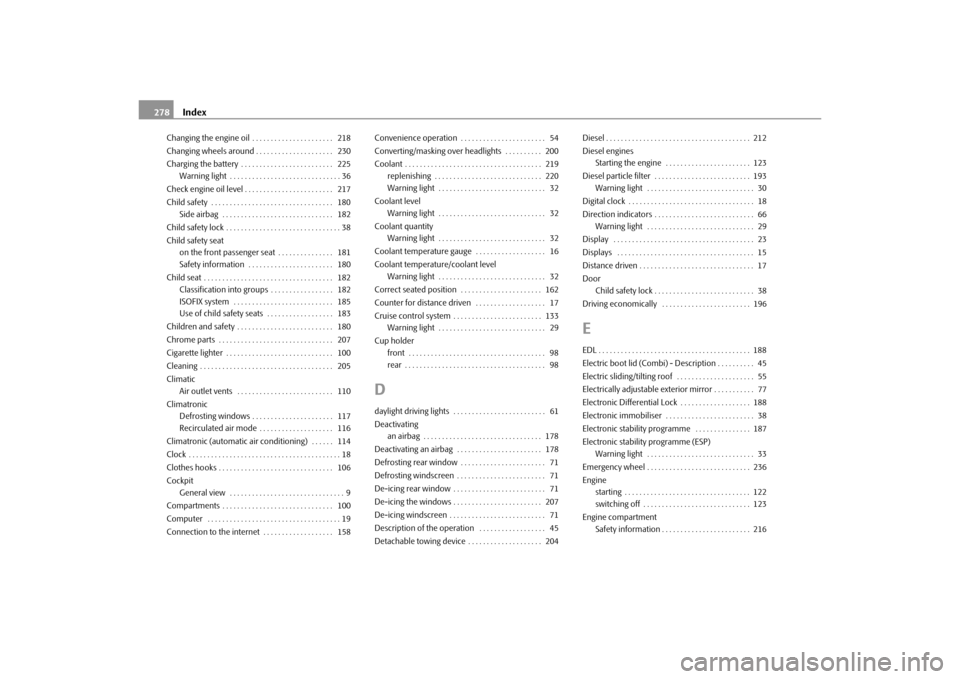
Index
278
Changing the engine oil . . . . . . . . . . . . . . . . . . . . . . 218
Changing wheels around . . . . . . . . . . . . . . . . . . . . . 230
Charging the battery . . . . . . . . . . . . . . . . . . . . . . . . . 225
Warning light . . . . . . . . . . . . . . . . . . . . . . . . . . . . . . 36
Check engine oil level . . . . . . . . . . . . . . . . . . . . . . . . 217
Child safety . . . . . . . . . . . . . . . . . . . . . . . . . . . . . . . . . 180 Side airbag . . . . . . . . . . . . . . . . . . . . . . . . . . . . . . 182
Child safety lock . . . . . . . . . . . . . . . . . . . . . . . . . . . . . . . 38
Child safety seat on the front passenger seat . . . . . . . . . . . . . . . 181
Safety information . . . . . . . . . . . . . . . . . . . . . . . 180
Child seat . . . . . . . . . . . . . . . . . . . . . . . . . . . . . . . . . . . 182 Classification into groups . . . . . . . . . . . . . . . . . 182
ISOFIX system . . . . . . . . . . . . . . . . . . . . . . . . . . . 185
Use of child safety seats . . . . . . . . . . . . . . . . . . 183
Children and safety . . . . . . . . . . . . . . . . . . . . . . . . . . 180
Chrome parts . . . . . . . . . . . . . . . . . . . . . . . . . . . . . . . 207
Cigarette lighter . . . . . . . . . . . . . . . . . . . . . . . . . . . . . 100
Cleaning . . . . . . . . . . . . . . . . . . . . . . . . . . . . . . . . . . . . 205
Climatic Air outlet vents . . . . . . . . . . . . . . . . . . . . . . . . . . 110
Climatronic Defrosting windows . . . . . . . . . . . . . . . . . . . . . . 117
Recirculated air mode . . . . . . . . . . . . . . . . . . . . 116
Climatronic (automat ic air conditioning) . . . . . . 114
Clock . . . . . . . . . . . . . . . . . . . . . . . . . . . . . . . . . . . . . . . . . 18
Clothes hooks . . . . . . . . . . . . . . . . . . . . . . . . . . . . . . . 106
Cockpit General view . . . . . . . . . . . . . . . . . . . . . . . . . . . . . . . 9
Compartments . . . . . . . . . . . . . . . . . . . . . . . . . . . . . . 100
Computer . . . . . . . . . . . . . . . . . . . . . . . . . . . . . . . . . . . . 19
Connection to the internet . . . . . . . . . . . . . . . . . . . 158 Convenience operation . . . . . . . . . . . . . . . . . . . . . . . 54
Converting/masking over headlights . . . . . . . . . . 200
Coolant . . . . . . . . . . . . . . . . . . . . . . . . . . . . . . . . . . . . . 219
replenishing . . . . . . . . . . . . . . . . . . . . . . . . . . . . . 220
Warning light . . . . . . . . . . . . . . . . . . . . . . . . . . . . . 32
Coolant level Warning light . . . . . . . . . . . . . . . . . . . . . . . . . . . . . 32
Coolant quantity Warning light . . . . . . . . . . . . . . . . . . . . . . . . . . . . . 32
Coolant temperature gauge . . . . . . . . . . . . . . . . . . . 16
Coolant temperature/coolant level Warning light . . . . . . . . . . . . . . . . . . . . . . . . . . . . . 32
Correct seated position . . . . . . . . . . . . . . . . . . . . . . 162
Counter for distance driven . . . . . . . . . . . . . . . . . . . 17
Cruise control system . . . . . . . . . . . . . . . . . . . . . . . . 133 Warning light . . . . . . . . . . . . . . . . . . . . . . . . . . . . . 29
Cup holder front . . . . . . . . . . . . . . . . . . . . . . . . . . . . . . . . . . . . . 98
rear . . . . . . . . . . . . . . . . . . . . . . . . . . . . . . . . . . . . . . 98
Ddaylight driving lights . . . . . . . . . . . . . . . . . . . . . . . . . 61
Deactivatingan airbag . . . . . . . . . . . . . . . . . . . . . . . . . . . . . . . . 178
Deactivating an airbag . . . . . . . . . . . . . . . . . . . . . . . 178
Defrosting rear window . . . . . . . . . . . . . . . . . . . . . . . 71
Defrosting windscreen . . . . . . . . . . . . . . . . . . . . . . . . 71
De-icing rear window . . . . . . . . . . . . . . . . . . . . . . . . . 71
De-icing the windows . . . . . . . . . . . . . . . . . . . . . . . . 207
De-icing windscreen . . . . . . . . . . . . . . . . . . . . . . . . . . 71
Description of the operation . . . . . . . . . . . . . . . . . . 45
Detachable towing device . . . . . . . . . . . . . . . . . . . . 204 Diesel . . . . . . . . . . . . . . . . . . . . . . . . . . . . . . . . . . . . . . . 212
Diesel engines
Starting the engine . . . . . . . . . . . . . . . . . . . . . . . 123
Diesel particle filter . . . . . . . . . . . . . . . . . . . . . . . . . . 193 Warning light . . . . . . . . . . . . . . . . . . . . . . . . . . . . . 30
Digital clock . . . . . . . . . . . . . . . . . . . . . . . . . . . . . . . . . . 18
Direction indicators . . . . . . . . . . . . . . . . . . . . . . . . . . . 66 Warning light . . . . . . . . . . . . . . . . . . . . . . . . . . . . . 29
Display . . . . . . . . . . . . . . . . . . . . . . . . . . . . . . . . . . . . . . 23
Displays . . . . . . . . . . . . . . . . . . . . . . . . . . . . . . . . . . . . . 15
Distance driven . . . . . . . . . . . . . . . . . . . . . . . . . . . . . . . 17
Door Child safety lock . . . . . . . . . . . . . . . . . . . . . . . . . . . 38
Driving economically . . . . . . . . . . . . . . . . . . . . . . . . 196
EEDL . . . . . . . . . . . . . . . . . . . . . . . . . . . . . . . . . . . . . . . . . 188
Electric boot lid (Combi) - Description . . . . . . . . . . 45
Electric sliding/tilting roof . . . . . . . . . . . . . . . . . . . . . 55
Electrically adjustable exterior mirror . . . . . . . . . . . 77
Electronic Differential Lock . . . . . . . . . . . . . . . . . . . 188
Electronic immobiliser . . . . . . . . . . . . . . . . . . . . . . . . 38
Electronic stability programme . . . . . . . . . . . . . . . 187
Electronic stability programme (ESP) Warning light . . . . . . . . . . . . . . . . . . . . . . . . . . . . . 33
Emergency wheel . . . . . . . . . . . . . . . . . . . . . . . . . . . . 236
Engine starting . . . . . . . . . . . . . . . . . . . . . . . . . . . . . . . . . . 122
switching off . . . . . . . . . . . . . . . . . . . . . . . . . . . . . 123
Engine compartment Safety information . . . . . . . . . . . . . . . . . . . . . . . . 216
s3fg.2.book Page 278 Friday, April 30, 2010 12:17 PM