battery SKODA SUPERB 2013 2.G / (B6/3T) User Guide
[x] Cancel search | Manufacturer: SKODA, Model Year: 2013, Model line: SUPERB, Model: SKODA SUPERB 2013 2.G / (B6/3T)Pages: 274, PDF Size: 17.31 MB
Page 40 of 274
Switching off›Turn the slot of the safety lock in the opposite direction to the arrow » Fig. 16
(mirror-inverted on the right door).
Opening/closing a door
Fig. 17
Door handle/door opening lever:
First read and observe the introductory information and safety warn- ings
on page 32.
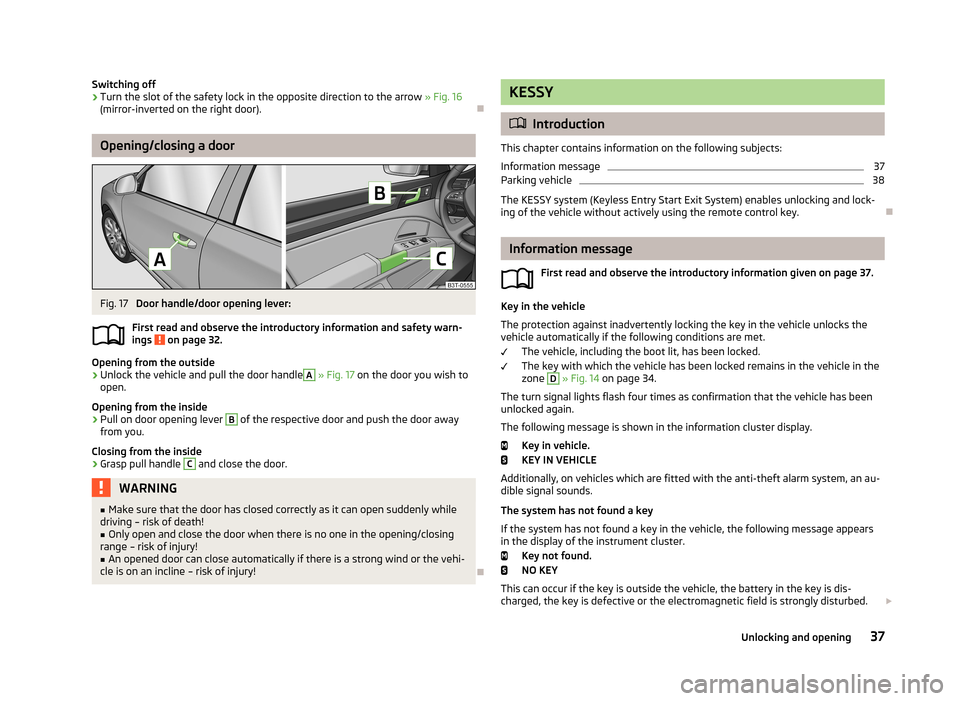
Opening from the outside
›
Unlock the vehicle and pull the door handle
A
» Fig. 17 on the door you wish to
open.
Opening from the inside
›
Pull on door opening lever
B
of the respective door and push the door away
from you.
Closing from the inside
›
Grasp pull handle
C
and close the door.
WARNING■ Make sure that the door has closed correctly as it can open suddenly while
driving – risk of death!■
Only open and close the door when there is no one in the opening/closing
range – risk of injury!
■
An opened door can close automatically if there is a strong wind or the vehi-
cle is on an incline – risk of injury!
KESSY
Introduction
This chapter contains information on the following subjects:
Information message
37
Parking vehicle
38
The KESSY system (Keyless Entry Start Exit System) enables unlocking and lock-
ing of the vehicle without actively using the remote control key.
Information message
First read and observe the introductory information given on page 37.
Key in the vehicle
The protection against inadvertently locking the key in the vehicle unlocks the vehicle automatically if the following conditions are met.
The vehicle, including the boot lit, has been locked.The key with which the vehicle has been locked remains in the vehicle in the
zone
D
» Fig. 14 on page 34.
The turn signal lights flash four times as confirmation that the vehicle has been
unlocked again.
The following message is shown in the information cluster display. Key in vehicle.
KEY IN VEHICLE
Additionally, on vehicles which are fitted with the anti-theft alarm system, an au-
dible signal sounds.
The system has not found a key
If the system has not found a key in the vehicle, the following message appears in the display of the instrument cluster.
Key not found.
NO KEY
This can occur if the key is outside the vehicle, the battery in the key is dis-
charged, the key is defective or the electromagnetic field is strongly disturbed.
37Unlocking and opening
Page 41 of 274
Fault in KESSY system
If there is a fault in the KESSY system, the following message will appear in the
display of the instrument cluster.
Keyless access system faulty.CHECK KEYLESS
Low voltage of the key battery
If the voltage of the battery in the remote control key is too low, the following
message appears in the display of the instrument cluster.
Change the key battery!
KEY BATTERY
Change the key battery » page 239!
Parking vehicle
First read and observe the introductory information given on page 37.
If the vehicle is not unlocked within 60 hours/ 90 hours, the sensors in the handleof the driver /front passenger's door are deactivated automatically » Fig. 14 on
page 34.
Activation after 60 hours
›
Unlock the driver's door using the sensor
2
» Fig. 14 on page 34.
›
Press the handle of the boot lid.
›
Unlock the vehicle using the symbol button
on the remote control key.
›
Unlocking the driver's door in an emergency » page 240.
Activation after 90 hours
›
Unlock the vehicle using the symbol button
on the remote control key.
›
Unlocking the driver's door in an emergency » page 240.
Anti-theft alarm system
Introduction
This chapter contains information on the following subjects:
Activating/deactivating
39
Interior monitor and towing protection
39
The anti-theft alarm system increases the level of protection against people
seeking to break into the vehicle. The system triggers audible and visual warning
signals if an attempt is made to break into the vehicle (hereafter referred to only
as alarm).
An alarm is triggered when the following monitored areas of the vehicle have a
fault.
› Bonnet.
› Boot lid.
› Doors.
› Ignition lock.
› Vehicle inclination
» page 39.
› Interior of car
» page 39.
› A drop in voltage of the on-board power supply.
› Socket of the factory-fitted towing device
» page 162, Towing a trailer .
An alarm is immediately triggered if either of the two battery terminals is discon-
nected while the anti-theft alarm system is activated.
The alarm is switched off by unlocking the vehicle or switching on the ignition.
CAUTION
Before leaving the vehicle, it must be checked that all of the doors and windows
including the sliding/tilting roof are locked in order to ensure the full functionality
of the anti-theft alarm system.
Note
The working life of the alarm siren is 5 years.
38Using the system
Page 47 of 274
The top lid position is adjusted, for example, in the following situations.
› When the space for opening the lid is limited (e.g. garage height).
› For a more convenient operation, such as by a person's height.
The top position which is reached when the lid opens automatically, is always
lower than the maximum top position which can be reached when the lid is
opened manually.
The lid always opens to the height which was last stored.
Malfunctions
First read and observe the introductory information and safety warn-
ings
on page 41.
If the battery is disconnected and reconnected while the lid is open, it is necessa-
ry to activate the system of the electric boot lid. Activation means closing the lid
by hand. Thus, the end position of the lid is stored under fully closed in secured lock.
Examples of operational malfunctions
Description of the malfunc-
tionPossible solutionsThe lid cannot be lifted out of
the lock.Emergency unlocking of the lid » page 241The lid does not react to an
opening signalRemove any obstacle (e.g. snow), open the lid
again » page 42
Press the handle A
and pull the lid upwards
The lid remains in the top po-
sitionManual closing of the lid
Electric power windows
Introduction
This chapter contains information on the following subjects:
Opening/closing the window from the driver seat
45
Opening the windows in the front passenger door and in the rear doors
45Force limit46Window convenience operation46
Operational faults
46
The power windows operate only when ignition is switched on.
After switching the ignition off, it is still possible to open or close the windows for
approx. 10 minutes. The power windows are only switched off completely once
the driver or front passenger door are opened.
When driving always use the existing heating, air conditioning and ventilation
system for ventilating the interior of the vehicle. If the windows are opened, dust
as well as other dirt can get into the vehicle and in addition the wind noise is
more at certain speeds.
WARNING■ Ensure that no persons are still left in the vehicle when locking the vehicle.
In an emergency, the windows will no longer be able to be opened from the
inside.■
The system is fitted with a force limiter » page 46. If there is an obstacle,
the closing process is stopped and the window goes down by several centi-
metres. However, the windows should be closed carefully – risk of injury.
■
It is recommended to deactivate the electrically operated power windows in
the rear doors (safety pushbutton)
S
» Fig. 25 on page 45 when children are
being transported on the rear seats.
CAUTION
■ Keep the windows clean to ensure the correct functionality of the electric win-
dows.■
In the event that the windows are frozen, first of all eliminate the
ice » page 200 , Windows and exterior mirrors and only then operate the electri-
cal power windows. Otherwise, the window sealing and the electrical power win-
dow mechanism could be damaged.
■
In the winter, ice accumulating on the surface of the window may cause there
to be more resistance when closing the window. The window will stop and move back several centimetres.
■
It is necessary to deactivate the force limiter to close the window » page 46.
■
Make sure that the windows are closed whenever you leave the locked vehicle.
44Using the system
Page 49 of 274
The window can be completely opened automatically by briefly pressing the but-ton as far as the stop. Renewed pressing of the button causes the window tostop immediately.
Closing›
Pull gently on the top edge of the corresponding button and hold until the win-
dow has moved into the desired position. Releasing the button causes the win-
dow to stop immediately.
The window can also be fully closed automatically by pulling the button up to the
stop. Renewed pulling of the button causes the window to stop immediately.
Force limit
First read and observe the introductory information and safety warn-ings
on page 44.
The electrical power window system is fitted with a force limiter. It reduces the
risk of bruises or injuries when closing the windows.
If there is an obstacle, the closing process is stopped and the window goes down
by several centimetres.
If the obstacle prevents the window from being closed during the next 10 sec-
onds, the closing process is interrupted once again and the window goes down by several centimetres.
If you attempt to close the window again within 10 seconds of the window being moved down for the second time, even though the obstacle was not yet been re-moved, the closing process is only stopped. During this time it is not possible to
automatically close the window. The force limiter is still switched on.
The force limiter is only switched off if you attempt to close the window again
within the next 10 seconds - the window will now close with full force!
If you wait longer than 10 seconds, the force limiter is switched on again.
Window convenience operation
First read and observe the introductory information and safety warn-ings
on page 44.
The windows can be operated by the locking or unlocking.
The prerequisite for ensuring that the convenience operating feature correctly is the automatic opening/closing of all windows is operational.
Opening can take place in one of the following ways.
›
Press and hold the symbol button on the key.
›
Hold the key in the driver's lock in the unlock position.
›
Press and hold the upper part of the central locking button in the driver's
door » page 36 .
›
Hold the button
A
1)
in the opening position » Fig. 25 on page 45.
Closing can take place in one of the following ways.
›
Press and hold the symbol button
on the key.
›
Hold the key in the driver's lock in the lock position.
›
Press and hold the lower part of the central locking button » page 36 in the
driver's door.
›
Hold the button
A
1) in the closing position » Fig. 25 on page 45.
›
In the KESSY system, hold a finger on the sensor
1
» Fig. 14 on page 34.
You can interrupt the opening or closing process for the windows immediately by
releasing the key or the the button
A
and interrupting the locking/unlocking.
Convenience opening or closing the window using the key in the driver's lock is
only possible within 45 seconds after locking the vehicle.
Operational faults
First read and observe the introductory information and safety warn-
ings
on page 44.
The automatic power windows do not work if the vehicle battery was disconnec- ted and connected while a window is open. The system must be activated.
Activation sequence:
1)
Convenience opening and closing the windows with the button
A
is possible immediately after un-
locking the vehicle or turning off the ignition and opening the driver's or front passenger's door.
46Using the system
Page 50 of 274
›Switch on the ignition.›Pull the top edge of the button and close the window.›
Release the button.
›
Pull the relevant button upwards again for approx. 3 seconds, and keep it press-
ed down.
Electric sliding/tilting roof
Introduction
This chapter contains information on the following subjects:
Operation
47
Convenience operation of sliding/tilting roof
48
Electric sliding/tilting roof with solar cells
48
The electric sliding/tilting roof (abbreviated in the following as 'sliding/tilting
roof') can only be operated when the ignition is turned on and when the outdoor
temperature is higher than -20 °C.
The sliding/tilting roof can still be operated for approx. 10 minutes after switchingthe ignition off. However, as soon as the driver or front passenger's door is
opened it is no longer possible to operate the sliding/tilting roof.
CAUTION
■ Always close the sliding/tilting roof before disconnecting the battery.■If the battery has been disconnected and reconnected, it is possible that the
sliding/tilting roof does not operate correctly. In this case, turn the rotary switch
to the switch position A
» Fig. 27 on page 47 and push forward for about 10 sec-
onds.
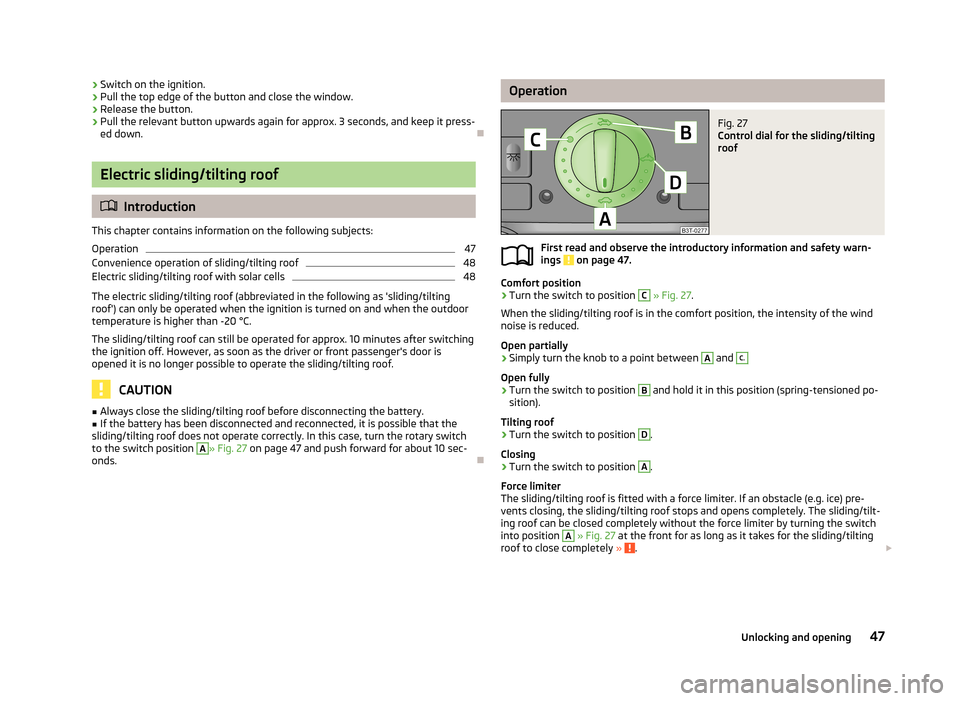
OperationFig. 27
Control dial for the sliding/tilting
roof
First read and observe the introductory information and safety warn-
ings on page 47.
Comfort position
›
Turn the switch to position
C
» Fig. 27 .
When the sliding/tilting roof is in the comfort position, the intensity of the wind
noise is reduced.
Open partially
›
Simply turn the knob to a point between
A
and
C.
Open fully
›
Turn the switch to position
B
and hold it in this position (spring-tensioned po-
sition).
Tilting roof
›
Turn the switch to position
D
.
Closing
›
Turn the switch to position
A
.
Force limiter
The sliding/tilting roof is fitted with a force limiter. If an obstacle (e.g. ice) pre-
vents closing, the sliding/tilting roof stops and opens completely. The sliding/tilt- ing roof can be closed completely without the force limiter by turning the switchinto position
A
» Fig. 27 at the front for as long as it takes for the sliding/tilting
roof to close completely » .
47Unlocking and opening
Page 51 of 274
WARNINGWhen closing the sliding/tilting roof proceed with caution to avoid causing
crushing injuries – risk of injury!
CAUTION
During the winter it may be necessary to remove any ice and snow in the vicinity
of the sliding/tilting roof before opening it to prevent any damage to the opening
mechanism.
Convenience operation of sliding/tilting roof
First read and observe the introductory information and safety warn-ings
on page 47.
The sliding/tilting roof can be operated by locking/unlocking using the key or us-
ing the KESSY system with the aid of the sensor
1
» Fig. 14 on page 34.
›
Press and hold the symbol button
on the key.
›
In the KESSY system, hold a finger on the sensor
1
» Fig. 14 on page 34.
By releasing the lock or lifting your finger off the sensor
1
when using the KESSY
system, the closing process is immediately interrupted.
WARNINGClose the sliding/tilting roof carefully – risk of injury! The force limiter does not
work when convenience closing is in operation.
Electric sliding/tilting roof with solar cells
First read and observe the introductory information and safety warn-ings
on page 47.
If there is sufficient bright sunlight, the solar cells in the sliding/tilting roof deliver
the electrical power for the fresh air blower. Further information » page 103, Cli-
matronic (automatic air conditioning system) .
The operation of the sliding/tilting roof with solar cells is the same as of a normal
sliding/tilting roof.
Panoramic sliding roof (Superb Combi)
Introduction
This chapter contains information on the following subjects:
Operation
49
Opening/closing the sun screen
49
Convenience operation of Sliding/tilting roof
50
The panoramic sliding/tilting roof (abbreviated in the following as 'sliding/tilting
roof') can only be operated when the ignition is turned on and when the outdoor temperature is higher than -20 °C.
The sliding/tilting roof can still be operated for approx. 10 minutes after switchingthe ignition off. However, as soon as the driver or front passenger's door is
opened it is no longer possible to operate the sliding/tilting roof.
CAUTION
■ Always close the sliding/tilting roof before disconnecting the battery.■If, for example, the battery has been disconnected and reconnected, it is possi-
ble that the sliding/tilting roof does not operate correctly. Next, move the rotary
switch into position A
» Fig. 28 on page 49, pull the recess firmly downwards
and forwards. The sliding/tilting roof opens and closes again after around 10 sec-
onds. Do not release the control dial until it has done so.
■
If, for example, the battery has been disconnected and reconnected, it is possi-
ble that the sun screen does not operate correctly. Then turn the switch to posi-
tion
A
» Fig. 28 on page 49and press and hold the button
G
» Fig. 29 on
page 49. The sun screen opens and closes again after around 10 seconds. Do
not release the control dial until it has done so.
48Using the system
Page 59 of 274
The function is switched on automatically if the following conditions are met:The light switch is in position » Fig. 32 on page 53.
The visibility in the vehicle environment is reduced. The ignition is switched off.
The functions and settings of the illumination time can be activated/deactivated
via the MAXI DOT display in the menu items Coming Home or Leaving
Home » page 29 .
The light is regulated based on data gathered by the light sensor attached be- tween the windscreen and the interior mirror » page 53.
The function switches on the parking and low beam lights, the entry lighting in
the exterior mirrors and the licence plate light.
COMING HOME
The light turns on automatically when you open the driver's door on (within 60 seconds of turning off the ignition).
The light turns off 10 seconds after closing all the doors and the tailgate or after
the preset time.
If a door or the boot lid remains open, the light goes out after 60 seconds.
LEAVING HOME
The light turns on automatically after the vehicle is unlocked with the remote
control.
The light turns off after 10 seconds or after a preset time or after the vehicle is
locked.
CAUTION
Do not affix any stickers or similar objects in front of the light sensor on the wind-
screen, so that its functionality is not impaired or disabled.
Note
If this function is activated constantly, the battery will be heavily discharged par-
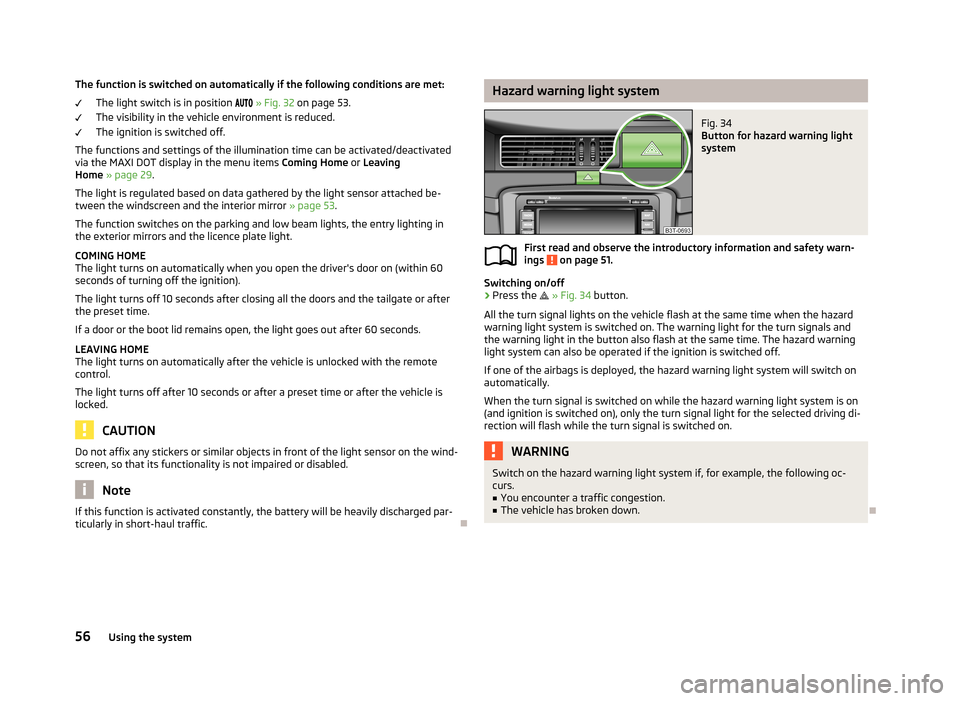
ticularly in short-haul traffic.Hazard warning light systemFig. 34
Button for hazard warning light
system
First read and observe the introductory information and safety warn-
ings on page 51.
Switching on/off
›
Press the
» Fig. 34 button.
All the turn signal lights on the vehicle flash at the same time when the hazard
warning light system is switched on. The warning light for the turn signals and
the warning light in the button also flash at the same time. The hazard warning
light system can also be operated if the ignition is switched off.
If one of the airbags is deployed, the hazard warning light system will switch on
automatically.
When the turn signal is switched on while the hazard warning light system is on
(and ignition is switched on), only the turn signal light for the selected driving di- rection will flash while the turn signal is switched on.
WARNINGSwitch on the hazard warning light system if, for example, the following oc-
curs.■
You encounter a traffic congestion.
■
The vehicle has broken down.
56Using the system
Page 63 of 274
The front - and rear window heater only operates when the engine is running.
The windscreen and rear window heater automatically switches off after approxi-
mately 10 minutes.
For the sake of the environment
The heating should be switched off as soon as the window is de-iced or free from
mist. The reduced current consumption will have a favourable effect on fuel econ-
omy » page 146 , Saving electrical energy .
Note
■
If the on-board voltage drops, the windscreen and rear window heater switches
off automatically, to provide sufficient electrical energy for the engine con- trol » page 218 , Automatic load deactivation .■
If the light is flashing inside the button the heater is off due to low battery.
Sun visors
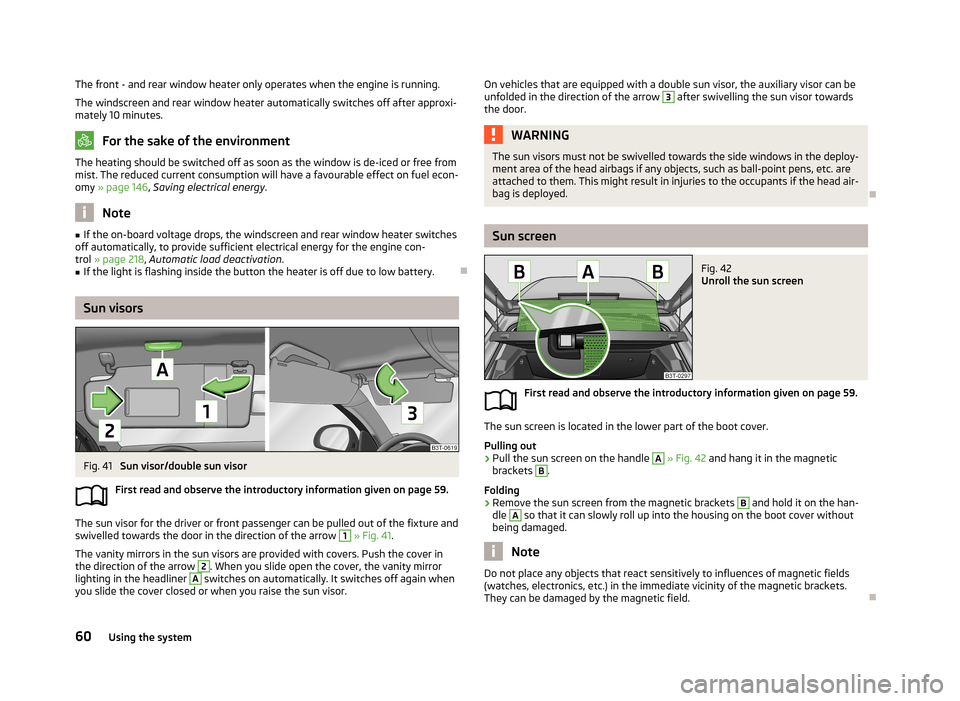
Fig. 41
Sun visor/double sun visor
First read and observe the introductory information given on page 59.
The sun visor for the driver or front passenger can be pulled out of the fixture and
swivelled towards the door in the direction of the arrow
1
» Fig. 41 .
The vanity mirrors in the sun visors are provided with covers. Push the cover in
the direction of the arrow
2
. When you slide open the cover, the vanity mirror
lighting in the headliner
A
switches on automatically. It switches off again when
you slide the cover closed or when you raise the sun visor.
On vehicles that are equipped with a double sun visor, the auxiliary visor can be
unfolded in the direction of the arrow 3 after swivelling the sun visor towards
the door.WARNINGThe sun visors must not be swivelled towards the side windows in the deploy-
ment area of the head airbags if any objects, such as ball-point pens, etc. are attached to them. This might result in injuries to the occupants if the head air-
bag is deployed.
Sun screen
Fig. 42
Unroll the sun screen
First read and observe the introductory information given on page 59.
The sun screen is located in the lower part of the boot cover.
Pulling out
›
Pull the sun screen on the handle
A
» Fig. 42 and hang it in the magnetic
brackets
B
.
Folding
›
Remove the sun screen from the magnetic brackets
B
and hold it on the han-
dle
A
so that it can slowly roll up into the housing on the boot cover without
being damaged.
Note
Do not place any objects that react sensitively to influences of magnetic fields
(watches, electronics, etc.) in the immediate vicinity of the magnetic brackets.
They can be damaged by the magnetic field.
60Using the system
Page 75 of 274
Note■The ventilation should only be switched on when the engine is running. This
has a significant effect of saving on the battery capacity.■
We do not recommend using the front seat ventilation and heating at the same
time. Using the ventilation to cool the seat surface considerably reduces the
heating capacity, at the same time affecting the ability of the control unit to de-
tect the right seat surface temperature.
Convenience features of passenger seat
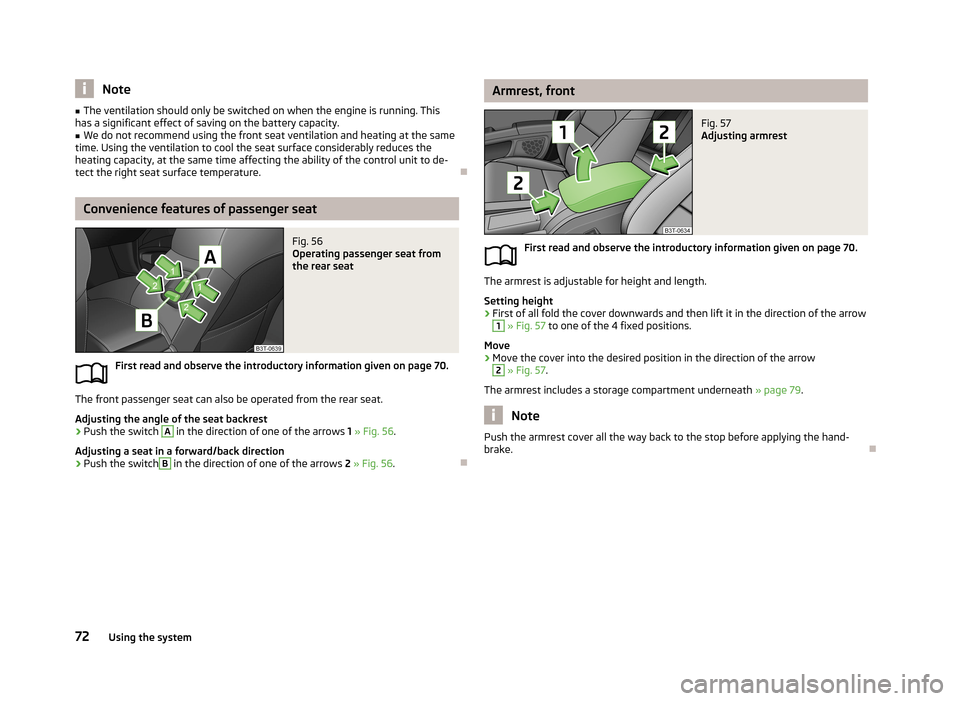
Fig. 56
Operating passenger seat from
the rear seat
First read and observe the introductory information given on page 70.
The front passenger seat can also be operated from the rear seat.
Adjusting the angle of the seat backrest
›
Push the switch
A
in the direction of one of the arrows 1 » Fig. 56 .
Adjusting a seat in a forward/back direction
›
Push the switch
B
in the direction of one of the arrows 2 » Fig. 56 .
Armrest, frontFig. 57
Adjusting armrest
First read and observe the introductory information given on page 70.
The armrest is adjustable for height and length.
Setting height
›
First of all fold the cover downwards and then lift it in the direction of the arrow
1
» Fig. 57 to one of the 4 fixed positions.
Move
›
Move the cover into the desired position in the direction of the arrow
2
» Fig. 57 .
The armrest includes a storage compartment underneath » page 79.
Note
Push the armrest cover all the way back to the stop before applying the hand-
brake.
72Using the system
Page 81 of 274
›Grasp the ashtray insert B
» Fig. 68 in the area marked with the arrows and
remove it in the direction of the arrow 2.
Insertion takes place in the reverse order.WARNINGNever place flammable objects in the ashtray – risk of fire!
Note
The ashtrays are fitted with an interior light which lights up when the parking
light is on.
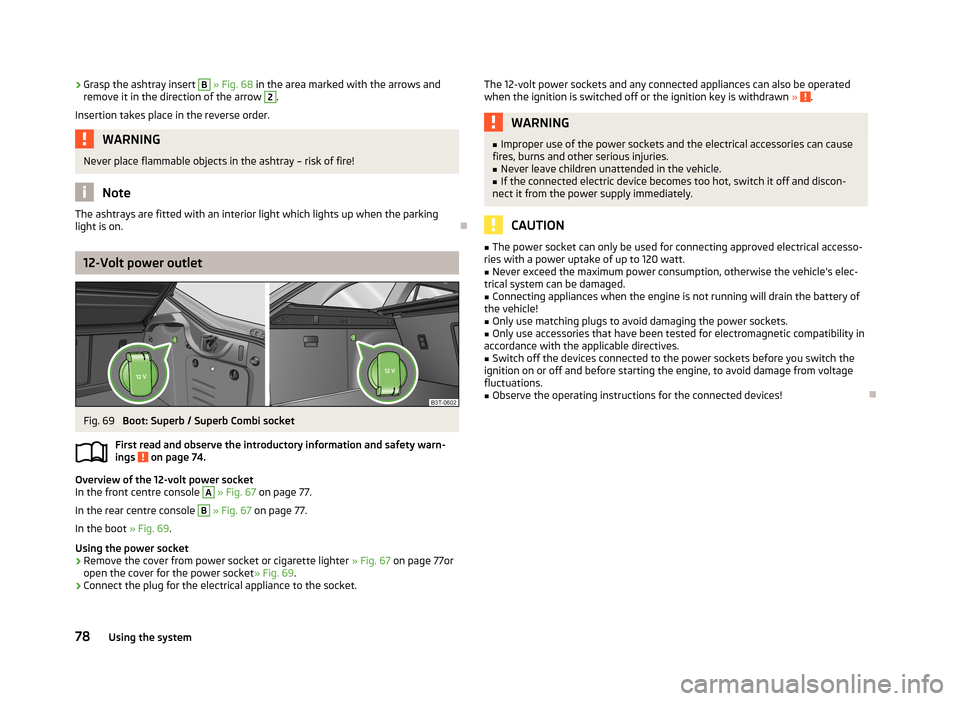
12-Volt power outlet
Fig. 69
Boot: Superb / Superb Combi socket
First read and observe the introductory information and safety warn- ings
on page 74.
Overview of the 12-volt power socket
In the front centre console
A
» Fig. 67 on page 77.
In the rear centre console
B
» Fig. 67 on page 77.
In the boot » Fig. 69.
Using the power socket
›
Remove the cover from power socket or cigarette lighter » Fig. 67 on page 77or
open the cover for the power socket » Fig. 69.
›
Connect the plug for the electrical appliance to the socket.
The 12-volt power sockets and any connected appliances can also be operated
when the ignition is switched off or the ignition key is withdrawn » .WARNING■
Improper use of the power sockets and the electrical accessories can cause
fires, burns and other serious injuries.■
Never leave children unattended in the vehicle.
■
If the connected electric device becomes too hot, switch it off and discon-
nect it from the power supply immediately.
CAUTION
■ The power socket can only be used for connecting approved electrical accesso-
ries with a power uptake of up to 120 watt.■
Never exceed the maximum power consumption, otherwise the vehicle's elec-
trical system can be damaged.
■
Connecting appliances when the engine is not running will drain the battery of
the vehicle!
■
Only use matching plugs to avoid damaging the power sockets.
■
Only use accessories that have been tested for electromagnetic compatibility in
accordance with the applicable directives.
■
Switch off the devices connected to the power sockets before you switch the
ignition on or off and before starting the engine, to avoid damage from voltage
fluctuations.
■
Observe the operating instructions for the connected devices!
78Using the system