engine SKODA YETI 2010 1.G / 5L Repair Manual
[x] Cancel search | Manufacturer: SKODA, Model Year: 2010, Model line: YETI, Model: SKODA YETI 2010 1.G / 5LPages: 271, PDF Size: 14.71 MB
Page 184 of 271
Driving and the Environment183
Using the system
Safety
Driving Tips
General Maintenance
Breakdown assistance
Technical Data
Fill up your tank. The fuel consumption of the vehicle is much higher when driving
off-road than when driving on the road.
Install the towing eye at the front or at the rear before driving off-road. It is not
always possible to install the towing eye if the vehicle got stuck.
Always check the inflation pressure of a ll the tyres and if necessary correct it.
Check the vehicle tool kit and supplement it according to your needs.
Fill with engine oil up to the line , so that the engine is sufficiently supplied with
engine oil when the vehicle is in a tilted position page 205, “Check engine oil level”.
Top up wash fluid.
Stow your load as low as possible in th e vehicle and attach all the items which are
loose.
Off-road driving
Never be alone when driving off-road and be prepared to encounter unexpected
situations. Travel together with at least two off-road vehicles. Equipment with which
you can call for help in an emer gency is particularly useful.
Drive slowly through unclear terrain.
You must stop when encountering difficul t passages and explore the continuation
of the route on foot. If you cannot go on or if you doubt the safety of the route, turn
back and choose another way.
Drive slowly over hilltops. Ma ke sure that the wheels of the vehicle do not lift off
the ground, as this could severely damage the vehicle and it may become disabled.
Drive slowly on difficult stretches of the route. When driving on a slippery ground,
s h i f t u p i n to t h e n e xt h i g h e r g e a r a n d m a ke s u re t h a t t he v e h i c l e a l w a y s s t a y s i n m o t i o n.
Do not drive too fast so that you do n't lose control over your vehicle.
If your vehicle got stuck in sand, snow or sludge, it may be more effective to reverse
the vehicle than trying to drive forwards.
Place stones, footmats or pieces of wood under the spinning wheels in order to
achieve traction on a sandy or slippery ground.
Do no drive throug h water before reading what you must take into account
page 179.
Keep sufficient distance from other vehicles even at low speeds. When the first
vehicle suddenly gets stuck, the following vehi cle can still stop in time without getting
stuck itself.
Do not plan day trips which are too far in distance.
Do not use the cruise control system when driving off-road. It is only intended for
driving on the road.
WARNING
The intelligent engineering of your ve hicle cannot overcome the physical
limits of your vehicle.
Be very alert and look ahead when driving off-road. Excessive speed or
incorrect driving manoeuvres can caus e damage to the vehicle and lead to
serious injuries.
Observe the important guidelines page 179.Caution
Pay attention to the ground clearance of the vehicle! The vehicle can be severely
damaged and become disabled once it touches the ground.
Never drive off-road with an almost empty fuel tank. The fuel supply to the engine
can be interrupted and therefore the cata lytic converter can be severely damaged.
Do not leave your foot on the clutch pedal or let the clutch slip when driving off-
road. Overwise you may unintentionally de press the clutch pedal on uneven ground
leading to a loss of control over the vehicle. In addition, the force for connecting the
engine and the gearbox is lost. Moreover, driving while letting the clutch slip causes a
fast wear of the clutch linings.Note
The fuel consumption is high er when driving off-road than when driving on conven-
tional roads, especially through difficult terr ain. When you prepare for your journey, be
aware of an increase in fuel consumption; the nearest filling station may be far away.
AA
s2ug.6.book Page 183 Friday, April 9, 2010 2:24 PM
Page 185 of 271
Driving and the Environment
184
Shifting gears correctlyThe gear you must shift into depends on th e terrain. Choosing the correct gear contrib-
utes to safe driving. In partic ular if you do not have much experience driving off-road,
it is always better, before negotiating a difficult stretch of the road, to pause and reflect
on which gear to engage. Your experience will tell you which gear is the best for certain
sections of the terrain.
Basically:
When the gear or the driving stage has been properly selected, it is unnecessary to
slow down the vehicle on a downhill sectio n using the footbrake as in most cases the
engine braking power is sufficient.
Depress the accelerator only as much as is necessary. A too great acceleration may
lead to the wheels spinning and thus results in the loss over the control of the vehicle.
Manual gearbox
If you are driving thro ugh difficult terrain, on no account use the clutch or change
the gear. When the clutch is depressed, th e vehicle may come to a standstill because
of the increased grip of all the tyres of the vehicle (e.g. in the mud, in deep sand or on
a slope). Once the vehicle has come to a stan dstill, it may be difficult or even impos-
sible to start off under these conditions.
When negotiating a steep downhill section or a steep uphill section, always shift
into the 1st or 2nd gear.
On a soft or slippery ground, you must drive at the appropriate speed and you
must select the highest possible gear for this.
Automatic gearbox
Select the selector lever position for normal flat stretches of terrain
page 121.
While in the Tiptronic mode, select the se lector lever position or if you are
driving through mud, sand, water or hilly sections of terrain page 123.
When negotiating a steep downhill section or a steep uphill section, select the
selector lever position while in the Tiptronic mode.
On a soft or slippery ground, you must drive at the appropriate speed and you
must select the highest possible driving stage.
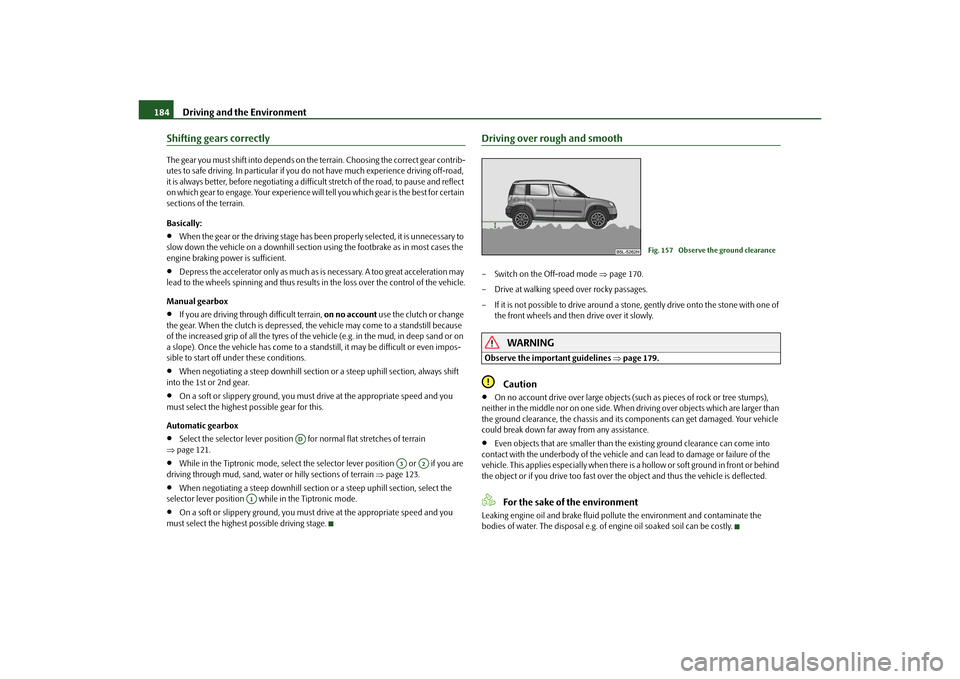
Driving over rough and smooth– Switch on the Off-road mode page 170.
– Drive at walking speed over rocky passages.
– If it is not possible to drive around a stone, gently drive onto the stone with one of the front wheels and then drive over it slowly.
WARNING
Observe the important guidelines page 179.
Caution
On no account drive over large objects (suc h as pieces of rock or tree stumps),
neither in the middle nor on one side. When driving over objects which are larger than
the ground clearance, the chassis and its components can get damaged. Your vehicle
could break down far away from any assistance.
Even objects that are smaller than the existing ground clearance can come into
contact with the underbody of the vehicle an d can lead to damage or failure of the
vehicle. This applies especially when there is a hollow or soft ground in front or behind
the object or if you drive too fast over the object and thus the vehicle is deflected.For the sake of the environment
Leaking engine oil and brake fluid poll ute the environment and contaminate the
bodies of water. The disposal e.g. of engine oil soaked soil can be costly.
AD
A3
A2
A1
Fig. 157 Observe the ground clearance
s2ug.6.book Page 184 Friday, April 9, 2010 2:24 PM
Page 186 of 271
Driving and the Environment185
Using the system
Safety
Driving Tips
General Maintenance
Breakdown assistance
Technical Data
Crossing bodies of waterParticular attention is required when driving through bodies of water page 179.Driving through snow-covered terrain– Before you drive through snow-covered te rrain, mount snow chains on the front
wheels or on the rear wheels page 220, “Snow chains” in order to achieve the
best possible traction.
–Switch on the Off-road mode page 170.
Even harmless looking sections of terrain can be dangerous. This applies in particular
for sections where no ruts or other tracks are visible.
WARNING
Driving through snow-covered terrain poses special dangers. Never choose
a dangerous route and never take a risk which could jeopardize your safety and
that of your passengers. If you cannot go on or if you doubt the safety of the
route, turn back and choose another way.
Potholes, troughs, trenches, precipices , sheets of ice or other obstructions
are often completely or partially obscured by snow.
The hidden dangers of snow can cause an accident, serious injuries or your
vehicle to break down under extreme weather conditions.
Driving over steep terrainDriving uphill and downhill– Stop the vehicle before driv ing uphill or downhill, exit the vehicle and explore the
situation.
– Walk a stretch and check the firmness of the soil and look for obstructions or other hidden dangers.
– Check how the route continues beyond the slope.
–Switch on the Off-road mode page 170. – Drive slowly and steadily straight uphill or downhill.
– Do not stop the vehicle on a hillside or attempt to turn around.
– You must prevent the engine from cutting out.
Driving uphill– Check before driving over a hilltop, how it
continues on the other side. If you drive
up a steep hill, the vehicle faces the sky and you cannot see what is directly in front
of the vehicle.
– Switch on the Off-road mode page 170.
– Do not shift gears or release the clutch during the climbing phase.
– Depress the accelerator only as much as is necessary in order to handle the slope.If you can go no further on a slope– Never attempt to make a turn with the vehicle on a hillside.
– If the engine cuts out, press the foot brake and restart the engine.
– Engage the reverse gear and carefully drive backwards in your own tracks.
– Press the foot brake in order to maintain a constant speed.Driving downhill– Switch on the Off-road mode page 170.
– Shift into first gear or select the first driving stage, while in the Tiptronic mode, to drive downhill on steep hillsides in order to use the Downhill Drive Support to its
maximum.
– Press the foot brake gently, so you do not lose the control over your vehicle.
– If it is feasible and safe, drive straight down (maximum gradient).
– Do not release the clutch or shift into Neutral.
WARNING
Never attempt to drive uphill or downhill if it is too steep for your vehicle.
The vehicle could slip or roll over - risk of accident!
s2ug.6.book Page 185 Friday, April 9, 2010 2:24 PM
Page 187 of 271
Driving and the Environment
186
Never attempt to make a turn on a hillside. The vehicle could tilt or roll over.
This can result in serious accidents.
If the engine cuts out on a slope or you can no longer go on for whatever
other reason, then stop!
Never let the vehicle roll down the hill side at idling speed. You can lose the
control over your vehicle.
If the engine cuts out, press the foot brake and restart the engine. Engage the
reverse gear and carefully drive backward s in your own tracks. Use the engine
braking power and press the foot brake in order to maintain a slow and
constant speed.
Observe the important guidelines page 179.
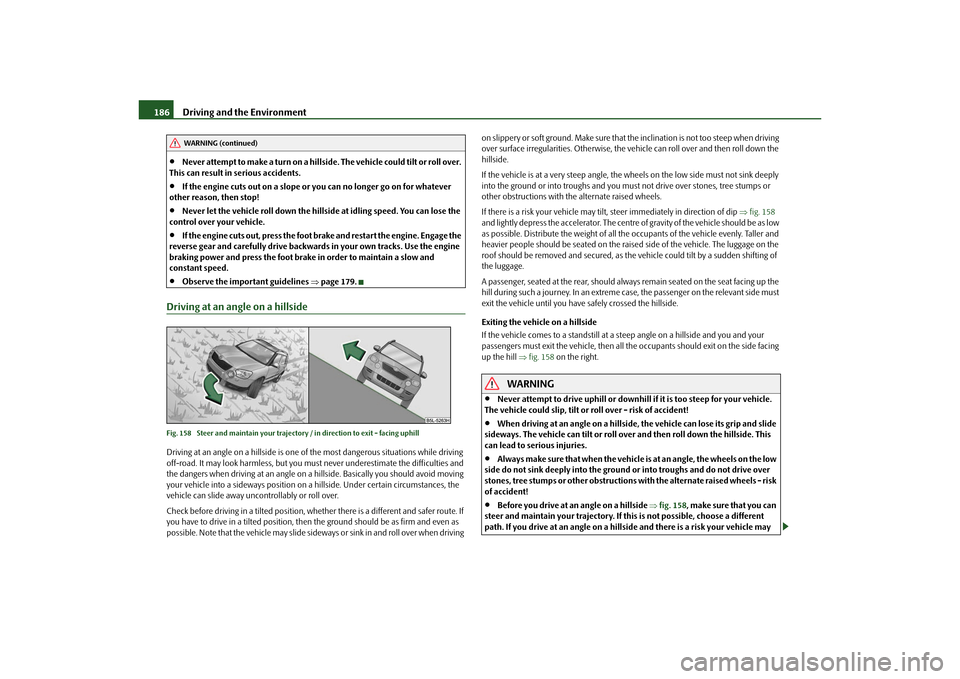
Driving at an angle on a hillsideFig. 158 Steer and maintain your trajectory / in direction to exit - facing uphillDriving at an angle on a hillside is one of the most dangerous situations while driving
off-road. It may look harmless, but you must never underestimate the difficulties and
the dangers when driving at an angle on a hillside. Basically you should avoid moving
your vehicle into a sideways position on a hillside. Under certain circumstances, the
vehicle can slide away uncon trollably or roll over.
Check before driving in a tilted position, whether there is a different and safer route. If
you have to drive in a tilted position, then the ground should be as firm and even as
possible. Note that the vehicle may slide sideways or sink in and roll over when driving on slippery or soft ground. Make sure that
the inclination is not too steep when driving
over surface irregularities. Otherwise, the vehicle can roll over and then roll down the
hillside.
If the vehicle is at a very steep angle, the wheels on the low side must not sink deeply
into the ground or into troughs and you mu st not drive over stones, tree stumps or
other obstructions with the alternate raised wheels.
If there is a risk your ve hicle may tilt, steer immedi ately in direction of dip fig. 158
and lightly depress the accelerator. The centre of gravity of the vehicle should be as low
as possible. Distribute the weight of all the occupants of the vehicle evenly. Taller and
heavier people should be seated on the rais ed side of the vehicle. The luggage on the
roof should be removed and secured, as the vehicle could tilt by a sudden shifting of
the luggage.
A passenger, seated at the rear, should always remain seated on the seat facing up the
hill during such a journey. In an extreme case , the passenger on the relevant side must
exit the vehicle until you have safely crossed the hillside.
Exiting the vehicle on a hillside
If the vehicle comes to a standstill at a st eep angle on a hillside and you and your
passengers must exit the vehicle, then all th e occupants should exit on the side facing
up the hill fig. 158 on the right.
WARNING
Never attempt to drive uphill or downhill if it is too steep for your vehicle.
The vehicle could slip, tilt or roll over - risk of accident!
When driving at an angle on a hillside, the vehicle can lose its grip and slide
sideways. The vehicle can tilt or roll over and then roll down the hillside. This
can lead to serious injuries.
Always make sure that when the vehicle is at an angle, the wheels on the low
side do not sink deeply into the ground or into troughs and do not drive over
stones, tree stumps or other obstructions with the alternate raised wheels - risk
of accident!
Before you drive at an angle on a hillside fig. 158 , make sure that you can
steer and maintain your trajectory. If this is not possible, choose a different
path. If you drive at an an gle on a hillside and there is a risk your vehicle may
WARNING (continued)
s2ug.6.book Page 186 Friday, April 9, 2010 2:24 PM
Page 189 of 271
Driving and the Environment
188WARNING
Driving through mud can be dangerous. The vehicle can slide uncontrol-
lably which causes an increased risk of injury. Adopt a particularly cautious
style of driving. Pay attention to the information and warning notes.
An incorrect tyre inflation pressure may cause a major or fatal accident! An
incorrect tyre inflation pressure may result in bursting of a tyre, which causes
the vehicle to get out of control.
Observe the important guidelines page 179.
Stuck vehicleIf you can no longer drive on ...– Carefully dig out all the wheels and make sure that no other parts of the vehicle are
stuck in the sand.
– Engage the reverse gear.
– Gently depress the accelerator and try to drive backwards in your own track.
– Place scrub, footmats or a sackcloth directly in front of the tyres in order to improve
the road adherence and thus achieve an improved traction to drive out.Rocking out vehicle–Switch off the TCS page 165.
– Set the steering wheel straight.
– Drive so far back until the wheels just begin to spin.
– Quickly shift into first gear and drive forwards until the wheels begin to spin.
– Drive back and forth repeatedly until the momentum is sufficient to free the vehicle.
–Switch on the TCS.A few tips– Ensure that the Off-road mode is switched on page 170. – Avoid prolonged spinning of the wheels, otherwise the vehicle would still sink
deeper into the ground.
– Remove mud, dirt and stones from the tread of the tyre.
You need training and experience if you wish to rock out a vehicle. If you make a
mistake, the vehicle can still sink in further and you can only free it with the help of
others.
WARNING
Observe the important guidelines page 179.After driving off-roadCheck the vehicle for damage after driving off-road - especially on the underside of the
vehicle.
– Switch off the Off-road mode page 170.
– Check the tyres and the axles for damage and remove coarse dirt, stones and foreign bodies from the tyre tread.
– Clean the turn signal lights, the headlights, the number plate and the windows.
– Check the underbody of the vehicle and remove trapped objects, such as scrub or wood pieces.
– Contact your specialist gara ge if you detect any damage.
– In case of thick layers of dirt, clean the radiator grille, the engine compartment and the underbody of the vehicle.
WARNING
Combustible materials which are tra pped under the vehicle floor can be
dangerous. They can impair the driving safety and the safety of all the occu-
pants of the vehicle. After driving off-road, always check the underside of the
vehicle and remove trapped objects.
Never continue the journey if objects are trapped under the vehicle. This
can damage the fuel lines, the brake system, the seals and other parts of the
chassis.
s2ug.6.book Page 188 Friday, April 9, 2010 2:24 PM
Page 192 of 271
Towing a trailer191
Using the system
Safety
Driving Tips
General Maintenance
Breakdown assistance
Technical Data
Headlights
Before starting off with a hitched trailer, also check the setting of the headlights. Alter
the setting as necessary with the ai
d of the headlight beam adjuster page 58.
Detachable ball head
The ball rod is detachable on vehicles which feature a factory-fitted towing device. It is
stowed together with separate fitting instru ctions in the spare wheel well in the luggage
compartment of the vehicle.
Further information on the towing device page 192.
Note
We recommend that you also have your vehicle inspected between service inter-
vals if you tow a trailer frequently.
The handbrake on the towing vehicle must be put on when coupling and decou-
pling the trailer.
Driving Tips
Particular caution is required when towing a trailer.– Do not, as far as possible, drive with your vehicle unladen and the trailer laden.
– Do not make full use of the legal maximum speeds. This applies in particular to downhill sections.
– Apply the brakes in good time.
– Keep a check on the coolant temperature gauge if the outside temperature is high.
Distribution of weight
The distribution of the weight is very poor if your vehicle is unladen and the trailer is
laden. Maintain a particularly low speed if you cannot avoid driving with this combina-
tion.
Driving speed
Do not drive faster than 80 km/hour for safety reasons. This also applies for countries
in which higher speeds are allowed. The fact that the driving stability of the vehicle + trailer combination reduces with
increasing speed means that the legally allowed speed should not be used when there
are unfavourable road, weather or wind cond
itions, particularly near accident black
spots.
You must always reduce your speed immediat ely as soon as you detect even just the
slightest swaying of the trailer. On no account attempt to stop the trailer from
“swaying” by accelerating.
Apply the brakes in good time! If the trailer is fitted with a trailer brake, apply the
brakes gently at first and then brake firmly. This will avoid brake jolts resulting from the
trailer wheels locking. Shift down gears in good time before negotiating a downhill
section to allow the engine to also act as a brake.
Engine overheating
Please keep a check on the coolant temperature gauge if you have to negotiate a
lengthy slope in a low gear at a high engi ne speed when the outside temperature is
very high page 17, “Coolant temperature gauge”.
If the needle of the coolant temperature gauge moves into the right-hand area or even
the red area of the scale, reduce your speed immediately. Stop and switch off the
engine if the warning light
in the instrument cluster begins flashing. Wait a few
minutes and check the level of coolant in the coolant expansion bottle page 208,
“Inspecting the coolant level”.
Please refer to the following guidelines page 33, “Coolant temperature/ Coolant
quantity ”.
The coolant temperature can be reduced by switching on the heating.
Any increase in the cooling effect of the coolant fan through shifting down a gear and
increasing the engine speed is not possible since the fan speed is independent of the
engine speed. One should also not drop a gear for this reason when towing a trailer as
long as the engine can manage th e slope without any drop in speed.
s2ug.6.book Page 191 Friday, April 9, 2010 2:24 PM
Page 198 of 271
Taking care of your vehicle and cleaning the vehicle197
Using the system
Safety
Driving Tips
General Maintenance
Breakdown assistance
Technical Data
Underbody protectionThe underside of your vehicle is protected for life against chemical and mechanical
influences.
One cannot, however, completely rule out damage to the protective layer when
driving so we recommend that you inspect the protective layer on the underside of
your vehicle and on the chassis at certain intervals - this is best done at the beginning
and end of the winter - and to touch up any damaged areas.
The authorised Škoda Service Partners have suitable spray products available as well
as the necessary equipment and are familiar with the instructions for use. It is therefore
best to have such touch-up work or additional corrosion protection measures carried
out by an authorised Škoda Service Partner.
WARNING
Never use additional underbody protection or corrosion-protection agents for
the exhaust pipes, catalytic converters, di esel particle filter or heat shields.
When the engine reaches its operating temperature, these substances might
ignite - risk of fire!Protection of hollow spacesAll the cavities of your vehicle which are at risk from corrosion are protected for life by
a layer of protective wax applied in the factory.
This wax protection does not require to be inspected or re-treated. Please remove any
small amount of wax which flows out of the cavities at high temperatures with a plastic
scraper and clean the spot using petroleum cleaner.
WARNING
Safety and environmental pr otection regulations should observed when using
petroleum cleaner to remove wax - a risk of fire!
Engine compartmentGood corrosion protection is very importan t, particularly in winter when one often
drives over its salt-strewn roads. One should therefore clean the whole engine
compartment before and after the salt spreading period and treat with preservative in
order to prevent the salt from being destructive.
The authorised Škoda Service Partners have the cleaning agents and preservatives
recommended by the manufacturer and also the required equipment.
WARNING
It is necessary to observ e the guidelines given in the chapter before working
on the engine compartment page 204, “Working in the engine compart-
ment”.
Let the engine cool down before cleaning the engine compartment.Caution
Engine cleaning may be only be un dertaken when the ignition is off.
It is recommended to cover the generator before washing the engine compart-
ment.For the sake of the environment
The dirty water produced by washing the engine has washed away petrol, and residues
of grease and oil and should therefore be cleaned by an oil separator. This is why
engine washing should only be undertaken in a specialist garage or at a fueling station
(when these are fitted with the required equipment).Care of the interior of vehiclePlastic parts, artificial leather and clothsYou can clean plastic parts and artificial leather with a moist cloth. You should only
treat such parts with special solvent-free plastic cleaning and care products it does
prove to be adequate.
s2ug.6.book Page 197 Friday, April 9, 2010 2:24 PM
Page 201 of 271
Fuel
200
FuelPetrolGrades of petrolYour vehicle can only be operated with unleaded petrol, which complies with the
standard EN 228. The individual grades of petrol are distinguished by their octane
number (RON). On the inside of the fuel filler flap, you will find the information
regarding the RON required by your engine page 201, fig. 160.
Prescribed fuel - unleaded petrol 95/91 RON
Use unleaded petrol 95 RON. You can also use unleaded petrol 91 RON, but this leads
to a slight loss in performance.
If, in case of necessity, the vehicle must be refuelled with petrol of a lower octane
number than the one prescribed, you must co ntinue driving at medium engine speeds
and low engine load. Driving at high engine speeds or a high engine load can severely
damage the engine! Refuel as soon as possib le with petrol of the prescribed octane
number.
Prescribed fuel - unleaded petrol min. 95 RON
Use unleaded petrol 95 RON.
In case of necessity, you can refuel with petrol 91 RON if petrol 95 RON is not avail-
able. You must continue driving at medium engine speeds and minimum engine load.
Driving at high engine speeds or a high engine load can severely damage the engine!
Refuel as soon as possib le with petrol of the prescribed octane number.
Even in case of necessity, you must not use petrol of a lower octane number than 91,
otherwise the engine can be severely damaged!
You can find further information on refuelling page 201.
Unleaded petrol with higher octane number
You can make unlimited use of unleaded pe trol which has a higher octane number
than the one prescribed. On vehicles with prescribed unleaded petrol
95/91 RON, the use of petrol with a
higher octane number than 95 does not result in a noticeable power increase or a
lower fuel consumption.
On vehicles with prescribed unleaded petrol min. 95 RON, the use of petrol with a
higher octane number than 95 does not result in a power increase or a lower fuel
consumption.
Caution
All Škoda vehicles with petrol engines are equipped with a catalytic converter and
must be only driven with unleaded petrol. Fi lling the tank even only once with leaded
petrol will result in the cata lytic converter being destroyed!
Only use unleaded petrol which complies with the standard EN 228.
If you use petrol with a lower octane num ber than the one prescribed, the engine
can be severely damaged!Note
The handling, performance and life of your engine are determined to a significant
extent by the quality of the fuel. Do not use any petrol additives.DieselDiesel fuelYour vehicle can only be operated with diesel fuel, which complies with the standard
EN 590 (standard DIN 51628 in Germany, standard ÖNORM C 1590 in Austria).
Fuel additives
You must not use fuel additives, so-called “flow improvers” (petrol and similar prod-
ucts) in diesel fuel.
You can find information on refuelling page 201.
s2ug.6.book Page 200 Friday, April 9, 2010 2:24 PM
Page 202 of 271
Fuel201
Using the system
Safety
Driving Tips
General Maintenance
Breakdown assistance
Technical Data
Caution
Therefore, your vehicle can only be operated with diesel fuel which complies with
the standard EN 590 (standard DIN 51628 in Germany, standard ÖNORM C 1590 in
Austria). Filling the tank even only once wi th diesel fuel which does not comply with
the standard, can result in damage to the engine parts, the lubrication system, the fuel
and exhaust system.
If by mistake you have refuelled with a different fuel other than the diesel fuel
which complies to the above mentioned standards (e.g. petrol), do not start the engine
or switch on the ignition! This can result in severe engine damage! Contact a specialist
garage and have the fuel sy stem of the engine cleaned.
Water which has collected in the fuel fi lter can result in engine problems.
Your vehicle is not adapted for use of biofue l (RME), therefore this fuel must not be
refuelled and driven. The use of biofuel (RME) can lead to damage to the engine or the
fuel system.
Operation in winterWinter-grade diesel fuel
A different grade of diesel fuel is available at filling stations in winter than during the
summer. Using “summer-grade diesel fuel” at temperatures below 0°C can result in
operational problems because th e diesel becomes viscous as a result of paraffin sepa-
ration.
It is therefore the case that the standard EN 590 (standard DIN 51628 in Germany,
standard ÖNORM C 1590 in Austria) is the diesel fuel class prescribed for certain
periods of the year which can also be purc hased at the corresponding time during the
year. “Winter-grade diesel fuel” will still operate properly even at a temperature of -
20°C.
It is often the case in countries with different climatic conditions that diesel fuels avail-
able have a different temperature characteristic. The authorised Škoda Service Part-
ners and filling stations in the country concer ned will be able to provide you with infor-
mation regarding the diesel fuels available.
Prewarming fuel
The vehicle is fitted with a fuel filter prewarming system. This secures operation of a
vehicle using diesel fuel down to an environmental temperature of -25°C.
Caution
It is not permitted to add the various fuel additives on the market, including petrol, to
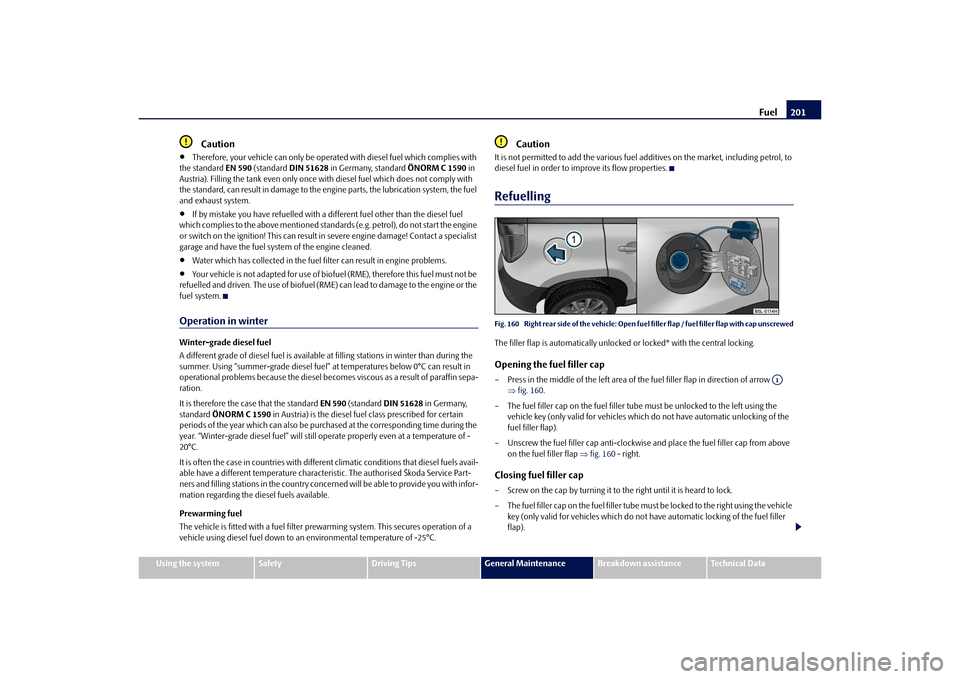
diesel fuel in order to improve its flow properties.RefuellingFig. 160 Right rear side of the ve hicle: Open fuel filler flap / fuel filler flap with cap unscrewedThe filler flap is automatically unlocked or locked* with the central locking.Opening the fuel filler cap– Press in the middle of the left area of the fuel filler flap in direction of arrow
fig. 160 .
– The fuel filler cap on the fuel filler tube must be unlocked to the left using the
vehicle key (only valid for vehicles which do not have automatic unlocking of the
fuel filler flap).
– Unscrew the fuel filler ca p anti-clockwise and place the fuel filler cap from above
on the fuel filler flap fig. 160 - right.Closing fuel filler cap– Screw on the cap by turning it to the right until it is heard to lock.
– The fuel filler cap on the fuel filler tube must be locked to the right using the vehicle
key (only valid for vehicles which do not have automatic locking of the fuel filler
flap).
A1
s2ug.6.book Page 201 Friday, April 9, 2010 2:24 PM
Page 203 of 271
Fuel
202
– Close the fuel filler flap until it locks.
The correct grade of fuel for your vehicle as well as the tyre size and inflation pressures
are stated on a sticker affixed to the inside of the fuel filler flap. Further information on
fuel page 200.
The fuel tank has a capa city of about 60 litres.
WARNING
Pay attention to any legal requirements if you do carry a spare canister in the
vehicle. We do not recommend carrying any fuel canisters in your vehicle for
safety reasons. The canister can be damaged in the event of an accident and fuel
may leak out.
Caution
Before refuelling it is necessary to switch off the auxiliary heating system (auxiliary
heating and ventilation) *.
Remove any fuel which has spilled onto th e paintwork of your vehicle immediately
- risk of paint damage!
On vehicles fitted with a catalytic converte r, never let the fuel tank run completely
empty. An irregular supply of fuel to the engine can result in misfiring and unburnt fuel
may get into the exhaust system, which may result in overheating and damage to the
catalytic converter.
Make sure that the valve is not pressed into the filler tube when inserting the pump
nozzle into the filler tube. Otherwise you are unintentiona lly filling up the volume,
which in case of heat can cause an expansion of the fuel. This can lead to an overflow
of fuel or damage to parts of the fuel reservoir.
The fuel tank is full just as soon as th e pump nozzle switches off for the first time,
provided the nozzle has been operated prop erly. Do not continue refuelling - other-
wise the expansion volume is filled up.Note
The fuel tank has a capacity of about 60 litres, containing a reserve of 10.5 litres.s2ug.6.book Page 202 Friday, April 9, 2010 2:24 PM