engine SKODA YETI 2012 1.G / 5L Workshop Manual
[x] Cancel search | Manufacturer: SKODA, Model Year: 2012, Model line: YETI, Model: SKODA YETI 2012 1.G / 5LPages: 225, PDF Size: 5.47 MB
Page 152 of 225

›
The use of solvent-free adhesives.
› No CFCs used in the production process.
› Without use of mercury.
› Use of water-soluble paints.
Trade-in and recycling of old cars
ŠKODA
meets the requirements of the brand and its products with regard to pro-
tecting the environment and the preserving resources. All new ŠKODA vehicles
can be utilized up to 95 % and always 1)
be returned. In a lot of countries sufficient
trade-in networks have been created, where you can trade-in your vehicle. After
you trade-in your vehicle, you will receive a confirmation stating the recycling in
accordance with environmental regulations. Note
Detailed information about the trade-in and recycling of old cars is available from
a ŠKODA Service Partner. ÐDriving abroad
Introductory information
In certain countries it is also possible that the
ŠKODA Service Partner network is
limited or has not been established yet. This is the reason why procuring certain
spare parts may be somewhat complicated and specialist garages may only be
able to make limited repairs. ŠKODA in the Czech Republic and its importers are
happy to provide information about technical aspects of the vehicle, required
maintenance work and possibilities for getting repairs done. ÐUnleaded petrol
A vehicle fitted with a petrol engine must always be refuelled with unleaded pet-
rol » page 168 , Unleaded petrol . Information regarding the locations of filling sta-
tions that offer unleaded petrol is, for example, provided by the automobile asso-
ciations. Ð Headlights
The low beam of your headlights is set asymmetrically. It illuminates the side of
the road on which the vehicle is being driven to a greater extent.
When driving in countries in which the traffic drives on the other side of the road
than in your home country, the asymmetrical low beam may dazzle oncoming
drivers. To prevent oncoming traffic from being dazzled, the headlights must be
adjusted by a
ŠKODA Service Partner.
Headlights with Xenon lights are adjusted in the menu of the information dis-
play » page 15, MAXI DOT (information display) . Note
Further information on adjusting the headlights is available from a ŠKODA Service
Partner. Ð Avoiding damage to your vehicle
To prevent damage to your vehicle, pay special attention: › When driving on poorly maintained roads and lanes
› When driving over kerb stones
› When driving up steep ramps
› So that any low-slung parts, such as the spoiler and exhaust, do not touch the
ground and get damaged
This particularly applies to models with a sport suspension and also when your
vehicle is fully laden. Ð1)
Subject to fulfilment of the national legal requirements.
150 Driving Tips
Page 153 of 225

Driving through water on the street
Fig. 134
Driving through water
The following must be observed to avoid damage to the vehicle when driving
through bodies of water (e.g. flooded roads): › Therefore determine the depth of the water before driving through bodies of
water. The water level must fit around the strut on the side member as a maxi-
mum » Fig. 134;
› Do not drive any faster than at a walking speed. At a higher speed, a water
wave can form in front of the vehicle which can cause water to penetrate into
the air induction system of the engine or into other parts of the vehicle;
› Never stop in the water, do not reverse and do not switch the engine off;
› Deactivate the START-STOP
system before driving through water » page 106,
START/STOP . WARNING
■ Driving through water, mud, sludge etc. can reduce the braking power and
extend the braking distance - risk of accident!
■ Avoid abrupt and sudden braking immediately after water crossings.
■ After driving through bodies of water, the brakes must be cleaned and dried
as soon as possible by intermittent braking. Only apply the brakes for the pur-
pose of drying and cleaning the brake discs if the traffic conditions permit this.
Do not place any other road users in jeopardy. CAUTION
■ When driving through bodies of water, parts of the vehicle such as the engine,
gearbox, chassis or electrics can be severely damaged.
■ Oncoming vehicles can generate water waves which can exceed the permissible
water level for your vehicle. ■
Potholes, mud or rocks can be hidden under the water making it difficult or im-
possible to drive through the body of water. ■ Do not drive through salt water. The salt can lead to corrosion. Any vehicle parts
that have come into contact with salt water must be rinsed immediately with
fresh water. Note
After driving through a body of water, we recommend that the vehicle is checked
by a
ŠKODA specialist garage. Ð Off-road driving
ä
Introduction
This chapter contains information on the following subjects:
Explanation of technical terms 152
Before driving off-road 153
Off-road driving 154
Changing gear when driving off-road 154
Driving at an angle on a hillside 155
Stuck vehicle 155
After driving off-road 156
We cannot discuss all the possible driving situations in this manual, because
there are so many types of terrains which may hide different risks and dangers.
The examples listed in this manual are general rules for safe off-road driving. It is
however not possible to predict if these rules are valid for all the situations which
may occur. Before driving through unknown terrain, it is therefore important that
you know what lies ahead of you. This way you can estimate any possible danger
in advance.
When driving off-road, pay attention to the national legal regulations. £
151
Driving and the Environment
Page 154 of 225

WARNING
■ Be very alert and look ahead when driving off-road. Always adjust your driv-
ing to the current of-road, traffic and weather conditions. Excessive speed or
incorrect driving manoeuvres can cause damage to the vehicle and lead to se-
rious injuries.
■ The Assistance systems of your vehicle cannot overcome the physical limits
of your vehicle.
■ Do not drive over embankments, ramps or hillsides at too high a speed. This
can lead to the wheels of the vehicle lifting off the ground so that you can no
longer steer and control the vehicle.
■ If the wheels lose contact with the ground, for example when the vehicle re-
bounds while driving over corrugations, steer straight ahead. If the wheels are
turned when making the contact with the ground again, the vehicle can roll
over.
■ There should never be any person in front or behind the vehicle when rocks,
scrub, wood pieces or other objects are placed under the wheels in order to
achieve traction on a sandy or slippery ground. Turning the wheels can trans-
form these objects into dangerous
“bullets” – risk of death!
■ Luggage and other items, which are transported on the roof of the vehicle,
additionally raise the centre of gravity and thus increase the risk of a rollover. ■ Never attempt to drive uphill or downhill if it is too steep for your vehicle.
The vehicle could slip, tilt or roll over - risk of accident! » table on page 153
■ Never attempt to make a turn on a hillside. The vehicle could tilt or roll over.
This can result in serious accidents.
■ Never let the vehicle roll down the hillside at idling speed. You can lose the
control over your vehicle.
■ If the engine cuts out, stop and restart the engine.
■ Objects trapped under the floor of the vehicle can damage the fuel lines, the
brake system, the seals and other parts of the chassis. Check the underside of
the vehicle and remove the trapped objects. Combustible objects such as dry
leaves or twigs could ignite on hot vehicle parts - risk of fire! CAUTION
■ Pay attention to the ground clearance of the vehicle! When driving over objects
which are larger than the ground clearance, the chassis and its components can
get damaged. ■ Do not leave your foot on the clutch pedal or let the clutch slip when driving off-
road. Overwise you may unintentionally depress the clutch pedal on uneven
ground leading to a loss of control over the vehicle. For the sake of the environment
Pay attention to the environment when driving off-road. Ð Explanation of technical terms
Fig. 135
Embankment angle/slope angle Fig. 136
Ground clearance/ramp angle
First read and observe the introductory information and safety warn-
ings on page 151.
The technical data » table on page 153
refer to ideal conditions. These values
may differ depending on the load and composition of the soil and the environ-
ment. The driver is responsible to decide whether a vehicle can overcome a cer-
tain situation. £
ä
152 Driving Tips
Page 155 of 225
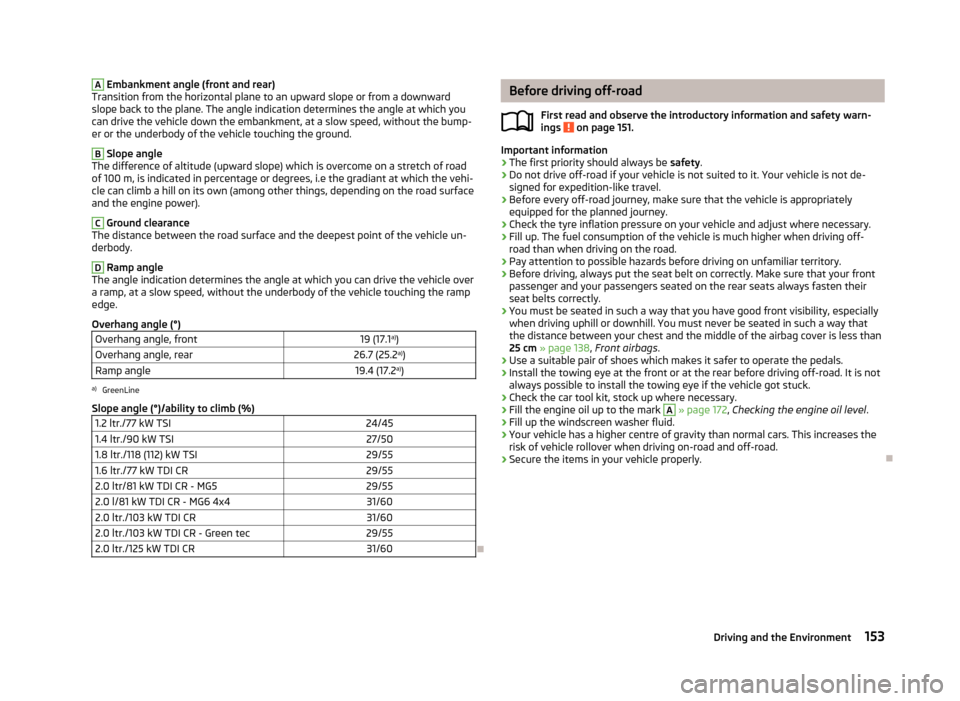
A
Embankment angle (front and rear)
Transition from the horizontal plane to an upward slope or from a downward
slope back to the plane. The angle indication determines the angle at which you
can drive the vehicle down the embankment, at a slow speed, without the bump-
er or the underbody of the vehicle touching the ground. B
Slope angle
The difference of altitude (upward slope) which is overcome on a stretch of road
of 100 m, is indicated in percentage or degrees, i.e the gradiant at which the vehi-
cle can climb a hill on its own (among other things, depending on the road surface
and the engine power). C
Ground clearance
The distance between the road surface and the deepest point of the vehicle un-
derbody. D
Ramp angle
The angle indication determines the angle at which you can drive the vehicle over
a ramp, at a slow speed, without the underbody of the vehicle touching the ramp
edge.
Overhang angle (°)
Overhang angle, front 19 (17.1a)
)
Overhang angle, rear 26.7 (25.2a)
)
Ramp angle 19.4 (17.2a)
) a)
GreenLine
Slope angle (°)/ability to climb (%) 1.2 ltr./77 kW TSI 24/45
1.4 ltr./90 kW TSI 27/50
1.8 ltr./118 (112) kW TSI 29/55
1.6 ltr./77 kW TDI CR 29/55
2.0 ltr/81 kW TDI CR - MG5 29/55
2.0 l/81 kW TDI CR - MG6 4x4 31/60
2.0 ltr./103 kW TDI CR 31/60
2.0 ltr./103 kW TDI CR - Green tec 29/55
2.0 ltr./125 kW TDI CR 31/60 Ð Before driving off-road
First read and observe the introductory information and safety warn-
ings on page 151.
Important information
› The first priority should always be
safety.
› Do not drive off-road if your vehicle is not suited to it. Your vehicle is not de-
signed for expedition-like travel.
› Before every off-road journey, make sure that the vehicle is appropriately
equipped for the planned journey.
› Check the tyre inflation pressure on your vehicle and adjust where necessary.
› Fill up. The fuel consumption of the vehicle is much higher when driving off-
road than when driving on the road.
› Pay attention to possible hazards before driving on unfamiliar territory.
› Before driving, always put the seat belt on correctly. Make sure that your front
passenger and your passengers seated on the rear seats always fasten their
seat belts correctly.
› You must be seated in such a way that you have good front visibility, especially
when driving uphill or downhill. You must never be seated in such a way that
the distance between your chest and the middle of the airbag cover is less than
25 cm » page 138, Front airbags.
› Use a suitable pair of shoes which makes it safer to operate the pedals.
› Install the towing eye at the front or at the rear before driving off-road. It is not
always possible to install the towing eye if the vehicle got stuck.
› Check the car tool kit, stock up where necessary.
› Fill the engine oil up to the mark A
» page 172
, Checking the engine oil level .
› Fill up the windscreen washer fluid.
› Your vehicle has a higher centre of gravity than normal cars. This increases the
risk of vehicle rollover when driving on-road and off-road.
› Secure the items in your vehicle properly. Ð
ä
153
Driving and the Environment
Page 156 of 225

Off-road driving
First read and observe the introductory information and safety warn-
ings on page 151.
Important information
› Switch on the
OFF ROADmode » page 98 , OFF ROAD mode.
› Drive slowly through tricky route sections. Shift up when driving up on slippery
surfaces, make sure the vehicle always remains in motion. Do not drive too fast
otherwise you may lose control over the vehicle.
› Drive slowly over hilltops. Make sure that the wheels of the vehicle do not lift
off the ground, as this could severely damage the vehicle and it may become
disabled.
› If your vehicle got stuck in sand, snow or sludge, it may be more effective to re-
verse the vehicle than trying to drive forwards.
› Place stones, footmats or pieces of wood under the spinning wheels in order to
achieve traction on a sandy or slippery ground.
› Read the instructions before driving through water
» page 151.
› Keep sufficient distance from other vehicles even at low speeds. When the first
vehicle suddenly gets stuck, the following vehicle can still stop in time without
getting stuck itself.
Driving uphill
› Drive slowly and steadily straight uphill.
› Do not shift gears or press the clutch pedal while climbing.
› Only press the accelerator enough to move up the hill.
› Do not stop or turn the vehicle around on the hillside.
› Prevent the engine from cutting out.
If you can go no further on a slope
› Never attempt to make a turn with the vehicle on a hillside.
› If the engine cuts out, stop and restart the engine.
› Shift into reverse gear and carefully move backwards in your own lane.
Downhill
› Shift into first gear or select the first driving stage, while in Tiptronic mode, to
drive downhill on steep hillsides. The Downhill Drive Support is optimally utilis-
ed in this way.
› Use the foot break carefully otherwise you may lose control over the vehicle.
› If it is feasible and safe, drive straight down.
› Do not press down on the clutch or shift into Neutral.
ä
Driving over rutted roads and troughs
› Only drive over rutted roads and troughs when they do not exceed your vehi-
cle's ground clearance. Your vehicle may
“sink” and get stuck in soft ground.
› Never drive over rutted roads and troughs which are too deep. If you cannot
avoid this, it is better that you turn back.
Crossing a trench › If possible, drive through the trench at an acute angle. Make sure when driving
through the trench that the tilt angle is not too steep.
Driving in sand and mud
› You should always drive at a constant speed through sand or mud whenever
possible and at the same time do not shift gears.
› Never drive too fast, otherwise the wheels may spin and the vehicle can get
stuck. If you feel that the tyres are losing grip, turn the steering wheel quickly
back and forth. This leads to an improved grip on the front tyres for a short peri-
od of time. Ð Changing gear when driving off-road
First read and observe the introductory information and safety warn-
ings on page 151.
The gear you must shift into depends on the terrain. Choosing the correct gear
contributes to safe driving.
Important information
› When the gear or the driving stage has been properly selected, it is unnecessary
to slow down the vehicle on a downhill section using the footbrake as in most
cases the engine braking power is sufficient.
› Depress the accelerator only as much as is necessary. A too great acceleration
may lead to the wheels spinning and thus results in the loss over the control of
the vehicle. £
ä
154 Driving Tips
Page 158 of 225
Rocking out vehicle
›
Switch off the TCS.
› Set the steering wheel straight.
› Drive back until the wheels just begin to spin.
› Shift into first gear and drive forwards until the wheels just begin to spin again.
› Drive back and forth repeatedly until the momentum is sufficient to free the ve-
hicle.
› Switch on the TCS. ÐAfter driving off-road
First read and observe the introductory information and safety warn-
ings on page 151.
Check the vehicle for damage after driving off-road - especially on the underside
of the vehicle.
Remove coarse dirt and trapped objects, such as scrub, chips, small stones and
foreign bodies from the tyre tread.
Clean the indicator lights, headlamps, indicator light and windows.
In case of thick layers of dirt, clean the radiator grille, the engine compartment
and the underbody of the vehicle.
We recommend you have any damage repaired by a
ŠKODA Service Partner.Ðä
156 Driving Tips
Page 159 of 225
Towing a trailer
Towing a trailer
Technical requirements
If your vehicle has already been factory-fitted with a towing device or is fitted
with a towing device from ŠKODA Original Accessories, then it meets all of the
technical requirements and national legal provisions for towing a trailer.
On vehicles with a towing device, the ball rod is detachable and is stowed togeth-
er with separate operating instructions in the spare wheel well or in the compart-
ment for the spare wheel within the boot » page 190, Vehicle tool kit.
Your vehicle is fitted with a 13-pin power socket for the electrical connection be-
tween the vehicle and trailer. If the trailer that is to be towed has a 7-pin connec-
tor, you can use a suitable adapter from
ŠKODA Original Accessories.
If a towing device is retrofitted, it must be completed in accordance with the
manufacturer's specifications. Note
If you have any questions, please contact a ŠKODA Service Partner. ÐLoading a trailer
Loading a trailer
The vehicle/trailer combination must be balanced, whereby the maximum permis-
sible drawbar load must be utilised. If the drawbar load is too low, it jeopardises
the performance of the vehicle/trailer combination.
Distribution of the load
Distribute the load in the trailer in such a way that heavy items are located as
close to the axle as possible. Secure the items from slipping.
The distribution of the weight is very poor if your vehicle is unladen and the trail-
er is laden. Maintain a particularly low speed if you cannot avoid driving with this
combination. Tyre pressure
Correct the tyre inflation pressure on your vehicle for a
“full load” » page 182 ,
Service life of tyres.
Trailer load
The permissible trailer load must not be exceeded under any circumstan-
ces » page 208 , Technical data .
The trailer loads specified apply only to altitudes up to 1 000 metres above mean
sea level. As the engine output drops at an increasing altitude due to the declin-
ing air pressure and therefore the climbing ability is also reduced, this means that
the maximum permissible towed weight must be reduced by 10 % for every fur-
ther increase of 1 000 m in height. The towed weight comprises the actual weight
of the (loaded) towing vehicle and the (loaded) trailer. Always drive particularly
carefully with the trailer.
The trailer and drawbar load information on the type plate of the towing device
are merely test data for the towing device The vehicle-specific values are detailed
in the vehicle documents. WARNING
■ If the maximum permissible axle and drawbar load and the maximum per-
missible total or towed weight of the vehicle and the trailer are exceeded this
can cause accidents and serious injuries.
■ Slipping loads can significantly affect the stability and safety of the vehicle/
trailer combination, causing accidents and serious injuries. Ð Towing a trailer
Exterior mirrors
You have to have additional exterior mirrors fitted if you are not able to see the
traffic behind the trailer with the standard rear-view mirrors. The national legal
requirements must be observed.
Headlights
The headlight settings must be checked before starting a journey with a coupled
trailer. If necessary, adjust the settings with the headlight beam adjust-
ment » page 44 , Headlight beam adjustment .
Driving speed
For safety reasons, do not drive faster than the maximum permissible speed indi-
cated on the trailer. £
157
Towing a trailer
Page 160 of 225

Immediately reduce your speed as soon as even the slightest swaying of the trail-
er is detected. Never attempt to stop the trailer from “swaying” by accelerating.
Brakes
Apply the brakes in good time! If the trailer is fitted with a trailer brake, apply the
brakes gently at first, then brake firmly. This will avoid brake jolts resulting from
the trailer wheels locking. On downhill sections shift down a gear in good time to
also use the engine as a brake.
Trailer stabilisation
The trailer stabilisation is an extension of the stabilisation control that works in
conjunction with the counter-steering assistance to reduce the amount the trail-
er "sways". After turning on the ignition, the ESC indicator light in the instru-
ment cluster lights up for about 2 seconds longer than the ABS indicator light.
Prerequisites for stabilising the trailer.
› The towing device is factory-fitted or a compatible towing device has been ret-
rofitted.
› The ESC is active. The indicator light
or in the instrument cluster is not illu-
minated.
› The trailer is electrically connected to the towing vehicle by means of the trailer
socket.
› The speed is higher than approx. 60 km/h.
› Trailers must have a fixed drawbar.
› The ESC works for both braked and unbraked trailers.
Trailer is connected to the anti-theft alarm system. › If the vehicle is factory-fitted with an anti-theft alarm system and a towing de-
vice.
› If the trailer is electrically connected to the towing vehicle by means of the trail-
er socket.
› If the electrical system of the vehicle and trailer is fully functional.
› If the vehicle is locked with the car key and the anti-theft alarm system is acti-
vated.
When the vehicle is locked, the alarm is activated as soon as the electrical con-
nection to the trailer is interrupted.
Always deactivate the anti-theft alarm system before a trailer is connected/dis-
connected. Otherwise, the anti-theft alarm system could accidentally be trig-
gered » page 31 , Anti-theft alarm system . Engine overheating
If the needle for the coolant temperature gauge moves into the right-hand area
or the red area of the scale, the speed must be reduced immediately. Stop and
switch off the engine if the indicator light
in the instrument cluster starts to
flash. Wait a few minutes and check the level of coolant in the coolant expansion
bottle » page 174, Checking the coolant level .
The following guidelines must be observed » page 20, Coolant temperature/cool-
ant level .
The coolant temperature can be reduced by switching on the heating. WARNING
■ The increased safety offered by the trailer stabilisation must not tempt you
to take greater risks than otherwise. ■ Adapt your speed to the conditions of the road surface and to the traffic sit-
uation.
■ Improper or incorrectly connected electric cables can energise the trailer and
cause functional faults to the vehicle's entire electrical system as well as acci-
dents and severe injuries.
■ Any work on the electrical system must be carried out only by ŠKODA spe-
cialist garages.
■ Never directly connect the trailer's electrical system with the electrical con-
nections for the tail lights or other current sources. CAUTION
■ The trailer stabilisation need not be able to correctly detect all of driving situa-
tions.
■ Trailers that sway slightly are not always detected by the trailer stabilisation
and thus are not stabilised accordingly.
■ Release the pressure on the accelerator pedal if the system is being regulated.
■ Avoid abrupt and sudden driving/braking manoeuvres.
■ When the ball rod is removed, the mounting shaft must be sealed with an ap-
propriate cover. This prevents foreign matter from penetrating into the mounting
shaft. See the fitting instructions for the towing device. £
158 Driving Tips
Page 166 of 225

Wheels
First read and observe the introductory information and safety warn-
ings on page 160.
Wheel rims
Also thoroughly wash the wheel rims when washing the vehicle on a regular ba-
sis. Regularly remove salt and brake abrasion from the wheel rims otherwise the
material will be affected. Damage to the paint layer on the wheel rims must be
touched up immediately.
Light alloy wheels
After washing thoroughly and treat the wheel rims with a protective product for
light alloy wheels. Products which cause abrasion must not be used to treat the
wheel rims. WARNING
Water, ice and grit in the brake system can affect the braking efficiency - risk
of accident! CAUTION
Severe layers of dirt on the wheels can also result in wheel imbalance. This may
show itself in the form of a wheel vibration which is transmitted to the steering
wheel which, in certain circumstances, can cause premature wear of the steering.
This means it is necessary to remove the dirt. Note
We recommend that any repairs to damaged paintwork are carried out by a
ŠKODA Service Partner. ÐUnderbody protection
First read and observe the introductory information and safety warn-
ings on page 160.
The underside of your vehicle is protected for life against chemical and mechani-
cal influences.ä
ä As damage to the
protective layer when driving cannot be ruled out completely,
we recommend that you inspect the protective layer on the underside of your ve-
hicle and on the chassis at specific intervals - preferably at the beginning and end
of the winter.
ŠKODA Service Partners have suitable spray products and the necessary equip-
ment available, and are familiar with the instructions for use. We therefore rec-
ommend that touch-up work or additional corrosion protection measures are car-
ried out by a ŠKODA Service Partner. WARNING
Never use additional underbody protection or anti-corrosion agents for ex-
haust pipes, catalytic converters, diesel particle filters or heat shields. When
the engine reaches its operating temperature, these substances might ignite -
risk of fire! Ð Protection of hollow spaces
First read and observe the introductory information and safety warn-
ings on page 160.
All the cavities of your vehicle which are at risk from corrosion are protected for
life by a layer of protective wax applied in the factory.
This wax protection does not require to be inspected or re-treated. If any small
amount of wax flow out of the cavities at high temperatures, these must be re-
moved with a plastic scraper and the stains cleaned using a petroleum cleaner. WARNING
Safety regulations should be observed when using petroleum cleaner to re-
move wax - risk of fire! Ð
ä
164 General Maintenance
Page 170 of 225

Unleaded petrol
First read and observe the introductory information and safety warn-
ings on page 167.
Your vehicle can only be operated with
unleaded fuel that complies with the
standard EN 228 (in Germany: standard DIN 51626-1 or E10 for unleaded fuel with
an octane rating of 95 RON and 91 RON or DIN 51626-2 or E5 for unleaded fuel
with the octane rating 95 RON and 98 RON).
Prescribed fuel - unleaded fuel 95/91 RON
Use unleaded fuel with the octane rating 95 RON. Unleaded petrol 91 RON can al-
so be used but results in a slight loss in performance.
If, in an emergency, the vehicle has to be refuelled with petrol of a lower octane
number than the one prescribed, the journey must only be continued at medium
engine speeds and a low engine load. Driving at high engine revs or a high engine
load can severely damage the engine! Refuel using petrol of the prescribed oc-
tane number as soon as possible.
Prescribed fuel - unleaded petrol min. 95 RON
Use unleaded fuel with the octane rating 95 RON.
In case of necessity, you can refuel with petrol with the octane rating 91 RON if
petrol with the octane rating 95 RON is not available. The journey must only be
continued at medium engine speeds and a minimum engine load. Driving at high
engine revs or a high engine load can severely damage the engine! Refuel using
petrol of the prescribed octane number as soon as possible.
Even in the event of an emergency, petrol of a lower octane number than 91 RON
must not be used, otherwise the engine can be severely damaged!
Unleaded petrol with higher octane number
Unleaded petrol that has a higher octane number than that required by the en-
gine can be used without limitations.
On vehicles with prescribed unleaded petrol 95/91 RON, the use of petrol with a
higher octane number than 95 RON does not result in a noticeable power in-
crease or a lower fuel consumption.
On vehicles using prescribed unleaded petrol of min. 95 RON, the use of petrol
with a higher octane number than 95 RON can increase the power and reduce
fuel consumption. ä
Prescribed fuel - unleaded fuel 98/95 RON
Use unleaded fuel with the octane rating 98 RON. Unleaded petrol 95 RON can
also be used but results in a slight loss in performance.
In case of necessity, you can refuel with petrol with the octane rating 91 RON of
unleaded fuel with octane rating 98 RON or 95 RON is not available. The journey
must only be continued at medium engine speeds and a minimum engine load.
Driving at high engine revs or a high engine load can severely damage the engine!
Refuel using petrol of the prescribed octane number as soon as possible.
Even in the event of an emergency, petrol of a lower octane number than 91 RON
must not be used, otherwise the engine can be severely damaged!
Fuel additives
Only use unleaded petrol, which complies with the standard EN
228 (in Germany:
standard DIN 51626-1 or E10 for unleaded fuel with an octane rating of 95 RON
and 91 RON or DIN 51626-2 or E5 for unleaded fuel with an octane rating of
95 RON and 98 RON), as these meet all of the requirements for fault-free engine
operation. We therefore recommend that no fuel additives are used. CAUTION
■ All
ŠKODA vehicles with petrol engines must only be operated with unleaded
petrol. Just filling the tank with leaded petrol once will damage the exhaust sys-
tem!
■ Engine parts can be damaged if petrol with a lower octane number than the one
prescribed is used.
■ In no case may fuel additives with metal components be used, especially not
with manganese and iron content.
LRP (lead replacement petrol) fuels with met-
allic components may not be used. There is a risk of causing considerable damage
to parts of the engine or exhaust system!
■ Fuels with metallic content may not be used. There is a risk of causing consider-
able damage to parts of the engine or exhaust system!
■ The use of unsuitable fuel additives can cause considerable damage to parts of
the engine or the exhaust system. Ð
168 General Maintenance