air condition SKODA YETI 2014 1.G / 5L Owner's Guide
[x] Cancel search | Manufacturer: SKODA, Model Year: 2014, Model line: YETI, Model: SKODA YETI 2014 1.G / 5LPages: 248, PDF Size: 29.49 MB
Page 192 of 248
Air bubbles can influence the colour of the indicator. For this reason carefully
knock on the indicator before carrying out the check.
› Black colour - electrolyte level is correct.
› Colourless or light yellow colour - electrolyte level too low, the battery must
be replaced.
Vehicles with a START-STOP system are fitted with a battery control unit for
checking the energy level for recurring engine start.
We recommend that you have the acid level checked regularly by a specialist garage, especially in the following cases.
› High external temperatures.
› Longer day trips.
› After each charge.
Winter time
The vehicle battery only has a proportion of the starting power in lower tem-
peratures. A discharged vehicle battery may already freeze at temperatures
just below 0 °C .
We therefore recommend that you have the battery checked and, if necessary,
recharged by a specialist garage before the start of the winter.
Note
■ The battery acid level is also checked regularly by a specialist garage as part
of the inspection service.■
For technical reasons, on vehicles with the description “AGM”, the electrolyte
level cannot be checked.
Charging
Read and observe
and on page 187 first.
A properly charged vehicle battery is essential for reliably starting the engine.A charging operation can be performed if the following conditions are satis-
fied.
The engine is turned off.
The ignition is switched off.
All consumers are turned off.
The bonnet is open.
“Fast charging” with high currents
›
Disconnect both battery cables (first of all “negative”, then “positive”).
› Attach the terminal clamps of the charger to the battery terminals (red =
“positive”, black = “negative”).›
Plug the mains cable of the charger into the power socket and switch on the
device.
›
After charging has been successful: Switch off the charger and remove the
mains cable from the power socket.
›
Only then disconnect the charger's terminal clamps.
›
Reconnect the cables to the battery (first “positive”, then “negative”).
Charging with low voltages
It is not necessary to disconnect the cables from the battery if you recharge
the vehicle battery, for example from a mini-charger.
Refer to the instructions of the charger manufacturer .
A charging current of 0.1 multiple of the total vehicle battery capacity (or low-
er) must be used until full charging is achieved.
The vent plugs of the vehicle battery should not be opened for charging.
WARNING■ When you charge a battery, hydrogen is released, and a highly explosive
gas mixture is also produced. An explosion can be caused through sparkling
over during unclamping or loosening of the cable plug while the ignition is
on.■
Creating a bridge between the poles on the battery (e.g. with metal ob-
jects - cables) creates a short circuit - risk of damage to the battery, explo-
sion and burning of the battery, jets of acid spurting out.
■
Avoid creating sparks when working with cables and electrical devices.
Strong sparking represents a risk of injury.
■
Before carrying out any work on the electrical system, switch off the en-
gine, the ignition and all electrical consumers and disconnect the negative
terminal
.
■
“Quick-charging” the vehicle battery is dangerous and requires a special
charger and specialist knowledge.
■
We therefore recommend that vehicle batteries be “rapidly charged” by a
specialist garage.
CAUTION
On vehicles with the START / STOP system or additional heating (auxiliary
heating), do not connect the pole terminal of the charger directly to the nega-
tive terminal of the vehicle battery but only to the engine earth » page 206.189Inspecting and replenishing
Page 218 of 248
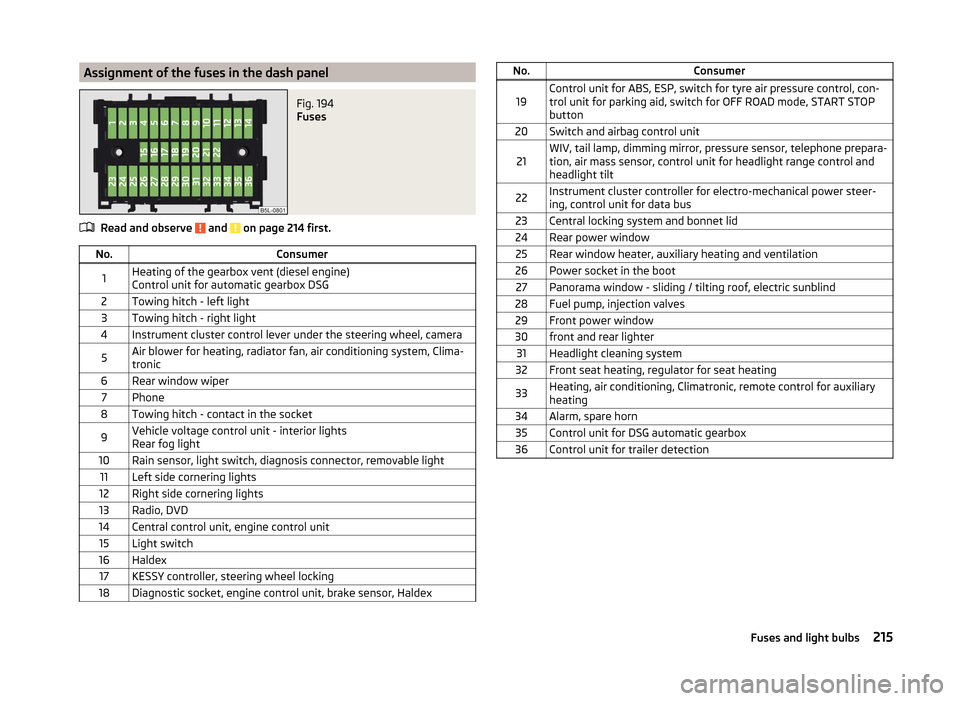
Assignment of the fuses in the dash panelFig. 194
Fuses
Read and observe and on page 214 first.
No.Consumer1Heating of the gearbox vent (diesel engine)
Control unit for automatic gearbox DSG2Towing hitch - left light3Towing hitch - right light4Instrument cluster control lever under the steering wheel, camera5Air blower for heating, radiator fan, air conditioning system, Clima-
tronic6Rear window wiper7Phone8Towing hitch - contact in the socket9Vehicle voltage control unit - interior lights
Rear fog light10Rain sensor, light switch, diagnosis connector, removable light11Left side cornering lights12Right side cornering lights13Radio, DVD14Central control unit, engine control unit15Light switch16Haldex17KESSY controller, steering wheel locking18Diagnostic socket, engine control unit, brake sensor, HaldexNo.Consumer19Control unit for ABS, ESP, switch for tyre air pressure control, con-
trol unit for parking aid, switch for OFF ROAD mode, START STOP button20Switch and airbag control unit21WIV, tail lamp, dimming mirror, pressure sensor, telephone prepara-
tion, air mass sensor, control unit for headlight range control and
headlight tilt22Instrument cluster controller for electro-mechanical power steer-
ing, control unit for data bus23Central locking system and bonnet lid24Rear power window25Rear window heater, auxiliary heating and ventilation26Power socket in the boot27Panorama window - sliding / tilting roof, electric sunblind28Fuel pump, injection valves29Front power window30front and rear lighter31Headlight cleaning system32Front seat heating, regulator for seat heating33Heating, air conditioning, Climatronic, remote control for auxiliary
heating34Alarm, spare horn35Control unit for DSG automatic gearbox36Control unit for trailer detection215Fuses and light bulbs
Page 225 of 248
Technical data
Technical data
Vehicle data
Introduction
This chapter contains information on the following subjects:
Vehicle characteristics
222
Operating weight and payload
223
Measurement of fuel consumption and CO 2 emissions according to ECE
Regulations and EU Directives
223
Dimensions
224
angle and gradeability
225
Vehicle-specific details per engine type
226
The details given in the vehicle's technical documentation always take prece-
dence over the details in the Owner's Manual.
The listed performance values were determined without performance-reduc- ing equipment, e.g. air conditioning system.
Vehicle characteristics
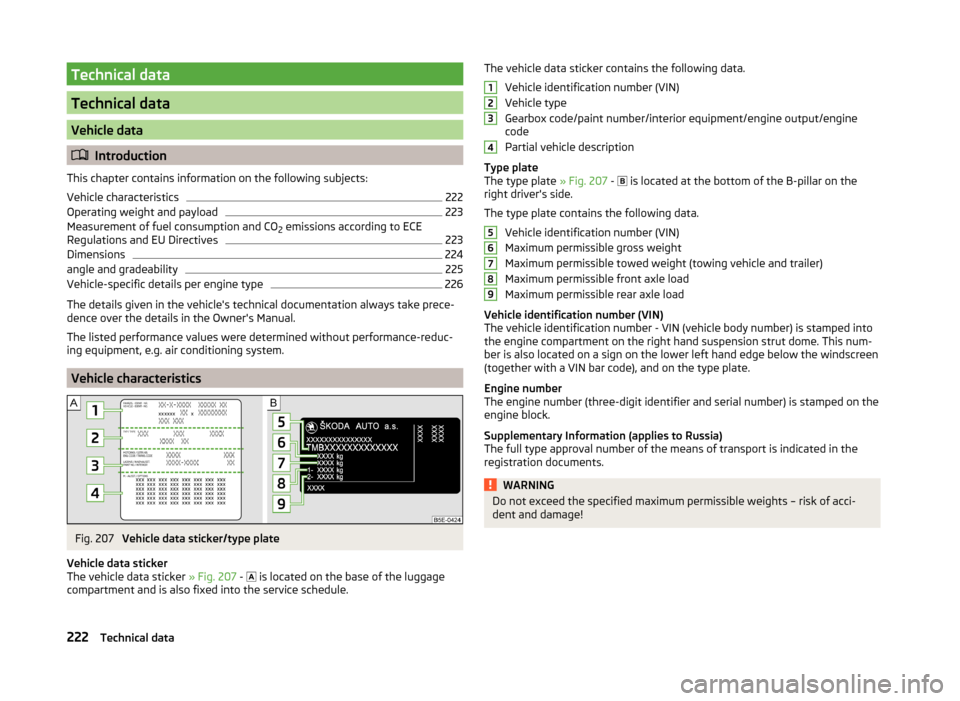
Fig. 207
Vehicle data sticker/type plate
Vehicle data sticker
The vehicle data sticker » Fig. 207 -
is located on the base of the luggage
compartment and is also fixed into the service schedule.
The vehicle data sticker contains the following data.
Vehicle identification number (VIN)
Vehicle type
Gearbox code/paint number/interior equipment/engine output/engine
code
Partial vehicle description
Type plate
The type plate » Fig. 207 -
is located at the bottom of the B-pillar on the
right driver's side.
The type plate contains the following data. Vehicle identification number (VIN)
Maximum permissible gross weight
Maximum permissible towed weight (towing vehicle and trailer)
Maximum permissible front axle load
Maximum permissible rear axle load
Vehicle identification number (VIN)
The vehicle identification number - VIN (vehicle body number) is stamped into
the engine compartment on the right hand suspension strut dome. This num-
ber is also located on a sign on the lower left hand edge below the windscreen
(together with a VIN bar code), and on the type plate.
Engine number
The engine number (three-digit identifier and serial number) is stamped on the engine block.
Supplementary Information (applies to Russia)
The full type approval number of the means of transport is indicated in the
registration documents.WARNINGDo not exceed the specified maximum permissible weights – risk of acci-
dent and damage!123456789222Technical data
Page 226 of 248

Operating weight and payload
Operating weight
This value represents the minimum operating weight without additional
weight-increasing equipment such as air conditioning system, spare wheel, or
trailer hitch.
The specified operating weight is for orientation purposes only.
The operating weight also contains the weight of the driver (75 kg), the weight
of the operating fluids, the tool kit, and a fuel tank filled to 90 % capacity.
Operating weight of the vehicle » page 226.
Payload
It is possible to calculate the approximate maximum payload from the differ-
ence between the permissible total weight and the operating weight.
The payload consists of the following weights.
› The weight of the passengers.
› The weight of all items of luggage and other loads.
› The weight of the roof, including the roof rack system.
› The weight of the equipment that is excluded from the operating weight.
› The trailer nose weight with trailer (max. 80 kg and 85 kg 1)
).
Note
If required, you can find out the precise weight of your vehicle at a specialist
garage.
Measurement of fuel consumption and CO 2 emissions according to
ECE Regulations and EU Directives
The data on fuel consumption and CO 2 emissions were not available at the
time of going to press.
The data on fuel consumption and CO 2 emissions are given on the ŠKODA
websites or in the sales and technical vehicle documentation.
The measurement of the intra-urban cycle begins with a cold start of the en-
gine. Afterwards urban driving is simulated.
In the extra-urban driving cycle, the vehicle is accelerated and decelerated in
all gears, corresponding to daily routine driving conditions. The driving speed
varies between 0 and 120 km/h.
The calculation of the combined fuel consumption considers a weighting of
about 37 % for the intra-urban cycle and 63 % for the extra-urban cycle.
Note
■ The fuel consumption and emission levels given on the ŠKODA websites or in
the commercial and technical vehicle documentation have been established in
accordance with rules and under conditions that are set out by legal or techni-
cal rules for the determination of operational and technical data of motor vehi-
cles.■
Depending on the extent of the equipment, the driving style, traffic condi-
tions, weather influences and vehicle condition, consumption values can in
practice result in fuel economy figures in the use of the vehicle that differ from
the fuel consumption values listed on the ŠKODA websites or in the commer-
cial and technical vehicle documentation.
1)
Applies to vehicles 4x4 with the 2.0 l/103 kW TDI CR and 2.0 L/125 kW TDI CR engine.
223Technical data
Page 234 of 248
Index
A
abroad lead-free petrol
178
Abroad Headlights
69
ABS Function
143
Warning light38
Acceptance and recycling of used vehicles169
Accessories166
Adaptive headlights (AFS)66
adjusting auxiliary heating and ventilation
111
Adjusting Belt height
15
Exterior mirrors76
Head restraints82
Interior mirror75
seats78
Steering wheel10
the seats electronically78
Adjusting the seats9
Adjusting the seats electronically78
adjustment Front seat
77
Adjustment Headlight beam
64
AFS66
Display messages39
Warning light39
Air-conditioning system Air outlet vents
105
Airbag16
Deactivating21
Deactivating the front passenger airbag22
Deployment17
Front airbag18
Head airbag20
Knee airbag19
Modifications and damage to the airbag system 168
Side airbag
19
Warning light40
Airbag system16
Air conditioning104
Air distribution control106
Climatronic108
manual air conditioning107
Air distribution control106
Air outlet vents105
Alarm Switching off
56
Triggering56
Alcantara cleaning
175
Alternator Warning light
36
Anti-theft alarm system Activating/deactivating
56
Trailer165
Anti-theft wheel bolts203
Antilock Braking System143
Armrest Front
81
artificial leather175
Ashtray89
ASR warning light
37
Assistance systems TSA
144
Assistence systems OFF ROAD-mode
144
Assist system ABS
143
Assist systems142
ABS38
ASR37
Cruise Control System154
DSR144
EDL143
ESC38, 143
HBA144
HHC144
Park assist150
Parking aid146
START-STOP155
TCS143
Audio See Infotainment / radio
4
Auto Check Control33
Automatic driving lamp control66
Automatic gearbox Manual shifting of gears
139
Selector lever-emergency unlocking212
Selector lever lock139
Starting-off and driving140
Tiptronic139
Using the selector lever138
Automatic gearbox modes138
Automatic load deactivation190
automatic transmission selector lever lock defect
139
Automatic transmission138
Kickdown140
Selector lever lock139
Auxiliary heating and ventilation Switching on and off directly
111
System settings111
Auxiliary heating (auxiliary heating and ventila- tion)
110
Radio remote control111
B
Ball head Check fitting
161
Ready position160
231Index
Page 239 of 248
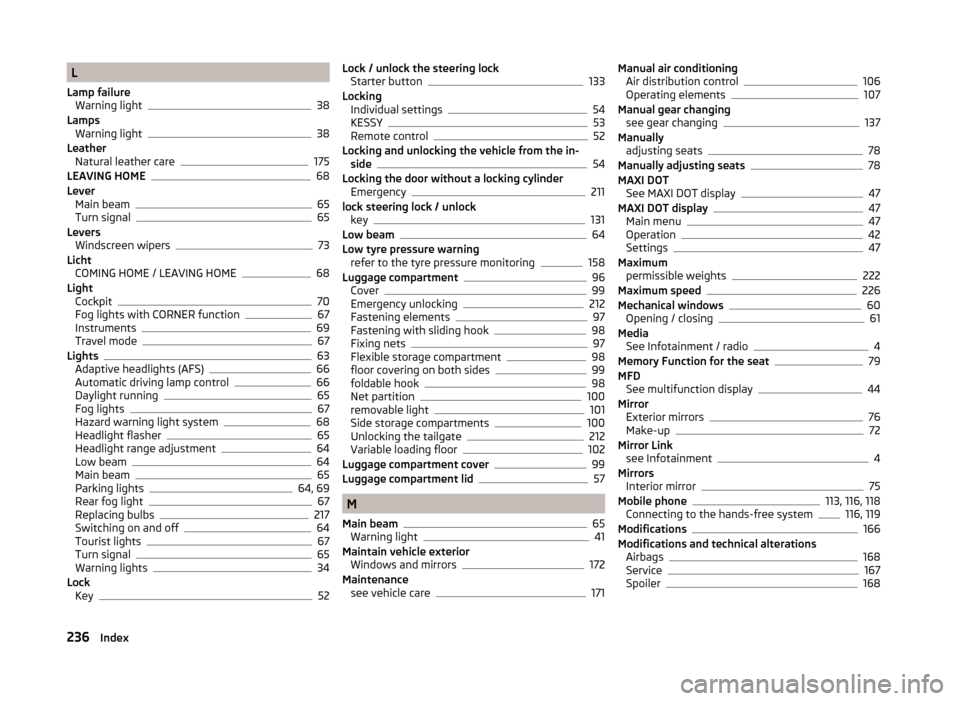
L
Lamp failure Warning light
38
Lamps Warning light
38
Leather Natural leather care
175
LEAVING HOME68
Lever Main beam
65
Turn signal65
Levers Windscreen wipers
73
Licht COMING HOME / LEAVING HOME
68
Light Cockpit
70
Fog lights with CORNER function67
Instruments69
Travel mode67
Lights63
Adaptive headlights (AFS)66
Automatic driving lamp control66
Daylight running65
Fog lights67
Hazard warning light system68
Headlight flasher65
Headlight range adjustment64
Low beam64
Main beam65
Parking lights64, 69
Rear fog light67
Replacing bulbs217
Switching on and off64
Tourist lights67
Turn signal65
Warning lights34
Lock Key
52
Lock / unlock the steering lockStarter button133
Locking Individual settings
54
KESSY53
Remote control52
Locking and unlocking the vehicle from the in- side
54
Locking the door without a locking cylinder Emergency
211
lock steering lock / unlock key
131
Low beam64
Low tyre pressure warning refer to the tyre pressure monitoring
158
Luggage compartment96
Cover99
Emergency unlocking212
Fastening elements97
Fastening with sliding hook98
Fixing nets97
Flexible storage compartment98
floor covering on both sides99
foldable hook98
Net partition100
removable light101
Side storage compartments100
Unlocking the tailgate212
Variable loading floor102
Luggage compartment cover99
Luggage compartment lid57
M
Main beam
65
Warning light41
Maintain vehicle exterior Windows and mirrors
172
Maintenance see vehicle care
171
Manual air conditioningAir distribution control106
Operating elements107
Manual gear changing see gear changing
137
Manually adjusting seats
78
Manually adjusting seats78
MAXI DOT See MAXI DOT display
47
MAXI DOT display47
Main menu47
Operation42
Settings47
Maximum permissible weights
222
Maximum speed226
Mechanical windows60
Opening / closing61
Media See Infotainment / radio
4
Memory Function for the seat79
MFD See multifunction display
44
Mirror Exterior mirrors
76
Make-up72
Mirror Link see Infotainment
4
Mirrors Interior mirror
75
Mobile phone113, 116, 118
Connecting to the hands-free system116, 119
Modifications166
Modifications and technical alterations Airbags
168
Service167
Spoiler168
236Index