air condition SMART FORTWO 2016 Owner's Manual
[x] Cancel search | Manufacturer: SMART, Model Year: 2016, Model line: FORTWO, Model: SMART FORTWO 2016Pages: 214, PDF Size: 4.93 MB
Page 125 of 214
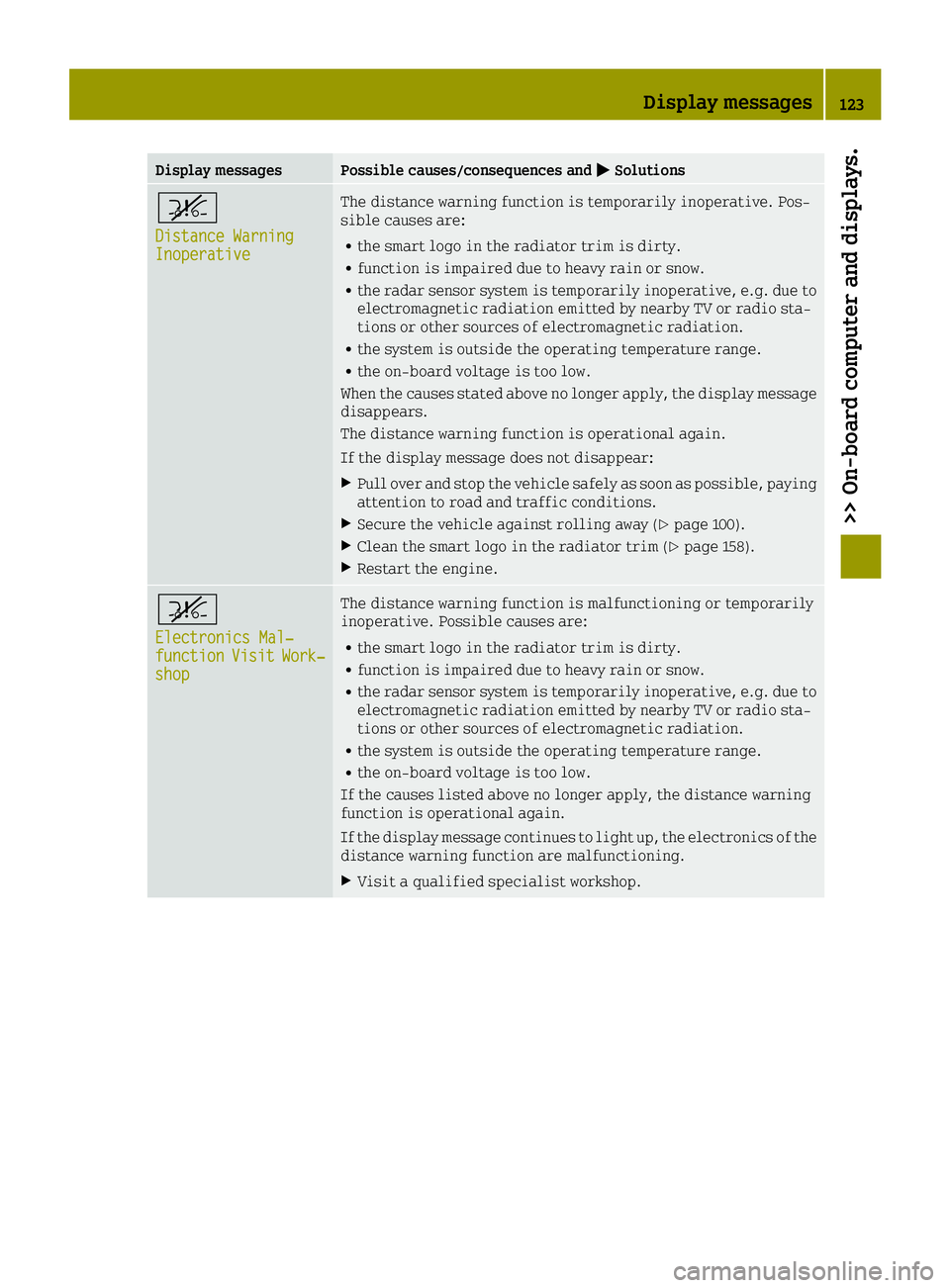
Display messagesPossible causes/consequences and0050Solutions
^
Distance WarningInoperative
The distance warning function is temporarily inoperative. Pos-
sible causes are:
Rthe smart logo in the radiator trim is dirty.
Rfunction is impaired due to heavy rain or snow.
Rthe radar sensor system is temporarily inoperative, e.g. due to
electromagnetic radiation emitted by nearby TV or radio sta-
tions or other sources of electromagnetic radiation.
Rthe system is outside the operating temperature range.
Rthe on-board voltage is too low.
When the causes stated above no longer apply, the display message
disappears.
The distance warning function is operational again.
If the display message does not disappear:
XPull over and stop the vehicle safely as soon as possible, paying
attention to road and traffic conditions.
XSecure the vehicle against rolling away (Ypage 100).
XClean the smart logo in the radiator trim (Ypage 158).
XRestart the engine.
^
Electronics Mal‐functionVisitWork‐shop
The distance warning function is malfunctioning or temporarily
inoperative. Possible causes are:
Rthe smart logo in the radiator trim is dirty.
Rfunction is impaired due to heavy rain or snow.
Rthe radar sensor system is temporarily inoperative, e.g. due to
electromagnetic radiation emitted by nearby TV or radio sta-
tions or other sources of electromagnetic radiation.
Rthe system is outside the operating temperature range.
Rthe on-board voltage is too low.
If the causes listed above no longer apply, the distance warning
function is operational again.
If the display message continues to light up, the electronics of the
distance warning function are malfunctioning.
XVisit a qualified specialist workshop.
Display messages123
>> On-board computer and displays.
Z
Page 127 of 214
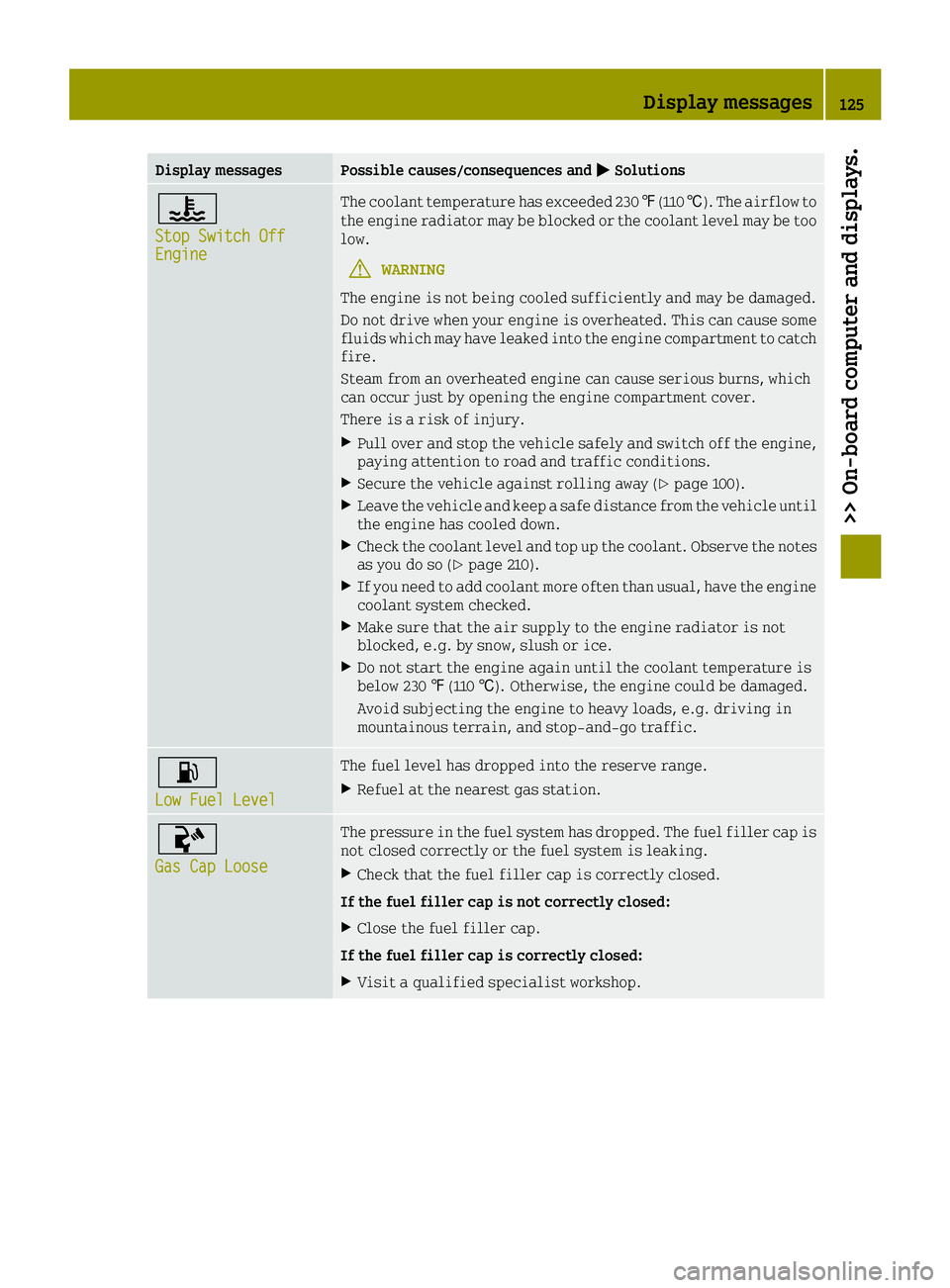
Display messagesPossible causes/consequences and0050Solutions
00AC
Stop Switch OffEngine
The coolant temperature has exceeded 230 ‡(110 †). The airflow to
the engine radiator may be blocked or the coolant level may be too
low.
GWARNING
The engine is not being cooled sufficiently and may be damaged.
Do not drive when your engine is overheated. This can cause some
fluids which may have leaked into the engine compartment to catch
fire.
Steam from an overheated engine can cause serious burns, which
can occur just by opening the engine compartment cover.
There is a risk of injury.
XPull over and stop the vehicle safely and switch off the engine,
paying attention to road and traffic conditions.
XSecure the vehicle against rolling away (Ypage 100).
XLeave the vehicle and keep a safe distance from the vehicle until
the engine has cooled down.
XCheck the coolant level and top up the coolant. Observe the notes
as you do so (Ypage 210).
XIf you need to add coolant more often than usual, have the engine coolant system checked.
XMake sure that the air supply to the engine radiator is not
blocked, e.g. by snow, slush or ice.
XDo not start the engine again until the coolant temperature is
below 230 ‡(110 †). Otherwise, the engine could be damaged.
Avoid subjecting the engine to heavy loads, e.g. driving in
mountainous terrain, and stop-and-go traffic.
00B4
Low Fuel Level
The fuel level has dropped into the reserve range.
XRefuel at the nearest gas station.
00AC
Gas Cap Loose
The pressure in the fuel system has dropped. The fuel filler cap is
not closed correctly or the fuel system is leaking.
XCheck that the fuel filler cap is correctly closed.
If the fuel filler cap is not correctly closed:
XClose the fuel filler cap.
If the fuel filler cap is correctly closed:
XVisit a qualified specialist workshop.
Display messages125
>> On-board computer and displays.
Z
Page 134 of 214
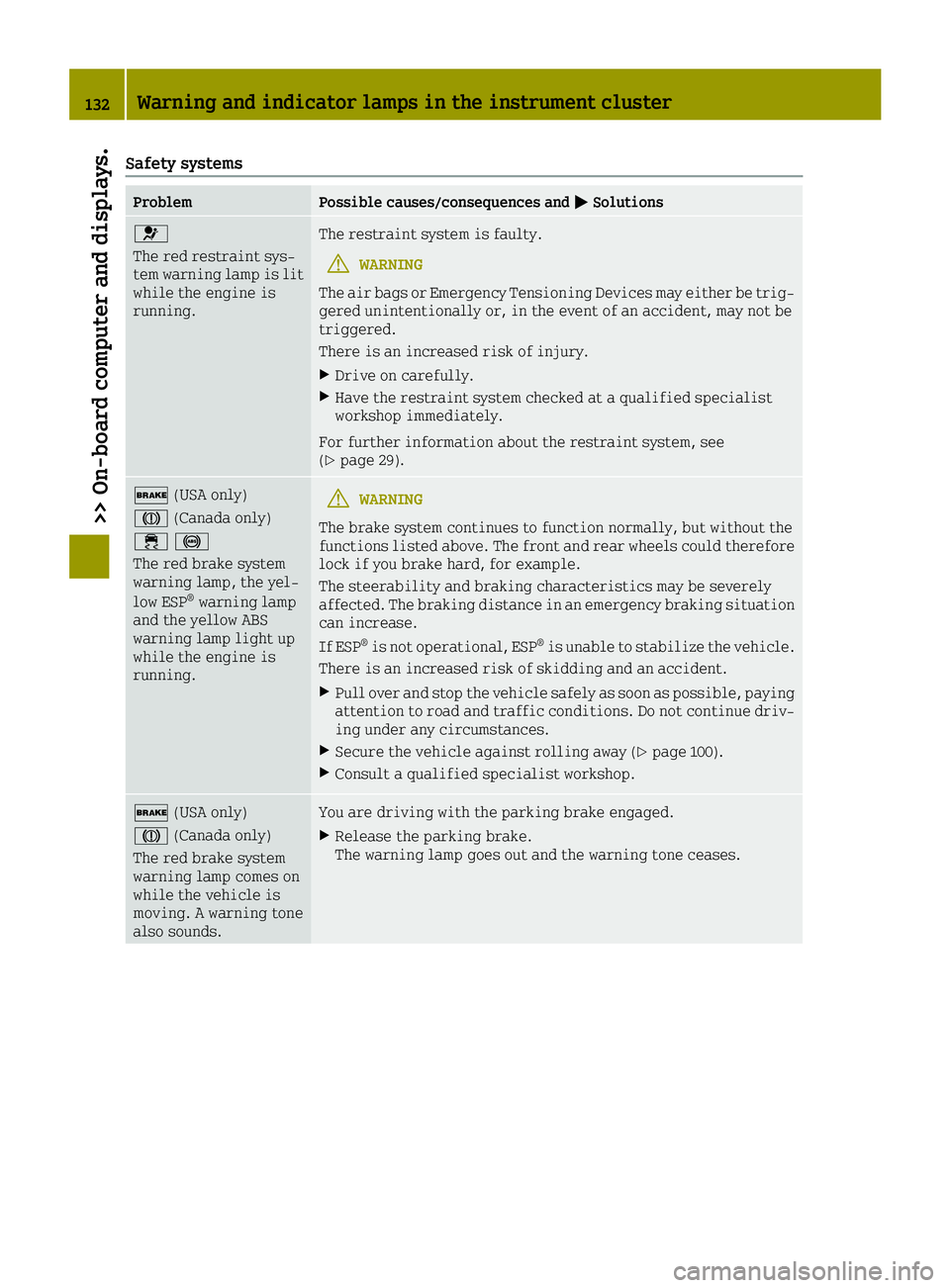
Safety systems
ProblemPossible causes/consequences and0050Solutions
0075
The red restraint sys-
tem warning lamp is lit
while the engine is
running.The restraint system is faulty.
GWARNING
The air bags or Emergency Tensioning Devices may either be trig-
gered unintentionally or, in the event of an accident, may not be
triggered.
There is an increased risk of injury.
XDrive on carefully.
XHave the restraint system checked at a qualified specialist
workshop immediately.
For further information about the restraint system, see
(
Ypage 29).
0027 (USA only)
004D (Canada only)
00E50025
The red brake system
warning lamp, the yel-
low ESP
®warning lamp
and the yellow ABS
warning lamp light up
while the engine is
running.
GWARNING
The brake system continues to function normally, but without the
functions listed above. The front and rear wheels could therefore
lock if you brake hard, for example.
The steerability and braking characteristics may be severely
affected. The braking distance in an emergency braking situation
can increase.
If ESP
®is not operational, ESP®is unable to stabilize the vehicle.
There is an increased risk of skidding and an accident.
XPull over and stop the vehicle safely as soon as possible, paying
attention to road and traffic conditions. Do not continue driv-
ing under any circumstances.
XSecure the vehicle against rolling away (Ypage 100).
XConsult a qualified specialist workshop.
0027 (USA only)
004D (Canada only)
The red brake system
warning lamp comes on
while the vehicle is
moving. A warning tone
also sounds.You are driving with the parking brake engaged.
XRelease the parking brake.
The warning lamp goes out and the warning tone ceases.
132Warning and indicator lamps in the instrument cluster
>> On-board computer and displays.
Page 135 of 214
ProblemPossible causes/consequences and0050Solutions
0027(USA only)
004D (Canada only)
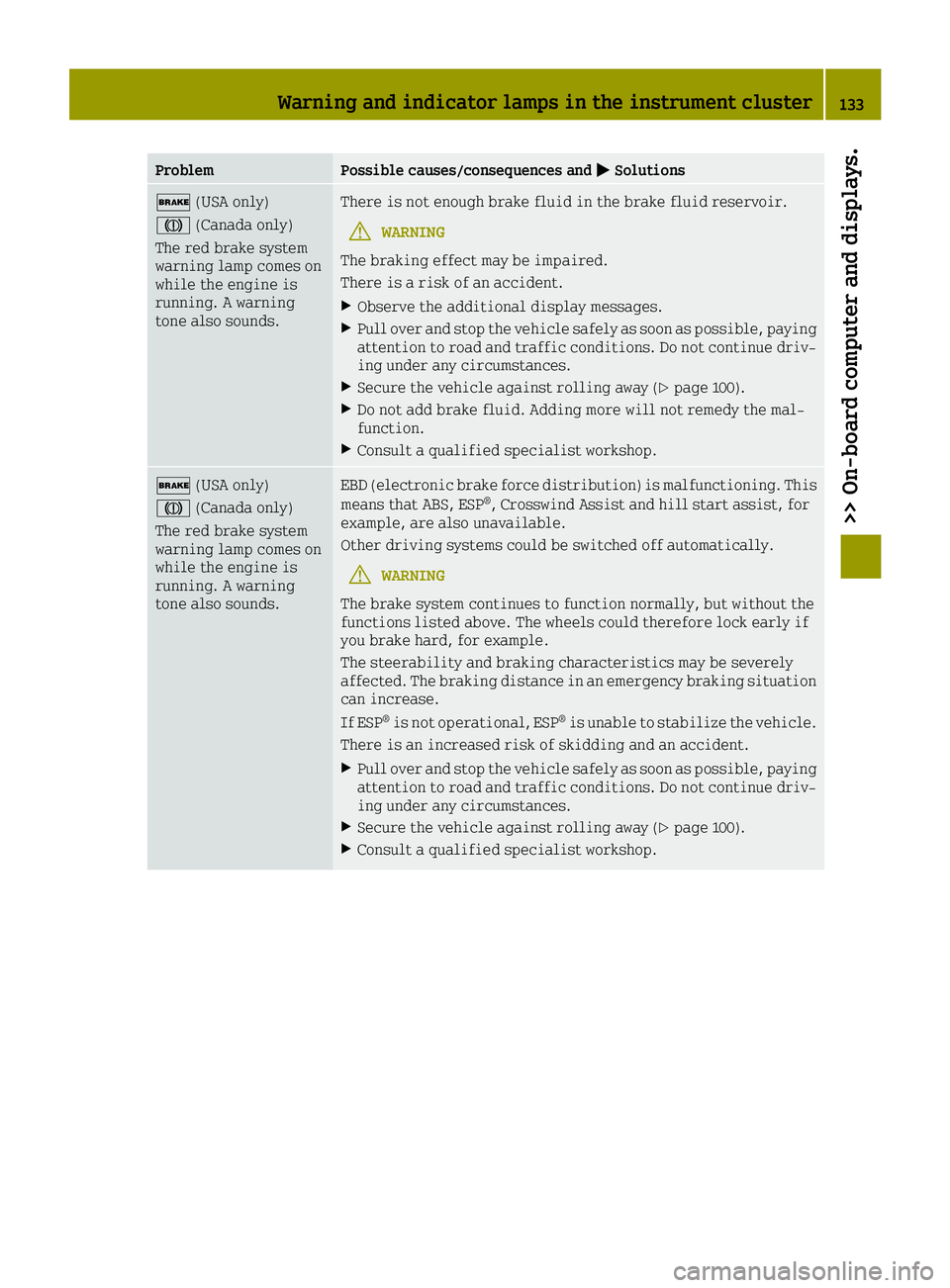
The red brake system
warning lamp comes on
while the engine is
running. A warning
tone also sounds.There is not enough brake fluid in the brake fluid reservoir.
GWARNING
The braking effect may be impaired.
There is a risk of an accident.
XObserve the additional display messages.
XPull over and stop the vehicle safely as soon as possible, paying
attention to road and traffic conditions. Do not continue driv-
ing under any circumstances.
XSecure the vehicle against rolling away (Ypage 100).
XDo not add brake fluid. Adding more will not remedy the mal-
function.
XConsult a qualified specialist workshop.
0027 (USA only)
004D (Canada only)
The red brake system
warning lamp comes on
while the engine is
running. A warning
tone also sounds.EBD (electronic brake force distribution) is malfunctioning. This
means that ABS, ESP®, Crosswind Assist and hill start assist, for
example, are also unavailable.
Other driving systems could be switched off automatically.
GWARNING
The brake system continues to function normally, but without the
functions listed above. The wheels could therefore lock early if
you brake hard, for example.
The steerability and braking characteristics may be severely
affected. The braking distance in an emergency braking situation
can increase.
If ESP
®is not operational, ESP®is unable to stabilize the vehicle.
There is an increased risk of skidding and an accident.
XPull over and stop the vehicle safely as soon as possible, paying
attention to road and traffic conditions. Do not continue driv-
ing under any circumstances.
XSecure the vehicle against rolling away (Ypage 100).
XConsult a qualified specialist workshop.
Warning and indicator lamps in the instrument cluster133
>> On-board computer and displays.
Z
Page 140 of 214
ProblemPossible causes/consequences and0050Solutions
00B3
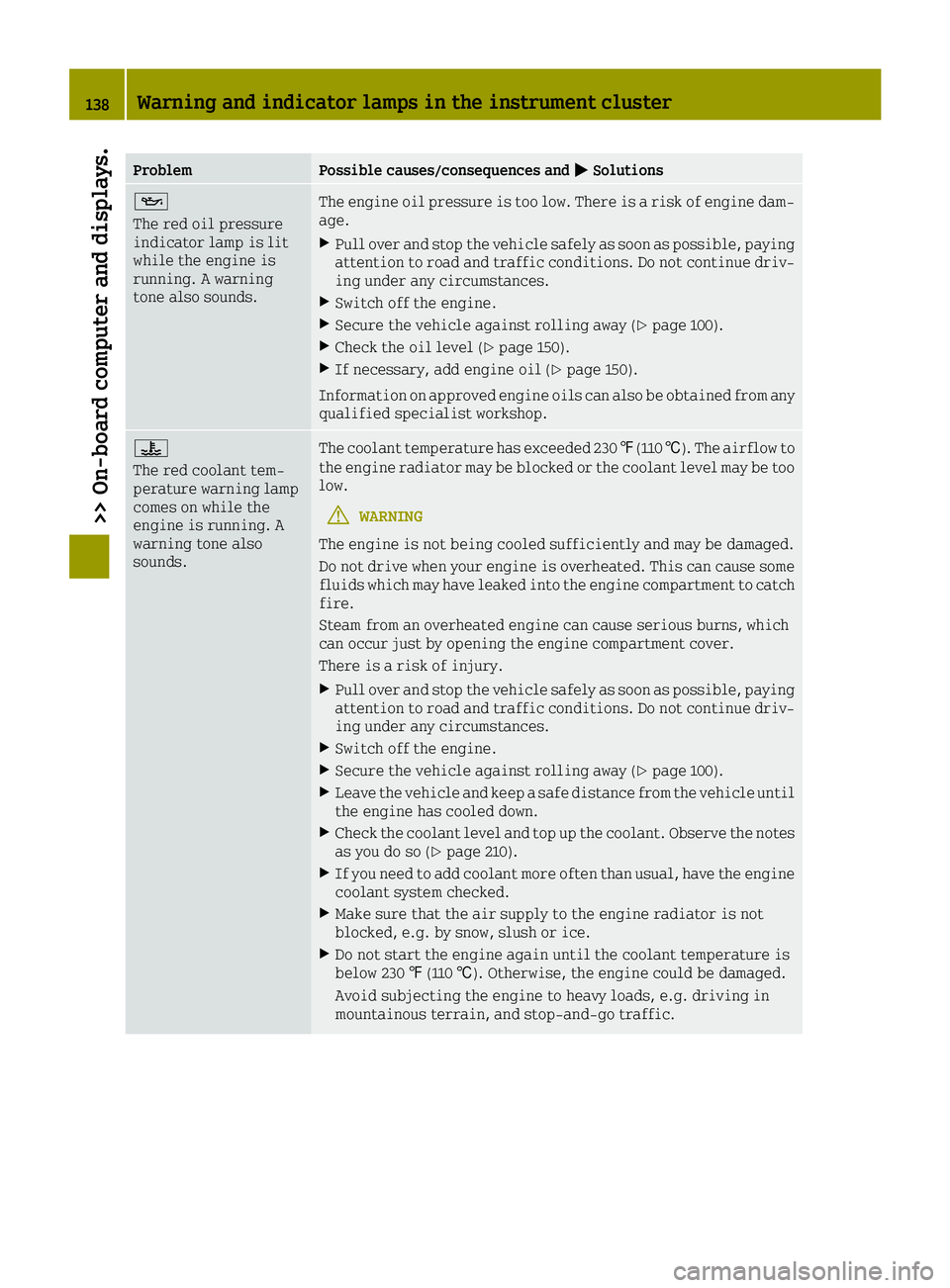
The red oil pressure
indicator lamp is lit
while the engine is
running. A warning
tone also sounds.The engine oil pressure is too low. There is a risk of engine dam-
age.
XPull over and stop the vehicle safely as soon as possible, paying
attention to road and traffic conditions. Do not continue driv-
ing under any circumstances.
XSwitch off the engine.
XSecure the vehicle against rolling away (Ypage 100).
XCheck the oil level (Ypage 150).
XIf necessary, add engine oil (Ypage 150).
Information on approved engine oils can also be obtained from any
qualified specialist workshop.
00AC
The red coolant tem-
perature warning lamp
comes on while the
engine is running. A
warning tone also
sounds.The coolant temperature has exceeded 230 ‡(110 †). The airflow to
the engine radiator may be blocked or the coolant level may be too
low.
GWARNING
The engine is not being cooled sufficiently and may be damaged.
Do not drive when your engine is overheated. This can cause some
fluids which may have leaked into the engine compartment to catch
fire.
Steam from an overheated engine can cause serious burns, which
can occur just by opening the engine compartment cover.
There is a risk of injury.
XPull over and stop the vehicle safely as soon as possible, paying attention to road and traffic conditions. Do not continue driv-
ing under any circumstances.
XSwitch off the engine.
XSecure the vehicle against rolling away (Ypage 100).
XLeave the vehicle and keep a safe distance from the vehicle until
the engine has cooled down.
XCheck the coolant level and top up the coolant. Observe the notes
as you do so (Ypage 210).
XIf you need to add coolant more often than usual, have the engine
coolant system checked.
XMake sure that the air supply to the engine radiator is not
blocked, e.g. by snow, slush or ice.
XDo not start the engine again until the coolant temperature is
below 230 ‡(110 †). Otherwise, the engine could be damaged.
Avoid subjecting the engine to heavy loads, e.g. driving in
mountainous terrain, and stop-and-go traffic.
138Warning and indicator lamps in the instrument cluster
>> On-board computer and displays.
Page 156 of 214
Information on the type of service and ser-
vice intervals (see the separate Maintenance
Booklet).
For further information inquire at any smart
center or look under
http://www.smartUSA.com (only USA).
iThe service display does not show any
information on the engine oil level.
Observe the notes on the engine oil level
(
Ypage 150).
Whenever a service is due, this is shown
approximately 30 days or 1500 km (1000 miles)
beforehand. After starting the engine, a ser-
vice message appears in the instrument clus-
ter display for a few seconds; see the follow-
ing example.
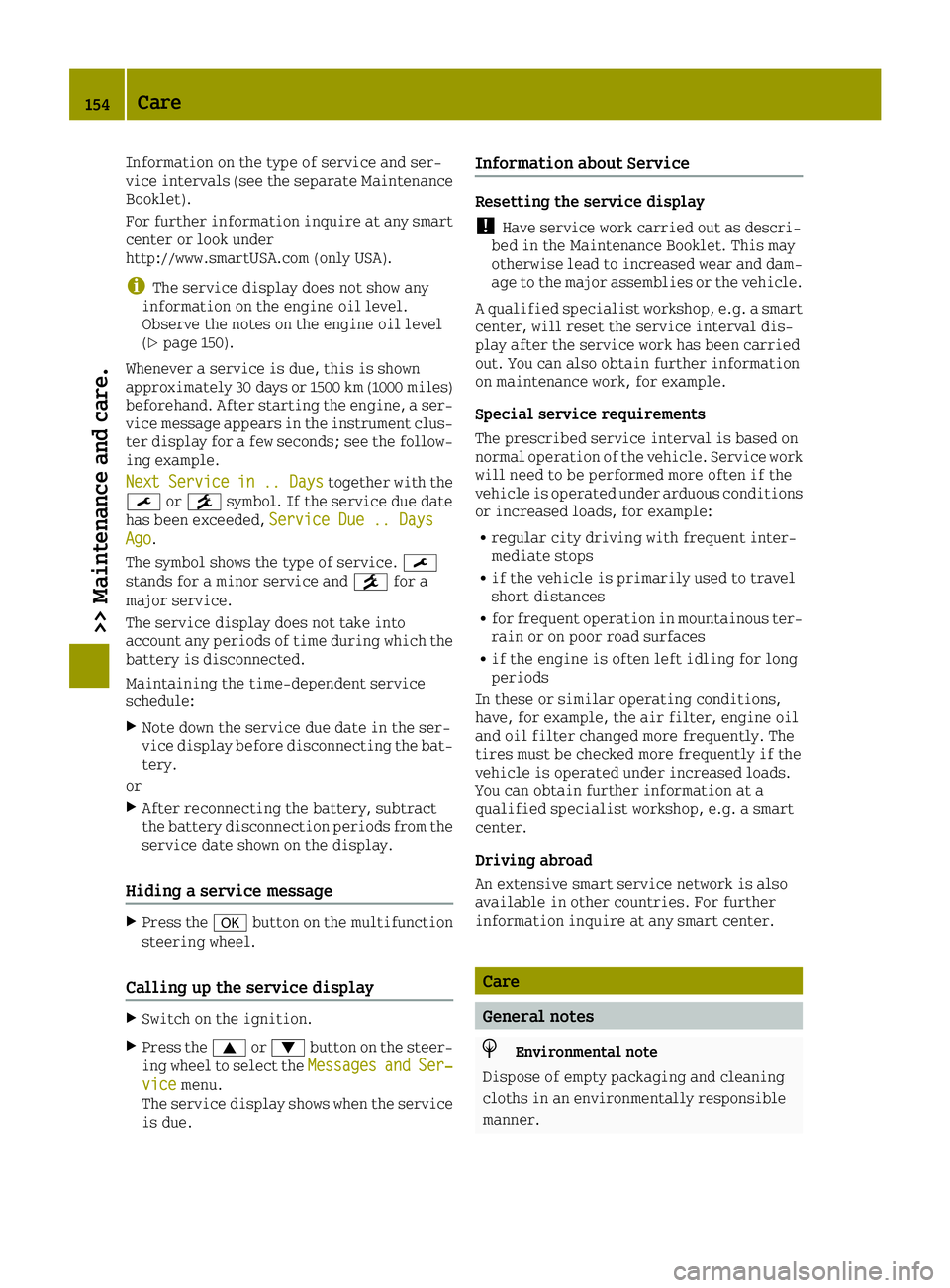
Next
Servicein.. Daystogether with the
0099 or009A symbol. If the service due date
has been exceeded, Service Due .. Days
Ago.
The symbol shows the type of service. 0099
stands for a minor service and 009Afor a
major service.
The service display does not take into
account any periods of time during which the
battery is disconnected.
Maintaining the time-dependent service
schedule:
XNote down the service due date in the ser-
vice display before disconnecting the bat-
tery.
or
XAfter reconnecting the battery, subtract
the battery disconnection periods from the
service date shown on the display.
Hiding a service message
XPress the 0076button on the multifunction
steering wheel.
Calling up the service display
XSwitch on the ignition.
XPress the 0063or0064 button on the steer-
ing wheel to select the MessagesandSer‐vicemenu.
The service display shows when the service
is due.
Information about Service
Resetting the service display
!Have service work carried out as descri-
bed in the Maintenance Booklet. This may
otherwise lead to increased wear and dam-
age to the major assemblies or the vehicle.
A qualified specialist workshop, e.g. a smart center, will reset the service interval dis-
play after the service work has been carried
out. You can also obtain further information
on maintenance work, for example.
Special service requirements
The prescribed service interval is based on
normal operation of the vehicle. Service work
will need to be performed more often if the
vehicle is operated under arduous conditions
or increased loads, for example:
Rregular city driving with frequent inter-
mediate stops
Rif the vehicle is primarily used to travel
short distances
Rfor frequent operation in mountainous ter-
rain or on poor road surfaces
Rif the engine is often left idling for long
periods
In these or similar operating conditions,
have, for example, the air filter, engine oil
and oil filter changed more frequently. The
tires must be checked more frequently if the
vehicle is operated under increased loads.
You can obtain further information at a
qualified specialist workshop, e.g. a smart
center.
Driving abroad
An extensive smart service network is also
available in other countries. For further
information inquire at any smart center.
Care
General notes
HEnvironmental note
Dispose of empty packaging and cleaning
cloths in an environmentally responsible
manner.
154Care
>> Maintenance and care.
Page 157 of 214
!For cleaning your vehicle, do not use any
of the following:
Rdry, rough or hard cloths
Rabrasive cleaning agents
Rsolvents
Rcleaning agents containing solvents
Do not scrub.
Do not touch the surfaces or protective
films with hard objects, e.g. a ring or ice
scraper. You could otherwise scratch or
damage the surfaces and protective film.
!Do not park the vehicle for an extended
period straight after cleaning it, partic-
ularly after having cleaned the wheels with
wheel cleaner. Wheel cleaners could cause
increased corrosion of the brake discs and
brake pads/linings. For this reason, you
should drive for a few minutes after clean-
ing. Braking heats the brake discs and the
brake pads/linings, thus drying them. The
vehicle can then be parked.
Regular care of your vehicle is a condition
for retaining the quality in the long term.
Use care products and cleaning agents rec-
ommended and approved by smart.
Exterior care
Automatic car wash
GWARNING
Braking efficiency is reduced after wash-
ing the vehicle. There is a risk of an acci-
dent.
After the vehicle has been washed, brake
carefully while paying attention to the
traffic conditions until full braking power
is restored.
!Never clean your vehicle in a Touchless
Automatic Car Wash as these use special
cleaning agents. These cleaning agents can
damage the paintwork or plastic parts.
!Make sure that:
Rthe side windows are fully closed
Rthe climate control blower is switched
off
Rthe windshield wiper switch is at posi-
tion 0
The vehicle may otherwise be damaged.
You can wash the vehicle in an automatic car
wash from the very start.
If the vehicle is very dirty, pre-wash it
before cleaning it in an automatic car wash.
After using an automatic car wash, wipe off
wax from the windshield and the wiper blades.
This will prevent smears and reduce wiping
noises caused by residue on the windshield.
Washing by hand
In some countries, washing by hand is only
allowed at specially equipped washing bays.
Observe the legal requirements in each coun-
try.
XDo not use hot water and do not wash the
vehicle in direct sunlight.
XUse a soft sponge to clean.
XUse a mild cleaning agent, such as a car
shampoo approved by smart.
XThoroughly hose down the vehicle with a
gentle jet of water.
XDo not point the water jet directly towards
the air inlet.
XUse plenty of water and rinse out the sponge frequently.
XRinse the vehicle with clean water and dry
thoroughly with a chamois.
XDo not let the cleaning agent dry on the
paintwork.
Carefully remove all deposits of road salt as
soon as possible when driving in winter.
Power washers
GWARNING
The water jet from a circular jet nozzle
(dirt blasters) can cause invisible exte-
rior damage to the tires or chassis compo- nents. Components damaged in this way may
fail unexpectedly. There is a risk of an
accident.
Care155
>> Maintenance and care.
Z
Page 158 of 214
Do not use power washers with circular jet
nozzles to clean the vehicle. Have damaged
tires or chassis components replaced
immediately.
!Always maintain a distance of at least
11.8 in (30 cm) between the vehicle and the
power washer nozzle. Information about the
correct distance is available from the
equipment manufacturer.
Move the power washer nozzle around when
cleaning your vehicle.
Do not aim directly at any of the following:
Rtires
Rdoor gaps, roof gaps, joints, etc.
Relectrical components
Rbattery
Rconnectors
Rlights
Rseals
Rtrim
Rventilation slots
Damaged seals or electrical components
can lead to leaks or failures.
Cleaning the paintwork
!Do not affix:
Rstickers
Rfilms
Rmagnetic plates or similar items
to painted surfaces. You could otherwise
damage the paintwork.
XRemove dirt immediately, where possible,
while avoiding rubbing too hard.
XSoak insect remains with insect remover
and rinse off the treated areas afterwards.
XSoak bird droppings with water and rinse
off the treated areas afterwards.
XRemove coolant, brake fluid, tree resin,
oils, fuels and greases by rubbing gently
with a cloth soaked in petroleum ether or
lighter fluid.
XUse tar remover to remove tar stains.
XUse silicone remover to remove wax.
XUse a suitable touch-up stick, e.g. MB
Touch-Up Stick, to repair slight damage to
the paintwork quickly and provisionally. The following cannot always be completely
repaired:
Rscratches
Rcorrosive deposits
Rareas affected by corrosion
Rdamage caused by inadequate care
In such cases, visit a qualified specialist
workshop.
When water no longer forms beads on the paint surface, use the care product Paint Care,
which has been approved by smart. This is the
case approximately every three to five
months, depending on the climate conditions
and the care product used.
If the dirt has penetrated the paint surface or
if the paintwork has become dull, then the
paintwork should be cleaned. Use the care
product Paint Care, which has been approved
by smart to clean the paintwork.
Do not use these care products in the sun or on
the hood while the hood is hot.
Matte finish care
!Never polish the vehicle or the light alloy
wheels. Polishing causes the finish to
shine.
!The following may cause the paint to
become shiny and thus reduce the matte
effect:
Rstrong rubbing of the paintwork with
unsuitable materials
Rfrequent use of automatic car washes
Rwashing the vehicle in direct sunlight
!Never use paint cleaner, buffing or pol-
ishing products, or gloss preserver, e.g.
wax. These products are only suitable for
high-gloss surfaces. Their use on vehicles
with matte finish leads to considerable
surface damage (shiny, mottled areas).
Always have paintwork repairs carried out
at a qualified specialist workshop.
!Do not use wash programs with a hot wax
treatment under any circumstances.
Observe these notes if your vehicle has a
clear matte finish. This will help you to avoid
damage to the paintwork due to incorrect
treatment.
These notes also apply to light alloy wheels
with a clear matte finish.
156Care
>> Maintenance and care.
Page 166 of 214
GWARNING
If the required tire pressure is not reached after driving for a short period, the tire is
too badly damaged. The tire sealant cannot repair the tire in this instance. Damaged
tires and a tire pressure that is too low can
significantly impair the vehicle's brakingand driving characteristics. There is a
risk of accident.
Do not continue driving. Contact a quali-
fied specialist workshop.
XCorrect the tire pressure if it is still at
least 130 kPa (1.3 bar/19 psi). For values, see
the tire and loading information table on
the driver's side B-pillar.
XTo increase the tire pressure: switch on the
tire inflation compressor.
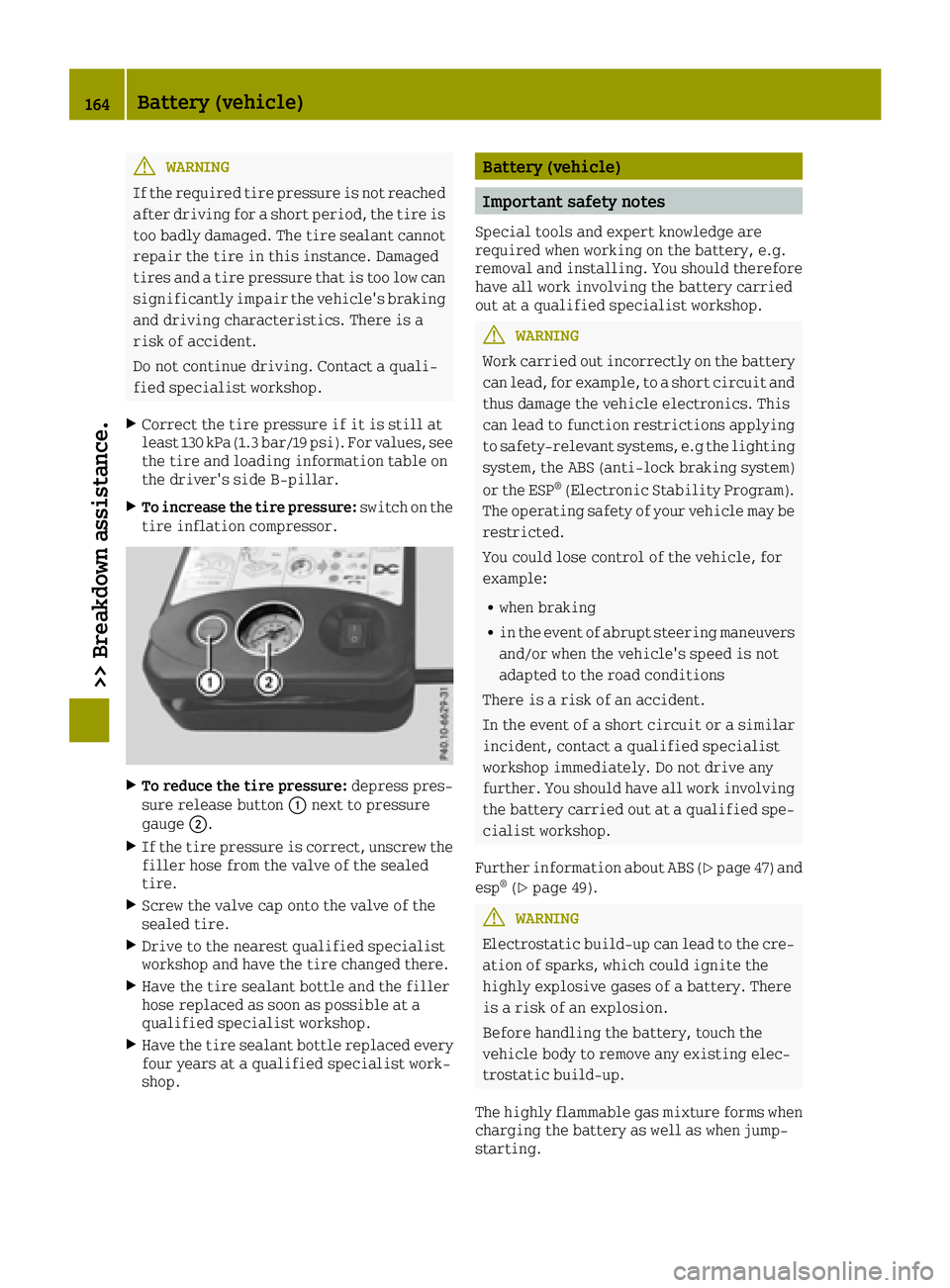
XTo reduce the tire pressure: depress pres-
sure release button 0043next to pressure
gauge 0044.
XIf the tire pressure is correct, unscrew the
filler hose from the valve of the sealed
tire.
XScrew the valve cap onto the valve of the
sealed tire.
XDrive to the nearest qualified specialist
workshop and have the tire changed there.
XHave the tire sealant bottle and the filler
hose replaced as soon as possible at a
qualified specialist workshop.
XHave the tire sealant bottle replaced every
four years at a qualified specialist work-
shop.
Battery (vehicle)
Important safety notes
Special tools and expert knowledge are
required when working on the battery, e.g.
removal and installing. You should therefore
have all work involving the battery carried
out at a qualified specialist workshop.
GWARNING
Work carried out incorrectly on the battery
can lead, for example, to a short circuit and
thus damage the vehicle electronics. This
can lead to function restrictions applying
to safety-relevant systems, e.g the lighting system, the ABS (anti-lock braking system)
or the ESP
®(Electronic Stability Program).
The operating safety of your vehicle may be restricted.
You could lose control of the vehicle, for
example:
Rwhen braking
Rin the event of abrupt steering maneuvers
and/or when the vehicle's speed is not
adapted to the road conditions
There is a risk of an accident.
In the event of a short circuit or a similar
incident, contact a qualified specialist
workshop immediately. Do not drive any
further. You should have all work involving
the battery carried out at a qualified spe-
cialist workshop.
Further information about ABS (
Ypage 47) and
esp®(Ypage 49).
GWARNING
Electrostatic build-up can lead to the cre- ation of sparks, which could ignite the
highly explosive gases of a battery. There
is a risk of an explosion.
Before handling the battery, touch the
vehicle body to remove any existing elec-
trostatic build-up.
The highly flammable gas mixture forms when charging the battery as well as when jump-
starting.
164Battery (vehicle)
>> Breakdown assistance.
Page 181 of 214
RAfter fitting new tires, run them in at mod-
erate speeds for the first 60 miles (100 km),
as they only reach their full performance
after this distance.
RDo not drive with tires which have too little
tread depth, as this significantly reduces
the traction on wet roads (hydroplaning).
RReplace the tires after six years at the lat-
est, regardless of wear.
Winter operation
General notes
Have your vehicle winterproofed at a quali-
fied specialist workshop at the onset of win-
ter.
Observe the notes in the "Changing a wheel"
section (
Ypage 196).
Driving with summer tires
At temperatures below 45 ‡(+7 †), summer
tires lose elasticity and therefore traction
and braking power. Change the tires on your
vehicle to M+S tires. Using summer tires at
very cold temperatures could cause tears to
form, thereby damaging the tires perma-
nently. smart cannot accept responsibility
for this type of damage.
GWARNING
Damaged tires can cause tire inflation
pressure loss. As a result, you could lose
control of your vehicle. There is a risk of
accident.
Check the tires regularly for signs of dam- age and replace any damaged tires imme-
diately.
M+S tires
GWARNING
M+S tires with a tire tread depth of less
than 00CFin (4 mm) are not suitable for use in
winter and do not provide sufficient trac-
tion. There is a risk of an accident.
M+S tires with a tread depth of less than 00CF
in (4 mm) must be replaced immediately.
At temperatures below 45 ‡(+7 †) use winter
tires marked with M+S.
Only winter tires bearing the 004Dsnowflake
symbol in addition to the M+S marking pro-
vide the best possible grip in wintry road
conditions. Only these tires will allow driv-
ing safety systems such as ABS and ESP
®to
function optimally in winter. These tires
have been developed specifically for driving
in snow.
Use M+S tires of the same make and tread on
all wheels to maintain safe handling charac- teristics.
Always observe the maximum permissible
speed specified for the M+S tires you have
mounted. Therefore, only use tire types and
sizes approved for smart. Observe the tire
load rating and speed rating required for
smart.
Tires with a specified direction of rotation
have additional benefits, e.g. if there is a
risk of aquaplaning. These advantages can
only be gained if the tires are fitted corre-
sponding to the direction of rotation.
An arrow on the sidewall of the tire indicates
its correct direction of rotation.
When you have mounted the M+S tires:
XCheck the tire pressures (Ypage 180).
XVehicles for USA: restart the tire pressure
monitor (Ypage 185).
Snow chains
GWARNING
If snow chains are installed to the front
wheels, they may drag against the vehicle
body or chassis components. This could
cause damage to the vehicle or the tires.
There is a risk of an accident.
To avoid hazardous situations:
Rnever install snow chains to the front
wheels
Ralways install snow chains in pairs to the rear wheels.
Winter operation179
>> Wheels and tires.
Z