brake SMART FORTWO 2016 Owner's Manual
[x] Cancel search | Manufacturer: SMART, Model Year: 2016, Model line: FORTWO, Model: SMART FORTWO 2016Pages: 214, PDF Size: 4.93 MB
Page 73 of 214
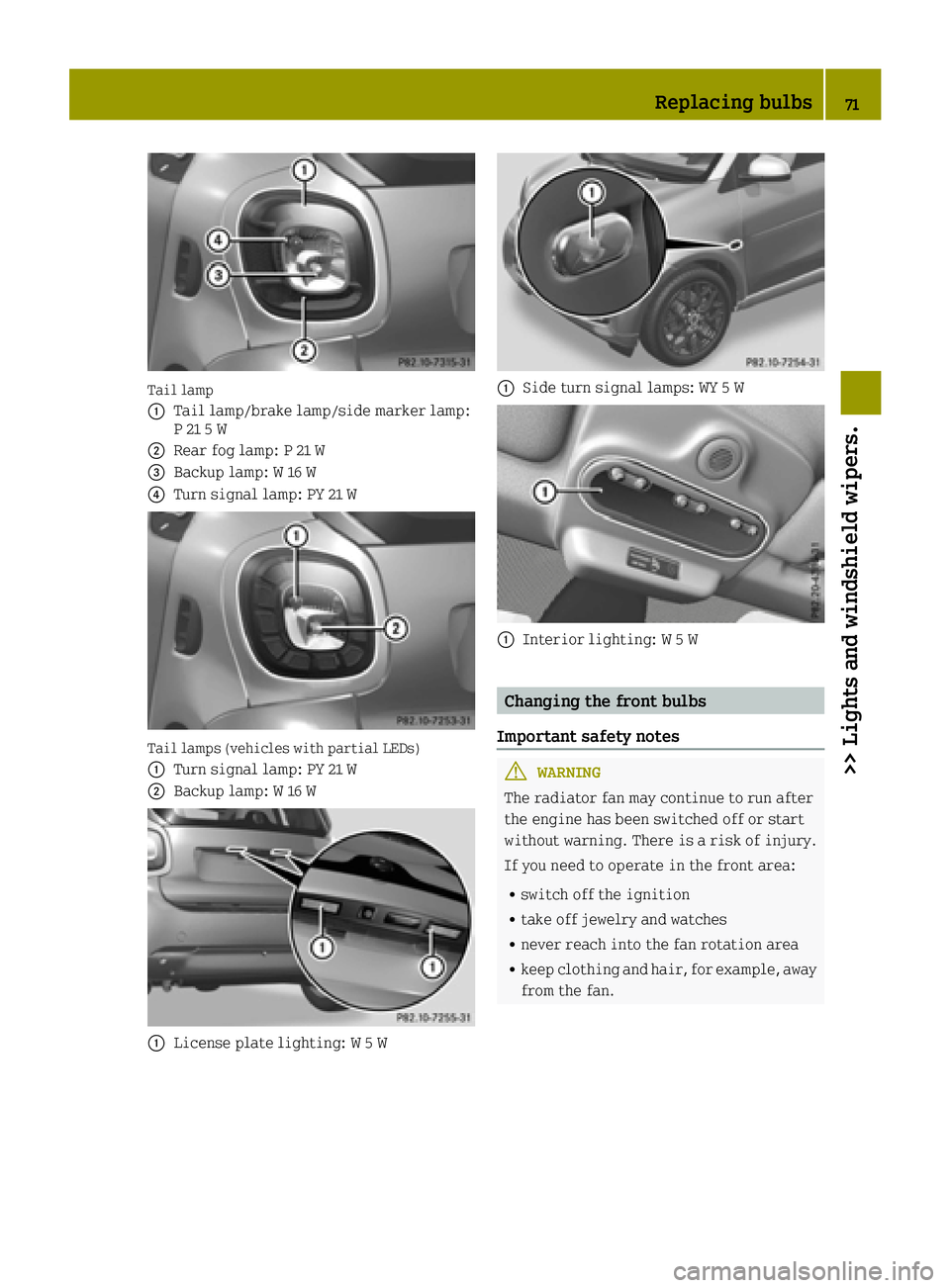
Tail lamp
0043
Tail lamp/brake lamp/side marker lamp:
P 21 5 W
0044Rear fog lamp: P 21 W
0087Backup lamp: W 16 W
0085Turn signal lamp: PY 21 W
Tail lamps (vehicles with partial LEDs)
0043
Turn signal lamp: PY 21 W
0044Backup lamp: W 16 W
0043License plate lighting: W 5 W
0043Side turn signal lamps: WY 5 W
0043Interior lighting: W 5 W
Changing the front bulbs
Important safety notes
GWARNING
The radiator fan may continue to run after
the engine has been switched off or start
without warning. There is a risk of injury.
If you need to operate in the front area:
Rswitch off the ignition
Rtake off jewelry and watches
Rnever reach into the fan rotation area
Rkeep clothing and hair, for example, away
from the fan.
Replacing bulbs71
>> Lights and windshield wipers.
Z
Page 75 of 214
XBend the cover back into position.
XTighten the two screws0043again.
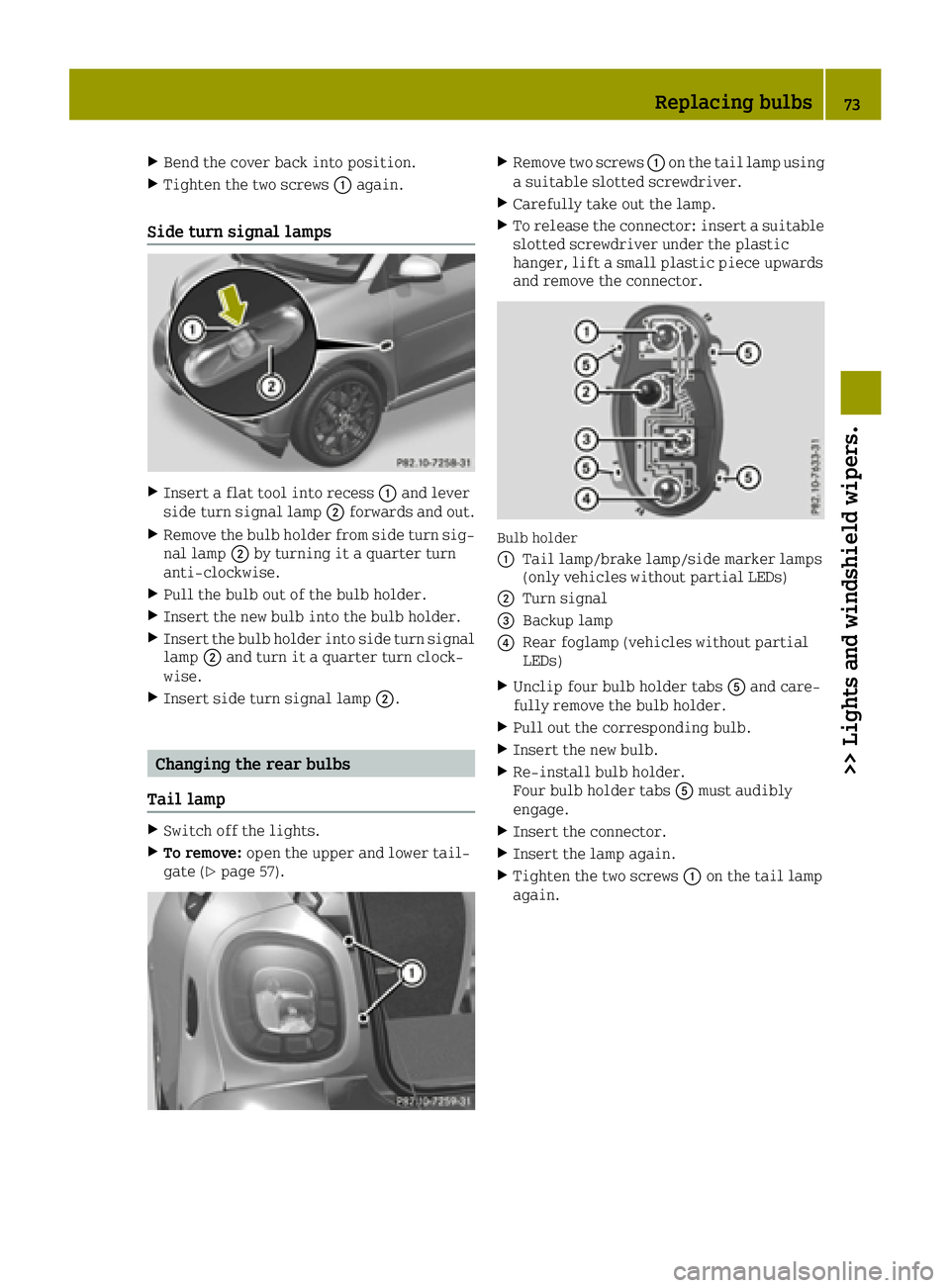
Side turn signal lamps
XInsert a flat tool into recess 0043and lever
side turn signal lamp 0044forwards and out.
XRemove the bulb holder from side turn sig-
nal lamp 0044by turning it a quarter turn
anti-clockwise.
XPull the bulb out of the bulb holder.
XInsert the new bulb into the bulb holder.
XInsert the bulb holder into side turn signal
lamp 0044and turn it a quarter turn clock-
wise.
XInsert side turn signal lamp 0044.
Changing the rear bulbs
Tail lamp
XSwitch off the lights.
XTo remove: open the upper and lower tail-
gate (Ypage 57).
XRemove two screws 0043on the tail lamp using
a suitable slotted screwdriver.
XCarefully take out the lamp.
XTo release the connector: insert a suitable
slotted screwdriver under the plastic
hanger, lift a small plastic piece upwards
and remove the connector.
Bulb holder
0043
Tail lamp/brake lamp/side marker lamps
(only vehicles without partial LEDs)
0044Turn signal
0087Backup lamp
0085Rear foglamp (vehicles without partial
LEDs)
XUnclip four bulb holder tabs 0083and care-
fully remove the bulb holder.
XPull out the corresponding bulb.
XInsert the new bulb.
XRe-install bulb holder.
Four bulb holder tabs 0083must audibly
engage.
XInsert the connector.
XInsert the lamp again.
XTighten the two screws 0043on the tail lamp
again.
Replacing bulbs73
>> Lights and windshield wipers.
Z
Page 88 of 214
Useful information
i
This Operator's Manual describes all
models and all standard and optional
equipment of your vehicle available at the
time of publication of the Operator's Man- ual. Country-specific differences are pos-
sible. Bear in mind that your vehicle may
not feature all functions described here.
This also applies to safety-relevant sys-
tems and functions.
iRead the information on qualified spe-
cialist workshops: (Ypage 20).
Notes on breaking-in a new vehicle
Important safety notes
In certain driving and driving safety sys-
tems, the sensors adjust automatically while
a certain distance is being driven after the
vehicle has been delivered or after repairs.
Full system effectiveness is not reached until
the end of this teach-in procedure.
New and replaced brake pads and discs only
reach their optimum braking effect after sev-
eral hundred kilometers of driving. Compen-
sate for this by applying greater force to the brake pedal.
The first 1000 miles (1500 km)
The more you look after the engine when it is
new, the more satisfied you will be with its
performance in the future.
RYou should therefore drive at varying vehi-
cle and engine speeds for the first
1000 miles (1500 km).
RAvoid heavy loads, e.g. driving at full
throttle, during this period.
RChange gear in good time, before the tach-ometer needle is 00C3of the way to the red
area of the tachometer.
RDo not manually shift to a lower gear to
brake the vehicle.
RVehicles with automatic transmission: if
possible, do not depress the accelerator pedal beyond the pressure point (kick-
down).
RVehicles with automatic transmission:
ideally, for the first 1000 miles(1500 km),
drive in program
E(Comfort).
After 1000 miles (1500 km), you can increase
the engine speed gradually and bring the
vehicle to full speed.
You should also observe these notes on run-
ning-in if the engine or parts of the drive
train on your vehicle have been replaced.
Observe the maximum permissible speed.
Driving
Important safety notes
GWARNING
Objects in the driver's footwell can
restrict the pedal travel or obstruct a
depressed pedal. The operating and road
safety of the vehicle is jeopardized. There
is a risk of an accident.
Make sure that all objects in the vehicle are
stowed correctly, and that they cannot enter
the driver's footwell. Install the floormats securely and as specified in order to
ensure sufficient clearance for the pedals.
Do not use loose floormats and do not place
floormats on top of one another.
GWARNING
Unsuitable footwear can hinder correct
usage of the pedals, e.g.:
Rshoes with thick soles
Rshoes with high heels
Rslippers
There is a risk of an accident.
Wear suitable footwear to ensure correct
usage of the pedals.
GWARNING
If you switch off the ignition while driv-
ing, safety-relevant functions are only
available with limitations, or not at all.
This could affect, for example, the power
86Driving
>> Driving and parking.
Page 89 of 214
steering and the brake boosting effect. Youwill require considerably more effort to
steer and brake. There is a risk of an acci-
dent.
Do not switch off the ignition while driv-
ing.
GWARNING
If the parking brake has not been fully
released when driving, the parking brake
can:
Roverheat and cause a fire
Rlose its hold function.
There is a risk of fire and an accident.
Release the parking brake fully before
driving off.
!Do not warm up the engine with the vehicle
stationary. Drive off immediately. Avoid
high engine speeds and driving at full
throttle until the engine has reached its
operating temperature.
Only shift the automatic transmission to
the desired drive position when the vehi-
cle is stationary.
Where possible, avoid spinning the drive
wheels when pulling away on slippery
roads. You could otherwise damage the
drive train.
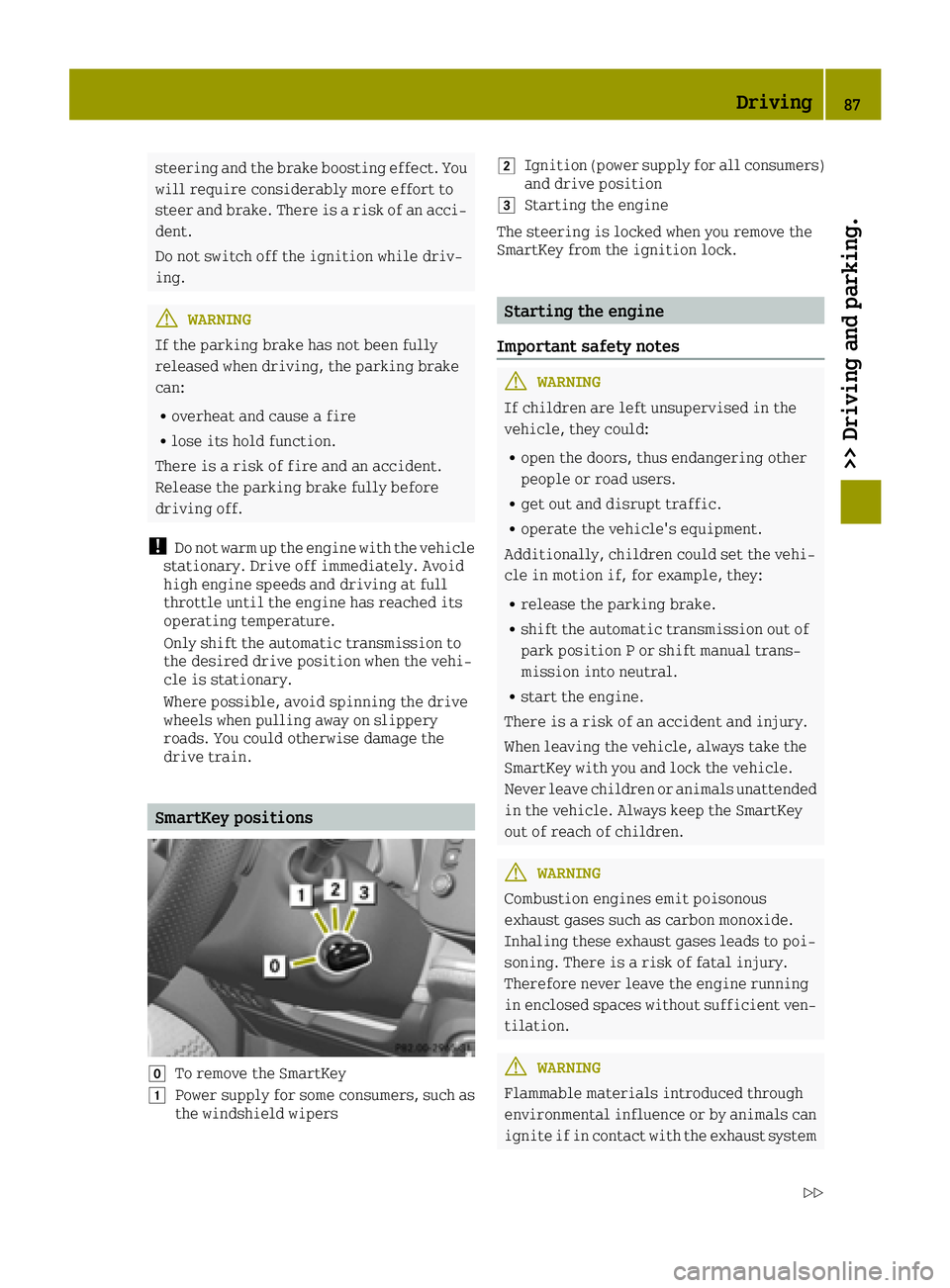
SmartKey positions
005ATo remove the SmartKey
0047Power supply for some consumers, such as
the windshield wipers
0048Ignition (power supply for all consumers)
and drive position
0049Starting the engine
The steering is locked when you remove the
SmartKey from the ignition lock.
Starting the engine
Important safety notes
GWARNING
If children are left unsupervised in the
vehicle, they could:
Ropen the doors, thus endangering other
people or road users.
Rget out and disrupt traffic.
Roperate the vehicle's equipment.
Additionally, children could set the vehi-
cle in motion if, for example, they:
Rrelease the parking brake.
Rshift the automatic transmission out of
park position P or shift manual trans-
mission into neutral.
Rstart the engine.
There is a risk of an accident and injury.
When leaving the vehicle, always take the
SmartKey with you and lock the vehicle.
Never leave children or animals unattended
in the vehicle. Always keep the SmartKey
out of reach of children.
GWARNING
Combustion engines emit poisonous
exhaust gases such as carbon monoxide.
Inhaling these exhaust gases leads to poi-
soning. There is a risk of fatal injury.
Therefore never leave the engine running
in enclosed spaces without sufficient ven- tilation.
GWARNING
Flammable materials introduced through
environmental influence or by animals can
ignite if in contact with the exhaust system
Driving87
>> Driving and parking.
Z
Page 90 of 214
or parts of the engine that heat up. There is
a risk of fire.
Carry out regular checks to make sure that
there are no flammable foreign materials
in the engine compartment or in the exhaust
system.
!Do not depress the accelerator when
starting the engine.
iDuring a cold start, the engine runs at
higher speeds to enable the catalytic con-
verter to reach its operating temperature.
The sound of the engine may change during
this time.
Manual transmission
XDepress the brake pedal and keep it
depressed.
XDepress the clutch pedal fully.
XShift to neutral.
Automatic transmission
XShift the transmission to position P
(Ypage 92).
The transmission position display in the
multifunction display shows P
(
Ypage 92).
iYou can start the engine in transmission
positions Pand N.
In order to start the engine in transmission
position Nyou must depress the brake pedal
and keep it depressed.
Starting procedure
XTurn the key to position 3in the ignition
lock (Ypage 87) and release it as soon as the
engine is running.
Pulling away
General notes
GWARNING
Vehicles with automatic transmission:
If the engine speed is above the idling
speed and you engage transmission posi-
tion Dor R, the vehicle could pull away
suddenly. There is a risk of an accident.
When engaging transmission position Dor
R, always firmly depress the brake pedal
and do not simultaneously accelerate.
!Vehicles with manual transmission:
change gear in good time and avoid spin-
ning the wheels. You could otherwise dam-
age the vehicle.
!Release the parking brake before driving
off. The parking brake can otherwise over-
heat, malfunction and wear out quickly.
Accelerate gently when pulling away.
The vehicle locks centrally once you have
pulled away.
You can open the doors from the inside at any
time.
You can also deactivate the automatic locking
feature (
Ypage 55).
Vehicles with automatic transmission: you
can only shift the transmission from position
P to the desired transmission position if:
Rthe ignition is switched on
Ryou depress the brake pedal and keep it
depressed and
Ryou press release button on the selector
lever (Ypage 92).
Only then is the shift lock released.
iVehicles with automatic transmission:
transmission shifts take place at higher
engine speeds after a cold start. This helps
the catalytic converter to reach its oper-
ating temperature more quickly.
Hill start assist
Hill start assist helps you when pulling away forwards or in reverse on an uphill gradient.
It holds the vehicle for a short time after you have removed your foot from the brake pedal.
This gives you enough time to move your foot
from the brake pedal to the accelerator pedal
and to depress it before the vehicle begins to
roll.
GWARNING
After a short time, hill start assist will no
longer brake your vehicle and it could roll
88Driving
>> Driving and parking.
Page 91 of 214
away. There is a risk of an accident and
injury.
Therefore, quickly move your foot from the
brake pedal to the accelerator pedal. Never
leave the vehicle when it is held by hill
start assist.
Hill start assist is not active if:
Ryou pull away on level ground
Ryou pull away in a forward gear on a down-
hill slope
Ron vehicles with automatic transmission,
the transmission is in position N.
Rthe parking brake is applied.
RESP®is malfunctioning
Driving89
>> Driving and parking.
Z
Page 93 of 214
Manual transmission
Gear lever
!
Only engage gear when the clutch pedal is
depressed.
!When shifting into 5thgear, you should
always push the gear lever all the way to the
right. You could otherwise shift uninten-
tionally into 3rdgear and damage the
transmission.
If you shift down at too high a speed (trans-
mission braking), this can cause the engine
to overrev, leading to engine damage.
Never hold the vehicle stopped on a hill by
using the clutch pedal. There is otherwise
a risk of damaging the clutch.
!On long and steep downhill gradients,
especially if the vehicle is laden, you must
shift into gear 1,2or 3in good time. By
doing so, you will make use of the braking
effect of the engine. This relieves the load
on the brake system and prevents the brakes
from overheating and wearing too quickly.
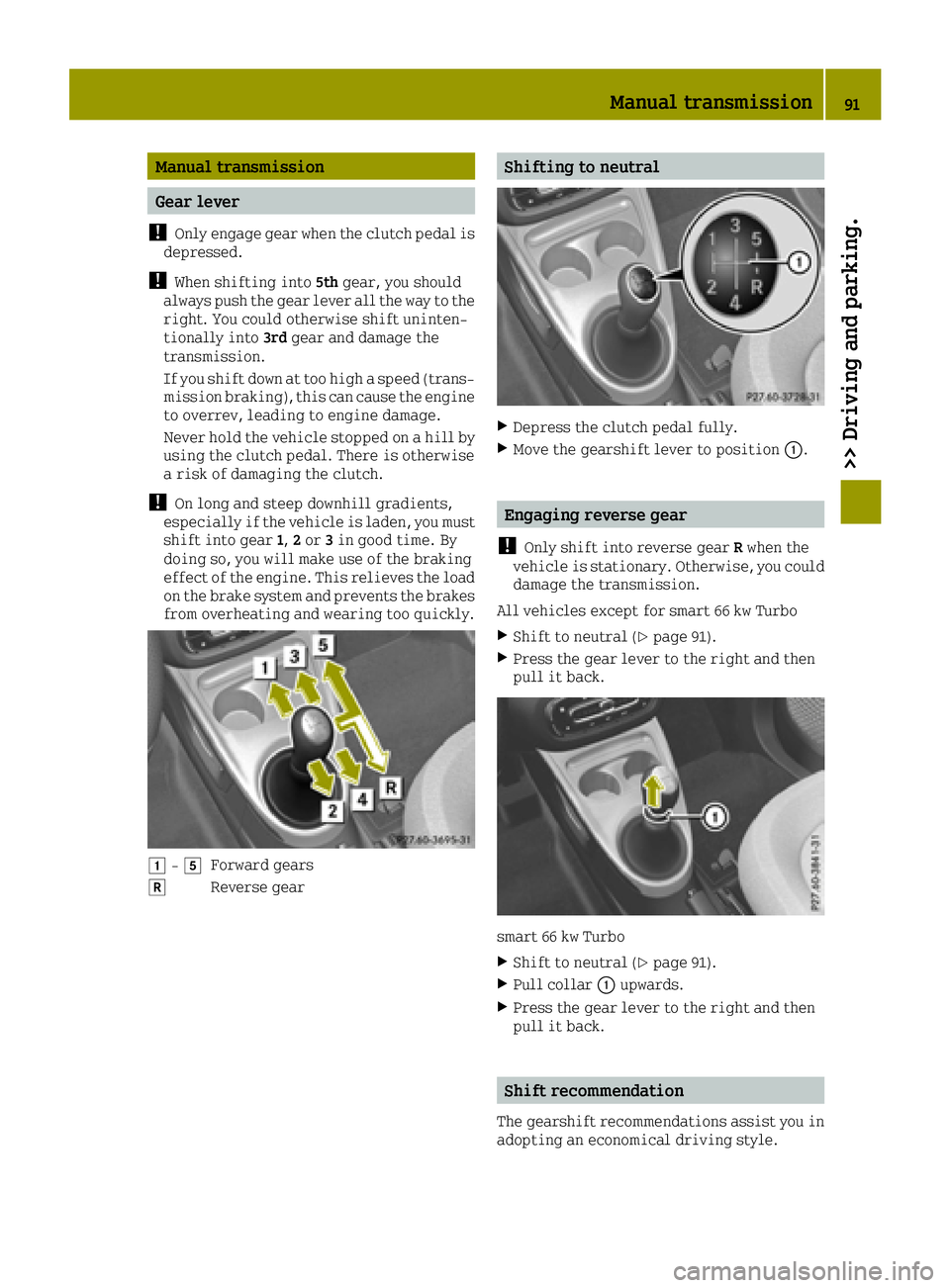
0047 -004BForward gears
005EReverse gear
Shifting to neutral
XDepress the clutch pedal fully.
XMove the gearshift lever to position 0043.
Engaging reverse gear
!
Only shift into reverse gear Rwhen the
vehicle is stationary. Otherwise, you could
damage the transmission.
All vehicles except for smart 66 kw Turbo
XShift to neutral (Ypage 91).
XPress the gear lever to the right and then
pull it back.
smart 66 kw Turbo
XShift to neutral (Ypage 91).
XPull collar 0043upwards.
XPress the gear lever to the right and then
pull it back.
Shift recommendation
The gearshift recommendations assist you in
adopting an economical driving style.
Manual transmission91
>> Driving and parking.
Z
Page 94 of 214
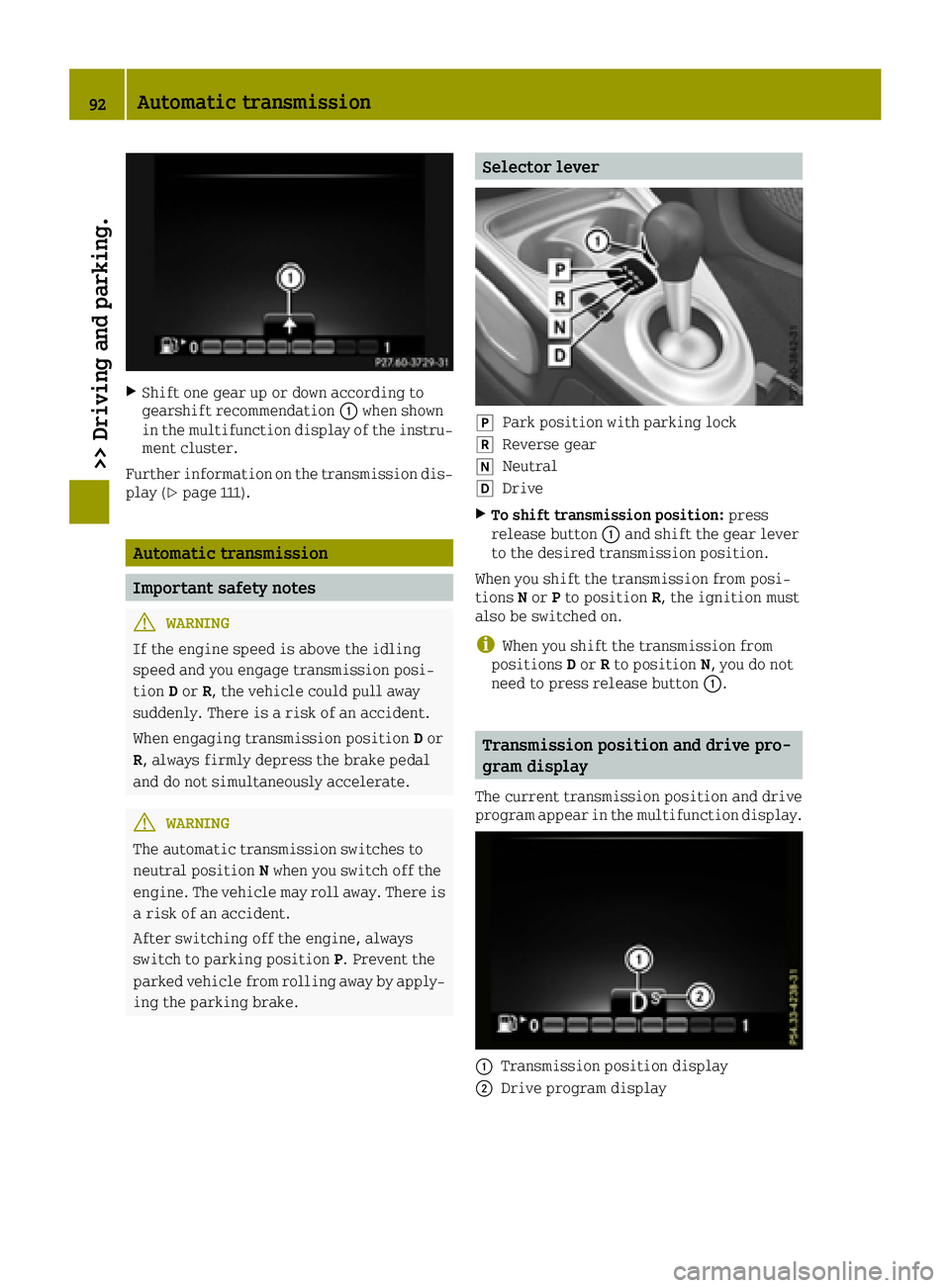
XShift one gear up or down according to
gearshift recommendation0043when shown
in the multifunction display of the instru-
ment cluster.
Further information on the transmission dis-
play (
Ypage 111).
Automatic transmission
Important safety notes
GWARNING
If the engine speed is above the idling
speed and you engage transmission posi-
tion Dor R, the vehicle could pull away
suddenly. There is a risk of an accident.
When engaging transmission position Dor
R, always firmly depress the brake pedal
and do not simultaneously accelerate.
GWARNING
The automatic transmission switches to
neutral position Nwhen you switch off the
engine. The vehicle may roll away. There is a risk of an accident.
After switching off the engine, always
switch to parking position P. Prevent the
parked vehicle from rolling away by apply-
ing the parking brake.
Selector lever
005DPark position with parking lock
005EReverse gear
005CNeutral
005BDrive
XTo shift transmission position: press
release button 0043and shift the gear lever
to the desired transmission position.
When you shift the transmission from posi-
tions Nor Pto position R, the ignition must
also be switched on.
iWhen you shift the transmission from
positions Dor Rto position N, you do not
need to press release button 0043.
Transmission position and drive pro-
gram display
The current transmission position and drive
program appear in the multifunction display.
0043Transmission position display
0044Drive program display
92Automatic transmission
>> Driving and parking.
Page 95 of 214
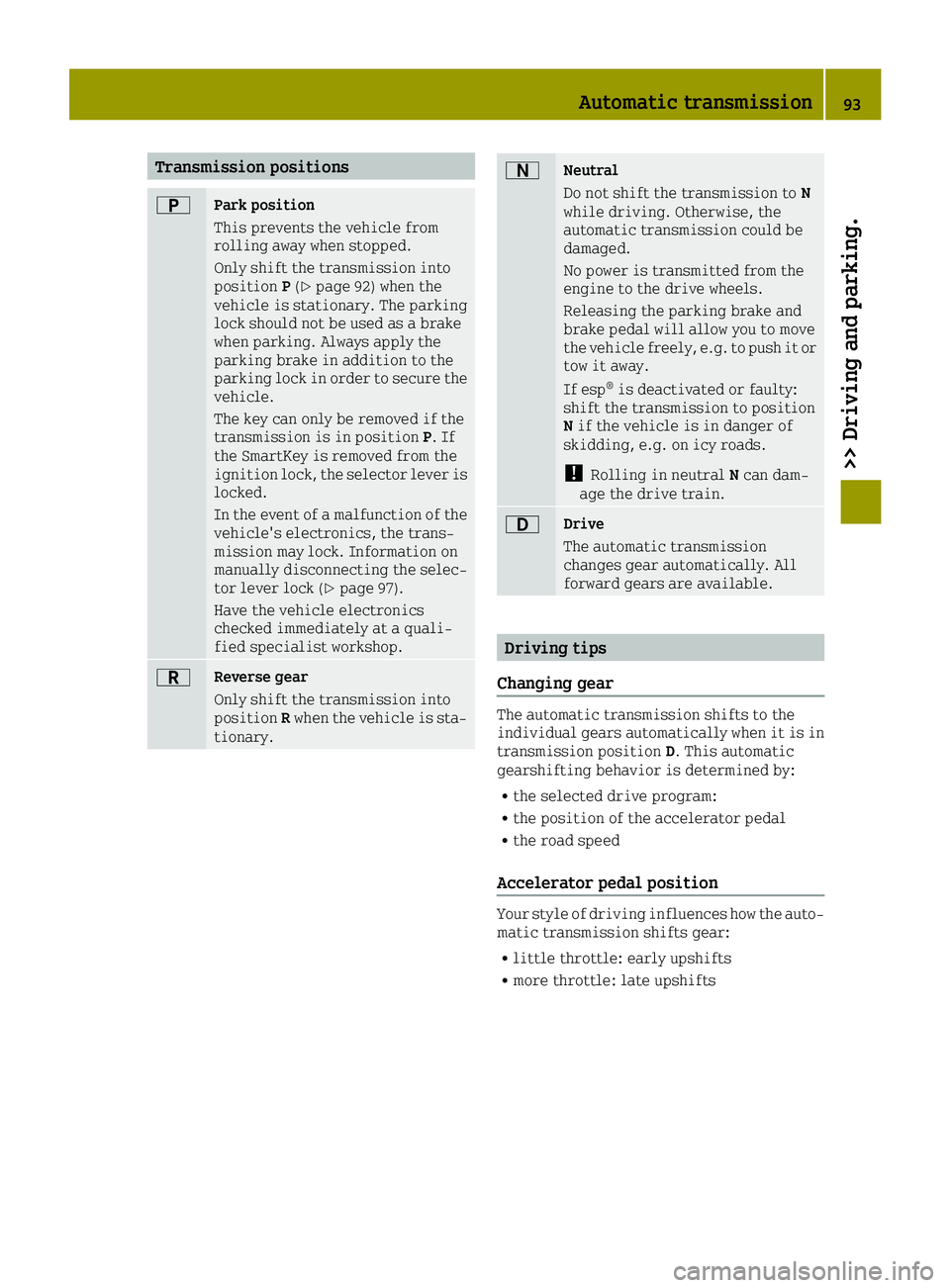
Transmission positions
0045Park position
This prevents the vehicle from
rolling away when stopped.
Only shift the transmission into
positionP(
Ypage 92) when the
vehicle is stationary. The parking
lock should not be used as a brake
when parking. Always apply the
parking brake in addition to the
parking lock in order to secure the
vehicle.
The key can only be removed if the
transmission is in position P. If
the SmartKey is removed from the
ignition lock, the selector lever is
locked.
In the event of a malfunction of the
vehicle's electronics, the trans-
mission may lock. Information on
manually disconnecting the selec-
tor lever lock (
Ypage 97).
Have the vehicle electronics
checked immediately at a quali-
fied specialist workshop.
0046Reverse gear
Only shift the transmission into
position Rwhen the vehicle is sta-
tionary.
0044Neutral
Do not shift the transmission to N
while driving. Otherwise, the
automatic transmission could be
damaged.
No power is transmitted from the
engine to the drive wheels.
Releasing the parking brake and
brake pedal will allow you to move
the vehicle freely, e.g. to push it or
tow it away.
If esp
®is deactivated or faulty:
shift the transmission to position
N if the vehicle is in danger of
skidding, e.g. on icy roads.
!Rolling in neutral Ncan dam-
age the drive train.
003ADrive
The automatic transmission
changes gear automatically. All
forward gears are available.
Driving tips
Changing gear
The automatic transmission shifts to the
individual gears automatically when it is in
transmission position D. This automatic
gearshifting behavior is determined by:
Rthe selected drive program:
Rthe position of the accelerator pedal
Rthe road speed
Accelerator pedal position
Your style of driving influences how the auto-
matic transmission shifts gear:
Rlittle throttle: early upshifts
Rmore throttle: late upshifts
Automatic transmission93
>> Driving and parking.
Z
Page 99 of 214
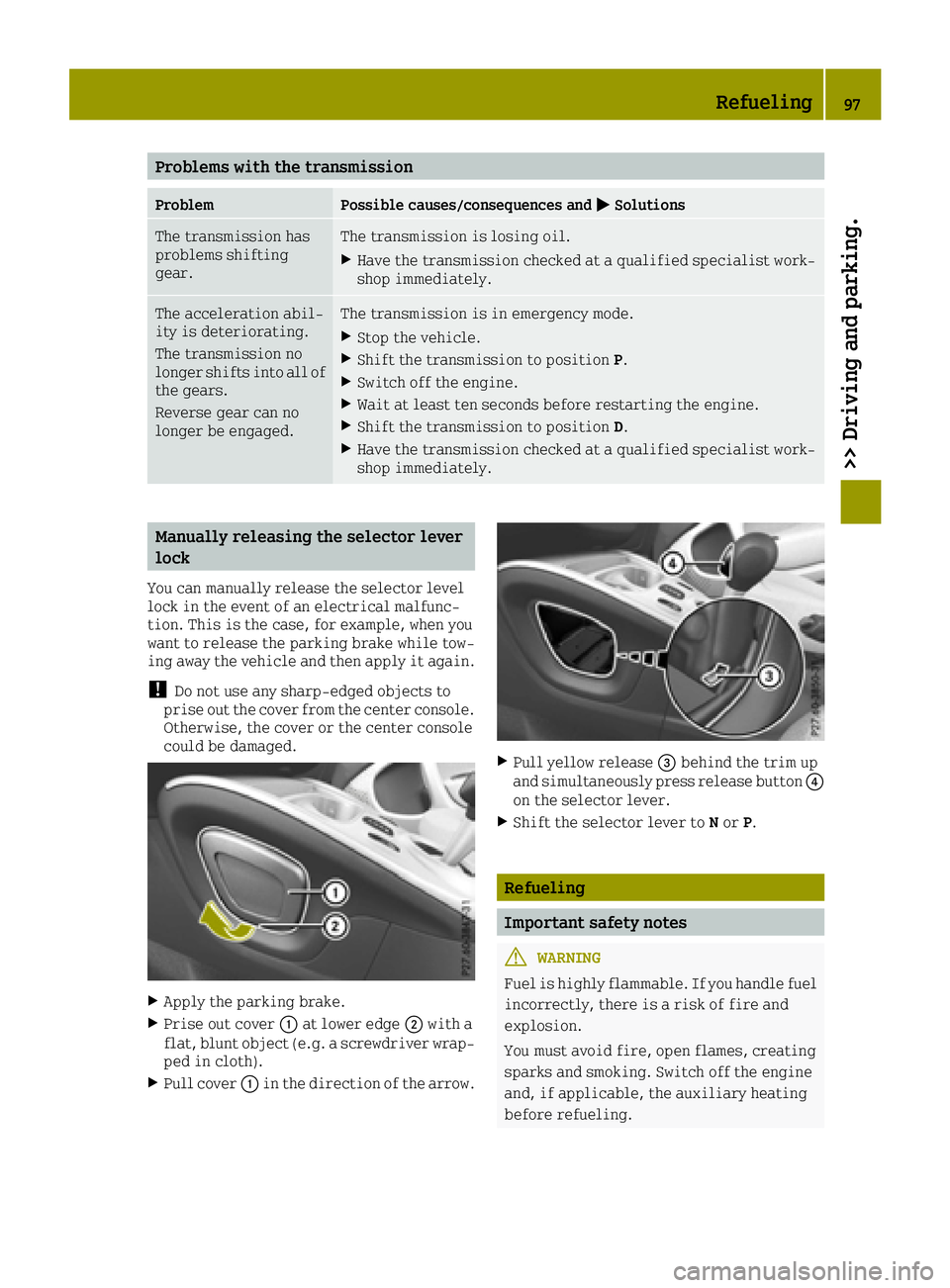
Problems with the transmission
ProblemPossible causes/consequences and0050Solutions
The transmission has
problems shifting
gear.The transmission is losing oil.
XHave the transmission checked at a qualified specialist work-
shop immediately.
The acceleration abil-
ity is deteriorating.
The transmission no
longer shifts into all of
the gears.
Reverse gear can no
longer be engaged.The transmission is in emergency mode.
XStop the vehicle.
XShift the transmission to position P.
XSwitch off the engine.
XWait at least ten seconds before restarting the engine.
XShift the transmission to positionD.
XHave the transmission checked at a qualified specialist work-
shop immediately.
Manually releasing the selector lever
lock
You can manually release the selector level
lock in the event of an electrical malfunc-
tion. This is the case, for example, when you
want to release the parking brake while tow-
ing away the vehicle and then apply it again.
!Do not use any sharp-edged objects to
prise out the cover from the center console.
Otherwise, the cover or the center console
could be damaged.
XApply the parking brake.
XPrise out cover 0043at lower edge 0044with a
flat, blunt object (e.g. a screwdriver wrap-
ped in cloth).
XPull cover 0043in the direction of the arrow.
XPull yellow release 0087behind the trim up
and simultaneously press release button 0085
on the selector lever.
XShift the selector lever to Nor P.
Refueling
Important safety notes
GWARNING
Fuel is highly flammable. If you handle fuel
incorrectly, there is a risk of fire and
explosion.
You must avoid fire, open flames, creating
sparks and smoking. Switch off the engine
and, if applicable, the auxiliary heating
before refueling.
Refueling97
>> Driving and parking.
Z