display SMART FORTWO 2016 Owner's Manual
[x] Cancel search | Manufacturer: SMART, Model Year: 2016, Model line: FORTWO, Model: SMART FORTWO 2016Pages: 214, PDF Size: 4.93 MB
Page 49 of 214
Switching off the alarm
XTo switch off the alarm:press the0036
button on the key.
The alarm is switched off.
or
XSwitch on the ignition.
The alarm is switched off.
The alarm is not switched off, even if you
close the open door that triggered it, for
example.
Driving safety systems
Overview of driving safety systems
In this section, you will find information
about the following driving safety systems:
RABS (Anti-lock BrakingSystem)
(Ypage 47)
RDistance warning function (Ypage 48)
Resp®(Electronic StabilityProgram)
(Ypage 49)
REBD (Electronic Brake forceDistribution)
(Ypage 50)
Important safety notes
If you fail to adapt your driving style or
become distracted, the driving safety sys-
tems can neither reduce the risk of accident
nor override the laws of physics. Driving
safety systems are merely aids designed to
assist driving. You are responsible for the
distance to the vehicle in front, for vehicle
speed and for braking in good time. Always
adapt your driving style to suit the prevail-
ing road, weather and traffic conditions and
maintain a safe distance from the vehicle in
front. Drive carefully.
The driving safety systems described only
work as effectively as possible when there is
adequate contact between the tires and the
road surface. Please pay special attention to
the notes on tires, recommended minimum
tire tread depths, etc. (
Ypage 177).
In wintry driving conditions, always use win-
ter tires (M+S tires) and if necessary, snow
chains. Only in this way will the driving
safety systems described in this section work
as effectively as possible. For safety reasons, smart recommends that you
only use snow chains that have been specially
approved for your vehicle by smart, or fine-
link snow chains that are of a corresponding
standard of quality. For more information,
please contact a qualified specialist work-
shop.
ABS (Anti-lock Braking System)
General information
ABS regulates brake pressure in such a way
that the wheels do not lock when you brake.
This allows you to continue steering the vehi-
cle when braking.
The 0025 (Canada only) or 00DF(USA only) abs
warning lamp in the instrument cluster lights up when the ignition is switched on. It goes
out when the engine is running.
Important safety notes
iObserve the "Important safety notes" sec-
tion for driving safety systems (Ypage 47).
When ABS is malfunctioning, other systems,
including driving safety systems, will also
become inoperative. Observe the information
on the ABS warning lamp (
Ypage 132) and
display messages which may be shown in the
instrument cluster (
Ypage 121).
GWARNING
If ABS is faulty, the wheels could lock when
braking. The steerability and braking
characteristics may be severely impaired.
Additionally, further driving safety sys-
tems are deactivated. There is an increased
danger of skidding and accidents.
Drive on carefully. Have ABS checked imme-
diately at a qualified specialist workshop.
abs works from a speed of about 4 mph (6 km/h),
regardless of road-surface conditions. ABS
works on slippery surfaces, even if you only
brake gently.
Driving safety systems47
>> Safety.
Z
Page 51 of 214
XTo switch off:press button0044.
Indicator lamp 0043lights up.
XTo switch on: press button0044.
Indicator lamp 0043goes out.
Starting at a speed of around 4 mph (7 km/h),
the distance warning function warns you if
you rapidly approach a vehicle in front. An
intermittent warning tone will then sound
and the 00BAdistance warning lamp will
light up in the instrument cluster.
XBrake immediately in order to increase the distance from the vehicle in front.
or
XTake evasive action, provided it is safe to
do so.
Due to the nature of the system, particularly
complicated but non-critical driving condi-
tions may also cause the system to display a
warning.
With the help of the radar sensor system, the
distance warning function can detect obsta-
cles that are in the path of your vehicle for an
extended period of time.
Up to a speed of around 45 mph (70 km/h), the
distance warning function can also react to
stationary obstacles, such as stopped or
parked vehicles.
ESP®(Electronic Stability Program)
General notes
iObserve the "Important safety notes" sec-
tion (Ypage 47).
esp
®monitors driving stability and traction,
i.e. power transmission between the tires and the road surface.
If esp
®detects that the vehicle is deviating
from the direction desired by the driver, one
or more wheels are braked to stabilize the
vehicle. The engine output is also modified
to keep the vehicle on the desired course
within physical limits. esp
®assists the
driver when pulling away on wet or slippery
roads. esp
®can also stabilize the vehicle
during braking.
ETS (Electronic Traction System)
iObserve the "Important safety notes" sec-
tion (Ypage 47).
ETS traction control is part of esp
®.
ETS brakes the drive wheels individually if
they spin. This enables you to pull away and
accelerate on slippery surfaces, for example if the road surface is slippery on one side. In
addition, more drive torque is transferred to
the wheel with traction.
Important safety notes
GWARNING
If ESP
®is malfunctioning, ESP®is unable to
stabilize the vehicle. Additionally, fur-
ther driving safety systems are deactiva-
ted. This increases the risk of skidding and
an accident.
Drive on carefully. Have ESP
®checked at a
qualified specialist workshop.
!If you test the parking brake using a brake
dynamometer, switch the ignition off.
Application of the brakes by ESP
®may oth-
erwise destroy the brake system.
When towing the vehicle with the rear axle
raised, observe the notes on esp
®
(Ypage 171).
If the 00E5esp®warning lamp lights up per-
manently, esp®or hill start assist are
unavailable due to a malfunction.
Observe the information on warning lamps
(
Ypage 134) and display messages which may
be shown in the instrument cluster
(
Ypage 121).
iOnly use wheels with the recommended
tire sizes. Only then will esp®function
properly.
Characteristics of ESP®
General information
If the 00E5esp®warning lamp goes out before
the journey begins, esp®is automatically
active.
If esp
®intervenes, the 00E5esp®warning
lamp flashes in the instrument cluster.
Driving safety systems49
>> Safety.
Z
Page 52 of 214
If esp®intervenes:
XOnly depress the accelerator pedal as far as
necessary when pulling away.
XAdapt your driving style to suit the pre-
vailing road and weather conditions.
Crosswind Assist
General information
Strong crosswinds can cause your vehicle to
deviate from a straight course. The crosswind
driving assistance function integrated into
esp
®significantly reduces these effects.
esp®intervenes automatically according to
the direction and intensity of the crosswinds
affecting your vehicle.
esp
®intervenes with stabilizing braking to
assist you in keeping the vehicle in the lane.
crosswind assist is active at vehicle speeds
above 45 mph (70 km/h )when driving straight
ahead or cornering gently.
Important safety notes
crosswind assist does not work if esp®is dis-
abled because of a malfunction.
EBD (electronic brake force distribu-
tion)
General information
EBD monitors and controls the brake pressure
on the rear wheels to improve driving sta-
bility while braking.
Important safety notes
iObserve the "Important safety notes" sec-
tion (Ypage 47).
GWARNING
If EBD is malfunctioning, the rear wheels
can lock, e.g. under full braking. This
increases the risk of skidding and an acci-
dent.
You should therefore adapt your driving
style to the different handling character-
istics. Have the brake system checked at a
qualified specialist workshop. Observe information regarding indicator
and warning lamps (
Ypage 134) as well as
display messages (Ypage 120).
50Driving safety systems
>> Safety.
Page 63 of 214
Useful information
i
This Operator's Manual describes all
models and all standard and optional
equipment of your vehicle available at the
time of publication of the Operator's Man- ual. Country-specific differences are pos-
sible. Bear in mind that your vehicle may
not feature all functions described here.
This also applies to safety-relevant sys-
tems and functions.
iRead the information on qualified spe-
cialist workshops: (Ypage 20).
Correcting the driver's seat position
GWARNING
You could lose control of your vehicle if you
do the following while driving:
Radjust the driver's seat, steering wheel
or mirrors
Rfasten the seat belt
There is a risk of an accident.
Adjust the driver's seat, steering wheel or
mirrors and fasten your seat belt before
starting the engine.
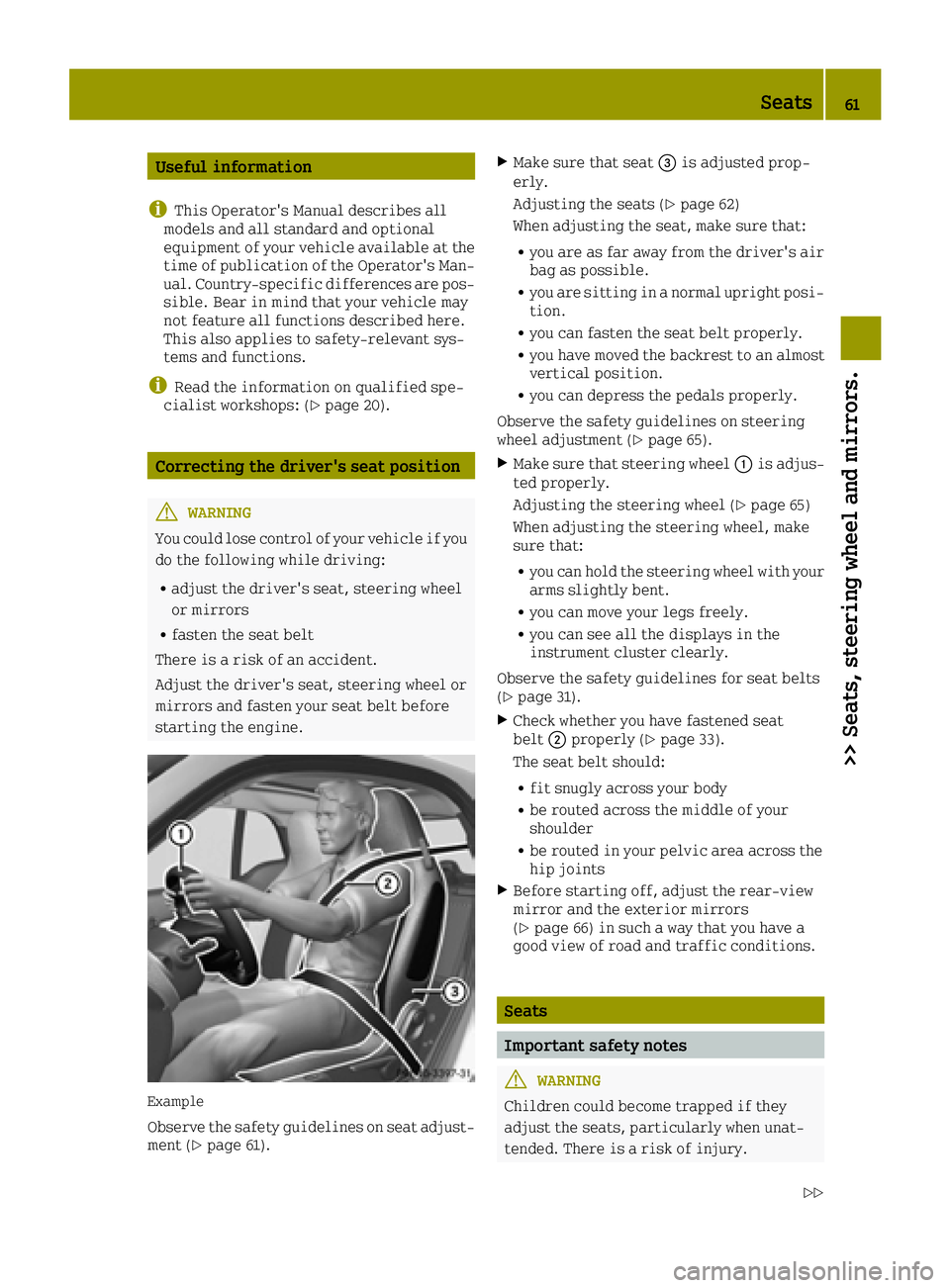
Example
Observe the safety guidelines on seat adjust-
ment (Ypage 61).
XMake sure that seat 0087is adjusted prop-
erly.
Adjusting the seats (
Ypage 62)
When adjusting the seat, make sure that:
Ryou are as far away from the driver's air
bag as possible.
Ryou are sitting in a normal upright posi-
tion.
Ryou can fasten the seat belt properly.
Ryou have moved the backrest to an almost
vertical position.
Ryou can depress the pedals properly.
Observe the safety guidelines on steering
wheel adjustment (
Ypage 65).
XMake sure that steering wheel 0043is adjus-
ted properly.
Adjusting the steering wheel (
Ypage 65)
When adjusting the steering wheel, make
sure that:
Ryou can hold the steering wheel with your
arms slightly bent.
Ryou can move your legs freely.
Ryou can see all the displays in the
instrument cluster clearly.
Observe the safety guidelines for seat belts
(
Ypage 31).
XCheck whether you have fastened seat
belt 0044properly (Ypage 33).
The seat belt should:
Rfit snugly across your body
Rbe routed across the middle of your
shoulder
Rbe routed in your pelvic area across the
hip joints
XBefore starting off, adjust the rear-view
mirror and the exterior mirrors
(
Ypage 66) in such a way that you have a
good view of road and traffic conditions.
Seats
Important safety notes
GWARNING
Children could become trapped if they
adjust the seats, particularly when unat-
tended. There is a risk of injury.
Seats61
>> Seats, steering wheel and mirrors.
Z
Page 90 of 214
or parts of the engine that heat up. There is
a risk of fire.
Carry out regular checks to make sure that
there are no flammable foreign materials
in the engine compartment or in the exhaust
system.
!Do not depress the accelerator when
starting the engine.
iDuring a cold start, the engine runs at
higher speeds to enable the catalytic con-
verter to reach its operating temperature.
The sound of the engine may change during
this time.
Manual transmission
XDepress the brake pedal and keep it
depressed.
XDepress the clutch pedal fully.
XShift to neutral.
Automatic transmission
XShift the transmission to position P
(Ypage 92).
The transmission position display in the
multifunction display shows P
(
Ypage 92).
iYou can start the engine in transmission
positions Pand N.
In order to start the engine in transmission
position Nyou must depress the brake pedal
and keep it depressed.
Starting procedure
XTurn the key to position 3in the ignition
lock (Ypage 87) and release it as soon as the
engine is running.
Pulling away
General notes
GWARNING
Vehicles with automatic transmission:
If the engine speed is above the idling
speed and you engage transmission posi-
tion Dor R, the vehicle could pull away
suddenly. There is a risk of an accident.
When engaging transmission position Dor
R, always firmly depress the brake pedal
and do not simultaneously accelerate.
!Vehicles with manual transmission:
change gear in good time and avoid spin-
ning the wheels. You could otherwise dam-
age the vehicle.
!Release the parking brake before driving
off. The parking brake can otherwise over-
heat, malfunction and wear out quickly.
Accelerate gently when pulling away.
The vehicle locks centrally once you have
pulled away.
You can open the doors from the inside at any
time.
You can also deactivate the automatic locking
feature (
Ypage 55).
Vehicles with automatic transmission: you
can only shift the transmission from position
P to the desired transmission position if:
Rthe ignition is switched on
Ryou depress the brake pedal and keep it
depressed and
Ryou press release button on the selector
lever (Ypage 92).
Only then is the shift lock released.
iVehicles with automatic transmission:
transmission shifts take place at higher
engine speeds after a cold start. This helps
the catalytic converter to reach its oper-
ating temperature more quickly.
Hill start assist
Hill start assist helps you when pulling away forwards or in reverse on an uphill gradient.
It holds the vehicle for a short time after you have removed your foot from the brake pedal.
This gives you enough time to move your foot
from the brake pedal to the accelerator pedal
and to depress it before the vehicle begins to
roll.
GWARNING
After a short time, hill start assist will no
longer brake your vehicle and it could roll
88Driving
>> Driving and parking.
Page 94 of 214
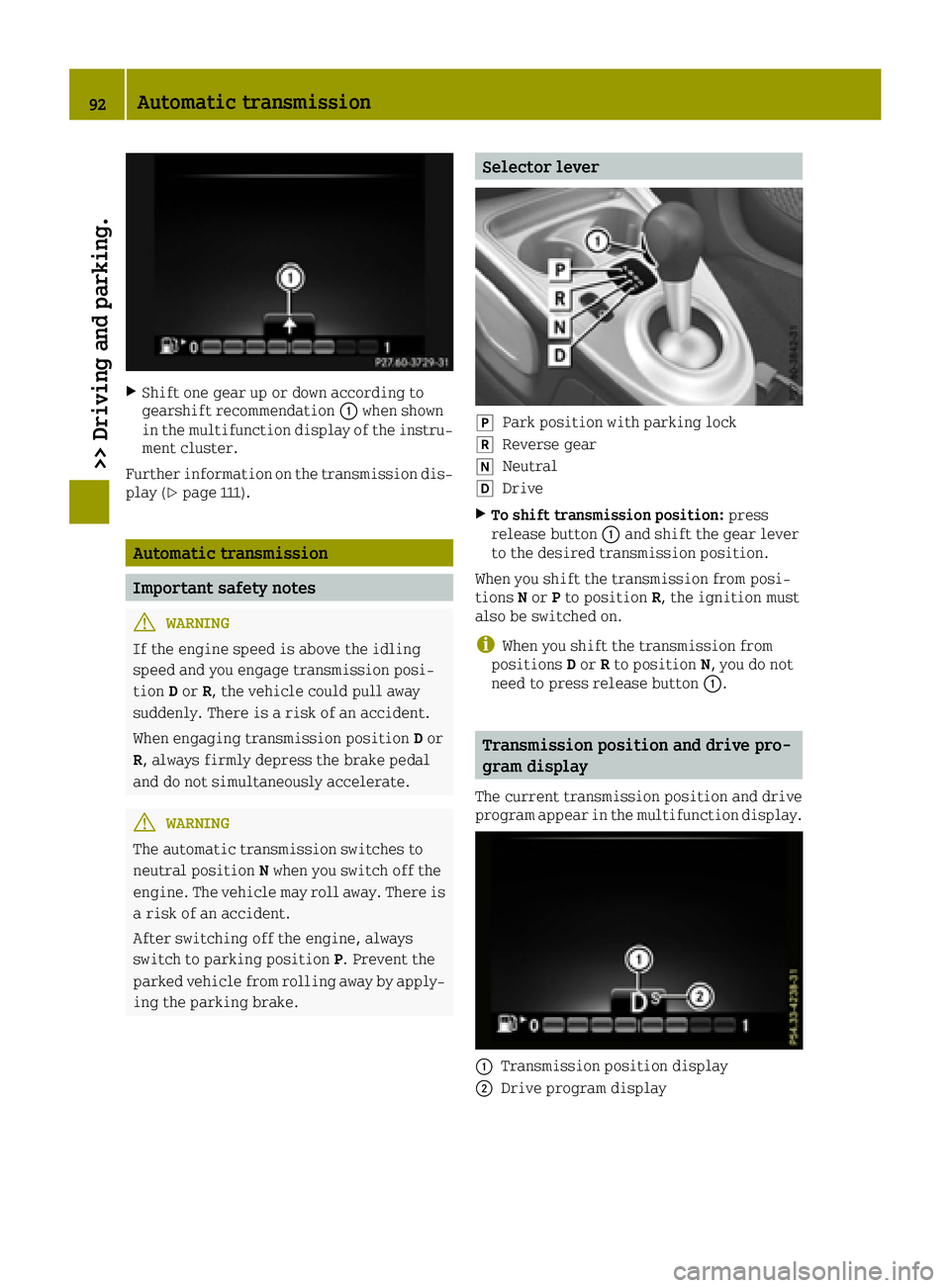
XShift one gear up or down according to
gearshift recommendation0043when shown
in the multifunction display of the instru-
ment cluster.
Further information on the transmission dis-
play (
Ypage 111).
Automatic transmission
Important safety notes
GWARNING
If the engine speed is above the idling
speed and you engage transmission posi-
tion Dor R, the vehicle could pull away
suddenly. There is a risk of an accident.
When engaging transmission position Dor
R, always firmly depress the brake pedal
and do not simultaneously accelerate.
GWARNING
The automatic transmission switches to
neutral position Nwhen you switch off the
engine. The vehicle may roll away. There is a risk of an accident.
After switching off the engine, always
switch to parking position P. Prevent the
parked vehicle from rolling away by apply-
ing the parking brake.
Selector lever
005DPark position with parking lock
005EReverse gear
005CNeutral
005BDrive
XTo shift transmission position: press
release button 0043and shift the gear lever
to the desired transmission position.
When you shift the transmission from posi-
tions Nor Pto position R, the ignition must
also be switched on.
iWhen you shift the transmission from
positions Dor Rto position N, you do not
need to press release button 0043.
Transmission position and drive pro-
gram display
The current transmission position and drive
program appear in the multifunction display.
0043Transmission position display
0044Drive program display
92Automatic transmission
>> Driving and parking.
Page 96 of 214
Kickdown
If you want maximum acceleration, use kick-
down:
XDepress the accelerator pedal beyond the
pressure point.
The automatic transmission shifts to a
lower gear depending on the engine speed.
XEase off the accelerator pedal once the
desired speed is reached.
The automatic transmission shifts back up.
Rocking the vehicle free
Shifting the transmission repeatedly
between gearsDand Rmay help to free the
vehicle if it has become stuck in slush or
snow.
XShift the selector lever alternately
between positions Dand R.
The vehicle's engine management system lim-
its the speed to a maximum of 5 mph (9 km/h)
when shifting back and forth.
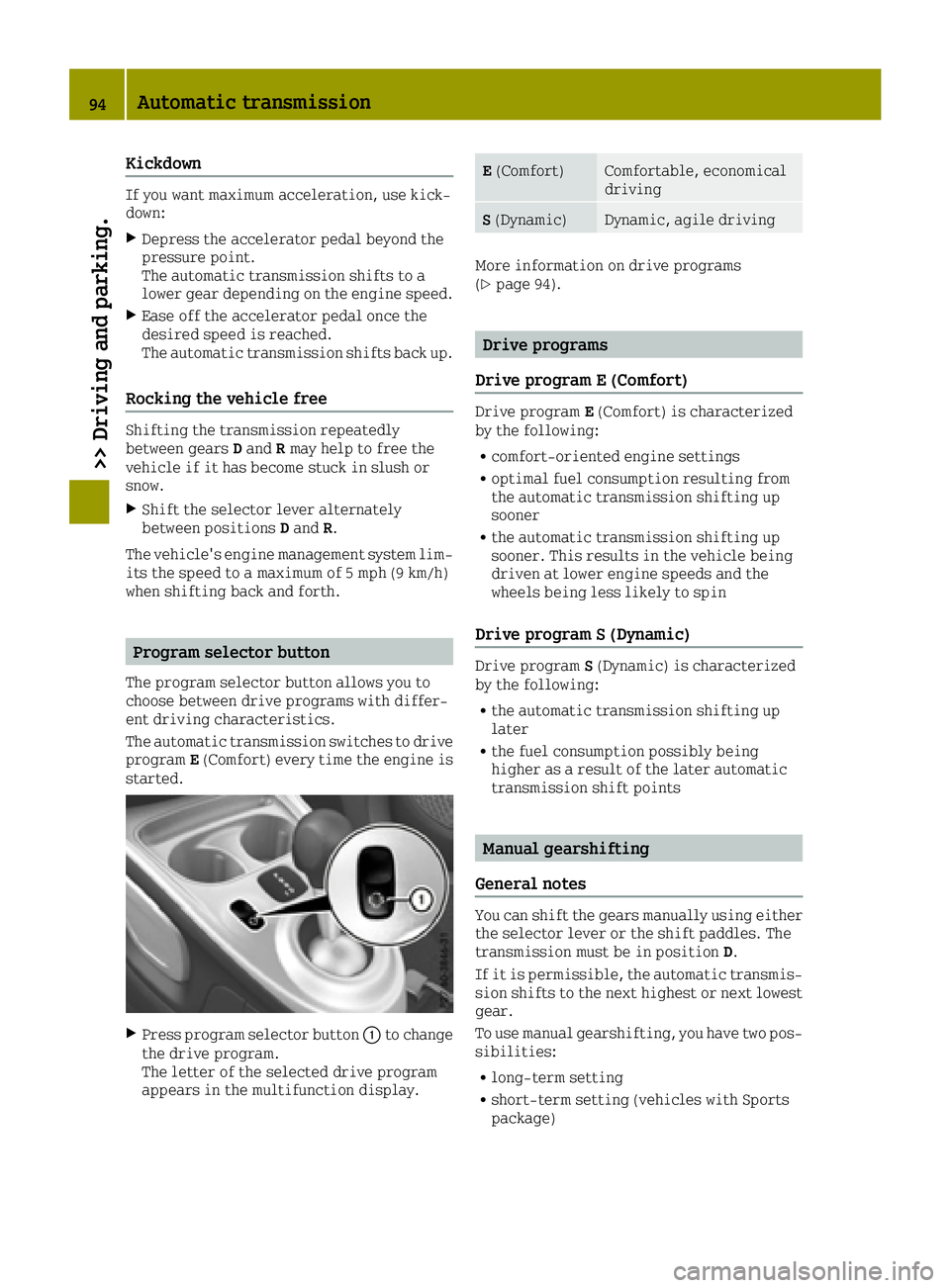
Program selector button
The program selector button allows you to
choose between drive programs with differ-
ent driving characteristics.
The automatic transmission switches to drive
program E(Comfort) every time the engine is
started.
XPress program selector button 0043to change
the drive program.
The letter of the selected drive program
appears in the multifunction display.
E (Comfort)Comfortable, economical
driving
S(Dynamic)Dynamic, agile driving
More information on drive programs
(Ypage 94).
Drive programs
Drive program E (Comfort)
Drive program E(Comfort) is characterized
by the following:
Rcomfort-oriented engine settings
Roptimal fuel consumption resulting from
the automatic transmission shifting up
sooner
Rthe automatic transmission shifting up
sooner. This results in the vehicle being
driven at lower engine speeds and the
wheels being less likely to spin
Drive program S (Dynamic)
Drive program S(Dynamic) is characterized
by the following:
Rthe automatic transmission shifting up
later
Rthe fuel consumption possibly being
higher as a result of the later automatic
transmission shift points
Manual gearshifting
General notes
You can shift the gears manually using either
the selector lever or the shift paddles. The
transmission must be in position D.
If it is permissible, the automatic transmis-
sion shifts to the next highest or next lowest
gear.
To use manual gearshifting, you have two pos-
sibilities:
Rlong-term setting
Rshort-term setting (vehicles with Sports
package)
94Automatic transmission
>> Driving and parking.
Page 97 of 214
If you activate the manual gearshift setting,
the currently selected gear is shown in the
multifunction display instead ofD.
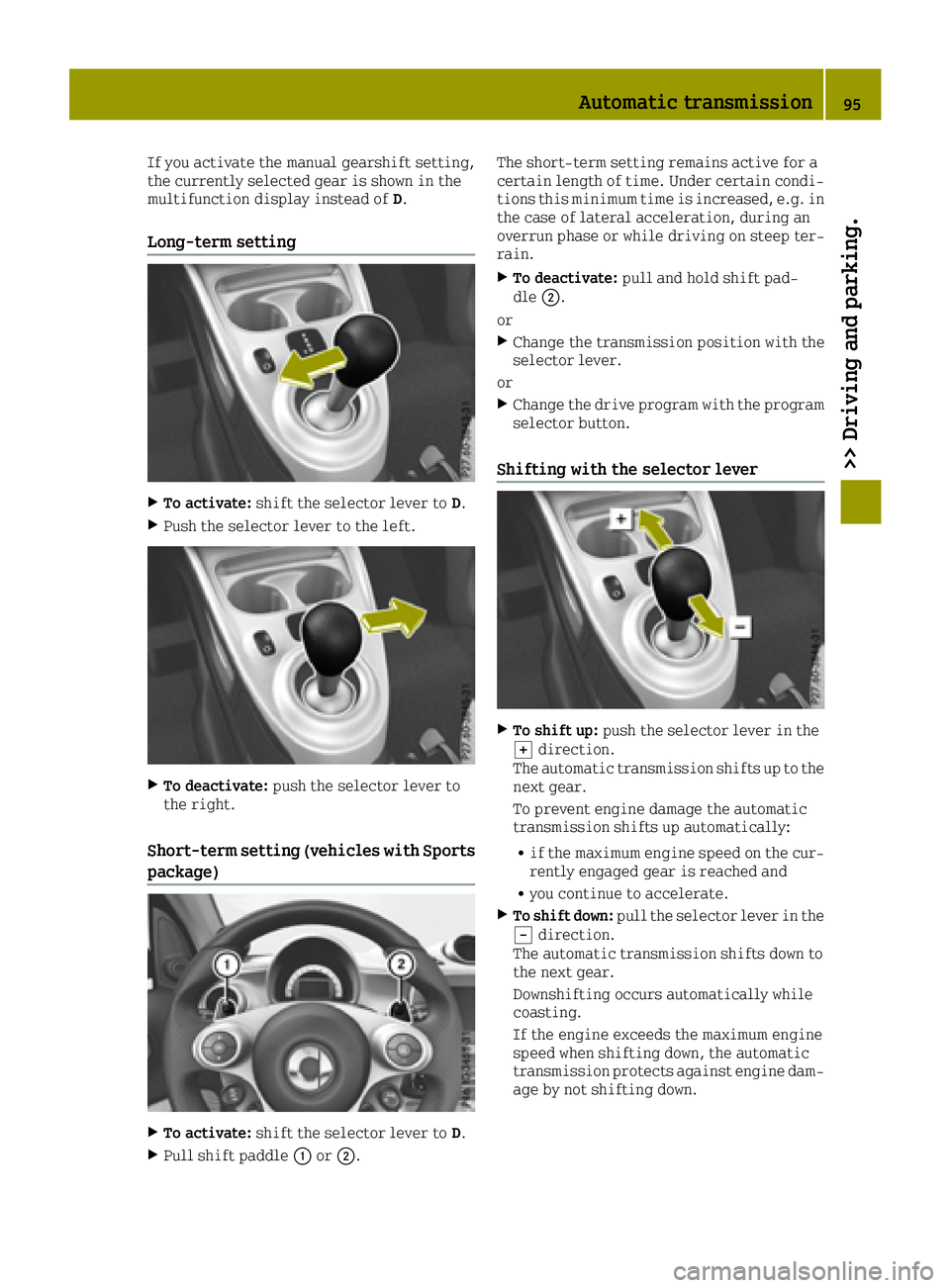
Long-term setting
XTo activate:shift the selector lever to D.
XPush the selector lever to the left.
XTo deactivate:push the selector lever to
the right.
Short-term setting (vehicles with Sports
package)
XTo activate: shift the selector lever to D.
XPull shift paddle0043or0044. The short-term setting remains active for a
certain length of time. Under certain condi-
tions this minimum time is increased, e.g. in
the case of lateral acceleration, during an
overrun phase or while driving on steep ter-
rain.
XTo deactivate:
pull and hold shift pad-
dle 0044.
or
XChange the transmission position with the
selector lever.
or
XChange the drive program with the program
selector button.
Shifting with the selector lever
XTo shift up: push the selector lever in the
0064 direction.
The automatic transmission shifts up to the
next gear.
To prevent engine damage the automatic
transmission shifts up automatically:
Rif the maximum engine speed on the cur-
rently engaged gear is reached and
Ryou continue to accelerate.
XTo shift down: pull the selector lever in the
0058 direction.
The automatic transmission shifts down to
the next gear.
Downshifting occurs automatically while
coasting.
If the engine exceeds the maximum engine
speed when shifting down, the automatic
transmission protects against engine dam-
age by not shifting down.
Automatic transmission95
>> Driving and parking.
Z
Page 98 of 214
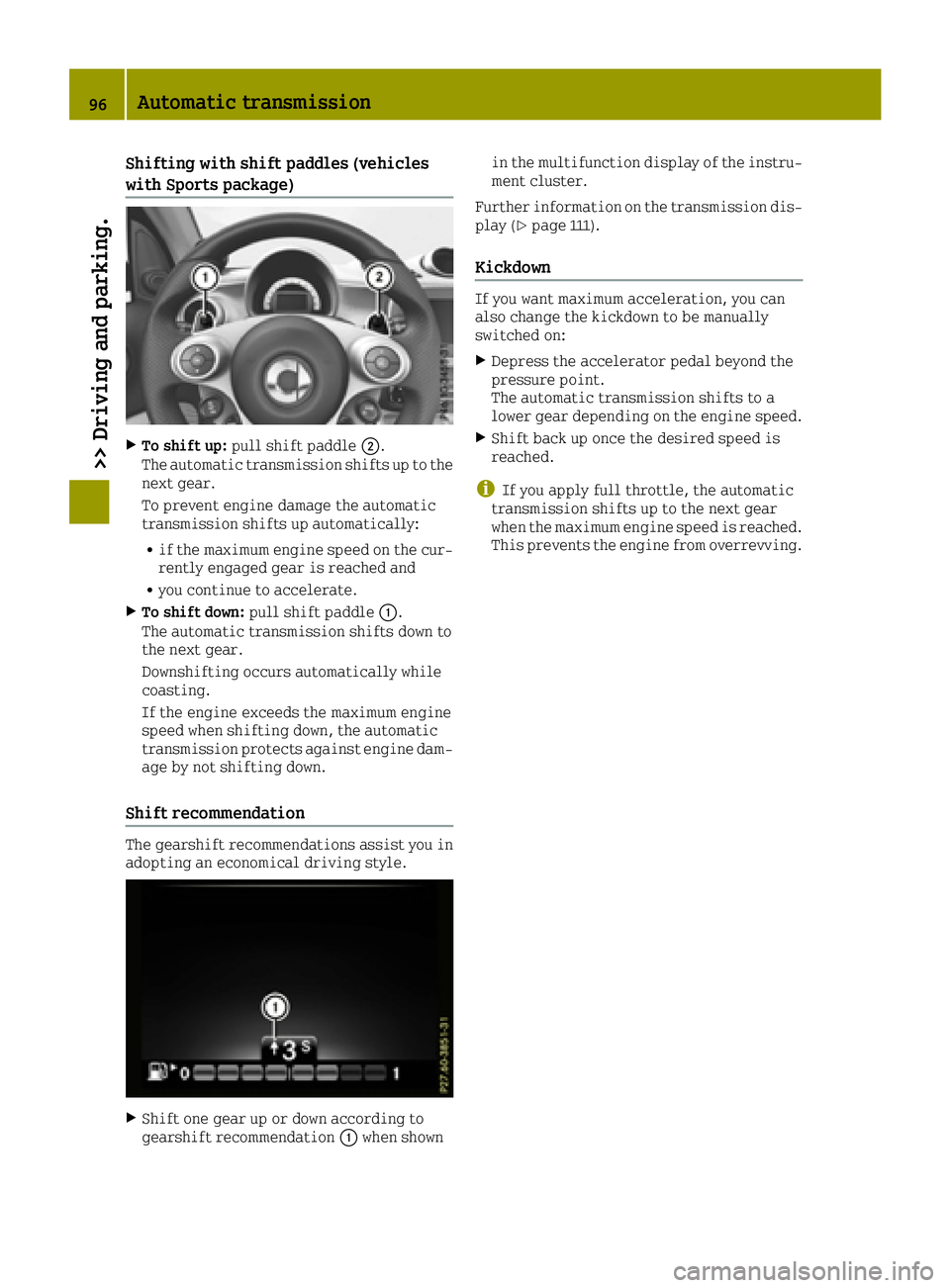
Shifting with shift paddles (vehicles
with Sports package)
XTo shift up:pull shift paddle 0044.
The automatic transmission shifts up to the
next gear.
To prevent engine damage the automatic
transmission shifts up automatically:
Rif the maximum engine speed on the cur-
rently engaged gear is reached and
Ryou continue to accelerate.
XTo shift down: pull shift paddle 0043.
The automatic transmission shifts down to
the next gear.
Downshifting occurs automatically while
coasting.
If the engine exceeds the maximum engine
speed when shifting down, the automatic
transmission protects against engine dam-
age by not shifting down.
Shift recommendation
The gearshift recommendations assist you in
adopting an economical driving style.
XShift one gear up or down according to
gearshift recommendation 0043when shown in the multifunction display of the instru-
ment cluster.
Further information on the transmission dis-
play (
Ypage 111).
Kickdown
If you want maximum acceleration, you can
also change the kickdown to be manually
switched on:
XDepress the accelerator pedal beyond the
pressure point.
The automatic transmission shifts to a
lower gear depending on the engine speed.
XShift back up once the desired speed is
reached.
iIf you apply full throttle, the automatic
transmission shifts up to the next gear
when the maximum engine speed is reached.
This prevents the engine from overrevving.
96Automatic transmission
>> Driving and parking.
Page 101 of 214
XCompletely insert the filler neck of the
fuel pump nozzle into the tank, hook in
place and refuel.
XOnly fill the tank until the pump nozzle
switches off.
iDo not add any more fuel after the pump
stops filling for the first time. Otherwise,
fuel may leak out.
Closing the fuel filler flap
XReplace the cap on the filler neck and turn
clockwise until it engages audibly.
XClose the fuel filler flap.
iClose the fuel filler flap before locking
the vehicle.
iIf you are driving with the fuel filler cap
open, the 00B6reserve fuel warning lamp
flashes. A message appears in the multi-
function display (
Ypage 125).
In addition, the 00B9Check Engine warning
lamp may light up (
Ypage 136).
For further information on warning and
indicator lamps in the instrument cluster,
see (
Ypage 136).
Refueling99
>> Driving and parking.
Z