tires SMART FORTWO 2016 Owner's Manual
[x] Cancel search | Manufacturer: SMART, Model Year: 2016, Model line: FORTWO, Model: SMART FORTWO 2016Pages: 214, PDF Size: 4.93 MB
Page 158 of 214
Do not use power washers with circular jet
nozzles to clean the vehicle. Have damaged
tires or chassis components replaced
immediately.
!Always maintain a distance of at least
11.8 in (30 cm) between the vehicle and the
power washer nozzle. Information about the
correct distance is available from the
equipment manufacturer.
Move the power washer nozzle around when
cleaning your vehicle.
Do not aim directly at any of the following:
Rtires
Rdoor gaps, roof gaps, joints, etc.
Relectrical components
Rbattery
Rconnectors
Rlights
Rseals
Rtrim
Rventilation slots
Damaged seals or electrical components
can lead to leaks or failures.
Cleaning the paintwork
!Do not affix:
Rstickers
Rfilms
Rmagnetic plates or similar items
to painted surfaces. You could otherwise
damage the paintwork.
XRemove dirt immediately, where possible,
while avoiding rubbing too hard.
XSoak insect remains with insect remover
and rinse off the treated areas afterwards.
XSoak bird droppings with water and rinse
off the treated areas afterwards.
XRemove coolant, brake fluid, tree resin,
oils, fuels and greases by rubbing gently
with a cloth soaked in petroleum ether or
lighter fluid.
XUse tar remover to remove tar stains.
XUse silicone remover to remove wax.
XUse a suitable touch-up stick, e.g. MB
Touch-Up Stick, to repair slight damage to
the paintwork quickly and provisionally. The following cannot always be completely
repaired:
Rscratches
Rcorrosive deposits
Rareas affected by corrosion
Rdamage caused by inadequate care
In such cases, visit a qualified specialist
workshop.
When water no longer forms beads on the paint surface, use the care product Paint Care,
which has been approved by smart. This is the
case approximately every three to five
months, depending on the climate conditions
and the care product used.
If the dirt has penetrated the paint surface or
if the paintwork has become dull, then the
paintwork should be cleaned. Use the care
product Paint Care, which has been approved
by smart to clean the paintwork.
Do not use these care products in the sun or on
the hood while the hood is hot.
Matte finish care
!Never polish the vehicle or the light alloy
wheels. Polishing causes the finish to
shine.
!The following may cause the paint to
become shiny and thus reduce the matte
effect:
Rstrong rubbing of the paintwork with
unsuitable materials
Rfrequent use of automatic car washes
Rwashing the vehicle in direct sunlight
!Never use paint cleaner, buffing or pol-
ishing products, or gloss preserver, e.g.
wax. These products are only suitable for
high-gloss surfaces. Their use on vehicles
with matte finish leads to considerable
surface damage (shiny, mottled areas).
Always have paintwork repairs carried out
at a qualified specialist workshop.
!Do not use wash programs with a hot wax
treatment under any circumstances.
Observe these notes if your vehicle has a
clear matte finish. This will help you to avoid
damage to the paintwork due to incorrect
treatment.
These notes also apply to light alloy wheels
with a clear matte finish.
156Care
>> Maintenance and care.
Page 159 of 214
iThe vehicle should preferably be washed
by hand using a soft sponge, car shampoo
and plenty of water.
iUse only insect remover and car shampoo
from the range of approved smart care
products.
Cleaning the panoramic roof
!Only use cleaning agents or cleaning
cloths which are suitable for plastic light
lenses. Unsuitable cleaning agents or
cleaning cloths could scratch or damage
the plastic windows of the panoramic roof.
Do not use cleaning agents which contain
solvents.
XClean the plastic panes of the panoramic
roof using a wet sponge and a mild cleaning
agent, e.g. smart car shampoo, a commer-
cially available glass cleaner or cleaning
cloths.
Cleaning the wheels
GWARNING
The water jet from a circular jet nozzle
(dirt blasters) can cause invisible exte-
rior damage to the tires or chassis compo- nents. Components damaged in this way may
fail unexpectedly. There is a risk of an
accident.
Do not use power washers with circular jet
nozzles to clean the vehicle. Have damaged
tires or chassis components replaced
immediately.
!Do not use acidic wheel cleaning products
to remove brake dust. This could damage
wheel bolts and brake components.
!Do not park the vehicle for an extended
period straight after cleaning it, partic-
ularly after having cleaned the wheels with
wheel cleaner. Wheel cleaners could cause
increased corrosion of the brake discs and
brake pads/linings. For this reason, you
should drive for a few minutes after clean-
ing. Braking heats the brake discs and the
brake pads/linings, thus drying them. The
vehicle can then be parked.
Cleaning the windows
GWARNING
You could become trapped by the wind-
shield wipers if they start moving while
cleaning the windshield or wiper blades.
There is a risk of injury.
Always switch off the windshield wipers
and the ignition before cleaning the wind-
shield or wiper blades.
!Do not use dry cloths, abrasive products,
solvents or cleaning agents containing
solvents to clean the inside of the windows.
Do not touch the insides of the windows with
hard objects, e.g. an ice scraper or ring.
There is otherwise a risk of damaging the
windows.
!Clean the water drainage channels of the
windshield and the rear window at regular
intervals. Deposits such as leaves, petals
and pollen may under certain circumstan-
ces prevent water from draining away. This
can lead to corrosion damage and damage to
electronic components.
XClean the inside and outside of the windows
with a damp cloth and a cleaning agent that
is recommended and approved by smart.
Cleaning wiper blades
GWARNING
You could become trapped by the wind-
shield wipers if they start moving while
cleaning the windshield or wiper blades.
There is a risk of injury.
Always switch off the windshield wipers
and the ignition before cleaning the wind-
shield or wiper blades.
!Do not pull the wiper blade. Otherwise,
the wiper blade could be damaged.
!Do not clean wiper blades too often and do
not rub them too hard. Otherwise, the
graphite coating could be damaged. This
could cause wiper noise.
Care157
>> Maintenance and care.
Z
Page 165 of 214
XTurn the key to position1in the ignition
lock (Ypage 87).
XPress on/off switch 0084on tire inflation
compressor 0044toI.
The tire inflation compressor is switched
on. The tire is inflated.
iFirst, tire sealant is pumped into the
tire. The pressure can briefly rise to
approximately 600 kPa (6.0 bar/86 psi).
Do not switch off the tire inflation com-
pressor during this phase.
XLet the tire inflation compressor run for a
maximum of 15 minutes. The tire should then
have attained a pressure of at least 180 kPa
(1.8 bar/26 psi).
If a tire pressure of 180 kPa (1.8 bar/26 psi) is
achieved after a maximum of 15 minutes, see
"Tire pressure is achieved" (
Ypage 163).
If a tire pressure of 180 kPa (1.8 bar/26 psi)
has not been achieved after a maximum of
15 minutes, see "Tire pressure is not ach-
ieved" (
Ypage 163).
iIf tire sealant leaks out, allow it to dry. It
can then be removed like a layer of film.
If your clothes are soiled with tire sealant,
have them cleaned with perchloroethylene
at a dry cleaner as soon as possible.
Tire pressure not reached
If a tire pressure of 180 kPa (1.8 bar/26 psi)
has not been achieved after a maximum of
10 minutes:
XSwitch off the tire inflation compressor.
XUnscrew the filler hose from the valve of
the faulty tire.
XVery slowly drive forwards or reverse
approximately 30 ft (10 m).
XPump up the tire again.
After a maximum of 10 minutes, the tire
pressure must be at least 180 kPa (1.8 bar/
26 psi).
GWARNING
If the required tire pressure is not reached after the specified time, the tire is too
badly damaged. The tire sealant cannot
repair the tire in this instance. Damaged
tires and a tire pressure that is too low can
significantly impair the vehicle's braking
and driving characteristics. There is a
risk of accident.
Do not continue driving. Contact a quali-
fied specialist workshop.
Tire pressure reached
GWARNING
A tire temporarily sealed with tire sealant impairs the driving characteristics and is
not suitable for higher speeds. There is a
risk of accident.
You should therefore adapt your driving
style accordingly and drive carefully. Do
not exceed the specified maximum speed
with a tire that has been repaired using
tire sealant.
The maximum speed for a tire sealed with tire
sealant is 50 mph (80 km/h). The 50 mph
(80 km/h) maximum speed sticker must be
affixed to the instrument cluster within the
driver's field of vision.
!After use, excess tire sealant may run out
of the filler hose. This could cause stains.
Therefore, place the filler hose in the
plastic bag that contained the TIREFIT kit.
HEnvironmental note
Have the used tire sealant bottle disposed
of professionally, e.g. at a qualified spe-
cialist workshop.
If a tire pressure of 180 kPa (1.8 bar/26 psi)
has been achieved after 10 minutes:
XSwitch off the tire inflation compressor.
XUnscrew the filler hose from the valve of
the faulty tire.
XStow the tire sealant bottle and the tire
inflation compressor.
XPull away immediately.
XStop after driving for approximately
2 miles (3 km) and check the tire pressure
with the tire inflation compressor.
The tire pressure must now be at least
130 kPa (1.3 bar/19 psi).
Flat tire163
>> Breakdown assistance.
Z
Page 166 of 214
GWARNING
If the required tire pressure is not reached after driving for a short period, the tire is
too badly damaged. The tire sealant cannot repair the tire in this instance. Damaged
tires and a tire pressure that is too low can
significantly impair the vehicle's brakingand driving characteristics. There is a
risk of accident.
Do not continue driving. Contact a quali-
fied specialist workshop.
XCorrect the tire pressure if it is still at
least 130 kPa (1.3 bar/19 psi). For values, see
the tire and loading information table on
the driver's side B-pillar.
XTo increase the tire pressure: switch on the
tire inflation compressor.
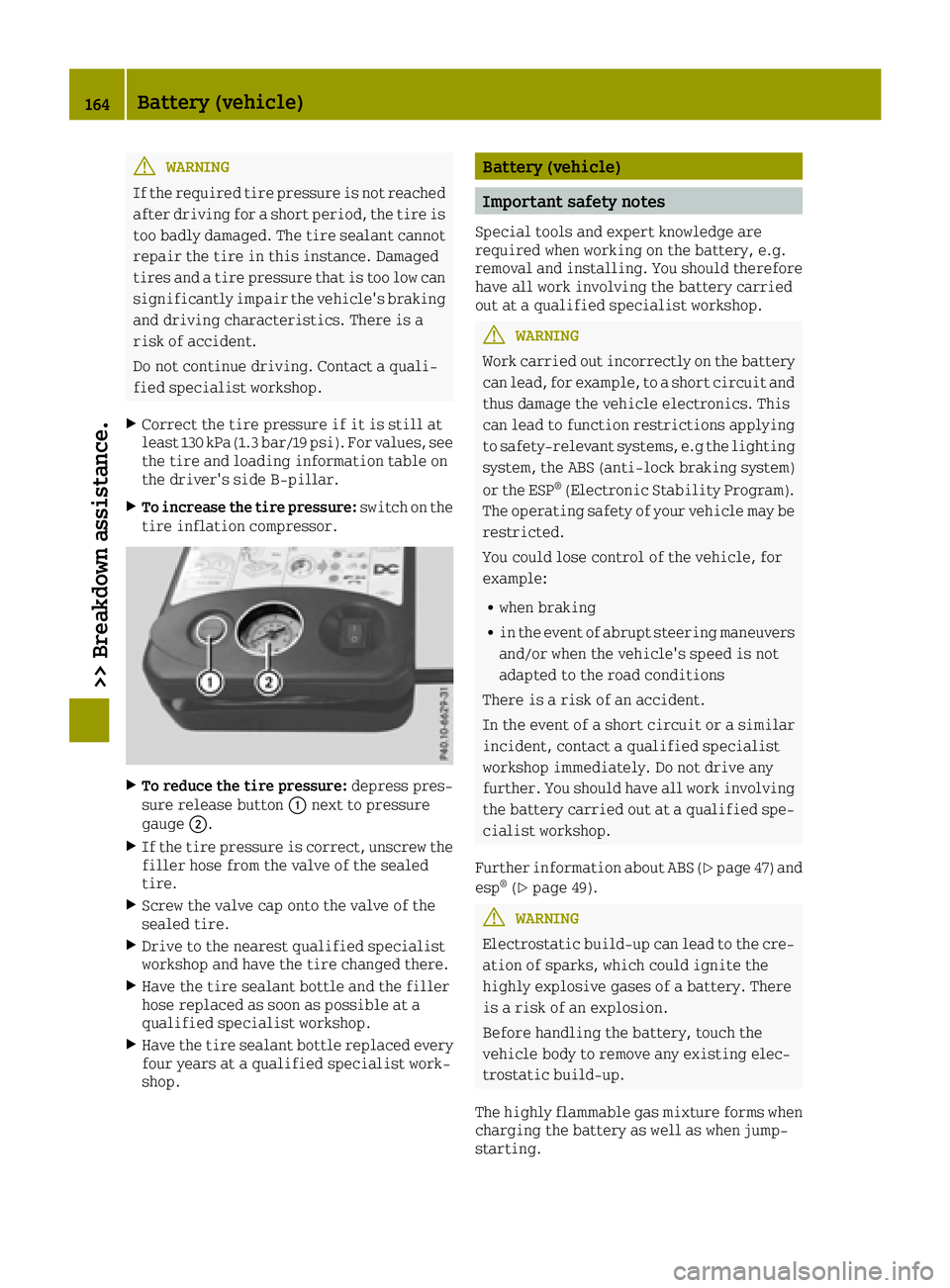
XTo reduce the tire pressure: depress pres-
sure release button 0043next to pressure
gauge 0044.
XIf the tire pressure is correct, unscrew the
filler hose from the valve of the sealed
tire.
XScrew the valve cap onto the valve of the
sealed tire.
XDrive to the nearest qualified specialist
workshop and have the tire changed there.
XHave the tire sealant bottle and the filler
hose replaced as soon as possible at a
qualified specialist workshop.
XHave the tire sealant bottle replaced every
four years at a qualified specialist work-
shop.
Battery (vehicle)
Important safety notes
Special tools and expert knowledge are
required when working on the battery, e.g.
removal and installing. You should therefore
have all work involving the battery carried
out at a qualified specialist workshop.
GWARNING
Work carried out incorrectly on the battery
can lead, for example, to a short circuit and
thus damage the vehicle electronics. This
can lead to function restrictions applying
to safety-relevant systems, e.g the lighting system, the ABS (anti-lock braking system)
or the ESP
®(Electronic Stability Program).
The operating safety of your vehicle may be restricted.
You could lose control of the vehicle, for
example:
Rwhen braking
Rin the event of abrupt steering maneuvers
and/or when the vehicle's speed is not
adapted to the road conditions
There is a risk of an accident.
In the event of a short circuit or a similar
incident, contact a qualified specialist
workshop immediately. Do not drive any
further. You should have all work involving
the battery carried out at a qualified spe-
cialist workshop.
Further information about ABS (
Ypage 47) and
esp®(Ypage 49).
GWARNING
Electrostatic build-up can lead to the cre- ation of sparks, which could ignite the
highly explosive gases of a battery. There
is a risk of an explosion.
Before handling the battery, touch the
vehicle body to remove any existing elec-
trostatic build-up.
The highly flammable gas mixture forms when charging the battery as well as when jump-
starting.
164Battery (vehicle)
>> Breakdown assistance.
Page 179 of 214
Useful information
i
This Operator's Manual describes all
models and all standard and optional
equipment of your vehicle available at the
time of publication of the Operator's Man- ual. Country-specific differences are pos-
sible. Bear in mind that your vehicle may
not feature all functions described here.
This also applies to safety-relevant sys-
tems and functions.
iRead the information on qualified spe-
cialist workshops: (Ypage 20).
Important safety notes
GWARNING
If wheels and tires of the wrong size are
used, the wheel brakes or suspension com-
ponents may be damaged. There is a risk of
an accident.
Always replace wheels and tires with those
that fulfill the specifications of the orig-
inal part.
When replacing wheels, make sure to use the
correct:
Rdesignation
Rmodel
When replacing tires, make sure to use the
correct:
Rdesignation
Rmanufacturer
Rmodel
GWarning
A flat tire severely impairs the driving,
steering and braking characteristics of
the vehicle. There is a risk of an accident.
do not drive with a flat tire. Immediately
replace the flat tire with your spare wheel,
or consult a qualified specialist workshop.
Accessories that are not approved for your
vehicle by smart or that are not being used
correctly can impair driving safety. Before purchasing and using non-approved
accessories, visit a qualified specialist
workshop and inquire about:
Rsuitability
Rlegal stipulations
Rfactory recommendations
Information on dimensions and types of
wheels and tires for your vehicle
(
Ypage 200).
Information on air pressure for the tires on
your vehicle can be found:
Ron the tire and loading information table
on the driver's side B-pillar
Runder "tire pressure" (Ypage 180)
iFurther information on wheels and tires
can be obtained at any qualified specialist
workshop.
Operation
Information on driving
RCheck the tire pressures when the vehicle
is heavily laden and, if necessary, adjust
before beginning your journey.
RWhile driving, pay attention to vibrations,
noises and unusual handling characteris-
tics, e.g. pulling to one side. This may
indicate that the wheels or tires are dam-
aged. If you suspect that a tire is defec-
tive, reduce your speed immediately. Stop
the vehicle as soon as possible to check the
wheels and tires for damage. Hidden tire
damage could also be causing the unusual
handling characteristics. If you find no
signs of damage, have the tires and wheels
checked at a qualified specialist work-
shop.
RWhen parking your vehicle, make sure that
the tires do not get deformed by the curb or
other obstacles. If it is necessary to drive
over curbs, speed humps or similar eleva-
tions, try to do so slowly and at an obtuse
angle. Otherwise, the tires, particularly
the sidewalls, may be damaged.
Operation177
>> Wheels and tires.
Z
Page 180 of 214

Regular checking of wheels and tires
GWARNING
Damaged tires can cause tire inflation
pressure loss. As a result, you could lose
control of your vehicle. There is a risk of
accident.
Check the tires regularly for signs of dam- age and replace any damaged tires imme-
diately.
Regularly check the wheels and tires of your
vehicle for damage, at least once a month, as
well as after driving on rough roads. Damaged
wheels can cause a loss of tire pressure. Pay
particular attention to damage such as:
Rcuts in the tires
Rpunctures in the tires
Rtears in the tires
Rbulges on tires
Rdeformation or severe corrosion on wheels
Regularly check the tire tread depth and the
condition of the tread across the whole width
of the tire (
Ypage 178). If necessary, turn the
front wheels to full lock in order to inspect
the inner side of the tire surface.
All wheels must have a valve cap to protect the
valve against dirt and moisture. Do not fit
anything onto the valve other than the stand-
ard valve cap or other valve caps approved for
your vehicle by smart. Do not use any other
valve caps or systems, e.g. tire pressure mon-
itoring systems.
Regularly check the pressure of all the tires
particularly prior to long trips. Adjust the
tire pressure as necessary (
Ypage 180).
The service life of tires depends, among
other things, on the following factors:
RDriving style
RTire pressure
RDistance covered
Notes on tire profile
GWARNING
Insufficient tire tread will reduce tire
traction. The tire is no longer able to dis-
sipate water. This means that on wet road
surfaces, the risk of hydroplaning increa-
ses, in particular where speed is not adap- ted to suit the driving conditions. There is
a risk of accident.
If the tire pressure is too high or too low,
tires may exhibit different levels of wear
at different locations on the tire tread.
Thus, you should regularly check the tread
depth and the condition of the tread across
the entire width of all tires.
Minimum tire tread depth for:
RSummer tires: 00CEin (3 mm)
RM+S tires: 00CFin (4 mm)
For safety reasons, replace the tires before
the legally prescribed limit for the mini-
mum tire tread depth is reached.
Indicator 0043shows which position the bar
marking (arrow) for tread wear is integrated
into the tire tread.
Treadwear indicators (TWI) are required by
law. Six indicators are positioned on the tire
tread. They are visible once a tread depth of
approximately 00CDin (1.6 mm) has been
reached. If this is the case, the tire is so worn
that it must be replaced.
Selecting, mounting and replacing
tires
ROnly mount tires and wheels of the same
type and make.
Exception: it is permissible to fit a dif-
ferent type or make in the event of a flat
tire.
ROnly mount tires of the correct size onto the
wheels.
178Operation
>> Wheels and tires.
Page 181 of 214
RAfter fitting new tires, run them in at mod-
erate speeds for the first 60 miles (100 km),
as they only reach their full performance
after this distance.
RDo not drive with tires which have too little
tread depth, as this significantly reduces
the traction on wet roads (hydroplaning).
RReplace the tires after six years at the lat-
est, regardless of wear.
Winter operation
General notes
Have your vehicle winterproofed at a quali-
fied specialist workshop at the onset of win-
ter.
Observe the notes in the "Changing a wheel"
section (
Ypage 196).
Driving with summer tires
At temperatures below 45 ‡(+7 †), summer
tires lose elasticity and therefore traction
and braking power. Change the tires on your
vehicle to M+S tires. Using summer tires at
very cold temperatures could cause tears to
form, thereby damaging the tires perma-
nently. smart cannot accept responsibility
for this type of damage.
GWARNING
Damaged tires can cause tire inflation
pressure loss. As a result, you could lose
control of your vehicle. There is a risk of
accident.
Check the tires regularly for signs of dam- age and replace any damaged tires imme-
diately.
M+S tires
GWARNING
M+S tires with a tire tread depth of less
than 00CFin (4 mm) are not suitable for use in
winter and do not provide sufficient trac-
tion. There is a risk of an accident.
M+S tires with a tread depth of less than 00CF
in (4 mm) must be replaced immediately.
At temperatures below 45 ‡(+7 †) use winter
tires marked with M+S.
Only winter tires bearing the 004Dsnowflake
symbol in addition to the M+S marking pro-
vide the best possible grip in wintry road
conditions. Only these tires will allow driv-
ing safety systems such as ABS and ESP
®to
function optimally in winter. These tires
have been developed specifically for driving
in snow.
Use M+S tires of the same make and tread on
all wheels to maintain safe handling charac- teristics.
Always observe the maximum permissible
speed specified for the M+S tires you have
mounted. Therefore, only use tire types and
sizes approved for smart. Observe the tire
load rating and speed rating required for
smart.
Tires with a specified direction of rotation
have additional benefits, e.g. if there is a
risk of aquaplaning. These advantages can
only be gained if the tires are fitted corre-
sponding to the direction of rotation.
An arrow on the sidewall of the tire indicates
its correct direction of rotation.
When you have mounted the M+S tires:
XCheck the tire pressures (Ypage 180).
XVehicles for USA: restart the tire pressure
monitor (Ypage 185).
Snow chains
GWARNING
If snow chains are installed to the front
wheels, they may drag against the vehicle
body or chassis components. This could
cause damage to the vehicle or the tires.
There is a risk of an accident.
To avoid hazardous situations:
Rnever install snow chains to the front
wheels
Ralways install snow chains in pairs to the rear wheels.
Winter operation179
>> Wheels and tires.
Z
Page 182 of 214
!Vehicles with steel wheels:if you mount
snow chains on steel wheels, you may dam-
age the hub caps. Remove the hub caps from
the relevant wheels before mounting the
snow chains.
smart recommends that you only use snow
chains that have been specially approved for
smart. For more information, please contact
the smart center or a qualified specialist
workshop.
Bear in mind that snow chains are designed
for a certain wheel size. If you mount tires
that are larger or smaller than the original
tires, you will require new snow chains of the
correct size.
If you intend to mount snow chains, please
bear the following points in mind:
RSnow chains may not be mounted on all
wheel/tire combinations. Permissible
wheel-tire combinations (
Ypage 200).
ROnly use snow chains when driving on roads
completely covered by snow. Remove the
snow chains as soon as possible when you
come to a road that is not snow-covered.
RLocal regulations may restrict the use of
snow chains. Observe the appropriate reg-
ulations if you wish to mount snow chains.
Rdo not exceed the maximum permissible
speed of 30 mph (50 km/h).
Tire pressure
Tire pressure specifications
GWARNING
Underinflated or overinflated tires pose
the following risks:
Rthe tires may burst, especially as the
load and vehicle speed increase.
Rthe tires may wear excessively and/or
unevenly, which may greatly impair tire
traction.
Rthe driving characteristics, as well as
steering and braking, may be greatly
impaired.
There is a risk of an accident.
Follow recommended tire inflation pres-
sures and check the pressure of all the tires including the spare wheel:
Rmonthly, at least
Rif the load changes
Rbefore beginning a long journey
Runder different operating conditions,
e.g. off-road driving
If necessary, correct the tire pressure.
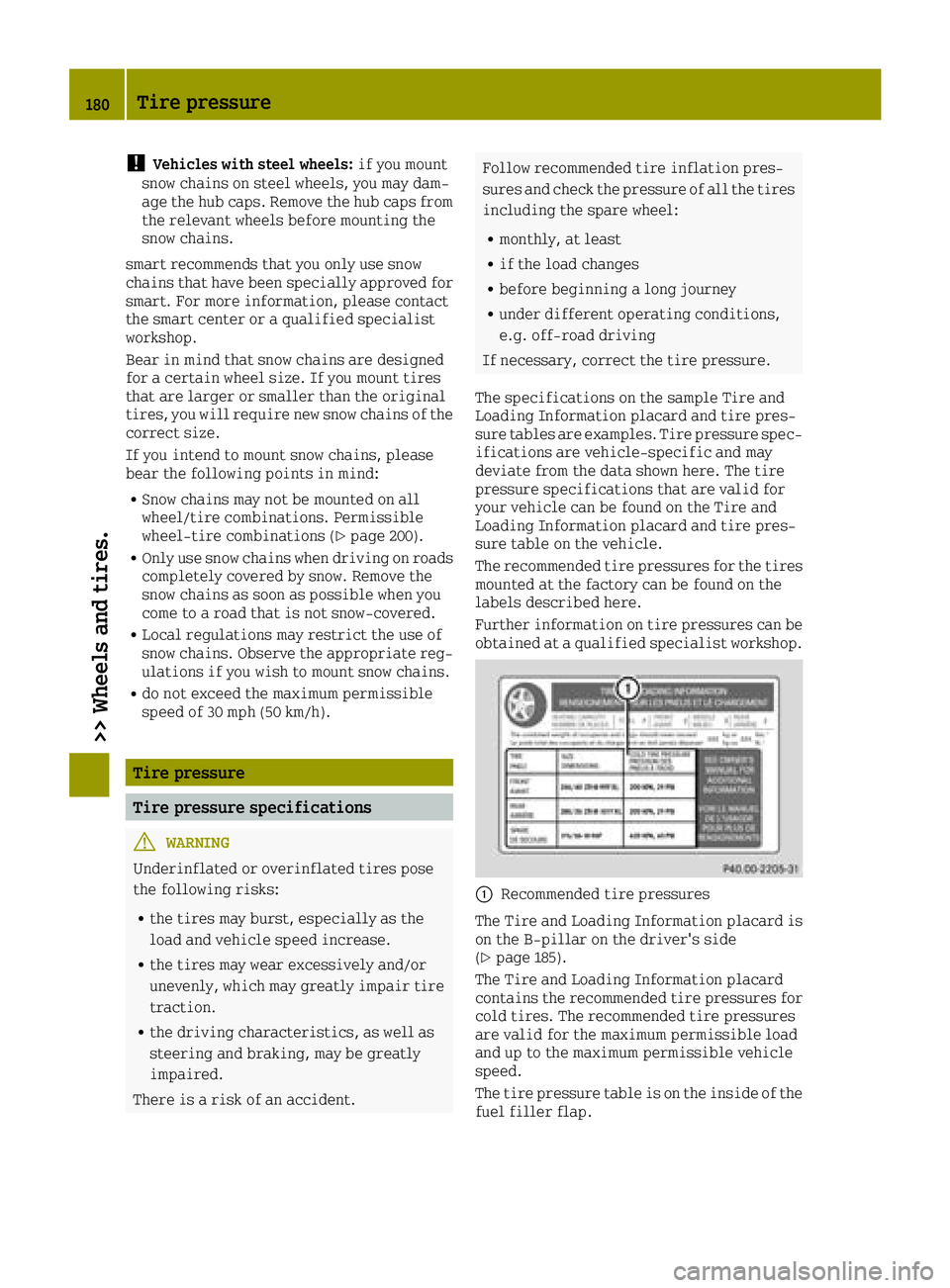
The specifications on the sample Tire and
Loading Information placard and tire pres-
sure tables are examples. Tire pressure spec-
ifications are vehicle-specific and may
deviate from the data shown here. The tire
pressure specifications that are valid for
your vehicle can be found on the Tire and
Loading Information placard and tire pres-
sure table on the vehicle.
The recommended tire pressures for the tires
mounted at the factory can be found on the
labels described here.
Further information on tire pressures can be
obtained at a qualified specialist workshop.
0043Recommended tire pressures
The Tire and Loading Information placard is
on the B-pillar on the driver's side
(
Ypage 185).
The Tire and Loading Information placard
contains the recommended tire pressures for
cold tires. The recommended tire pressures
are valid for the maximum permissible load
and up to the maximum permissible vehicle
speed.
The tire pressure table is on the inside of the
fuel filler flap.
180Tire pressure
>> Wheels and tires.
Page 183 of 214
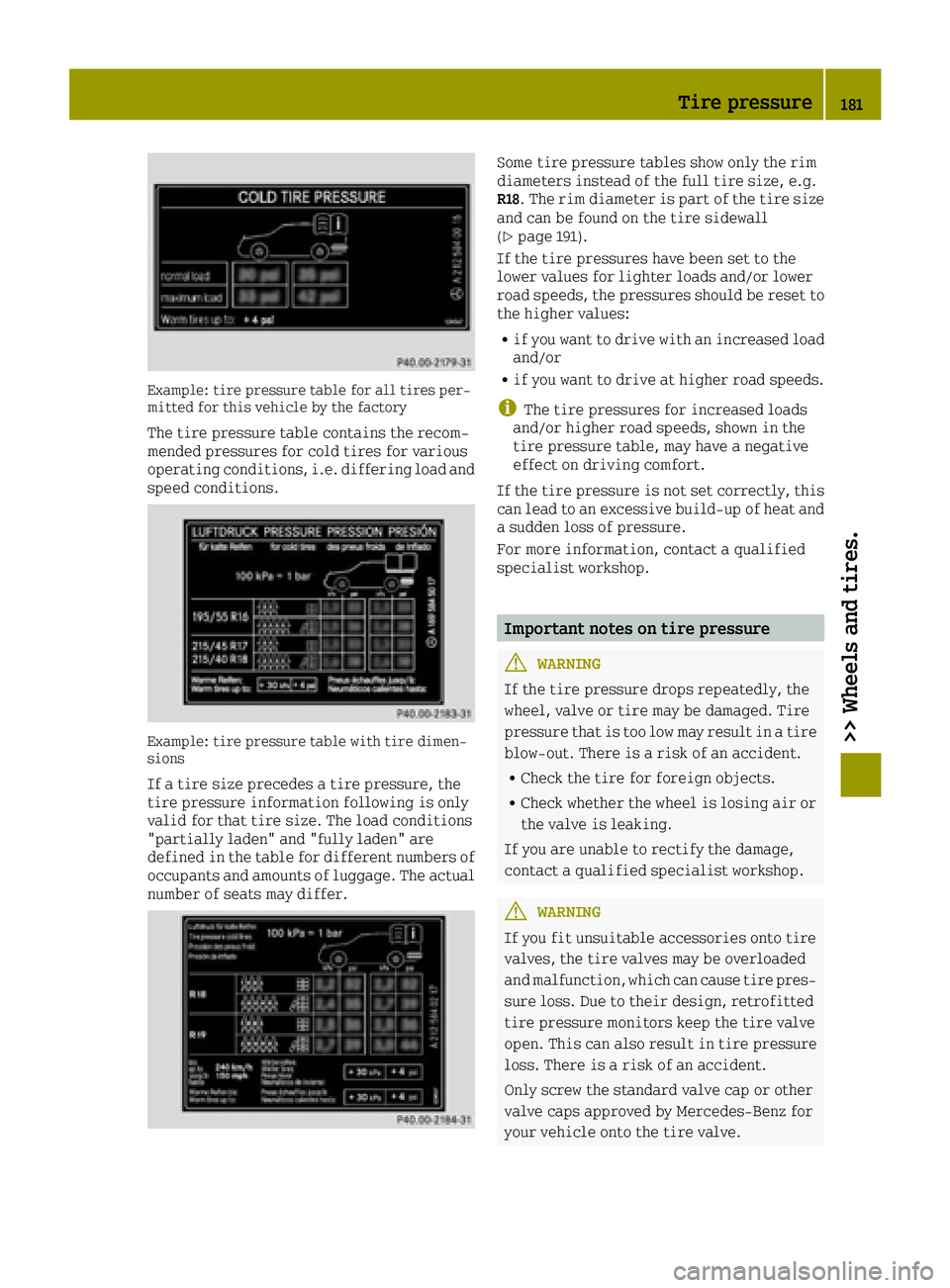
Example: tire pressure table for all tires per-
mitted for this vehicle by the factory
The tire pressure table contains the recom-
mended pressures for cold tires for various
operating conditions, i.e. differing load and
speed conditions.
Example: tire pressure table with tire dimen-
sions
If a tire size precedes a tire pressure, the
tire pressure information following is only
valid for that tire size. The load conditions
"partially laden" and "fully laden" are
defined in the table for different numbers of
occupants and amounts of luggage. The actual
number of seats may differ.
Some tire pressure tables show only the rim
diameters instead of the full tire size, e.g.
R18. The rim diameter is part of the tire size
and can be found on the tire sidewall
(
Ypage 191).
If the tire pressures have been set to the
lower values for lighter loads and/or lower
road speeds, the pressures should be reset to
the higher values:
Rif you want to drive with an increased load
and/or
Rif you want to drive at higher road speeds.
iThe tire pressures for increased loads
and/or higher road speeds, shown in the
tire pressure table, may have a negative
effect on driving comfort.
If the tire pressure is not set correctly, this
can lead to an excessive build-up of heat and
a sudden loss of pressure.
For more information, contact a qualified
specialist workshop.
Important notes on tire pressure
GWARNING
If the tire pressure drops repeatedly, the
wheel, valve or tire may be damaged. Tire
pressure that is too low may result in a tire
blow-out. There is a risk of an accident.
RCheck the tire for foreign objects.
RCheck whether the wheel is losing air or
the valve is leaking.
If you are unable to rectify the damage,
contact a qualified specialist workshop.
GWARNING
If you fit unsuitable accessories onto tire
valves, the tire valves may be overloaded
and malfunction, which can cause tire pres-
sure loss. Due to their design, retrofitted
tire pressure monitors keep the tire valve
open. This can also result in tire pressure
loss. There is a risk of an accident.
Only screw the standard valve cap or other
valve caps approved by Mercedes-Benz for
your vehicle onto the tire valve.
Tire pressure181
>> Wheels and tires.
Z
Page 184 of 214
Use a suitable pressure gauge to check the
tire pressure. The outer appearance of a tire
does not permit any reliable conclusion
about the tire pressure. On vehicles equip-
ped with the electronic tire pressure moni-
tor, the tire pressure can be checked in the
on-board computer.
The tire temperature and pressure increase
when the vehicle is in motion. This is
dependent on the driving speed and the load.
Therefore, you should only correct tire pres-
sures when the tires are cold.
The tires are cold:
Rif the vehicle has been parked with the
tires out of direct sunlight for at least
three hours and
Rif the vehicle has not been driven further
than 1 mile (1.6 km)
The tire temperature changes depending on
the outside temperature, the vehicle speed
and the tire load. If the tire temperature
changes by 18 ‡(10 †), the tire pressure
changes by approximately 10 kPa (0.1 bar/
1.5 psi). Take this into account when checking
the pressure of warm tires. Only correct the
tire pressure if it is too low for the current
operating conditions. If you check the tire
pressure when the tires are warm, the result-
ing value will be higher than if the tires were
cold. This is normal. Do not reduce the tire
pressure to the value specified for cold
tires. The tire pressure would otherwise be
too low.
Observe the recommended tire pressures for
cold tires:
Ron the Tire and Loading Information plac-
ard on the B-pillar on the driver's side
Rin the tire pressure table in the fuel filler
flap (Ypage 98).
Underinflated or overinflated tires
GWARNING
Tires with pressure that is too low can
overheat and burst as a consequence. In
addition, they also suffer from excessive
and/or irregular wear, which can severely
impair the braking properties and the
driving characteristics. There is a risk of an accident.
Avoid tire pressures that are too low in all
the tires, including the spare wheel.
Underinflated tires
Underinflated tires may:
Roverheat, leading to tire defects
Radversely affect handling
Rwear excessively and/or unevenly
Rhave an adverse effect on fuel consumption
GWARNING
Tires with excessively high pressure can
burst because they are damaged more easily by road debris, potholes etc. In addition,
they also suffer from irregular wear, which
can severely impair the braking properties
and the driving characteristics. There is a
risk of an accident.
Avoid tire pressures that are too high in all
the tires, including the spare wheel.
Overinflated tires
Overinflated tires may:
Rincrease the braking distance
Radversely affect handling
Rwear excessively and/or unevenly
Rhave an adverse effect on ride comfort
Rbe more susceptible to damage
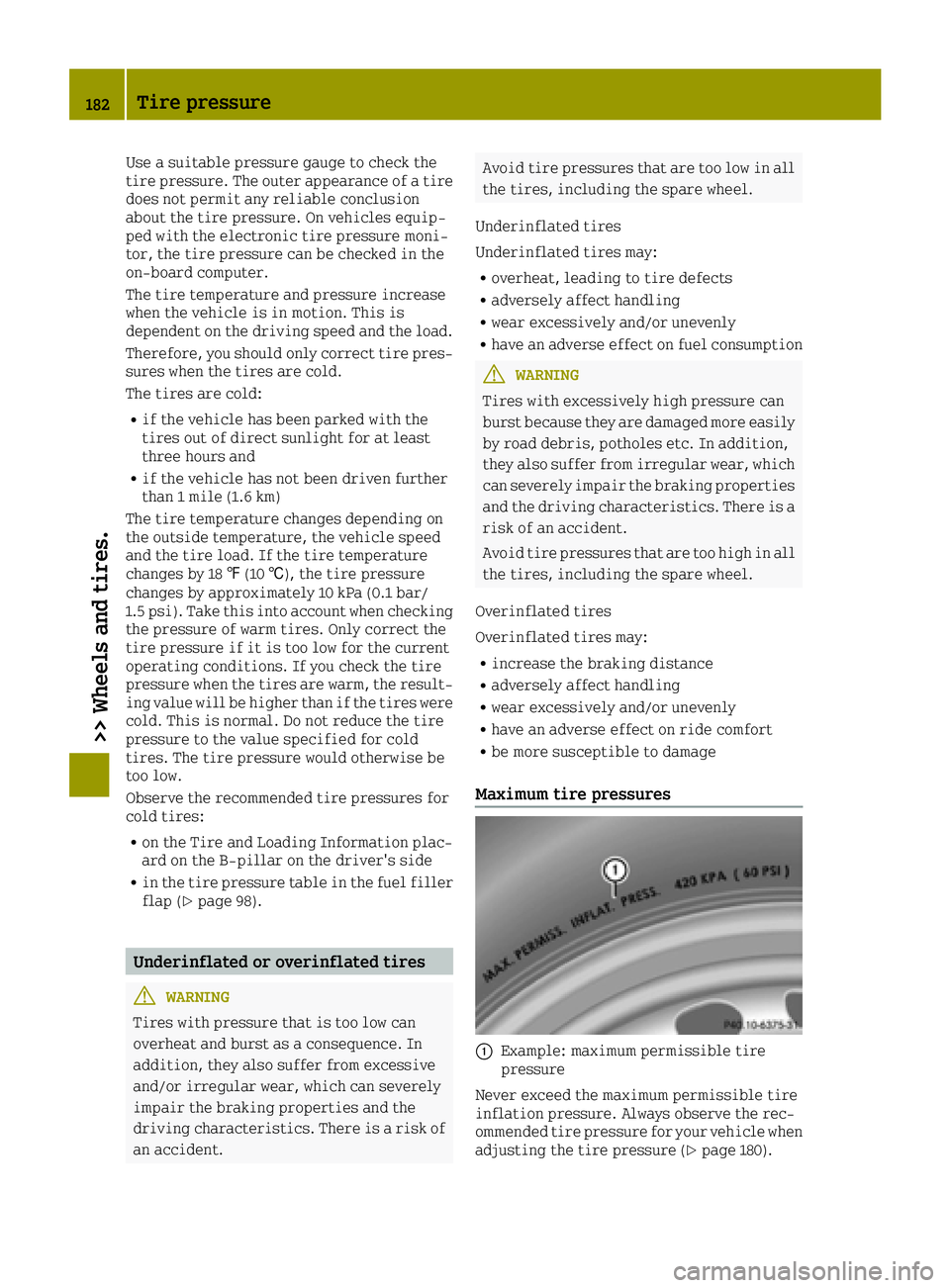
Maximum tire pressures
0043Example: maximum permissible tire
pressure
Never exceed the maximum permissible tire
inflation pressure. Always observe the rec-
ommended tire pressure for your vehicle when
adjusting the tire pressure (
Ypage 180).
182Tire pressure
>> Wheels and tires.