warning SMART FORTWO 2016 Workshop Manual
[x] Cancel search | Manufacturer: SMART, Model Year: 2016, Model line: FORTWO, Model: SMART FORTWO 2016Pages: 214, PDF Size: 4.93 MB
Page 67 of 214
Problems with the seat heating
ProblemPossible causes/consequences and0050Solutions
The seat heating has
switched off prema-
turely or cannot be
switched on.The on-board voltage is too low because too many electrical con-
sumers are switched on.
XSwitch off electrical consumers that you do not need, such as the
rear window defroster or interior lighting.
Once the battery is sufficiently charged, the seat heating will
switch back on automatically.
Steering wheel
Important safety notes
GWARNING
You could lose control of your vehicle if you
do the following while driving:
Radjust the driver's seat, steering wheel
or mirrors
Rfasten the seat belt
There is a risk of an accident.
Adjust the driver's seat, steering wheel or
mirrors and fasten your seat belt before
starting the engine.
GWARNING
Children could injure themselves if they
adjust the steering wheel. There is a risk of
injury.
When leaving the vehicle, always take the
SmartKey with you and lock the vehicle.
Never leave children unsupervised in the
vehicle.
Adjusting the steering wheel
GWARNING
If the steering wheel is unlocked while the
vehicle is in motion, it could change posi-
tion unexpectedly. This could cause you to
lose control of the vehicle. There is a risk
of an accident.
Before starting off, make sure the steering wheel is locked. Never unlock the steering
wheel while the vehicle is in motion.
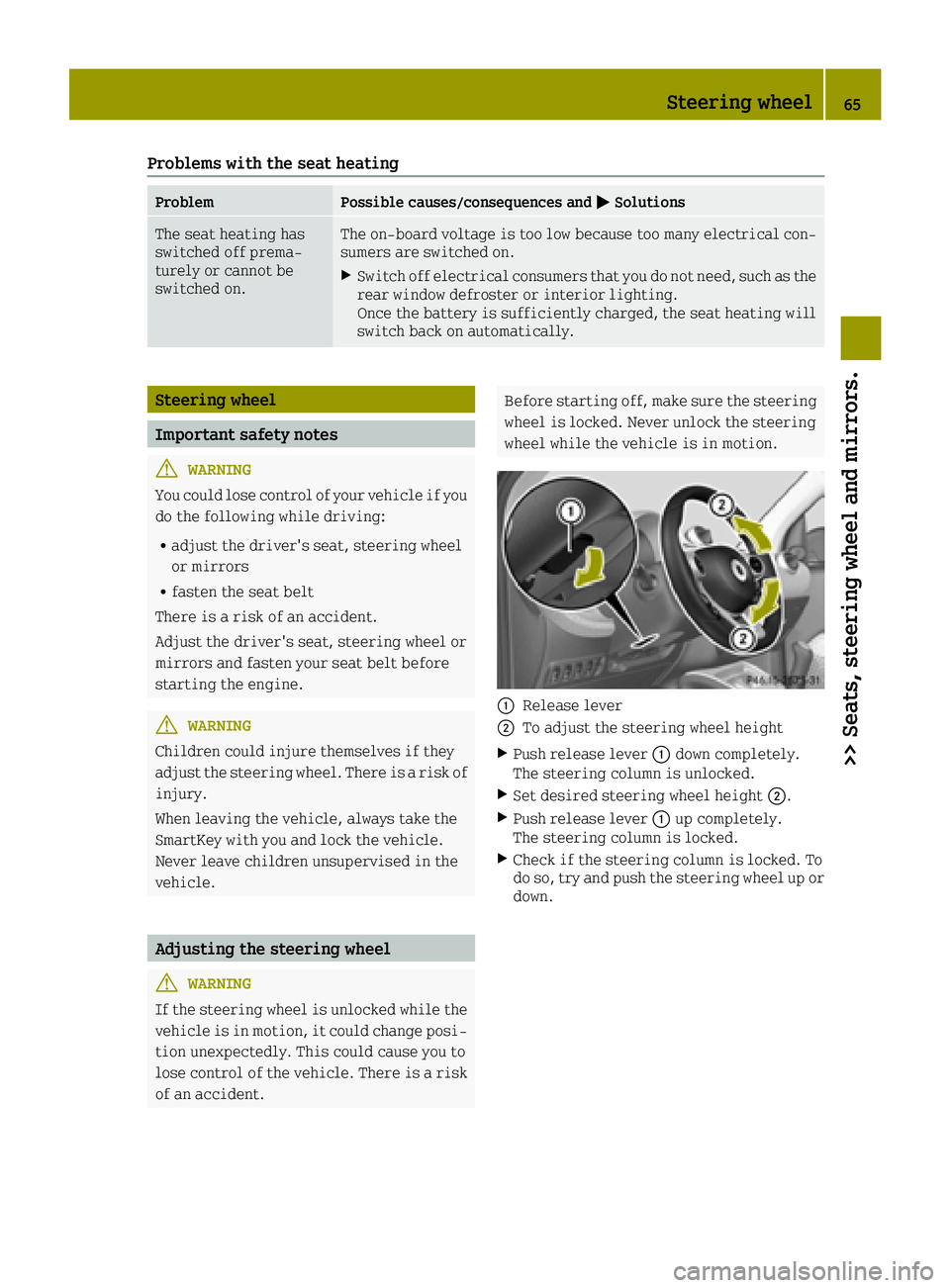
0043Release lever
0044To adjust the steering wheel height
XPush release lever 0043down completely.
The steering column is unlocked.
XSet desired steering wheel height 0044.
XPush release lever0043up completely.
The steering column is locked.
XCheck if the steering column is locked. To
do so, try and push the steering wheel up or down.
Steering wheel65
>> Seats, steering wheel and mirrors.
Z
Page 68 of 214
Mirrors
Rear-view mirror
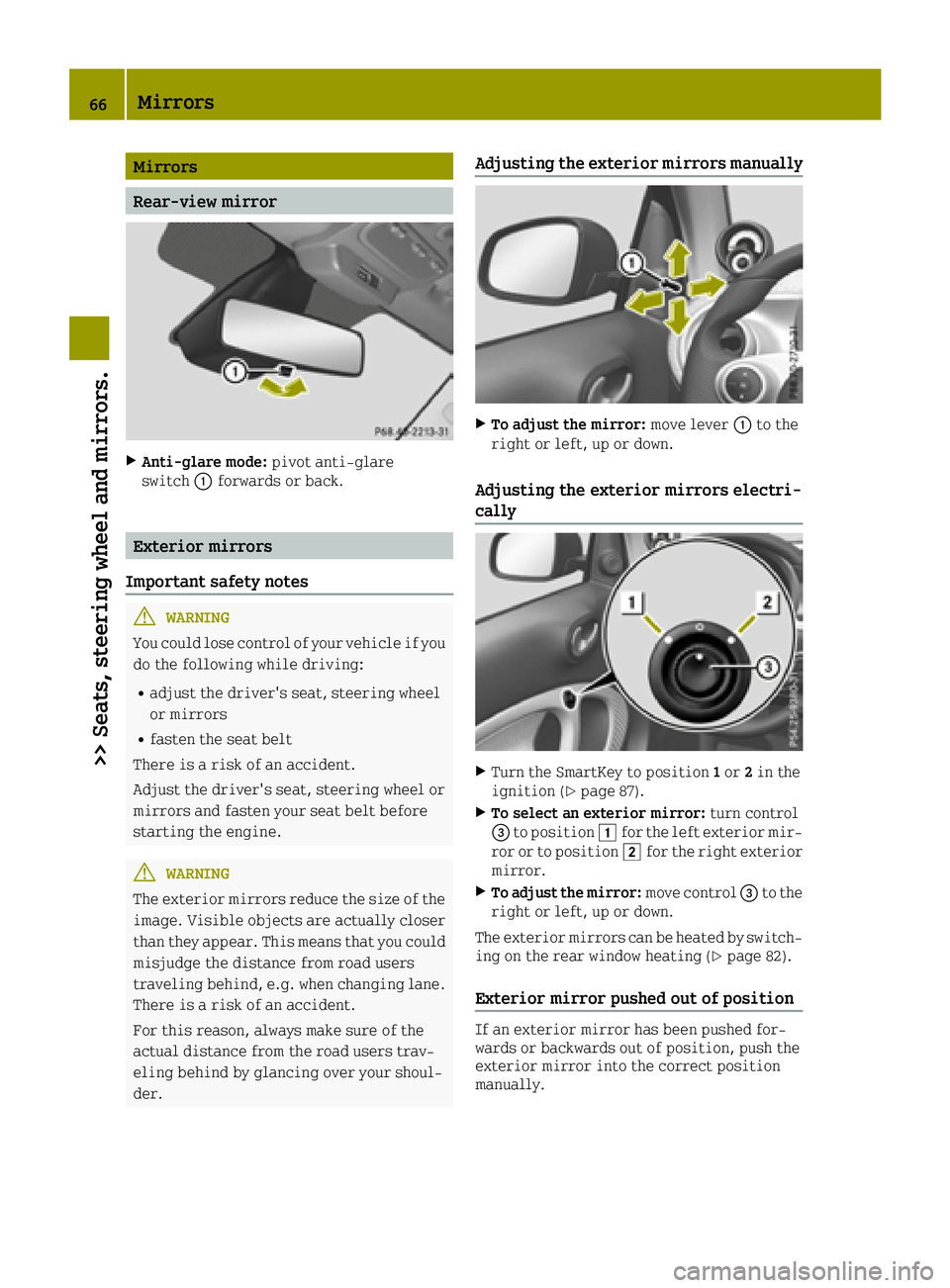
XAnti-glare mode:pivot anti-glare
switch 0043forwards or back.
Exterior mirrors
Important safety notes
GWARNING
You could lose control of your vehicle if you
do the following while driving:
Radjust the driver's seat, steering wheel
or mirrors
Rfasten the seat belt
There is a risk of an accident.
Adjust the driver's seat, steering wheel or
mirrors and fasten your seat belt before
starting the engine.
GWARNING
The exterior mirrors reduce the size of the
image. Visible objects are actually closer
than they appear. This means that you could
misjudge the distance from road users
traveling behind, e.g. when changing lane.
There is a risk of an accident.
For this reason, always make sure of the
actual distance from the road users trav-
eling behind by glancing over your shoul-
der.
Adjusting the exterior mirrors manually
XTo adjust the mirror: move lever0043to the
right or left, up or down.
Adjusting the exterior mirrors electri-
cally
XTurn the SmartKey to position 1or 2in the
ignition (Ypage 87).
XTo select an exterior mirror: turn control
0087 to position 0047for the left exterior mir-
ror or to position 0048for the right exterior
mirror.
XTo adjust the mirror: move control0087to the
right or left, up or down.
The exterior mirrors can be heated by switch- ing on the rear window heating (
Ypage 82).
Exterior mirror pushed out of position
If an exterior mirror has been pushed for-
wards or backwards out of position, push the
exterior mirror into the correct position
manually.
66Mirrors
>> Seats, steering wheel and mirrors.
Page 69 of 214
Useful information
i
This Operator's Manual describes all
models and all standard and optional
equipment of your vehicle available at the
time of publication of the Operator's Man- ual. Country-specific differences are pos-
sible. Bear in mind that your vehicle may
not feature all functions described here.
This also applies to safety-relevant sys-
tems and functions.
iRead the information on qualified spe-
cialist workshops: (Ypage 20).
Exterior lighting
General notes
For reasons of safety, smart recommends that
you drive with the lights switched on even
during the daytime. In some countries, oper-
ation of the headlamps varies due to legal
requirements and self-imposed obligations.
Exterior lighting settings
Operation
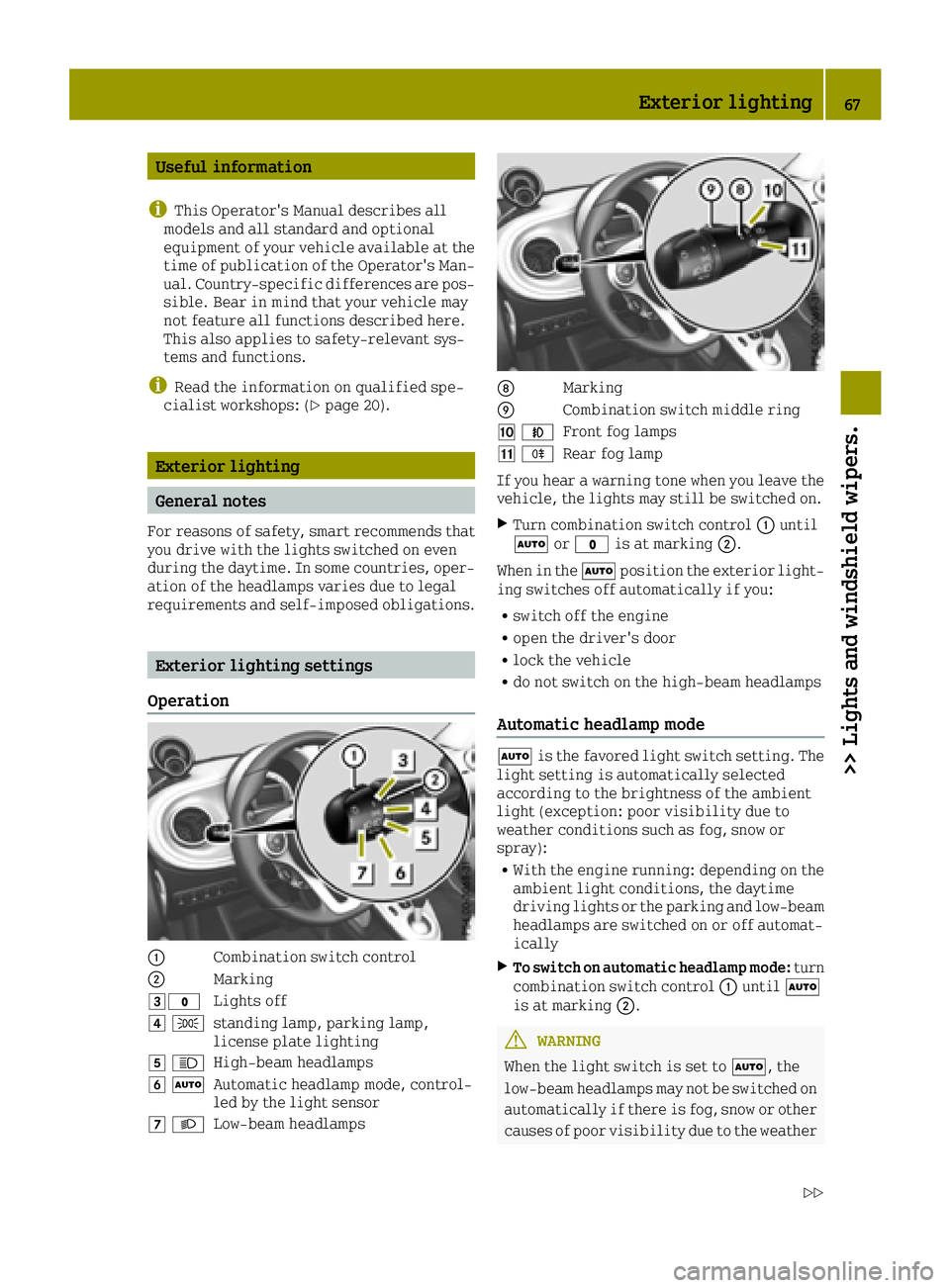
0043Combination switch control
0044Marking
0049003FLights off
004A 0060standing lamp, parking lamp,
license plate lighting
004B0057High-beam headlamps
004C0058Automatic headlamp mode, control-
led by the light sensor
004D0058Low-beam headlamps
006CMarking
006DCombination switch middle ring
00BE005AFront fog lamps
00BF005ERear fog lamp
If you hear a warning tone when you leave the
vehicle, the lights may still be switched on.
XTurn combination switch control 0043until
0058 or003F is at marking 0044.
When in the 0058position the exterior light-
ing switches off automatically if you:
Rswitch off the engine
Ropen the driver's door
Rlock the vehicle
Rdo not switch on the high-beam headlamps
Automatic headlamp mode
0058 is the favored light switch setting. The
light setting is automatically selected
according to the brightness of the ambient
light (exception: poor visibility due to
weather conditions such as fog, snow or
spray):
RWith the engine running: depending on the ambient light conditions, the daytime
driving lights or the parking and low-beam
headlamps are switched on or off automat-
ically
XTo switch on automatic headlamp mode: turn
combination switch control 0043until 0058
is at marking 0044.
GWARNING
When the light switch is set to 0058, the
low-beam headlamps may not be switched on
automatically if there is fog, snow or other causes of poor visibility due to the weather
Exterior lighting67
>> Lights and windshield wipers.
Z
Page 71 of 214
Switching on the high-beam headlamps
and headlamp flasher
High-beam headlamps
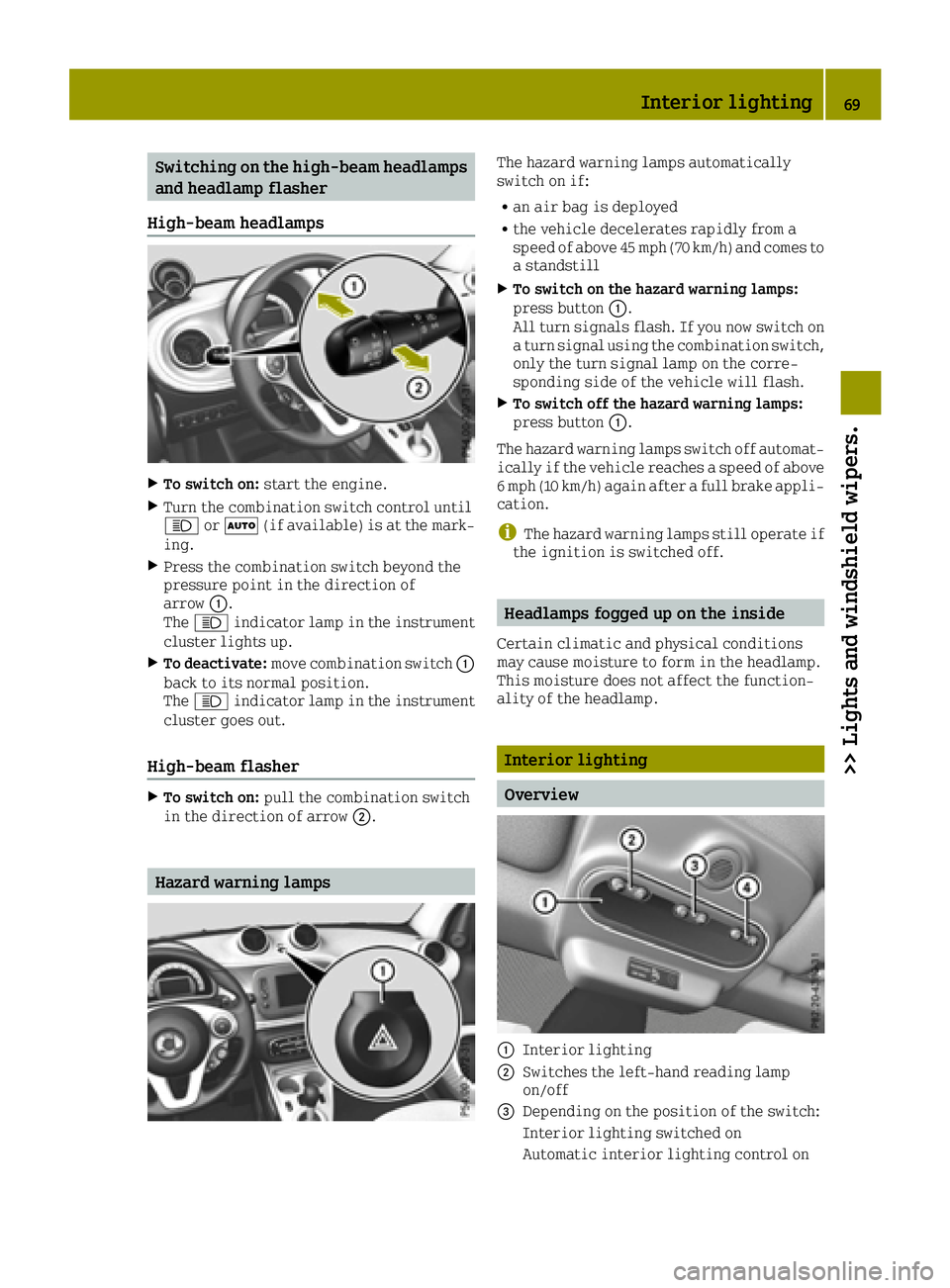
XTo switch on: start the engine.
XTurn the combination switch control until
0057or0058 (if available) is at the mark-
ing.
XPress the combination switch beyond the
pressure point in the direction of
arrow 0043.
The 0057 indicator lamp in the instrument
cluster lights up.
XTo deactivate: move combination switch 0043
back to its normal position.
The 0057 indicator lamp in the instrument
cluster goes out.
High-beam flasher
XTo switch on: pull the combination switch
in the direction of arrow 0044.
Hazard warning lamps
The hazard warning lamps automatically
switch on if:
Ran air bag is deployed
Rthe vehicle decelerates rapidly from a
speed of above 45 mph (70 km/h) and comes to
a standstill
XTo switch on the hazard warning lamps:
press button0043.
All turn signals flash. If you now switch on
a turn signal using the combination switch,
only the turn signal lamp on the corre-
sponding side of the vehicle will flash.
XTo switch off the hazard warning lamps:
press button 0043.
The hazard warning lamps switch off automat- ically if the vehicle reaches a speed of above
6 mph (10 km/h) again after a full brake appli-
cation.
iThe hazard warning lamps still operate if
the ignition is switched off.
Headlamps fogged up on the inside
Certain climatic and physical conditions
may cause moisture to form in the headlamp.
This moisture does not affect the function-
ality of the headlamp.
Interior lighting
Overview
0043Interior lighting
0044Switches the left-hand reading lamp
on/off
0087Depending on the position of the switch:
Interior lighting switched on
Automatic interior lighting control on
Interior lighting69
>> Lights and windshield wipers.
Z
Page 72 of 214
Interior lighting switched off
0085Switches the right-hand reading lamp on/
off
The interior lighting is switched on when a
door is open: if the corresponding door is
closed correctly the interior lighting goes
out.
Interior lighting control
If the doors are unlocked with the remote con-
trol, the interval timer for the interior
lighting is triggered. The interval timer
restarts when a door is opened.
The front interior lighting and the luggage
compartment light go out gradually.
The interior lighting interval timer is
switched off:
Rif a door remains open, the interior light-
ing switches off after 15 minutes without
dimming
Rif all doors (with additional locking mech-
anism) are closed, the interior lighting
switches off after 15 seconds
Rif all doors (without locking mechanism)
are closed, the interior lighting switches
off after 3 to 4 minutes
Ras soon as the engine is started and for as
long as the engine is running
Replacing bulbs
Important safety notes
GWARNING
Bulbs, lamps and connectors can get very
hot when operating. If you change a bulb,
you could burn yourself on these compo-
nents. There is a risk of injury.
Allow these components to cool down before changing a bulb.
Do not use a bulb that has been dropped or if
its glass tube has been scratched.
The bulb may explode if:
Ryou touch it
Rit is hot
Ryou drop it
Ryou scratch it
Only operate bulbs in enclosed lamps
designed for that purpose. Only fit spare
bulbs of the same type and the specified volt-
age.
Marks on the glass tube reduce the service
life of the bulbs. Do not touch the glass tube
with your bare hands. If necessary, clean the
glass tube when cold with alcohol or spirit
and rub it off with a lint-free cloth.
Protect bulbs from moisture during opera-
tion. Do not allow bulbs to come into contact
with liquids.
Replace only the bulbs listed (
Ypage 70).
If you require assistance replacing bulbs,
consult a qualified specialist workshop.
If the new bulb still does not light up, consult
a qualified specialist workshop.
The daytime driving lights and part of the
rear light clusters of your vehicle are equip-
ped with LED light bulbs. Do not replace these
bulbs yourself. Contact a qualified special-
ist workshop which has the necessary spe-
cialist knowledge and tools to carry out the
work required.
Headlamps and lamps are an important aspect
of vehicle safety. You must therefore make
sure that these function correctly at all
times. Have the headlamp setting checked
regularly.
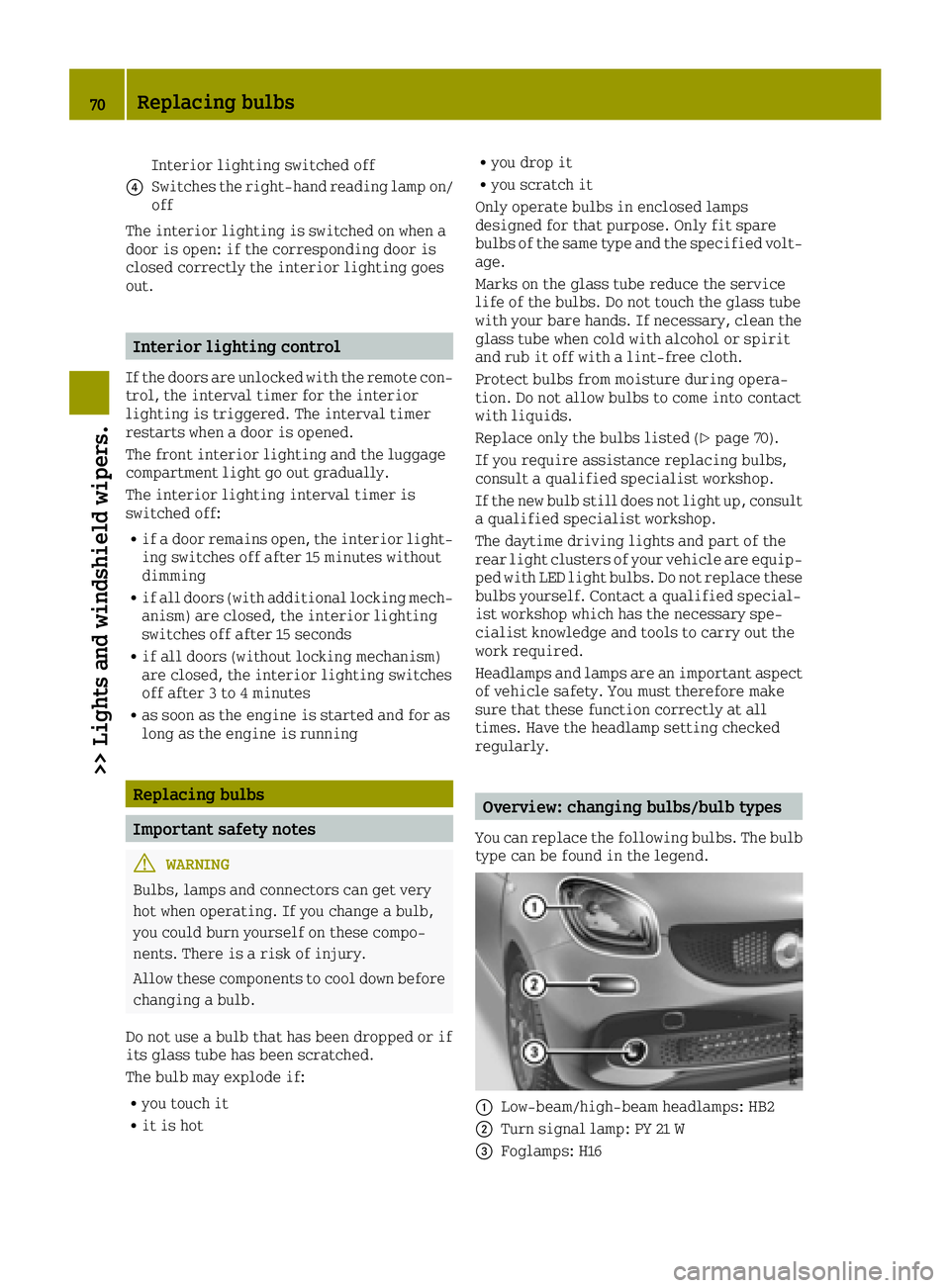
Overview: changing bulbs/bulb types
You can replace the following bulbs. The bulb
type can be found in the legend.
0043Low-beam/high-beam headlamps: HB2
0044Turn signal lamp: PY 21 W
0087Foglamps: H16
70Replacing bulbs
>> Lights and windshield wipers.
Page 73 of 214
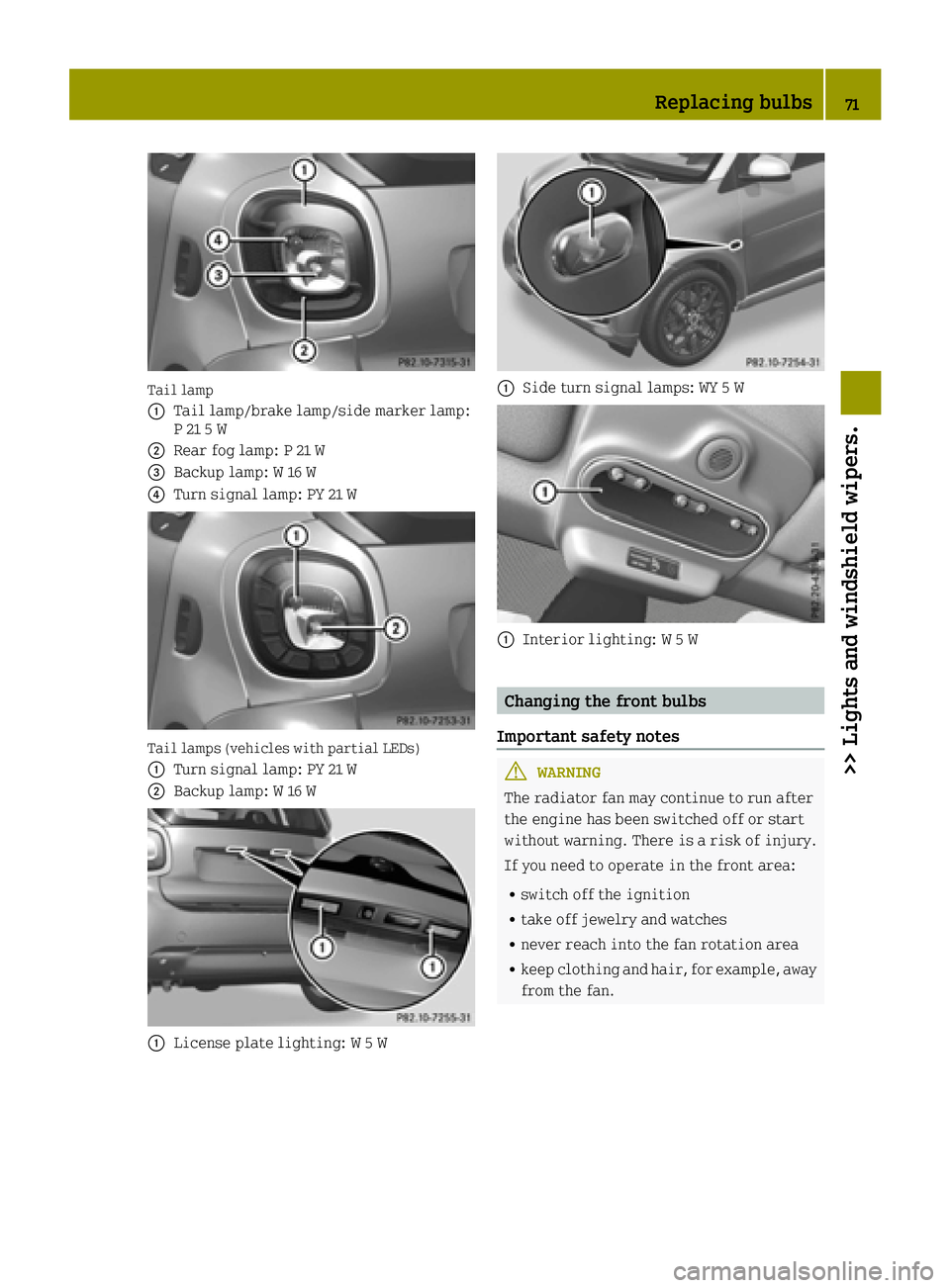
Tail lamp
0043
Tail lamp/brake lamp/side marker lamp:
P 21 5 W
0044Rear fog lamp: P 21 W
0087Backup lamp: W 16 W
0085Turn signal lamp: PY 21 W
Tail lamps (vehicles with partial LEDs)
0043
Turn signal lamp: PY 21 W
0044Backup lamp: W 16 W
0043License plate lighting: W 5 W
0043Side turn signal lamps: WY 5 W
0043Interior lighting: W 5 W
Changing the front bulbs
Important safety notes
GWARNING
The radiator fan may continue to run after
the engine has been switched off or start
without warning. There is a risk of injury.
If you need to operate in the front area:
Rswitch off the ignition
Rtake off jewelry and watches
Rnever reach into the fan rotation area
Rkeep clothing and hair, for example, away
from the fan.
Replacing bulbs71
>> Lights and windshield wipers.
Z
Page 77 of 214
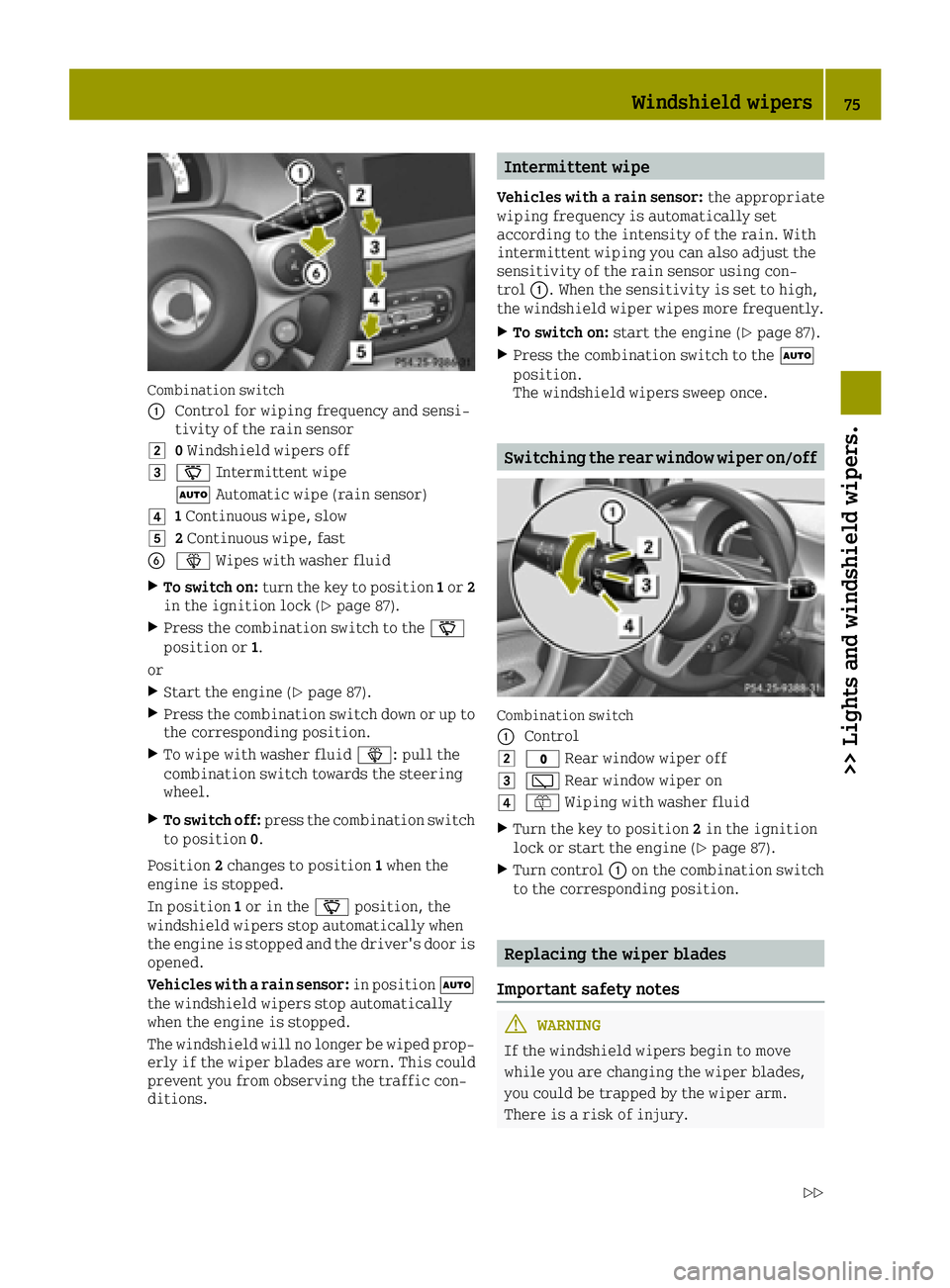
Combination switch
0043
Control for wiping frequency and sensi-
tivity of the rain sensor
00480Windshield wipers off
004900AE Intermittent wipe
0058 Automatic wipe (rain sensor)
004A1Continuous wipe, slow
004B2 Continuous wipe, fast
008400D4 Wipes with washer fluid
XTo switch on: turn the key to position 1or 2
in the ignition lock (Ypage 87).
XPress the combination switch to the 00AE
position or 1.
or
XStart the engine (Ypage 87).
XPress the combination switch down or up to
the corresponding position.
XTo wipe with washer fluid 00D4: pull the
combination switch towards the steering
wheel.
XTo switch off: press the combination switch
to position 0.
Position 2changes to position 1when the
engine is stopped.
In position 1or in the 00AEposition, the
windshield wipers stop automatically when
the engine is stopped and the driver's door is
opened.
Vehicles with a rain sensor: in position0058
the windshield wipers stop automatically
when the engine is stopped.
The windshield will no longer be wiped prop- erly if the wiper blades are worn. This could
prevent you from observing the traffic con-
ditions.
Intermittent wipe
Vehicles with a rain sensor: the appropriate
wiping frequency is automatically set
according to the intensity of the rain. With
intermittent wiping you can also adjust the
sensitivity of the rain sensor using con-
trol 0043. When the sensitivity is set to high,
the windshield wiper wipes more frequently.
XTo switch on: start the engine (Ypage 87).
XPress the combination switch to the 0058
position.
The windshield wipers sweep once.
Switching the rear window wiper on/off
Combination switch
0043
Control
0048003F Rear window wiper off
004900C5Rear window wiper on
004A00E2Wiping with washer fluid
XTurn the key to position 2in the ignition
lock or start the engine (Ypage 87).
XTurn control 0043on the combination switch
to the corresponding position.
Replacing the wiper blades
Important safety notes
GWARNING
If the windshield wipers begin to move
while you are changing the wiper blades,
you could be trapped by the wiper arm.
There is a risk of injury.
Windshield wipers75
>> Lights and windshield wipers.
Z
Page 86 of 214

Problems with the rear window defroster
ProblemPossible causes/consequences and0050Solutions
The rear window
defroster has deacti-
vated prematurely or
cannot be activated.The battery has not been sufficiently charged.
XSwitch off any consumers that are not required, e.g. reading
lamps, interior lighting or the seat heating.
When the battery is sufficiently charged, the rear window
defroster can be activated again.
Switching the air-recirculation mode
on/off
General notes
You can deactivate the flow of fresh air tem-
porarily if unpleasant odors are entering the
vehicle from outside or if you are driving
through a tunnel. The air already inside the
vehicle will then be recirculated.
If you switch on air-recirculation mode, the
windows can fog up more quickly, in partic-
ular at low temperatures. Only use air-recir-
culation mode briefly to prevent the windows
from fogging up.
Switching on/off
XStart the engine (Ypage 87).
XTo activate: press theÀbutton.
The indicator lamp above the Àbutton
lights up.
XTo deactivate: press theÀbutton.
or
XPress the 0064button.
or
XPress the 0058button.
The indicator lamp above the Àbutton
goes out.
Setting the air vents
Important safety notes
GWARNING
Very hot or very cold air can flow from the
air vents. This could result in burns or
frostbite in the immediate vicinity of the
air vents. There is a risk of injury.
Make sure that all vehicle occupants always
maintain a sufficient distance to the air
outlets. If necessary, redirect the airflow
to another area of the vehicle interior.
GWARNING
If you spray cleaning products or disin-
fectant into the ventilation system of the
vehicle, this could ignite. There is a risk
of fire.
Never spray these or any other substances
into the ventilation system. Always have
work on the ventilation system carried out
at a qualified specialist workshop.
In order to ensure the direct flow of fresh air
through the air vents into the vehicle inte-
rior, please observe the following notes:
Rkeep the air inlet between the service
cover and the windshield free of blockages,
such as ice, snow or leaves.
Rnever cover the air vents or air intake
grilles in the vehicle interior.
iFor optimum climate control in the vehi-
cle, open the air vents fully.
84Setting the air vents
>> Climate control.
Page 88 of 214
Useful information
i
This Operator's Manual describes all
models and all standard and optional
equipment of your vehicle available at the
time of publication of the Operator's Man- ual. Country-specific differences are pos-
sible. Bear in mind that your vehicle may
not feature all functions described here.
This also applies to safety-relevant sys-
tems and functions.
iRead the information on qualified spe-
cialist workshops: (Ypage 20).
Notes on breaking-in a new vehicle
Important safety notes
In certain driving and driving safety sys-
tems, the sensors adjust automatically while
a certain distance is being driven after the
vehicle has been delivered or after repairs.
Full system effectiveness is not reached until
the end of this teach-in procedure.
New and replaced brake pads and discs only
reach their optimum braking effect after sev-
eral hundred kilometers of driving. Compen-
sate for this by applying greater force to the brake pedal.
The first 1000 miles (1500 km)
The more you look after the engine when it is
new, the more satisfied you will be with its
performance in the future.
RYou should therefore drive at varying vehi-
cle and engine speeds for the first
1000 miles (1500 km).
RAvoid heavy loads, e.g. driving at full
throttle, during this period.
RChange gear in good time, before the tach-ometer needle is 00C3of the way to the red
area of the tachometer.
RDo not manually shift to a lower gear to
brake the vehicle.
RVehicles with automatic transmission: if
possible, do not depress the accelerator pedal beyond the pressure point (kick-
down).
RVehicles with automatic transmission:
ideally, for the first 1000 miles(1500 km),
drive in program
E(Comfort).
After 1000 miles (1500 km), you can increase
the engine speed gradually and bring the
vehicle to full speed.
You should also observe these notes on run-
ning-in if the engine or parts of the drive
train on your vehicle have been replaced.
Observe the maximum permissible speed.
Driving
Important safety notes
GWARNING
Objects in the driver's footwell can
restrict the pedal travel or obstruct a
depressed pedal. The operating and road
safety of the vehicle is jeopardized. There
is a risk of an accident.
Make sure that all objects in the vehicle are
stowed correctly, and that they cannot enter
the driver's footwell. Install the floormats securely and as specified in order to
ensure sufficient clearance for the pedals.
Do not use loose floormats and do not place
floormats on top of one another.
GWARNING
Unsuitable footwear can hinder correct
usage of the pedals, e.g.:
Rshoes with thick soles
Rshoes with high heels
Rslippers
There is a risk of an accident.
Wear suitable footwear to ensure correct
usage of the pedals.
GWARNING
If you switch off the ignition while driv-
ing, safety-relevant functions are only
available with limitations, or not at all.
This could affect, for example, the power
86Driving
>> Driving and parking.
Page 89 of 214
steering and the brake boosting effect. Youwill require considerably more effort to
steer and brake. There is a risk of an acci-
dent.
Do not switch off the ignition while driv-
ing.
GWARNING
If the parking brake has not been fully
released when driving, the parking brake
can:
Roverheat and cause a fire
Rlose its hold function.
There is a risk of fire and an accident.
Release the parking brake fully before
driving off.
!Do not warm up the engine with the vehicle
stationary. Drive off immediately. Avoid
high engine speeds and driving at full
throttle until the engine has reached its
operating temperature.
Only shift the automatic transmission to
the desired drive position when the vehi-
cle is stationary.
Where possible, avoid spinning the drive
wheels when pulling away on slippery
roads. You could otherwise damage the
drive train.
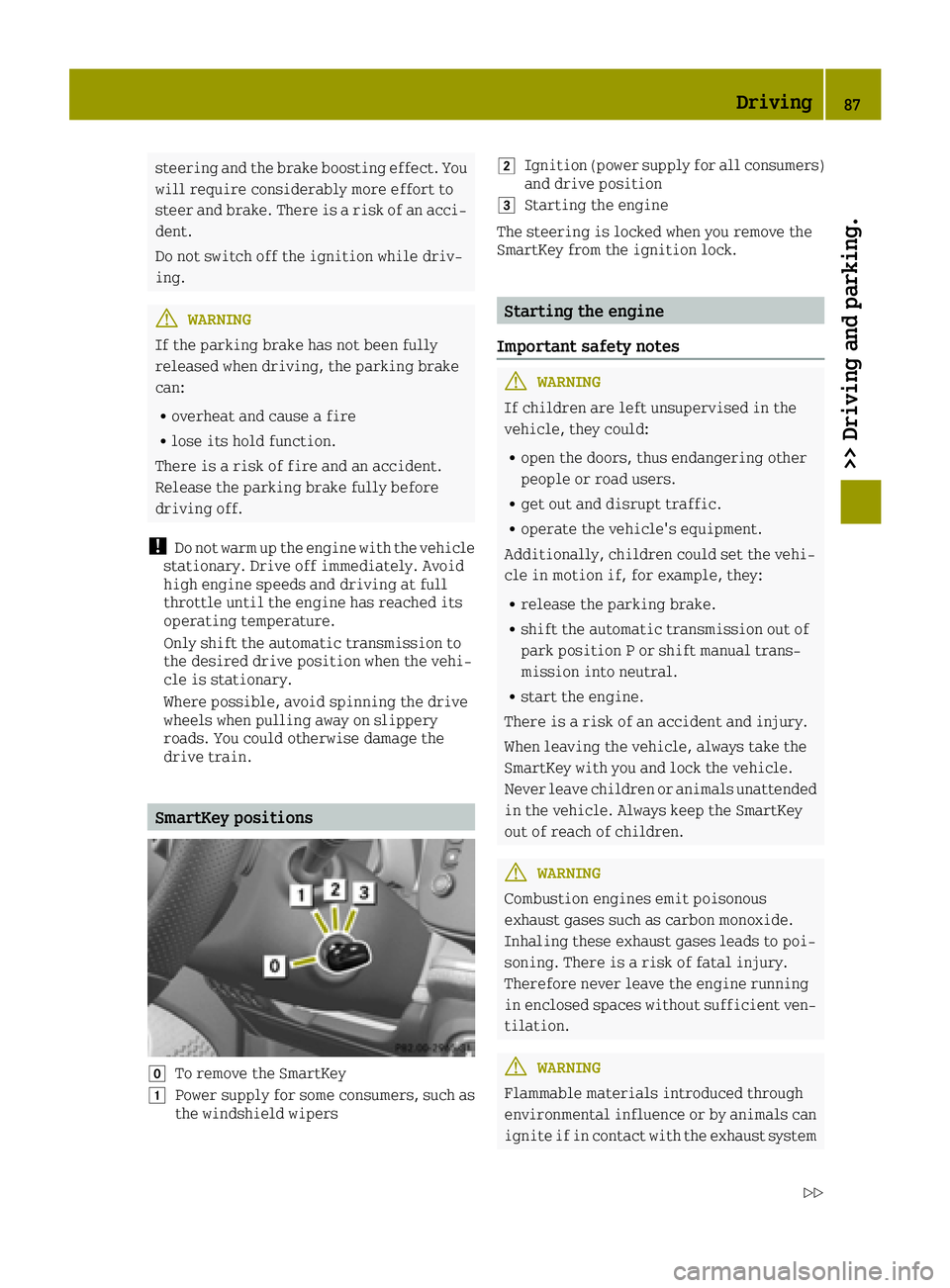
SmartKey positions
005ATo remove the SmartKey
0047Power supply for some consumers, such as
the windshield wipers
0048Ignition (power supply for all consumers)
and drive position
0049Starting the engine
The steering is locked when you remove the
SmartKey from the ignition lock.
Starting the engine
Important safety notes
GWARNING
If children are left unsupervised in the
vehicle, they could:
Ropen the doors, thus endangering other
people or road users.
Rget out and disrupt traffic.
Roperate the vehicle's equipment.
Additionally, children could set the vehi-
cle in motion if, for example, they:
Rrelease the parking brake.
Rshift the automatic transmission out of
park position P or shift manual trans-
mission into neutral.
Rstart the engine.
There is a risk of an accident and injury.
When leaving the vehicle, always take the
SmartKey with you and lock the vehicle.
Never leave children or animals unattended
in the vehicle. Always keep the SmartKey
out of reach of children.
GWARNING
Combustion engines emit poisonous
exhaust gases such as carbon monoxide.
Inhaling these exhaust gases leads to poi-
soning. There is a risk of fatal injury.
Therefore never leave the engine running
in enclosed spaces without sufficient ven- tilation.
GWARNING
Flammable materials introduced through
environmental influence or by animals can
ignite if in contact with the exhaust system
Driving87
>> Driving and parking.
Z