lock SMART FORTWO COUPE 2010 Repair Manual
[x] Cancel search | Manufacturer: SMART, Model Year: 2010, Model line: FORTWO COUPE, Model: SMART FORTWO COUPE 2010Pages: 216, PDF Size: 9.7 MB
Page 179 of 216
adversely affect handling and fuel
economy, and are more likely to fail from
being overheated.
Do not overinflate tires. Overinflated
tires can adversely affect handling and
ride comfort, wear unevenly, increase
stopping distance, and result in sudden
deflation (blowout) because they are more
likely to become punctured or damaged by
road debris, potholes etc.
Do not overload the tires by exceeding the
specified load limit as indicated on the
Tire and Loading Information placard on
the driver’s door B‑pillar. Overloading the
tires can overheat them, possibly causing
a blowout. Overloading the tires can also
result in handling or steering problems, or
brake failure.XDrive to the nearest authorized smart
center, to have the damaged tire
replaced.XContact an authorized smart center as
soon as possible to obtain a new filler
hose and a new tire sealant container.XBring used tire sealant materials to an
authorized smart center for proper
disposal.XReplace your tire sealant container
every 4 years. Replacement containers
are available at any authorized smart
center.GWarning!
After changing a tire, contact a smart
center to make sure the bolts holding the
wheel to the car are tight enough.
Otherwise, the wheels could come off. Each
bolt should be tightened to a torque of
81 lb‑ft (110 Nm).
Wheel change
Preparing the vehicle
XPark the vehicle on a hard, flat surface
when possible.XTurn on the hazard warning flasher.XTurn the steering wheel so that the front
wheels are in a straight-ahead position.XEngage the parking brake.XMove the gear selector lever to park
position P.XTurn off the engine.XHave any passenger exit the vehicle at a
safe distance from the roadway.
Removing the wheel
GWarning!
When jacking up the vehicle, only use a
suitable jack. Observe the manufacturer’s
safety instructions.
The jack must be designed for jacking up
this vehicle at the jack take-up brackets
built into both sides of the vehicle.
The jack is intended only for lifting the
vehicle briefly for wheel changes. It is not
suited for performing maintenance work
under the vehicle. To help avoid personal
injury, use the jack only to lift the vehicle
during a wheel change.
Never get beneath the vehicle while it is
supported by the jack. Keep hands and feet
away from the area under the lifted vehicle.
Always lower the vehicle onto sufficient
capacity jackstands before working under
the vehicle.
Always firmly engage the parking brake and
block the wheels with wheel chocks or other
sizeable objects before raising the
vehicle with the jack. Do not release the
parking brake while the vehicle is raised.
Make sure the ground on which the vehicle
is standing and where you place the jack is
Wheel change177>> Practical hints.451_AKB; 3; 22, en-USd2ureepe,Version: 2.11.8.12009-07-27T09:36:34+02:00 - Seite 177Z
Page 180 of 216
solid, level and not slippery. If necessary,
use a large underlay. On slippery surfaces,
such as tiled floors, you should use a non-
slip underlay, for example a rubber mat.
Do not use wooden blocks or similar objects
to support the jack. Otherwise the jack may
not be able to achieve its load-bearing
capacity if it is not at its full height.
The jack must always be vertical when in
use. Always try to use the jack on level
surface. If you do not position the jack
correctly, the vehicle can fall off the jack
and seriously or fatally injure you or
others.
Never start the engine when the vehicle is
raised.
Also observe the notes on the jack.XMake sure to have a suitable jack 17
, wheel
wrench 17
and wheel chock 17
.
Contact an authorized smart center for
information on which jack and wheel
wrench are required.XPrepare the vehicle as described
( Y page 177).XMake sure the surface is level.
Prevent the vehicle from rolling away by
blocking wheels with wheel chocks or other
sizeable objects:
XPlace one wheel chock or other sizeable
object in front of and another wheel
chock or other sizeable object behind
the wheel that is diagonally opposite to
the wheel being changed.
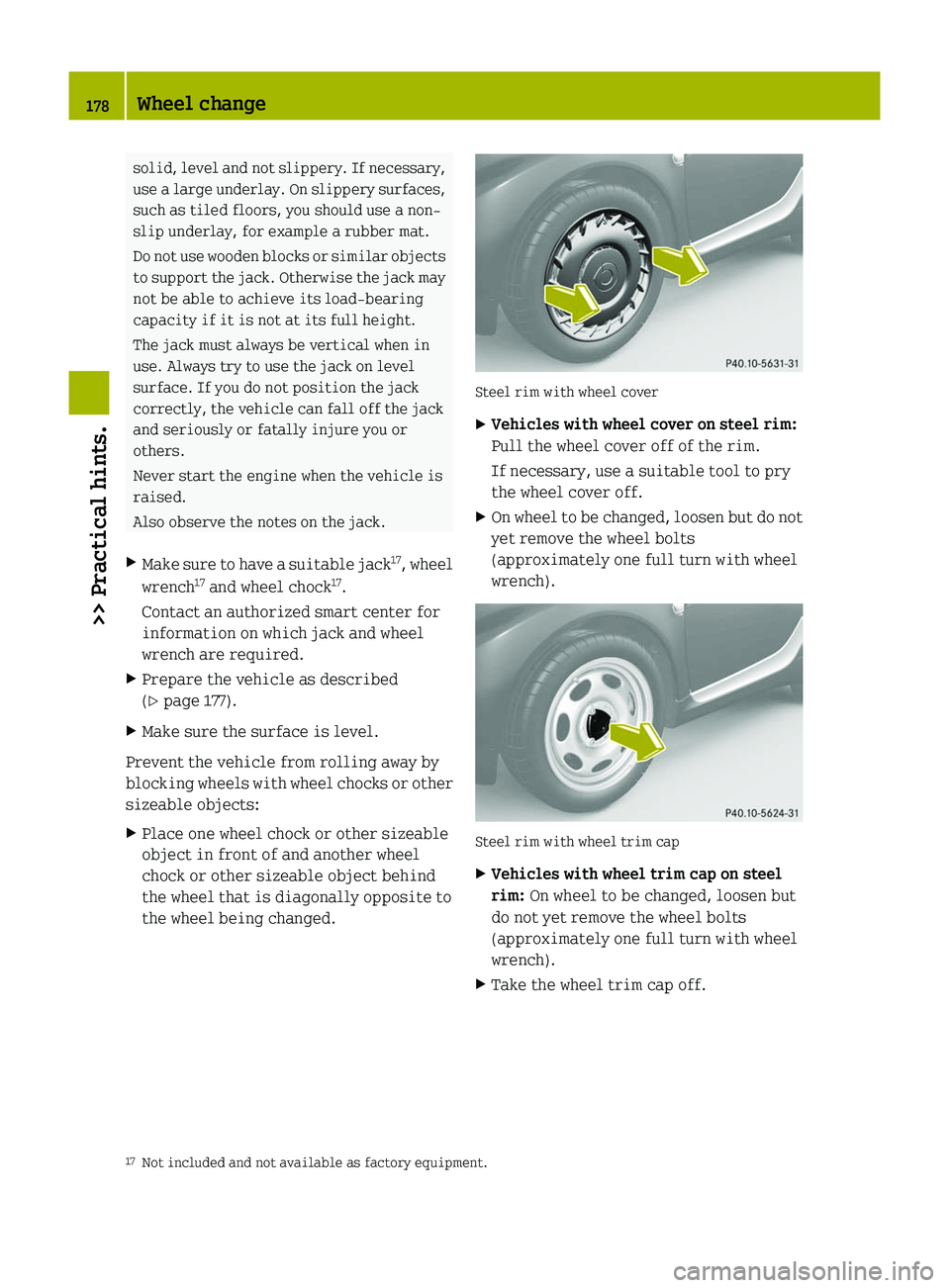
Steel rim with wheel cover
XVehicles with wheel cover on steel rim:
Pull the wheel cover off of the rim.
If necessary, use a suitable tool to pry
the wheel cover off.XOn wheel to be changed, loosen but do not
yet remove the wheel bolts
(approximately one full turn with wheel
wrench).
Steel rim with wheel trim cap
XVehicles with wheel trim cap on steel
rim: On wheel to be changed, loosen but
do not yet remove the wheel bolts
(approximately one full turn with wheel
wrench).XTake the wheel trim cap off.17 Not included and not available as factory equipment.178Wheel change>> Practical hints.
451_AKB; 3; 22, en-USd2ureepe,Version: 2.11.8.12009-07-27T09:36:34+02:00 - Seite 178
Page 184 of 216
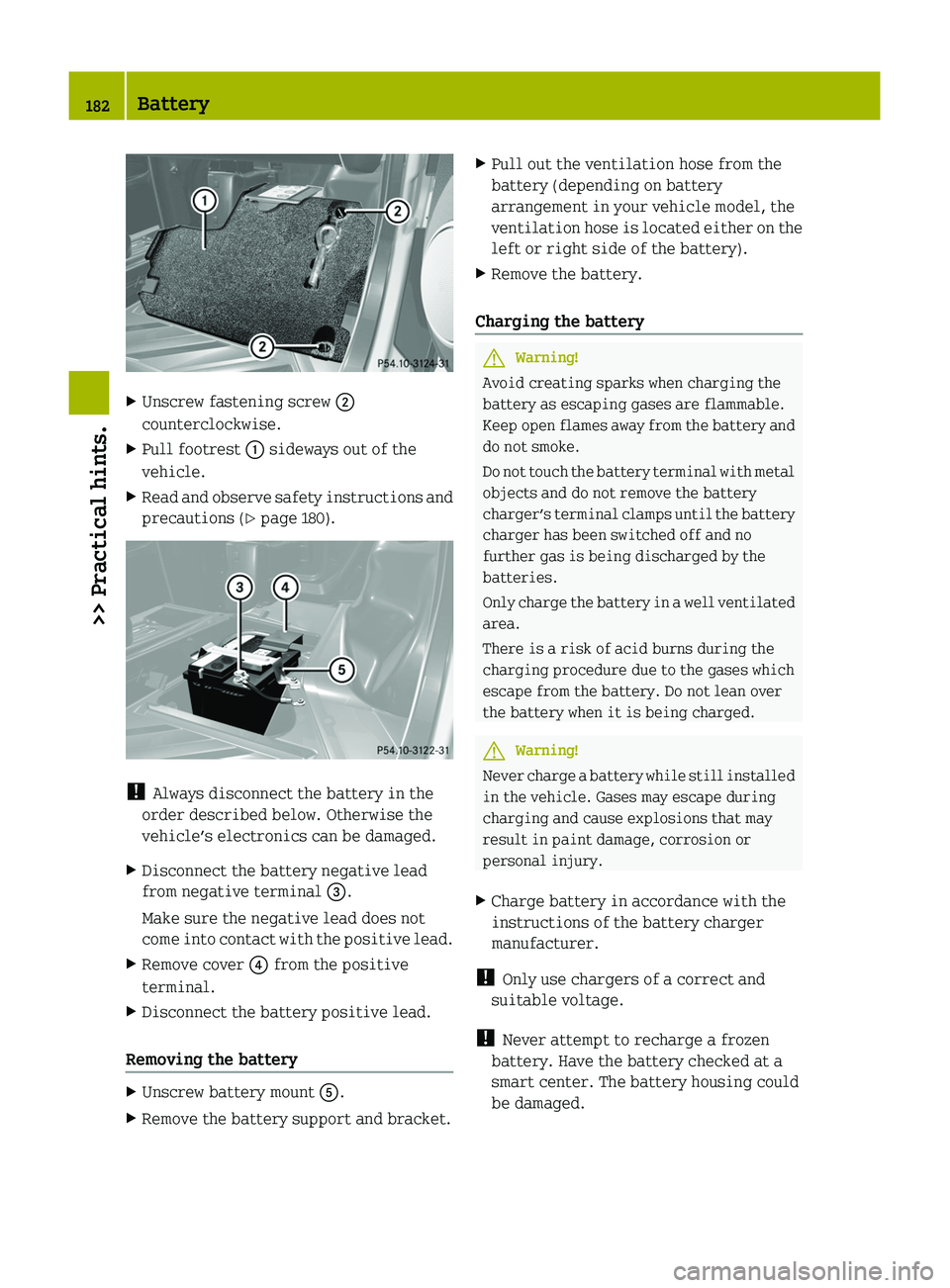
XUnscrew fastening screw 0047
counterclockwise.XPull footrest 0046 sideways out of the
vehicle.XRead and observe safety instructions and
precautions ( Y page 180).
!
Always disconnect the battery in the
order described below. Otherwise the
vehicle’s electronics can be damaged.
XDisconnect the battery negative lead
from negative terminal 008A.
Make sure the negative lead does not
come into contact with the positive lead.XRemove cover 0088 from the positive
terminal.XDisconnect the battery positive lead.
Removing the battery
XUnscrew battery mount 0086.XRemove the battery support and bracket.XPull out the ventilation hose from the
battery (depending on battery
arrangement in your vehicle model, the
ventilation hose is located either on the
left or right side of the battery).XRemove the battery.
Charging the battery
GWarning!
Avoid creating sparks when charging the
battery as escaping gases are flammable.
Keep open flames away from the battery and
do not smoke.
Do not touch the battery terminal with metal
objects and do not remove the battery
charger’s terminal clamps until the battery
charger has been switched off and no
further gas is being discharged by the
batteries.
Only charge the battery in a well ventilated
area.
There is a risk of acid burns during the
charging procedure due to the gases which
escape from the battery. Do not lean over
the battery when it is being charged.
GWarning!
Never charge a battery while still installed
in the vehicle. Gases may escape during
charging and cause explosions that may
result in paint damage, corrosion or
personal injury.
XCharge battery in accordance with the
instructions of the battery charger
manufacturer.
! Only use chargers of a correct and
suitable voltage.
! Never attempt to recharge a frozen
battery. Have the battery checked at a
smart center. The battery housing could
be damaged.
182Battery>> Practical hints.
451_AKB; 3; 22, en-USd2ureepe,Version: 2.11.8.12009-07-27T09:36:34+02:00 - Seite 182
Page 185 of 216
Reinstalling the batteryXReinstall the charged battery. Follow the
previously described steps in reverse
order.
! The battery, its filler caps and the
ventilation hose must always be securely
installed when the vehicle is in
operation.
Reconnecting the battery
! Always connect the battery in the order
described below. Otherwise the
vehicle’s electronics can be damaged.
XTurn off all electrical accessories.XRemove the key from the starter switch.
! Never invert the terminal connections!
XConnect the battery positive lead and
fasten cover 0088 (Y page 182).XConnect battery negative lead 008A
( Y page 182).
i
After battery power (e.g. due to
reconnection) was interrupted, you will
have to set the clock ( Y page 86).
i Have the battery’s charge status and
acid level checked at the start of the cold
season at a smart center.
Jump starting
GWarning!
Failure to follow these directions will
cause damage to the electronic components,
and can lead to a battery explosion and
severe injury or death.
Never lean over batteries while connecting
or jump starting, you might get injured.
Battery fluid contains sulfuric acid. Do not
allow this fluid to come in contact with
eyes, skin or clothing. In case it does,
immediately flush affected area with
water, and seek medical help if necessary.
A battery will also produce hydrogen gas,
which is flammable and very explosive.
Keep flames or sparks away from battery,
avoid improper connection of jumper
cables, smoking, etc.
Attempting to jump start a frozen battery
can result in it exploding, causing
personal injury.
Read all instructions before proceeding.
! Do not tow‑start vehicle. You could
otherwise seriously damage the
transmission which is not covered by the
smart Limited Warranty.
! Avoid repeated and lengthy starting
attempts.
Do not attempt to start the engine using
a battery quick charge unit.
If the engine does not run after several
unsuccessful starting attempts, have it
checked at the nearest authorized smart
center.
Excessive unburned fuel generated by
repeated failed starting attempts may
damage the catalytic converter and may
present a fire risk.
Make sure the jumper cables do not have
loose or missing insulation.
Make sure the cable clamps do not touch
any other metal part while the other end
is still attached to a battery.
If the battery is discharged, the engine can
be started with jumper cables and the fully
charged battery of another vehicle or an
equivalent starter pack. Observe the
following:
R Access to the battery is not possible on
all vehicles. If you cannot access the
battery in your vehicle provide jumpJump starting183>> Practical hints.451_AKB; 3; 22, en-USd2ureepe,Version: 2.11.8.12009-07-27T09:36:34+02:00 - Seite 183Z
Page 188 of 216
GWarning!
With the engine not running, there is no
power assistance for the brake and
steering* systems. In this case, it is
important to keep in mind that a
considerably higher degree of effort is
necessary to brake and steer the vehicle.
Adapt your driving accordingly.
! Do not tow the vehicle with the front
axle raised. Doing so may cause serious
damage to the brake system which is not
covered by the smart Limited Warranty.
! Before towing the vehicle observe the
following instructions:
R Do not tow with sling-type equipment
attached to suspension parts. This may
cause damage to the radiator and other
supports if towing on a bumpy road.
R Towing the vehicle should only be done
using the properly installed towing
eye bolt. Never attach a tow cable, tow
rope, or tow rod to the vehicle chassis,
frame, or suspension parts.
! Make sure the ignition is switched off
while towing the vehicle. Doing
otherwise may result in
R the ESP ®
being activated. Active
braking action through the ESP ®
may
seriously damage the brake system
which is not covered by the smart
Limited Warranty.
R a discharged battery.
! Make sure the gear selector lever is in
neutral position N while towing the
vehicle. Doing otherwise may result in
significant transmission damage.
! Towing the vehicle with a luggage
rack* mounted is not permissible. The
vehicle must not be towed by the luggage
rack*.
i If the battery is disconnected or
discharged, the gear selector lever will
remain locked in park position P.
Contact an authorized smart center for
assistance or call Roadside Assistance.
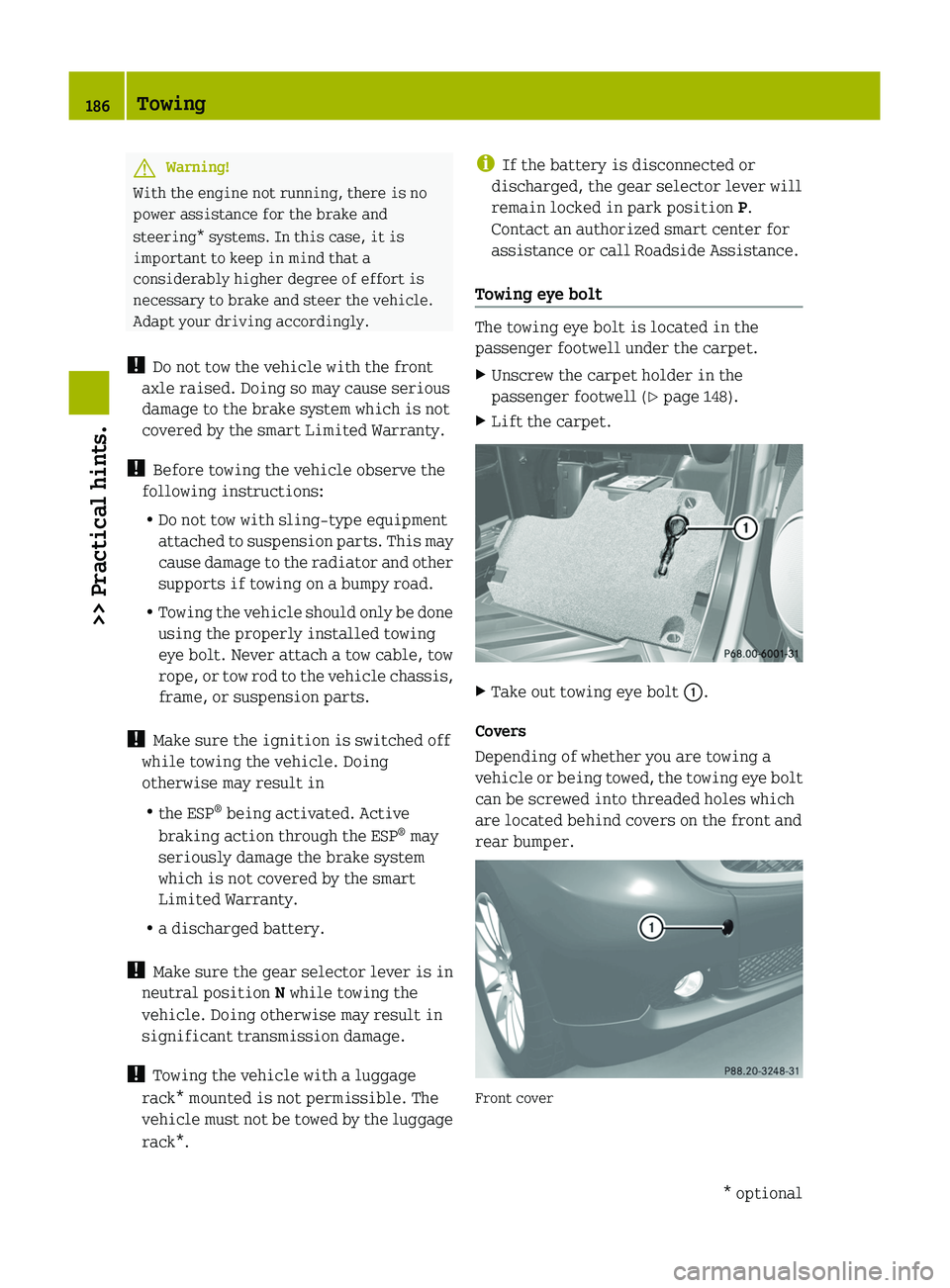
Towing eye bolt
The towing eye bolt is located in the
passenger footwell under the carpet.
XUnscrew the carpet holder in the
passenger footwell ( Y page 148).XLift the carpet.XTake out towing eye bolt 0046.
Covers
Depending of whether you are towing a
vehicle or being towed, the towing eye bolt
can be screwed into threaded holes which
are located behind covers on the front and
rear bumper.
Front cover
186Towing>> Practical hints.* optional451_AKB; 3; 22, en-USd2ureepe,Version: 2.11.8.12009-07-27T09:36:34+02:00 - Seite 186
Page 189 of 216

XRemove cover 0046 using a suitable object
to reveal the threaded hole for the towing
eye bolt.GWarning!
High outside temperature, stop-and-go
traffic, driving on long uphill grades, or
driving at high engine speed may increase
the temperature in the engine
compartment. Therefore the area around the
air slots in the rear apron may be hot. Let
the engine cool off before touching this
area to prevent burns.
Rear cover
XRemove cover 0047 using a suitable object
to reveal the threaded hole for the towing
eye bolt.
Installing towing eye bolt
XScrew towing eye bolt in clockwise to its
stop and tighten with a suitable object.GWarning!
For safety reasons, recovery or lashing
down of the vehicle by means of the towing
eye is not allowed. Failure to observe this
could result in the towing eye being ripped
out of its mounting and people being
injured.
Towing the vehicle
XEngage the parking brake.XConnect the strap or tow bar to the towing
eye.XSwitch on the ignition.XDepress the brake pedal and keep it
pressed.XMove the gear selector lever to neutral
position N.XRelease the brake pedal.
i
With the gear selector lever in neutral
position N, the key cannot be turned fully
to starter switch position 0. Therefore
turn the key in the starter switch as far
left as it will go when switching off the
ignition.
XSwitch off the ignition.XLeave the key in the starter switch.XSwitch on the hazard warning flasher.XRelease the parking brake.
Flat towing
Flat towing is when all wheels of the
vehicle are on the ground during the tow.
For vehicles that will be flat towed over
long distances observe the following
recommendations:
XPreparing the vehicle: Contact an
authorized smart center for information
on recommended tow bar equipment and
installing a matching on/off switch on
the battery terminal.XBefore towing: Make sure the ignition is
switched on.XEngage the parking brake.XDepress the brake pedal and keep it
pressed.XMove the gear selector lever to neutral
position N.XRelease the brake pedal.
i
With the gear selector lever in neutral
position N, the key cannot be turned fully
to starter switch position 0. Therefore
turn the key in the starter switch as far
Towing187>> Practical hints.451_AKB; 3; 22, en-USd2ureepe,Version: 2.11.8.12009-07-27T09:36:34+02:00 - Seite 187Z
Page 190 of 216

left as it will go when switching off the
ignition.XSwitch off the ignition.XLeave the key in the starter switch.XWait approximately 30 seconds until the
multifunction display in the instrument
cluster is completely blank.XTurn the battery off using the previously
installed battery switch.XRelease the parking brake.XDuring towing: Make sure the gear
selector lever remains in neutral
position N with the ignition switched
off.XAfter towing: Engage the parking brake.XTurn the battery on using the previously
installed battery switch.XMove the gear selector lever to park
position P.XRemove the key from the starter switch.XLock the doors.
!
Do not flat tow the vehicle with the front
axle raised. Doing so may cause serious
damage to the brake system which is not
covered by the smart Limited Warranty.
! Failure to follow the recommendations
for flat towing can cause damage to your
vehicle:
R Not following the battery disconnect
procedure in the proper sequence may
result in data loss in the vehicle’s
control units.
R Not disconnecting the battery and
leaving the key in starter switch
position 1 (ignition on) may result in
- the vehicle locking. The vehicle will
lock if the wheels are turning at
vehicle speeds of approximately
8 mph (14 km/h) or more.
- the ESP ®
being activated. Active
braking action through the ESP ®
may
seriously damage the brake system
which is not covered by the smart
Limited Warranty.
R Not moving the gear selector lever to
neutral position N may result in
significant transmission damage.
R in a discharged battery.
Fuses
The electrical fuses in your vehicle serve
to switch off malfunctioning power
circuits.
If a fuse is blown, the components and
systems secured by that fuse will stop
operating.
GWarning!
Only use fuses approved by smart with the
specified amperage for the system in
question and do not attempt to repair or
bridge a blown fuse this may cause an
overload leading to a fire, and/or cause
damage to electrical components and/or
systems. Contact a smart center if you
encounter any electrical problems.
! A blown fuse must be replaced by an
appropriate spare fuse (recognizable by
its color or the fuse rating given on the
fuse) of the amperage recommended in
the fuse chart. Any smart center will be
glad to advise you on this subject.
If a newly inserted fuse blows again, have
the cause determined and rectified at an
authorized smart center.
Before replacing fuses:
R Engage the parking brake.
R Make sure the gear selector lever is in
park position P.
R Turn off all electrical accessories.
188Fuses>> Practical hints.
451_AKB; 3; 22, en-USd2ureepe,Version: 2.11.8.12009-07-27T09:36:34+02:00 - Seite 188
Page 195 of 216

No.Accessory/ComponentAmperageColor0080Right high‑beam headlamp7.5 ABrown0081Left high‑beam headlamp7.5 ABrown0082Engine7.5 ABrown0083Rear window defroster, radiator fan40 AOrange0084Soft top (cabriolet only)30 AGreen0085Transmission40 AOrange006DHorn, doors, central locking20 AYellow006C———006BIgnition50 ARed0069ESP®40 AOrange00BAEPS*30 AGreen009DExterior rear view mirror heating7.5 ABrown009E———009FBackup (ignition)——00A0Backup (ignition)——00A1Backup (batt. +)——00A2Backup (batt. +)——00A3Backup (batt. +)——00A4Backup (batt. +)——00A5Seat heating20 AYellowFuses193>> Practical hints.* optional451_AKB; 3; 22, en-USd2ureepe,Version: 2.11.8.12009-07-27T09:36:34+02:00 - Seite 193Z
Page 201 of 216

Example certification label (Canada vehicles)
0047Vehicle Identification Number (VIN)008APaintwork code
Vehicle Identification Number (VIN)
The
Vehicle Identification Number (VIN)
can be found in the following locations:
R on the certification label on the driver’s
door B‑pillar ( Y page 198)
R on the rear right on the cargo
compartment floor ( Y page 199)
R in the lower edge of the windshield
( Y page 198)
XOpen the cargo compartment.XFold back the carpet.0046VIN (on the cargo compartment floor)
Engine number
The engine number is engraved into the
engine block. For more information,
contact any authorized smart center.
i When ordering parts, please specify
vehicle identification and engine
number.
Vehicle specification (model pure)
The quoted data apply only to the standard
vehicle. Contact an authorized smart
center for the corresponding data of all
special bodies and special equipment.
Engine (model pure)Engine, type132Mode of operation4‑stroke engine,
gasoline injectionNo. of cylinders3Valves per
cylinder4Bore2.83 in (72.00 mm)Stroke3.22 in (81.80 mm)Total piston
displacement61.0 cu in (999 cm 3
)Compression ratio10.0:1Output acc. to
SAE J 134970 hp/5 800 rpm
(52 kW/5 800 rpm)Maximum torque
acc. to SAE J 134968 lb-ft/4 500 rpm
(92 Nm/4 500 rpm)Maximum engine
speed6 400 rpmFiring order1-2-3Poly‑V‑belt802 mmElectrical system (model pure)Alternator14 V/90 AStarter motor12 V/0.95 kWBattery12 V/42 AhVehicle specification (model pure)199>> Technical data.451_AKB; 3; 22, en-USd2ureepe,Version: 2.11.8.12009-07-27T09:36:34+02:00 - Seite 199Z