park assist SMART FORTWO COUPE 2011 User Guide
[x] Cancel search | Manufacturer: SMART, Model Year: 2011, Model line: FORTWO COUPE, Model: SMART FORTWO COUPE 2011Pages: 228, PDF Size: 11.48 MB
Page 149 of 228
BrakesGWarning!
Make sure not to endanger any other road
users when carrying out braking
maneuvers.
Refer to the description of the hydraulic
brake assistant ( Y page 48).
! Because the ESP ®
operates
automatically, the engine must be turned
off (ignition switched off) when the
parking brake is being tested on a brake
test dynamometer. Active braking action
through the ESP ®
may otherwise seriously
damage the brake system which is not
covered by the smart Limited Warranty.
Brake pad wear or a leak in the brake system
may be the reason for low brake fluid level
in the brake fluid reservoir.
The brake fluid level in the brake fluid
reservoir may be too low if the brake
warning lamp in the instrument cluster
comes on ( Y page 22) although the parking
brake is released.
Have the brake system inspected
immediately. Contact an authorized smart
center.
All checks and service work on the brake
system should be carried out by qualified
technicians only. Contact an authorized
smart center.
Only install brake pads and use brake fluid
recommended by smart.
Inclines
! When driving down long and steep
grades, relieve the load on the brakes by
shifting into a lower gear to use the
engine’s braking power. This helps
prevent overheating of the brakes and
reduces brake pad wear.
When using the engine’s braking power, a
drive wheel may not spin for an extended
period of time, e.g. on slippery road
surfaces. This may cause serious damage
to the drive- train which is not covered
by the smart Limited Warranty.
High and low stressesGWarning!
Resting your foot on the brake pedal will
cause excessive and premature wear of the
brake pads.
It can also result in the brakes
overheating, thereby significantly
reducing their effectiveness and your
ability to stop the vehicle in sufficient
time to avoid an accident.
After hard braking, it is advisable to drive
on for some time, rather than immediately
park, so that the air stream will cool down
the brakes faster.
If your brake system is normally only
subjected to moderate loads, you should
occasionally test the effectiveness of the
brakes by applying above-normal braking
pressure at higher speeds. This will also
enhance the grip of the brake pads.
GWarning!
Make sure not to endanger any other road
users when carrying out these braking
maneuvers.
Wet road surface
GWarning!
After driving in heavy rain for some time
without applying the brakes or through
water deep enough to wet brake components,
the first braking action may be somewhat
reduced and increased pedal pressure may
be necessary to obtain expected braking
effect. Maintain a safe distance from
vehicles in front.
To help prevent brake disc corrosion after
driving on wet road surfaces (particularly
salted roads), it is advisable to brake the
vehicle with considerable force prior to
Driving instructions147>> Operation.BA 451 USA, CA Edition A 2011; 1; 4, en-UShereepeVersion: 3.0.3.62010-05-11T15:12:26+02:00 - Seite 147Z
Page 153 of 228
size designation, load and speed rating”
( Y page 139).
If you are uncertain about the correct
reading of the information given on a
tire’s sidewall, any authorized smart
center will be glad to assist you.
i For information on speed ratings for
winter tires, see “All-season and winter
tires” ( Y page 140).
Winter driving instructions
The most important rule for slippery or icy
roads is to drive sensibly and to avoid
abrupt acceleration, braking and steering
maneuvers.
When the vehicle is in danger of skidding,
move gear selector lever to neutral
position N. Try to keep the vehicle under
control by corrective steering action.
For information on driving with snow
chains*, see “Snow chains*” ( Y page 145).
GWarning!
On slippery road surfaces, never downshift
in order to obtain braking action. This
could result in drive wheel slip and
reduced vehicle control. Your vehicle’s ABS
will not prevent this type of loss of control.
Road salts and chemicals can adversely
affect braking efficiency. Increased pedal
force may become necessary to produce the
normal braking effect.
Depressing the brake pedal periodically
when traveling at length on salt-strewn
roads can bring road-salt-impaired
braking efficiency back to normal.
If the vehicle is parked after being driven
on salt-treated roads, the braking
efficiency should be tested as soon as
possible after driving is resumed.
GWarning!
Make sure not to endanger any other road
users when carrying out these braking
maneuvers.
GWarning!
If the vehicle becomes stuck in snow, make
sure snow is kept clear of the exhaust pipe
and from around the vehicle with the engine
running. Otherwise, deadly carbon
monoxide (CO) gases may enter vehicle
interior resulting in unconsciousness and
death.
To assure sufficient fresh air ventilation,
open a window slightly on the side of the
vehicle not facing the wind.
GWarning!
The outside temperature display is not
designed to serve as an ice-warning device
and is therefore unsuitable for that
purpose. Indicated temperatures just
above the freezing point do not guarantee
that the road surface is free of ice.
For more information, see “Winter driving”
( Y page 145).
Standing water
! Do not drive through flooded areas or
water of unknown depth. Before driving
through water, determine its depth.
Never accelerate before driving into
water. The bow wave could force water
into the engine and auxiliary
equipment, thus damaging them.
If you must drive through standing water,
drive slowly to prevent water from entering
the passenger compartment, the front
compartment, or the engine compartment.
Water in these areas could cause damage to
electrical components or wiring of the
engine or transmission, or could result in
water being ingested by the engine through
Driving instructions151>> Operation.* optionalBA 451 USA, CA Edition A 2011; 1; 4, en-UShereepeVersion: 3.0.3.62010-05-11T15:12:26+02:00 - Seite 151Z
Page 167 of 228

BrakeProblemPossible causes/consequences and 0050 Solutions00EB (USA only)
0031 (Canada only)
The ABS indicator
lamp illuminates
while the engine is
running. There is a malfunction in the ABS system.XHave the ABS system checked at an authorized smart center
immediately.00EB (USA only)
0031 (Canada only)
The ABS indicator
lamp illuminates
together with the
brake warning lamp
while the engine is
running.The ABS system fails.XStop the vehicle immediately in a safe location.XDo not continue to drive.XTurn off the engine.XEngage the parking brake when leaving the vehicle.XContact Roadside Assistance or an authorized smart center.GWarning!
When the ABS system is malfunctioning, the wheels may lock during hard braking, reducing
steering capability and extending the braking distance.
When the ABS is switched off due to a malfunction, the ESP ®
is also switched off. The basic
driving and braking functions are still available.
The risk of your vehicle skidding is then increased in certain situations. You should
therefore always adapt your speed and driving style to the prevailing road and weather
conditions.
What to do if ...165>> Practical hints.BA 451 USA, CA Edition A 2011; 1; 4, en-UShereepeVersion: 3.0.3.62010-05-11T15:12:26+02:00 - Seite 165Z
Page 168 of 228

ProblemPossible causes/consequences and 0050 Solutions0027 (USA only)
004D (Canada only)
The brake warning
lamp illuminates
while the engine is
running. You are driving with the parking brake engaged.XRelease the parking brake.The brake circuit fails or the brake fluid level in the brake
fluid reservoir is too low.XStop the vehicle immediately in a safe location.XDo not continue to drive.XTurn off the engine.XDo not add brake fluid as this will not solve the problem.XEngage the parking brake when leaving the vehicle.XContact Roadside Assistance or an authorized smart center.0027 (USA only)
004D (Canada only)
The brake warning
lamp illuminates
together with the ABS
indicator lamp while
the engine is running.The ABS system has failed.XStop the vehicle immediately in a safe location.XDo not continue to drive.XTurn off the engine.XEngage the parking brake when leaving the vehicle.XContact Roadside Assistance or an authorized smart center.GWarning!
Driving with the brake warning lamp illuminated can result in an accident. Have your brake
system checked immediately if the brake warning lamp stays on.
Do not add brake fluid before checking the brake system.
! If you find that the brake fluid in the brake fluid reservoir has fallen to the minimum
mark or below, have the brake system checked for brake pad thickness and leaks
immediately. Contact an authorized smart center immediately. Do not add brake fluid
as this will not solve the problem.
166What to do if ...>> Practical hints.
BA 451 USA, CA Edition A 2011; 1; 4, en-UShereepeVersion: 3.0.3.62010-05-11T15:12:26+02:00 - Seite 166
Page 172 of 228
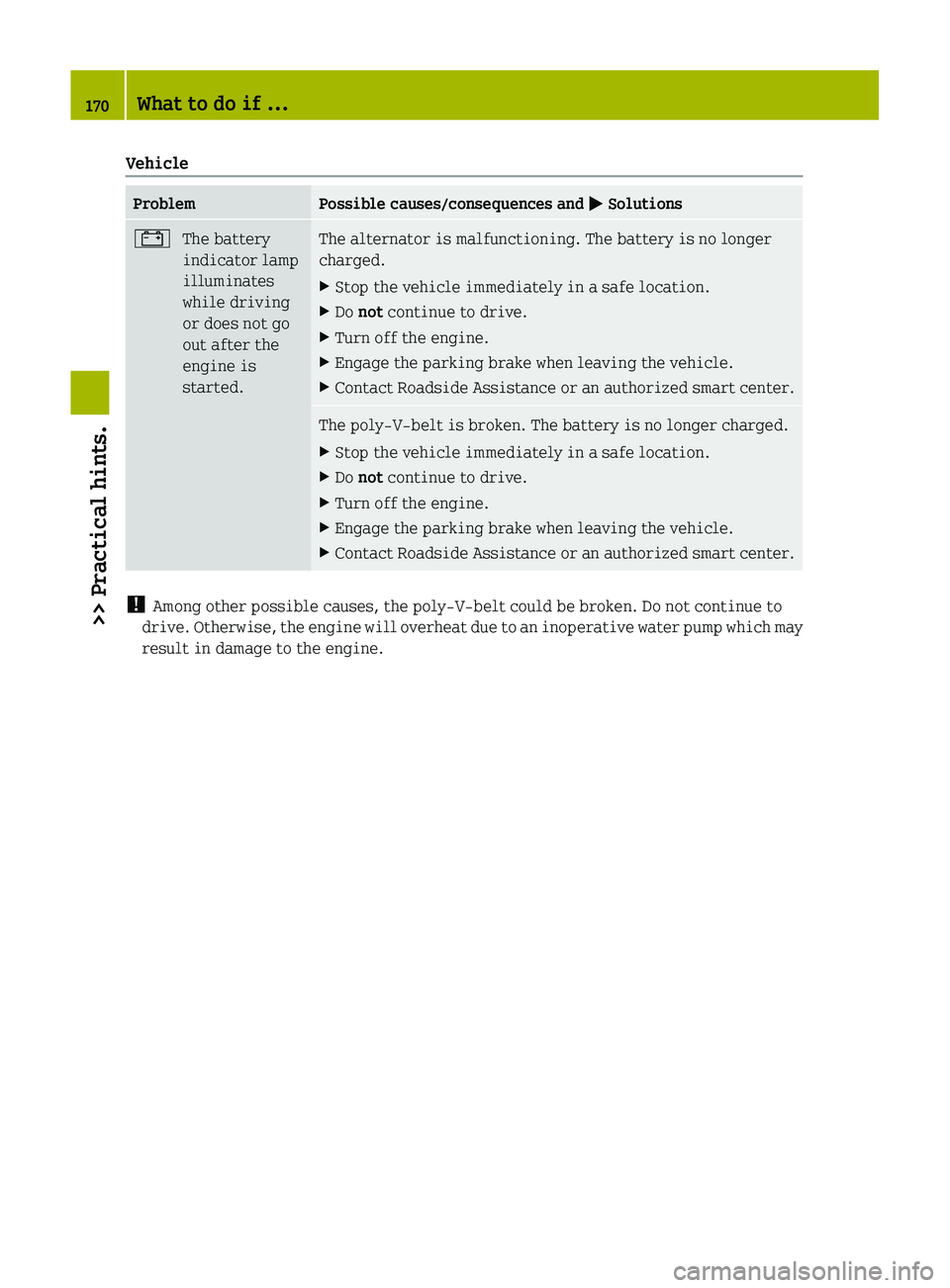
VehicleProblemPossible causes/consequences and 0050 Solutions003FThe battery
indicator lamp
illuminates
while driving
or does not go
out after the
engine is
started.The alternator is malfunctioning. The battery is no longer
charged. XStop the vehicle immediately in a safe location.XDo not continue to drive.XTurn off the engine.XEngage the parking brake when leaving the vehicle.XContact Roadside Assistance or an authorized smart center.The poly-V-belt is broken. The battery is no longer charged.XStop the vehicle immediately in a safe location.XDo not continue to drive.XTurn off the engine.XEngage the parking brake when leaving the vehicle.XContact Roadside Assistance or an authorized smart center.
!
Among other possible causes, the poly-V-belt could be broken. Do not continue to
drive. Otherwise, the engine will overheat due to an inoperative water pump which may
result in damage to the engine.
170What to do if ...>> Practical hints.
BA 451 USA, CA Edition A 2011; 1; 4, en-UShereepeVersion: 3.0.3.62010-05-11T15:12:26+02:00 - Seite 170
Page 174 of 228
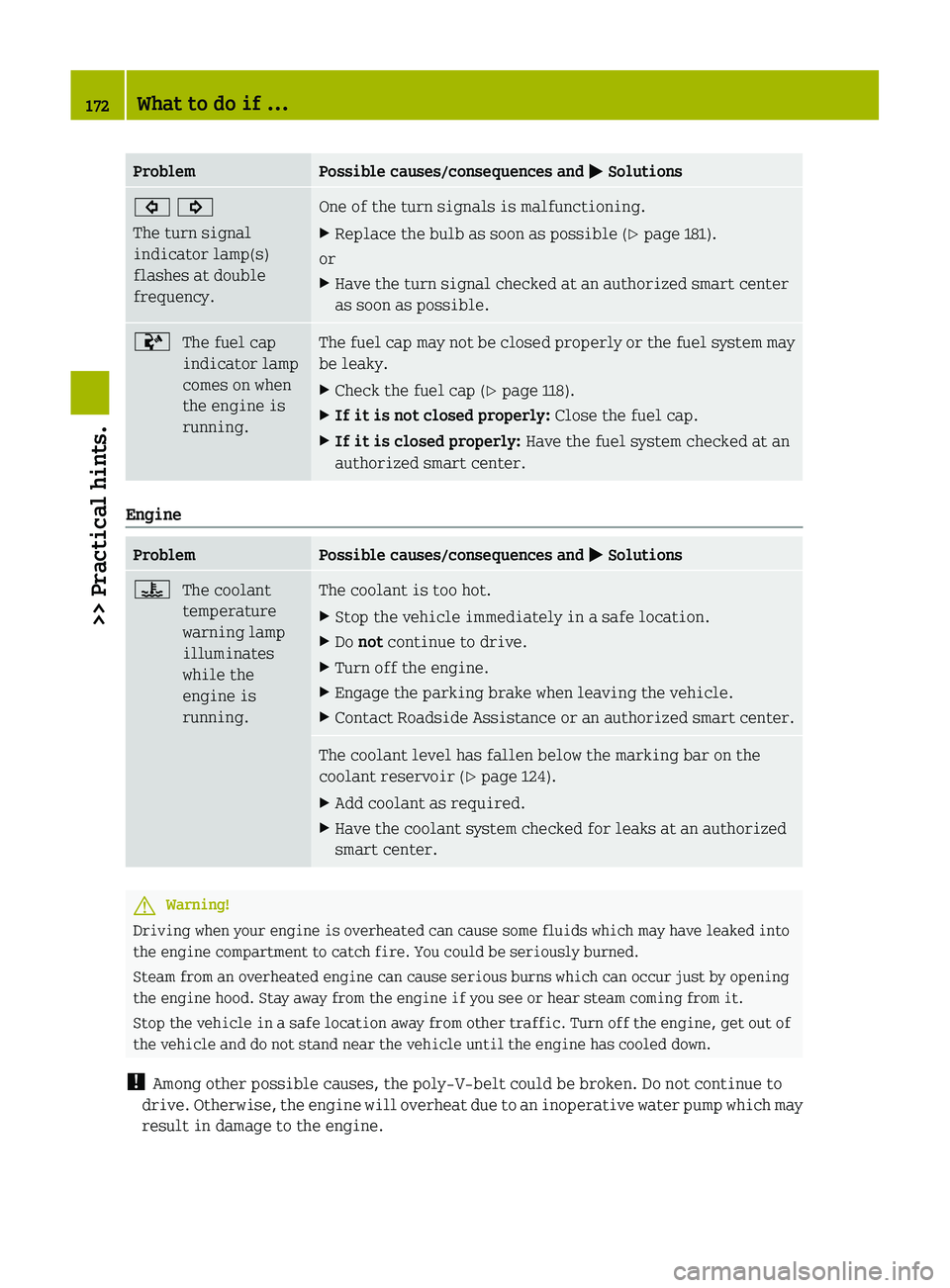
ProblemPossible causes/consequences and 0050 Solutions0026 0024
The turn signal
indicator lamp(s)
flashes at double
frequency.One of the turn signals is malfunctioning.XReplace the bulb as soon as possible ( Y page 181).
or
XHave the turn signal checked at an authorized smart center
as soon as possible.00ACThe fuel cap
indicator lamp
comes on when
the engine is
running.The fuel cap may not be closed properly or the fuel system may
be leaky. XCheck the fuel cap ( Y page 118).XIf it is not closed properly: Close the fuel cap.XIf it is closed properly: Have the fuel system checked at an
authorized smart center.
Engine
ProblemPossible causes/consequences and 0050 Solutions00AEThe coolant
temperature
warning lamp
illuminates
while the
engine is
running.The coolant is too hot. XStop the vehicle immediately in a safe location.XDo not continue to drive.XTurn off the engine.XEngage the parking brake when leaving the vehicle.XContact Roadside Assistance or an authorized smart center.The coolant level has fallen below the marking bar on the
coolant reservoir ( Y page 124).XAdd coolant as required.XHave the coolant system checked for leaks at an authorized
smart center.GWarning!
Driving when your engine is overheated can cause some fluids which may have leaked into
the engine compartment to catch fire. You could be seriously burned.
Steam from an overheated engine can cause serious burns which can occur just by opening
the engine hood. Stay away from the engine if you see or hear steam coming from it.
Stop the vehicle in a safe location away from other traffic. Turn off the engine, get out of
the vehicle and do not stand near the vehicle until the engine has cooled down.
! Among other possible causes, the poly-V-belt could be broken. Do not continue to
drive. Otherwise, the engine will overheat due to an inoperative water pump which may
result in damage to the engine.
172What to do if ...>> Practical hints.
BA 451 USA, CA Edition A 2011; 1; 4, en-UShereepeVersion: 3.0.3.62010-05-11T15:12:26+02:00 - Seite 172
Page 175 of 228
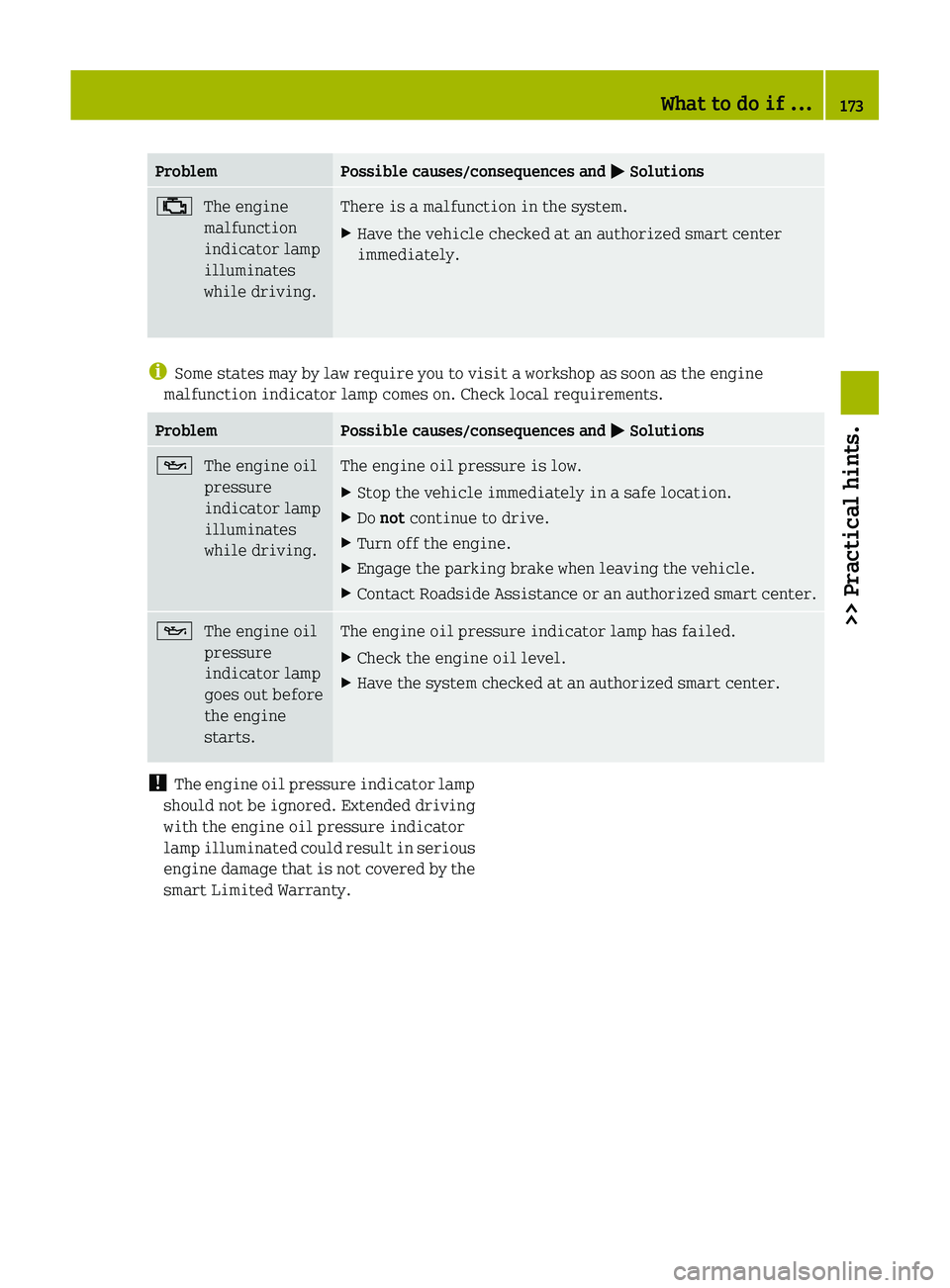
ProblemPossible causes/consequences and 0050 Solutions00BBThe engine
malfunction
indicator lamp
illuminates
while driving. There is a malfunction in the system.XHave the vehicle checked at an authorized smart center
immediately.
i Some states may by law require you to visit a workshop as soon as the engine
malfunction indicator lamp comes on. Check local requirements.
ProblemPossible causes/consequences and 0050 Solutions00B5The engine oil
pressure
indicator lamp
illuminates
while driving. The engine oil pressure is low.XStop the vehicle immediately in a safe location.XDo not continue to drive.XTurn off the engine.XEngage the parking brake when leaving the vehicle.XContact Roadside Assistance or an authorized smart center.00B5The engine oil
pressure
indicator lamp
goes out before
the engine
starts.The engine oil pressure indicator lamp has failed.XCheck the engine oil level.XHave the system checked at an authorized smart center.! The engine oil pressure indicator lamp
should not be ignored. Extended driving
with the engine oil pressure indicator
lamp illuminated could result in serious
engine damage that is not covered by the
smart Limited Warranty.What to do if ...173>> Practical hints.BA 451 USA, CA Edition A 2011; 1; 4, en-UShereepeVersion: 3.0.3.62010-05-11T15:12:26+02:00 - Seite 173Z
Page 178 of 228
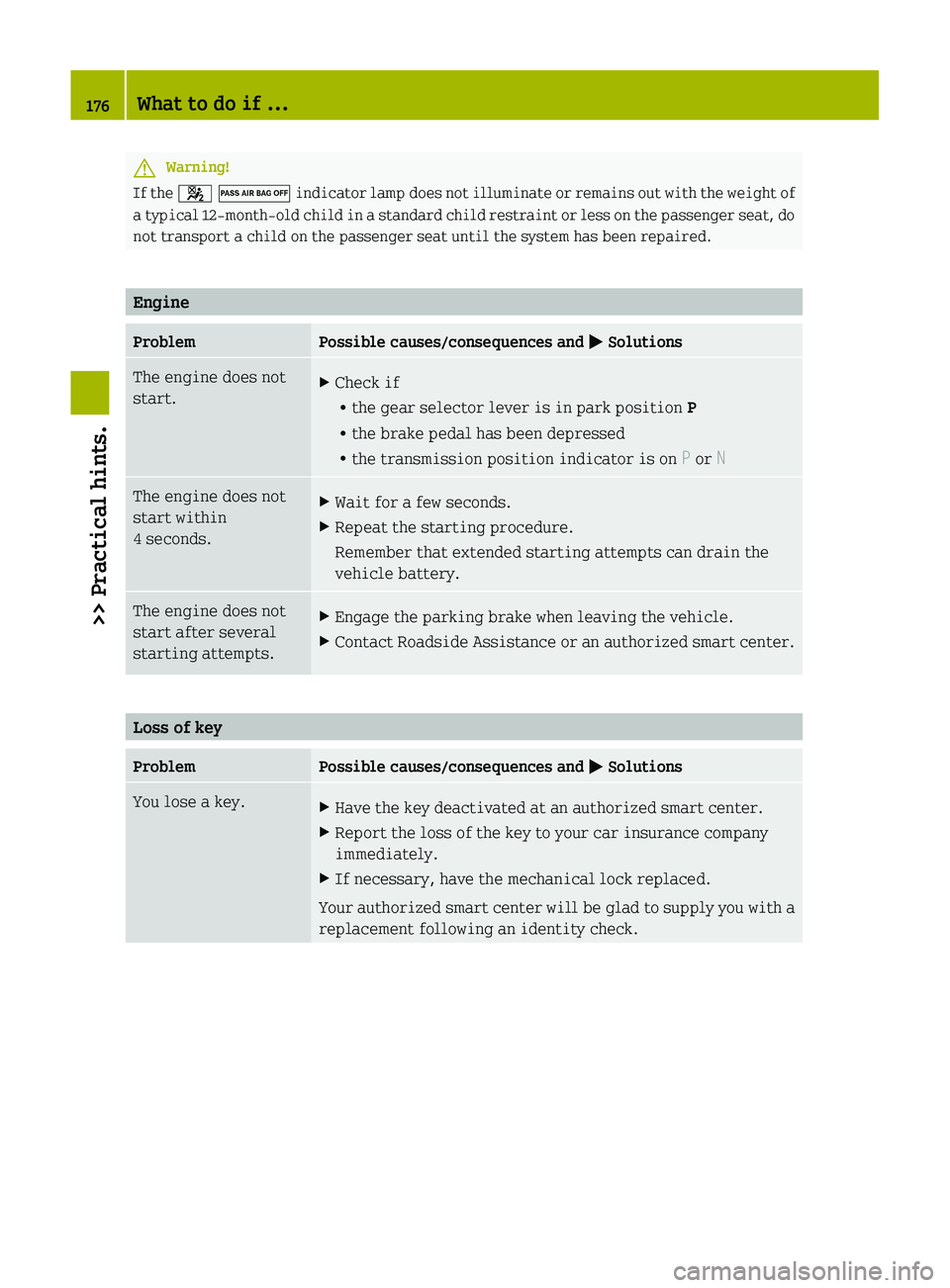
GWarning!
If the 007F 007B indicator lamp does not illuminate or remains out with the weight of
a typical 12‑month‑old child in a standard child restraint or less on the passenger seat, do
not transport a child on the passenger seat until the system has been repaired.
Engine
ProblemPossible causes/consequences and 0050 SolutionsThe engine does not
start.XCheck if
R the gear selector lever is in park position P
R the brake pedal has been depressed
R the transmission position indicator is on P or NThe engine does not
start within
4 seconds.XWait for a few seconds.XRepeat the starting procedure.
Remember that extended starting attempts can drain the
vehicle battery.The engine does not
start after several
starting attempts.XEngage the parking brake when leaving the vehicle.XContact Roadside Assistance or an authorized smart center.
Loss of key
ProblemPossible causes/consequences and 0050 SolutionsYou lose a key.XHave the key deactivated at an authorized smart center.XReport the loss of the key to your car insurance company
immediately.XIf necessary, have the mechanical lock replaced.
Your authorized smart center will be glad to supply you with a
replacement following an identity check.
176What to do if ...>> Practical hints.
BA 451 USA, CA Edition A 2011; 1; 4, en-UShereepeVersion: 3.0.3.62010-05-11T15:12:26+02:00 - Seite 176
Page 191 of 228
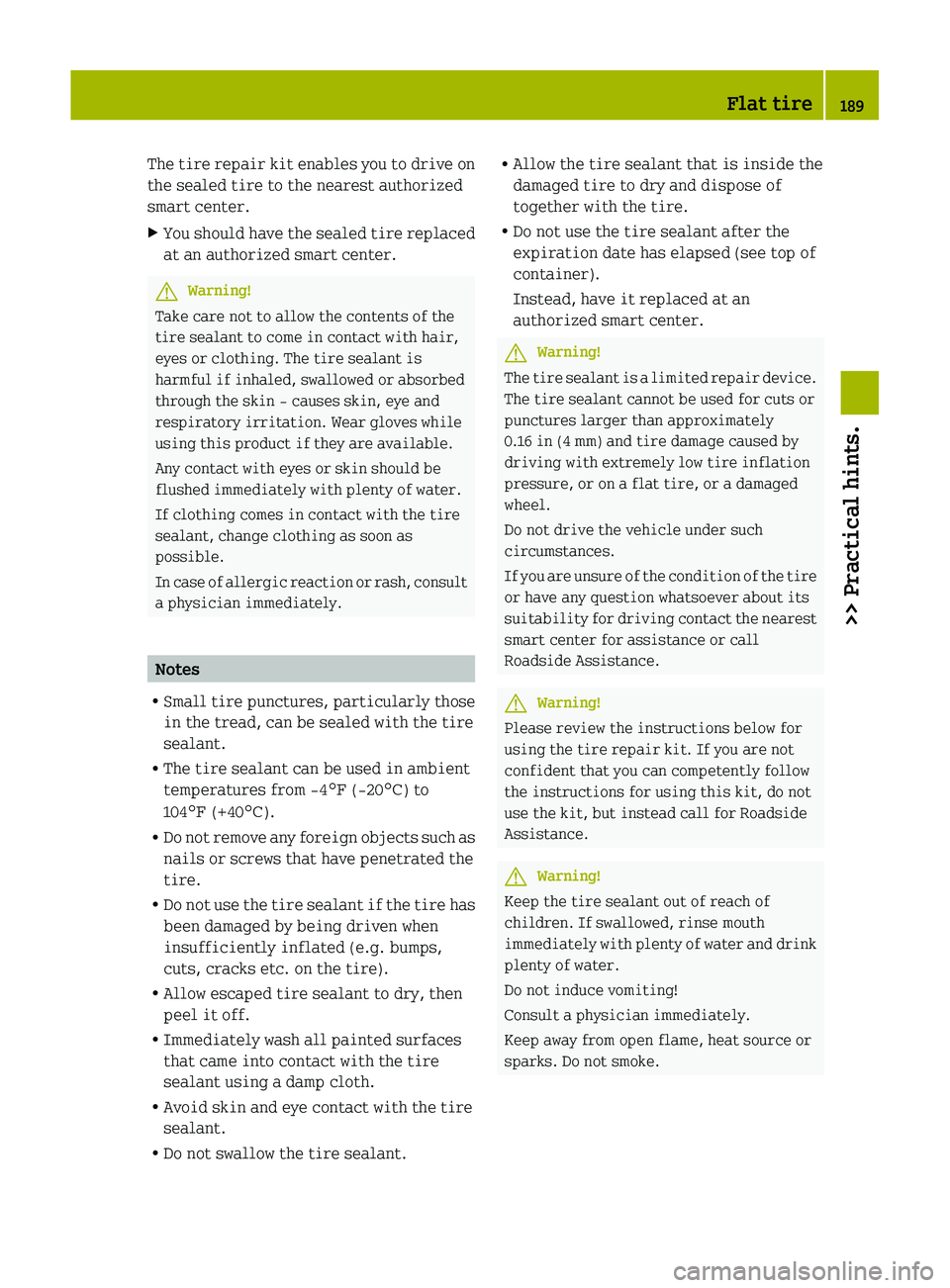
The tire repair kit enables you to drive on
the sealed tire to the nearest authorized
smart center.XYou should have the sealed tire replaced
at an authorized smart center.GWarning!
Take care not to allow the contents of the
tire sealant to come in contact with hair,
eyes or clothing. The tire sealant is
harmful if inhaled, swallowed or absorbed
through the skin - causes skin, eye and
respiratory irritation. Wear gloves while
using this product if they are available.
Any contact with eyes or skin should be
flushed immediately with plenty of water.
If clothing comes in contact with the tire
sealant, change clothing as soon as
possible.
In case of allergic reaction or rash, consult
a physician immediately.
Notes
R Small tire punctures, particularly those
in the tread, can be sealed with the tire
sealant.
R The tire sealant can be used in ambient
temperatures from ‑4 ¦ (‑20 ¥) to
104 ¦ (+40 ¥).
R Do not remove any foreign objects such as
nails or screws that have penetrated the
tire.
R Do not use the tire sealant if the tire has
been damaged by being driven when
insufficiently inflated (e.g. bumps,
cuts, cracks etc. on the tire).
R Allow escaped tire sealant to dry, then
peel it off.
R Immediately wash all painted surfaces
that came into contact with the tire
sealant using a damp cloth.
R Avoid skin and eye contact with the tire
sealant.
R Do not swallow the tire sealant.
RAllow the tire sealant that is inside the
damaged tire to dry and dispose of
together with the tire.
R Do not use the tire sealant after the
expiration date has elapsed (see top of
container).
Instead, have it replaced at an
authorized smart center.GWarning!
The tire sealant is a limited repair device.
The tire sealant cannot be used for cuts or
punctures larger than approximately
0.16 in (4 mm) and tire damage caused by
driving with extremely low tire inflation
pressure, or on a flat tire, or a damaged
wheel.
Do not drive the vehicle under such
circumstances.
If you are unsure of the condition of the tire
or have any question whatsoever about its
suitability for driving contact the nearest
smart center for assistance or call
Roadside Assistance.
GWarning!
Please review the instructions below for
using the tire repair kit. If you are not
confident that you can competently follow
the instructions for using this kit, do not
use the kit, but instead call for Roadside
Assistance.
GWarning!
Keep the tire sealant out of reach of
children. If swallowed, rinse mouth
immediately with plenty of water and drink
plenty of water.
Do not induce vomiting!
Consult a physician immediately.
Keep away from open flame, heat source or
sparks. Do not smoke.
Flat tire189>> Practical hints.BA 451 USA, CA Edition A 2011; 1; 4, en-UShereepeVersion: 3.0.3.62010-05-11T15:12:26+02:00 - Seite 189Z
Page 194 of 228
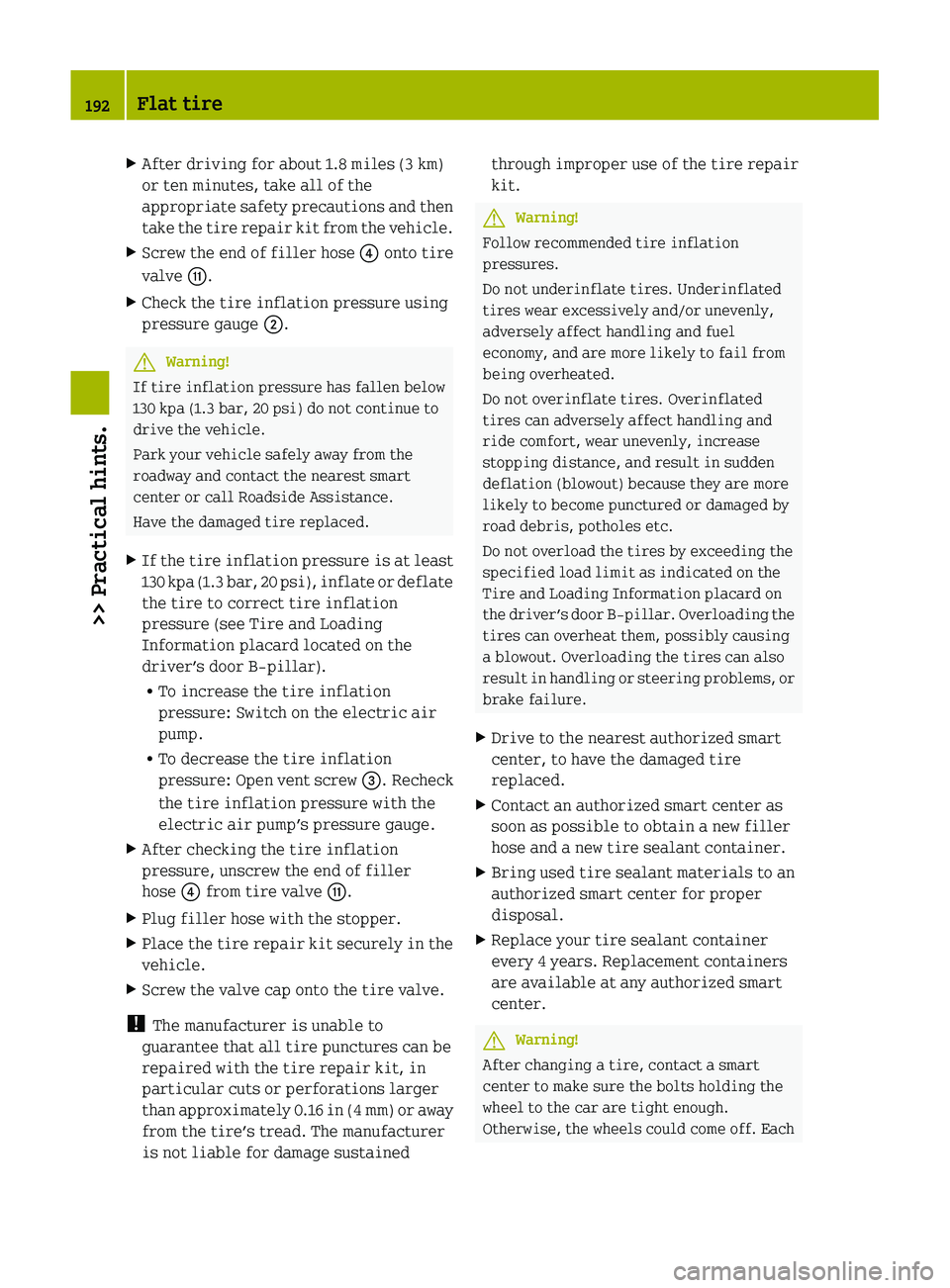
XAfter driving for about 1.8 miles (3 km)
or ten minutes, take all of the
appropriate safety precautions and then
take the tire repair kit from the vehicle.XScrew the end of filler hose 0088 onto tire
valve 0072.XCheck the tire inflation pressure using
pressure gauge 0047.GWarning!
If tire inflation pressure has fallen below
130 kpa (1.3 bar, 20 psi) do not continue to
drive the vehicle.
Park your vehicle safely away from the
roadway and contact the nearest smart
center or call Roadside Assistance.
Have the damaged tire replaced.
XIf the tire inflation pressure is at least
130 kpa (1.3 bar, 20 psi), inflate or deflate
the tire to correct tire inflation
pressure (see Tire and Loading
Information placard located on the
driver’s door B‑pillar).
R To increase the tire inflation
pressure: Switch on the electric air
pump.
R To decrease the tire inflation
pressure: Open vent screw 008A. Recheck
the tire inflation pressure with the
electric air pump’s pressure gauge.XAfter checking the tire inflation
pressure, unscrew the end of filler
hose 0088 from tire valve 0072.XPlug filler hose with the stopper.XPlace the tire repair kit securely in the
vehicle.XScrew the valve cap onto the tire valve.
! The manufacturer is unable to
guarantee that all tire punctures can be
repaired with the tire repair kit, in
particular cuts or perforations larger
than approximately 0.16 in (4 mm) or away
from the tire’s tread. The manufacturer
is not liable for damage sustained
through improper use of the tire repair
kit.GWarning!
Follow recommended tire inflation
pressures.
Do not underinflate tires. Underinflated
tires wear excessively and/or unevenly,
adversely affect handling and fuel
economy, and are more likely to fail from
being overheated.
Do not overinflate tires. Overinflated
tires can adversely affect handling and
ride comfort, wear unevenly, increase
stopping distance, and result in sudden
deflation (blowout) because they are more
likely to become punctured or damaged by
road debris, potholes etc.
Do not overload the tires by exceeding the
specified load limit as indicated on the
Tire and Loading Information placard on
the driver’s door B‑pillar. Overloading the
tires can overheat them, possibly causing
a blowout. Overloading the tires can also
result in handling or steering problems, or
brake failure.
XDrive to the nearest authorized smart
center, to have the damaged tire
replaced.XContact an authorized smart center as
soon as possible to obtain a new filler
hose and a new tire sealant container.XBring used tire sealant materials to an
authorized smart center for proper
disposal.XReplace your tire sealant container
every 4 years. Replacement containers
are available at any authorized smart
center.GWarning!
After changing a tire, contact a smart
center to make sure the bolts holding the
wheel to the car are tight enough.
Otherwise, the wheels could come off. Each
192Flat tire>> Practical hints.
BA 451 USA, CA Edition A 2011; 1; 4, en-UShereepeVersion: 3.0.3.62010-05-11T15:12:26+02:00 - Seite 192