key SMART FORTWO COUPE 2012 User Guide
[x] Cancel search | Manufacturer: SMART, Model Year: 2012, Model line: FORTWO COUPE, Model: SMART FORTWO COUPE 2012Pages: 228, PDF Size: 12.76 MB
Page 54 of 228
Opening and closing
Key
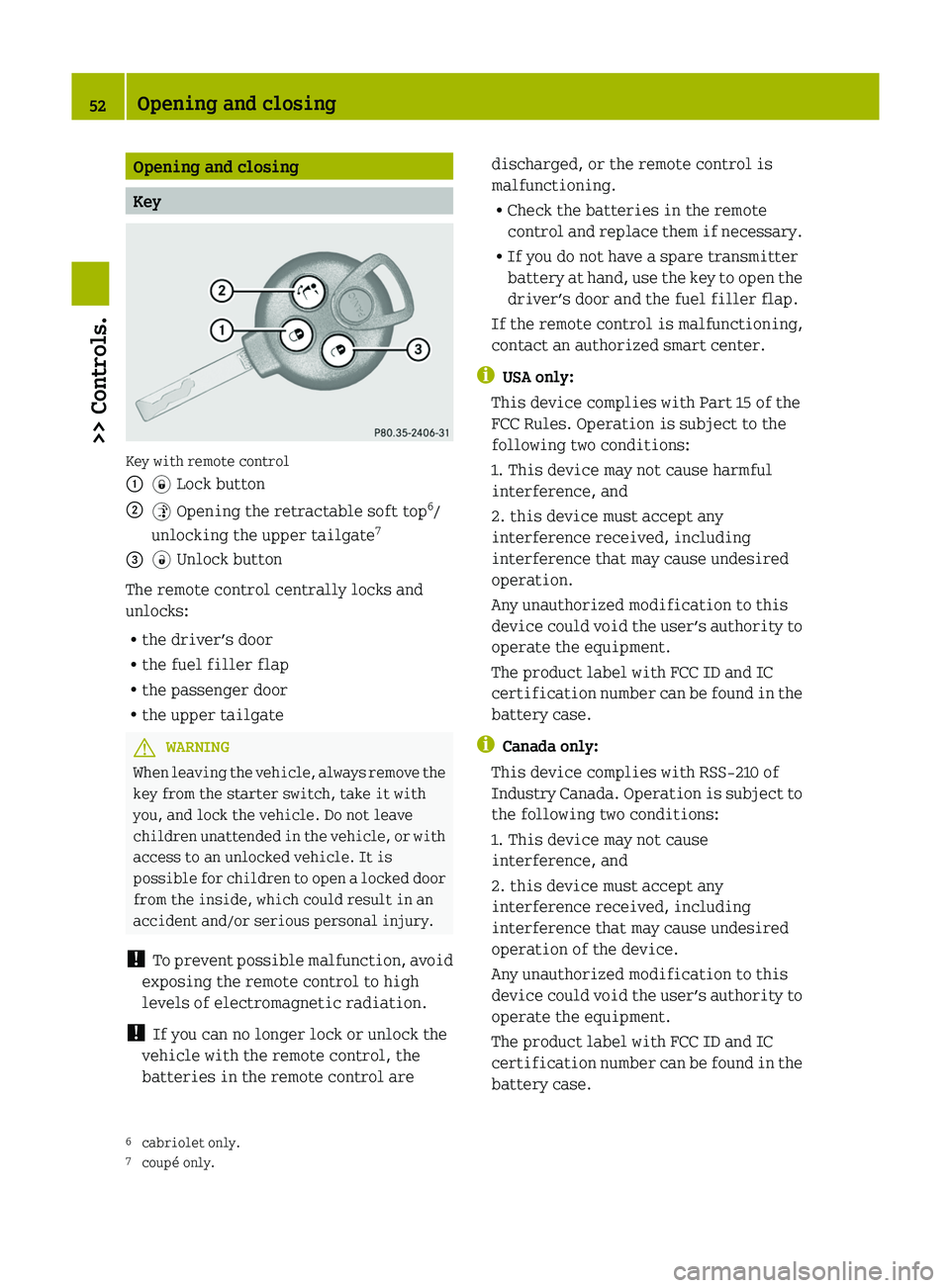
Key with remote control
:
* Lock button
; $ Opening the retractable soft top 6
/
unlocking the upper tailgate 7
= # Unlock button
The remote control centrally locks and
unlocks:
R the driver’s door
R the fuel filler flap
R the passenger door
R the upper tailgate G
WARNING
When leaving the vehicle, always remove the
key from the starter switch, take it with
you, and lock the vehicle. Do not leave
children
unattended in the vehicle, or with
access to an unlocked vehicle. It is
possible for children to open a locked door
from the inside, which could result in an
accident and/or serious personal injury.
! To prevent possible malfunction, avoid
exposing the remote control to high
levels of electromagnetic radiation.
! If you can no longer lock or unlock the
vehicle with the remote control, the
batteries in the remote control are discharged, or the remote control is
malfunctioning.
R
Check the batteries in the remote
control
and replace them if necessary.
R If you do not have a spare transmitter
battery at hand, use the key to open the
driver’s door and the fuel filler flap.
If the remote control is malfunctioning,
contact an authorized smart center.
i USA only:
This device complies with Part 15 of the
FCC Rules. Operation is subject to the
following two conditions:
1. This device may not cause harmful
interference, and
2. this device must accept any
interference received, including
interference that may cause undesired
operation.
Any unauthorized modification to this
device could void the user’s authority to
operate the equipment.
The product label with FCC ID and IC
certification number can be found in the
battery case.
i Canada only:
This device complies with RSS‑210 of
Industry Canada. Operation is subject to
the following two conditions:
1. This device may not cause
interference, and
2. this device must accept any
interference received, including
interference that may cause undesired
operation of the device.
Any unauthorized modification to this
device could void the user’s authority to
operate the equipment.
The product label with FCC ID and IC
certification number can be found in the
battery case.
6 cabriolet only.
7 coupé only. 52
Opening and closing
>> Controls.
Page 55 of 228
!
The remote control has an operating
range
of approximately 50 ft (15 meters).
This can fluctuate greatly as a
consequence of local conditions
(reflective or absorbing objects) and
interference emitted by other radio
transmission systems. Similarly, the
operating range fluctuates in line with
the direction from which the remote
control is activated.
To prevent theft, however, it is advisable
to only unlock the vehicle when you are
in close proximity to it. Locking and unlocking from the
outside
X Selective unlocking: Press button # on
the key once.
All turn signal lamps flash once.
The anti-theft warning system* is
disarmed.
The
driver’s door and the fuel filler flap
are unlocked.
X Global unlocking:
Press button # on the
key twice.
All turn signal lamps flash once again.
The passenger door and the tailgate are
unlocked in addition to the driver’s door
and the fuel filler flap.
X Global locking: Press button * on the
key.
With the doors, the tailgate(s), and the
fuel filler flap closed, the turn signal
lamps flash three times.
The
anti-theft warning system* is armed.
The indicator lamp on the central
locking switch flashes (Y page 54).
The interior and exterior 8
lamps come on
and then go out again after 12 seconds.
i In vehicles with anti-theft warning
system*, an acoustic signal will sound
when locking or unlocking the vehicle. When unlocking, the acoustic signal
sounds once. When locking, the acoustic
signal sounds three times.
The acoustic signal is activated at the
factory. If you wish to deactivate the
feature, contact an authorized smart
center.
Automatic locking
Auto-relock function The vehicle will lock again automatically
within approximately 60 seconds of
unlocking with the key if neither the
driver’s nor passenger door is opened.
!
To prevent an inadvertent lockout,
never
leave your key lying in the vehicle.
Drive lock function The vehicle locks automatically when the
ignition
is switched on and the wheels are
turning at vehicle speeds of approximately
8 mph (14 km/h) or more. The drive lock
function is enabled at the factory.
X Switching on: Switch off the ignition.
X Press the central locking switch
(Y page 54) and button * on the key
simultaneously.
An acoustic signal sounds.
The drive lock function is switched on.
X Switching off: Switch off the ignition.
X Press the central unlocking switch
(Y page 54) and button # on the key
simultaneously.
An acoustic signal sounds.
The drive lock function is switched off.
8 Vehicles with rain-light sensor* only. Opening and closing
53
>> Controls.
* optional Z
Page 56 of 228
Locking and unlocking from the inside
G
WARNING
When leaving the vehicle, always remove the
key from the starter switch, take it with
you, and lock the vehicle. Do not leave
children
unattended in the vehicle, or with
access to an unlocked vehicle. A child’s
unsupervised access to a vehicle could
result in an accident and/or serious
personal injury.
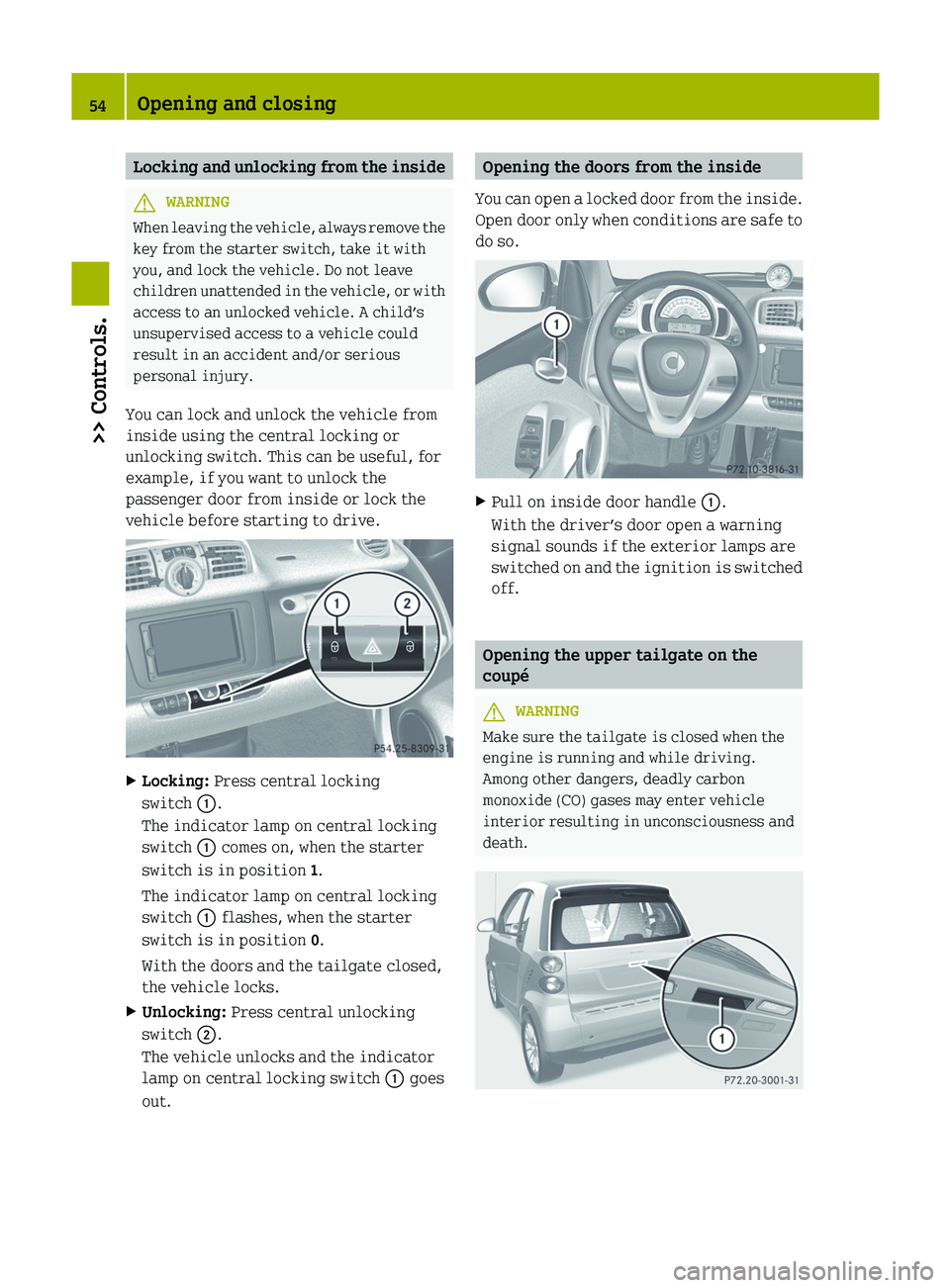
You can lock and unlock the vehicle from
inside using the central locking or
unlocking switch. This can be useful, for
example, if you want to unlock the
passenger door from inside or lock the
vehicle before starting to drive. X
Locking: Press central locking
switch :.
The indicator lamp on central locking
switch : comes on, when the starter
switch is in position 1.
The indicator lamp on central locking
switch : flashes, when the starter
switch is in position 0.
With the doors and the tailgate closed,
the vehicle locks.
X Unlocking: Press central unlocking
switch ;.
The vehicle unlocks and the indicator
lamp on central locking switch : goes
out. Opening the doors from the inside
You
can open a locked door from the inside.
Open door only when conditions are safe to
do so. X
Pull on inside door handle :.
With the driver’s door open a warning
signal sounds if the exterior lamps are
switched
on and the ignition is switched
off. Opening the upper tailgate on the
coupé
G
WARNING
Make sure the tailgate is closed when the
engine is running and while driving.
Among other dangers, deadly carbon
monoxide (CO) gases may enter vehicle
interior resulting in unconsciousness and
death. 54
Opening and closing
>> Controls.
Page 57 of 228
X
Press button # on the key twice.
X Press and hold button $ on the key for
approximately two seconds.
or
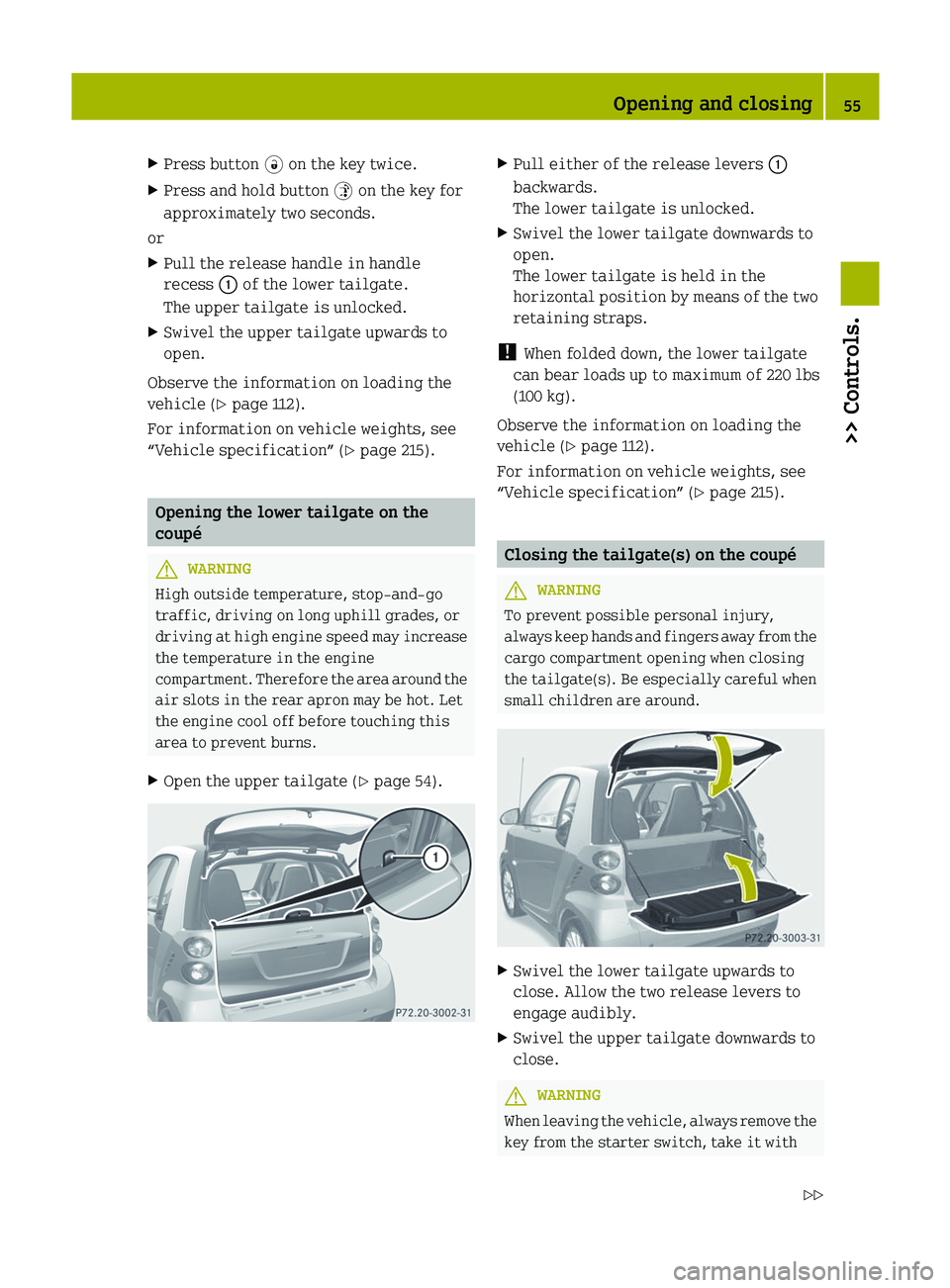
X Pull the release handle in handle
recess : of the lower tailgate.
The upper tailgate is unlocked.
X Swivel the upper tailgate upwards to
open.
Observe the information on loading the
vehicle ( Y page 112).
For information on vehicle weights, see
“Vehicle specification” (Y page 215). Opening the lower tailgate on the
coupé
G
WARNING
High outside temperature, stop-and-go
traffic, driving on long uphill grades, or
driving
at high engine speed may increase
the temperature in the engine
compartment. Therefore the area around the
air slots in the rear apron may be hot. Let
the engine cool off before touching this
area to prevent burns.
X Open the upper tailgate ( Y page 54). X
Pull either of the release levers :
backwards.
The lower tailgate is unlocked.
X Swivel the lower tailgate downwards to
open.
The lower tailgate is held in the
horizontal position by means of the two
retaining straps.
! When folded down, the lower tailgate
can bear loads up to maximum of 220 lbs
(100 kg).
Observe the information on loading the
vehicle ( Y page 112).
For information on vehicle weights, see
“Vehicle specification” (Y page 215). Closing the tailgate(s) on the coupé
G
WARNING
To prevent possible personal injury,
always
keep hands and fingers away from the
cargo compartment opening when closing
the tailgate(s). Be especially careful when
small children are around. X
Swivel the lower tailgate upwards to
close. Allow the two release levers to
engage audibly.
X Swivel the upper tailgate downwards to
close. G
WARNING
When leaving the vehicle, always remove the
key from the starter switch, take it with Opening and closing
55
>> Controls.
Z
Page 58 of 228
you, and lock the vehicle. Do not leave
children
unattended in the vehicle, or with
access to an unlocked vehicle. A child’s
unsupervised access to a vehicle could
result in an accident and/or serious
personal injury. Opening and closing the retractable
soft top (cabriolet only)
You can fully open the retractable soft top
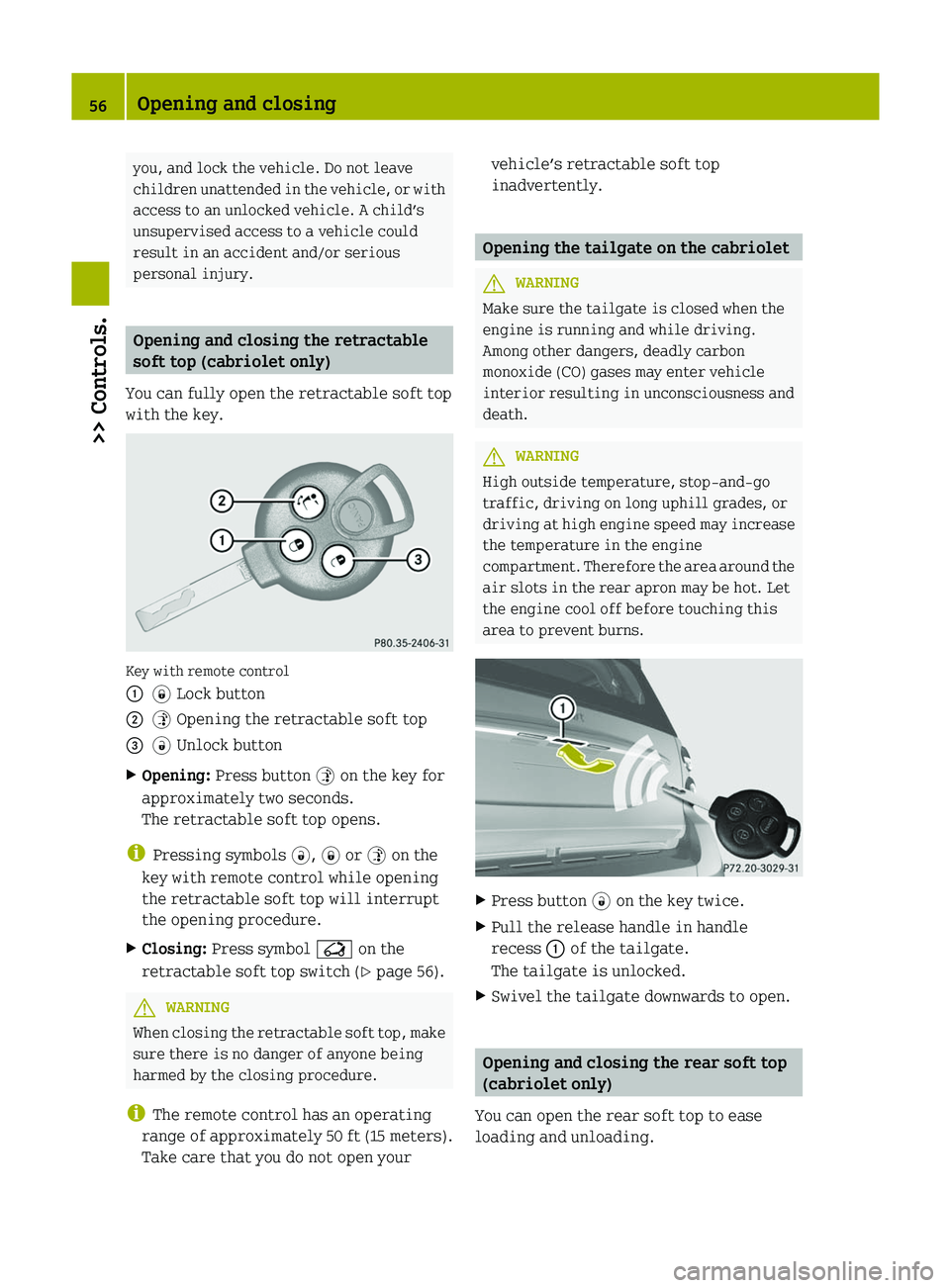
with the key. Key with remote control
:
* Lock button
; $ Opening the retractable soft top
= # Unlock button
X Opening: Press button $ on the key for
approximately two seconds.
The retractable soft top opens.
i Pressing symbols #, * or $ on the
key with remote control while opening
the retractable soft top will interrupt
the opening procedure.
X Closing: Press symbol G on the
retractable soft top switch
(Y page 56). G
WARNING
When closing the retractable soft top, make
sure there is no danger of anyone being
harmed by the closing procedure.
i The remote control has an operating
range
of approximately 50 ft (15 meters).
Take care that you do not open your vehicle’s retractable soft top
inadvertently.
Opening the tailgate on the cabriolet
G
WARNING
Make sure the tailgate is closed when the
engine is running and while driving.
Among other dangers, deadly carbon
monoxide (CO) gases may enter vehicle
interior resulting in unconsciousness and
death. G
WARNING
High outside temperature, stop-and-go
traffic, driving on long uphill grades, or
driving
at high engine speed may increase
the temperature in the engine
compartment. Therefore the area around the
air slots in the rear apron may be hot. Let
the engine cool off before touching this
area to prevent burns. X
Press button # on the key twice.
X Pull the release handle in handle
recess : of the tailgate.
The tailgate is unlocked.
X Swivel the tailgate downwards to open. Opening and closing the rear soft top
(cabriolet only)
You can open the rear soft top to ease
loading and unloading. 56
Opening and closing
>> Controls.
Page 59 of 228
X
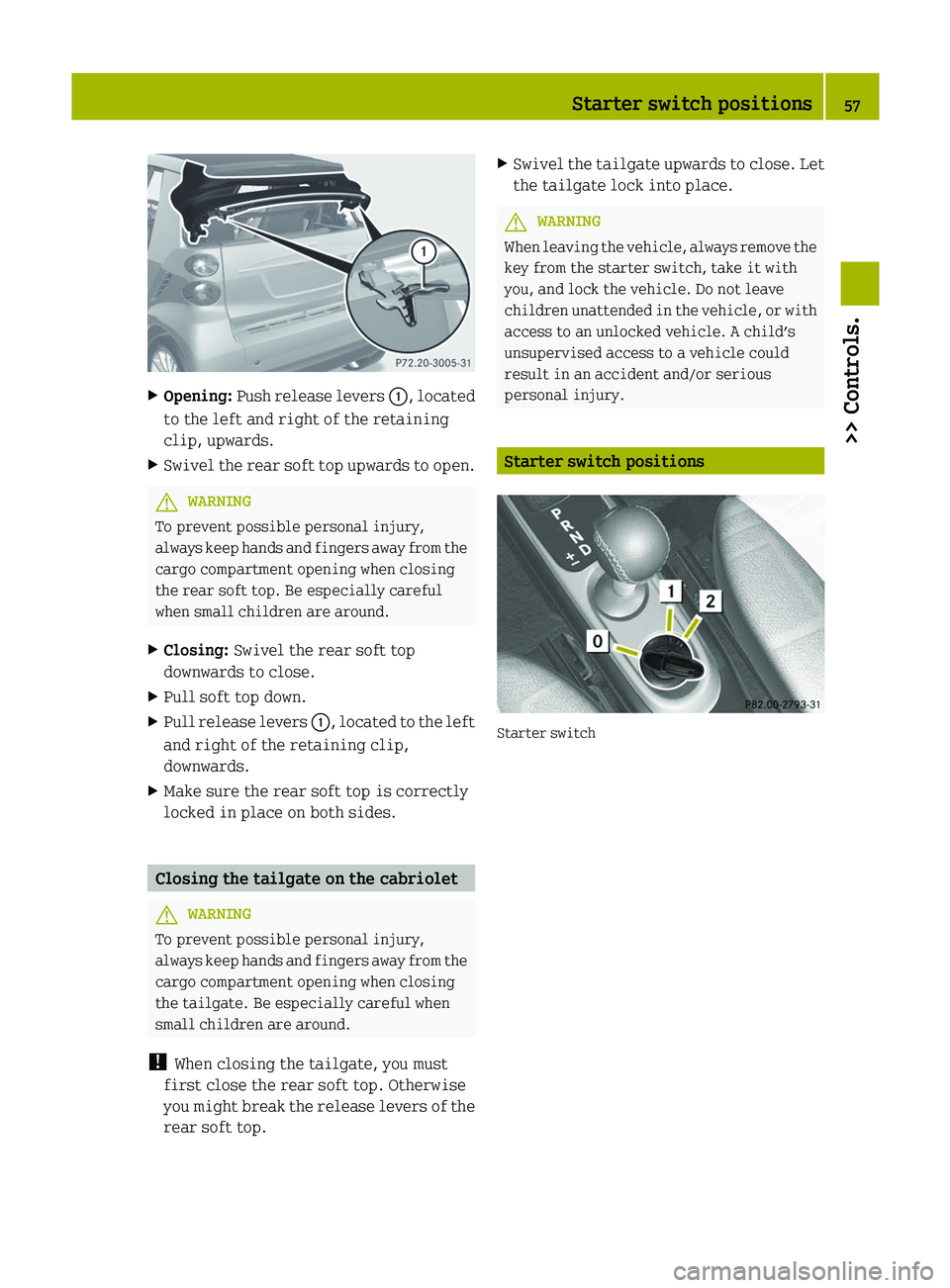
Opening: Push release levers :, located
to the left and right of the retaining
clip, upwards.
X Swivel the rear soft top upwards to open. G
WARNING
To prevent possible personal injury,
always
keep hands and fingers away from the
cargo compartment opening when closing
the rear soft top. Be especially careful
when small children are around.
X Closing: Swivel the rear soft top
downwards to close.
X Pull soft top down.
X Pull release levers :,
located to the left
and right of the retaining clip,
downwards.
X Make sure the rear soft top is correctly
locked in place on both sides. Closing the tailgate on the cabriolet
G
WARNING
To prevent possible personal injury,
always
keep hands and fingers away from the
cargo compartment opening when closing
the tailgate. Be especially careful when
small children are around.
! When closing the tailgate, you must
first close the rear soft top. Otherwise
you might break the release levers of the
rear soft top. X
Swivel the tailgate upwards to close. Let
the tailgate lock into place. G
WARNING
When leaving the vehicle, always remove the
key from the starter switch, take it with
you, and lock the vehicle. Do not leave
children
unattended in the vehicle, or with
access to an unlocked vehicle. A child’s
unsupervised access to a vehicle could
result in an accident and/or serious
personal injury. Starter switch positions
Starter switch Starter switch positions
57
>> Controls. Z
Page 60 of 228
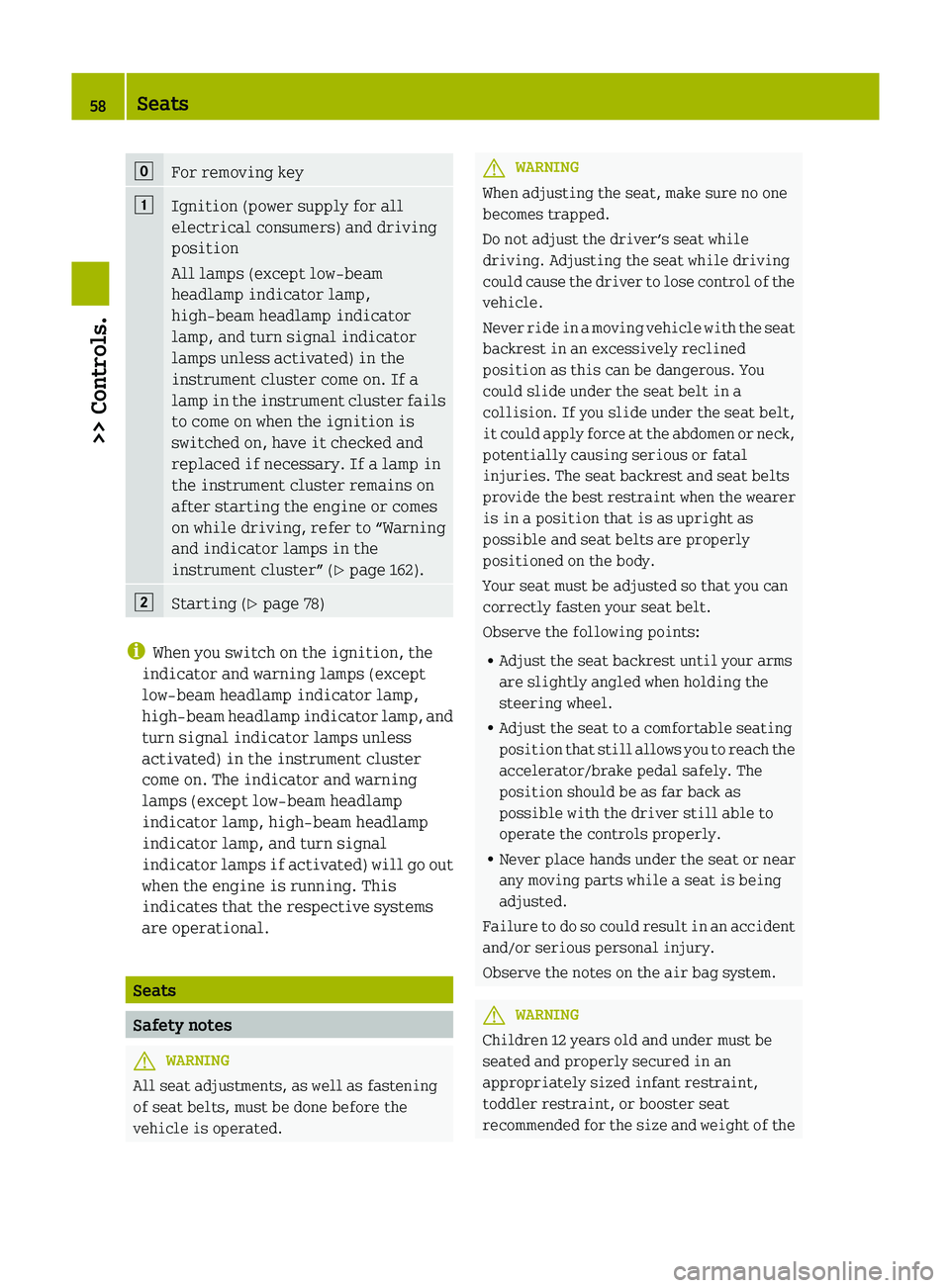
g
For removing key
1
Ignition (power supply for all
electrical consumers) and driving
position
All lamps (except low‑beam
headlamp indicator lamp,
high‑beam headlamp indicator
lamp, and turn signal indicator
lamps unless activated) in the
instrument cluster come on. If a
lamp
in the instrument cluster fails
to come on when the ignition is
switched on, have it checked and
replaced if necessary. If a lamp in
the instrument cluster remains on
after starting the engine or comes
on while driving, refer to “Warning
and indicator lamps in the
instrument cluster” ( Y page 162).2
Starting (
Y page 78)i
When you switch on the ignition, the
indicator and warning lamps (except
low‑beam headlamp indicator lamp,
high‑beam
headlamp indicator lamp, and
turn signal indicator lamps unless
activated) in the instrument cluster
come on. The indicator and warning
lamps (except low‑beam headlamp
indicator lamp, high‑beam headlamp
indicator lamp, and turn signal
indicator lamps if activated) will go out
when the engine is running. This
indicates that the respective systems
are operational. Seats
Safety notes
G
WARNING
All seat adjustments, as well as fastening
of seat belts, must be done before the
vehicle is operated. G
WARNING
When adjusting the seat, make sure no one
becomes trapped.
Do not adjust the driver’s seat while
driving. Adjusting the seat while driving
could
cause the driver to lose control of the
vehicle.
Never ride in a moving vehicle with the seat
backrest in an excessively reclined
position as this can be dangerous. You
could slide under the seat belt in a
collision. If you slide under the seat belt,
it could apply force at the abdomen or neck,
potentially causing serious or fatal
injuries. The seat backrest and seat belts
provide the best restraint when the wearer
is in a position that is as upright as
possible and seat belts are properly
positioned on the body.
Your seat must be adjusted so that you can
correctly fasten your seat belt.
Observe the following points:
R Adjust the seat backrest until your arms
are slightly angled when holding the
steering wheel.
R Adjust the seat to a comfortable seating
position that still allows you to reach the
accelerator/brake pedal safely. The
position should be as far back as
possible with the driver still able to
operate the controls properly.
R Never place hands under the seat or near
any moving parts while a seat is being
adjusted.
Failure to do so could result in an accident
and/or serious personal injury.
Observe the notes on the air bag system. G
WARNING
Children 12 years old and under must be
seated and properly secured in an
appropriately sized infant restraint,
toddler restraint, or booster seat
recommended
for the size and weight of the58
Seats
>> Controls.
Page 63 of 228
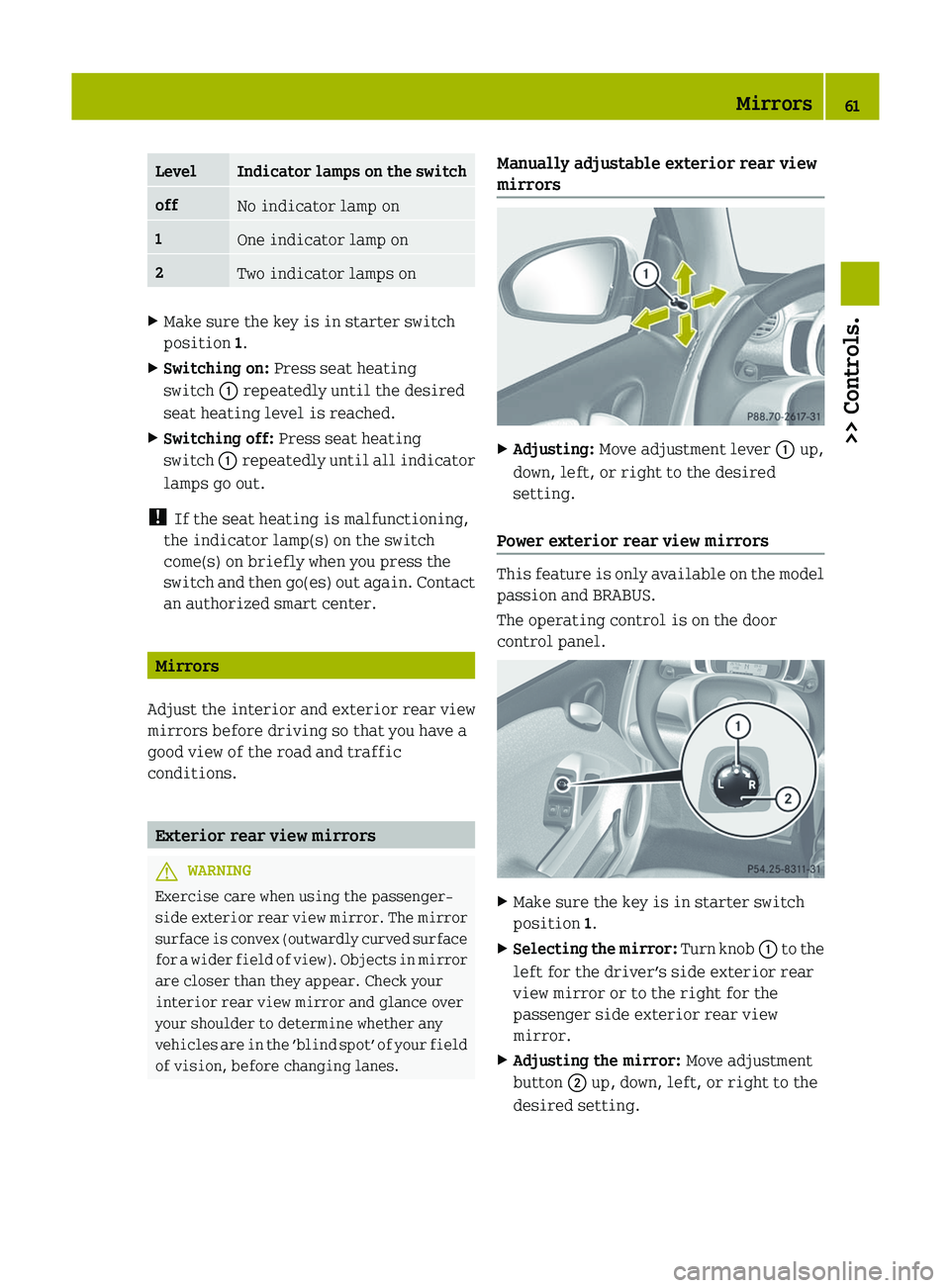
Level Indicator lamps on the switch
off
No indicator lamp on
1
One indicator lamp on
2
Two indicator lamps on
X
Make sure the key is in starter switch
position 1.
X Switching on: Press seat heating
switch : repeatedly until the desired
seat heating level is reached.
X Switching off: Press seat heating
switch :
repeatedly until all indicator
lamps go out.
! If the seat heating is malfunctioning,
the indicator lamp(s) on the switch
come(s) on briefly when you press the
switch
and then go(es) out again. Contact
an authorized smart center. Mirrors
Adjust the interior and exterior rear view
mirrors before driving so that you have a
good view of the road and traffic
conditions. Exterior rear view mirrors
G
WARNING
Exercise care when using the passenger-
side
exterior rear view mirror. The mirror
surface is convex (outwardly curved surface
for a wider field of view). Objects in mirror
are closer than they appear. Check your
interior rear view mirror and glance over
your shoulder to determine whether any
vehicles are in the ’blind spot’ of your field
of vision, before changing lanes. Manually adjustable exterior rear view
mirrors
X
Adjusting: Move adjustment lever : up,
down, left, or right to the desired
setting.
Power exterior rear view mirrors This feature is only available on the model
passion and BRABUS.
The operating control is on the door
control panel.
X
Make sure the key is in starter switch
position 1.
X Selecting the mirror:
Turn knob : to the
left for the driver’s side exterior rear
view mirror or to the right for the
passenger side exterior rear view
mirror.
X Adjusting the mirror: Move adjustment
button ; up, down, left, or right to the
desired setting. Mirrors
61
>> Controls. Z
Page 64 of 228
Exterior rear view mirror heating
This feature is only available on the model
passion and BRABUS and in conjunction
with power exterior rear view mirrors.
After switching on the rear window
defroster, the exterior rear view mirrors
will be heated automatically. This
prevents icing up the exterior rear view
mirrors
and also creates a clear view when
the exterior rear view mirrors have fogged
up.
If the rear window defroster is
automatically deactivated after
approximately 10 minutes of operation, the
exterior rear view mirror heating also
deactivates.
X Make sure the key is in starter switch
position 1.
X Switching on: Switch on the rear window
defroster (Y page 106).
The
exterior rear view mirror heating is
switched on.
X Switching off:
Switch off the rear window
defroster (Y page 106).
The exterior rear view mirror heating is
switched off.
i The exterior rear view mirror heating
also switches off if the key is turned to
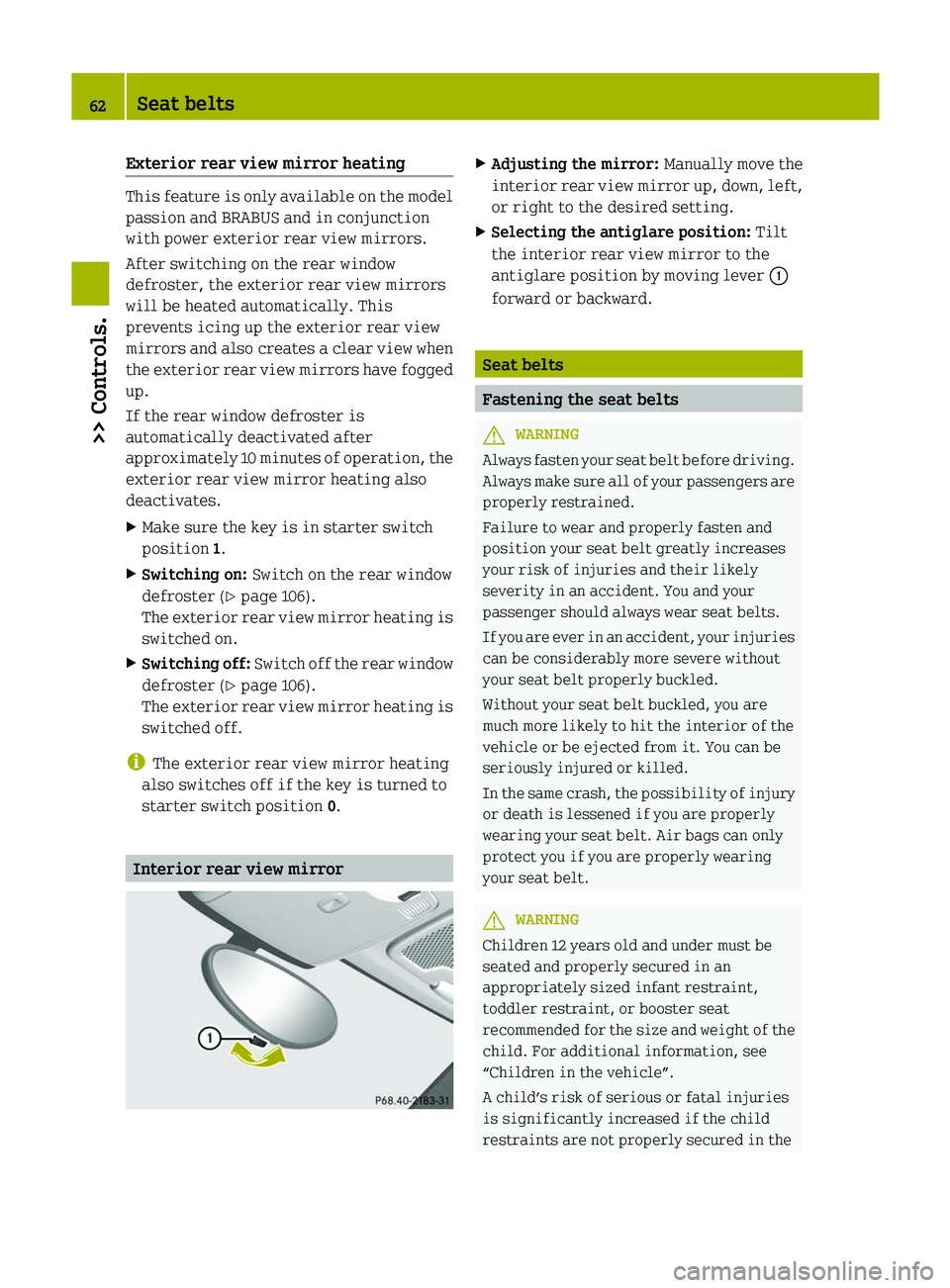
starter switch position 0.Interior rear view mirror X
Adjusting the mirror: Manually move the
interior
rear view mirror up, down, left,
or right to the desired setting.
X Selecting the antiglare position: Tilt
the interior rear view mirror to the
antiglare position by moving lever :
forward or backward. Seat belts
Fastening the seat belts
G
WARNING
Always fasten your seat belt before driving.
Always
make sure all of your passengers are
properly restrained.
Failure to wear and properly fasten and
position your seat belt greatly increases
your risk of injuries and their likely
severity in an accident. You and your
passenger should always wear seat belts.
If you are ever in an accident, your injuries
can be considerably more severe without
your seat belt properly buckled.
Without your seat belt buckled, you are
much more likely to hit the interior of the
vehicle or be ejected from it. You can be
seriously injured or killed.
In the same crash, the possibility of injury
or death is lessened if you are properly
wearing your seat belt. Air bags can only
protect you if you are properly wearing
your seat belt. G
WARNING
Children 12 years old and under must be
seated and properly secured in an
appropriately sized infant restraint,
toddler restraint, or booster seat
recommended
for the size and weight of the
child. For additional information, see
“Children in the vehicle”.
A child’s risk of serious or fatal injuries
is significantly increased if the child
restraints are not properly secured in the 62
Seat belts
>> Controls.
Page 68 of 228
To minimize risk to you and to others,
activate headlamps by turning exterior
lamp
switch to position L when driving
or when traffic and/or ambient lighting
conditions require you to do so.
In low ambient lighting conditions, only
switch from position à to L with the
vehicle at a standstill in a safe location.
Switching from position à to L will
briefly switch off the headlamps. Doing so
while driving in low ambient lighting
conditions may result in an accident.
The automatic headlamp feature is only an
aid to the driver. The driver is responsible
for the operation of the vehicle’s lights at
all times.
X Turn the exterior lamp switch to position
Ã.
With the key in starter switch position
1,
the tail and parking lamps, the license
plate lamps, and the side marker lamps
will come on and go out automatically
depending on the brightness of the
ambient light.
With the engine running, the low‑beam
headlamps, the tail and parking lamps,
the license plate lamps and the side
marker lamps will come on and go out
automatically depending on the
brightness of the ambient light.
Daytime running lamp mode (Canada only) In Canada, the daytime running lamp mode
is mandatory and therefore in a constant
mode.
X
Turn the exterior lamp switch to position
$.
i With the engine running, the low‑beam
headlamps cannot be switched off
manually.
You cannot switch on the high‑beam
headlamps.
The high‑beam flasher is available at all
times. For nighttime driving you should turn the
exterior lamp switch to position
L to
permit activation of the high‑beam
headlamps.
When the engine is running, and you
R turn
the exterior lamp switch to position
T, the low‑beam headlamps, the tail
and parking lamps, the license plate
lamps and the side marker lamps come on
R turn the exterior lamp switch to position
L, the manual headlamp mode has
priority over the daytime running lamp
mode.
The corresponding exterior lamps come
on (Y page 65).
Daytime running lamp mode* (USA only) In the USA, the daytime running lamp mode
is deactivated by default.
X
Activating: Switch off the ignition.
X Switch on the high-beam flasher and
press button * on the key
simultaneously.
An acoustic signal sounds.
The daytime running lamp mode is
activated.
X Turn the exterior lamp switch to position
$.
i With the engine running, the low‑beam
headlamps cannot be switched off
manually.
i When
the daytime running lamp mode is
activated, the rain-light sensor* is
without function.
When the engine is running, and you turn
the exterior lamp switch to position T
or L, the manual headlamp mode has
priority over the daytime running lamp
mode.
The corresponding exterior lamps come on
(Y page 64). 66
Lighting
>> Controls.
* optional