key SMART FORTWO COUPE 2012 Owner's Manual
[x] Cancel search | Manufacturer: SMART, Model Year: 2012, Model line: FORTWO COUPE, Model: SMART FORTWO COUPE 2012Pages: 228, PDF Size: 12.76 MB
Page 69 of 228
X
Deactivating: Switch off the ignition
and remove the key from the starter
switch.
X Switch on the high-beam flasher and
press button # on the key
simultaneously.
An acoustic signal sounds.
The daytime running lamp mode is
deactivated.
LED daytime running lamps* (USA only) Vehicles without rain-light sensor:
X
Switching on: Switch on the ignition.
The LED daytime running lamps are
switched on.
X Switching off: Switch on the parking
lamps or the low‑beam headlamps.
The LED daytime running lamps are
switched off.
Vehicles with rain-light sensor*:
X Turn the exterior lamp switch to position
Ã.
With the key in starter switch position
1, the LED daytime running lamps are
switched on. In low ambient light
conditions, low-beam headlamps, the
tail
and parking lamps, the license plate
lamps and the side marker lamps will
come on. The LED daytime running lamps
will then be switched off.
With the engine running, the low‑beam
headlamps, the tail and parking lamps,
the license plate lamps and the side
marker lamps will come on and go out
automatically depending on the
brightness of the ambient light.
When the engine is running, and you turn
the exterior lamp switch to position T
or L, the manual headlamp mode has
priority
over the LED daytime running lamp
mode.
The corresponding exterior lamps come on
(Y page 64). LED daytime running lamps*
(Canada only) X
Switching on: Switch on the ignition.
The LED daytime running lamps are
switched on.
X Switching off: Switch on the low‑beam
headlamps.
The LED daytime running lamps are
switched off. Combination switch (high beam, high
beam flasher and turn signals)
X Make sure the key is in starter switch
position 1.
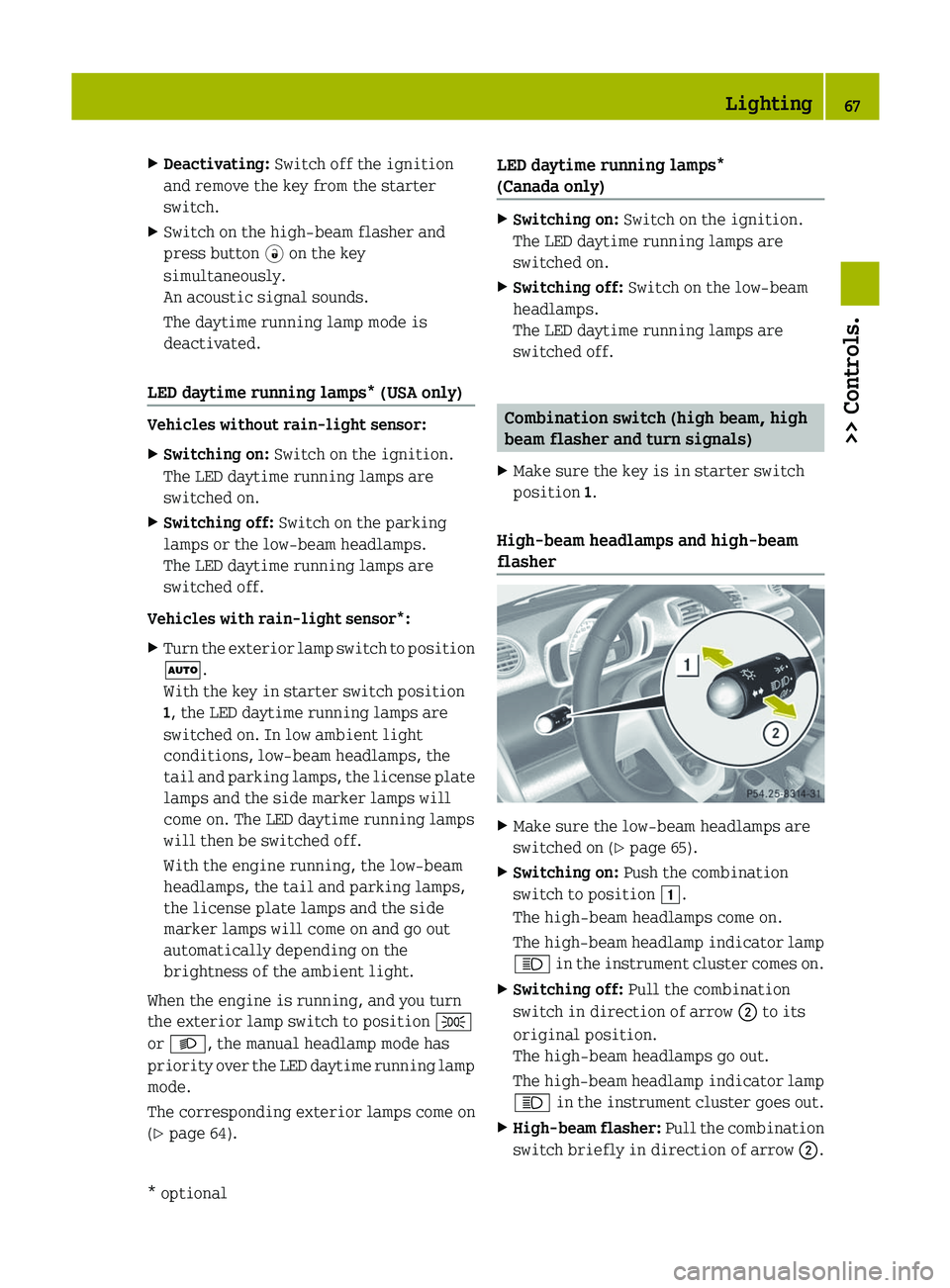
High‑beam headlamps and high-beam
flasher X
Make sure the low‑beam headlamps are
switched on (Y page 65).
X Switching on: Push the combination
switch to position 1.
The high‑beam headlamps come on.
The
high‑beam headlamp indicator lamp
K in the instrument cluster comes on.
X Switching off: Pull the combination
switch in direction of arrow ; to its
original position.
The high‑beam headlamps go out.
The
high‑beam headlamp indicator lamp
K in the instrument cluster goes out.
X High-beam flasher:
Pull the combination
switch briefly in direction of arrow ;. Lighting
67
>> Controls.
* optional Z
Page 70 of 228
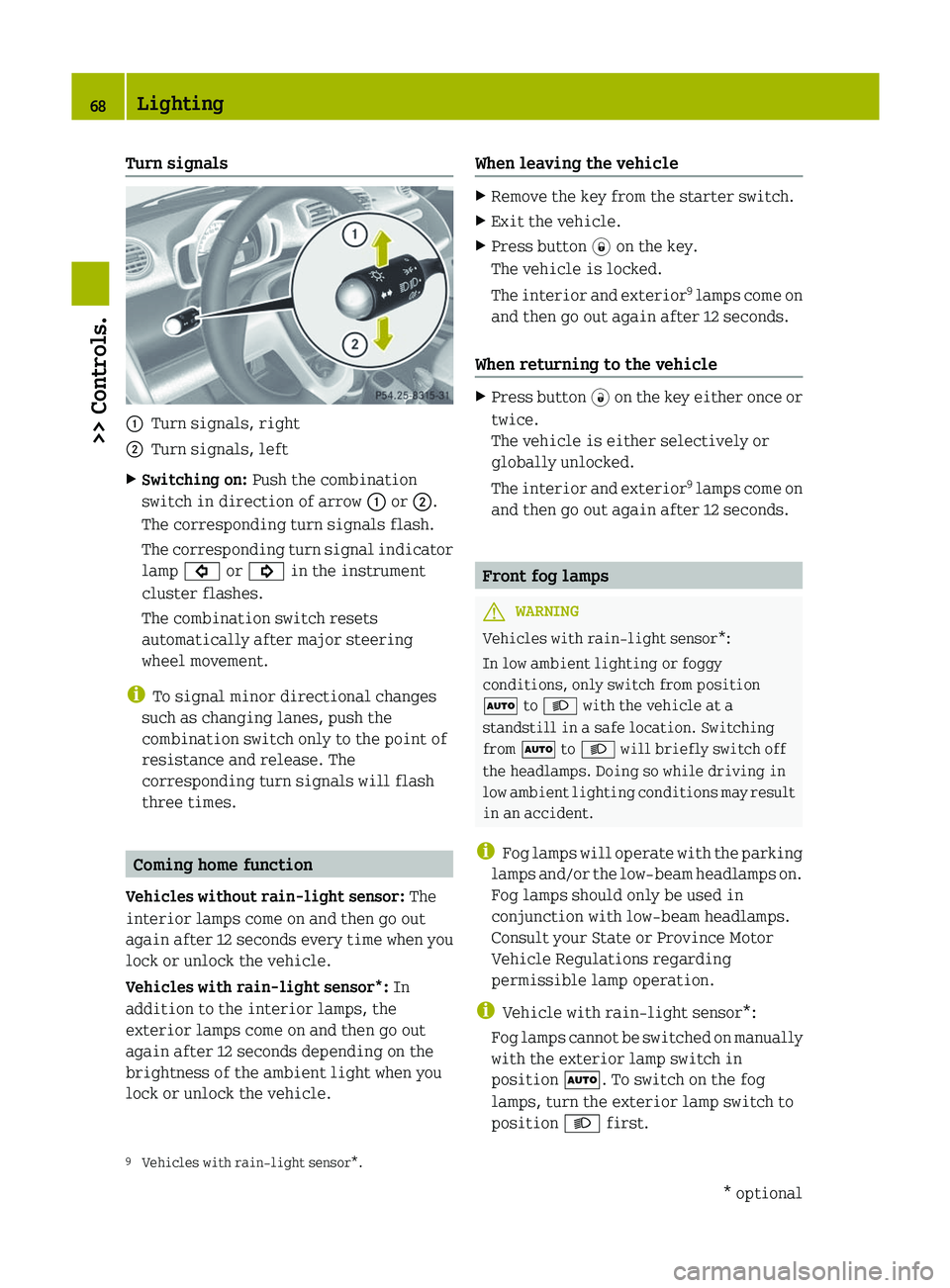
Turn signals
:
Turn signals, right
; Turn signals, left
X Switching on: Push the combination
switch in direction of arrow : or ;.
The corresponding turn signals flash.
The
corresponding turn signal indicator
lamp # or ! in the instrument
cluster flashes.
The combination switch resets
automatically after major steering
wheel movement.
i To signal minor directional changes
such as changing lanes, push the
combination switch only to the point of
resistance and release. The
corresponding turn signals will flash
three times. Coming home function
Vehicles without rain-light sensor: The
interior lamps come on and then go out
again
after 12 seconds every time when you
lock or unlock the vehicle.
Vehicles with rain-light sensor*: In
addition to the interior lamps, the
exterior lamps come on and then go out
again after 12 seconds depending on the
brightness of the ambient light when you
lock or unlock the vehicle. When leaving the vehicle X
Remove the key from the starter switch.
X Exit the vehicle.
X Press button * on the key.
The vehicle is locked.
The
interior and exterior 9
lamps come on
and then go out again after 12 seconds.
When returning to the vehicle X
Press button #
on the key either once or
twice.
The vehicle is either selectively or
globally unlocked.
The interior and exterior 9
lamps come on
and then go out again after 12 seconds. Front fog lamps
G
WARNING
Vehicles with rain-light sensor*:
In low ambient lighting or foggy
conditions, only switch from position
à to L with the vehicle at a
standstill in a safe location. Switching
from à to L will briefly switch off
the headlamps. Doing so while driving in
low
ambient lighting conditions may result
in an accident.
i Fog lamps will operate with the parking
lamps and/or the low‑beam headlamps on.
Fog lamps should only be used in
conjunction with low‑beam headlamps.
Consult your State or Province Motor
Vehicle Regulations regarding
permissible lamp operation.
i Vehicle with rain-light sensor*:
Fog lamps cannot be switched on manually
with the exterior lamp switch in
position Ã. To switch on the fog
lamps, turn the exterior lamp switch to
position L first.
9 Vehicles with rain-light sensor*. 68
Lighting
>> Controls.
* optional
Page 71 of 228
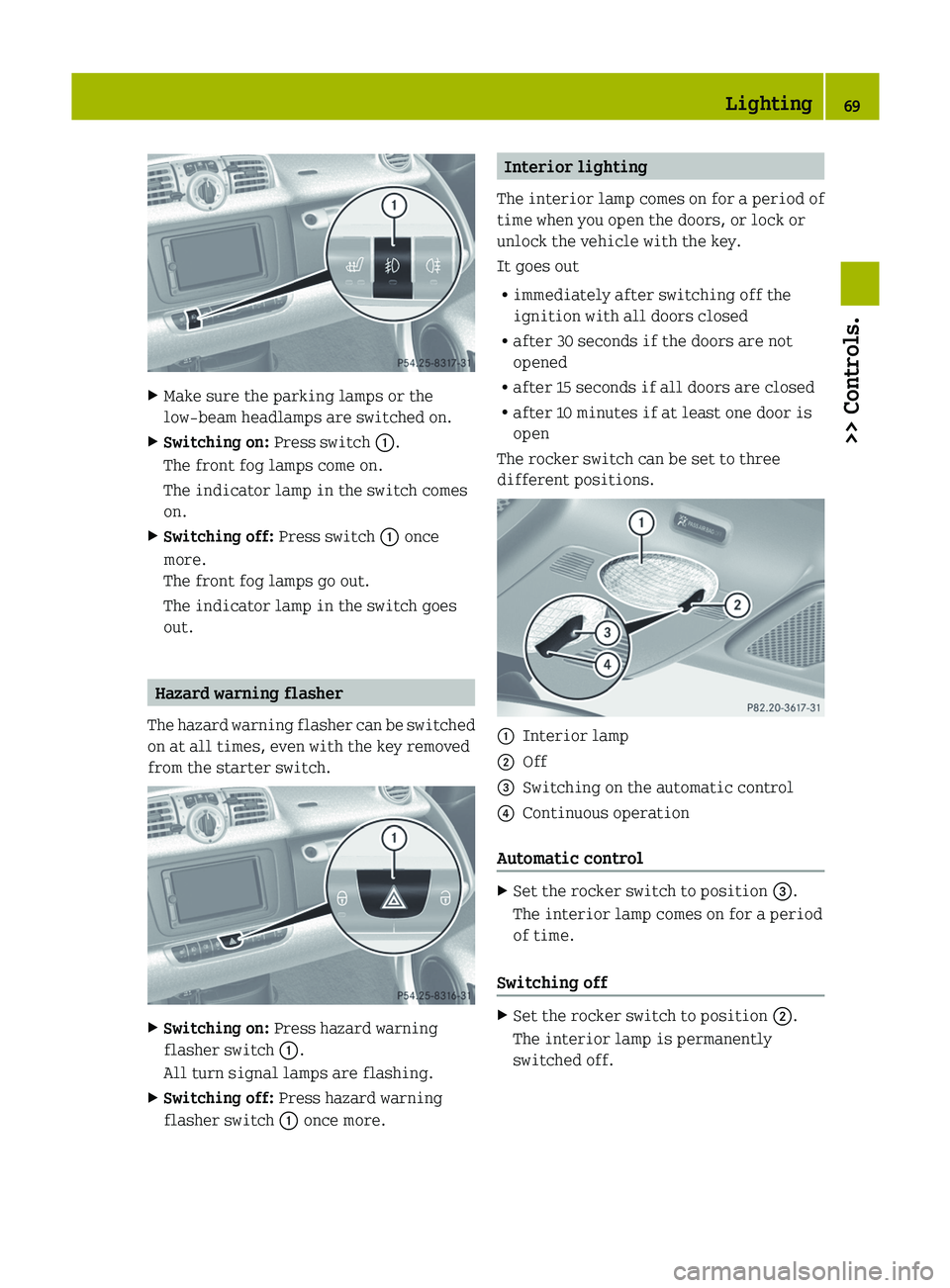
X
Make sure the parking lamps or the
low‑beam headlamps are switched on.
X Switching on: Press switch :.
The front fog lamps come on.
The indicator lamp in the switch comes
on.
X Switching off: Press switch : once
more.
The front fog lamps go out.
The indicator lamp in the switch goes
out. Hazard warning flasher
The hazard warning flasher can be switched
on at all times, even with the key removed
from the starter switch. X
Switching on: Press hazard warning
flasher switch :.
All turn signal lamps are flashing.
X Switching off: Press hazard warning
flasher switch : once more. Interior lighting
The
interior lamp comes on for a period of
time when you open the doors, or lock or
unlock the vehicle with the key.
It goes out
R immediately after switching off the
ignition with all doors closed
R after 30 seconds if the doors are not
opened
R after 15 seconds if all doors are closed
R after 10 minutes if at least one door is
open
The rocker switch can be set to three
different positions. :
Interior lamp
; Off
= Switching on the automatic control
? Continuous operation
Automatic control X
Set the rocker switch to position =.
The interior lamp comes on for a period
of time.
Switching off X
Set the rocker switch to position ;.
The interior lamp is permanently
switched off. Lighting
69
>> Controls. Z
Page 72 of 228
Continuous operation
X
Set the rocker switch to position ?.
The interior lamp is permanently
switched on.
! When leaving the vehicle, make sure the
interior lamp is not set to continuous
operation and none of the doors is left
open for a long period of time.
Doing otherwise could result in a
discharged battery.
Ambient lighting* The ambient lighting illuminates the
vehicle
interior with 6 LEDs when the low-
beam headlamps are switched on. The LEDs
can be dimmed.
The LEDS are located
R in the overhead control panel
R in the door pockets, driver’s and
passenger side
R in the storage trays to the left and right
of the steering wheel
R in the storage compartment, passenger
side
In addition to the ambient lighting, the
footwells on the driver’s and passenger
side are also illuminated by separate
lamps.
i When you open a door, the interior
lighting comes on and the brightness of
lamps in the footwells increases. X
Make sure the key is in starter switch
position 1.
X Switch on the low-beam headlamps.
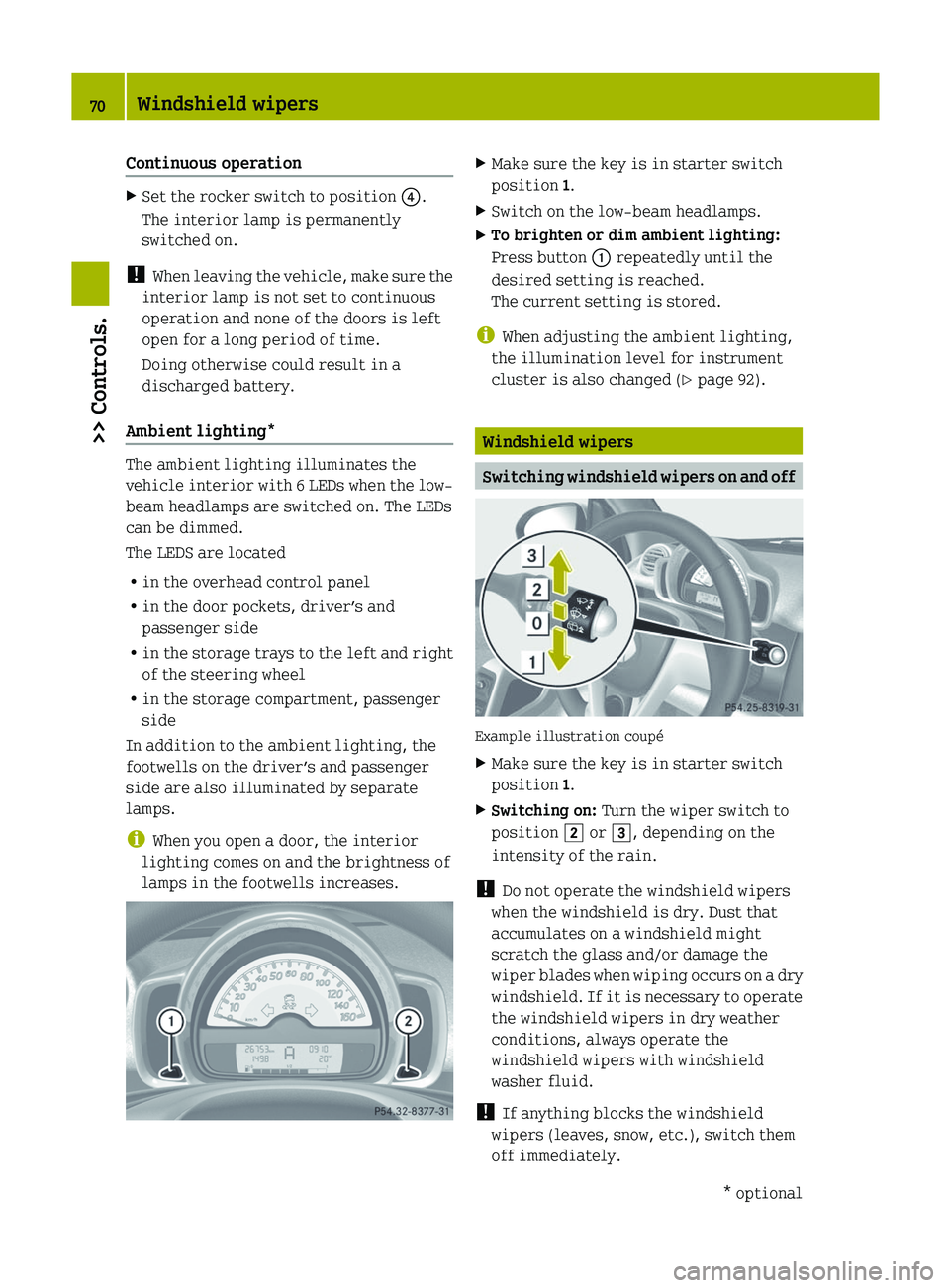
X To brighten or dim ambient lighting:
Press button : repeatedly until the
desired setting is reached.
The current setting is stored.
i When adjusting the ambient lighting,
the illumination level for instrument
cluster is also changed (Y page 92). Windshield wipers
Switching windshield wipers on and off
Example illustration coupé
X
Make sure the key is in starter switch
position 1.
X Switching on: Turn the wiper switch to
position 2 or 3, depending on the
intensity of the rain.
! Do not operate the windshield wipers
when the windshield is dry. Dust that
accumulates on a windshield might
scratch the glass and/or damage the
wiper
blades when wiping occurs on a dry
windshield. If it is necessary to operate
the windshield wipers in dry weather
conditions, always operate the
windshield wipers with windshield
washer fluid.
! If anything blocks the windshield
wipers (leaves, snow, etc.), switch them
off immediately. 70
Windshield wipers
>> Controls.
* optional
Page 73 of 228
For safety reasons, stop the vehicle in a
safe location and
R
-
remove the key from the starter
switch
- engage the parking brake
before attempting to remove any
blockage.
R Remove blockage.
R Turn the windshield wipers on again.
X Switching off: Turn the wiper switch to
position g. Intermittent wiping
Only switch on intermittent wiping under
wet weather conditions or in the presence
of precipitation.
Vehicles
with rain-light sensor*: When you
select intermittent wiping, the sensor is
activated. The sensor automatically sets a
suitable wiping interval depending on the
wetness of the sensor surface.
! Vehicles with rain-light sensor*:
Do not leave windshield wipers in
intermittent setting when the vehicle is
taken to an automatic car wash or during
windshield cleaning. Windshield wipers
will operate in the presence of water
sprayed on the windshield, and
windshield wipers may be damaged as a
result.
! Vehicles with rain-light sensor*:
If you have set intermittent wiping, dirt
on the surface of the sensor or optical
effects may cause the windshield wipers
to wipe in an undesired fashion. This
could then damage the windshield wiper
blades or scratch the windshield. You
should therefore switch off the
windshield wipers when weather
conditions are dry. X
Make sure the key is in starter switch
position 1.
X Activating intermittent wiping:
Turn the
wiper switch to position 1.
After the initial wipe, pauses between
wipes are automatically controlled
depending on the vehicle speed and by the
rain-light sensor*.
X Deactivating intermittent wiping: Turn
the wiper switch to position g. Wiping with windshield washer fluid
Example illustration coupé
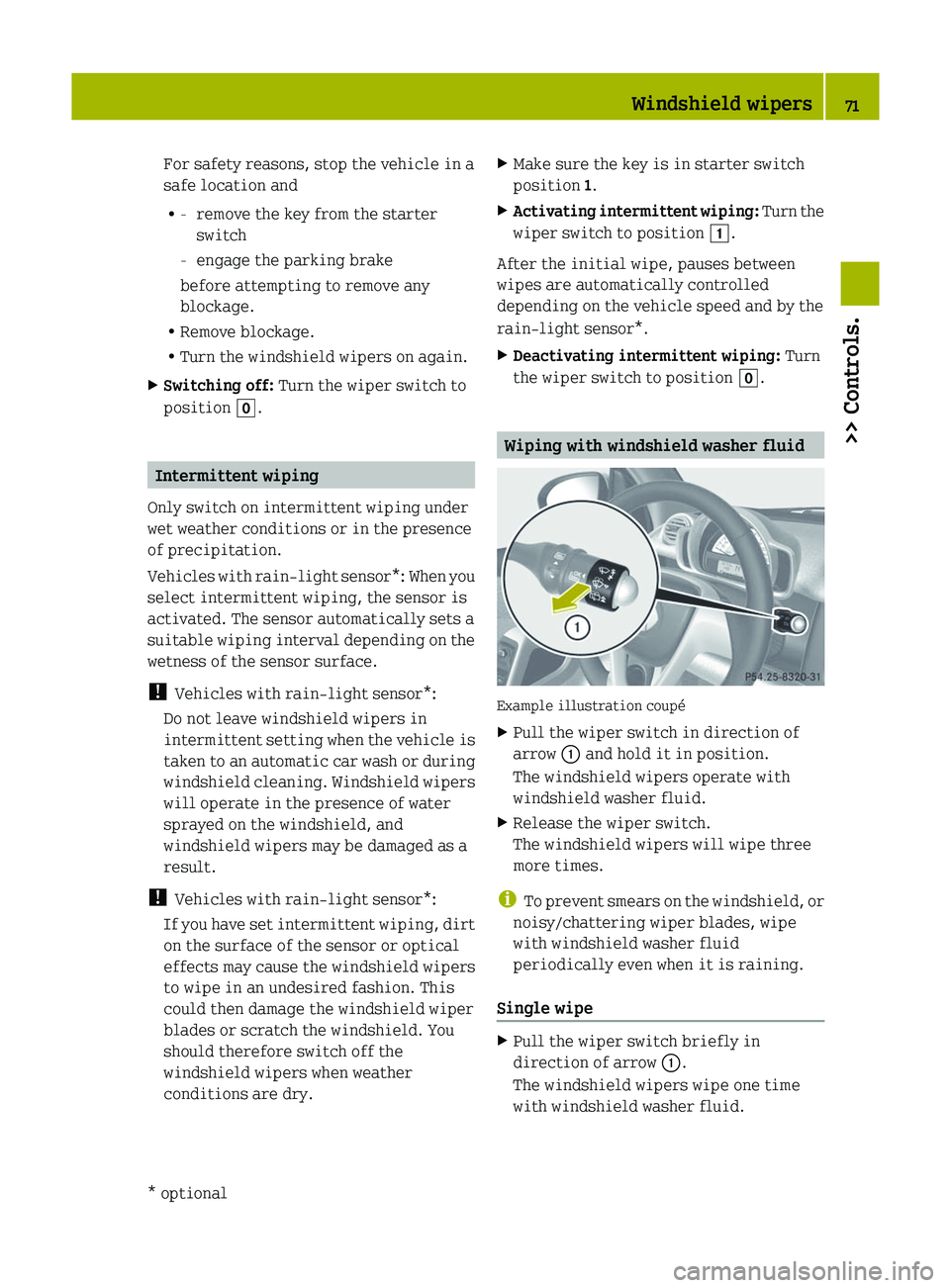
X
Pull the wiper switch in direction of
arrow : and hold it in position.
The windshield wipers operate with
windshield washer fluid.
X Release the wiper switch.
The windshield wipers will wipe three
more times.
i To
prevent smears on the windshield, or
noisy/chattering wiper blades, wipe
with windshield washer fluid
periodically even when it is raining.
Single wipe X
Pull the wiper switch briefly in
direction of arrow :.
The windshield wipers wipe one time
with windshield washer fluid. Windshield wipers
71
>> Controls.
* optional Z
Page 74 of 228
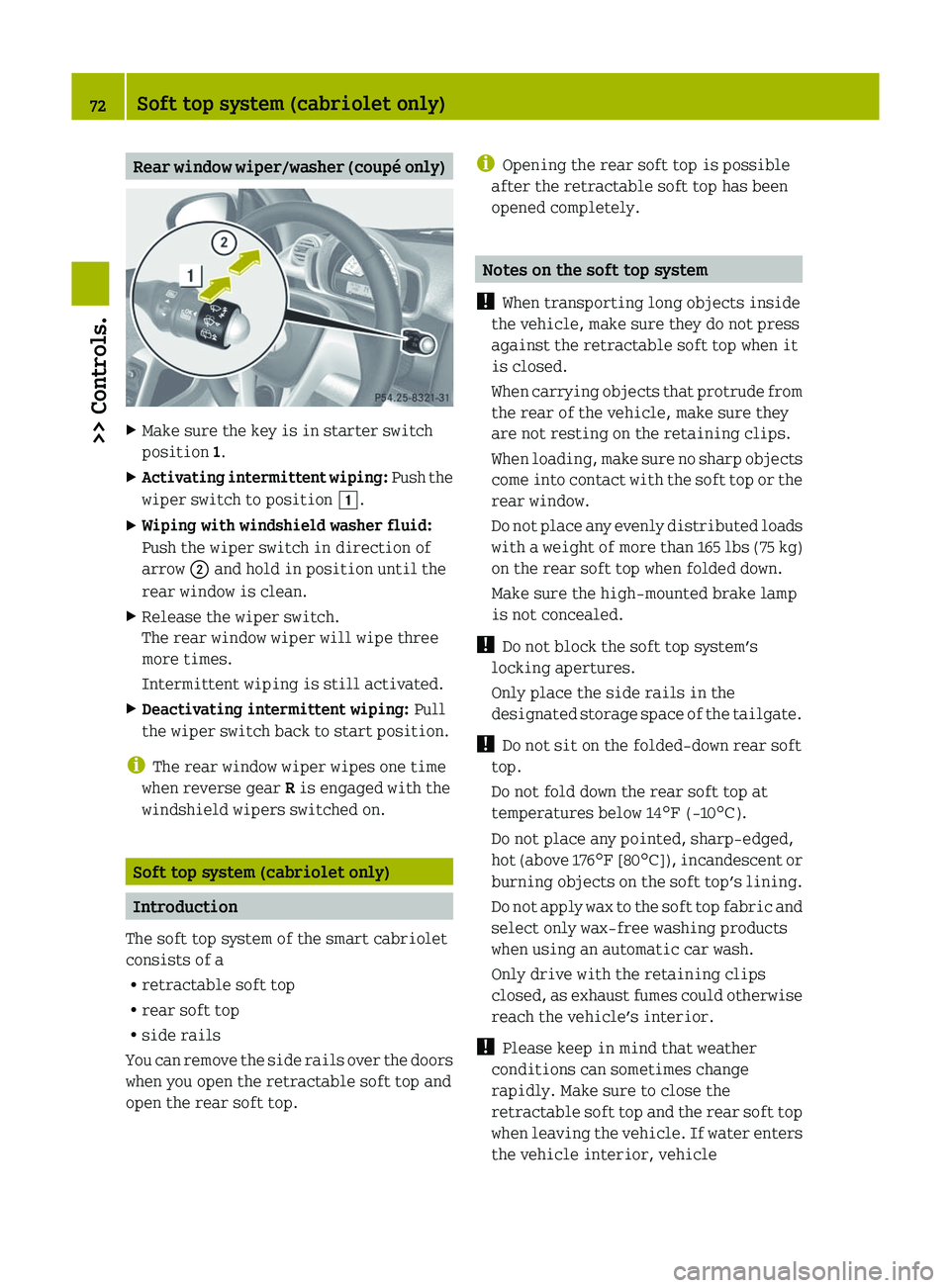
Rear window wiper/washer (coupé only)
X
Make sure the key is in starter switch
position 1.
X Activating intermittent wiping: Push the
wiper switch to position 1.
X Wiping with windshield washer fluid:
Push the wiper switch in direction of
arrow ; and hold in position until the
rear window is clean.
X Release the wiper switch.
The rear window wiper will wipe three
more times.
Intermittent wiping is still activated.
X Deactivating intermittent wiping: Pull
the wiper switch back to start position.
i The rear window wiper wipes one time
when reverse gear R is engaged with the
windshield wipers switched on. Soft top system (cabriolet only)
Introduction
The soft top system of the smart cabriolet
consists of a
R retractable soft top
R rear soft top
R side rails
You
can remove the side rails over the doors
when you open the retractable soft top and
open the rear soft top. i
Opening the rear soft top is possible
after the retractable soft top has been
opened completely. Notes on the soft top system
! When transporting long objects inside
the vehicle, make sure they do not press
against the retractable soft top when it
is closed.
When
carrying objects that protrude from
the rear of the vehicle, make sure they
are not resting on the retaining clips.
When loading, make sure no sharp objects
come into contact with the soft top or the
rear window.
Do not place any evenly distributed loads
with a weight of more than 165 lbs (75 kg)
on the rear soft top when folded down.
Make sure the high-mounted brake lamp
is not concealed.
! Do not block the soft top system’s
locking apertures.
Only place the side rails in the
designated storage space of the tailgate.
! Do not sit on the folded-down rear soft
top.
Do not fold down the rear soft top at
temperatures below 14 ¦ (-10¥).
Do not place any pointed, sharp-edged,
hot (above 176 ¦ [80¥]), incandescent or
burning objects on the soft top’s lining.
Do not apply wax to the soft top fabric and
select only wax-free washing products
when using an automatic car wash.
Only drive with the retaining clips
closed, as exhaust fumes could otherwise
reach the vehicle’s interior.
! Please keep in mind that weather
conditions can sometimes change
rapidly. Make sure to close the
retractable soft top and the rear soft top
when leaving the vehicle. If water enters
the vehicle interior, vehicle 72
Soft top system (cabriolet only)
>> Controls.
Page 75 of 228
electronics could be damaged which is
not covered by the smart Limited
Warranty.
Opening and closing the retractable
soft top
You
can open and close the retractable soft
top when the vehicle is either stationary
or in motion. G
WARNING
Never operate the retractable soft top if
there is the possibility of anyone being
harmed by the opening or closing
procedure. G
WARNING
The retractable soft top is made out of
fabric. In the event of an accident, the
fabric may tear. This may result in an
opening in the roof.
In a vehicle rollover, occupants not
wearing their seat belts or not wearing
them properly may be thrown out of the
opening. Such an opening also presents a
potential
for injury for occupants wearing
their seat belts properly as entire body
parts or portions of them may protrude from
the passenger compartment. G
WARNING
When leaving the vehicle, always remove the
key from the starter switch, take it with
you, and lock the vehicle. Do not leave
children
unattended in the vehicle, or with
access to an unlocked vehicle. A child’s
unsupervised access to a vehicle could
result in an accident and/or serious
personal injury.
! To avoid damaging the seals, do not
transport any objects with sharp edges
which can stick out of the retractable
soft top. Do not open the retractable soft top if
there is snow or ice on the roof, as this
could result in malfunctions.
If you cannot open or close the
retractable
soft top due to a malfunction
contact Roadside Assistance or an
authorized smart center.
i To avoid draining the battery, leave the
engine running when opening and
closing the retractable soft top.
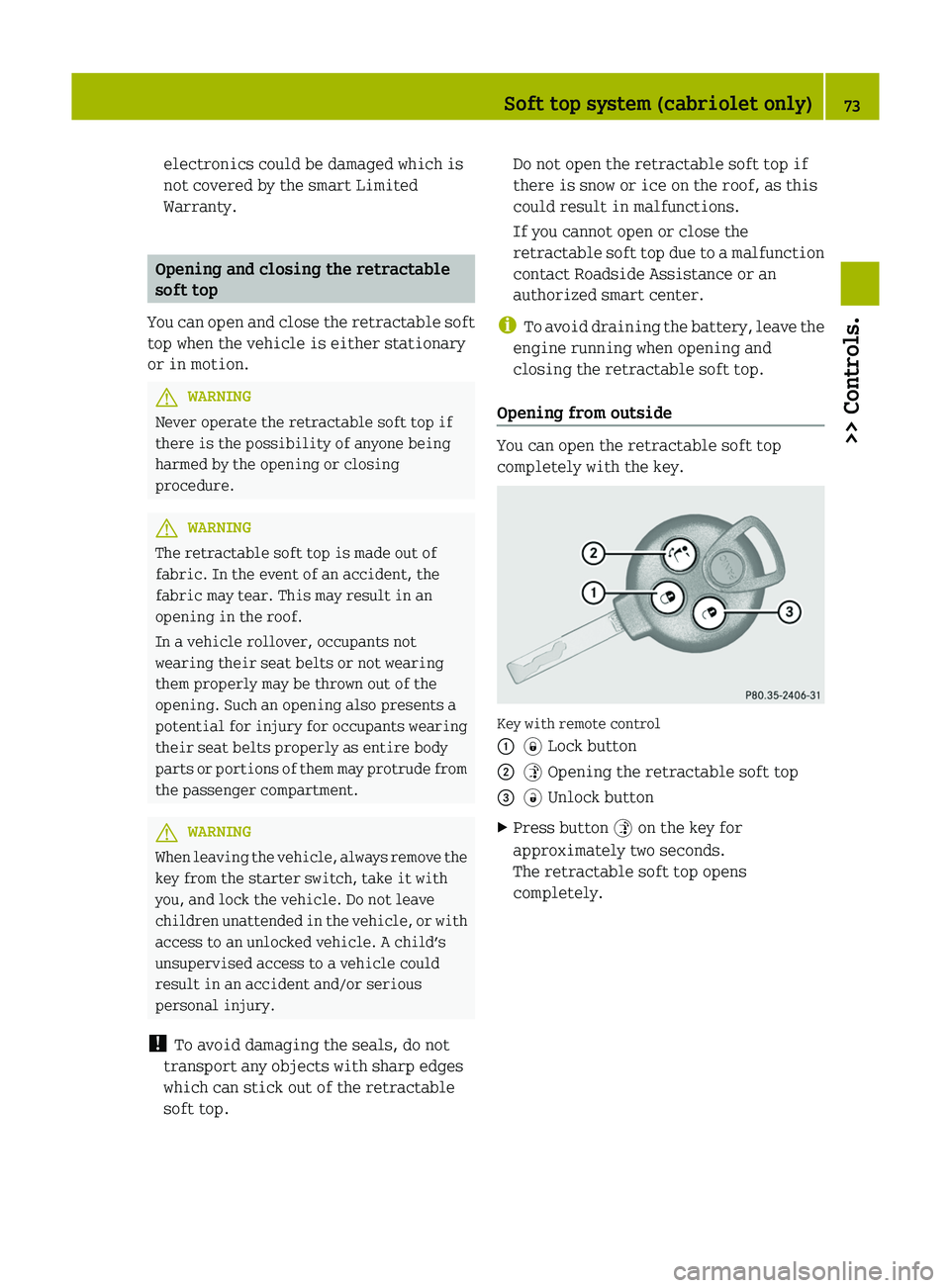
Opening from outside You can open the retractable soft top
completely with the key.
Key with remote control
:
* Lock button
; $ Opening the retractable soft top
= # Unlock button
X Press button $ on the key for
approximately two seconds.
The retractable soft top opens
completely. Soft top system (cabriolet only)
73
>> Controls. Z
Page 76 of 228
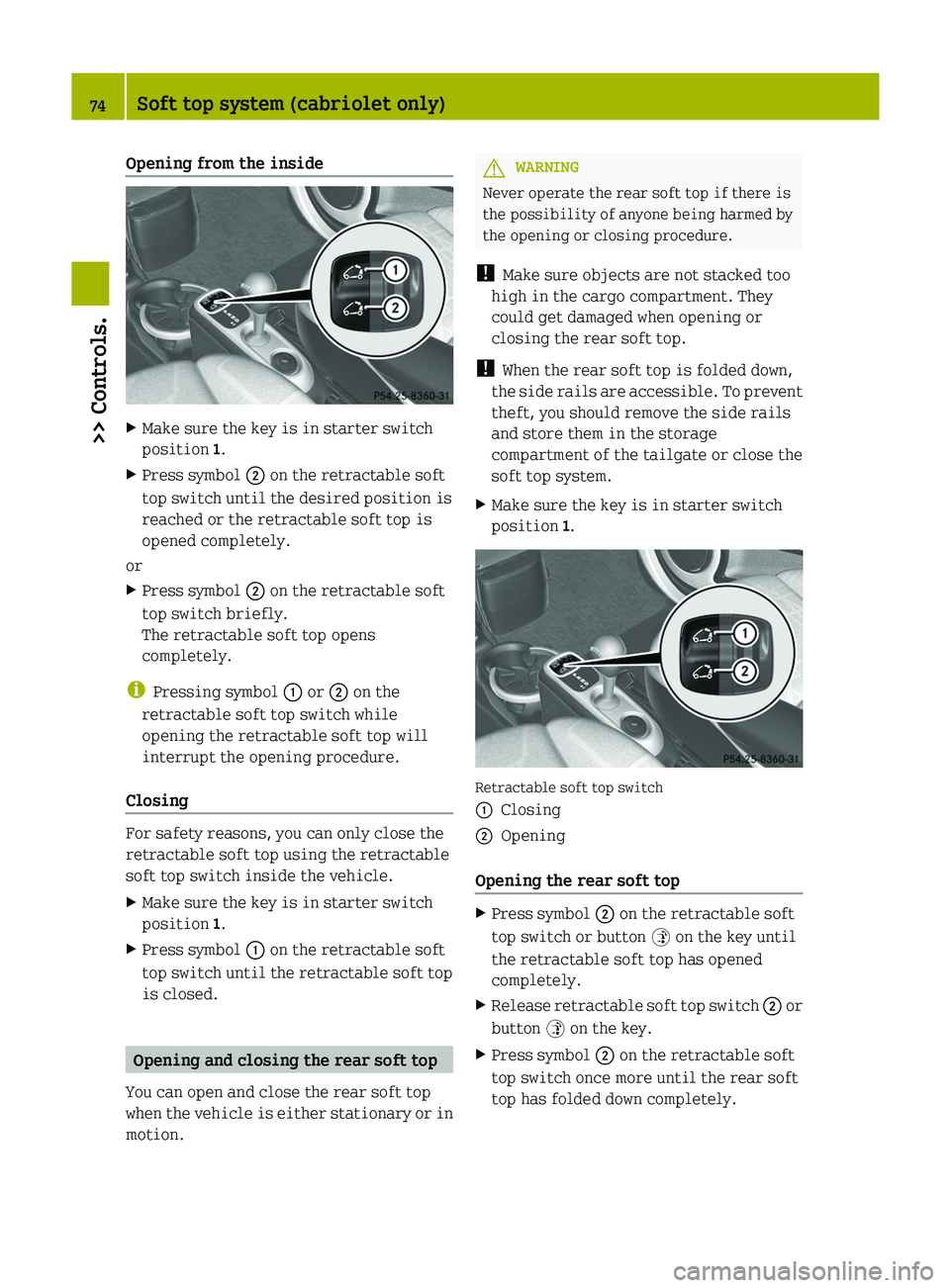
Opening from the inside
X
Make sure the key is in starter switch
position 1.
X Press symbol ; on the retractable soft
top switch until the desired position is
reached or the retractable soft top is
opened completely.
or
X Press symbol ; on the retractable soft
top switch briefly.
The retractable soft top opens
completely.
i Pressing symbol : or ; on the
retractable soft top switch while
opening the retractable soft top will
interrupt the opening procedure.
Closing For safety reasons, you can only close the
retractable soft top using the retractable
soft top switch inside the vehicle.
X
Make sure the key is in starter switch
position 1.
X Press symbol : on the retractable soft
top switch until the retractable soft top
is closed. Opening and closing the rear soft top
You can open and close the rear soft top
when
the vehicle is either stationary or in
motion. G
WARNING
Never operate the rear soft top if there is
the possibility of anyone being harmed by
the opening or closing procedure.
! Make sure objects are not stacked too
high in the cargo compartment. They
could get damaged when opening or
closing the rear soft top.
! When the rear soft top is folded down,
the
side rails are accessible. To prevent
theft, you should remove the side rails
and store them in the storage
compartment of the tailgate or close the
soft top system.
X Make sure the key is in starter switch
position 1. Retractable soft top switch
:
Closing
; Opening
Opening the rear soft top X
Press symbol ; on the retractable soft
top switch or button $ on the key until
the retractable soft top has opened
completely.
X Release retractable soft top switch ;
or
button $ on the key.
X Press symbol ; on the retractable soft
top switch once more until the rear soft
top has folded down completely. 74
Soft top system (cabriolet only)
>> Controls.
Page 80 of 228
G
WARNING
When closing the windows, make sure there
is no danger of anyone being harmed by the
closing procedure.
The closing of the side windows can be
immediately stopped by releasing the
switch.
When leaving the vehicle, always remove the
key from the starter switch, take it with
you, and lock the vehicle. Do not leave
children unattended in the vehicle, or with
access to an unlocked vehicle. A child’s
unsupervised access to a vehicle could
result in an accident and/or serious
personal injury.
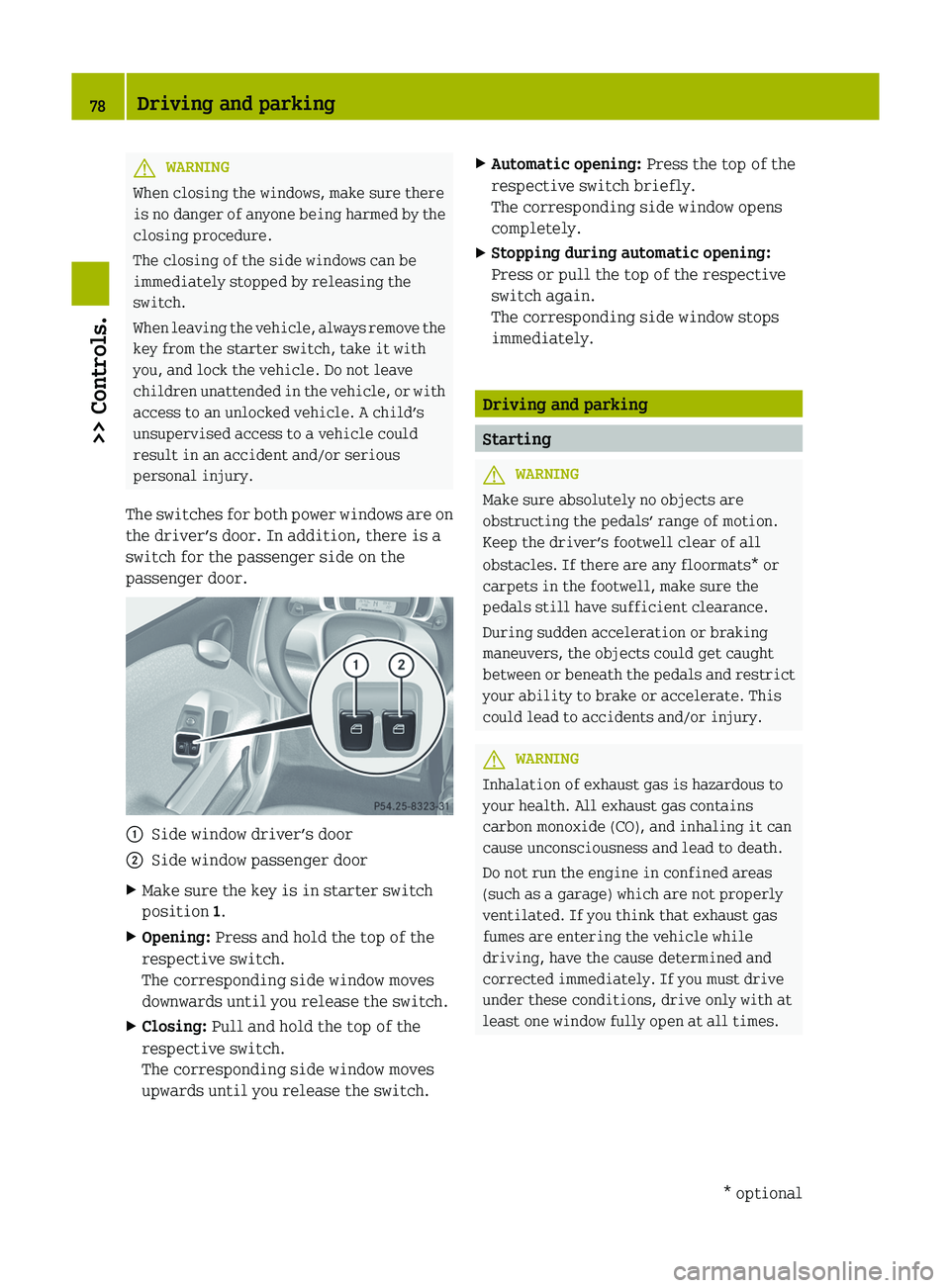
The switches for both power windows are on
the driver’s door. In addition, there is a
switch for the passenger side on the
passenger door. :
Side window driver’s door
; Side window passenger door
X Make sure the key is in starter switch
position 1.
X Opening: Press and hold the top of the
respective switch.
The corresponding side window moves
downwards until you release the switch.
X Closing: Pull and hold the top of the
respective switch.
The corresponding side window moves
upwards until you release the switch. X
Automatic opening: Press the top of the
respective switch briefly.
The corresponding side window opens
completely.
X Stopping during automatic opening:
Press or pull the top of the respective
switch again.
The corresponding side window stops
immediately. Driving and parking
Starting
G
WARNING
Make sure absolutely no objects are
obstructing the pedals’ range of motion.
Keep the driver’s footwell clear of all
obstacles. If there are any floormats*
or
carpets in the footwell, make sure the
pedals still have sufficient clearance.
During sudden acceleration or braking
maneuvers, the objects could get caught
between or beneath the pedals and restrict
your ability to brake or accelerate. This
could lead to accidents and/or injury. G
WARNING
Inhalation of exhaust gas is hazardous to
your health. All exhaust gas contains
carbon monoxide (CO), and inhaling it can
cause unconsciousness and lead to death.
Do not run the engine in confined areas
(such as a garage) which are not properly
ventilated. If you think that exhaust gas
fumes are entering the vehicle while
driving, have the cause determined and
corrected immediately. If you must drive
under these conditions, drive only with at
least one window fully open at all times. 78
Driving and parking
>> Controls.
* optional
Page 81 of 228
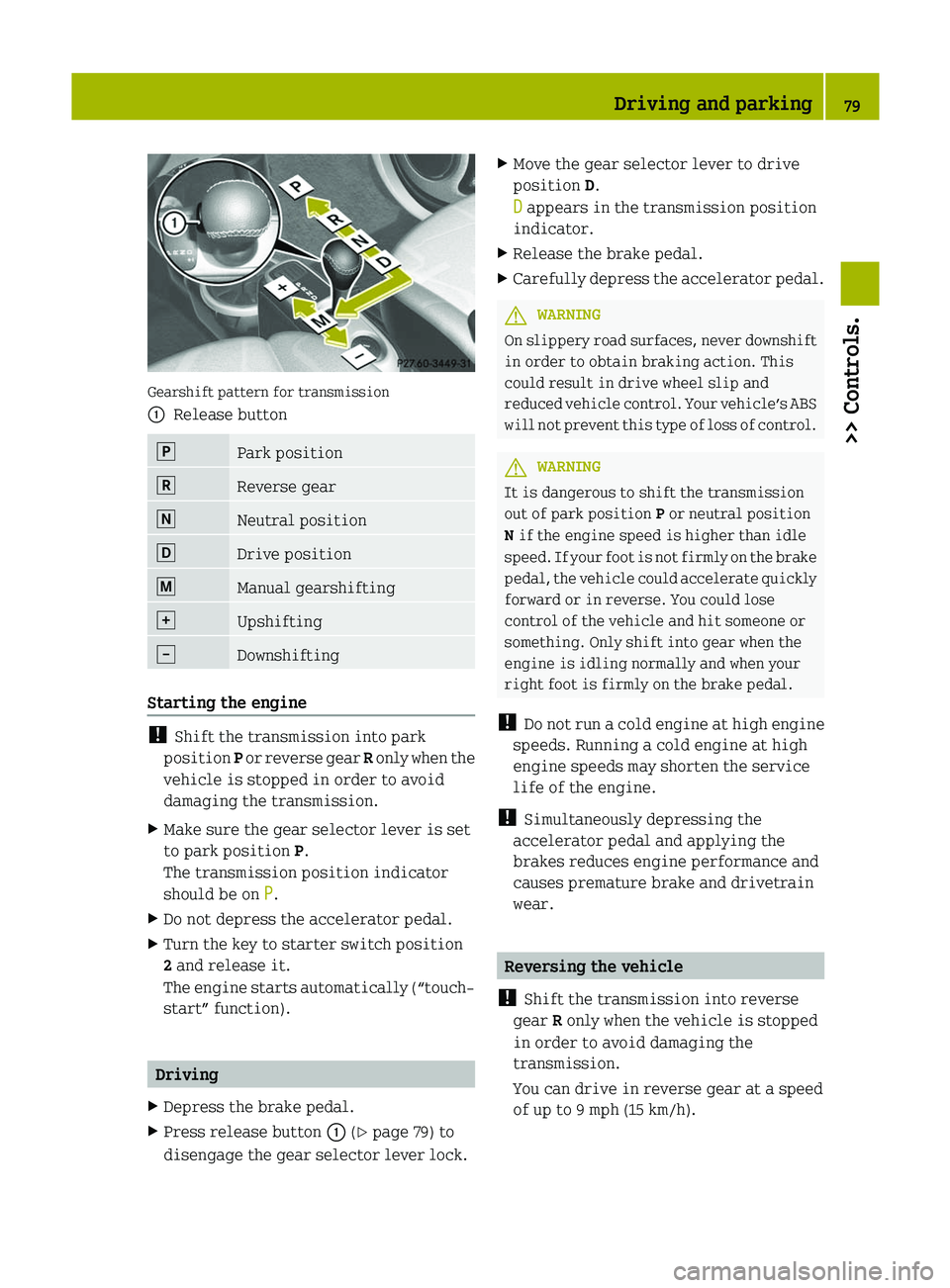
Gearshift pattern for transmission
:
Release button j
Park position
k
Reverse gear
i
Neutral position
h
Drive position
p
Manual gearshifting
q
Upshifting
±
Downshifting
Starting the engine
!
Shift the transmission into park
position P
or reverse gear R only when the
vehicle is stopped in order to avoid
damaging the transmission.
X Make sure the gear selector lever is set
to park position P.
The transmission position indicator
should be on P.
X Do not depress the accelerator pedal.
X Turn the key to starter switch position
2 and release it.
The
engine starts automatically (“touch-
start” function). Driving
X Depress the brake pedal.
X Press release button : (Y page 79) to
disengage the gear selector lever lock. X
Move the gear selector lever to drive
position D.
D appears in the transmission position
indicator.
X Release the brake pedal.
X Carefully depress the accelerator pedal. G
WARNING
On slippery road surfaces, never downshift
in order to obtain braking action. This
could result in drive wheel slip and
reduced
vehicle control. Your vehicle’s ABS
will not prevent this type of loss of control. G
WARNING
It is dangerous to shift the transmission
out of park position P or neutral position
N if the engine speed is higher than idle
speed.
If your foot is not firmly on the brake
pedal, the vehicle could accelerate quickly
forward or in reverse. You could lose
control of the vehicle and hit someone or
something. Only shift into gear when the
engine is idling normally and when your
right foot is firmly on the brake pedal.
! Do not run a cold engine at high engine
speeds. Running a cold engine at high
engine speeds may shorten the service
life of the engine.
! Simultaneously depressing the
accelerator pedal and applying the
brakes reduces engine performance and
causes premature brake and drivetrain
wear. Reversing the vehicle
! Shift the transmission into reverse
gear R only when the vehicle is stopped
in order to avoid damaging the
transmission.
You can drive in reverse gear at a speed
of up to 9 mph (15 km/h). Driving and parking
79
>> Controls. Z