tailgate SMART FORTWO COUPE 2012 User Guide
[x] Cancel search | Manufacturer: SMART, Model Year: 2012, Model line: FORTWO COUPE, Model: SMART FORTWO COUPE 2012Pages: 228, PDF Size: 12.76 MB
Page 76 of 228
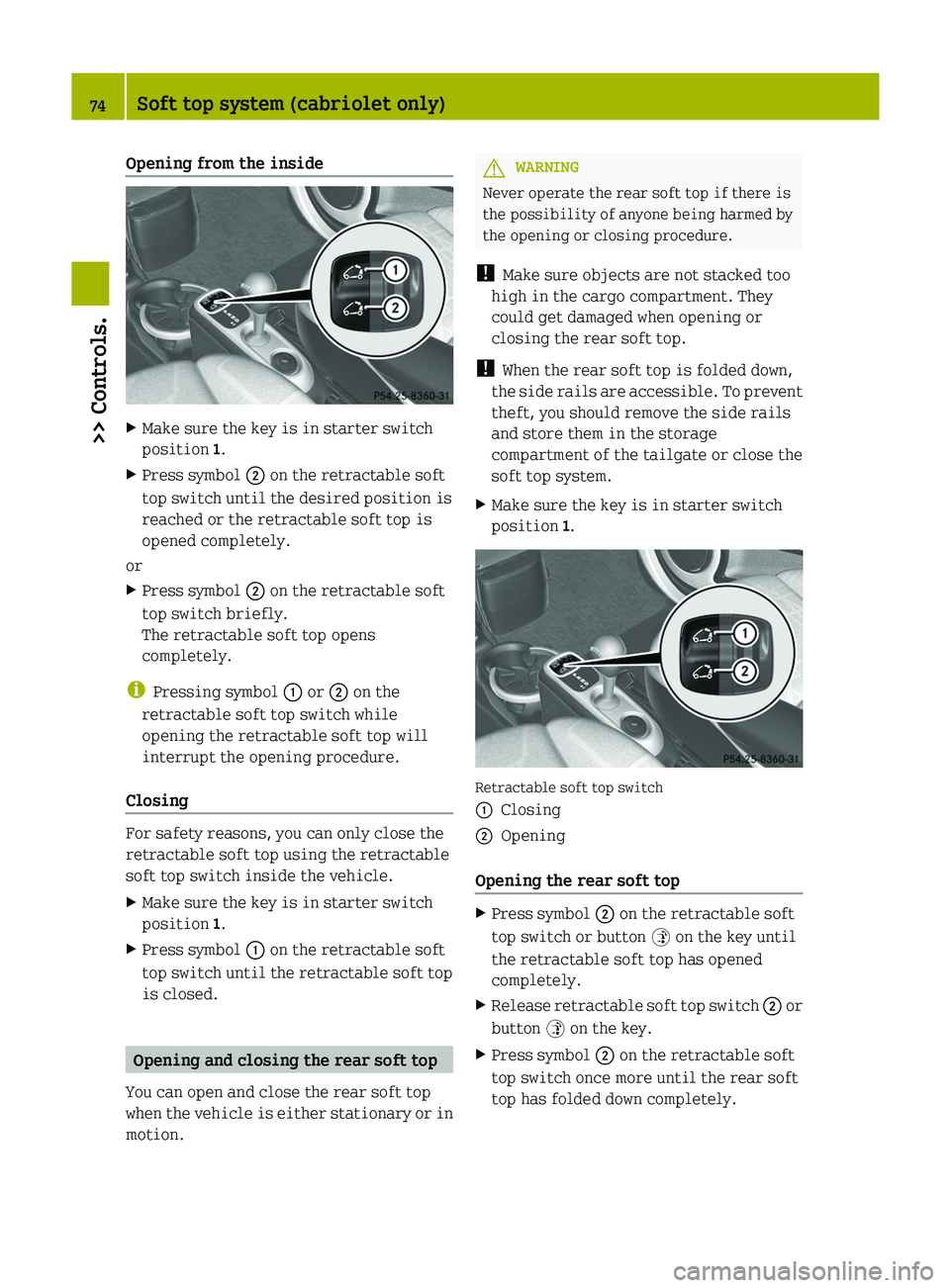
Opening from the inside
X
Make sure the key is in starter switch
position 1.
X Press symbol ; on the retractable soft
top switch until the desired position is
reached or the retractable soft top is
opened completely.
or
X Press symbol ; on the retractable soft
top switch briefly.
The retractable soft top opens
completely.
i Pressing symbol : or ; on the
retractable soft top switch while
opening the retractable soft top will
interrupt the opening procedure.
Closing For safety reasons, you can only close the
retractable soft top using the retractable
soft top switch inside the vehicle.
X
Make sure the key is in starter switch
position 1.
X Press symbol : on the retractable soft
top switch until the retractable soft top
is closed. Opening and closing the rear soft top
You can open and close the rear soft top
when
the vehicle is either stationary or in
motion. G
WARNING
Never operate the rear soft top if there is
the possibility of anyone being harmed by
the opening or closing procedure.
! Make sure objects are not stacked too
high in the cargo compartment. They
could get damaged when opening or
closing the rear soft top.
! When the rear soft top is folded down,
the
side rails are accessible. To prevent
theft, you should remove the side rails
and store them in the storage
compartment of the tailgate or close the
soft top system.
X Make sure the key is in starter switch
position 1. Retractable soft top switch
:
Closing
; Opening
Opening the rear soft top X
Press symbol ; on the retractable soft
top switch or button $ on the key until
the retractable soft top has opened
completely.
X Release retractable soft top switch ;
or
button $ on the key.
X Press symbol ; on the retractable soft
top switch once more until the rear soft
top has folded down completely. 74
Soft top system (cabriolet only)
>> Controls.
Page 77 of 228
Closing the rear soft top
X
Press symbol : on the retractable soft
top switch until the rear soft top has
folded up completely.
X Release retractable soft top switch :.
i If you release the retractable soft top
switch
while driving before the rear soft
top has closed completely, the rear soft
top will fold down again. Removing the side rails
X Open the retractable soft top
(Y page 56).
X Open the rear soft top ( Y page 74).
X Open the driver’s and passenger door
when conditions are safe to do so.
X Open the tailgate (Y page 56). X
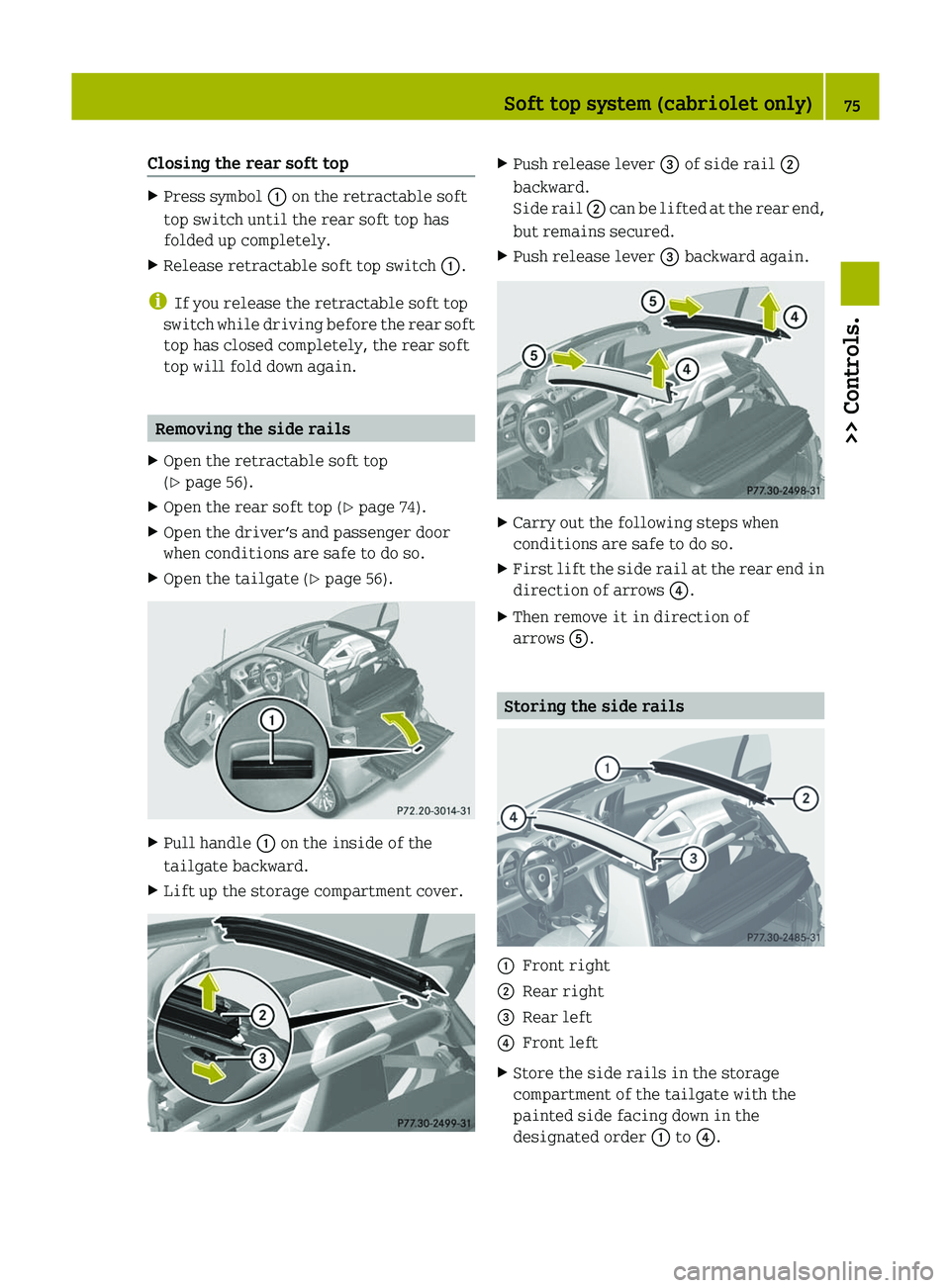
Pull handle : on the inside of the
tailgate backward.
X Lift up the storage compartment cover. X
Push release lever = of side rail ;
backward.
Side
rail ; can be lifted at the rear end,
but remains secured.
X Push release lever = backward again. X
Carry out the following steps when
conditions are safe to do so.
X First lift the side rail at the rear end in
direction of arrows ?.
X Then remove it in direction of
arrows A. Storing the side rails
:
Front right
; Rear right
= Rear left
? Front left
X Store the side rails in the storage
compartment of the tailgate with the
painted side facing down in the
designated order : to ?. Soft top system (cabriolet only)
75
>> Controls. Z
Page 78 of 228
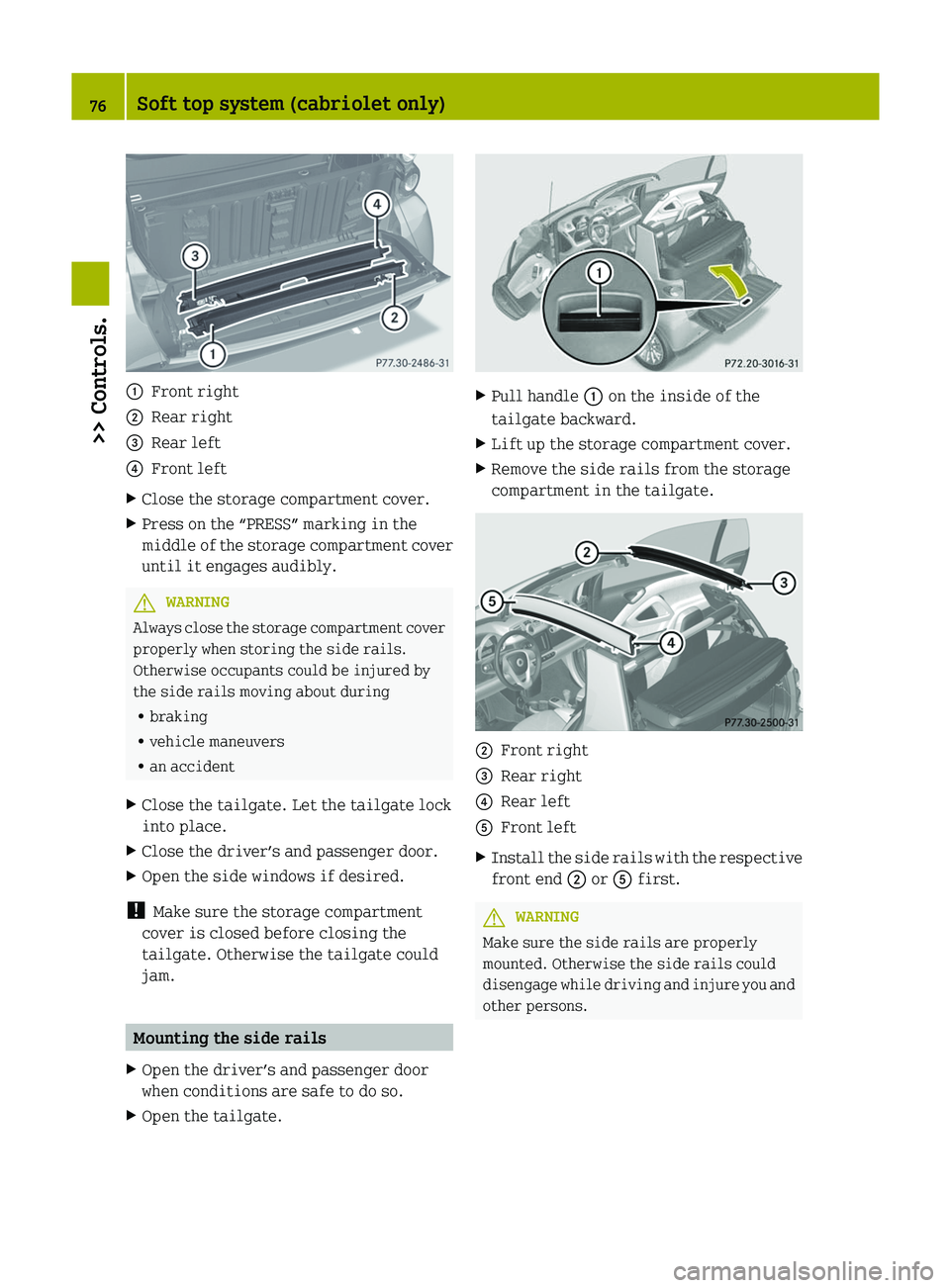
:
Front right
; Rear right
= Rear left
? Front left
X Close the storage compartment cover.
X Press on the “PRESS” marking in the
middle
of the storage compartment cover
until it engages audibly. G
WARNING
Always close the storage compartment cover
properly when storing the side rails.
Otherwise occupants could be injured by
the side rails moving about during
R braking
R vehicle maneuvers
R an accident
X Close the tailgate. Let the tailgate lock
into place.
X Close the driver’s and passenger door.
X Open the side windows if desired.
! Make sure the storage compartment
cover is closed before closing the
tailgate. Otherwise the tailgate could
jam. Mounting the side rails
X Open the driver’s and passenger door
when conditions are safe to do so.
X Open the tailgate. X
Pull handle : on the inside of the
tailgate backward.
X Lift up the storage compartment cover.
X Remove the side rails from the storage
compartment in the tailgate. ;
Front right
= Rear right
? Rear left
A Front left
X Install the side rails with the respective
front end ; or A first. G
WARNING
Make sure the side rails are properly
mounted. Otherwise the side rails could
disengage
while driving and injure you and
other persons. 76
Soft top system (cabriolet only)
>> Controls.
Page 79 of 228
X
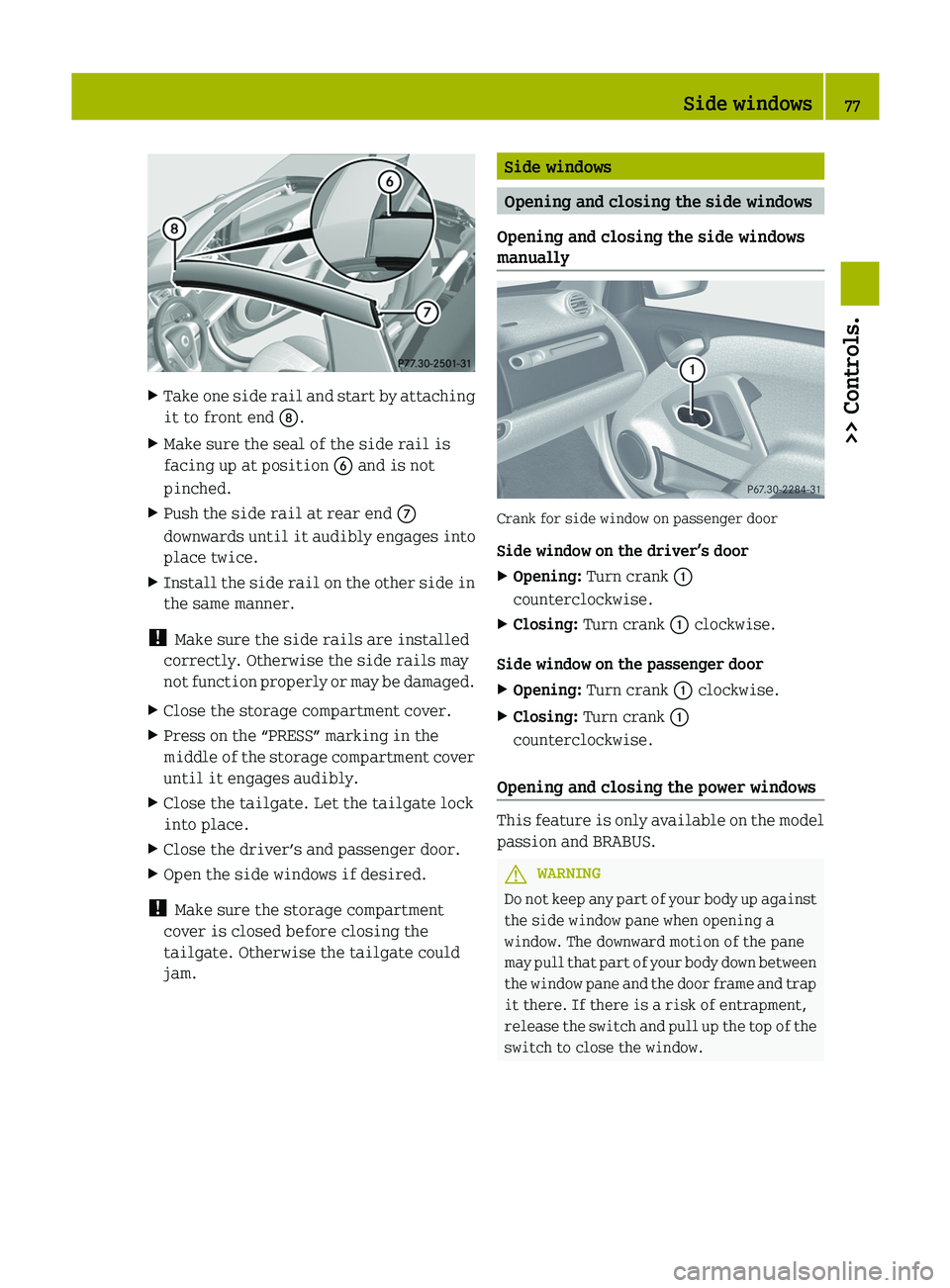
Take one side rail and start by attaching
it to front end D.
X Make sure the seal of the side rail is
facing up at position B and is not
pinched.
X Push the side rail at rear end C
downwards until it audibly engages into
place twice.
X Install the side rail on the other side in
the same manner.
! Make sure the side rails are installed
correctly. Otherwise the side rails may
not
function properly or may be damaged.
X Close the storage compartment cover.
X Press on the “PRESS” marking in the
middle
of the storage compartment cover
until it engages audibly.
X Close the tailgate. Let the tailgate lock
into place.
X Close the driver’s and passenger door.
X Open the side windows if desired.
! Make sure the storage compartment
cover is closed before closing the
tailgate. Otherwise the tailgate could
jam. Side windows
Opening and closing the side windows
Opening and closing the side windows
manually Crank for side window on passenger door
Side window on the driver’s door
X
Opening: Turn crank :
counterclockwise.
X Closing: Turn crank : clockwise.
Side window on the passenger door
X Opening: Turn crank : clockwise.
X Closing: Turn crank :
counterclockwise.
Opening and closing the power windows This feature is only available on the model
passion and BRABUS.
G
WARNING
Do not keep any part of your body up against
the side window pane when opening a
window. The downward motion of the pane
may
pull that part of your body down between
the window pane and the door frame and trap
it there. If there is a risk of entrapment,
release the switch and pull up the top of the
switch to close the window. Side windows
77
>> Controls. Z
Page 110 of 228
event of an accident. For this reason, heavy
objects must be tied down.
Vehicle occupants could be injured by
objects
being thrown around in the vehicle
in the event of
R hard braking
R a change of direction
R an accident G
WARNING
Do not place any objects on the mounted
cargo compartment cover blind.
Vehicle occupants could be injured by
objects
being thrown around in the vehicle
in the event of
R hard braking
R a change of direction
R an accident G
WARNING
Only place light loads in the parcel net
bag.
Do not transport heavy, sharp-edged or
fragile objects in the parcel net bag. The
parcel net bag cannot sufficiently secure
loads in an accident.
Vehicle occupants could be injured by
objects being thrown around in the vehicle
in the event of
R hard braking
R a change of direction
R an accident
Observe the loading guidelines.
The cargo compartment cover blind
R serves to protect objects that are stored
in the vehicle’s cargo compartment from
prying eyes
R prevents smaller objects from
penetrating into the passenger
compartment from the cargo
compartment; however, it is not intended
to act as a load restraining device The parcel net bag
R
is
for storing small, lightweight objects
R prevents small objects from sliding
around inside the passenger
compartment
! If objects are placed on the cargo
compartment cover blind when mounted,
the cover may be damaged.
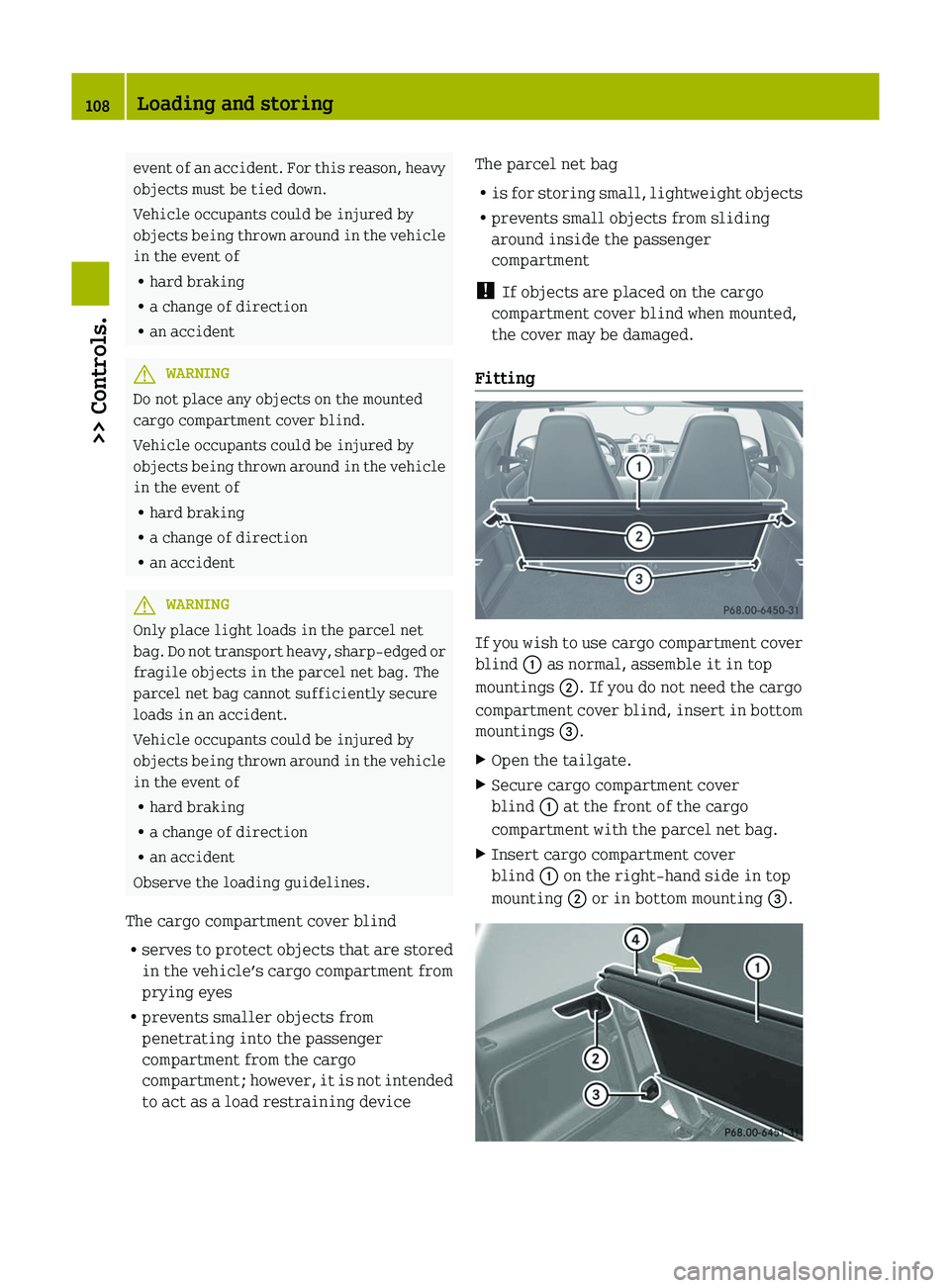
Fitting If you wish to use cargo compartment cover
blind : as normal, assemble it in top
mountings ;. If you do not need the cargo
compartment
cover blind, insert in bottom
mountings =.
X Open the tailgate.
X Secure cargo compartment cover
blind : at the front of the cargo
compartment with the parcel net bag.
X Insert cargo compartment cover
blind : on the right-hand side in top
mounting ; or in bottom mounting =.108
Loading and storing
>> Controls.
Page 113 of 228
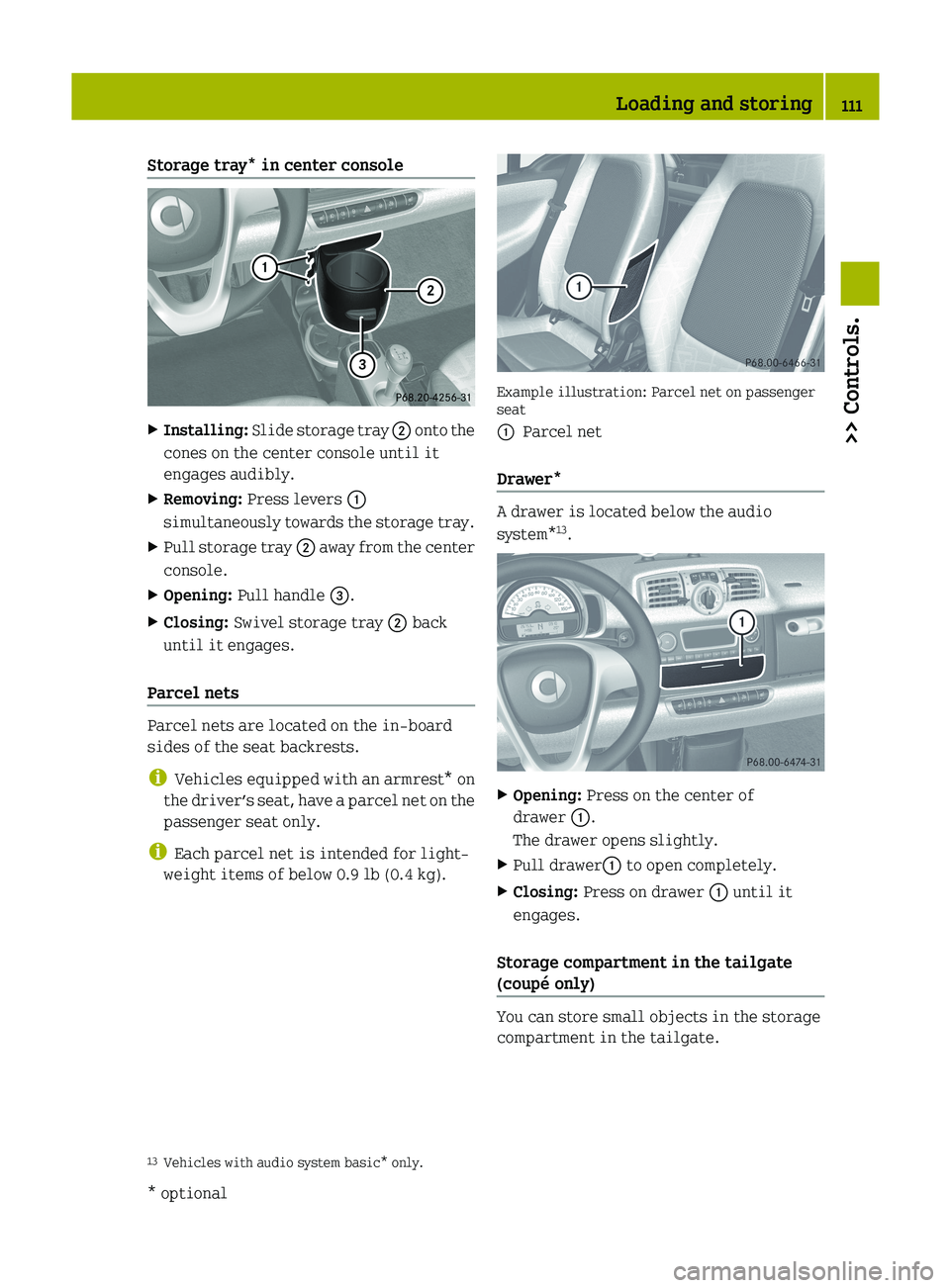
Storage tray* in center console
X
Installing: Slide storage tray ; onto the
cones on the center console until it
engages audibly.
X Removing: Press levers :
simultaneously
towards the storage tray.
X Pull storage tray ;
away from the center
console.
X Opening: Pull handle =.
X Closing: Swivel storage tray ; back
until it engages.
Parcel nets Parcel nets are located on the in-board
sides of the seat backrests.
i
Vehicles equipped with an armrest*
on
the driver’s seat, have a parcel net on the
passenger seat only.
i Each parcel net is intended for light-
weight items of below 0.9 lb (0.4 kg). Example illustration: Parcel net on passenger
seat
:
Parcel net
Drawer* A drawer is located below the audio
system*
13
. X
Opening: Press on the center of
drawer :.
The drawer opens slightly.
X Pull drawer: to open completely.
X Closing: Press on drawer : until it
engages.
Storage compartment in the tailgate
(coupé only) You can store small objects in the storage
compartment in the tailgate.
13 Vehicles with audio system basic* only. Loading and storing
111
>> Controls.
* optional Z
Page 114 of 228
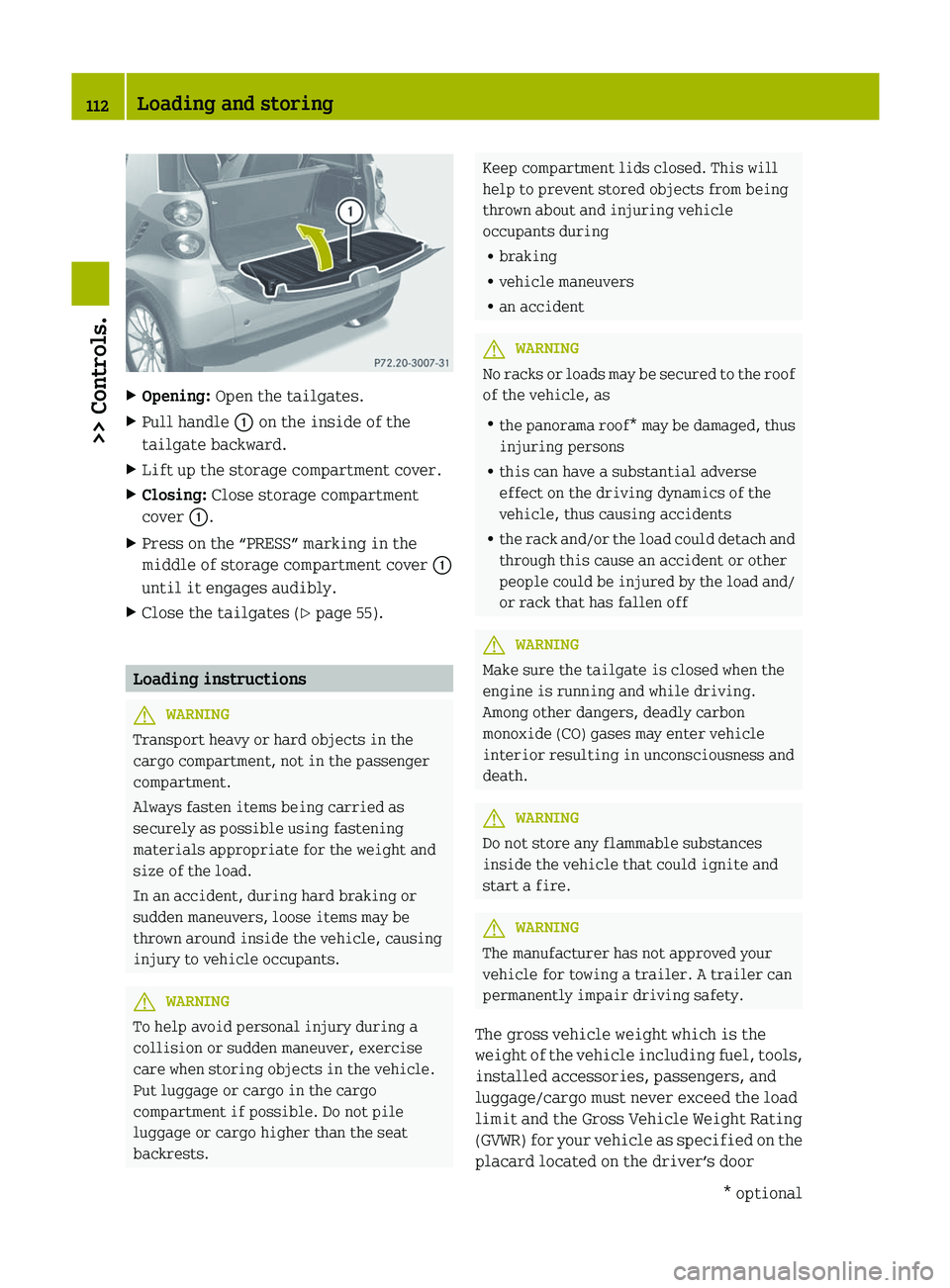
X
Opening: Open the tailgates.
X Pull handle : on the inside of the
tailgate backward.
X Lift up the storage compartment cover.
X Closing: Close storage compartment
cover :.
X Press on the “PRESS” marking in the
middle of storage compartment cover :
until it engages audibly.
X Close the tailgates ( Y page 55).Loading instructions
G
WARNING
Transport heavy or hard objects in the
cargo compartment, not in the passenger
compartment.
Always fasten items being carried as
securely as possible using fastening
materials appropriate for the weight and
size of the load.
In an accident, during hard braking or
sudden maneuvers, loose items may be
thrown around inside the vehicle, causing
injury to vehicle occupants. G
WARNING
To help avoid personal injury during a
collision or sudden maneuver, exercise
care when storing objects in the vehicle.
Put luggage or cargo in the cargo
compartment if possible. Do not pile
luggage or cargo higher than the seat
backrests. Keep compartment lids closed. This will
help to prevent stored objects from being
thrown about and injuring vehicle
occupants during
R
braking
R vehicle maneuvers
R an accident G
WARNING
No racks or loads may be secured to the roof
of the vehicle, as
R the
panorama roof* may be damaged, thus
injuring persons
R this can have a substantial adverse
effect on the driving dynamics of the
vehicle, thus causing accidents
R the rack and/or the load could detach and
through this cause an accident or other
people could be injured by the load and/
or rack that has fallen off G
WARNING
Make sure the tailgate is closed when the
engine is running and while driving.
Among other dangers, deadly carbon
monoxide (CO) gases may enter vehicle
interior resulting in unconsciousness and
death. G
WARNING
Do not store any flammable substances
inside the vehicle that could ignite and
start a fire. G
WARNING
The manufacturer has not approved your
vehicle for towing a trailer. A trailer can
permanently impair driving safety.
The gross vehicle weight which is the
weight
of the vehicle including fuel, tools,
installed accessories, passengers, and
luggage/cargo must never exceed the load
limit and the Gross Vehicle Weight Rating
(GVWR) for your vehicle as specified on the
placard located on the driver’s door 112
Loading and storing
>> Controls.
* optional
Page 120 of 228

X
Engage the parking brake.
X Move the gear selector lever to park
position P.
X Switch off the ignition.
X Open the tailgate. G
WARNING
Exercise extreme caution if you see flames
or smoke coming from the engine
compartment. Move away from the vehicle
and call the fire department.
If the coolant temperature warning lamp
indicates
that the engine is overheated, do
not attempt to open the engine compartment
cover. Move away from the vehicle and wait
until the engine has cooled before opening
the engine compartment. G
WARNING
To help prevent personal injury, stay clear
of moving parts when the engine
compartment cover is open and the engine
is running. G
WARNING
The engine is equipped with a
transistorized ignition system that
utilizes high voltage. Do not touch any
components (ignition coils, spark plug
sockets,
diagnostic socket) of the ignition
system
R while the engine is running
R while starting the engine
R if ignition is “on” and the engine is
turned manually X
Opening: Grasp the strap on cargo
compartment floor ;.
X Lift cargo compartment floor ;
with the
strap.
X Engage hook ? into top mounting = of
cargo compartment cover blind A.
X Remove fastening screw :.
X Remove engine compartment cover A.
X Closing:
Slide engine compartment cover
A forward into the tabs provided.
X Tighten fastening screw :.
X Disengage hook ? from top mounting
=.
X Fold cargo compartment floor ; back
down.
X Push the right hand and left hand cargo
compartment
floor edges under the edges
of the side panels.
X Close the tailgate. Engine oil
The amount of oil your engine needs will
depend on a number of factors, including
driving style. Increased oil consumption
can occur when the vehicle is new or the
vehicle is driven at higher engine speeds
frequently.
Engine
oil consumption checks should only
be made after the vehicle break-in period.
! Do not use any special lubricant
additives, as these may increase wear
and damage the drive assemblies. Using
special additives not approved by smart
may cause damage not covered by the
smart Limited Warranty. More
information on this subject is available
at any smart center.
Checking engine oil level !
Check the engine oil level at regular
intervals. 118
Engine compartment
>> Operation.
Page 121 of 228
When checking the engine oil level
R
the vehicle must be parked on level
ground
R the
vehicle must have been stationary for
at least five minutes with the engine
turned off
X Turn off the engine.
X Engage the parking brake.
X Open the tailgate.
X Open the engine compartment cover
(Y page 117).
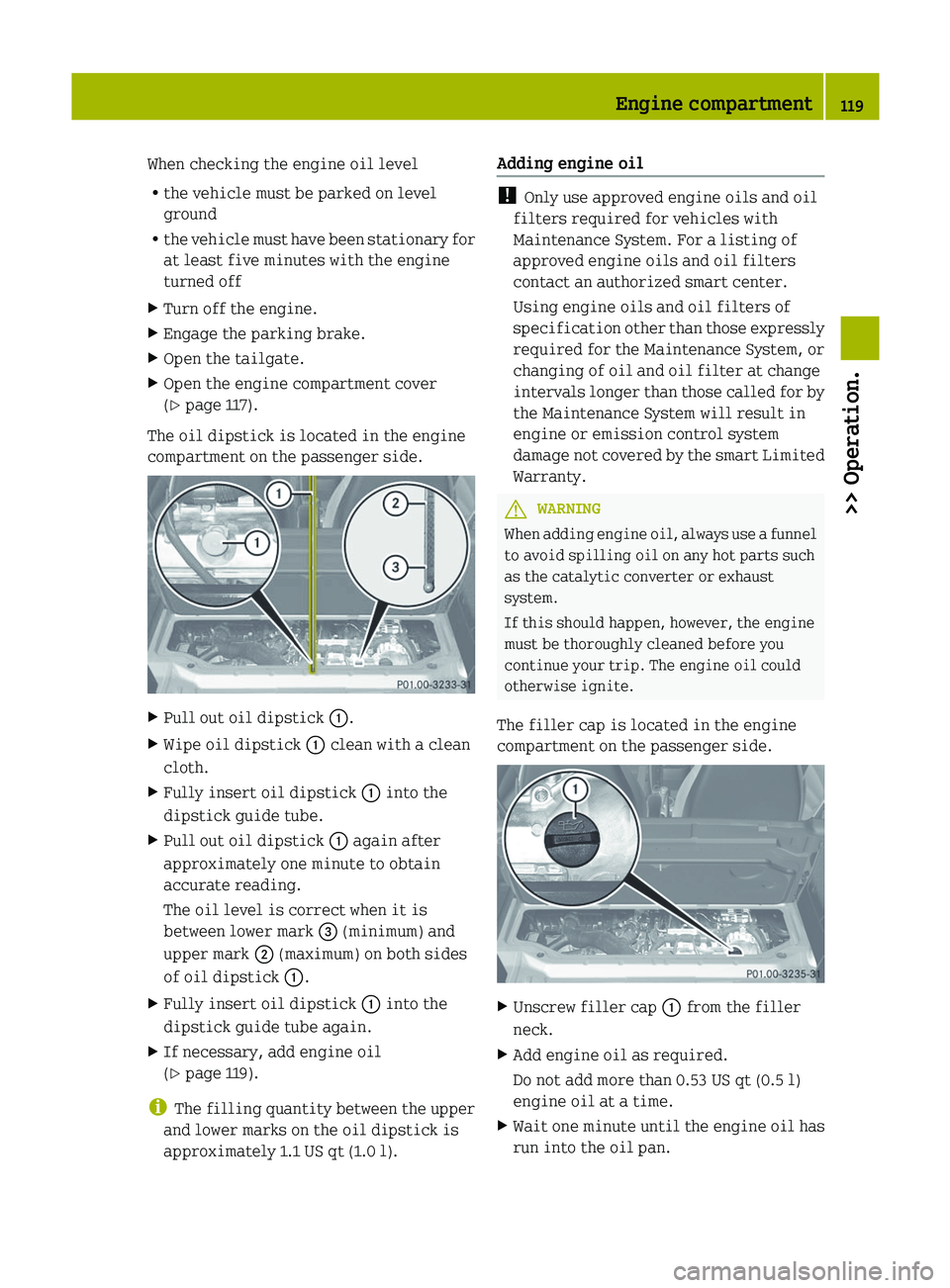
The oil dipstick is located in the engine
compartment on the passenger side. X
Pull out oil dipstick :.
X Wipe oil dipstick : clean with a clean
cloth.
X Fully insert oil dipstick : into the
dipstick guide tube.
X Pull out oil dipstick : again after
approximately one minute to obtain
accurate reading.
The oil level is correct when it is
between lower mark = (minimum) and
upper mark ; (maximum) on both sides
of oil dipstick :.
X Fully insert oil dipstick : into the
dipstick guide tube again.
X If necessary, add engine oil
(Y page 119).
i The
filling quantity between the upper
and lower marks on the oil dipstick is
approximately 1.1 US qt (1.0 l). Adding engine oil !
Only use approved engine oils and oil
filters required for vehicles with
Maintenance System. For a listing of
approved engine oils and oil filters
contact an authorized smart center.
Using engine oils and oil filters of
specification
other than those expressly
required for the Maintenance System, or
changing of oil and oil filter at change
intervals longer than those called for by
the Maintenance System will result in
engine or emission control system
damage not covered by the smart Limited
Warranty. G
WARNING
When adding engine oil, always use a funnel
to avoid spilling oil on any hot parts such
as the catalytic converter or exhaust
system.
If this should happen, however, the engine
must be thoroughly cleaned before you
continue your trip. The engine oil could
otherwise ignite.
The filler cap is located in the engine
compartment on the passenger side. X
Unscrew filler cap : from the filler
neck.
X Add engine oil as required.
Do not add more than 0.53 US qt (0.5 l)
engine oil at a time.
X Wait one minute until the engine oil has
run into the oil pan. Engine compartment
119
>> Operation. Z
Page 163 of 228

Display messages Possible causes/consequences and
M Solutions6
Reserve Fuel The fuel level has dropped below the reserve mark.
X
Refuel at the next gas station. Ö
Driver´s Door Ajar The driver’s door is open.
X
Close the driver’s door. Ø
Door Ajar The passenger door is open.
X
Close the passenger door. Õ
Tailgate Open A tailgate or the rear soft top
17
is open.
X Close the tailgates or the rear soft. Display messages Possible causes/consequences and
M Solutionsh
Check
Tire Pressure The tire inflation pressure in at least one tire is
significantly below the reference value.
X
Carefully bring the vehicle to a halt, avoiding abrupt
steering and braking maneuvers.
X Check and adjust tire inflation pressure as required
(Y page 126).
X If necessary, change the wheel ( Y page 194).G
WARNING
Each tire should be checked monthly when cold and inflated to the inflation pressure
recommended by the vehicle manufacturer on the Tire and Loading Information placard. If
your vehicle has tires of a different size than the size indicated on the Tire and Loading
Information placard, you should determine the proper tire inflation pressure for those
tires.
As
an added safety feature, your vehicle has been equipped with a tire pressure monitoring
system (TPMS) that illuminates a low tire pressure telltale when one or more of your tires
is significantly underinflated.
Accordingly, when the low tire pressure telltale illuminates, you should stop and check your
tires as soon as possible, and inflate them to the proper pressure. Driving on a significantly
underinflated tire causes the tire to overheat and can lead to tire failure.
Underinflation also reduces fuel efficiency and tire tread life, and may affect the vehicle’s
handling and stopping ability. Please note that the TPMS is not a substitute for proper tire
maintenance, and it is the driver’s responsibility to maintain correct tire pressure, even
if underinflation has not reached the level to trigger illumination of the TPMS low tire
pressure telltale.
17 cabriolet only. Display messages
161
>> Practical hints.
Z