tow SMART FORTWO COUPE 2012 Owner's Manual
[x] Cancel search | Manufacturer: SMART, Model Year: 2012, Model line: FORTWO COUPE, Model: SMART FORTWO COUPE 2012Pages: 228, PDF Size: 12.76 MB
Page 118 of 228
The first 1000 miles (1500 km)
In the Operation section you will find
detailed information on operating,
maintaining and caring for your vehicle.
The
more cautiously you treat your vehicle
during the break-in period, the more
satisfied you will be with its performance
later on.
R Drive your vehicle during the first
1 000 miles (1 500 km) at varying but
moderate vehicle and engine speeds.
R During this period, avoid heavy loads
(full throttle driving) and excessive
engine speeds (no more than 2
/ 3 of
maximum rpm in each gear).
R Shift gears in a timely manner.
R Do not attempt to slow the vehicle down
by shifting to a lower gear.
R Avoid accelerating by kickdown.
After 1 000 miles (1 500 km), you may
gradually increase vehicle and engine
speeds to the permissible maximum.
All of the above instructions also apply
when driving the first 1 000 miles (1 500 km)
after the engine has been replaced.
i Always obey applicable speed limits. At the gas station
Refueling
G
WARNING
Gasoline is highly flammable and
poisonous.
It burns violently and can cause
serious personal injury.
Never allow sparks, flame or smoking
materials near gasoline!
Turn off the engine before refueling.
Whenever you are around gasoline, avoid
inhaling fumes and skin or clothing
contact. Extinguish all smoking materials. Direct skin contact with fuels and the
inhalation of fuel vapors are damaging to
your health.
! Do not put diesel fuel in vehicles with
gasoline engines. Do not mix gasoline
with diesel fuel. Even small quantities
of diesel fuel will damage the injection
system. Damage caused by adding diesel
fuel will not be covered by the smart
Limited Warranty.
If diesel fuel has mixed with gasoline,
do not start the engine. Otherwise the
catalytic converter will be irreparably
damaged.
Contact an authorized smart center or
Roadside Assistance immediately and
have the vehicle towed.
! Damage
resulting from mixing gasoline
with diesel fuel is not covered by the
smart Limited Warranty.
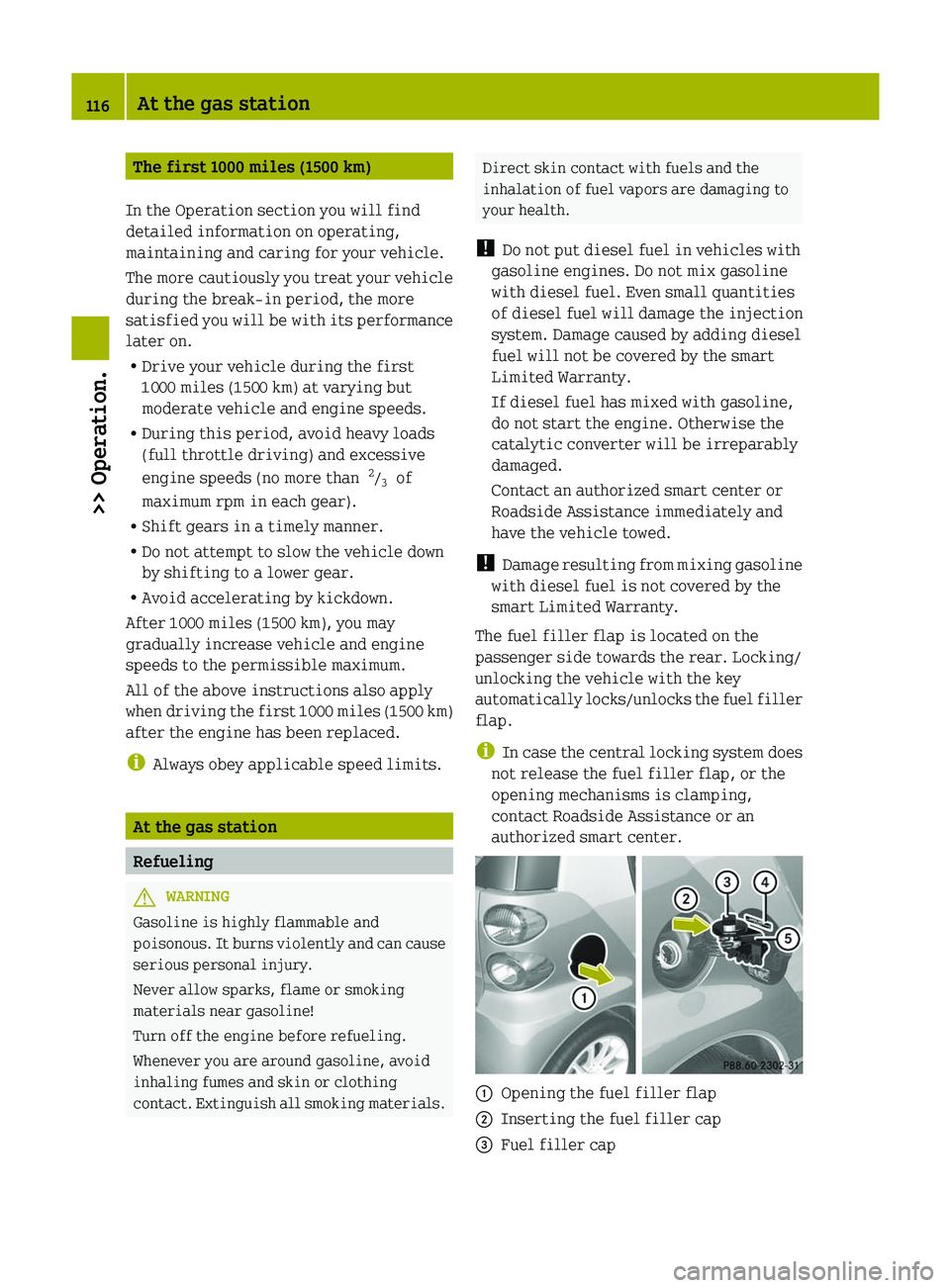
The fuel filler flap is located on the
passenger side towards the rear. Locking/
unlocking the vehicle with the key
automatically locks/unlocks the fuel filler
flap.
i In case the central locking system does
not release the fuel filler flap, or the
opening mechanisms is clamping,
contact Roadside Assistance or an
authorized smart center. :
Opening the fuel filler flap
; Inserting the fuel filler cap
= Fuel filler cap116
At the gas station
>> Operation.
Page 126 of 228
The brake fluid level is correct when it
is between the minimum mark and the
maximum mark.
R
If the brake fluid level has fallen
slightly below the minimum mark,
drive to an authorized smart center.
R If the brake fluid level has fallen
significantly below the minimum
mark, call Roadside Assistance or an
authorized smart center.
X Remount the service flap and close it
(Y page 120). Tires and wheels
Safety notes
Contact an authorized smart center for
information on tested and recommended
rims and tires for summer and winter
operation. They can also offer advice
concerning tire service and purchase. G
WARNING
Replace rims or tires with the same
designation, manufacturer and type as
shown on the original part. For further
information contact an authorized smart
center.
If incorrectly sized rims and tires
are mounted, the wheel brakes or
suspension components can be damaged.
Also, the operating clearance of the wheels
and the tires may no longer be correct. G
WARNING
Worn, old tires can cause accidents. If the
tire
tread is worn to minimum tread depth,
or if the tires have sustained damage,
replace them.
When replacing rims, only use genuine
smart wheel bolts specified for the
particular rim type. Failure to do so can
result in the bolts loosening and possibly
an accident.
Retreaded tires are not tested or
recommended by smart, since previous damage cannot always be recognized on
retreads. The operating safety of the
vehicle cannot be assured when such tires
are used.
G
WARNING
If you feel a sudden significant vibration
or ride disturbance, or you suspect that
possible damage to your vehicle has
occurred, you should turn on the hazard
warning flashers, carefully slow down, and
drive
with caution to an area which is a safe
distance from the road.
Inspect the tires and the vehicle underbody
for possible damage. If the vehicle or tires
appear unsafe, have the vehicle towed to the
nearest authorized smart center or tire
dealer for repairs. G
WARNING
Do not drive with a flat tire. A flat tire
affects the ability to steer or brake the
vehicle. You could lose control of the
vehicle.
Continued driving with a flat tire
or driving at high speed with a flat tire
will cause excessive heat build-up and
possibly a fire.
Modifications to the brake system and
wheels and the use of brake dust rings are
not permissible. Important guidelines
R Only
use sets of tires and rims of the same
type and make.
R Tires must be of the correct size for the
rim.
R Break in new tires for approximately
60 miles (100 km) at moderate speeds.
R Regularly check the tires and rims for
damage. Dented or bent rims can cause
tire pressure loss and damage to the tire
beads.124
Tires and wheels
>> Operation.
Page 148 of 228
Catalytic converter
Your smart is equipped with monolithic-
type catalytic converter, an important
element in conjunction with the oxygen
sensors to achieve substantial control of
the pollutants in the exhaust emissions.
Keep your vehicle in proper operating
condition by following our recommended
maintenance instructions as outlined in
your Maintenance Booklet. G
WARNING
The catalytic converter can become very
hot. Coming into contact with the catalytic
converter could result in burns.
Note the following:
R Do not remove the protective heat guards.
R Do not apply any underseal.
R As with any vehicle, do not idle, park, or
operate this vehicle in areas where
combustible materials such as grass,
hay, or leaves can come into contact with
the hot exhaust system, as these
materials could be ignited and cause a
vehicle fire.
! To prevent damage to the catalytic
converter, only use premium unleaded
gasoline in this vehicle.
Any noticeable irregularities in engine
operation should be repaired promptly.
Otherwise, excessive unburned fuel may
reach the catalytic converter, causing it
to overheat and potentially start a fire.
It is essential to observe the following
points, as there is otherwise a danger of
overheating and the catalytic converter
may be damaged.
R Fill up only with premium unleaded
gasoline. Even small quantities of
leaded gasoline can damage the catalytic
converter.
R Make sure you adhere to the prescribed
service intervals.
R Never run the fuel tank empty. R
If
the engine starts to misfire, bring the
vehicle to an immediate standstill
without endangering traffic.
R If the engine fails to start the first time,
you should not try to start it any more
than three times in succession.
R Do not try to start for more than four
seconds at a time. Tires
G
WARNING
If you feel a sudden significant vibration
or ride disturbance, or you suspect that
possible damage to your vehicle has
occurred, you should turn on the hazard
warning flashers, carefully slow down, and
drive
with caution to an area which is a safe
distance from the road.
Inspect the tires and the vehicle underbody
for possible damage. If the vehicle or tires
appear unsafe, have the vehicle towed to the
nearest smart center or tire dealer for
repairs.
Treadwear indicators (TWI) are required by
law. These indicators are located in six
places on the tread circumference and
become visible at a tread depth of
approximately 1
/ 16 in (1.6 mm), at which
point the tire is considered worn and
should be replaced.
The treadwear indicator appears as a solid
band across the tread. G
WARNING
Although the applicable federal motor
vehicle safety laws consider a tire to be
worn when the treadwear indicators (TWI)
become visible at approximately
1
/ 16 in
(1.6 mm), we recommend that you do not allow
your tires to wear down to that level. As
tread depth approaches 1
/ 8 in (3 mm), the
adhesion properties on a wet road are
sharply reduced. 146
Driving instructions
>> Operation.
Page 155 of 228
Exterior Special
considerations Lightly soiled
Hand-/Automatic
car washes Heavily soiled
Hand-/Automatic
car washes
Wheels and wheel
covers Two-layer metallic
paint (high-gloss) Car shampoo
concentrate, rim
care Car shampoo
concentrate, rim
care
Retractable soft top PAC fabric Car shampoo
concentrate, soft
top cleaner,
impregnation spray Car shampoo
concentrate, soft
top cleaner,
impregnation spray
Removing insects
Remove insect remains before you start to
wash the vehicle.
X
Spray insect remover on.
X Allow insect remover to work in briefly.
X Rub in gently with a soft cloth or sponge.
X Rinse with plenty of water.
X Treat the cleaned surface with hard wax.
Removing tar Remove any tar marks before washing the
vehicle.
X
Apply tar remover with a soft cloth.
X Allow tar remover to work in briefly.
X Rub in gently.
X Rinse with plenty of water.
X Treat the cleaned surface with hard wax.
Vehicle washing In the winter, thoroughly remove all traces
of road salt as soon as possible.
When
washing the vehicle underbody, do not
forget to clean the inner sides of the
wheels.
Washing your vehicle by hand
X Wash the vehicle using car shampoo
concentrate and a sponge.
X Rinse with clean water.
X Towel dry the vehicle. !
Do not wash the vehicle in direct
sunlight. The body panel surfaces and
paint finish may be damaged.
Washing your vehicle in an automatic car
wash
i When running your vehicle through an
automatic car wash, water droplets can
run
down the inside of the side windows.
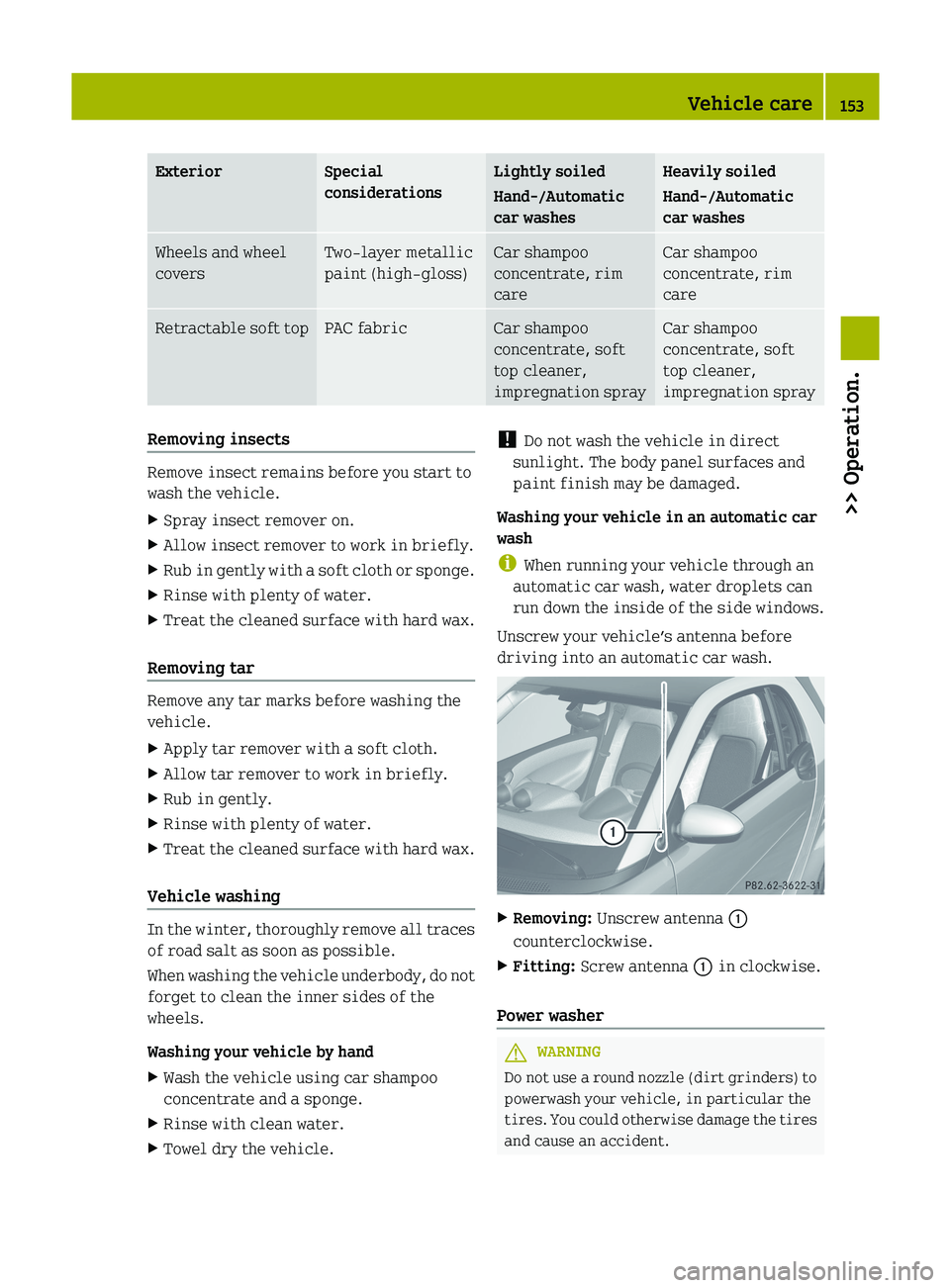
Unscrew your vehicle’s antenna before
driving into an automatic car wash. X
Removing: Unscrew antenna :
counterclockwise.
X Fitting: Screw antenna : in clockwise.
Power washer G
WARNING
Do not use a round nozzle (dirt grinders) to
powerwash your vehicle, in particular the
tires.
You could otherwise damage the tires
and cause an accident. Vehicle care
153
>> Operation. Z
Page 159 of 228
>> Practical hints.Where will I find ...
.......................... 158
Display messages ............................. 158
What to do if ... ............................... 162
Unlocking/locking manually ...............176
Replacing transmitter battery ............177
Replacing bulbs ...............................
178
Replacing wiper blades ..................... 184
Flat tire ........................................ 186
Wheel change .................................. 194
Battery .......................................... 196
Jump starting .................................. 199
Towing .......................................... 202
Fuses ............................................ 205
Page 183 of 228
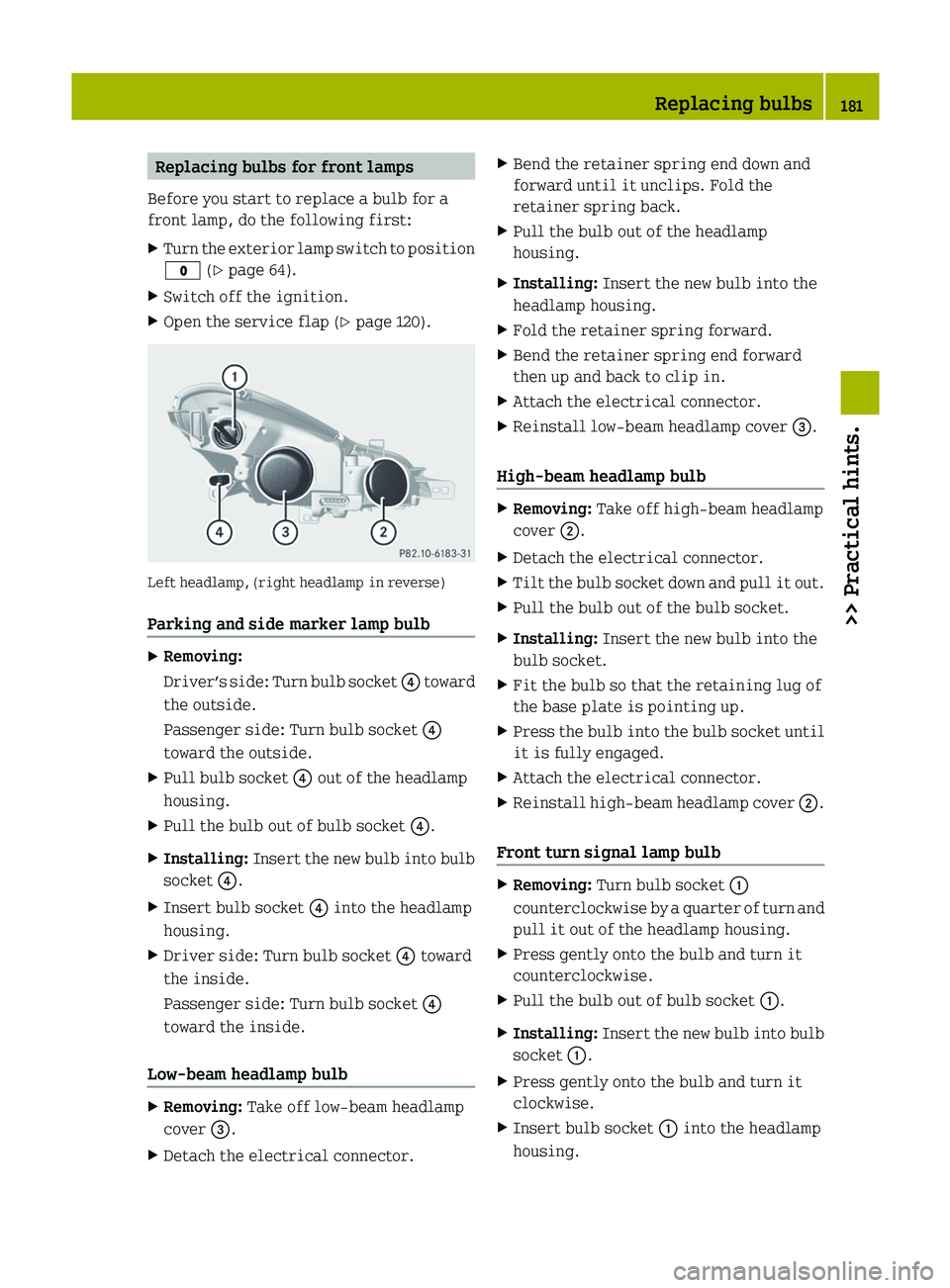
Replacing bulbs for front lamps
Before you start to replace a bulb for a
front lamp, do the following first:
X Turn the exterior lamp switch to position
$ (Y page 64).
X Switch off the ignition.
X Open the service flap (Y page 120). Left headlamp, (right headlamp in reverse)
Parking and side marker lamp bulb
X
Removing:
Driver’s
side: Turn bulb socket ? toward
the outside.
Passenger side: Turn bulb socket ?
toward the outside.
X Pull bulb socket ? out of the headlamp
housing.
X Pull the bulb out of bulb socket ?.
X Installing:
Insert the new bulb into bulb
socket ?.
X Insert bulb socket ? into the headlamp
housing.
X Driver side: Turn bulb socket ? toward
the inside.
Passenger side: Turn bulb socket ?
toward the inside.
Low‑beam headlamp bulb X
Removing: Take off low‑beam headlamp
cover =.
X Detach the electrical connector. X
Bend the retainer spring end down and
forward until it unclips. Fold the
retainer spring back.
X Pull the bulb out of the headlamp
housing.
X Installing: Insert the new bulb into the
headlamp housing.
X Fold the retainer spring forward.
X Bend the retainer spring end forward
then up and back to clip in.
X Attach the electrical connector.
X Reinstall low‑beam headlamp cover =.
High‑beam headlamp bulb X
Removing: Take off high‑beam headlamp
cover ;.
X Detach the electrical connector.
X Tilt the bulb socket down and pull it out.
X Pull the bulb out of the bulb socket.
X Installing: Insert the new bulb into the
bulb socket.
X Fit the bulb so that the retaining lug of
the base plate is pointing up.
X Press the bulb into the bulb socket until
it is fully engaged.
X Attach the electrical connector.
X Reinstall high‑beam headlamp cover ;.
Front turn signal lamp bulb X
Removing: Turn bulb socket :
counterclockwise
by a quarter of turn and
pull it out of the headlamp housing.
X Press gently onto the bulb and turn it
counterclockwise.
X Pull the bulb out of bulb socket :.
X Installing:
Insert the new bulb into bulb
socket :.
X Press gently onto the bulb and turn it
clockwise.
X Insert bulb socket : into the headlamp
housing. Replacing bulbs
181
>> Practical hints. Z
Page 187 of 228
tensioning spring could crack the
windshield.
Do
not allow the wiper arms to contact the
windshield glass without a wiper blade
inserted.
We recommend that you have this work
carried out at an authorized smart
center.
To ensure proper visibility
R it is vital that you have wiper blades that
are in perfect shape
R clean the wiper blades regularly with a
cleaning agent
R remove any tough dirt stains with a
sponge or brush Windshield wiper blades
! Do not pull on the wiper blade inserts.
They could tear.
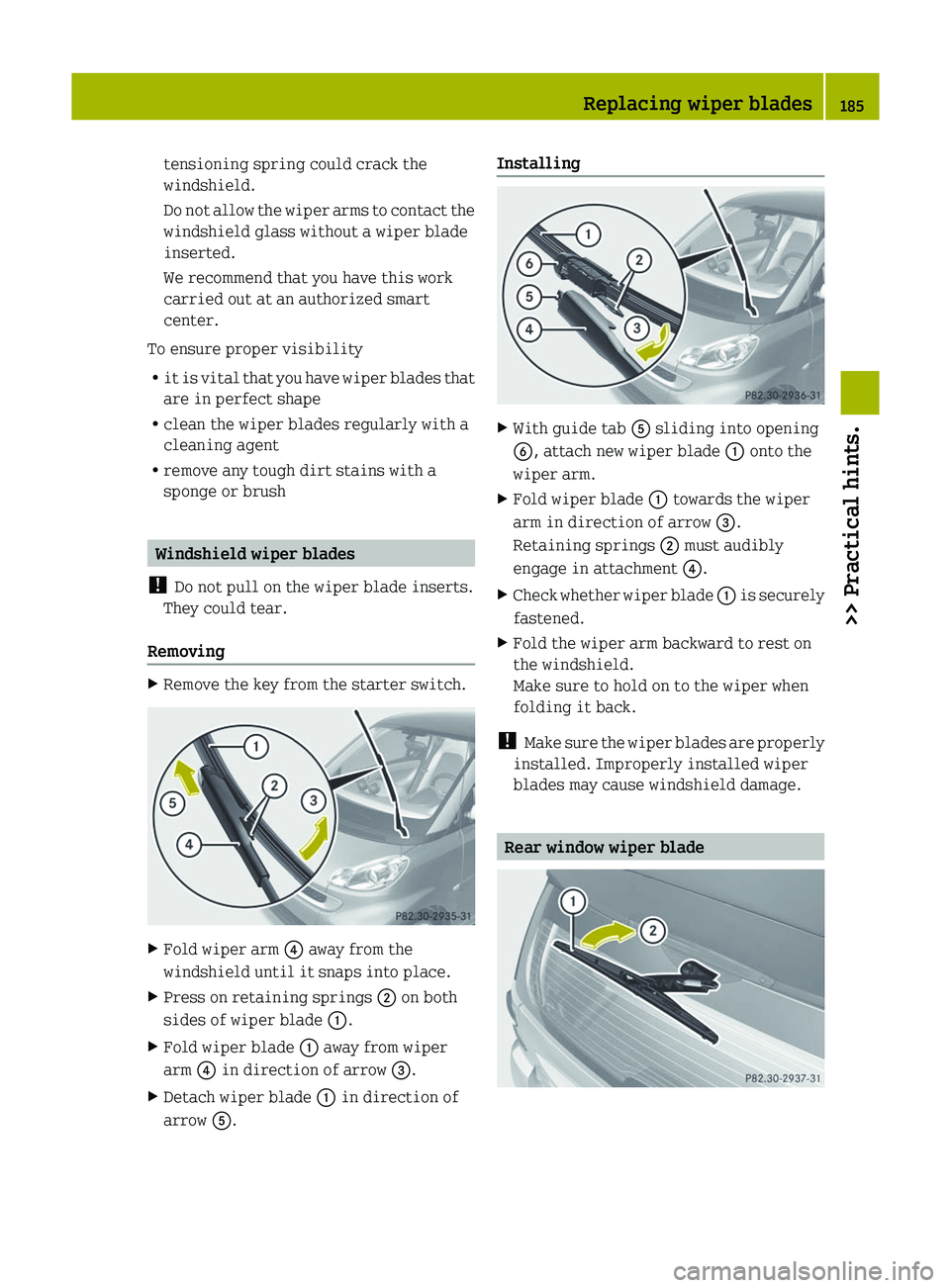
Removing X
Remove the key from the starter switch. X
Fold wiper arm ? away from the
windshield until it snaps into place.
X Press on retaining springs ; on both
sides of wiper blade :.
X Fold wiper blade : away from wiper
arm ? in direction of arrow =.
X Detach wiper blade : in direction of
arrow A. Installing
X
With guide tab A sliding into opening
B, attach new wiper blade : onto the
wiper arm.
X Fold wiper blade : towards the wiper
arm in direction of arrow =.
Retaining springs ; must audibly
engage in attachment ?.
X Check whether wiper blade :
is securely
fastened.
X Fold the wiper arm backward to rest on
the windshield.
Make sure to hold on to the wiper when
folding it back.
! Make
sure the wiper blades are properly
installed. Improperly installed wiper
blades may cause windshield damage. Rear window wiper blade Replacing wiper blades
185
>> Practical hints. Z
Page 193 of 228
result in handling or steering problems, or
brake failure.
X Drive to the nearest authorized smart
center, to have the damaged tire
replaced.
X Contact an authorized smart center as
soon as possible to obtain a new filler
hose and a new tire sealant container.
X Bring used tire sealant materials to an
authorized smart center for proper
disposal.
X Replace your tire sealant container
every 4 years. Replacement containers
are available at any authorized smart
center. G
WARNING
After changing a tire, contact a smart
center to make sure the bolts holding the
wheel to the car are tight enough.
Otherwise, the wheels could come off. Each
bolt should be tightened to a torque of
81 lb‑ft (110 Nm). Sealing a tire (Version 2)
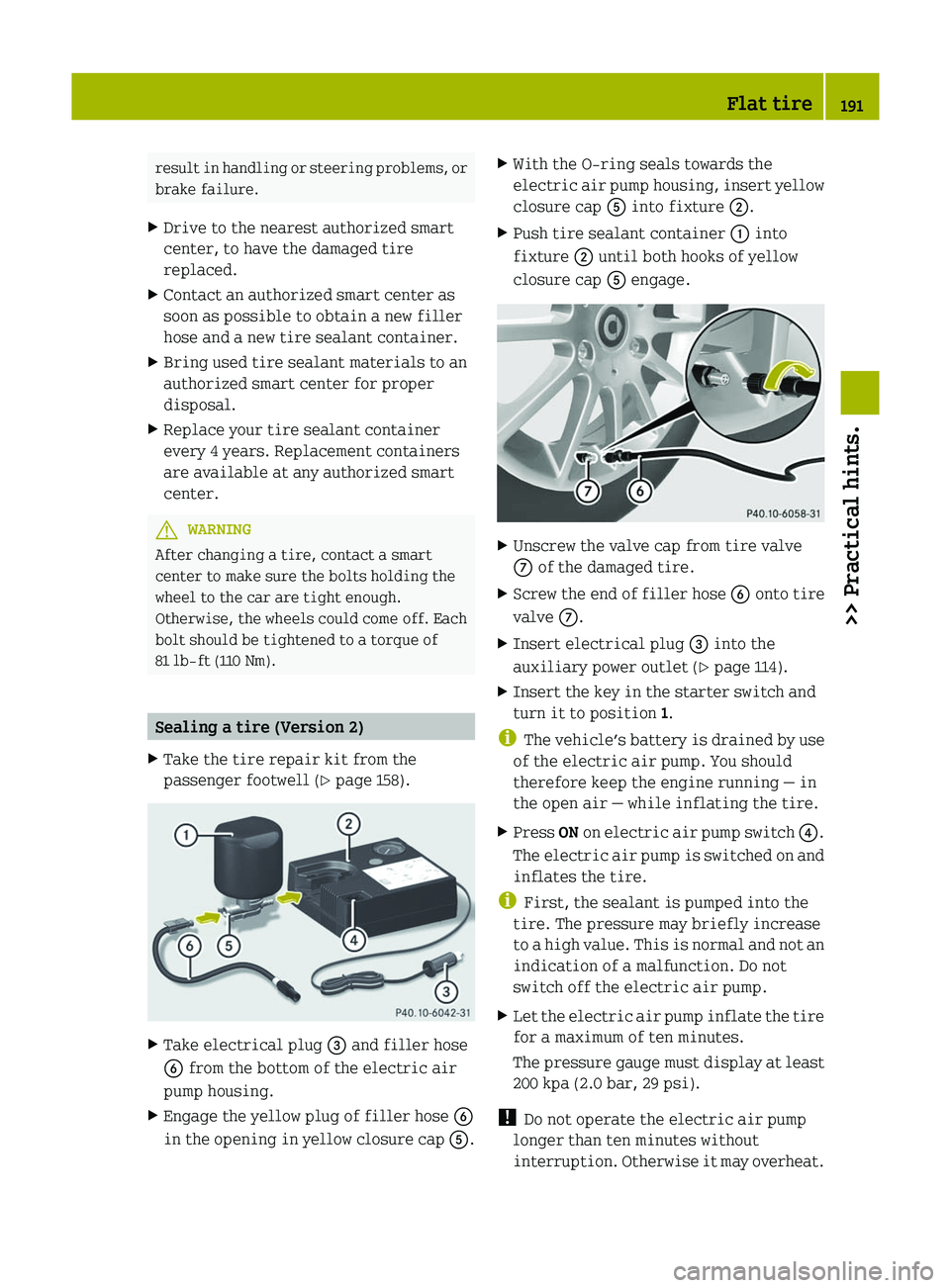
X Take the tire repair kit from the
passenger footwell (Y page 158). X
Take electrical plug = and filler hose
B from the bottom of the electric air
pump housing.
X Engage the yellow plug of filler hose B
in the opening in yellow closure cap A.X
With the O-ring seals towards the
electric
air pump housing, insert yellow
closure cap A into fixture ;.
X Push tire sealant container : into
fixture ; until both hooks of yellow
closure cap A engage. X
Unscrew the valve cap from tire valve
C of the damaged tire.
X Screw the end of filler hose B onto tire
valve C.
X Insert electrical plug = into the
auxiliary power outlet
(Y page 114).
X Insert the key in the starter switch and
turn it to position 1.
i The
vehicle’s battery is drained by use
of the electric air pump. You should
therefore keep the engine running — in
the open air — while inflating the tire.
X Press ON
on electric air pump switch ?.
The electric air pump is switched on and
inflates the tire.
i First, the sealant is pumped into the
tire. The pressure may briefly increase
to
a high value. This is normal and not an
indication of a malfunction. Do not
switch off the electric air pump.
X Let the electric air pump inflate the tire
for a maximum of ten minutes.
The
pressure gauge must display at least
200 kpa (2.0 bar, 29 psi).
! Do not operate the electric air pump
longer than ten minutes without
interruption.
Otherwise it may overheat. Flat tire
191
>> Practical hints. Z
Page 202 of 228
immediately flush affected area with
water, and seek medical help if necessary.
A battery will also produce hydrogen gas,
which is flammable and very explosive.
Keep flames or sparks away from battery,
avoid improper connection of jumper
cables, smoking, etc.
Attempting to jump start a frozen battery
can result in it exploding, causing
personal injury.
Read all instructions before proceeding.
! Do not tow‑start vehicle. You could
otherwise seriously damage the
transmission
which is not covered by the
smart Limited Warranty.
! Avoid repeated and lengthy starting
attempts.
Do not attempt to start the engine using
a battery quick charge unit.
If the engine does not run after several
unsuccessful starting attempts, have it
checked at the nearest authorized smart
center.
Excessive unburned fuel generated by
repeated failed starting attempts may
damage the catalytic converter and may
present a fire risk.
Make sure the jumper cables do not have
loose or missing insulation.
Make sure the cable clamps do not touch
any other metal part while the other end
is still attached to a battery.
If the battery is discharged, the engine can
be started with jumper cables and the fully
charged battery of another vehicle or an
equivalent starter pack. Observe the
following:
R Access to the battery is not possible on
all vehicles. If you cannot access the
battery in your vehicle provide jump start power by an external battery or
starter pack.
R Jump starting should only be performed
when the engine and catalytic converter
are cold.
R Do not start the engine if the battery is
frozen. Let the battery thaw out first.
R Only jump start from batteries with the
same
voltage rating (12 V). Jump starting
with a more powerful battery could
damage the vehicle’s electrical system.
Such damage will not be covered by the
smart Limited Warranty.
R Only use jumper cables with sufficient
cross-section and insulated terminal
clamps.
R Always make sure the jumper cables are
not on or near pulleys, fans or other parts
that move when an engine is started or
running.
R Should the battery be drained
completely, let the donating power
source charge the vehicle for several
minutes before reattempting the
starting process. G
WARNING
Keep flames or sparks away from battery. Do
not smoke.
Observe all safety instructions and
precautions when handling automotive
batteries. 200
Jump starting
>> Practical hints.
Page 204 of 228
X
Remove the jumper cables from negative terminals = and ? first.
X Remove the jumper cables from positive terminals : and ;.
You can now switch on the headlamps.
X Remount the positive terminal cover.
X Have the battery checked at the nearest authorized smart center. Towing
About towing
This section offers information on towing
methods for breakdown situations,
emergency towing, and flat towing smart
vehicles. Recommended towing method -
Breakdown situation
smart recommends that the vehicle be
transported with all wheels off the ground
using a flatbed carrier truck or
appropriate wheel lift/dolly equipment.
X Switch off the tow‑away protection* and
interior motion sensor*
(Y page 49).
! To
prevent damage during transport, do
not tie down the vehicle by its chassis or
suspension parts — use only wheel straps
to position and hold down the vehicle.
Improper tie down on a flatbed carrier
truck or trailer can damage suspension
parts and body panels. Emergency towing
When circumstances do not permit the
recommended towing method, the vehicle
may
be towed with all wheels on the ground
using a strap or tow bar connected to
another vehicle. Only tow the vehicle as far
as necessary to have the vehicle moved to a
safe location where the recommended
towing method can be employed. G
WARNING
If circumstances require towing the
vehicle with all wheels on the ground,
always tow with a tow bar if:
R the engine will not run
R there is a malfunction in the brake
system
R there is a malfunction in the power
supply or in the vehicle’s electrical
system
A
tow bar is necessary to adequately control
the towed vehicle.
Prior to towing the vehicle with all wheels
on the ground, make sure the gear selector
lever is in neutral position N and the
ignition is switched off. G
WARNING
With the engine not running, there is no
power assistance for the brake and
steering* systems. In this case, it is
important to keep in mind that a
considerably higher degree of effort is
necessary to brake and steer the vehicle.
Adapt your driving accordingly.
! Do not tow the vehicle with the front
axle raised. Doing so may cause serious
damage to the brake system which is not
covered by the smart Limited Warranty.
! Before towing the vehicle observe the
following instructions:
R Do not tow with sling-type equipment
attached
to suspension parts. This may202
Towing
>> Practical hints.
* optional