warning light SMART FORTWO COUPE 2012 Owner's Manual
[x] Cancel search | Manufacturer: SMART, Model Year: 2012, Model line: FORTWO COUPE, Model: SMART FORTWO COUPE 2012Pages: 228, PDF Size: 12.76 MB
Page 111 of 228
X
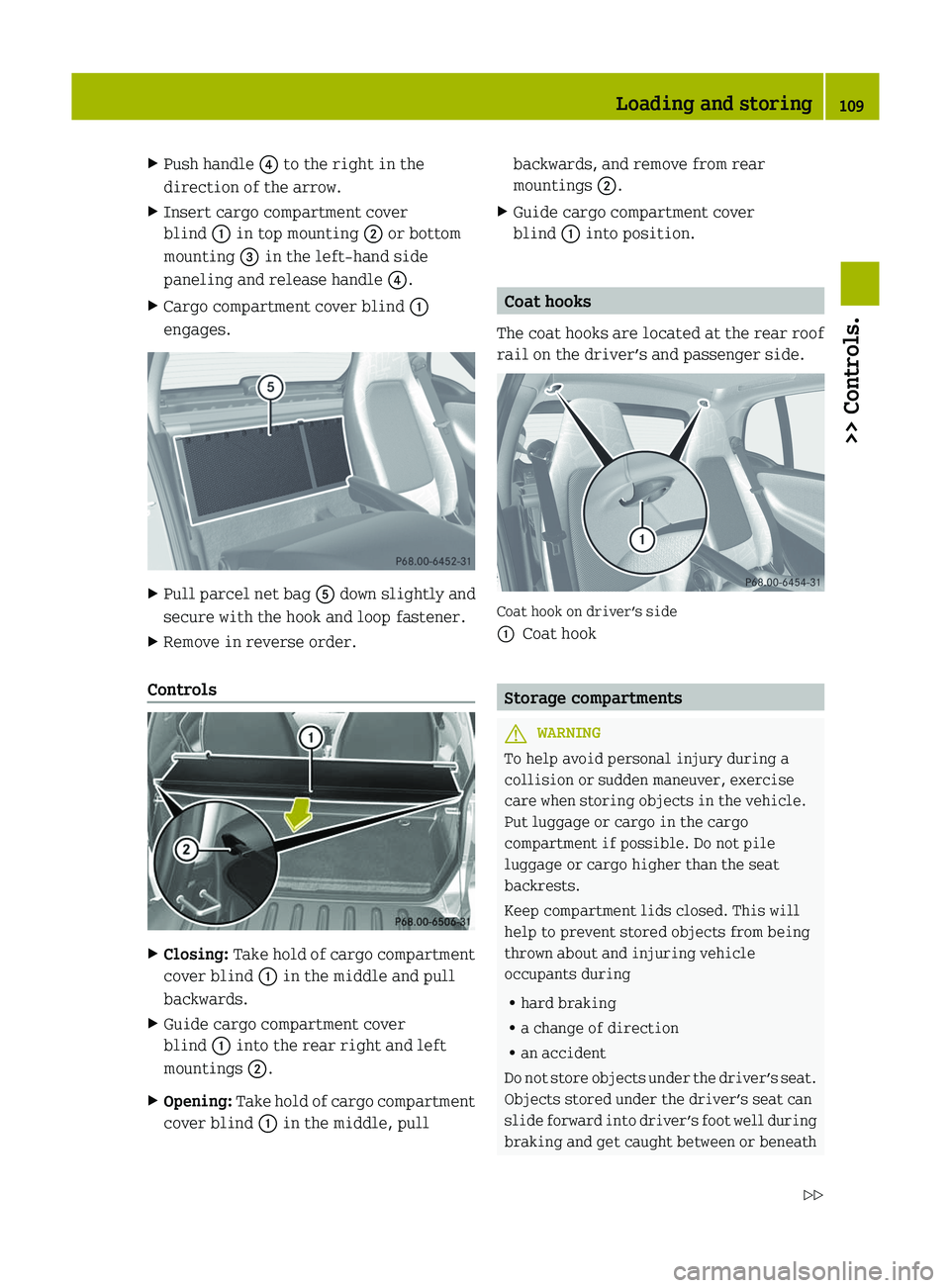
Push handle ? to the right in the
direction of the arrow.
X Insert cargo compartment cover
blind : in top mounting ; or bottom
mounting = in the left-hand side
paneling and release handle ?.
X Cargo compartment cover blind :
engages. X
Pull parcel net bag A down slightly and
secure with the hook and loop fastener.
X Remove in reverse order.
Controls X
Closing: Take hold of cargo compartment
cover blind : in the middle and pull
backwards.
X Guide cargo compartment cover
blind : into the rear right and left
mountings ;.
X Opening:
Take hold of cargo compartment
cover blind : in the middle, pull backwards, and remove from rear
mountings ;.
X Guide cargo compartment cover
blind : into position. Coat hooks
The coat hooks are located at the rear roof
rail on the driver’s and passenger side. Coat hook on driver’s side
:
Coat hook Storage compartments
G
WARNING
To help avoid personal injury during a
collision or sudden maneuver, exercise
care when storing objects in the vehicle.
Put luggage or cargo in the cargo
compartment if possible. Do not pile
luggage or cargo higher than the seat
backrests.
Keep compartment lids closed. This will
help to prevent stored objects from being
thrown about and injuring vehicle
occupants during
R hard braking
R a change of direction
R an accident
Do
not store objects under the driver’s seat.
Objects stored under the driver’s seat can
slide forward into driver’s foot well during
braking and get caught between or beneath Loading and storing
109
>> Controls.
Z
Page 119 of 228
?
Fuel type label
A Holder
X Turn off the engine.
X Remove the key from the starter switch.
X Open the fuel filler flap by pulling at the
point indicated by arrow :.
X Turn fuel filler cap = counterclockwise
and hold on to it until possible pressure
is released.
X Take off fuel filler cap =.
! The fuel filler cap is tethered to the
fuel filler flap. Do not drop the fuel
filler cap. It could damage the vehicle
paint finish.
X Insert fuel filler cap = in direction of
arrow ; into holder A on the inside of
the fuel filler flap.
X Fully insert filler nozzle unit and
refuel.
X Only fill your tank until the filler nozzle
unit
cuts out — do not top off or overfill .G
WARNING
Overfilling of the fuel tank may create
pressure in the system which could cause a
gas discharge. This could cause the gas to
spray
back out when removing the fuel pump
nozzle, which could cause personal injury.
X Replace fuel filler cap =.
X Turn fuel filler cap = clockwise until
the handle grip overturns.
i Make sure to close the fuel filler flap
before locking the vehicle as the fuel
filler flap locking pin prevents closing
after you have locked the vehicle.
X Close the fuel filler flap.
You should hear the latch close shut.
i Only use premium unleaded gasoline
with a minimum Posted Octane Rating of
91 (average of 96 RON/86 MON).
Information on gasoline quality can
normally be found on the fuel pump. Please contact gas station personnel in
case
labels on the pump cannot be found.
For more information on gasoline, see
“Premium unleaded gasoline”
(Y page 221) and “Fuel requirements”
(Y page 222), or contact an authorized
smart center. Check regularly and before a long trip
For information on quantities and
requirements of operating agents, see
“Service fluids and capacities”
(Y page 218).
Check the following:
R Engine oil level ( Y page 118)
R Tire inflation pressure ( Y page 126)
R Coolant level ( Y page 122)
R Vehicle lighting ( Y page 178)
R Windshield washer system (Y page 122)
R Brake fluid (Y page 123) Engine compartment
Engine compartment cover
Open the engine compartment cover to
check
the engine oil level and if necessary,
to add engine oil. G
WARNING
High outside temperature, stop-and-go
traffic, driving on long uphill grades or
driving
at high engine speed may increase
the temperature in the engine
compartment. Therefore, the engine
compartment cover and parts in the area
around the engine compartment cover may
be hot. Parts of the engine can become very
hot. To prevent burns, let the engine cool
off completely before touching the engine
compartment cover, parts in the area
around the engine compartment cover, and
parts of the engine. Engine compartment
117
>> Operation. Z
Page 122 of 228
X
Check the engine oil level once more.
X Add engine oil once more if necessary.
Be careful not to spill any oil when adding
to avoid environmental damage caused by
oil entering the ground and water.
! Excess engine oil must be siphoned or
drained
off. It could cause damage to the
engine or emission control system not
covered by the smart Limited Warranty.
X Screw filler cap : back on the filler
neck.
X Close the engine compartment cover
(Y page 117). Front compartment
Service flap
Remove the service flap to check the
coolant
level, windshield washer reservoir
level, and brake fluid level.
Insert the service flap on the front of the
vehicle so that it does not get damaged or
dirty.
i The service flap has a strap on the rear
side that ties it to the vehicle body. G
WARNING
Always turn the key to starter switch
position 0 and remove the key from the
starter switch before opening the service
flap.
If the windshield wipers should
inadvertently be switched on, you could be
seriously injured by the wiper washer
drive, which is located just below the
service flap. G
WARNING
Make sure the service flap is locked while
driving. Otherwise, the service flap could
become detached and pose a hazard to you
or others. G
WARNING
To help prevent personal injury, stay clear
of moving parts when the service flap is
open.
The radiator fan may continue to run for
approximately 30 seconds or may even
restart after the engine has been turned
off. Stay clear of fan blades.
! Check the fill levels at regular
intervals.
! Carefully remove ice, snow, and any
other deposits from the air intake
grilles above the service flap to ensure
air intake at all times.
X Park the vehicle on level ground.
X Turn off the engine.
X Engage the parking brake.
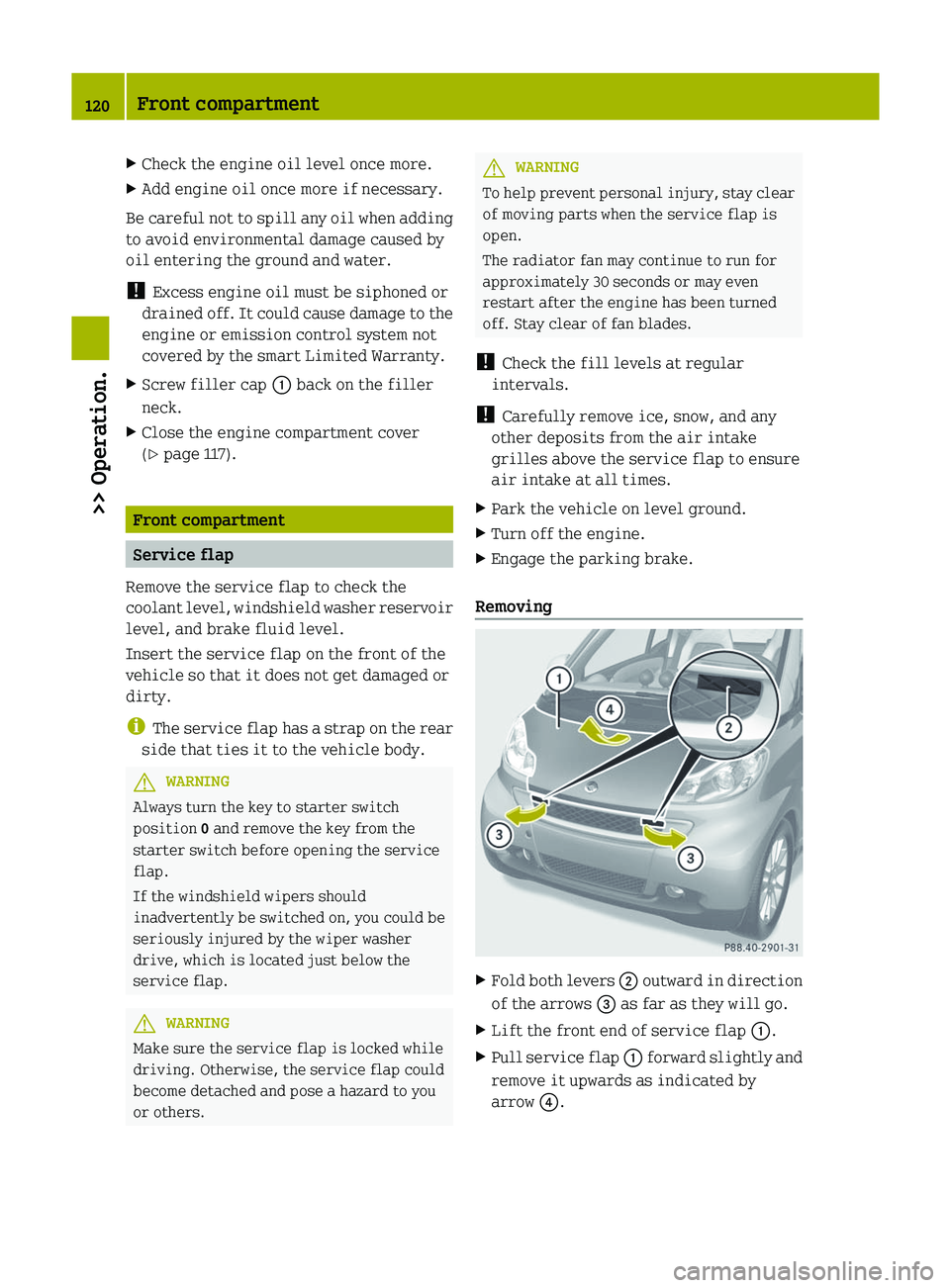
Removing X
Fold both levers ;
outward in direction
of the arrows = as far as they will go.
X Lift the front end of service flap :.
X Pull service flap :
forward slightly and
remove it upwards as indicated by
arrow ?. 120
Front compartment
>> Operation.
Page 126 of 228
The brake fluid level is correct when it
is between the minimum mark and the
maximum mark.
R
If the brake fluid level has fallen
slightly below the minimum mark,
drive to an authorized smart center.
R If the brake fluid level has fallen
significantly below the minimum
mark, call Roadside Assistance or an
authorized smart center.
X Remount the service flap and close it
(Y page 120). Tires and wheels
Safety notes
Contact an authorized smart center for
information on tested and recommended
rims and tires for summer and winter
operation. They can also offer advice
concerning tire service and purchase. G
WARNING
Replace rims or tires with the same
designation, manufacturer and type as
shown on the original part. For further
information contact an authorized smart
center.
If incorrectly sized rims and tires
are mounted, the wheel brakes or
suspension components can be damaged.
Also, the operating clearance of the wheels
and the tires may no longer be correct. G
WARNING
Worn, old tires can cause accidents. If the
tire
tread is worn to minimum tread depth,
or if the tires have sustained damage,
replace them.
When replacing rims, only use genuine
smart wheel bolts specified for the
particular rim type. Failure to do so can
result in the bolts loosening and possibly
an accident.
Retreaded tires are not tested or
recommended by smart, since previous damage cannot always be recognized on
retreads. The operating safety of the
vehicle cannot be assured when such tires
are used.
G
WARNING
If you feel a sudden significant vibration
or ride disturbance, or you suspect that
possible damage to your vehicle has
occurred, you should turn on the hazard
warning flashers, carefully slow down, and
drive
with caution to an area which is a safe
distance from the road.
Inspect the tires and the vehicle underbody
for possible damage. If the vehicle or tires
appear unsafe, have the vehicle towed to the
nearest authorized smart center or tire
dealer for repairs. G
WARNING
Do not drive with a flat tire. A flat tire
affects the ability to steer or brake the
vehicle. You could lose control of the
vehicle.
Continued driving with a flat tire
or driving at high speed with a flat tire
will cause excessive heat build-up and
possibly a fire.
Modifications to the brake system and
wheels and the use of brake dust rings are
not permissible. Important guidelines
R Only
use sets of tires and rims of the same
type and make.
R Tires must be of the correct size for the
rim.
R Break in new tires for approximately
60 miles (100 km) at moderate speeds.
R Regularly check the tires and rims for
damage. Dented or bent rims can cause
tire pressure loss and damage to the tire
beads.124
Tires and wheels
>> Operation.
Page 136 of 228
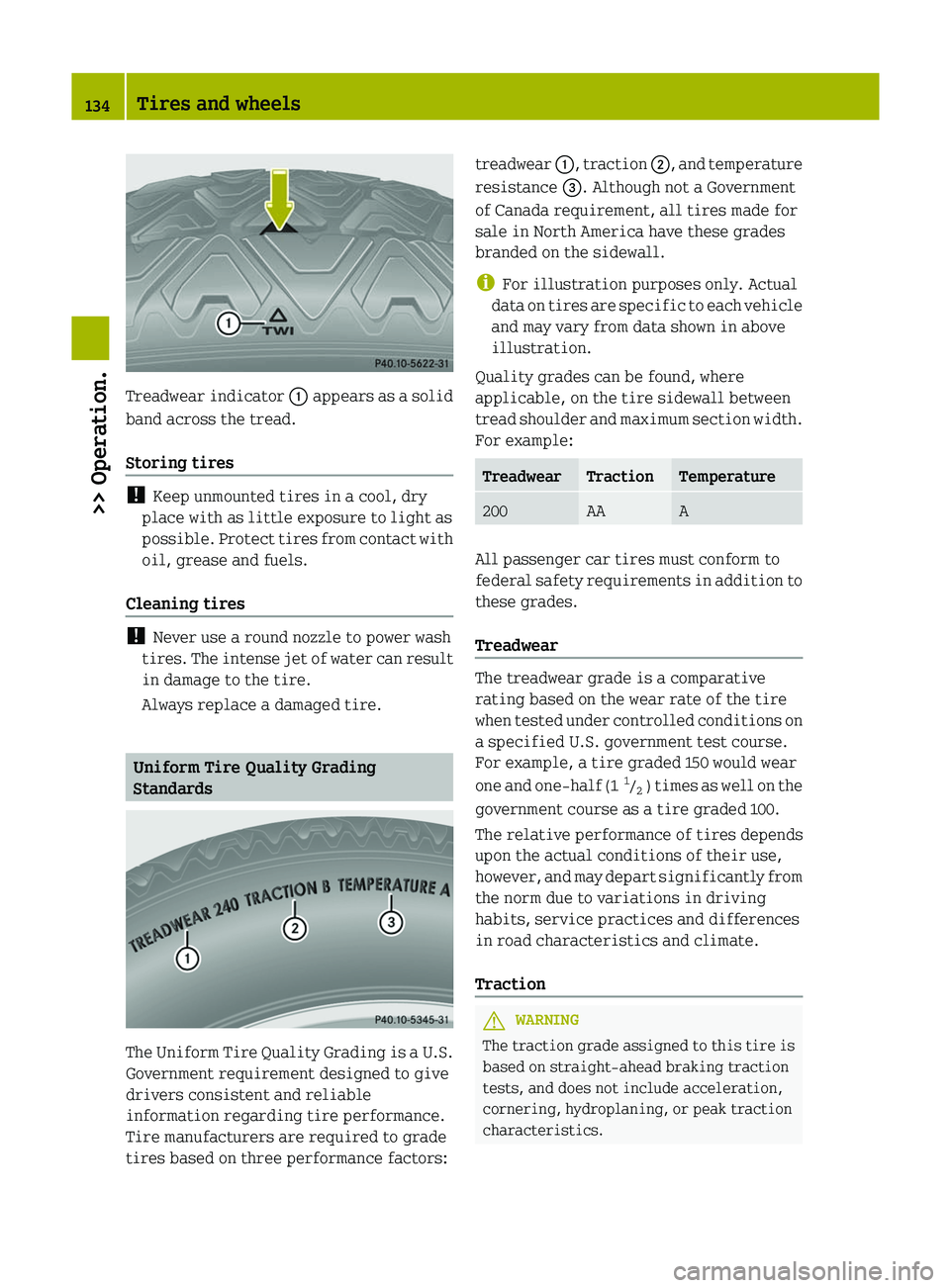
Treadwear indicator
: appears as a solid
band across the tread.
Storing tires !
Keep unmounted tires in a cool, dry
place with as little exposure to light as
possible.
Protect tires from contact with
oil, grease and fuels.
Cleaning tires !
Never use a round nozzle to power wash
tires.
The intense jet of water can result
in damage to the tire.
Always replace a damaged tire. Uniform Tire Quality Grading
Standards
The Uniform Tire Quality Grading is a U.S.
Government requirement designed to give
drivers consistent and reliable
information regarding tire performance.
Tire manufacturers are required to grade
tires based on three performance factors: treadwear
:,
traction ;, and temperature
resistance =. Although not a Government
of Canada requirement, all tires made for
sale in North America have these grades
branded on the sidewall.
i For illustration purposes only. Actual
data on tires are specific to each vehicle
and may vary from data shown in above
illustration.
Quality grades can be found, where
applicable, on the tire sidewall between
tread shoulder and maximum section width.
For example: Treadwear Traction Temperature
200 AA A
All passenger car tires must conform to
federal
safety requirements in addition to
these grades.
Treadwear The treadwear grade is a comparative
rating based on the wear rate of the tire
when
tested under controlled conditions on
a specified U.S. government test course.
For example, a tire graded 150 would wear
one and one-half (1 1
/ 2 ) times as well on the
government course as a tire graded 100.
The relative performance of tires depends
upon the actual conditions of their use,
however, and may depart significantly from
the norm due to variations in driving
habits, service practices and differences
in road characteristics and climate.
Traction G
WARNING
The traction grade assigned to this tire is
based on straight-ahead braking traction
tests, and does not include acceleration,
cornering, hydroplaning, or peak traction
characteristics. 134
Tires and wheels
>> Operation.
Page 150 of 228
(Y page 217), for example when purchasing
new tires.
For
information on how to identify the tire
speed rating on a tire’s sidewall, see “Tire
size designation, load and speed rating”
(Y page 136).
If you are uncertain about the correct
reading of the information given on a
tire’s sidewall, any authorized smart
center will be glad to assist you.
i For information on speed ratings for
winter tires, see “All-season and winter
tires” ( Y page 137). Winter driving instructions
The
most important rule for slippery or icy
roads is to drive sensibly and to avoid
abrupt acceleration, braking and steering
maneuvers.
When the vehicle is in danger of skidding,
move gear selector lever to neutral
position N. Try to keep the vehicle under
control by corrective steering action.
For information on driving with snow
chains*, see “Snow chains*” (Y page 142). G
WARNING
On slippery road surfaces, never downshift
in order to obtain braking action. This
could result in drive wheel slip and
reduced
vehicle control. Your vehicle’s ABS
will not prevent this type of loss of control.
Road salts and chemicals can adversely
affect braking efficiency. Increased pedal
force may become necessary to produce the
normal braking effect.
Depressing the brake pedal periodically
when traveling at length on salt-strewn
roads can bring road-salt-impaired
braking efficiency back to normal.
If the vehicle is parked after being driven
on salt-treated roads, the braking
efficiency should be tested as soon as
possible after driving is resumed. G
WARNING
Make sure not to endanger any other road
users when carrying out these braking
maneuvers. G
WARNING
If the vehicle becomes stuck in snow, make
sure
snow is kept clear of the exhaust pipe
and from around the vehicle with the engine
running. Otherwise, deadly carbon
monoxide (CO) gases may enter vehicle
interior resulting in unconsciousness and
death.
To assure sufficient fresh air ventilation,
open a window slightly on the side of the
vehicle not facing the wind. G
WARNING
The outside temperature display is not
designed
to serve as an ice-warning device
and is therefore unsuitable for that
purpose. Indicated temperatures just
above the freezing point do not guarantee
that the road surface is free of ice.
For more information, see “Winter driving”
(Y page 142). Standing water
! Do not drive through flooded areas or
water of unknown depth. Before driving
through water, determine its depth.
Never accelerate before driving into
water. The bow wave could force water
into the engine and auxiliary
equipment, thus damaging them.
If you must drive through standing water,
drive
slowly to prevent water from entering
R the front compartment
R the engine compartment
R the passenger compartment
Water in these areas could cause damage to
electrical components or wiring of the
engine or transmission, or could result in 148
Driving instructions
>> Operation.
* optional
Page 153 of 228
Such damage is caused not only by extreme
and varying climatic conditions, but also
by:
R
Air pollution
R Road salt
R Tar
R Gravel and stone chipping
To avoid paint damage, you should
immediately remove:
R Insects
R Bird droppings
R Tree sap, etc.
R Grease and oil
R Brake fluid
R Coolant
R Fuel
R Tar spots
! Failure to remove such dirt
immediately can cause damage to the
paint or the soft top fabric*
.
Environmental influences are not
covered by the smart Limited Warranty.
Frequent washing reduces and/or
eliminates the aggressiveness and potency
of the above adverse influences.
More frequent washings are necessary to
deal with unfavorable conditions:
R near the ocean
R in industrial areas (smoke, exhaust
emissions)
R during winter operation
You should check your vehicle from time to
time for stone chipping or other damage.
Any damage should be repaired as soon as
possible to prevent corrosion.
In doing so, do not neglect the underbody
of the vehicle. A prerequisite for a
thorough check is a washing of the
underbody followed by a thorough
inspection. Damaged areas need to be re-
undercoated.
Your vehicle has been treated at the factory
with a wax-base rustproofing in the body cavities which will last for the lifetime of
the vehicle. Post-production treatment is
neither necessary nor recommended by
smart because of the possibility of
incompatibility
between materials used in
the production process and others applied
later.
We have selected vehicle-care products
and compiled recommendations which are
specially matched to our vehicles and
which always reflect the latest technology.
You can obtain smart approved vehicle-
care products at an authorized smart
center.
Scratches, corrosive deposits, corrosion
or damage due to negligent or incorrect
care cannot always be removed or repaired
with the vehicle-care products
recommended here. In such cases it is best
to seek aid at an authorized smart center.
The following topics deal with the cleaning
and care of your vehicle and give important
“how-to” information as well as references
to smart approved vehicle-care products. Vehicle care
Contact an authorized smart center for
recommended and approved care products.
i Advice on caring for the soft top
system, see (Y page 154). G
WARNING
After washing the vehicle, the brakes may
still be wet and thus their functionality
impaired. Therefore, when you start off,
brake lightly several times without
endangering traffic. Vehicle care
151
>> Operation.
* optional Z
Page 155 of 228
Exterior Special
considerations Lightly soiled
Hand-/Automatic
car washes Heavily soiled
Hand-/Automatic
car washes
Wheels and wheel
covers Two-layer metallic
paint (high-gloss) Car shampoo
concentrate, rim
care Car shampoo
concentrate, rim
care
Retractable soft top PAC fabric Car shampoo
concentrate, soft
top cleaner,
impregnation spray Car shampoo
concentrate, soft
top cleaner,
impregnation spray
Removing insects
Remove insect remains before you start to
wash the vehicle.
X
Spray insect remover on.
X Allow insect remover to work in briefly.
X Rub in gently with a soft cloth or sponge.
X Rinse with plenty of water.
X Treat the cleaned surface with hard wax.
Removing tar Remove any tar marks before washing the
vehicle.
X
Apply tar remover with a soft cloth.
X Allow tar remover to work in briefly.
X Rub in gently.
X Rinse with plenty of water.
X Treat the cleaned surface with hard wax.
Vehicle washing In the winter, thoroughly remove all traces
of road salt as soon as possible.
When
washing the vehicle underbody, do not
forget to clean the inner sides of the
wheels.
Washing your vehicle by hand
X Wash the vehicle using car shampoo
concentrate and a sponge.
X Rinse with clean water.
X Towel dry the vehicle. !
Do not wash the vehicle in direct
sunlight. The body panel surfaces and
paint finish may be damaged.
Washing your vehicle in an automatic car
wash
i When running your vehicle through an
automatic car wash, water droplets can
run
down the inside of the side windows.
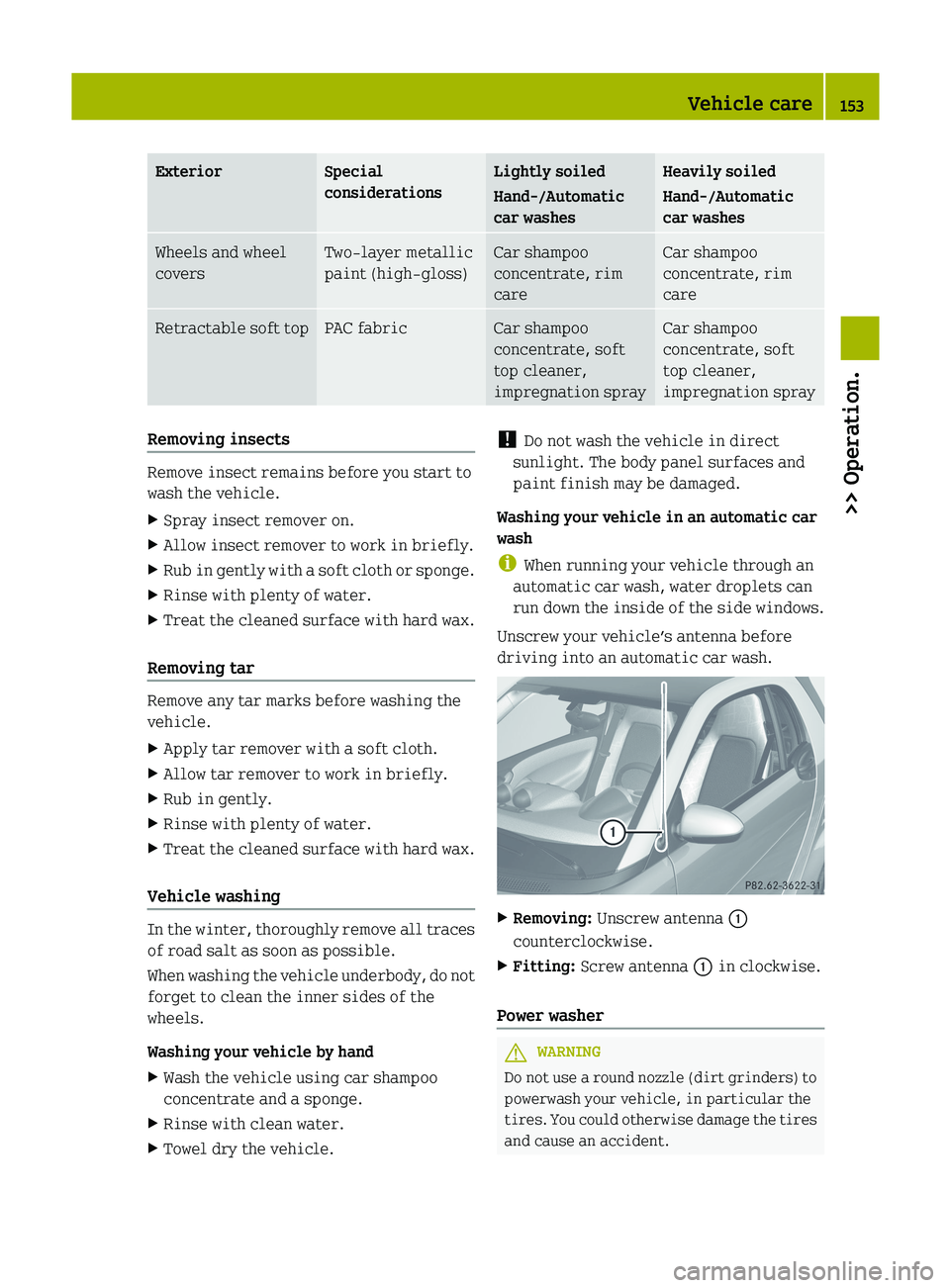
Unscrew your vehicle’s antenna before
driving into an automatic car wash. X
Removing: Unscrew antenna :
counterclockwise.
X Fitting: Screw antenna : in clockwise.
Power washer G
WARNING
Do not use a round nozzle (dirt grinders) to
powerwash your vehicle, in particular the
tires.
You could otherwise damage the tires
and cause an accident. Vehicle care
153
>> Operation. Z
Page 180 of 228
X
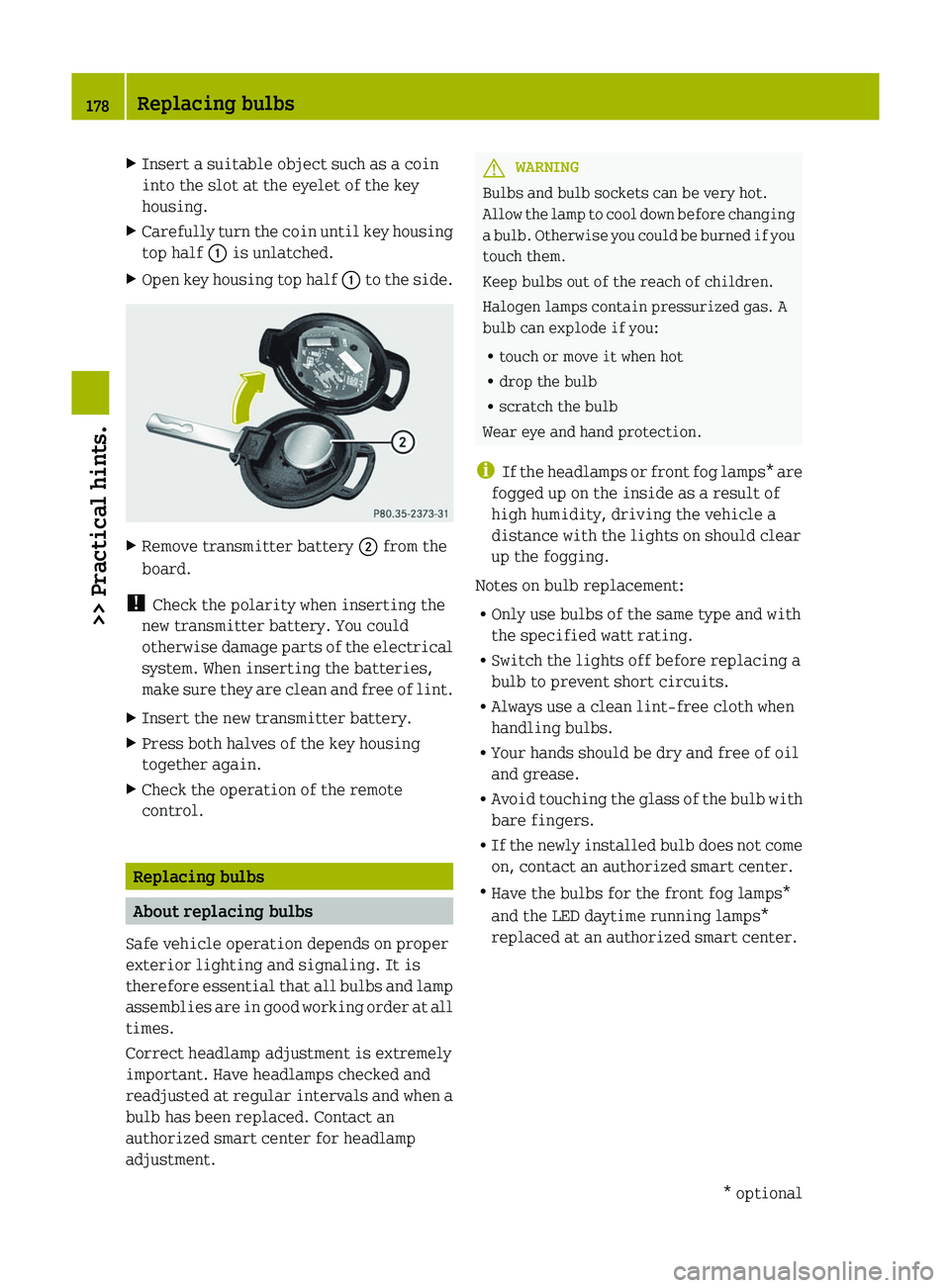
Insert a suitable object such as a coin
into the slot at the eyelet of the key
housing.
X Carefully turn the coin until key housing
top half : is unlatched.
X Open key housing top half : to the side.X
Remove transmitter battery ; from the
board.
! Check the polarity when inserting the
new transmitter battery. You could
otherwise
damage parts of the electrical
system. When inserting the batteries,
make sure they are clean and free of lint.
X Insert the new transmitter battery.
X Press both halves of the key housing
together again.
X Check the operation of the remote
control. Replacing bulbs
About replacing bulbs
Safe vehicle operation depends on proper
exterior lighting and signaling. It is
therefore
essential that all bulbs and lamp
assemblies are in good working order at all
times.
Correct headlamp adjustment is extremely
important. Have headlamps checked and
readjusted at regular intervals and when a
bulb has been replaced. Contact an
authorized smart center for headlamp
adjustment. G
WARNING
Bulbs and bulb sockets can be very hot.
Allow
the lamp to cool down before changing
a bulb. Otherwise you could be burned if you
touch them.
Keep bulbs out of the reach of children.
Halogen lamps contain pressurized gas. A
bulb can explode if you:
R touch or move it when hot
R drop the bulb
R scratch the bulb
Wear eye and hand protection.
i If the headlamps or front fog lamps* are
fogged up on the inside as a result of
high humidity, driving the vehicle a
distance with the lights on should clear
up the fogging.
Notes on bulb replacement:
R Only use bulbs of the same type and with
the specified watt rating.
R Switch the lights off before replacing a
bulb to prevent short circuits.
R Always use a clean lint-free cloth when
handling bulbs.
R Your hands should be dry and free of oil
and grease.
R Avoid touching the glass of the bulb with
bare fingers.
R If the newly installed bulb does not come
on, contact an authorized smart center.
R Have the bulbs for the front fog lamps*
and the LED daytime running lamps*
replaced at an authorized smart center.178
Replacing bulbs
>> Practical hints.
* optional
Page 186 of 228
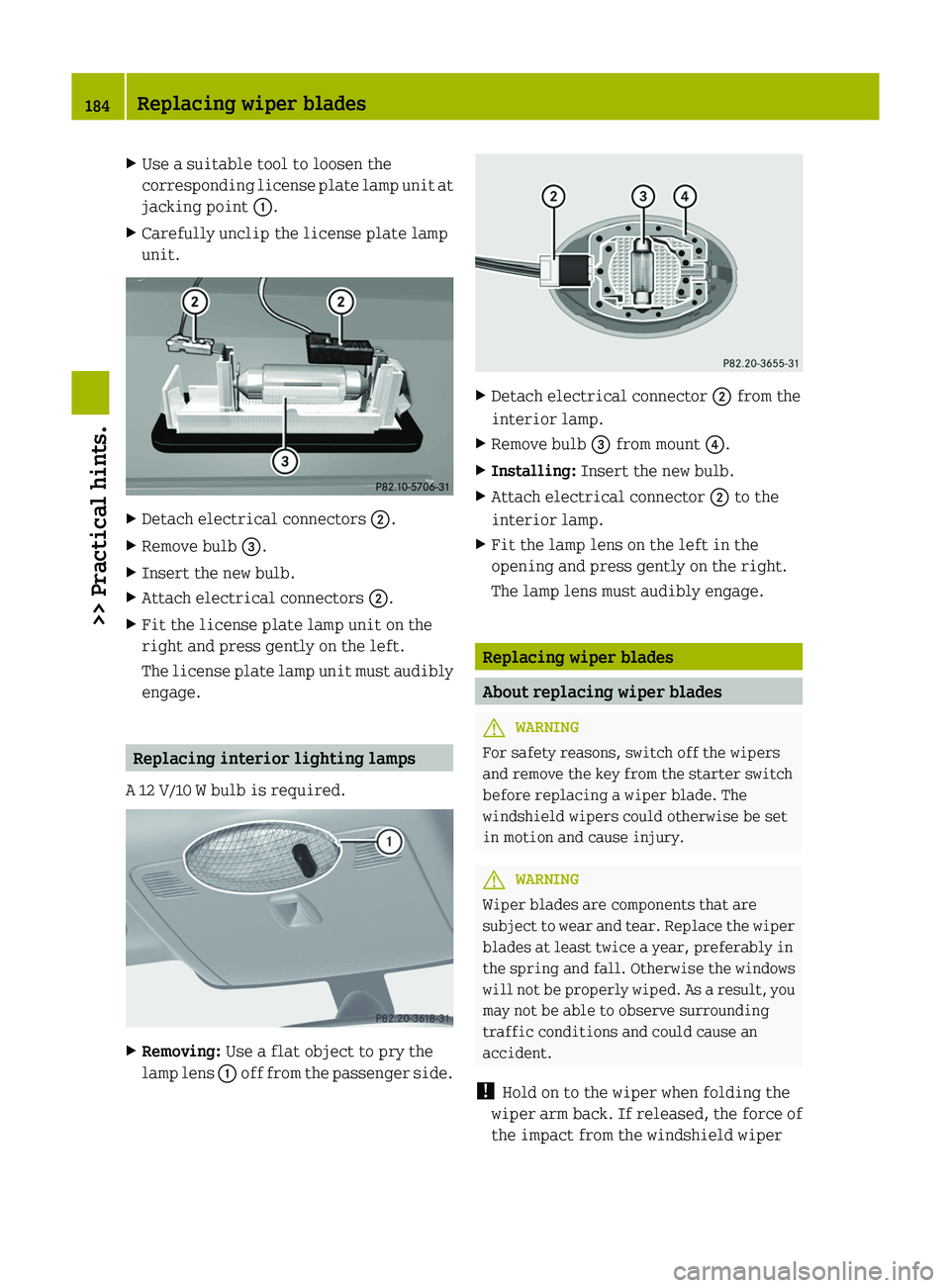
X
Use a suitable tool to loosen the
corresponding
license plate lamp unit at
jacking point :.
X Carefully unclip the license plate lamp
unit. X
Detach electrical connectors ;.
X Remove bulb =.
X Insert the new bulb.
X Attach electrical connectors ;.
X Fit the license plate lamp unit on the
right and press gently on the left.
The
license plate lamp unit must audibly
engage. Replacing interior lighting lamps
A 12 V/10 W bulb is required. X
Removing: Use a flat object to pry the
lamp
lens : off from the passenger side. X
Detach electrical connector ; from the
interior lamp.
X Remove bulb = from mount ?.
X Installing: Insert the new bulb.
X Attach electrical connector ; to the
interior lamp.
X Fit the lamp lens on the left in the
opening and press gently on the right.
The lamp lens must audibly engage. Replacing wiper blades
About replacing wiper blades
G
WARNING
For safety reasons, switch off the wipers
and remove the key from the starter switch
before replacing a wiper blade. The
windshield wipers could otherwise be set
in motion and cause injury. G
WARNING
Wiper blades are components that are
subject
to wear and tear. Replace the wiper
blades at least twice a year, preferably in
the spring and fall. Otherwise the windows
will not be properly wiped. As a result, you
may not be able to observe surrounding
traffic conditions and could cause an
accident.
! Hold on to the wiper when folding the
wiper arm back. If released, the force of
the impact from the windshield wiper 184
Replacing wiper blades
>> Practical hints.