Pressure SMART FORTWO COUPE 2012 Owner's Guide
[x] Cancel search | Manufacturer: SMART, Model Year: 2012, Model line: FORTWO COUPE, Model: SMART FORTWO COUPE 2012Pages: 228, PDF Size: 12.76 MB
Page 147 of 228
effect. Maintain a safe distance from
vehicles in front.
To
help prevent brake disc corrosion after
driving on wet road surfaces (particularly
salted roads), it is advisable to brake the
vehicle with considerable force prior to
parking. The heat generated serves to dry
the brakes. G
WARNING
Make sure not to endanger any other road
users when carrying out these braking
maneuvers.
Limited braking effect on salted roads Remember that the effect of the brakes can
be
limited on salted road surfaces. A layer
of salt can form on brake discs and brake
pads, considerably reducing the friction
between the brake disc and the brake pad.
The effect is most noticeable after long
trips without braking, e.g. on the highway,
and after the vehicle has been parked for
several hours. G
WARNING
The accumulation of salt on brake discs and
brake pads reduces braking effectiveness
and increases the distance necessary to
come to a complete standstill. This could
potentially cause an accident and/or
personal injury.
To avoid this risk, you should
R brake carefully every now and then on
salted
roads in order to remove any layer
of salt on the brake disc and brake pad,
but do so without endangering any other
road users
R keep a good safe distance from the
vehicle in front and drive carefully
R press the brake carefully at the end of the
trip and again when beginning the next
trip in order to remove any salt residues
from the brake disc New brake pads Only install brake pads recommended by
smart.
G
WARNING
If other than recommended brake pads are
installed,
or other than recommended brake
fluid is used, the braking properties of the
vehicle can be degraded to an extent that
safe braking is substantially impaired.
This could result in an accident. G
WARNING
New brake pads will not achieve their
optimal braking effect until after several
hundred miles (kilometers). This means
that you must compensate for the reduced
braking effect by pressing harder on the
brake pedal and adapt your driving style
accordingly. The same applies after brake
pads or brake discs have been changed. Drive sensibly - save fuel
Fuel consumption, to a great extent,
depends on driving habits and operating
conditions.
To save fuel you should:
R Shift gears in a timely manner.
R Avoid frequent acceleration and
deceleration.
R Keep
tires at the recommended inflation
pressures.
R Remove carriers* when not in use.
R Remove unnecessary loads.
R Allow engine to warm up under low load
use.
R Have all maintenance work performed at
the intervals specified in the
Maintenance Booklet and as required by
the Maintenance System. Contact an
authorized smart center.
Fuel consumption is also increased by
driving in cold weather, in stop-and-go
traffic, on short trips, and in hilly areas. Driving instructions
145
>> Operation.
* optional Z
Page 149 of 228

Depending upon the weather and/or road
surface (conditions), the tire traction
varies widely.
Specified
tire inflation pressures must be
maintained. This applies particularly if
the tires are subject to high loads (e.g.
high speeds, heavy loads, high ambient
temperatures). G
WARNING
Do not drive with a flat tire. A flat tire will
affect
your ability to steer or brake and may
cause you to lose control of the vehicle.
Continued driving with a flat tire or
driving at high speed with a flat tire will
cause excessive heat build-up and possibly
a fire.
For more information, see “Tires and
wheels” (Y page 124). Hydroplaning
Depending on the depth of the water layer
on the road, hydroplaning may occur
resulting in a loss of control, even at low
speeds and with new tires. Reduce vehicle
speed, avoid track grooves in the road and
apply
brakes cautiously when it is raining. Tire traction
The
safe speed on a wet, snow covered or icy
road is always lower than on a dry road.
You should pay particular attention to the
condition of the road whenever the outside
temperatures are close to the freezing
point. G
WARNING
If ice has formed on the road, tire traction
will be substantially reduced. Under such
weather
conditions, drive, steer and brake
with extreme caution.
smart recommends winter tires
(Y page 142) with a minimum tread depth of approximately
1
/ 6 in (4 mm) on all four
wheels for the winter season to ensure
normal
balanced handling characteristics.
On packed snow, they can reduce your
stopping distance compared to summer
tires.
Stopping distance, however, is still
considerably greater than when the road is
not covered with snow or ice. Exercise
appropriate caution.
! Avoid spinning of a drive wheel for an
extended period when driving off on
slippery road surfaces. Otherwise, the
drivetrain could be damaged, which is
not covered by the smart Limited
Warranty. Tire speed rating
Regardless of the tire speed rating, local
speed
limits should be obeyed. Use prudent
driving speeds appropriate to prevailing
conditions. G
WARNING
Even when permitted by law, never operate
a vehicle at speeds greater than the
maximum speed rating of the tires.
Exceeding the maximum speed for which
tires are rated can lead to sudden tire
failure,
causing loss of vehicle control and
possibly resulting in an accident and/or
personal injury and possible death, for you
and for others.
An electronic speed limiter prevents your
vehicle from exceeding a speed of 90 mph
(145 km/h).
The factory equipped tires on your vehicle
may have a tire speed rating above the
maximum speed permitted by the
electronic speed limiter.
Make sure your tires have the required tire
speed rating as specified for your vehicle
in the “Technical data section” Driving instructions
147
>> Operation. Z
Page 154 of 228
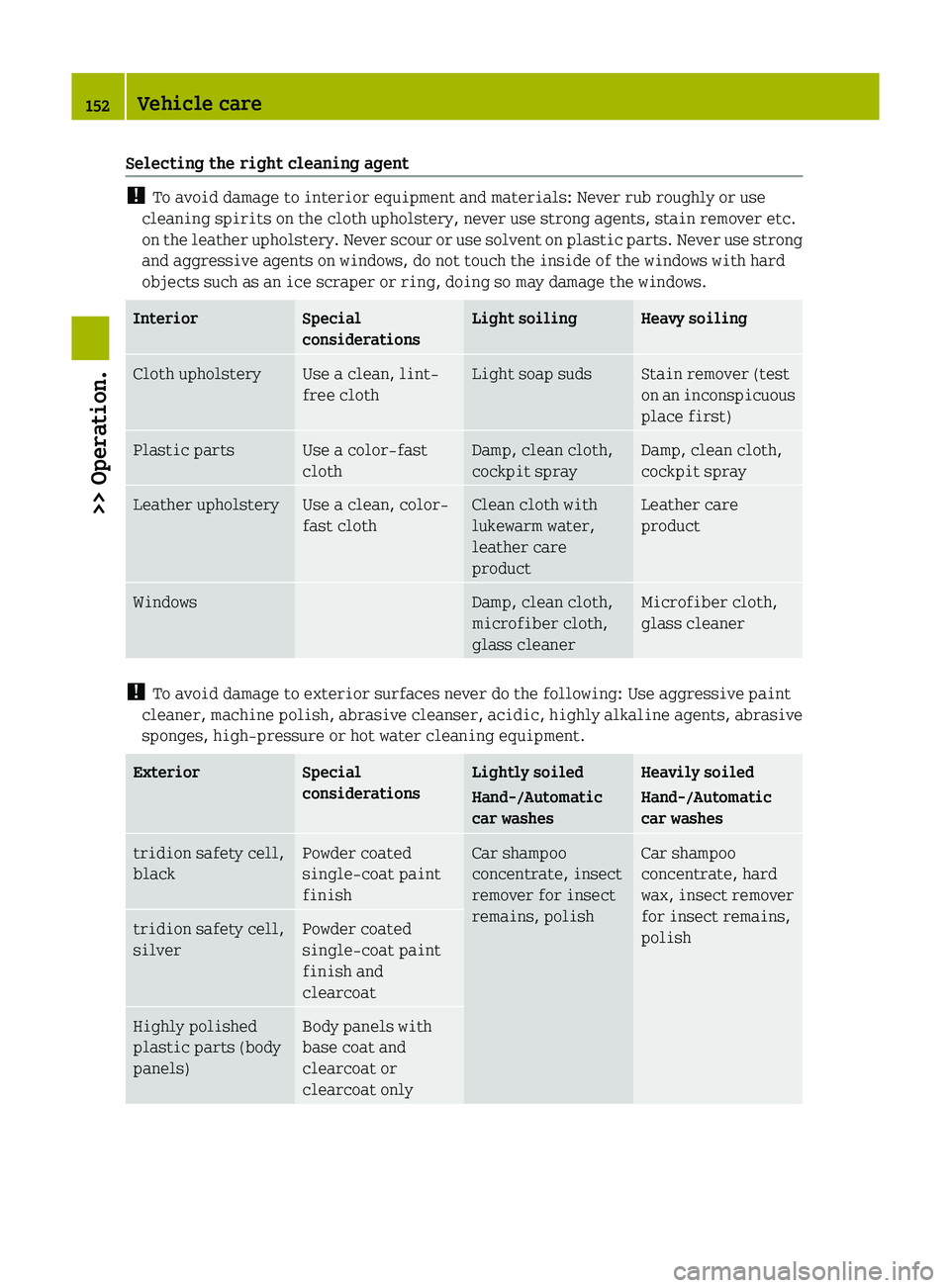
Selecting the right cleaning agent
!
To avoid damage to interior equipment and materials: Never rub roughly or use
cleaning spirits on the cloth upholstery, never use strong agents, stain remover etc.
on
the leather upholstery. Never scour or use solvent on plastic parts. Never use strong
and aggressive agents on windows, do not touch the inside of the windows with hard
objects such as an ice scraper or ring, doing so may damage the windows. Interior Special
considerations Light soiling Heavy soiling
Cloth upholstery Use a clean, lint-
free cloth Light soap suds Stain remover (test
on
an inconspicuous
place first) Plastic parts Use a color-fast
cloth Damp, clean cloth,
cockpit spray Damp, clean cloth,
cockpit spray
Leather upholstery Use a clean, color-
fast cloth Clean cloth with
lukewarm water,
leather care
product Leather care
product
Windows Damp, clean cloth,
microfiber cloth,
glass cleaner Microfiber cloth,
glass cleaner
!
To avoid damage to exterior surfaces never do the following: Use aggressive paint
cleaner, machine polish, abrasive cleanser, acidic, highly alkaline agents, abrasive
sponges, high-pressure or hot water cleaning equipment. Exterior Special
considerations Lightly soiled
Hand-/Automatic
car washes Heavily soiled
Hand-/Automatic
car washes
tridion safety cell,
black Powder coated
single-coat paint
finish Car shampoo
concentrate, insect
remover for insect
remains, polish Car shampoo
concentrate, hard
wax, insect remover
for insect remains,
polish
tridion safety cell,
silver Powder coated
single-coat paint
finish and
clearcoat
Highly polished
plastic parts (body
panels) Body panels with
base coat and
clearcoat or
clearcoat only152
Vehicle care
>> Operation.
Page 163 of 228

Display messages Possible causes/consequences and
M Solutions6
Reserve Fuel The fuel level has dropped below the reserve mark.
X
Refuel at the next gas station. Ö
Driver´s Door Ajar The driver’s door is open.
X
Close the driver’s door. Ø
Door Ajar The passenger door is open.
X
Close the passenger door. Õ
Tailgate Open A tailgate or the rear soft top
17
is open.
X Close the tailgates or the rear soft. Display messages Possible causes/consequences and
M Solutionsh
Check
Tire Pressure The tire inflation pressure in at least one tire is
significantly below the reference value.
X
Carefully bring the vehicle to a halt, avoiding abrupt
steering and braking maneuvers.
X Check and adjust tire inflation pressure as required
(Y page 126).
X If necessary, change the wheel ( Y page 194).G
WARNING
Each tire should be checked monthly when cold and inflated to the inflation pressure
recommended by the vehicle manufacturer on the Tire and Loading Information placard. If
your vehicle has tires of a different size than the size indicated on the Tire and Loading
Information placard, you should determine the proper tire inflation pressure for those
tires.
As
an added safety feature, your vehicle has been equipped with a tire pressure monitoring
system (TPMS) that illuminates a low tire pressure telltale when one or more of your tires
is significantly underinflated.
Accordingly, when the low tire pressure telltale illuminates, you should stop and check your
tires as soon as possible, and inflate them to the proper pressure. Driving on a significantly
underinflated tire causes the tire to overheat and can lead to tire failure.
Underinflation also reduces fuel efficiency and tire tread life, and may affect the vehicle’s
handling and stopping ability. Please note that the TPMS is not a substitute for proper tire
maintenance, and it is the driver’s responsibility to maintain correct tire pressure, even
if underinflation has not reached the level to trigger illumination of the TPMS low tire
pressure telltale.
17 cabriolet only. Display messages
161
>> Practical hints.
Z
Page 164 of 228

Your vehicle has also been equipped with a TPMS malfunction indicator to indicate when
the
system is not operating properly. The TPMS malfunction indicator is combined with the
low tire pressure telltale. When the system detects a malfunction, the telltale will flash for
approximately 1 minute and then remain continuously illuminated.
This sequence will continue upon subsequent vehicle start-ups as long as the malfunction
exists. When the malfunction indicator is illuminated, the system may not be able to detect
or signal low tire pressure as intended.
TPMS malfunctions may occur for a variety of reasons, including the installation of
incompatible replacement or alternate tires or wheels on the vehicle that prevent the TPMS
from functioning properly. Always check the TPMS malfunction telltale after replacing one
or more tires or wheels on your vehicle to ensure that the replacement or alternate tires
and wheels allow the TPMS to continue to function properly. Display messages Possible causes/consequences and
M SolutionsÒ
Danger: Ice
(Canada only) The outside temperature is below 3
¥. The road may be icy.
X Adjust your driving style to the prevailing road and weather
conditions. G
WARNING
The display message Danger:
Ice is not designed as an ice-warning device and is therefore
unsuitable for that purpose.
Indicated temperatures just above the freezing point do not guarantee that the road surface
is free of ice. The road may still be icy, especially in wooded areas or on bridges. Your
vehicle could start to skid if you do not adjust your driving style accordingly.
Therefore, always adjust your driving style to the prevailing road and weather conditions. What to do if ...
Warning and indicator lamps in the
instrument cluster
General information If any of the following lamps in the
instrument
cluster fails to come on during
the bulb self-check when switching on
ignition (Y page 57), have the respective
bulb checked and replaced if necessary. 162
What to do if ...
>> Practical hints.
Page 173 of 228
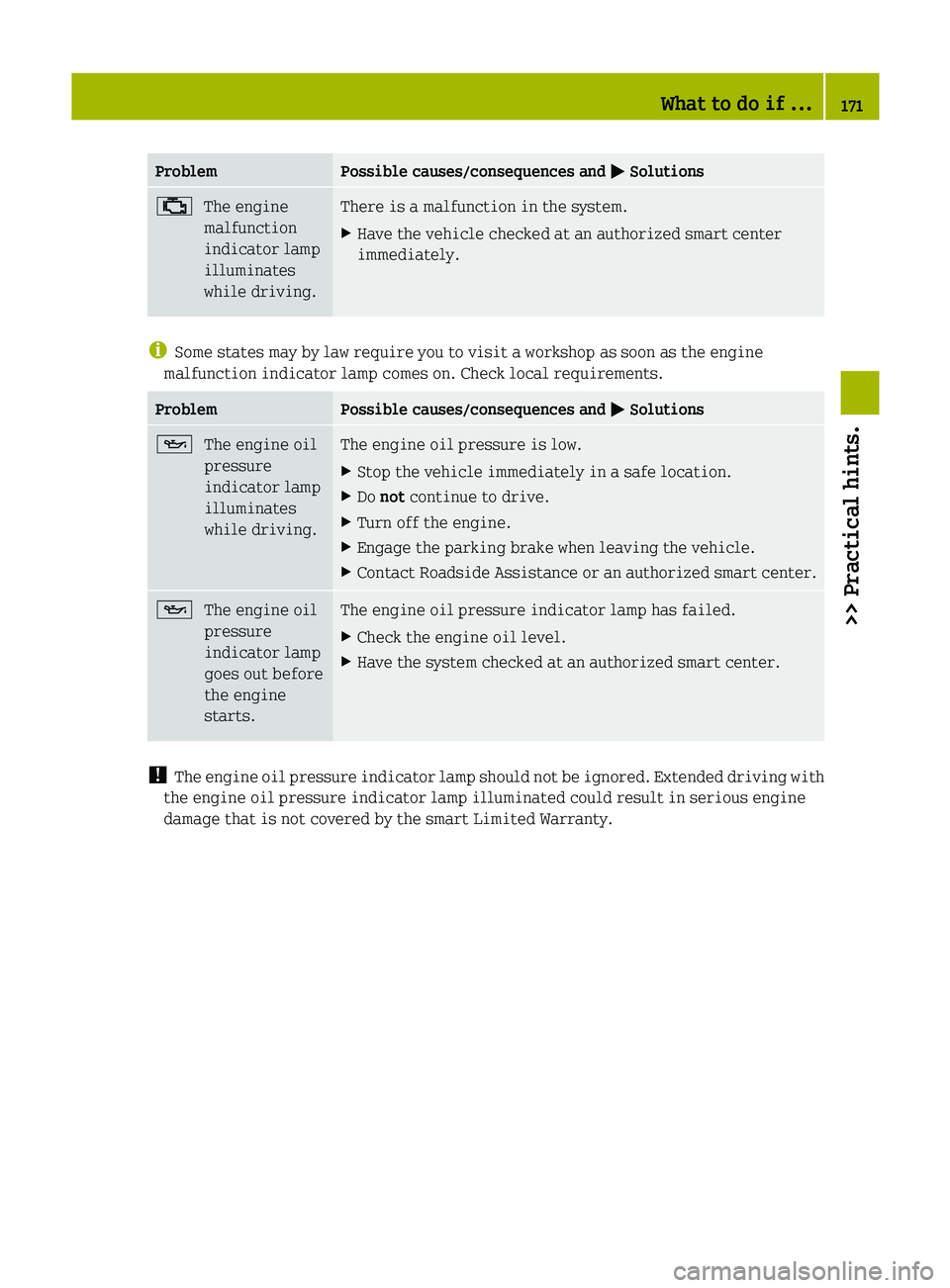
Problem Possible causes/consequences and
M Solutions;
The engine
malfunction
indicator lamp
illuminates
while driving. There is a malfunction in the system.
X
Have the vehicle checked at an authorized smart center
immediately. i
Some states may by law require you to visit a workshop as soon as the engine
malfunction indicator lamp comes on. Check local requirements. Problem Possible causes/consequences and
M Solutions5
The engine oil
pressure
indicator lamp
illuminates
while driving. The engine oil pressure is low.
X
Stop the vehicle immediately in a safe location.
X Do not continue to drive.
X Turn off the engine.
X Engage the parking brake when leaving the vehicle.
X Contact Roadside Assistance or an authorized smart center. 5
The engine oil
pressure
indicator lamp
goes out before
the engine
starts. The engine oil pressure indicator lamp has failed.
X
Check the engine oil level.
X Have the system checked at an authorized smart center. !
The engine oil pressure indicator lamp should not be ignored. Extended driving with
the engine oil pressure indicator lamp illuminated could result in serious engine
damage that is not covered by the smart Limited Warranty. What to do if ...
171
>> Practical hints. Z
Page 174 of 228
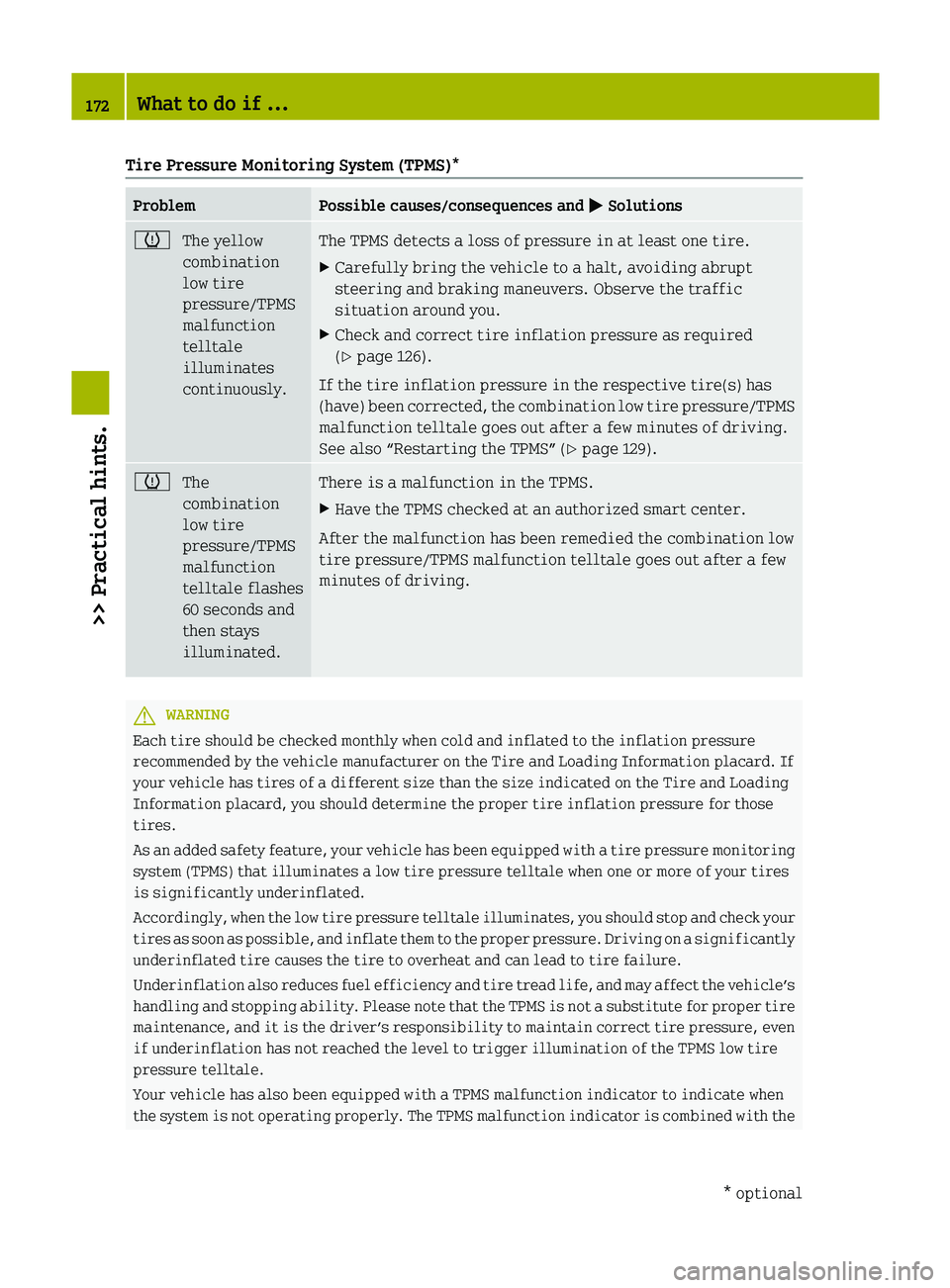
Tire Pressure Monitoring System (TPMS)*
Problem Possible causes/consequences and
M Solutionsh
The yellow
combination
low tire
pressure/TPMS
malfunction
telltale
illuminates
continuously. The TPMS detects a loss of pressure in at least one tire.
X
Carefully bring the vehicle to a halt, avoiding abrupt
steering and braking maneuvers. Observe the traffic
situation around you.
X Check and correct tire inflation pressure as required
(Y page 126).
If the tire inflation pressure in the respective tire(s) has
(have) been corrected, the combination low tire pressure/TPMS
malfunction telltale goes out after a few minutes of driving.
See also “Restarting the TPMS” (Y page 129). h
The
combination
low tire
pressure/TPMS
malfunction
telltale flashes
60 seconds and
then stays
illuminated. There is a malfunction in the TPMS.
X
Have the TPMS checked at an authorized smart center.
After the malfunction has been remedied the combination low
tire pressure/TPMS malfunction telltale goes out after a few
minutes of driving. G
WARNING
Each tire should be checked monthly when cold and inflated to the inflation pressure
recommended by the vehicle manufacturer on the Tire and Loading Information placard. If
your vehicle has tires of a different size than the size indicated on the Tire and Loading
Information placard, you should determine the proper tire inflation pressure for those
tires.
As
an added safety feature, your vehicle has been equipped with a tire pressure monitoring
system (TPMS) that illuminates a low tire pressure telltale when one or more of your tires
is significantly underinflated.
Accordingly, when the low tire pressure telltale illuminates, you should stop and check your
tires as soon as possible, and inflate them to the proper pressure. Driving on a significantly
underinflated tire causes the tire to overheat and can lead to tire failure.
Underinflation also reduces fuel efficiency and tire tread life, and may affect the vehicle’s
handling and stopping ability. Please note that the TPMS is not a substitute for proper tire
maintenance, and it is the driver’s responsibility to maintain correct tire pressure, even
if underinflation has not reached the level to trigger illumination of the TPMS low tire
pressure telltale.
Your vehicle has also been equipped with a TPMS malfunction indicator to indicate when
the system is not operating properly. The TPMS malfunction indicator is combined with the 172
What to do if ...
>> Practical hints.
* optional
Page 175 of 228
low tire pressure telltale. When the system detects a malfunction, the telltale will flash for
approximately 1 minute and then remain continuously illuminated.
This sequence will continue upon subsequent vehicle start-ups as long as the malfunction
exists.
When the malfunction indicator is illuminated, the system may not be able to detect
or signal low tire pressure as intended.
TPMS malfunctions may occur for a variety of reasons, including the installation of
incompatible replacement or alternate tires or wheels on the vehicle that prevent the TPMS
from functioning properly. Always check the TPMS malfunction telltale after replacing one
or more tires or wheels on your vehicle to ensure that the replacement or alternate tires
and wheels allow the TPMS to continue to function properly. Warning and indicator lamps in the overhead control panel
Problem Possible causes/consequences and
M Solutions4 0
The passenger front
air bag off indicator
lamp illuminates and
remains illuminated
with the weight of a
typical adult or
someone larger than a
small individual on
the passenger seat. There is a malfunction in the system.
X
Have the system checked at an authorized smart center. 4 0
The passenger front
air bag off indicator
lamp does not
illuminate
or remains
out with the weight of
a typical
12‑month‑old child in
a standard child
restraint or less on
the passenger seat There is a malfunction in the system.
X
Have the system checked at an authorized smart center. G
WARNING
If the 4 0
indicator lamp illuminates and remains illuminated with the weight
of a typical adult or someone larger than a small individual on the passenger seat, do not
have any passenger use the passenger seat until the system has been repaired. What to do if ...
173
>> Practical hints. Z
Page 188 of 228
X
Removing: Fold the wiper arm away from
the
rear window until you feel it engage.
X Fold wiper blade :
away from the wiper
arm in direction of arrow ; until it
disengages from its mounting.
X Detach wiper blade :.
X Installing:
Push the new wiper blade onto
the wiper arm until you feel it engage.
X Fold the wiper blade into a position
parallel to the wiper arm.
X Fold the wiper arm backward to rest on
the rear window.
Make sure to hold on to the wiper when
folding the wiper arm back.
! Make sure the wiper blade is properly
installed. An improperly installed
wiper blade may cause rear window
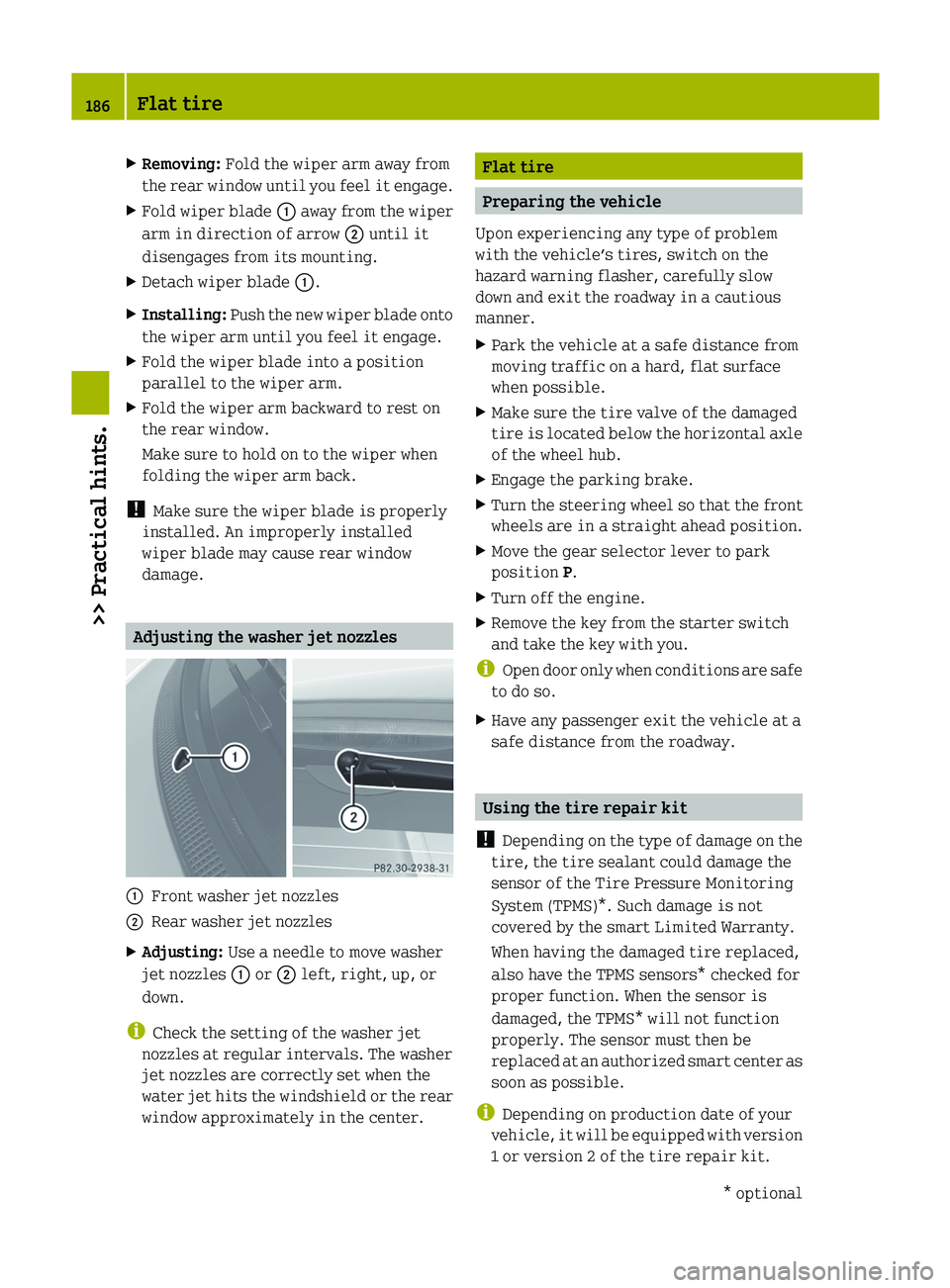
damage. Adjusting the washer jet nozzles
:
Front washer jet nozzles
; Rear washer jet nozzles
X Adjusting: Use a needle to move washer
jet nozzles : or ; left, right, up, or
down.
i Check the setting of the washer jet
nozzles at regular intervals. The washer
jet nozzles are correctly set when the
water
jet hits the windshield or the rear
window approximately in the center. Flat tire
Preparing the vehicle
Upon experiencing any type of problem
with the vehicle’s tires, switch on the
hazard warning flasher, carefully slow
down and exit the roadway in a cautious
manner.
X Park the vehicle at a safe distance from
moving traffic on a hard, flat surface
when possible.
X Make sure the tire valve of the damaged
tire
is located below the horizontal axle
of the wheel hub.
X Engage the parking brake.
X Turn the steering wheel so that the front
wheels are in a straight ahead position.
X Move the gear selector lever to park
position P.
X Turn off the engine.
X Remove the key from the starter switch
and take the key with you.
i Open
door only when conditions are safe
to do so.
X Have any passenger exit the vehicle at a
safe distance from the roadway. Using the tire repair kit
! Depending
on the type of damage on the
tire, the tire sealant could damage the
sensor of the Tire Pressure Monitoring
System (TPMS)*. Such damage is not
covered by the smart Limited Warranty.
When having the damaged tire replaced,
also have the TPMS sensors* checked for
proper function. When the sensor is
damaged, the TPMS* will not function
properly. The sensor must then be
replaced at an authorized smart center as
soon as possible.
i Depending on production date of your
vehicle, it will be equipped with version
1 or version 2 of the tire repair kit. 186
Flat tire
>> Practical hints.
* optional
Page 189 of 228
Please make sure to refer to the
description
of the tire repair kit in your
vehicle before sealing a tire.
The tire repair kit can be used to seal
punctures of up to approximately 0.16 in
(4 mm) on the tire tread.
The tire repair kit enables you to drive on
the sealed tire to the nearest authorized
smart center.
X You should have the sealed tire replaced
at an authorized smart center. G
WARNING
Take care not to allow the contents of the
tire sealant to come in contact with hair,
eyes or clothing. The tire sealant is
harmful if inhaled, swallowed or absorbed
through the skin - causes skin, eye and
respiratory irritation. Wear gloves while
using this product if they are available.
Any contact with eyes or skin should be
flushed immediately with plenty of water.
If clothing comes in contact with the tire
sealant, change clothing as soon as
possible.
In
case of allergic reaction or rash, consult
a physician immediately. Notes
R Small tire punctures, particularly those
in the tread, can be sealed with the tire
sealant.
R The tire sealant can be used in ambient
temperatures from ‑4 ¦ (‑20¥) to
104¦ (+40¥).
R Do
not remove any foreign objects such as
nails or screws that have penetrated the
tire.
R Do not use the tire sealant if the tire has
been damaged by being driven when
insufficiently inflated (e.g. bumps,
cuts, cracks etc. on the tire).
R Allow escaped tire sealant to dry, then
peel it off. R
Immediately wash all painted surfaces
that came into contact with the tire
sealant using a damp cloth.
R Avoid skin and eye contact with the tire
sealant.
R Do not swallow the tire sealant.
R Allow the tire sealant that is inside the
damaged tire to dry and dispose of
together with the tire.
R Do not use the tire sealant after the
expiration date has elapsed (see top of
container).
Instead, have it replaced at an
authorized smart center. G
WARNING
The tire sealant is a limited repair device.
The tire sealant cannot be used for cuts or
punctures larger than approximately
0.16 in (4 mm) and tire damage caused by
driving with extremely low tire inflation
pressure, or on a flat tire, or a damaged
wheel.
Do not drive the vehicle under such
circumstances.
If
you are unsure of the condition of the tire
or have any question whatsoever about its
suitability for driving contact the nearest
smart center for assistance or call
Roadside Assistance. G
WARNING
Please review the instructions below for
using the tire repair kit. If you are not
confident that you can competently follow
the instructions for using this kit, do not
use the kit, but instead call for Roadside
Assistance. G
WARNING
Keep the tire sealant out of reach of
children. If swallowed, rinse mouth
immediately
with plenty of water and drink
plenty of water.
Do not induce vomiting!
Consult a physician immediately. Flat tire
187
>> Practical hints.
Z