wheel SSANGYONG KORANDO 2012 Repair Manual
[x] Cancel search | Manufacturer: SSANGYONG, Model Year: 2012, Model line: KORANDO, Model: SSANGYONG KORANDO 2012Pages: 1082, PDF Size: 96.1 MB
Page 911 of 1082

06-54110-01
2. TORQUE STEER
Torque steer is a condition in which a vehicle pulls to either side because of an inequality of traction
between the left and right driving wheels when a large torque is applied to the front wheel of a FWD or
4WD.
Especially for a FWD vehicle, this mechanical condition can cause the steering effect because of the
output torque (rotational force) produced by the gyroscope.
This rotational force is due to the difference in distance between the left/right front wheels and the
transaxle which leads to the change of the shaft bending angle.
To prevent this, the intermediate shaft, called Intermediate shaft, is employed on each side so that the
bending angle and the length are kept constant.
A gyroscope is a device for measuring or maintaining orientation, based on the principles of angular
momentum. In essence, a mechanical gyroscope is a spinning wheel or disk whose axle is free to
take any orientation. Although this orientation does not remain fixed, it changes in response to an
external torque much less and in a different direction than it would without the large angular
momentum associated with the disk's high rate of spin and moment of inertia. Since external torque
is minimized by mounting the device in gimbals, its orientation remains nearly fixed, regardless of
any motion of the platform on which it is mounted.
Page 912 of 1082
06-6
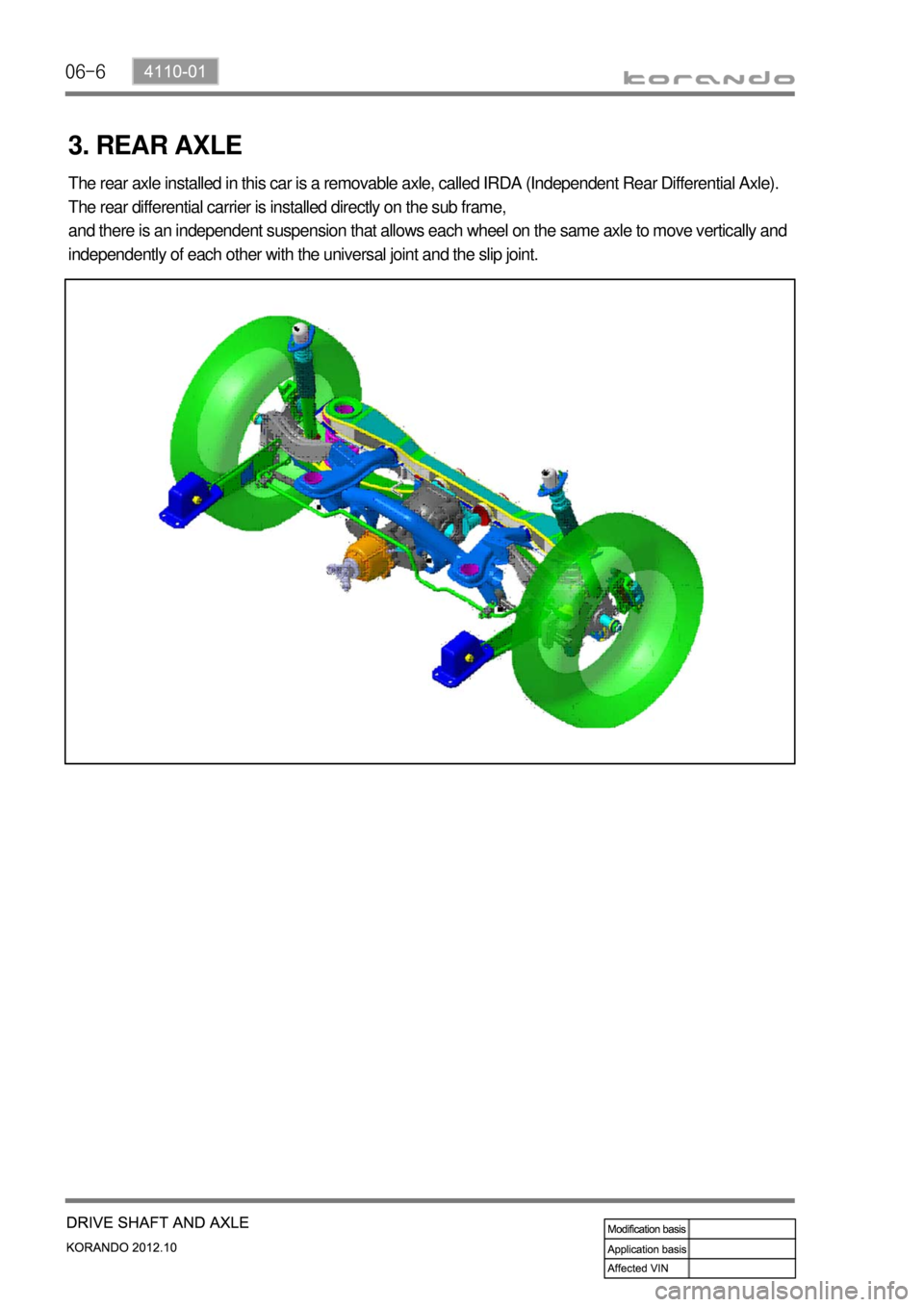
3. REAR AXLE
The rear axle installed in this car is a removable axle, called IRDA (Independent Rear Differential Axle).
The rear differential carrier is installed directly on the sub frame,
and there is an independent suspension that allows each wheel on the same axle to move vertically and
independently of each other with the universal joint and the slip joint.
Page 914 of 1082

07-4
1. OVERVIEW
The AWD system in this vehicle is the electronic 4WD system and controls the traction to rear wheels
according to the driving conditions.
1) Driving Mode
(1) AUTO mode (Normal driving mode)
Normally the vehicle is in 2WD mode.
Automatically change to this mode when the vehicle needs higher traction.
(2) LOCK mode (when pressing 4WD LOCK switch)
This mode provides the highest traction. Use
this mode when driving on unpaved, rugged,
steep, sandy, wet or slippery roads.
In 4WD LOCK mode, if the rear wheel speed
exceeds 40 km/h, 4WD LOCK mode is
canceled and 4WD AUTO mode is activated
(Indicator OFF). If the speed is decreased
below 35 km/h, 4WD LOCK mode is resumed
(Indicator ON again). -
-
Mode table ▶
4WD LOCK switch Vehicle speed Driving mode
Not pressed (4WD AUTO) No conditions 4WD AUTO
Pressed (4WD LOCK) over 40 km/h 4WD AUTO
Pressed (4WD LOCK) below 35 km/h 4WD LOCK
Page 915 of 1082

07-50000-00
2. SYSTEM LAYOUT
1) Components
(1) PTU (Power Transfer Unit)
<007b008f008c004700970096009e008c00990047009b009900880095009a008d008c00990047009c00950090009b0047009000950047009b008f008c0047008d009900960095009b0047009e008f008c008c00930047008b00990090009d008c0047009400
96008b008c00930047008a008f00880095008e008c009a0047>the angle of engine torque to 90°
and transfer it to E-coupling to distribute the torque to rear wheels.
(2) E-Coupling (Electronic Coupling)
E-Coupling transfer the engine torque from PTU to rear axle and controls to distribute it between front
wheels and rear wheels.
(3) E-Coupling Control Unit (ECU)
E-Coupling controls the current (clutch engagement force) of EMCD in E-Coupling according to CAN
signals (wheel speed, engine torque, pedal position, ABS/ESP signals).
* EMCD: Electro-Magnetic Control Device PTU assemblyE-coupling control unit
(located on the floor under driver seat)E-coupling
Page 917 of 1082

08-4
1) Wheel Alignment
System Description Specification
Front Ground clearance (A)76.8 ± 5 mm
Trim height : wheel
center ↔ Wheel
house433 mm
Camber (maintenance
free)-0.15 ± 0.5˚
Caster (maintenance
free)4.8 ± 0.5˚
Total toe-in0.0 ± 0.1˚
(adjust by tie rod)
King pin angle12.85˚
Rear Ground clearance (A)63.3 ± 5 mm
Trim height : wheel
center ↔ Wheel
house437 mm
Camber (maintenance
free)-0.5 ± 0.5˚
[ adjust by cam bolt on
upper arm ]
Total toe-in0.0 ± 0.1˚
[ adjust by cam bolt on
track rod ]
Page 921 of 1082
08-8
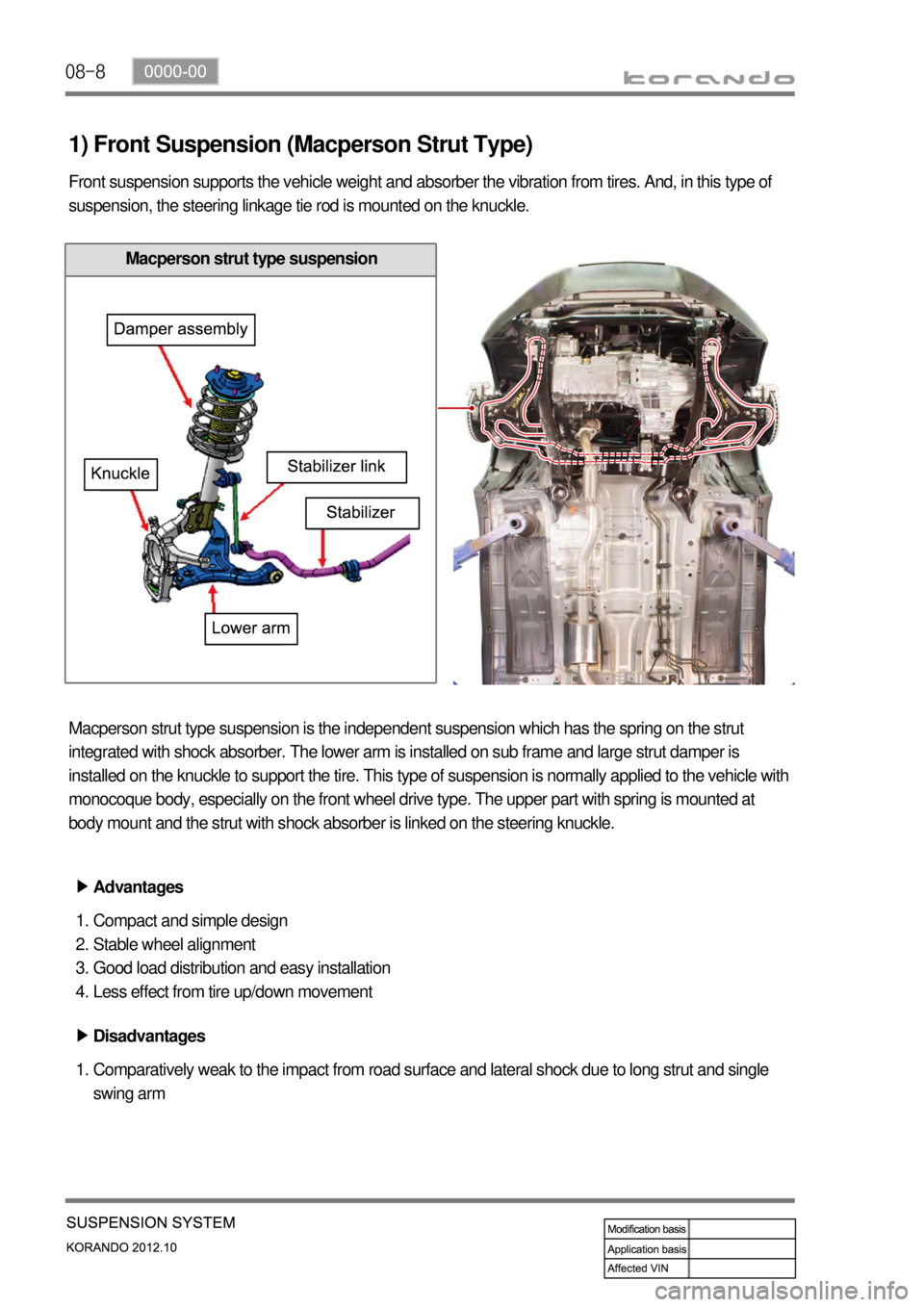
1) Front Suspension (Macperson Strut Type)
Front suspension supports the vehicle weight and absorber the vibration from tires. And, in this type of
suspension, the steering linkage tie rod is mounted on the knuckle.
Macperson strut type suspension is the independent suspension which has the spring on the strut
integrated with shock absorber. The lower arm is installed on sub frame and large strut damper is
installed on the knuckle to support the tire. This type of suspension is normally applied to the vehicle with
monocoque body, especially on the front wheel drive type. The upper part with spring is mounted at
body mount and the strut with shock absorber is linked on the steering knuckle.
Advantages ▶
Compact and simple design
Stable wheel alignment
Good load distribution and easy installation
Less effect from tire up/down movement 1.
2.
3.
4.
Disadvantages ▶
Comparatively weak to the impact from road surface and lateral shock due to long strut and single
swing arm 1.
Macperson strut type suspension
Page 924 of 1082

09-4
3) Parts Arrangement
Part nameVehicle with
CBSVehicle with ABS/EBDVehicle with
ESP
HECU
Not appliedAppliedApplied Front wheel speed sensor
Rear wheel speed sensor
ABS warning lamp
EBD indicator
Longitudinal G sensor 2WD: N/A, 4WD: Applied Not applied
Sensor cluster
(Yaw rate sensor,
lateral/longitudinal G sensor)
Not applied Applied
ESP indicator
ESP OFF switch and warning
lamp
Steering wheel angle sensor
Page 925 of 1082
09-54850-00
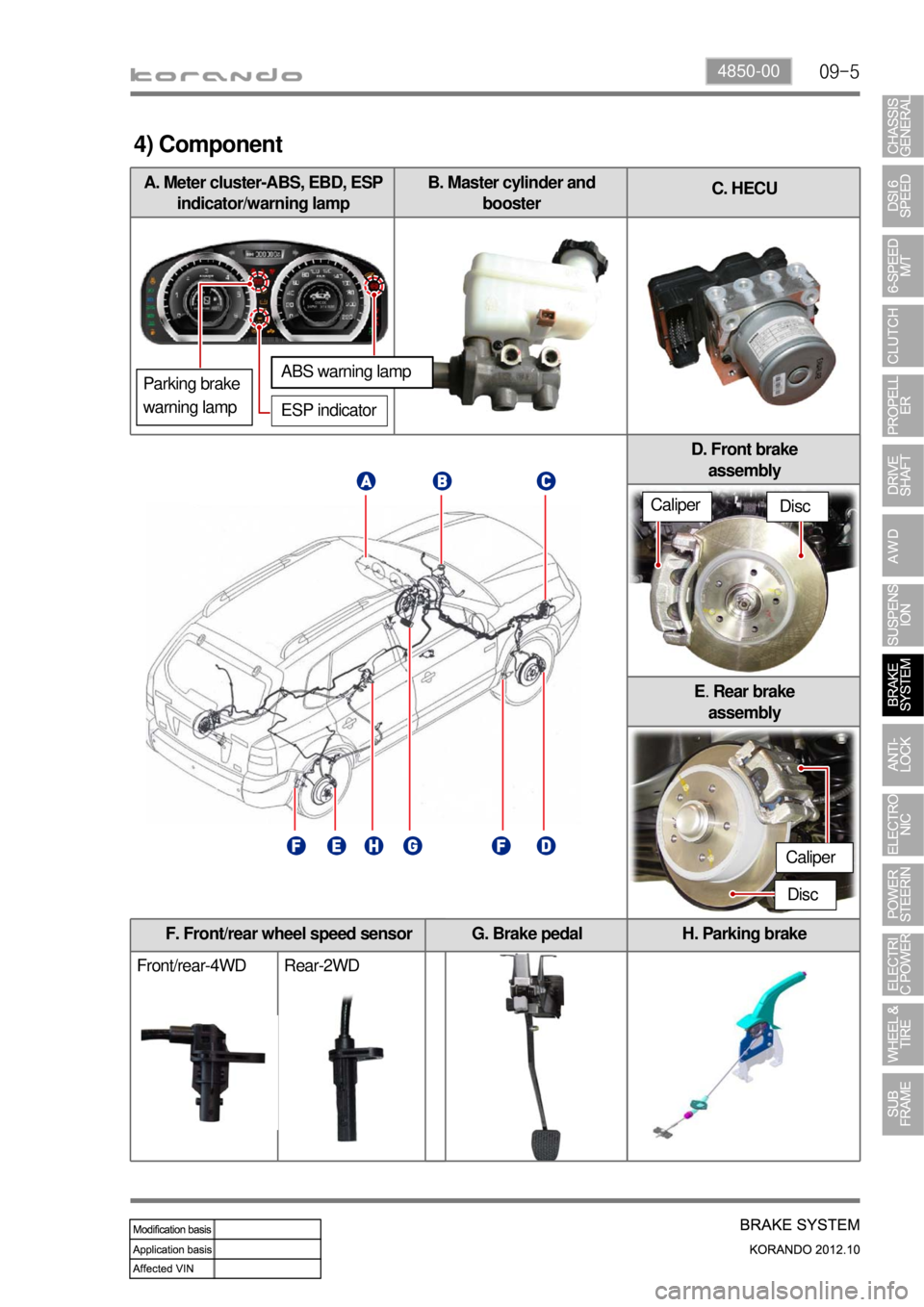
F. Front/rear wheel speed sensor
Front/rear-4WD Rear-2WDH. Parking brake
A. Meter cluster-ABS, EBD, ESP
indicator/warning lampB. Master cylinder and
boosterC. HECU
G. Brake pedal
4) Component
ABS warning lamp
ESP indicator
D. Front brake
assembly
E. Rear brake
assembly
Disc
Disc
Parking brake
warning lamp
Caliper
Caliper
Page 927 of 1082
09-74850-00
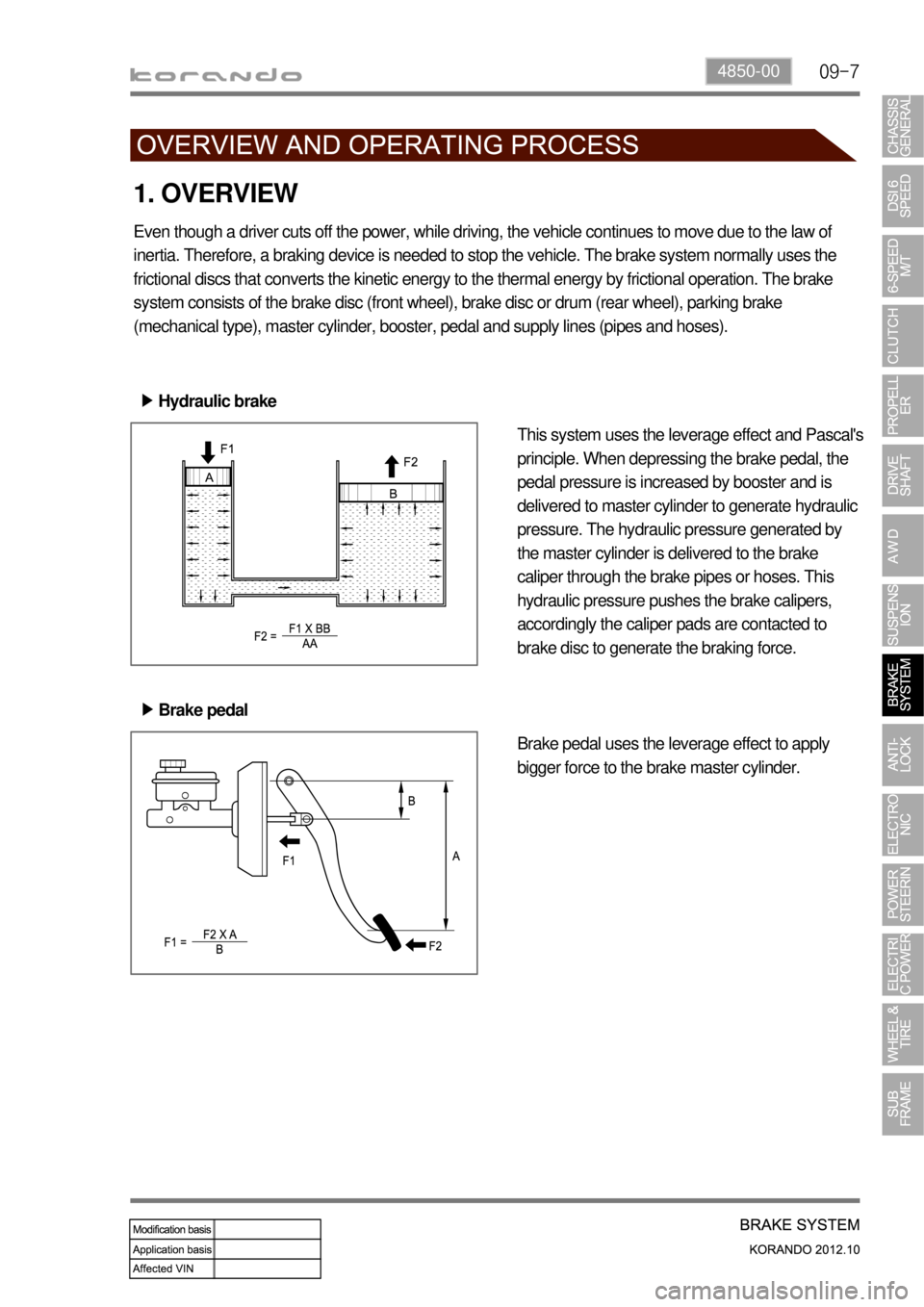
1. OVERVIEW
Even though a driver cuts off the power, while driving, the vehicle continues to move due to the law of
inertia. Therefore, a braking device is needed to stop the vehicle. The brake system normally uses the
frictional discs that converts the kinetic energy to the thermal energy by frictional operation. The brake
system consists of the brake disc (front wheel), brake disc or drum (rear wheel), parking brake
(mechanical type), master cylinder, booster, pedal and supply lines (pipes and hoses).
Hydraulic brake ▶
Brake pedal ▶This system uses the leverage effect and Pascal's
principle. When depressing the brake pedal, the
pedal pressure is increased by booster and is
delivered to master cylinder to generate hydraulic
pressure. The hydraulic pressure generated by
the master cylinder is delivered to the brake
caliper through the brake pipes or hoses. This
hydraulic pressure pushes the brake calipers,
accordingly the caliper pads are contacted to
brake disc to generate the braking force.
Brake pedal uses the leverage effect to apply
bigger force to the brake master cylinder.
Page 928 of 1082

09-8
Pad guide bolt:
25.5~30.4Nm
Brake hose bracket
mounting bolt (12 mm):
9.8 ~ 12.8Nm
Air breather screw: 8.8 ~
10.8Nm
Caliper mounting bolt
(19mm x 2EA):
83.3 ~ 102.9Nm
Brake hose bolt
(12 mm):
19.6 ~ 29.4Nm
Wheel disc
Brake caliper
Brake hub
Brake disc
Knuckle Drive shaft Brake hoseBrake pad
Shock absorber
Brake disc
Back plate
Knuckle
2. SECTIONAL DIAGRAM
Front disc brake ▶