ABS SSANGYONG NEW ACTYON SPORTS 2013 Owner's Manual
[x] Cancel search | Manufacturer: SSANGYONG, Model Year: 2013, Model line: NEW ACTYON SPORTS, Model: SSANGYONG NEW ACTYON SPORTS 2013Pages: 751, PDF Size: 72.63 MB
Page 541 of 751
08-4
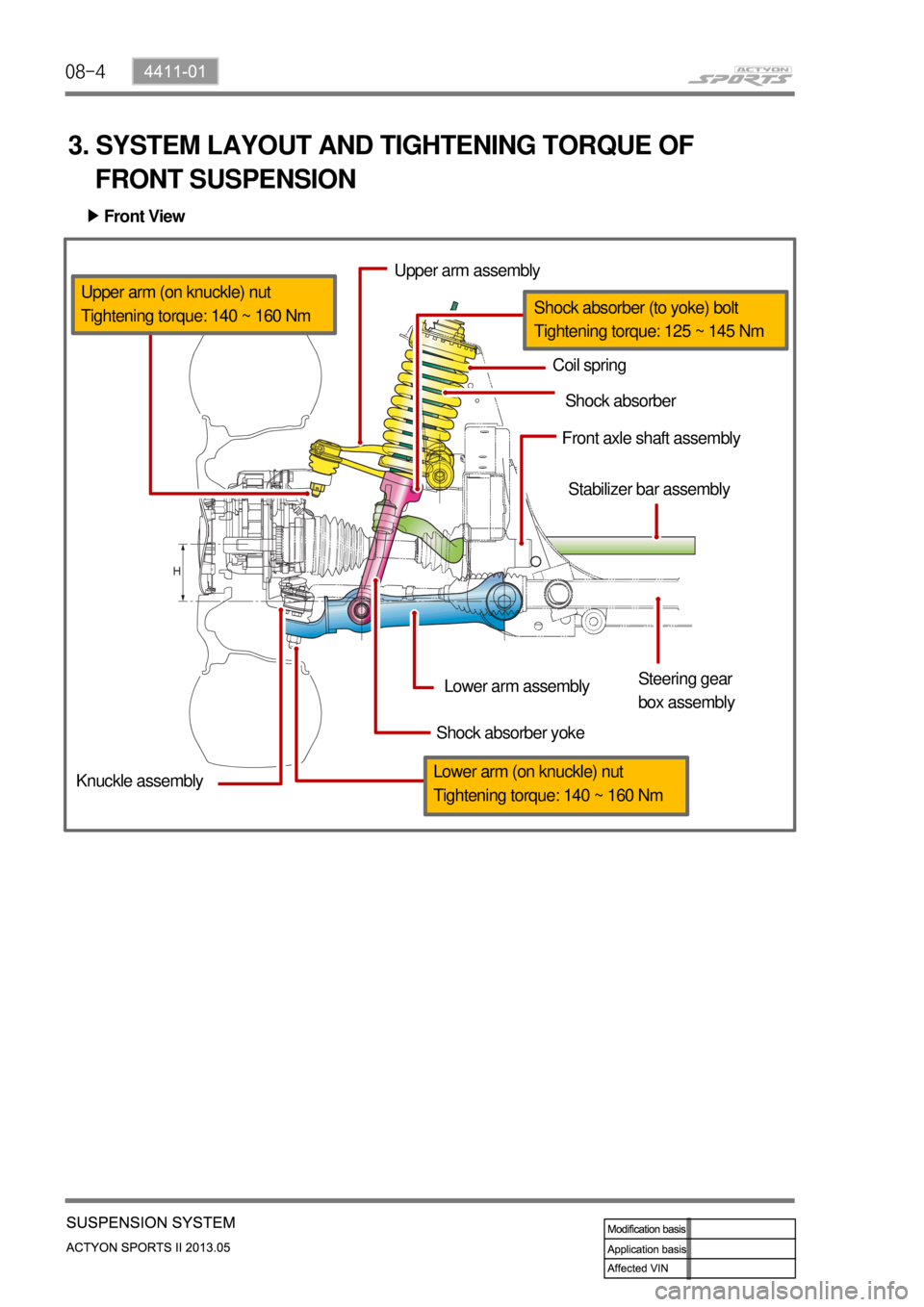
3. SYSTEM LAYOUT AND TIGHTENING TORQUE OF
FRONT SUSPENSION
Upper arm assembly
Coil spring
Shock absorber
Front axle shaft assembly
Steering gear
box assembly Lower arm assembly
Shock absorber yoke
Knuckle assembly
Stabilizer bar assembly
Front View ▶
Upper arm (on knuckle) nut
Tightening torque: 140 ~ 160 Nm
Lower arm (on knuckle) nut
Tightening torque: 140 ~ 160 Nm
Shock absorber (to yoke) bolt
Tightening torque: 125 ~ 145 Nm
Page 542 of 751

08-54411-01
Stabilizer bar link lower nut
Tightening torque: 110 ~ 130 Nm
Coil spring mounting nut
Tightening torque: 60 ~ 80 Nm
Stabilizer bar link upper nut
Tightening torque: 30 ~ 50 NmUpper arm (frame side) bolt/nut
Tightening torque: 110 ~ 130 Nm
Stabilizer bar clamp bolt
Tightening torque: 40 ~ 60 Nm
Lower arm (end yoke) bolt
Tightening torque: 70 ~ 80 Nm
Lower arm (shock absorber yoke side) nut
Tightening torque: 150 ~ 170 Nm
Lower arm (frame side) bolt/nut
Tightening torque: 210 ~ 230 Nm Top View ▶
Page 543 of 751
08-6
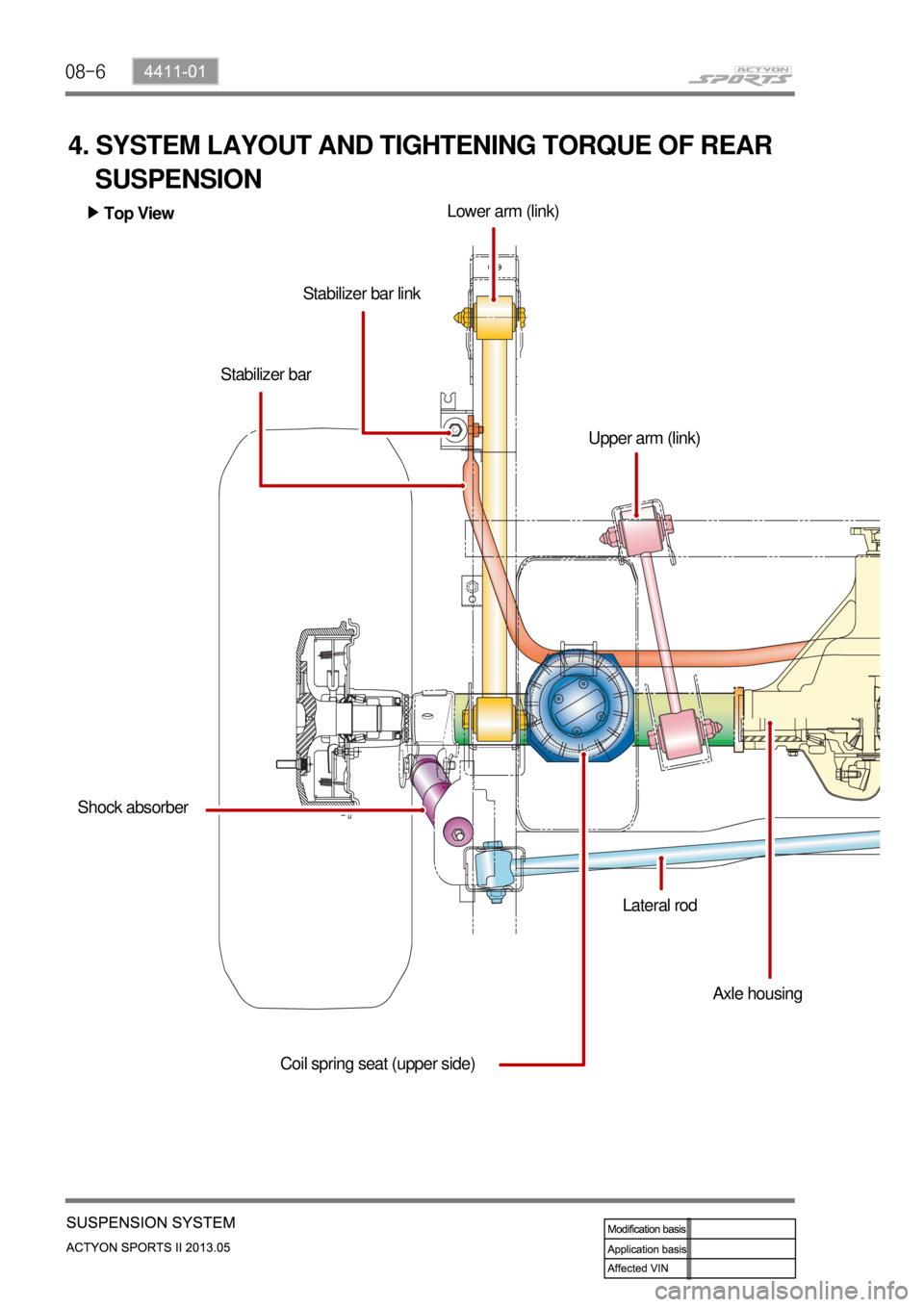
4. SYSTEM LAYOUT AND TIGHTENING TORQUE OF REAR
SUSPENSION
Lower arm (link)
Stabilizer bar link
Stabilizer bar
Shock absorber
Coil spring seat (upper side)Lateral rod
Axle housing Upper arm (link)Top View ▶
Page 544 of 751

08-74411-01
Lateral rod
Tightening torque: 150 ~ 180 Nm
Shock absorber upper bolt/nut
Tightening torque: 30 ~ 45 Nm
Shock absorber lower bolt/nut
Tightening torque: 80 ~ 100 Nm
Upper arm bolt/nut
Tightening torque:150~180 Nm
Lower arm bolt/nut
Tightening torque: 150 ~ 180 NmStabilizer bar link lower
Tightening torque: 60 ~ 80 Nm
Stabilizer bar mounting bracket
Tightening torque: 40 ~ 60 Nm
Stabilizer bar link upper
Tightening torque: 30 ~ 45 Nm
Page 545 of 751
08-8
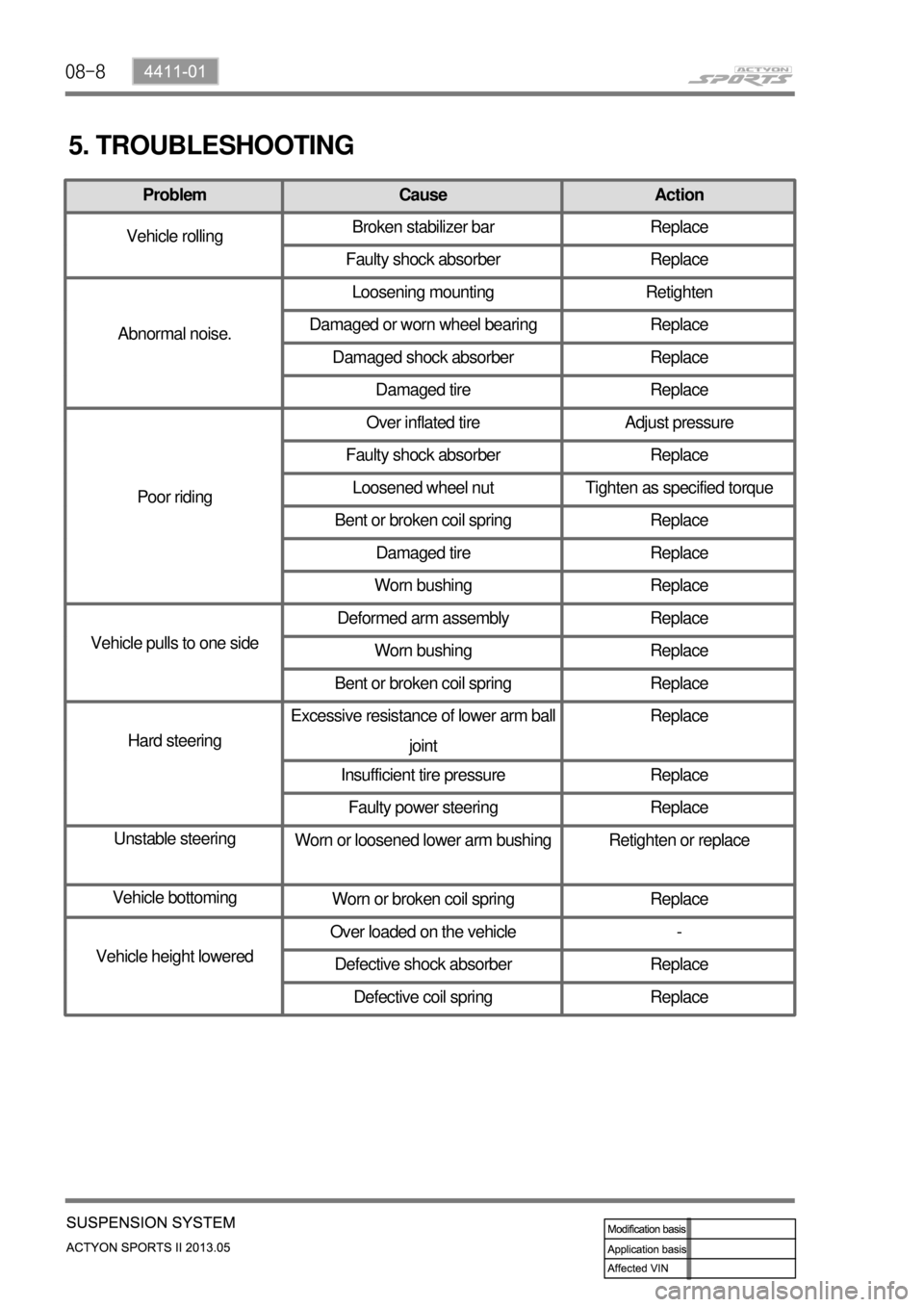
5. TROUBLESHOOTING
Problem Cause Action
Vehicle rollingBroken stabilizer bar Replace
Faulty shock absorber Replace
Abnormal noise.Loosening mounting Retighten
Damaged or worn wheel bearing Replace
Damaged shock absorber Replace
Damaged tire Replace
Poor ridingOver inflated tire Adjust pressure
Faulty shock absorber Replace
Loosened wheel nut Tighten as specified torque
Bent or broken coil spring Replace
Damaged tire Replace
Worn bushing Replace
Vehicle pulls to one sideDeformed arm assembly Replace
Worn bushing Replace
Bent or broken coil spring Replace
Hard steeringExcessive resistance of lower arm ball
jointReplace
Insufficient tire pressure Replace
Faulty power steering Replace
Unstable steering
Worn or loosened lower arm bushing Retighten or replace
Vehicle bottoming
Worn or broken coil spring Replace
Vehicle height loweredOver loaded on the vehicle -
Defective shock absorber Replace
Defective coil spring Replace
Page 546 of 751
08-94411-01
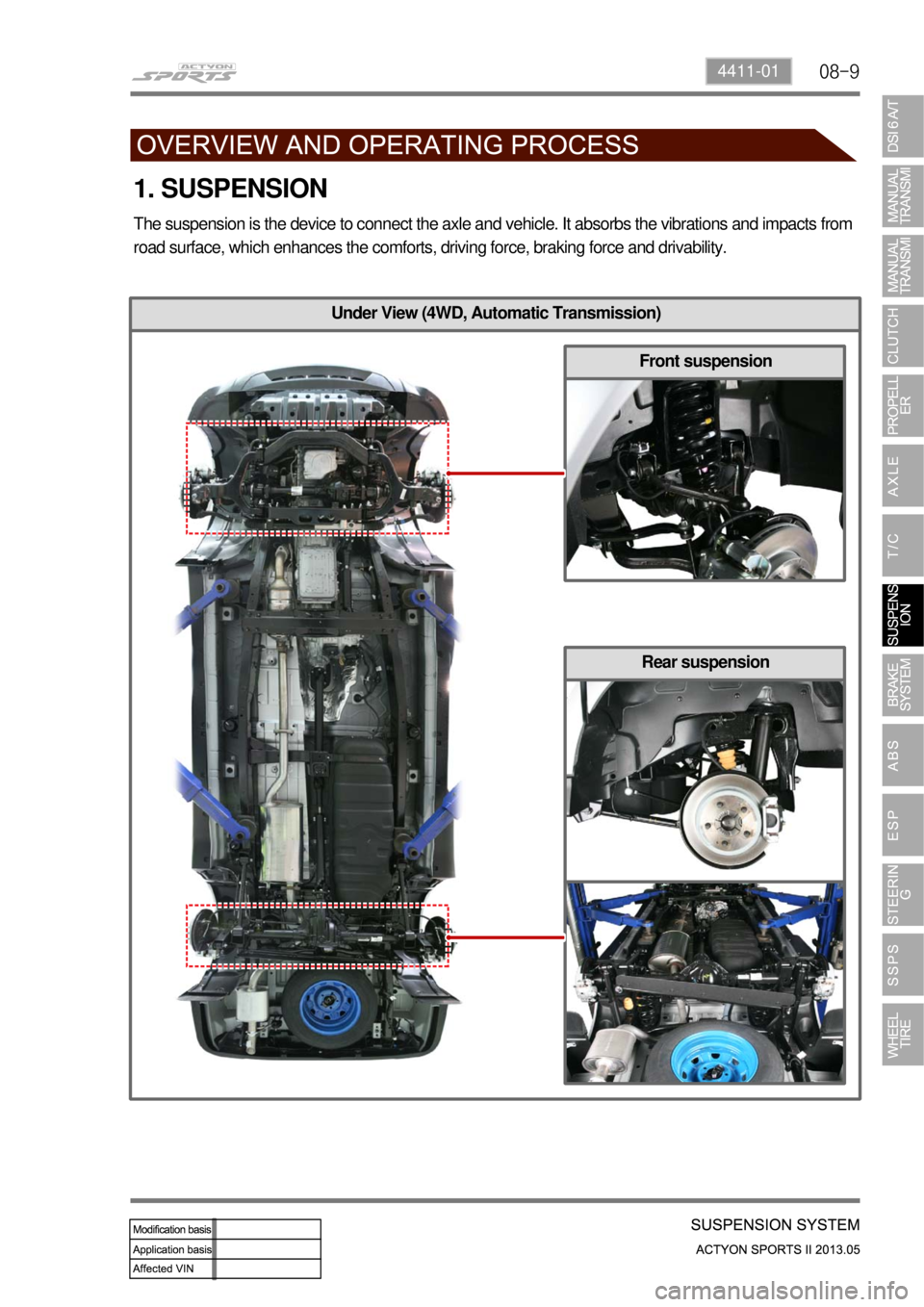
Under View (4WD, Automatic Transmission)
Rear suspension
1. SUSPENSION
The suspension is the device to connect the axle and vehicle. It absorbs the vibrations and impacts from
road surface, which enhances the comforts, driving force, braking force and drivability.
Front suspension
Page 547 of 751
08-10
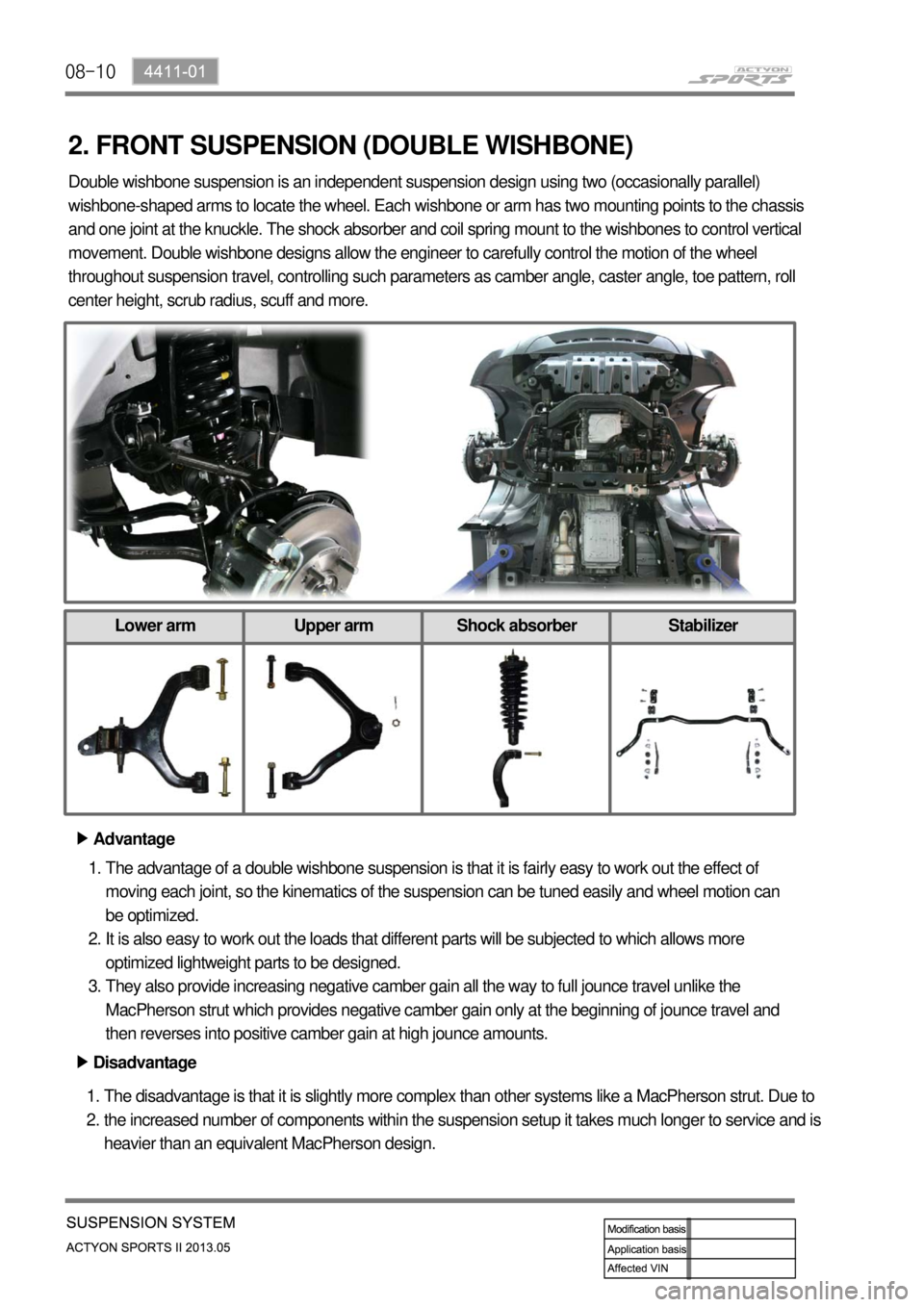
2. FRONT SUSPENSION (DOUBLE WISHBONE)
Advantage ▶
The advantage of a double wishbone suspension is that it is fairly easy to work out the effect of
moving each joint, so the kinematics of the suspension can be tuned easily and wheel motion can
be optimized.
It is also easy to work out the loads that different parts will be subjected to which allows more
optimized lightweight parts to be designed.
They also provide increasing negative camber gain all the way to full jounce travel unlike the
MacPherson strut which provides negative camber gain only at the beginning of jounce travel and
then reverses into positive camber gain at high jounce amounts. 1.
2.
3.
Disadvantage ▶
The disadvantage is that it is slightly more complex than other systems like a MacPherson strut. Due to
the increased number of components within the suspension setup it takes much longer to service and is
heavier than an equivalent MacPherson design. 1.
2. Double wishbone suspension is an independent suspension design using two (occasionally parallel)
wishbone-shaped arms to locate the wheel. Each wishbone or arm has two mounting points to the chassis
and one joint at the knuckle. The shock absorber and coil spring mount to the wishbones to control vertical
movement. Double wishbone designs allow the engineer to carefully control the motion of the wheel
throughout suspension travel, controlling such parameters as camber angle, caster angle, toe pattern, roll
center height, scrub radius, scuff and more.
Lower arm Upper arm Shock absorber Stabilizer
Page 548 of 751
08-114411-01
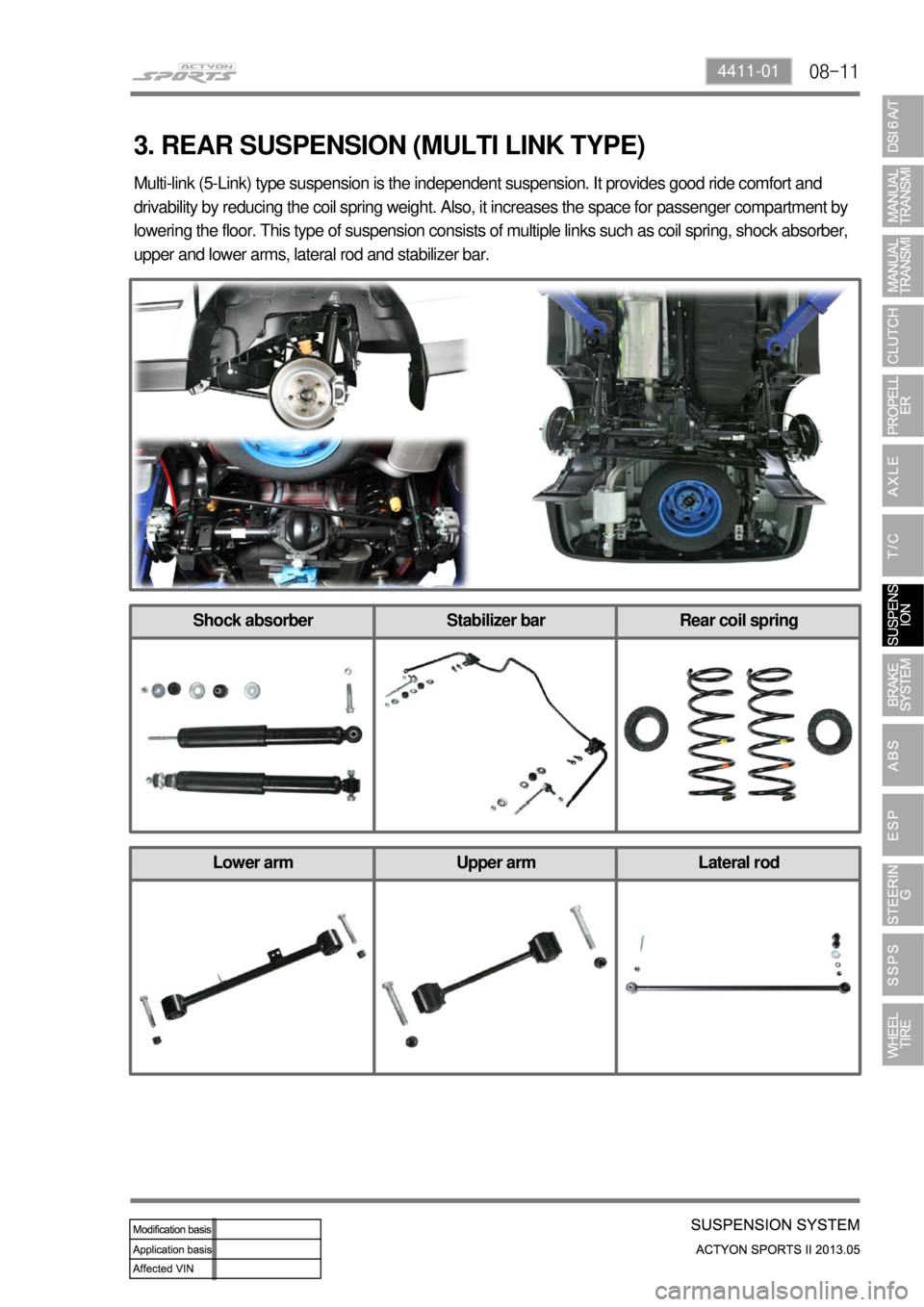
3. REAR SUSPENSION (MULTI LINK TYPE)
Multi-link (5-Link) type suspension is the independent suspension. It provides good ride comfort and
drivability by reducing the coil spring weight. Also, it increases the space for passenger compartment by
lowering the floor. This type of suspension consists of multiple links such as coil spring, shock absorber,
upper and lower arms, lateral rod and stabilizer bar.
Shock absorber Stabilizer bar Rear coil spring
Lower arm Upper arm Lateral rod
Page 550 of 751

08-134411-01
2) Camber
The angle between the center line of the tire and the vertical line when viewed from the front of the
vehicle
Positive camber: Top of the tire is tilted outward ▶
Advantages: The axle is not bent when it is loaded.
The force required to operate the steering wheel is reduced due to smaller
contact area (or load area) of the tire.
Restoring force of the steering wheel is gained (when turning the steering
wheel, the tire circles and the force to lift the frame is applied. In this case,
the shock absorber contracts and the restoration force is applied to the
steering wheel.) -
-
-
Disadvantages:Cornering force decreases as the positive camber increases when the
vehicle makes turn.
The hub bearing is worn unevenly if camber is excessive. -
-
Zero camber: When the tire center line is perpendicular to the ground level ▶
Negative camber ▶
Advantages:
Better traction force due to wide load area (applicable for off-road vehicle)
Better corner driving when the vehicle makes turn as the cornering force
increases (applicable for high-speed F1 vehicle) -
-
Disadvantages:
he axle is easy to be bent or deviated in the negative camber than in the
positive camber when load is applied on the axle.
Difficult to control due to wide load area. -
-
Camber
-0.5 ± 0.25°
Page 553 of 751
09-4
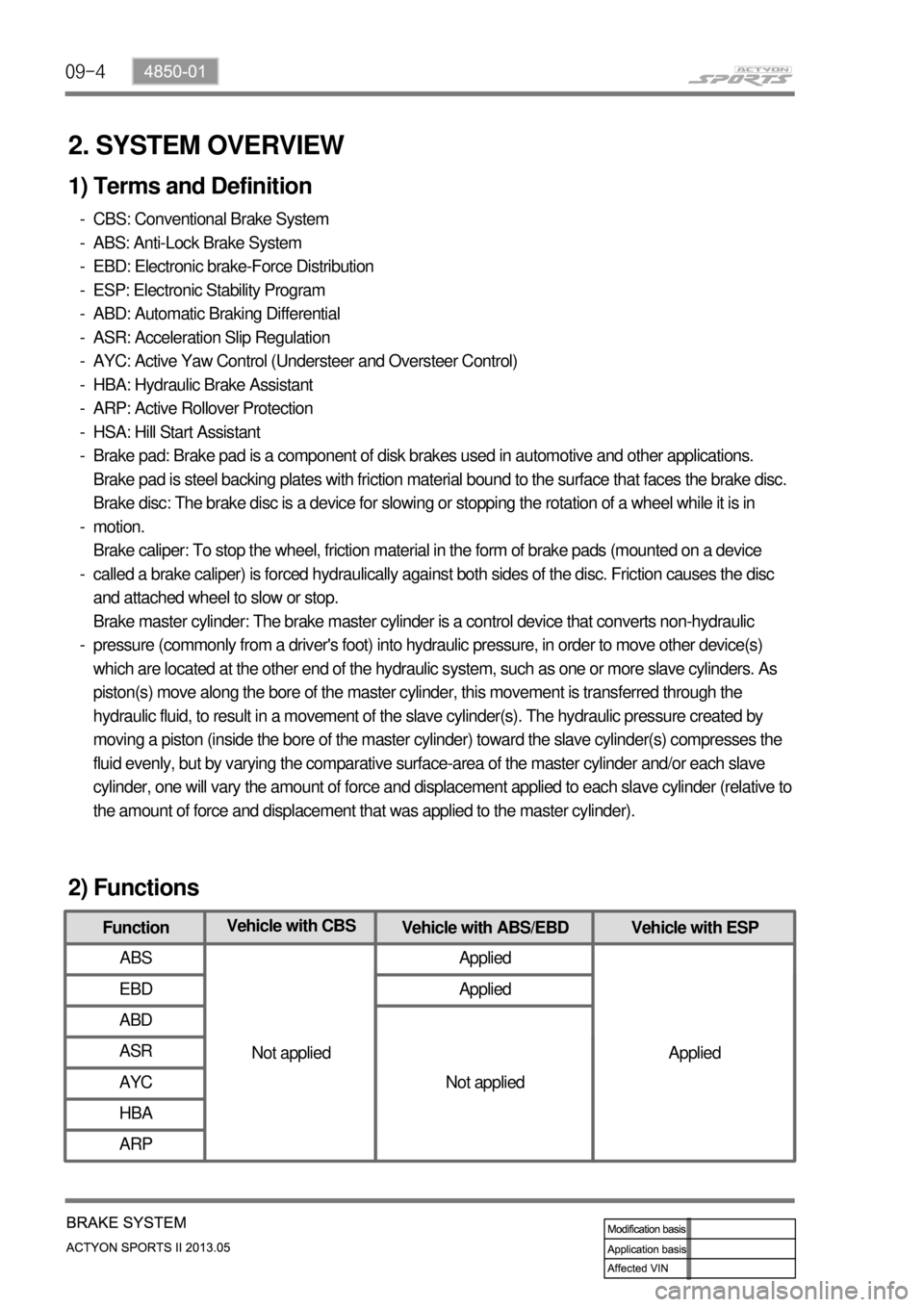
2. SYSTEM OVERVIEW
1) Terms and Definition
CBS: Conventional Brake System
ABS: Anti-Lock Brake System
EBD: Electronic brake-Force Distribution
ESP: Electronic Stability Program
ABD: Automatic Braking Differential
ASR: Acceleration Slip Regulation
AYC: Active Yaw Control (Understeer and Oversteer Control)
HBA: Hydraulic Brake Assistant
ARP: Active Rollover Protection
HSA: Hill Start Assistant
Brake pad: Brake pad is a component of disk brakes used in automotive and other applications.
Brake pad is steel backing plates with friction material bound to the surface that faces the brake disc.
Brake disc: The brake disc is a device for slowing or stopping the rotation of a wheel while it is in
motion.
Brake caliper: To stop the wheel, friction material in the form of brake pads (mounted on a device
called a brake caliper) is forced hydraulically against both sides of the disc. Friction causes the disc
and attached wheel to slow or stop.
Brake master cylinder: The brake master cylinder is a control device that converts non-hydraulic
pressure (commonly from a driver's foot) into hydraulic pressure, in order to move other device(s)
which are located at the other end of the hydraulic system, such as one or more slave cylinders. As
piston(s) move along the bore of the master cylinder, this movement is transferred through the
hydraulic fluid, to result in a movement of the slave cylinder(s). The hydraulic pressure created by
moving a piston (inside the bore of the master cylinder) toward the slave cylinder(s) compresses the
fluid evenly, but by varying the comparative surface-area of the master cylinder and/or each slave
cylinder, one will vary the amount of force and displacement applied to each slave cylinder (relative to
the amount of force and displacement that was applied to the master cylinder). -
-
-
-
-
-
-
-
-
-
-
-
-
-
FunctionVehicle with CBS
Vehicle with ABS/EBD Vehicle with ESP
ABS
Not appliedApplied
Applied EBD Applied
ABD
Not applied ASR
AYC
HBA
ARP
2) Functions