ABS SSANGYONG NEW ACTYON SPORTS 2013 Workshop Manual
[x] Cancel search | Manufacturer: SSANGYONG, Model Year: 2013, Model line: NEW ACTYON SPORTS, Model: SSANGYONG NEW ACTYON SPORTS 2013Pages: 751, PDF Size: 72.63 MB
Page 600 of 751

10-20
6. HYDRAULIC CIRCUIT OF ABS
1) Normal Brake Operation (ABS is not working) Mode
If the driver depress the brake pedal so that the ABS does not operate, the hydraulic pressure in the
master cylinder increases through the vacuum booster and it is delivered to the wheel via the normal
open inlet valve. At this moment, the normally-closed outlet valve is closed The speed of the wheel that
hydraulic pressure is delivered reduces gradually.
Solenoid valve Valve Open/Close Pump motor
Inlet valve - Normal open (NO) valve Open
OFF
Outlet valve - Normal close (NC) valve Close
Page 601 of 751

10-214892-01
2) DUMP (ABS is working) Mode
Even when the hydraulic pressure on each circuit is constant, the wheel can be locked as the wheel
speed decreases. This is when the ABS HECU detects the wheel speed and the vehicle speed and
gives the optimized braking without locking the wheels. In order to prevent the hydraulic pressure from
increasing, the inlet valve will be closed, the outlet valve will be opened and the oil will flow into the low
pressure chamber. In addition, the ABS HECU operates the pump to circulate the oil in the low pressure
chamber to the master cylinder. This may make the driver to feel the brake pedal vibration and some
Solenoid valve Valve Open/Close Pump motor
Inlet valve - Normal open (NO) valve Close
ON
Outlet valve - Normal close (NC) valve Open
Page 602 of 751

10-22
3) HOLD (ABS is working) Mode
As hydraulic pressure on each wheel increases, the wheel tends to lock. In order to prevent the wheel
from locking, the hydraulic valve modulator operates the inlet valve control solenoid to stop increasing
the hydraulic pressure by closing the inlet valve. At this moment, the outlet valve is closed. This
procedure helps the wheel to maintain a constant hydraulic pressure.
Solenoid valve Valve Open/Close Pump motor
Inlet valve - Normal open (NO) valve Close
OFF
Outlet valve - Normal close (NC) valve Close
Page 603 of 751

10-234892-01
4) RISE (ABS is working) Mode
As the wheel speed increases, the inlet valve opens and the wheel's pressure increases due to the
master cylinder pressure. In addition, the pump circulates the oil in the low pressure chamber to the
wheel. As the hydraulic pressure to the wheel increases, the wheel speed will reduce. This operation
continues repetitively until there are no signs that the ABS HECU tends to lock the wheels. Since the
ABS hydraulic pressure control process takes place repeatedly for a short time, there may be some
vibration and noises at the brake pedal.
Solenoid valve Valve Open/Close Pump motor
Inlet valve - Normal open (NO) valve Open
ON
Outlet valve - Normal close (NC) valve Close
Page 605 of 751
11-34890-10
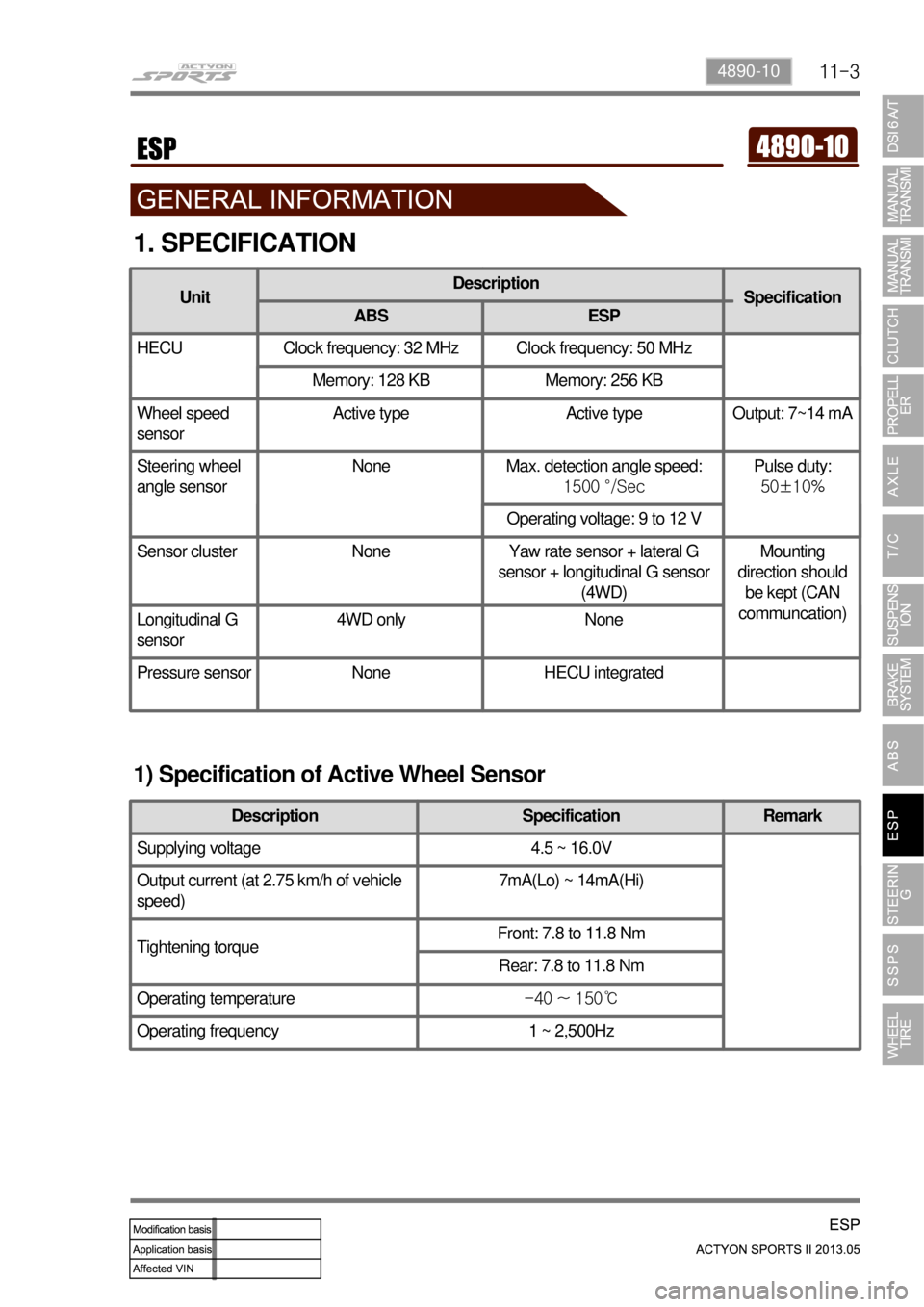
1. SPECIFICATION
1) Specification of Active Wheel Sensor
Description Specification Remark
Supplying voltage 4.5 ~ 16.0V
Output current (at 2.75 km/h of vehicle
speed)7mA(Lo) ~ 14mA(Hi)
Tightening torqueFront: 7.8 to 11.8 Nm
Rear: 7.8 to 11.8 Nm
Operating temperature-40 ~ 150℃
Operating frequency 1 ~ 2,500Hz
UnitDescription
Specification
ABS ESP
HECU Clock frequency: 32 MHz Clock frequency: 50 MHz
Memory: 128 KB Memory: 256 KB
Wheel speed
sensorActive type Active type Output: 7~14 mA
Steering wheel
angle sensorNone Max. detection angle speed:
1500 °/SecPulse duty:
50±10%
Operating voltage: 9 to 12 V
Sensor cluster None Yaw rate sensor + lateral G
sensor + longitudinal G sensor
(4WD)Mounting
direction should
be kept (CAN
communcation)
Longitudinal G
sensor4WD only None
Pressure sensor None HECU integrated
Page 612 of 751
11-10
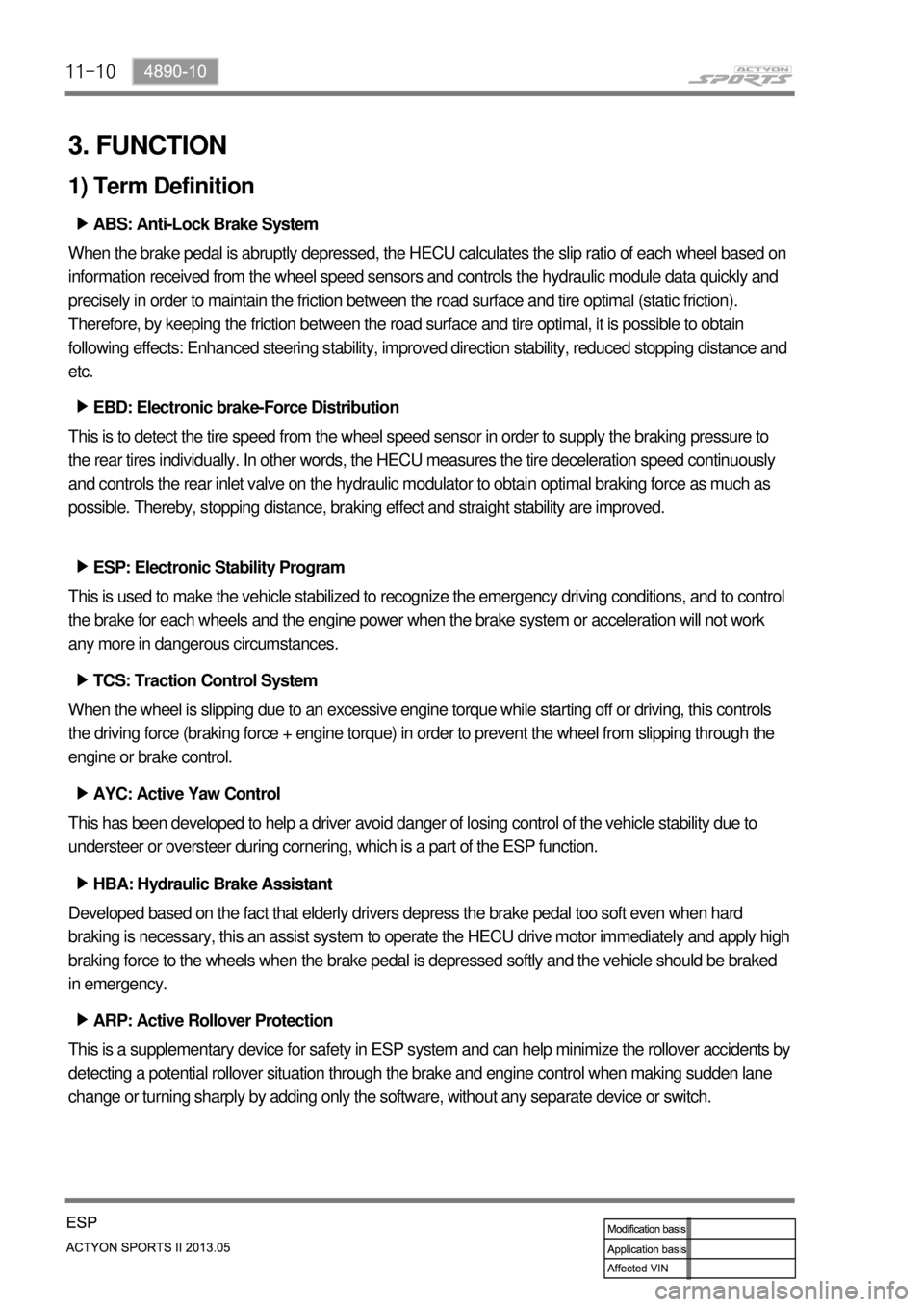
3. FUNCTION
1) Term Definition
ABS: Anti-Lock Brake System ▶
When the brake pedal is abruptly depressed, the HECU calculates the slip ratio of each wheel based on
information received from the wheel speed sensors and controls the hydraulic module data quickly and
precisely in order to maintain the friction between the road surface and tire optimal (static friction).
Therefore, by keeping the friction between the road surface and tire optimal, it is possible to obtain
following effects: Enhanced steering stability, improved direction stability, reduced stopping distance and
etc.
EBD: Electronic brake-Force Distribution ▶
This is to detect the tire speed from the wheel speed sensor in order to supply the braking pressure to
the rear tires individually. In other words, the HECU measures the tire deceleration speed continuously
and controls the rear inlet valve on the hydraulic modulator to obtain optimal braking force as much as
possible. Thereby, stopping distance, braking effect and straight stability are improved.
ESP: Electronic Stability Program ▶
This is used to make the vehicle stabilized to recognize the emergency driving conditions, and to control
the brake for each wheels and the engine power when the brake system or acceleration will not work
any more in dangerous circumstances.
TCS: Traction Control System ▶
When the wheel is slipping due to an excessive engine torque while starting off or driving, this controls
the driving force (braking force + engine torque) in order to prevent the wheel from slipping through the
engine or brake control.
AYC: Active Yaw Control ▶
This has been developed to help a driver avoid danger of losing control of the vehicle stability due to
understeer or oversteer during cornering, which is a part of the ESP function.
HBA: Hydraulic Brake Assistant ▶
Developed based on the fact that elderly drivers depress the brake pedal too soft even when hard
braking is necessary, this an assist system to operate the HECU drive motor immediately and apply high
braking force to the wheels when the brake pedal is depressed softly and the vehicle should be braked
in emergency.
ARP: Active Rollover Protection ▶
This is a supplementary device for safety in ESP system and can help minimize the rollover accidents by
detecting a potential rollover situation through the brake and engine control when making sudden lane
change or turning sharply by adding only the software, without any separate device or switch.
Page 613 of 751

11-114890-10
2) Component Overview By System
3) Part Overview By System
Part Vehicle with ABS Vehicle with ESP
HECU
Yes Yes Front wheel speed sensor
Rear wheel speed sensor
ABS warning lamp
EBD indicator lamp
G sensor (integrated in HECU) 4WD: Yes, 2WD: No No
Sensor cluster (Yaw rate sensor +
lateral sensor+ G sensor)
No Yes ESP operation indicator lamp and
warning lamp
ESP OFF switch and indicator
Steering wheel angle sensor
Function Vehicle with ABS Vehicle with ESP
ABS Yes
Yes EBD Yes
HBA
No
ARP
Page 614 of 751
11-12
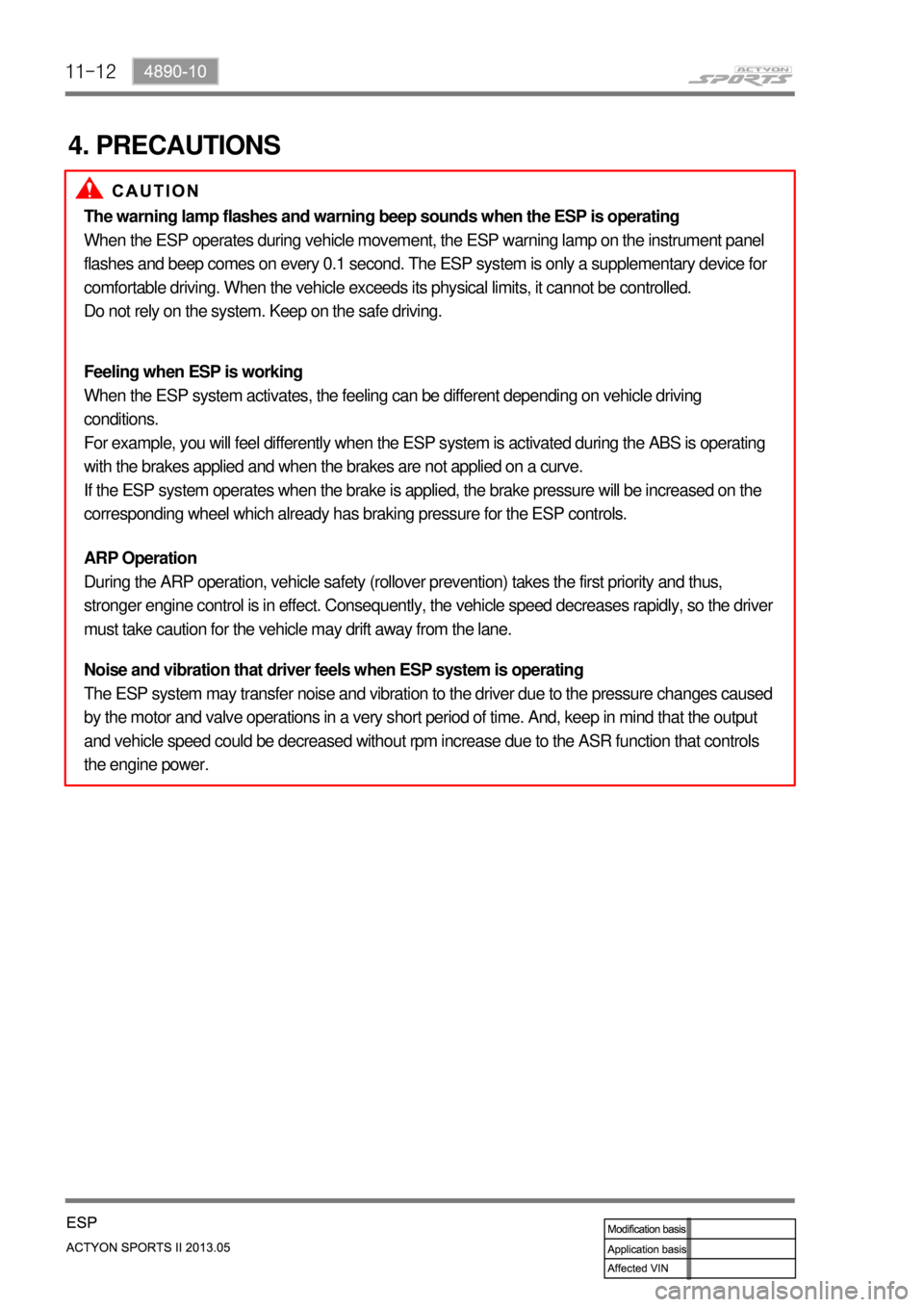
4. PRECAUTIONS
The warning lamp flashes and warning beep sounds when the ESP is operating
When the ESP operates during vehicle movement, the ESP warning lamp on the instrument panel
flashes and beep comes on every 0.1 second. The ESP system is only a supplementary device for
comfortable driving. When the vehicle exceeds its physical limits, it cannot be controlled.
Do not rely on the system. Keep on the safe driving.
Feeling when ESP is working
When the ESP system activates, the feeling can be different depending on vehicle driving
conditions.
For example, you will feel differently when the ESP system is activated during the ABS is operating
with the brakes applied and when the brakes are not applied on a curve.
If the ESP system operates when the brake is applied, the brake pressure will be increased on the
corresponding wheel which already has braking pressure for the ESP controls.
ARP Operation
During the ARP operation, vehicle safety (rollover prevention) takes the first priority and thus,
stronger engine control is in effect. Consequently, the vehicle speed decreases rapidly, so the driver
must take caution for the vehicle may drift away from the lane.
Noise and vibration that driver feels when ESP system is operating
The ESP system may transfer noise and vibration to the driver due to the pressure changes caused
by the motor and valve operations in a very short period of time. And, keep in mind that the output
and vehicle speed could be decreased without rpm increase due to the ASR function that controls
the engine power.
Page 615 of 751

11-134890-10
5. WARNING LAMPS
1) ABS Warning Lamp
ABS warning lamp module indicates the self diagnosis and malfunction.
ABS warning lamp ON:
When turning the ignition switch to ON position, ABS warning lamp comes on for 3 seconds for
self diagnosis and goes off if the system is OK (initialization mode).
When the system is defective, the warning lamp comes on.
When disengaging the connector, the warning lamp comes on.
ABS is not available during lamp ON. In this condition, Only normal brake system without ABS
function is available.
When the communication between warning lamp CAN module in meter cluster, the warning
lamp comes on. 1.
2.
3.
4.
5.ABS warning lamp
Brake warning lamp
ESP OFF indicator
ESP warning lamp/indicator
EBD warning lamp 1.
2.
3.
4.
5.
Page 616 of 751
11-14
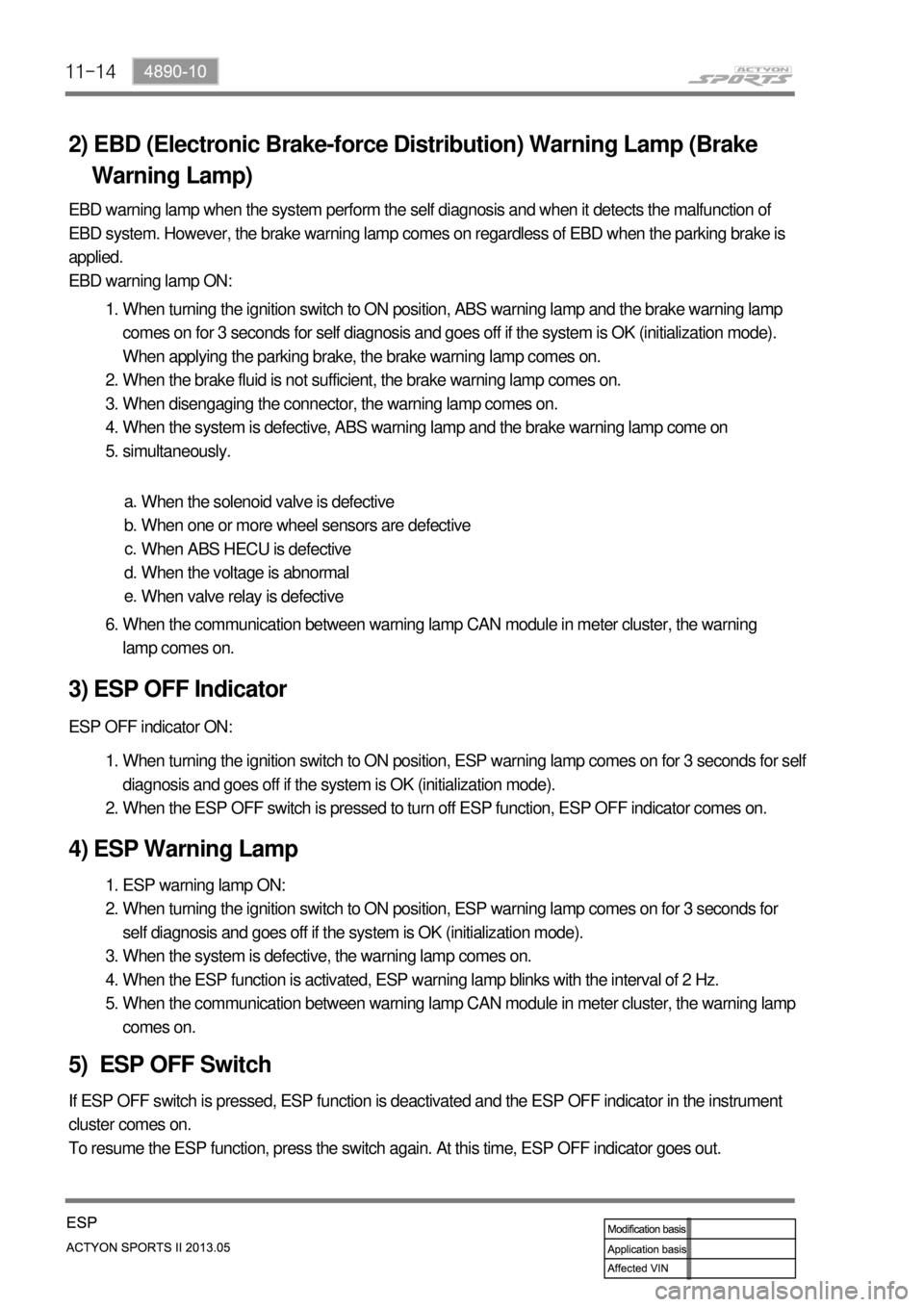
2) EBD (Electronic Brake-force Distribution) Warning Lamp (Brake
Warning Lamp)
EBD warning lamp when the system perform the self diagnosis and when it detects the malfunction of
EBD system. However, the brake warning lamp comes on regardless of EBD when the parking brake is
applied.
EBD warning lamp ON:
When turning the ignition switch to ON position, ABS warning lamp and the brake warning lamp
comes on for 3 seconds for self diagnosis and goes off if the system is OK (initialization mode).
When applying the parking brake, the brake warning lamp comes on.
When the brake fluid is not sufficient, the brake warning lamp comes on.
When disengaging the connector, the warning lamp comes on.
When the system is defective, ABS warning lamp and the brake warning lamp come on
simultaneously. 1.
2.
3.
4.
5.
When the solenoid valve is defective
When one or more wheel sensors are defective
When ABS HECU is defective
When the voltage is abnormal
When valve relay is defective a.
b.
c.
d.
e.
When the communication between warning lamp CAN module in meter cluster, the warning
lamp comes on. 6.
3) ESP OFF Indicator
ESP OFF indicator ON:
When turning the ignition switch to ON position, ESP warning lamp comes on for 3 seconds for self
diagnosis and goes off if the system is OK (initialization mode).
When the ESP OFF switch is pressed to turn off ESP function, ESP OFF indicator comes on. 1.
2.
4) ESP Warning Lamp
ESP warning lamp ON:
When turning the ignition switch to ON position, ESP warning lamp comes on for 3 seconds for
self diagnosis and goes off if the system is OK (initialization mode).
When the system is defective, the warning lamp comes on.
When the ESP function is activated, ESP warning lamp blinks with the interval of 2 Hz.
When the communication between warning lamp CAN module in meter cluster, the warning lamp
comes on. 1.
2.
3.
4.
5.
5) ESP OFF Switch
If ESP OFF switch is pressed, ESP function is deactivated and the ESP OFF indicator in the instrument
cluster comes on.
To resume the ESP function, press the switch again. At this time, ESP OFF indicator goes out.