ECU SSANGYONG TURISMO 2013 User Guide
[x] Cancel search | Manufacturer: SSANGYONG, Model Year: 2013, Model line: TURISMO, Model: SSANGYONG TURISMO 2013Pages: 796, PDF Size: 78.99 MB
Page 270 of 796
07-51543-00
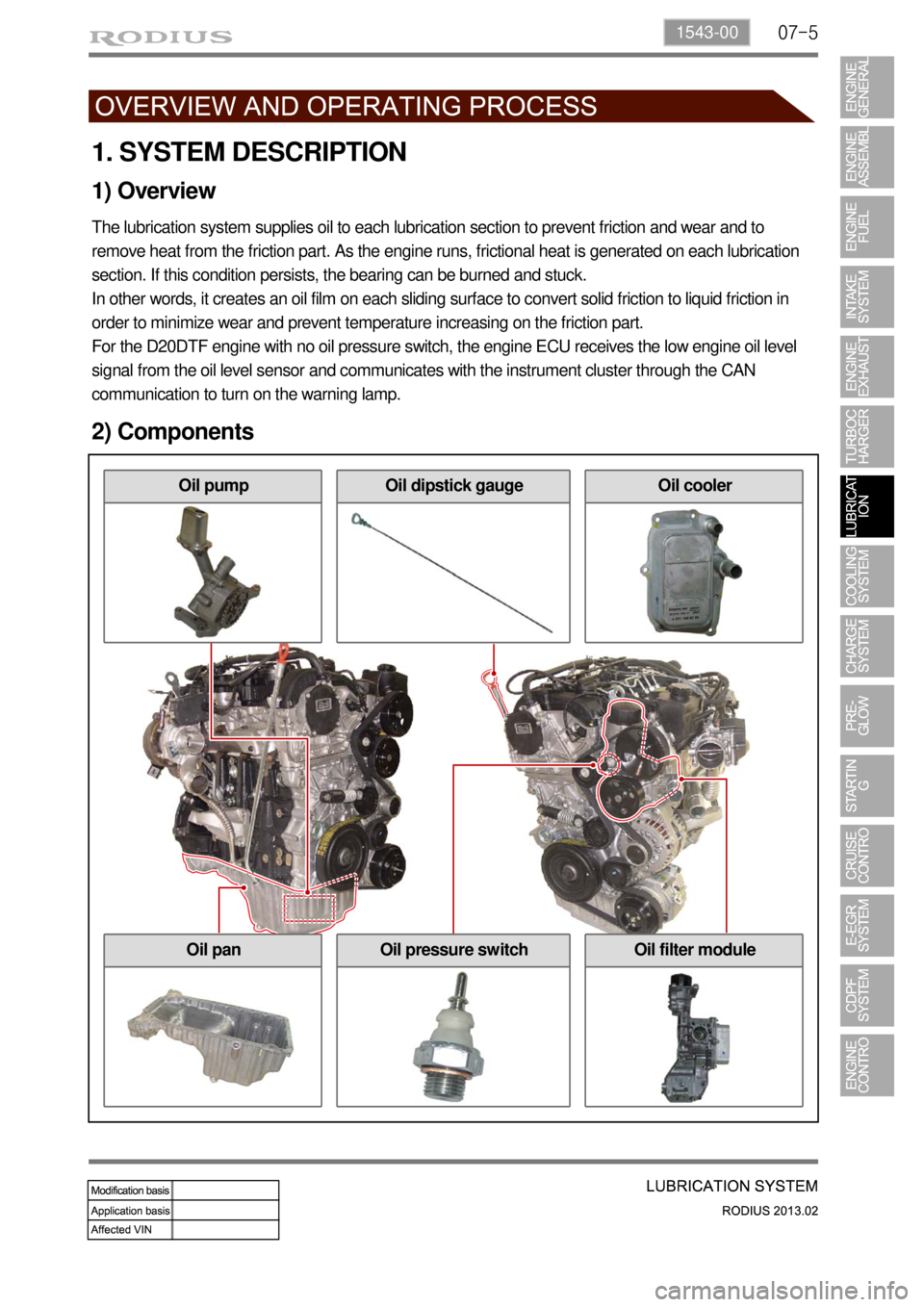
1. SYSTEM DESCRIPTION
1) Overview
The lubrication system supplies oil to each lubrication section to prevent friction and wear and to
remove heat from the friction part. As the engine runs, frictional heat is generated on each lubrication
section. If this condition persists, the bearing can be burned and stuck.
In other words, it creates an oil film on each sliding surface to convert solid friction to liquid friction in
order to minimize wear and prevent temperature increasing on the friction part.
For the D20DTF engine with no oil pressure switch, the engine ECU receives the low engine oil level
signal from the oil level sensor and communicates with the instrument cluster through the CAN
communication to turn on the warning lamp.
2) Components
Oil coolerOil dipstick gaugeOil pump
Oil filter moduleOil pressure switchOil pan
Page 278 of 796

08-91520-00
Coolant temperature sensor
Measures the coolant
temperature and sends the
result to the engine ECU.
Electric fan
Circulates the fresh air forcibly to exchange heat
with the radiator core fin.
Radiator
Releases heat through fins and cools down the hot
coolant as the coolant passes through the tube of the
radiator core.
MT - 400W , AT- 600W
Page 291 of 796
10-4
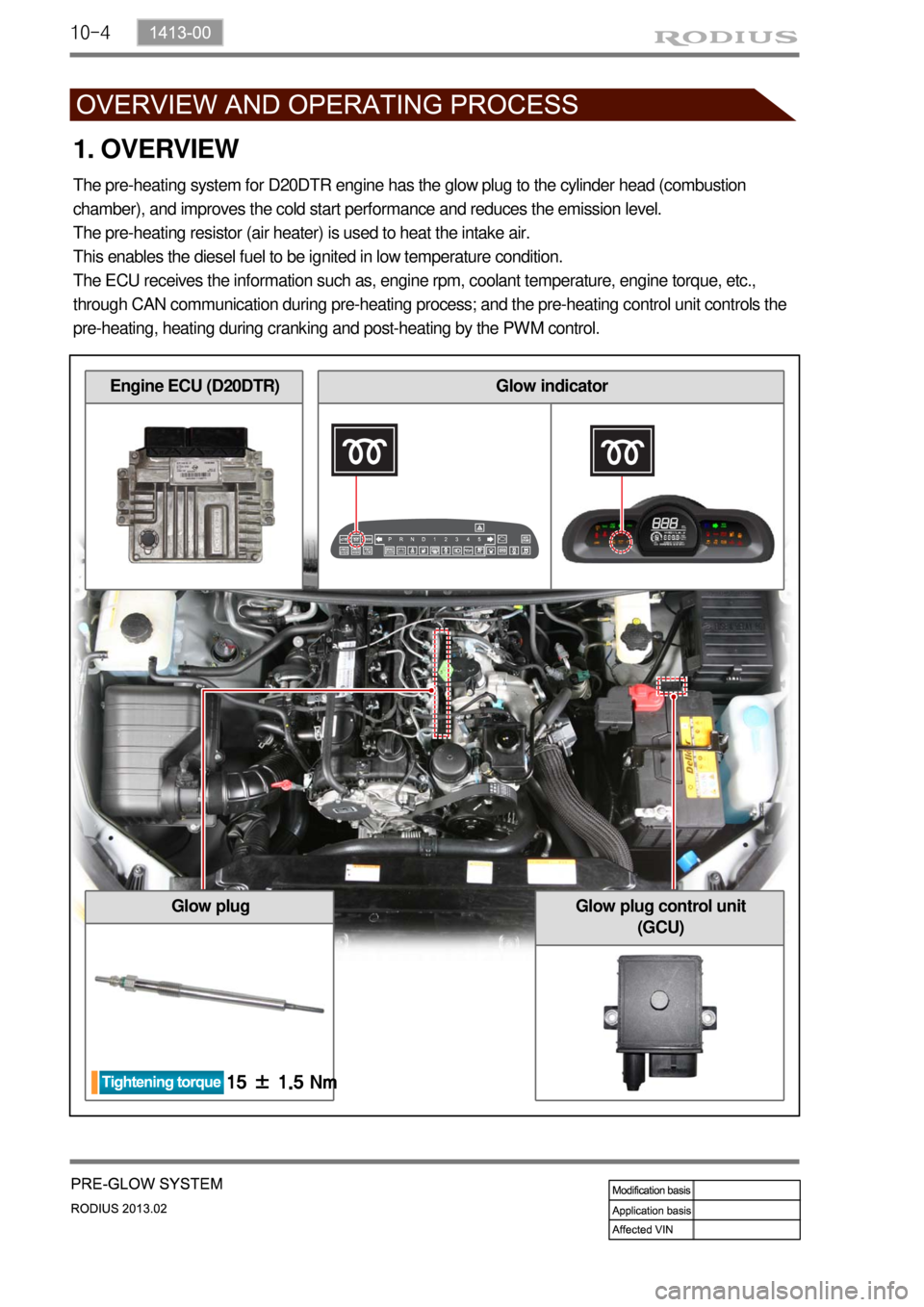
1. OVERVIEW
The pre-heating system for D20DTR engine has the glow plug to the cylinder head (combustion
chamber), and improves the cold start performance and reduces the emission level.
The pre-heating resistor (air heater) is used to heat the intake air.
This enables the diesel fuel to be ignited in low temperature condition.
The ECU receives the information such as, engine rpm, coolant temperature, engine torque, etc.,
through CAN communication during pre-heating process; and the pre-heating control unit controls the
pre-heating, heating during cranking and post-heating by the PWM control.
Glow plug
Engine ECU (D20DTR)Glow indicator
Glow plug control unit
(GCU)
Page 294 of 796

10-71413-00
4) Operation
Glow plug is installed in the cylinder head. It enhances the cold starting performance and reduces the
exhaust gas during cold starting.
ECU receives the data (engine rpm, coolant temperature, vehicle speed) through CAN lines. Based on
the data, GCU controls the pre-glow, cranking and post-glow. It also checks the glow plugs, and sends
the result to ECU.
(1) Temperature/Current Properties of GCU
GCU increases the temperature of glow plug very rapidly (approx. 2 seconds up to
1000°C)
FETs (similar to transistor) for each cylinder are integrated in GCU. During the pre-glow
period, battery voltage is supplied to the glow plugs directly to heat them rapidly.
After getting the desired temperature by pre-glowing, the temperature is controlled by duty
ratio. Step 1:
Step 2 & 3:
Step 4:
This shows the supplying voltage and time by GCU in each step. The step 4 is the period to keep
the temperature. -Step 1: I1
Step 2: I2
Step 3: I3
Step 4: I4
Page 311 of 796

13-4
1. SYSTEM DESCRIPTION
1) Overview
The EGR (Electric-Exhaust Gas Recirculation) valve reduces the NOx emission level by recirculating
some of the exhaust gas to the intake system.
To meet Euro-V regulation, the capacity and response rate of E-EGR valve in D20DTR engine have
been greatly improved. The EGR cooler with high capacity reduces the Nox, and the bypass valve
reduces the CO and HC due to EGR gas before warming up.
Also, the engine ECU adjusts the E-EGR opening by using the air mass signal through HFM sensor. If
the exhaust gas gets into the intake manifold when the EGR valve is open, the amount of fresh air
through HFM sensor should be decresed.
Benefits of E-EGR valve ▶
Improved accuracy and response through electric control
Feedback function (Potentiometer)
Preventing chattering of EGR valve and improved durability
Self-cleaning function -
-
-
-
Page 312 of 796

13-51793-00
EGR pipe
Transports the exhaust gas from the EGR cooler
and EGR bypass valve to the intake duct.E-EGR valve
Receives the electric signal from the ECU to
control the valve.
E-EGR cooler and bypass valve
The cooler lowers the high temperature of the
exhaust gas and the bypass valve directly
supplies the exhaust gas to the intake duct
without passing through the EGR cooler to
reduce the emission of exhaust gas before
warming up the engine.HFM sensor
Used as a main map value to control the EGR.
The coolant temperature, engine rpm, engine
load, intake air temperature (HFM: decreased at
60˚C or more), atmospheric pressure
(atmospheric pressure sensor: altitude
compensation) are used as auxiliary map values.
2) Location and Components
See the section "Engine control" for E-EGR
valve control logic.EGR coolerEGR bypass
For details, see the section "Engine control".
*
Page 314 of 796

13-71793-00
2) Input/Output Devices
3) Control Logic
The EGR system controls the EGR amount based on the map values shown below:
Main map value: Intake air volume
Auxiliary map value: ※
※
Compensation by the coolant temperature
Compensation by the atmospheric pressure: Altitude compensation
Compensation by the boost pressure deviation (the difference between the requested value and
the measured value of boost pressure)
Compensation by the engine load: During sudden acceleration
Compensation by the intake air temperature -
-
-
-
-
The engine ECU calculates the EGR amount by adding main map value (intake air volume) and
auxiliary map value and directly drives the solenoid valve in the E-EGR to regulate the opening extent
of the EGR valve and sends the feedback to the potentiometer.
(1) Operating conditions
Intake air temperature: between -10 and 50℃
Atmospheric pressure: 0.92 bar or more
Engine coolant temperature: between 0 and 100°C
When there is no fault code related to EGR -
-
-
-
(2) Shut off conditions
Abrupt acceleration: with engine speed of 2600 rpm or more
When the engine is idling for more than 1 minute
Vehicle speed: 100 km/h or more
Engine torque: 380 Nm or more -
-
-
-
Page 318 of 796
14-6
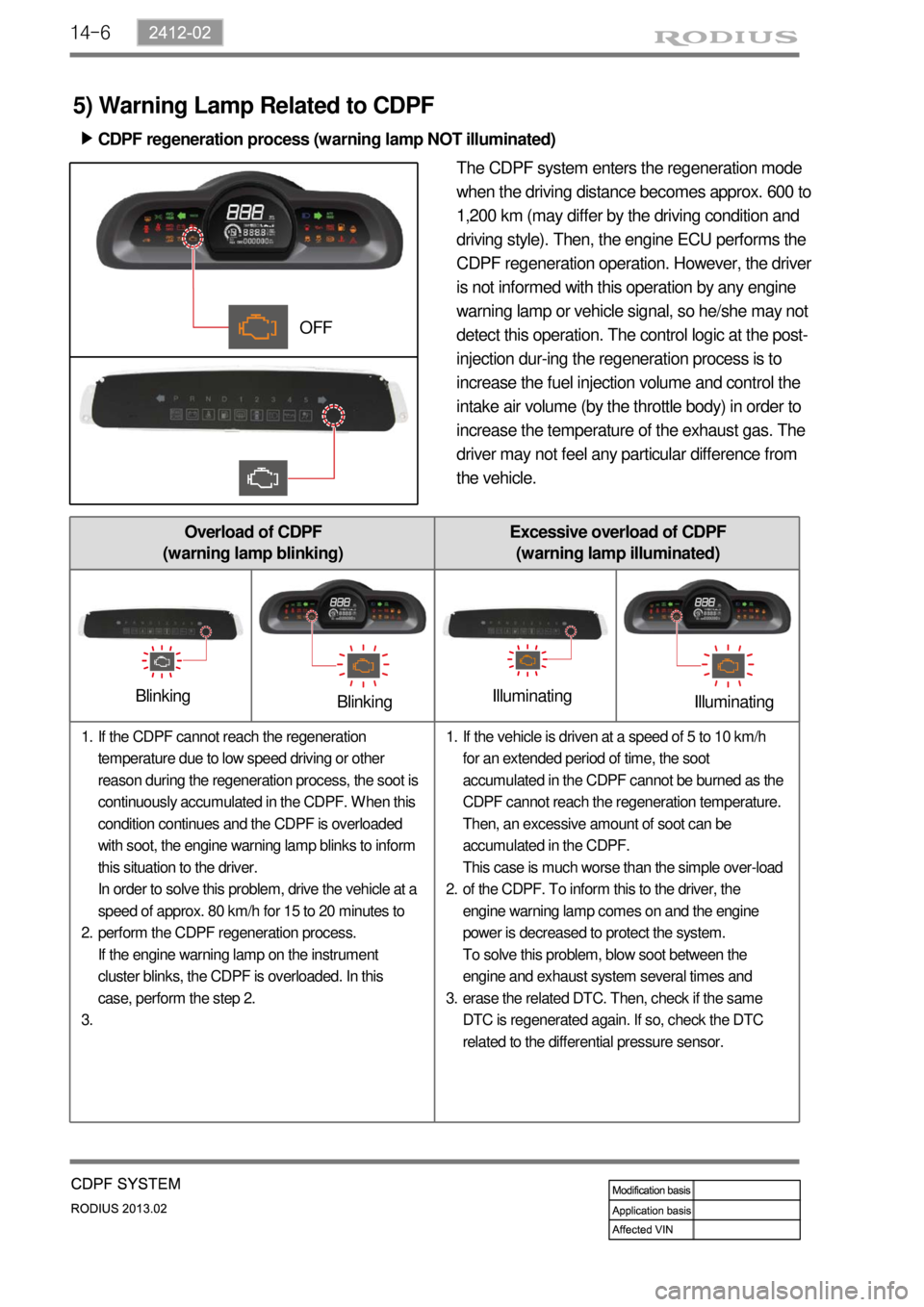
Overload of CDPF
(warning lamp blinking)Excessive overload of CDPF
(warning lamp illuminated)
5) Warning Lamp Related to CDPF
CDPF regeneration process (warning lamp NOT illuminated) ▶
The CDPF system enters the regeneration mode
when the driving distance becomes approx. 600 to
1,200 km (may differ by the driving condition and
driving style). Then, the engine ECU performs the
CDPF regeneration operation. However, the driver
is not informed with this operation by any engine
warning lamp or vehicle signal, so he/she may not
detect this operation. The control logic at the post-
injection dur-ing the regeneration process is to
increase the fuel injection volume and control the
intake air volume (by the throttle body) in order to
increase the temperature of the exhaust gas. The
driver may not feel any particular difference from
the vehicle.
If the CDPF cannot reach the regeneration
temperature due to low speed driving or other
reason during the regeneration process, the soot is
continuously accumulated in the CDPF. W hen this
condition continues and the CDPF is overloaded
with soot, the engine warning lamp blinks to inform
this situation to the driver.
In order to solve this problem, drive the vehicle at a
speed of approx. 80 km/h for 15 to 20 minutes to
perform the CDPF regeneration process.
If the engine warning lamp on the instrument
cluster blinks, the CDPF is overloaded. In this
case, perform the step 2. 1.
2.
3.If the vehicle is driven at a speed of 5 to 10 km/h
for an extended period of time, the soot
accumulated in the CDPF cannot be burned as the
CDPF cannot reach the regeneration temperature.
Then, an excessive amount of soot can be
accumulated in the CDPF.
This case is much worse than the simple over-load
of the CDPF. To inform this to the driver, the
engine warning lamp comes on and the engine
power is decreased to protect the system.
To solve this problem, blow soot between the
engine and exhaust system several times and
erase the related DTC. Then, check if the same
DTC is regenerated again. If so, check the DTC
related to the differential pressure sensor. 1.
2.
3.
OFF
Blinking Illuminating
Blinking Illuminating
Page 321 of 796

14-92412-02
Differential Pressure Sensor
Calculates the amount of PM
collected by reading the pressure
difference between pre-CDPF and
post-CDPF.Engine ECU (D20DTR)
Post injection
Electric Throttle Body
Regulates the air intake
rate.CDPF
(DOC+DPF)Front EGT Sensor
Measures the combustion
temperature.
Rear EGT Sensor
Measures the CDPF
temperature.
2. COMPONENTS
For details, refer to section "Engine Control". *
Page 324 of 796
14-12
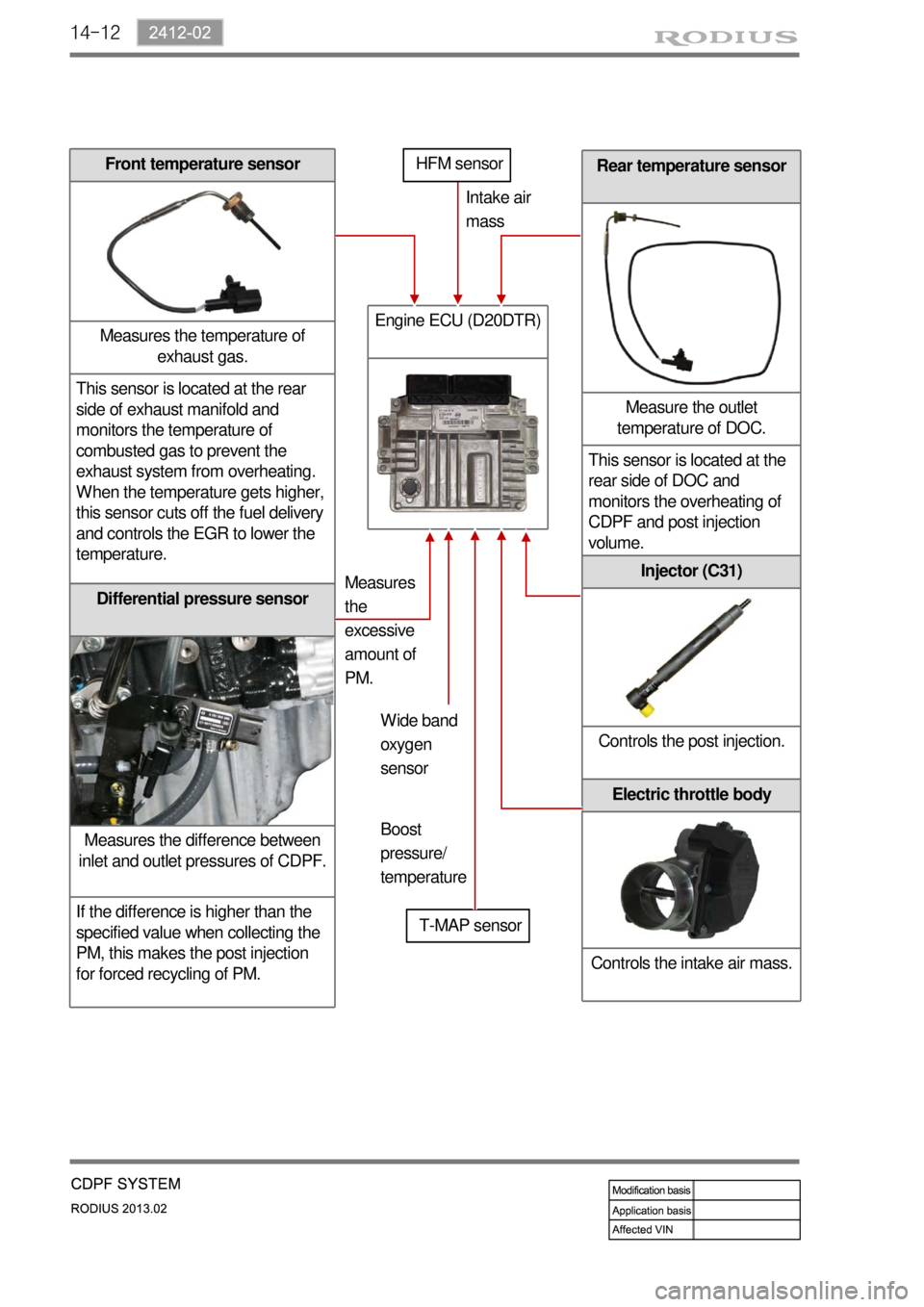
Rear temperature sensor
Measure the outlet
temperature of DOC.
This sensor is located at the
rear side of DOC and
monitors the overheating of
CDPF and post injection
volume.
Differential pressure sensor
Measures the difference between
inlet and outlet pressures of CDPF.
If the difference is higher than the
specified value when collecting the
PM, this makes the post injection
for forced recycling of PM.
Front temperature sensor
Measures the temperature of
exhaust gas.
This sensor is located at the rear
side of exhaust manifold and
monitors the temperature of
combusted gas to prevent the
exhaust system from overheating.
When the temperature gets higher,
this sensor cuts off the fuel delivery
and controls the EGR to lower the
temperature.
Engine ECU (D20DTR)
T-MAP sensorIntake air
mass
Measures
the
excessive
amount of
PM.
Injector (C31)
Controls the post injection.
Electric throttle body
Controls the intake air mass.
HFM sensor
Wide band
oxygen
sensor
Boost
pressure/
temperature