ECU SSANGYONG TURISMO 2013 Workshop Manual
[x] Cancel search | Manufacturer: SSANGYONG, Model Year: 2013, Model line: TURISMO, Model: SSANGYONG TURISMO 2013Pages: 796, PDF Size: 78.99 MB
Page 477 of 796

03-37010-06
1. SPECIFICATIONS
Item Item Specification
Immobilizer
unitOperating voltage
(CAN) 6.0 V to 16.0 V
(6.0 V ~18.0 V)
Operating temperature-30℃ ~ 80℃
Coil inductance420 uH ± 20 uH
Modulation methodFSK
(Frequency Shift Keying : frequency
displacement)
Frequency134.2 KHz ± 4 KHz
TransponderFrequency134.2 KHz ± 4 KHz
Operating temperature-40℃ ~ +85℃
Transponder coding Up to 5
2. CAUTIONS
The vehicle owner must observe the service works when deleting the transponder codes or
registering additional keys.
In any cases, the immobilizer system can not be removed from the vehicle. If you attempt to
remove it and damage the system, starting will be impossible, so never attempt to remove,
damage or modify it.
The remote engine starter cannot be installed to the vehicle equipped with the immobilizer
system.
Do not drop or shock to the transponder in the ignition key as it may be damaged.
With a damaged transponder, the engine cannot be started.
For the vehicle with the immobilizer, there can be a problem in starting the vehicle or the system
error: 1.
2.
3.
4.
5.
6.
When more than one immobilizer keys come into contact with (each) other(s) or key is close
to any device sending or receiving electromagnetic fields or waves
When the ignition key is close to any electronic or electric devices such as lighting equipment,
security keys or security cards
When the ignition key is close to a magnetic or metal object or a battery -
-
-
Page 478 of 796

03-4
1. SYSTEM LAYOUT
1) Location
Immobilizer Warning LampImmobilizer Unit
ECUREKES KeyDiagnostic Connector
Page 479 of 796

03-57010-06
2) System Diagram
The certification for the immobilizer is performed when turning the ignition switch to the "ON" position
after the CAN communication between the ECU and immobilizer is established.
Page 480 of 796
03-6
2. OVERVIEW
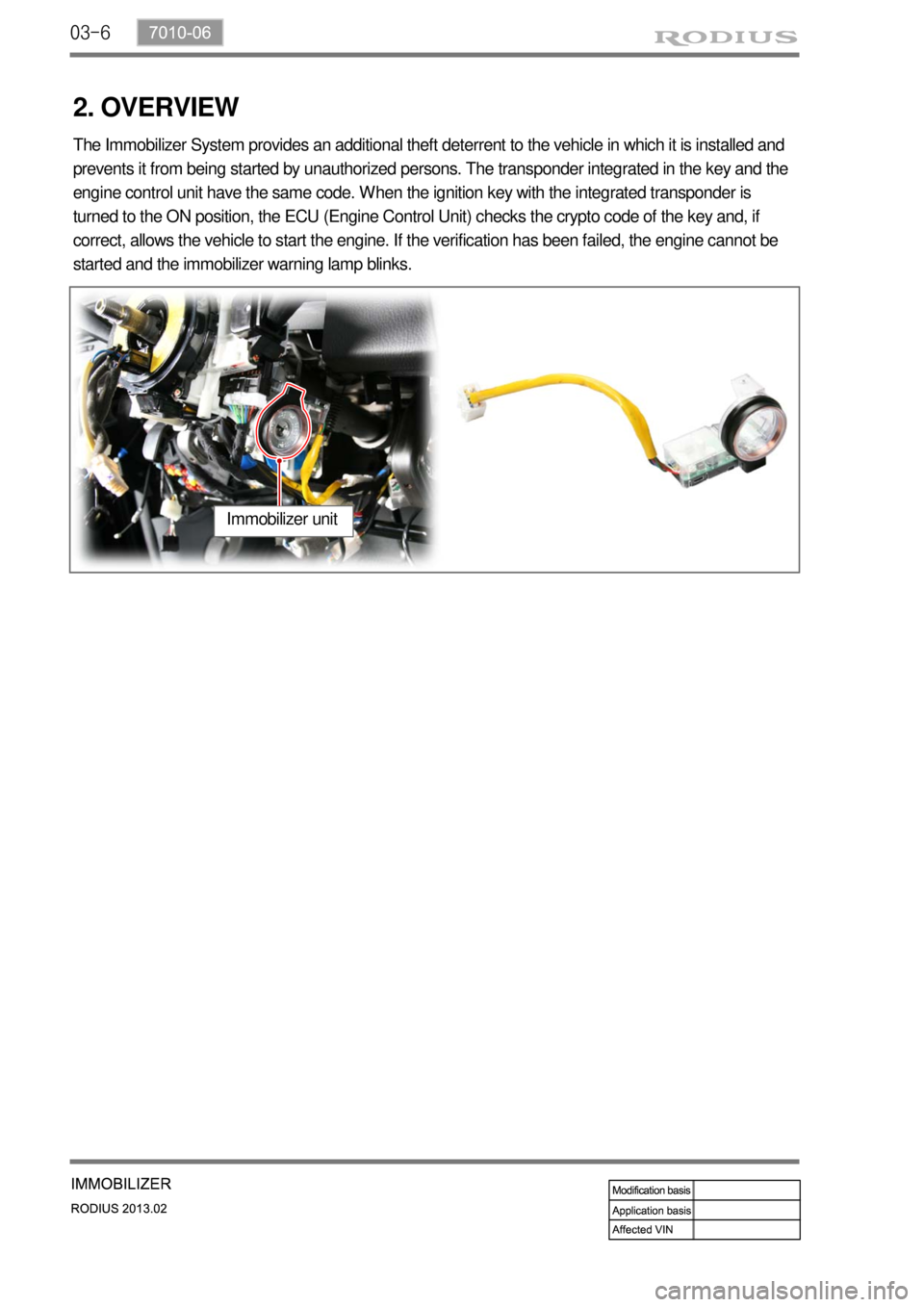
The Immobilizer System provides an additional theft deterrent to the vehicle in which it is installed and
prevents it from being started by unauthorized persons. The transponder integrated in the key and the
engine control unit have the same code. When the ignition key with the integrated transponder is
turned to the ON position, the ECU (Engine Control Unit) checks the crypto code of the key and, if
correct, allows the vehicle to start the engine. If the verification has been failed, the engine cannot be
started and the immobilizer warning lamp blinks.
Immobilizer unit
Page 482 of 796

03-8
Transponder
3. VERIFICATION OF KEY
1) Verification
The immobilizer system prevents the vehicle theft by allowing only the authorized key to start the
engine. The transponder inside the key communicates with the immobilizer installed in the key box,
and the system permits the engine to start after confirming the encrypted coding from the engine ECU.
In the following cases, a driver may be unable to start the vehicle with the immobilizer.The immobilizer unit transmits
the encrypted code to the
transponder. (2)
The transponder sends an encrypted signal to the unit as a response.
The transmitted code is changed to an encrypted signal in the unit.
The system compares the signal from transponder and the encrypted signal in immobilizer unit. (3)
(4)
(5)
When two or more immobilizer keys come into contact with (each) other(s).
When the key is close to any device sending or receiving electromagnetic fields or waves.
When the key is close to any electronic or electric devices such as lightening equipment,
security keys or security cards.
When the key is close to a magnetic or metal object or a battery. -
-
-
-
Immobilizer Unit
Page 483 of 796

03-97010-06
ECU
Immobilizer Indicator and Warning Lamp ▶
This indicator comes on when the ignition
key is communicating with the engine control
unit (during engine starting) and goes out
after starting the engine.
When turning the ignition key to ON position, the
ECU transmits the challenge message to the
immobilizer unit to verify whether the key is valid. (1)
Only when the two signals are identical, it
recognizes the key as the authorized one and
transmits the positive message to the ECU.
The ECU allows the engine to be started. (6)
(7)
Do not drop or shock to the transponder in the key as it may be damaged.
With a damaged transponder, the engine cannot be started.
When you erase the code or register an extra key, let the owner attend on the site.
In any case, the immobilizer system cannot be removed from the vehicle. If you attempt to
remove it and damage the system, starting will be impossible, so never attempt to remove,
damage or modify it.
The remote engine starter cannot be installed on the vehicle equipped with the immobilizer
system. -
-
-
-
-Lamp ON: in communication
Blinking twice for one second:
immobilizer system failure
Blinking once for two seconds:
immobilizer unit is not coded
The immobilizer indicator does not come
on if the communication time between
immobilizer key and ECU is too short.
Immobilizer Indicator and Warning Lamp
Page 511 of 796
07-4
2. CAUTIONS ON RAIN SENSOR
When the wiper switch is in the AUTO position, the wiper will operate for 1 cycle if the initial engine
start is made. This may cause the wiper blades to wear prematurely. Therefore, other than rainy
days, set the switch to the OFF position. Especially during the winter time, check if the wiper blades
are not frozen to the windshield.
Operating the wiper with the blades frozen can damage the wiper motor.
If you operate the wipers when the windshield is dry without spraying washer fluid, the windshield can
be scratched and the wiper blades can wear prematurely. Use the wiper with the washer fluid when
the windshield is dry.
When it does not rain, turn the wiper switch to the OFF position.
Turn the wiper switch to the OFF position before any car wash to avoid unwanted operation of the
wipers. -
-
-
-
When cleaning the windshield over the sensor with damp clothes, the wiper may operate suddenly.
It could cause serious injury. Make sure to place the wiper switch to the OFF position and ignition
switch OFF when not in use.
Irregular operation (abrupt operation) ▶
Check if the sensor is off the position.
Check if the rain sensor cover is securely installed.
Check if the customer is familiar to how to control the wiper sensitivity.
Check if the wiper sensitivity control is set to the FAST side (step 5).
Check the wiper blade for wear.
If the wiper blade cannot wipe the glass uniformly and clearly, it may cause the rain sensor to work
irregularly. Therefore, in this case, replace the wiper blade with a new one. -
-
-
-
Page 649 of 796

09-34891-01
1. SPECIFICATIONS
1) Pressure Sensor
UnitDescription
Location
ABS ESP
HECU
(Hydraulic &
Electronic Control
Unit) CPU:MCU60 (32bit)
Clock Frequency:
28 MHz
Memory: 128~256 KB CPU:MCU60 (32bit)
Clock Frequency:
28 MHz
Memory:256~512 KB Under the front washer
reservoir
Wheel Speed
SensorActive type wheel speed
sensorActive type wheel speed
sensorOn each wheel
Front air gap:
0.3 ~ 1.3mm,
Rear air gap:
0.3 ~ 1.3 mm
Steering Wheel
Angle SensorN/AMaximum angular speed:
1500°/sec
Operating voltage:
9~16 VUnder the steering
wheel
Sensor ClusterN/AIntegrated with yaw rate
sensor and lateral sensorUnder the audio
assembly
Pressure Sensor
N/A Analog outputUnder the master
cylinder
Description Specification
Supplying voltage approx. 5 V (4.75~5.25 V)
Max. pressure 350 bar
Page 651 of 796
09-54891-01
2. FUNCTION
1) Term Definition
ABS: Anti-Lock Brake System ▶
When the brake pedal is abruptly depressed, the HECU calculates the slip ratio of each wheel based
on information received from the wheel speed sensors and controls the hydraulic module data quickly
and precisely in order to maintain the friction between the road surface and tire optimal (static friction).
Therefore, by keeping the friction between the road surface and tire optimal, it is possible to obtain
following effects: Enhanced steering stability, improved direction stability, reduced stopping distance
and etc.
EBD: Electronic brake-Force Distribution ▶
This is to detect the tire speed from the wheel speed sensor in order to supply the braking pressure to
the rear tires individually. In other words, the HECU measures the tire deceleration speed continuously
and controls the rear inlet valve on the hydraulic modulator to obtain optimal braking force as much as
possible. Thereby, stopping distance, braking effect and straight stability are improved.
ESP: Electronic Stability Program ▶
This is used to make the vehicle stabilized to recognize the emergency driving conditions, and to
control the brake for each wheels and the engine power when the brake system or acceleration will not
work any more in dangerous circumstances.
TCS: Traction Control System ▶
When the wheel is slipping due to an excessive engine torque while starting off or driving, this controls
the driving force (braking force + engine torque) in order to prevent the wheel from slipping through the
engine or brake control.
AYC: Active Yaw Control ▶
This has been developed to help a driver avoid danger of losing control of the vehicle stability due to
understeer or oversteer during cornering, which is a part of the ESP function.
HBA: Hydraulic Brake Assistant ▶
Developed based on the fact that elderly drivers depress the brake pedal too soft even when hard
braking is necessary, this an assist system to operate the HECU drive motor immediately and apply
high braking force to the wheels when the brake pedal is depressed softly and the vehicle should be
braked in emergency.
ARP: Active Rollover Protection ▶
This is a supplementary device for safety in ESP system and can help minimize the rollover accidents
by detecting a potential rollover situation through the brake and engine control when making sudden
lane change or turning sharply by adding only the software, without any separate device or switch.
Page 652 of 796
09-6
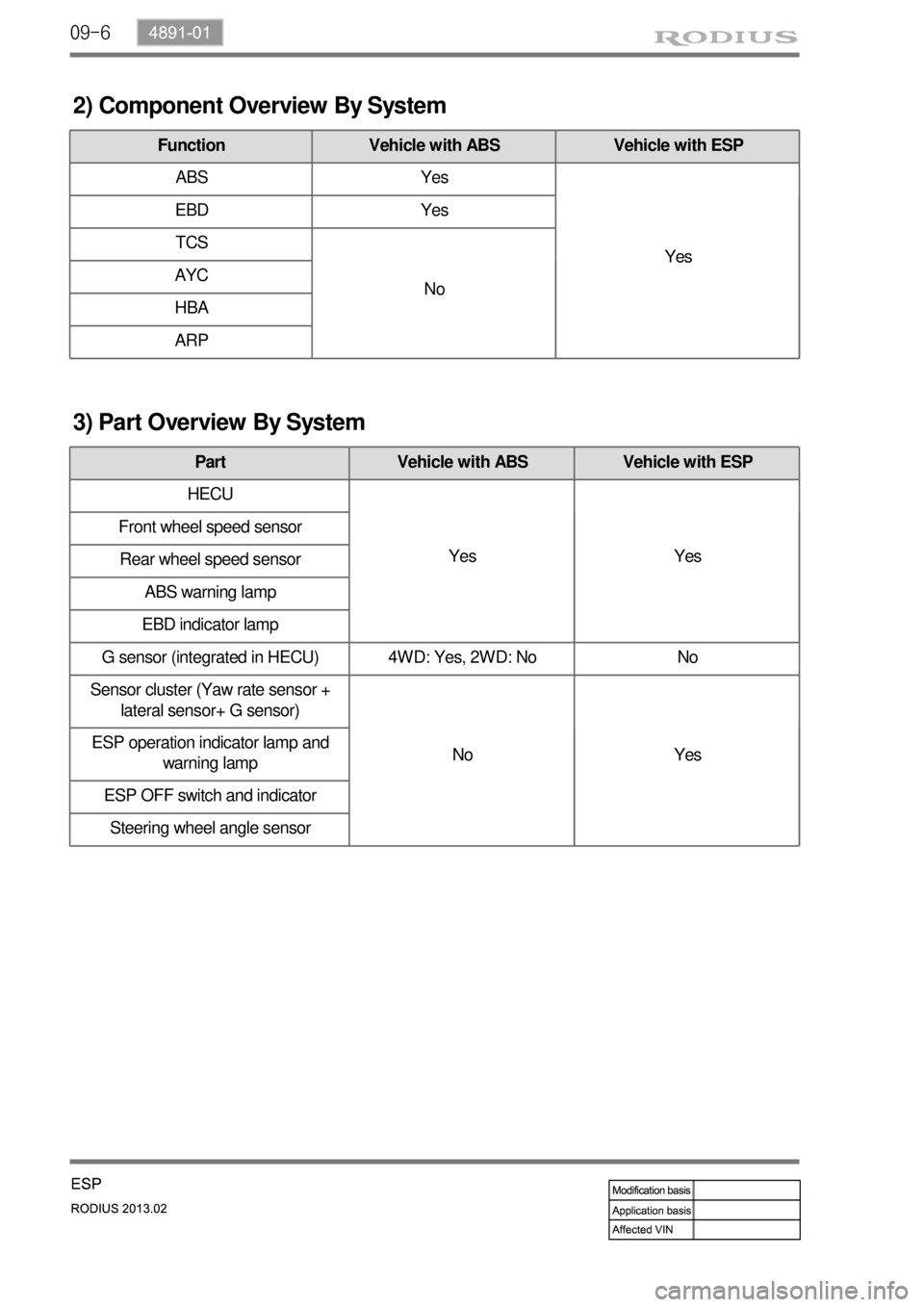
2) Component Overview By System
Function Vehicle with ABS Vehicle with ESP
ABS Yes
Yes EBD Yes
TCS
No AYC
HBA
ARP
3) Part Overview By System
Part Vehicle with ABS Vehicle with ESP
HECU
Yes Yes Front wheel speed sensor
Rear wheel speed sensor
ABS warning lamp
EBD indicator lamp
G sensor (integrated in HECU) 4WD: Yes, 2WD: No No
Sensor cluster (Yaw rate sensor +
lateral sensor+ G sensor)
No Yes ESP operation indicator lamp and
warning lamp
ESP OFF switch and indicator
Steering wheel angle sensor