belt SSANGYONG TURISMO 2013 User Guide
[x] Cancel search | Manufacturer: SSANGYONG, Model Year: 2013, Model line: TURISMO, Model: SSANGYONG TURISMO 2013Pages: 796, PDF Size: 78.99 MB
Page 453 of 796

02-22
5) Seat Belt Warning
The seat belt warning light comes on and the chime buzzer in the ICM box sounds for 6 seconds
when turning the ignition key to “ON” from “OFF”. If the seat belt is fastened before turning
the ignition key to “ON” position, the warning light in the indicator display blinks for 6
seconds, however, the chime buzzer does not sound.
The seat belt warning light goes off and the chime buzzer in the ICM box stops when turning the
ignition switch to “OFF” position.
The chime buzzer stops and the seat belt warning light stays on for the specified duration (6
seconds) when fastening the seat belt during the warning operation.
The seat belt warning light comes on and the chime buzzer sounds for 6 seconds again when
unfastening the seat belt during fastening operation. 1.
2.
3.
4.
Page 473 of 796
02-42
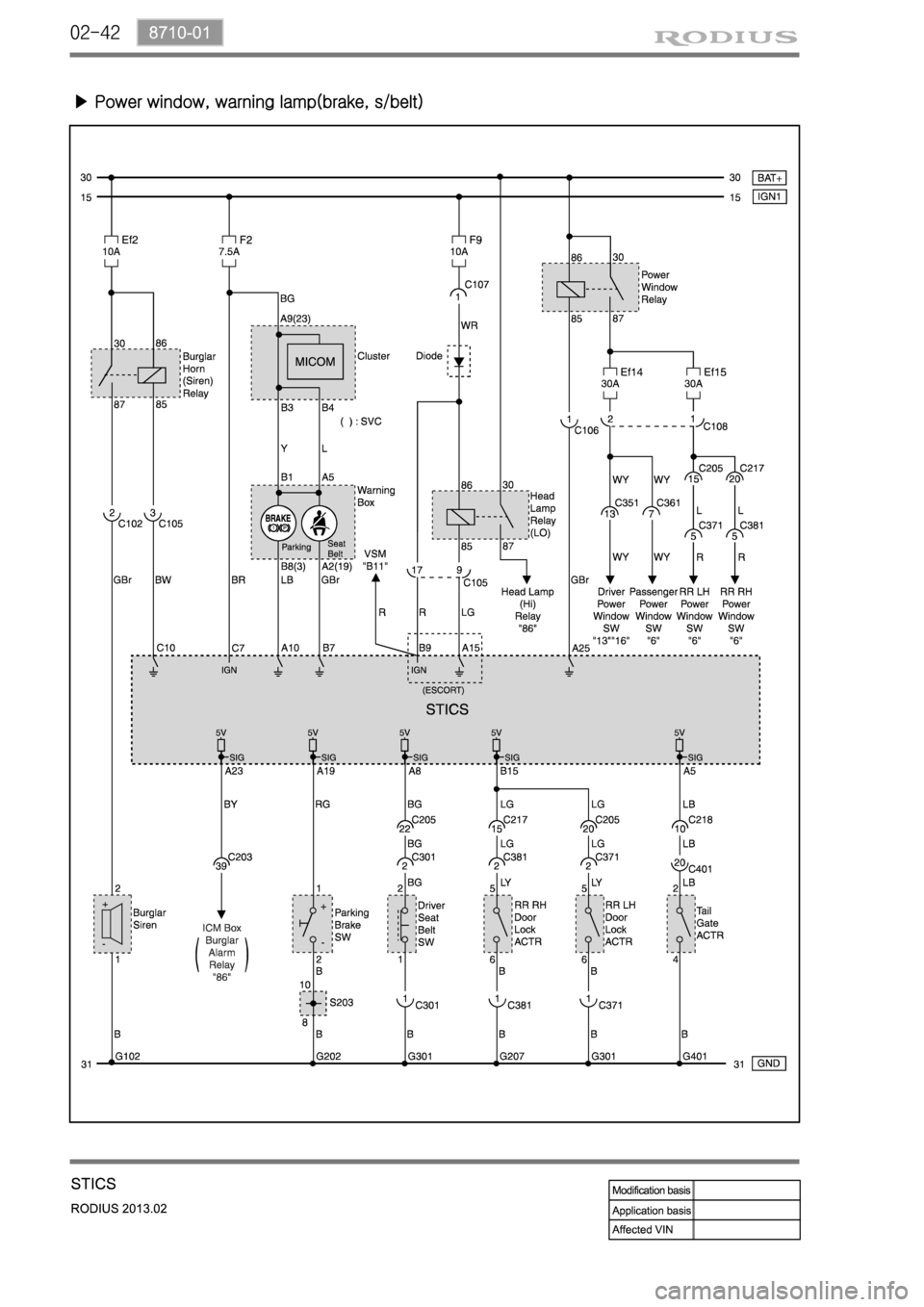
▶ Power window, warning lamp(brake, s/belt)
Page 688 of 796
11-6
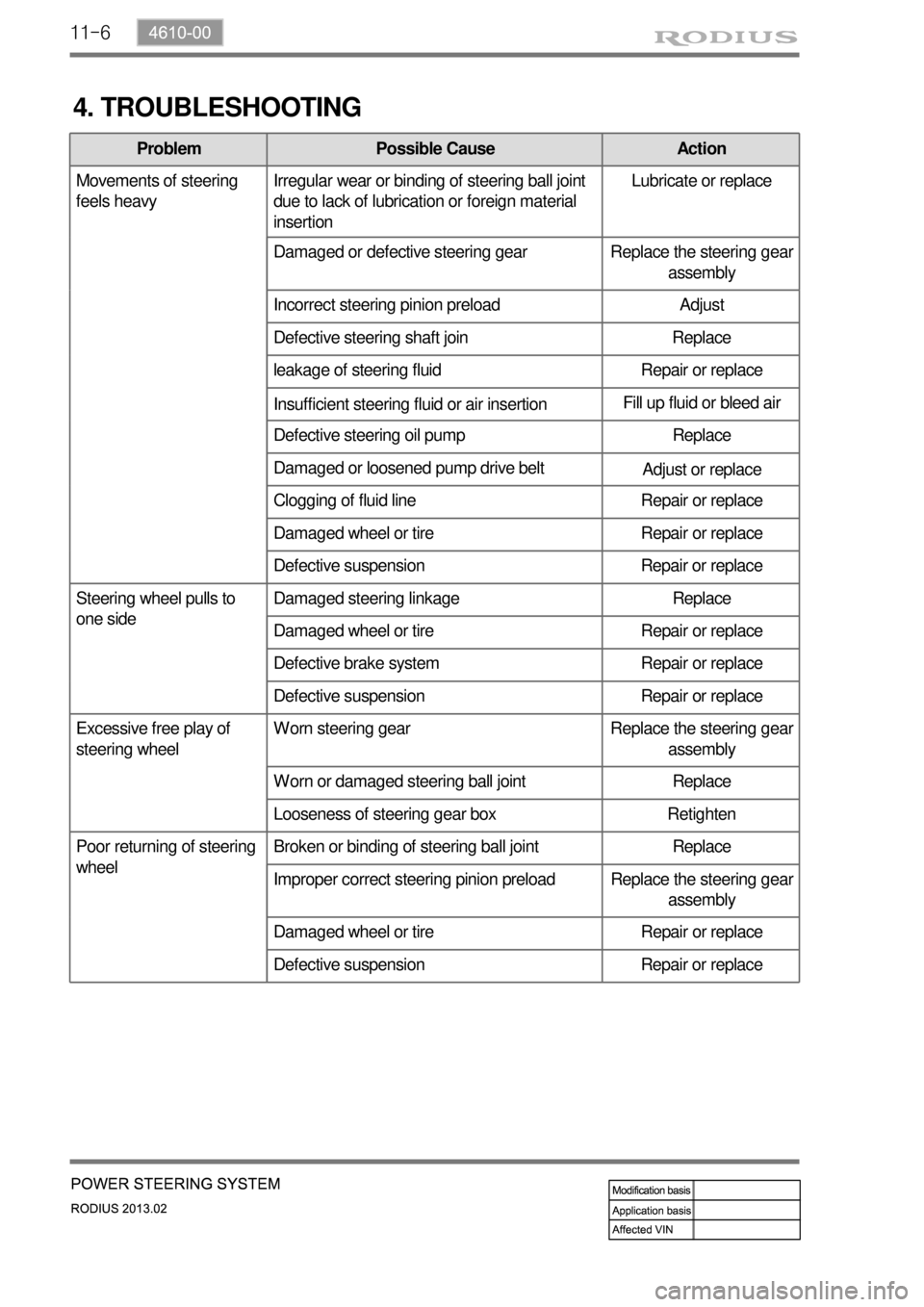
4. TROUBLESHOOTING
Problem Possible Cause Action
Movements of steering
feels heavyIrregular wear or binding of steering ball joint
due to lack of lubrication or foreign material
insertionLubricate or replace
Damaged or defective steering gear Replace the steering gear
assembly
Incorrect steering pinion preload Adjust
Defective steering shaft join Replace
leakage of steering fluid Repair or replace
Insufficient steering fluid or air insertionFill up fluid or bleed air
Defective steering oil pump Replace
Damaged or loosened pump drive belt
Adjust or replace
Clogging of fluid line Repair or replace
Damaged wheel or tire Repair or replace
Defective suspension Repair or replace
Steering wheel pulls to
one sideDamaged steering linkage Replace
Damaged wheel or tire Repair or replace
Defective brake system Repair or replace
Defective suspension Repair or replace
Excessive free play of
steering wheelWorn steering gear Replace the steering gear
assembly
Worn or damaged steering ball joint Replace
Looseness of steering gear box Retighten
Poor returning of steering
wheelBroken or binding of steering ball joint Replace
Improper correct steering pinion preload Replace the steering gear
assembly
Damaged wheel or tire Repair or replace
Defective suspension Repair or replace
Page 689 of 796
11-74610-00
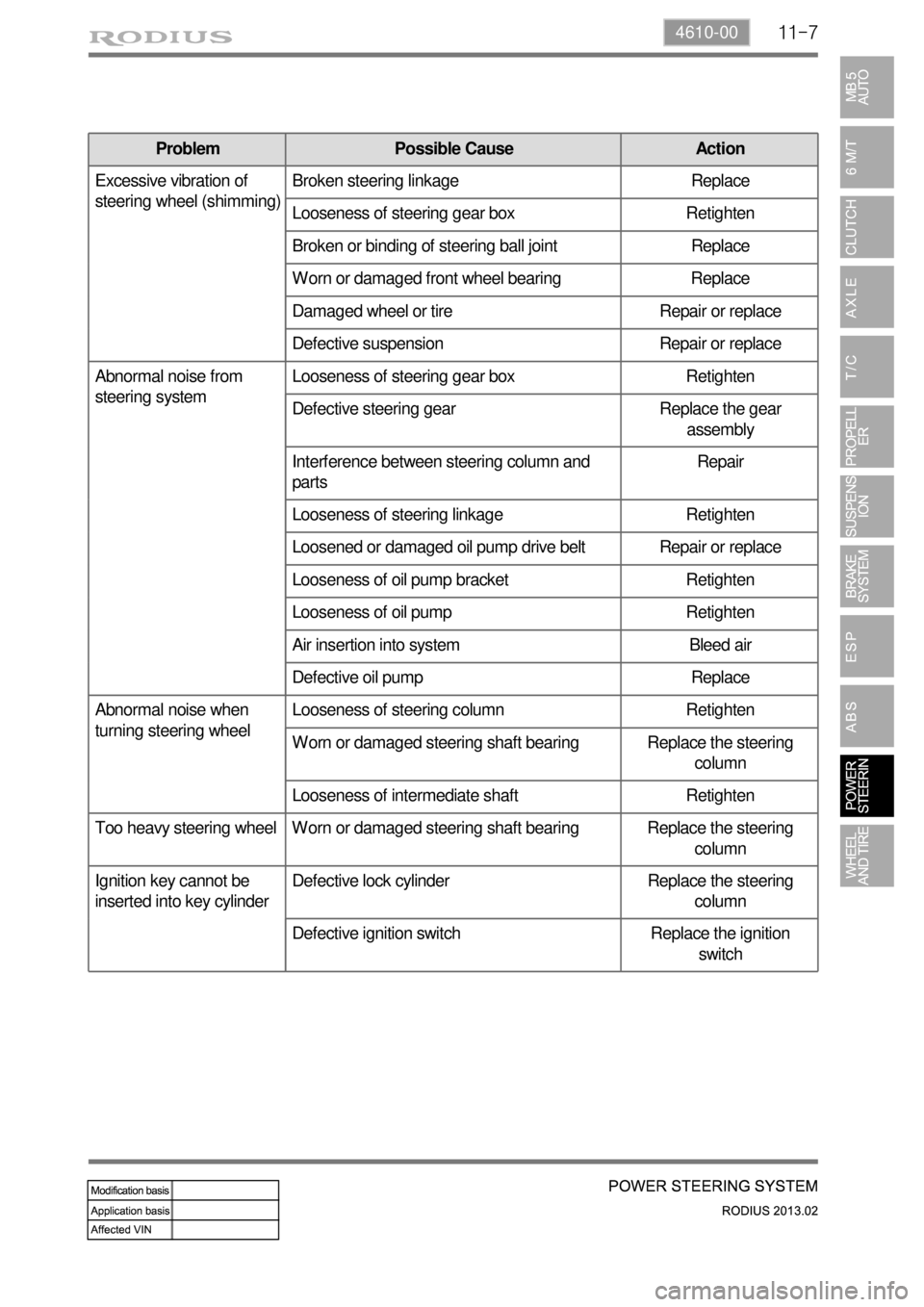
Problem Possible Cause Action
Excessive vibration of
steering wheel (shimming)Broken steering linkage Replace
Looseness of steering gear box Retighten
Broken or binding of steering ball joint Replace
Worn or damaged front wheel bearing Replace
Damaged wheel or tire Repair or replace
Defective suspension Repair or replace
Abnormal noise from
steering systemLooseness of steering gear box Retighten
Defective steering gear Replace the gear
assembly
Interference between steering column and
partsRepair
Looseness of steering linkage Retighten
Loosened or damaged oil pump drive belt Repair or replace
Looseness of oil pump bracket Retighten
Looseness of oil pump Retighten
Air insertion into system Bleed air
Defective oil pump Replace
Abnormal noise when
turning steering wheelLooseness of steering column Retighten
Worn or damaged steering shaft bearing Replace the steering
column
Looseness of intermediate shaft Retighten
Too heavy steering wheel Worn or damaged steering shaft bearing Replace the steering
column
Ignition key cannot be
inserted into key cylinderDefective lock cylinder Replace the steering
column
Defective ignition switch Replace the ignition
switch
Page 693 of 796

11-114610-00
Oil Pump Pressure Check ▶
Check the oil pump pressure to locate any
defect in oil pump.
Before checking the pressure, check the oil
level and belt tension. Prepare the empty
container to collect the spilled oil during the
service.
Unscrew the pressure line fitting in power
steering pump.
Install the pressure gauge between the
power steering pump and the power steering
oil pressure line.
Place the shift lever to neutral position. Apply
the parking brake.
Open the valve in pressure gauge. Start the
engine and let it run at idle speed.
Turn the steering wheel several times so that
the oil temperature reaches to normal
operating level. A.
B.
C.
D.
E.
Fully close the valve in pressure gauge and
measure the oil pressure. F.
To prevent internal damage, do not close the
gauge valve over 10 seconds.
Keep the oil temperature at proper range. -
-
Relief pressure93.3 ~ 100.4 kgf/cm²
Page 697 of 796

11-154610-00
The steering pump is driven by the engine power through a belt. This pump circulates the power
steering oil from the reservoir -> steering pump -> oil supply pipe -> steering gear box -> oil return pipe
-> reservoir to perform steering operations
Return hose & tube
Lower shaft Column & shaft
Steering wheel
Power steering gear boxHigh pressure hosePower steering
pump & tank
Return line
High pressure line
Steering pump Steering return pipe Steering cylinder
Page 700 of 796

12-54170-01
1. OVERVIEW
A radial tire uses a cord angle of 90 degrees. That is, the cord material runs in a radial or direct line
from one bead to the other across the tread. In addition, a radial tire has a belt overwrap under the
tread surface to provide greater structural stability. The belt overwrap of a radial tire distortion while the
radial structure enables high speed driving.
Tire supports the weight of the vehicle, reduces the impact from the road and at the same time,
transmits the power to propel, brake and steer on the road. It also functions to maintain a
vehicle’s movement. In order to complete such tasks, a tire must be structured to be a resilient
vessel of air.
There is wear limit mark on the tire, which protrudes as a strip shape located approximately 1.6 mm
from the groove bottom. This wear limit mark is not seen from the outside so there is additional
"▲" mark on the shoulder to let the driver find the wear mark easily. To measure the tire groove
depth, measure at any point other than the point which has a wear limit mark.
The tire is worn unevenly according to the driver's driving habit, improper servicing, low tire inflation
pressure, changed tire location, etc.
1) Structure of Tire
Tread
This thick layer of rubber provides the interface
between the tire and the road. Wear-resistant
rubber is used to protect the carcass and belt
against fractures and impacts and to deliver a
long driving life.
Shoulder
Located between the tread and sidewall, the
shoulder rubber is the thickest so that the
design must allow for the easy diffusion of heat
generated within the tire while driving.
Sidewall
The part between the shoulder and bead, the
flexible sidewall protects the carcass and
enhances the ride. A tire’s type, size,
structure, pattern, manufacturing company,
product name and various characters are
indicated here. Bead
The bead attaches the tire to the rim and wraps
the end of the cord fabric. Comprised of the bead
wire, core, flipper and other parts, the bead is
generally designed to be slightly tight around the
rim so that in the case of a sudden drop in
inflation pressure, the tire will not fall off the rim.
Carcass
As the most important framework of a tire, the
entire inner layer of cord fabric is called the
carcass. The carcass acts to support air
pressure, vertical load and absorb shocks.
Valve
Belt
Bead core
Page 731 of 796

02-38810-03
1. SPECIFICATIONS
Description Item Specification
Air bag unit
(SDM)Operating voltage 10.0 V to 16.5 V
Voltage for diagnosis and self-
diagnosis8.0 V to 16.5 V
Operating temperature-40℃ ~ 85℃
Storage temperature-40℃ ~ 90℃
Overvoltage protection 24 V
Ground resistance100 mΩ or less
Driver/passenger
air bag moduleOperating voltage 8.0 V to 16.5 V
Seat air bag moduleOperating voltage 10.0 V to 16.5 V
Side impact sensor voltage 8.0 V to 16.5 V
Seat belt pretensioner Operating voltage 10.0 V to 16.5 V
If you measure the air bag module using a multitester, the air bag module may be deployed,
causing a personal injury.
Never use the multitester to check the air bag module.
Page 732 of 796

02-4
2. OPERATION
1) Air Bag
▶Air bag inflates when:
In response to a severe frontal impact, the driver’s and front passenger’s air bags
deploy at the same time to supplement the seat belts to prevent or reduce any personal
injuries. -
▶Air bag can inflate when:
Underbody impact from the road surface; impact against the curb at a very high speed;
dropping impact onto the road surface with a large angle -
▶Air bag does not inflate when:
Rollover, side impact or rear impact
If the severity of impact to the vehicle is not significant and the seat belts are enough to protect
occupants. -
-
Air bag seldom inflates when: ▶
Oblique impact, rollover
Weak impact in which the sensor is unable to detect (under the inflation requirements)
Impact against narrow objects such as a utility pole or a tree
The vehicle falls into a drainage or a puddle
The front of the vehicle crashes into a high impact point vehicle such as a truck
Impact on the hood by falling stones
The air bag warning light is on
Moderate or severe impact to the middle of the vehicle body’s side structure. In that case,
only the side curtain air bags deploy. -
-
-
-
-
-
-
-
Page 733 of 796
02-58810-03
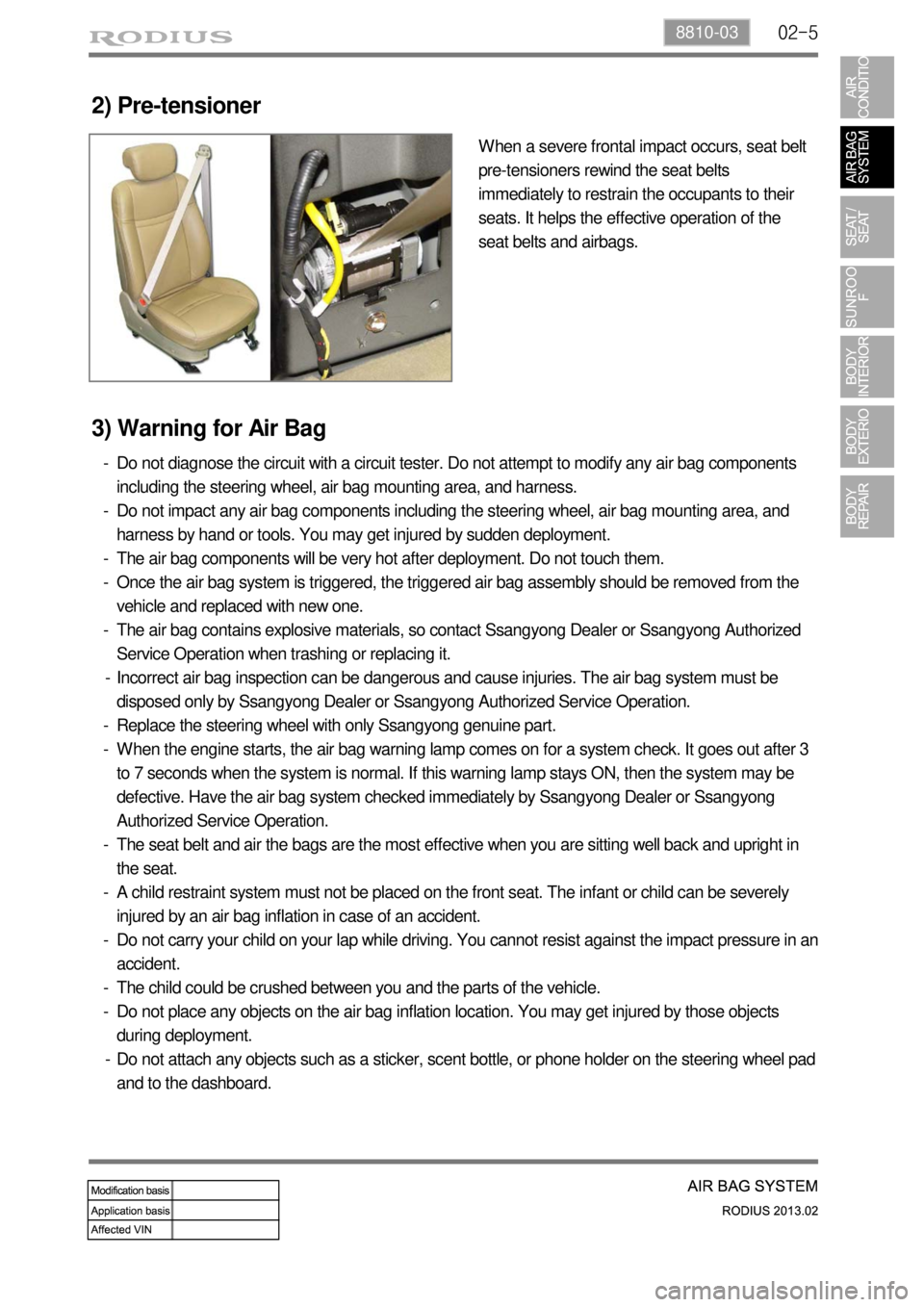
When a severe frontal impact occurs, seat belt
pre-tensioners rewind the seat belts
immediately to restrain the occupants to their
seats. It helps the effective operation of the
seat belts and airbags.
2) Pre-tensioner
3) Warning for Air Bag
Do not diagnose the circuit with a circuit tester. Do not attempt to modify any air bag components
including the steering wheel, air bag mounting area, and harness.
Do not impact any air bag components including the steering wheel, air bag mounting area, and
harness by hand or tools. You may get injured by sudden deployment.
The air bag components will be very hot after deployment. Do not touch them.
Once the air bag system is triggered, the triggered air bag assembly should be removed from the
vehicle and replaced with new one.
The air bag contains explosive materials, so contact Ssangyong Dealer or Ssangyong Authorized
Service Operation when trashing or replacing it.
Incorrect air bag inspection can be dangerous and cause injuries. The air bag system must be
disposed only by Ssangyong Dealer or Ssangyong Authorized Service Operation.
Replace the steering wheel with only Ssangyong genuine part.
When the engine starts, the air bag warning lamp comes on for a system check. It goes out after 3
to 7 seconds when the system is normal. If this warning lamp stays ON, then the system may be
defective. Have the air bag system checked immediately by Ssangyong Dealer or Ssangyong
Authorized Service Operation.
The seat belt and air the bags are the most effective when you are sitting well back and upright in
the seat.
A child restraint system must not be placed on the front seat. The infant or child can be severely
injured by an air bag inflation in case of an accident.
Do not carry your child on your lap while driving. You cannot resist against the impact pressure in an
accident.
The child could be crushed between you and the parts of the vehicle.
Do not place any objects on the air bag inflation location. You may get injured by those objects
during deployment.
Do not attach any objects such as a sticker, scent bottle, or phone holder on the steering wheel pad
and to the dashboard. -
-
-
-
-
-
-
-
-
-
-
-
-
-