belt SSANGYONG TURISMO 2013 Service Manual
[x] Cancel search | Manufacturer: SSANGYONG, Model Year: 2013, Model line: TURISMO, Model: SSANGYONG TURISMO 2013Pages: 796, PDF Size: 78.99 MB
Page 156 of 796

01-12
6. TIGHTENING TORQUE
Name SizeNumbers of
fastenerTightening
torque (Nm)Note (total
tightening
torque)
Main bearing capM12×82 10 55±5Nm,
180˚ Not-reusable
Connecting rod capM9×52 8 40±5Nm,
90˚+10˚ 50 ~80Nm
Crankshaft rear sealM6×20 6 10±1Nm -
Oil pumpM8×35 3 25±2.5Nm -
Drive plateM10×22 8 45±5Nm,
90˚+10˚ Not-reusable
Isolation damper center
boltM18×50 1 200±20Nm,
180˚+20˚660 ~ 720Nm
Not-reusable
Oil panM6×20 18 10±1Nm -
M6×35 2 10±1Nm -
M6×85 2 10±1Nm -
M6×120 2 10±1Nm -
M8×40 2 25±2.5Nm -
Mounting nut for high
pressure pumpM14×1.5-8-1 1 65±5Nm -
Mounting bolt for high
pressure pumpM8×30 3 25±2.5Nm -
Cylinder headM13×150 12 85Nm
270°±10° -
Camshaft capM6×30 16 10±1Nm -
M8×60 4 25±2.5Nm -
Exhaust stud bolt 10 15±1.5Nm -
Exhaust sprocketM11×40 1 30±3Nm -
Chain tensioner screw
plug
M38×1.5 1 25±2.5Nm -
Coolant temperature
sensor1 20±2.0Nm -
Belt auto tensionerM8×30(LOW) 1 25±2.5Nm -
M10×75(U
pper) 1 55±5.5Nm -
Water pumpM6×50 7 10±1.0Nm -
Page 167 of 796
02-8
4. CHECK AND INSPECTION
1) Cylinder
(1) Compression pressure test
Specified value ▶
Compression ratio16.5 : 1
Test conditionat normal operating temperature (80˚C)
Compression
pressureStandard32 bar
Minimum18 bar
Differential limit between cylindersMaximum 3 bar
The compression pressure test is to check the conditions of internal components (piston, piston ring,
intake and exhaust vale, cylinder head gasket). This test provides current engine operating status.
Measurement ▶
Warm the engine up to normal operating temperature (80°C).
Disconnect the fuel rail pressure sensor connector to cut off the fuel injection.
Remove the air cleaner duct and glow plugs. -
-
-
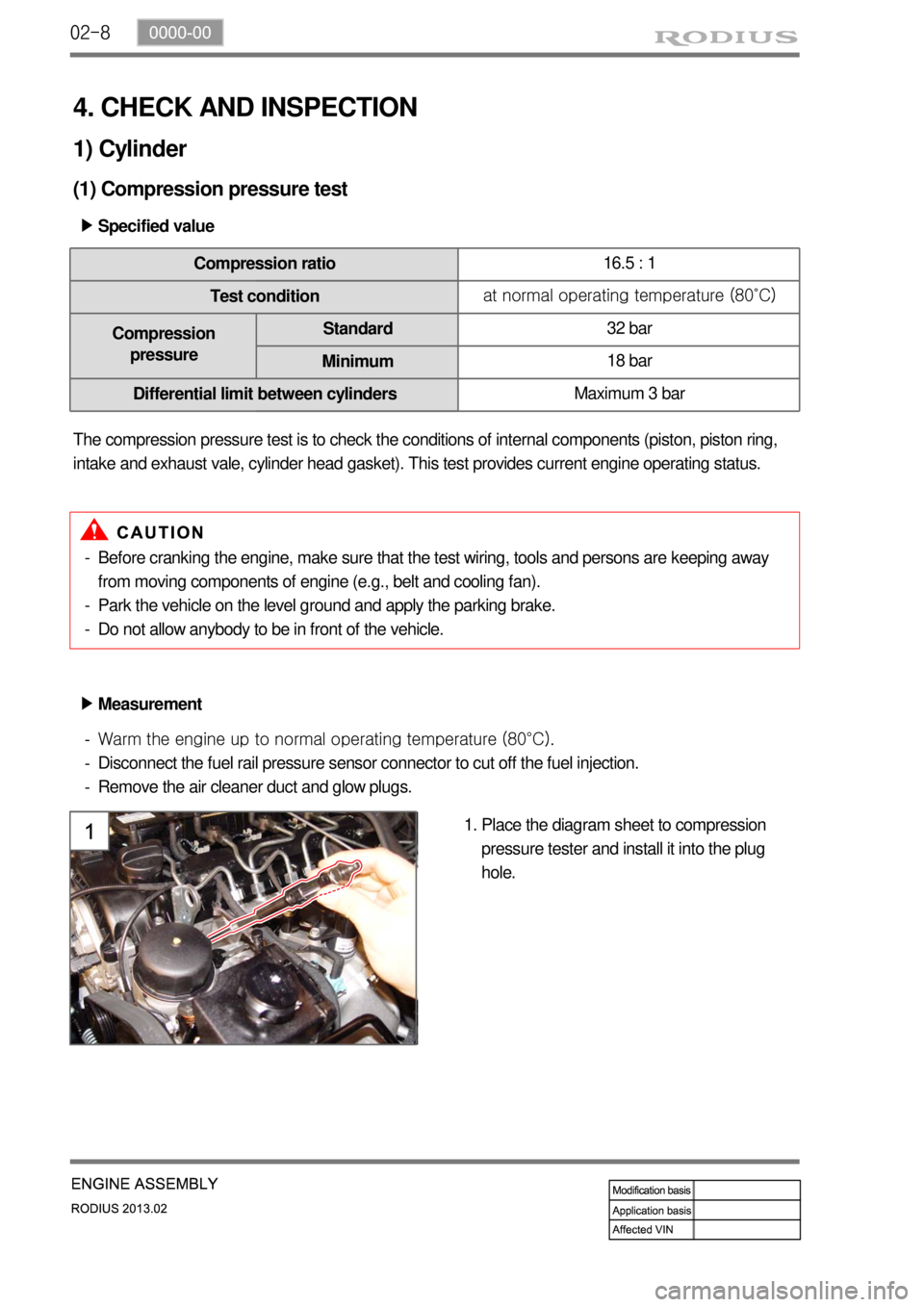
Place the diagram sheet to compression
pressure tester and install it into the plug
hole. 1. Before cranking the engine, make sure that the test wiring, tools and persons are keeping away
from moving components of engine (e.g., belt and cooling fan).
Park the vehicle on the level ground and apply the parking brake.
Do not allow anybody to be in front of the vehicle. -
-
-
Page 173 of 796

02-14
D20DTR Engine
1. BELT LAYOUT
It is single drive type and uses FEAD (Front End Accessories Drive) design to make a compact layout.
Components ▶
HPS
(Hydraulic Power Steering)
1 Crankshaft pulley (DDU)
2 Auto tensioner
3 Tensioner pulley
4 Vacuum pump
5 A/C compressor pulley
6 Alternator pulley
7 Water pump pulley
8 Idle pulley #1
9 Idle pulley #2
10 Power steering pump pulley
Page 174 of 796

02-150000-00
The strut type tensioner automatically adjusts the belt tension to provide the reliability and durability for
the system. And, the belt tension is decreased to minimize the friction loss and improve the belt
operating noise.
1) Crankshaft Pulley (Isolation Damper)
(1) Overview
(2) Sectional drawing
Axial & radial bearing
Sleeve
Hub
Isolation pulley rubber Pulley
Damper rubber
Inertia ring
Page 175 of 796

02-16
(3) Features
Rubber damper: Decrease crankshaft torsion
Improve belt NHV: Reduce unbalance speed to crankshaft due to irregular combustion
Minimize noise: Anti-vibration from crankshaft and belt
Post bonded type rubber damper: Improve durability of rubber damper 1.
2.
3.
4.
Page 176 of 796

02-170000-00
2) Belt Tensioner
(1) Overview
The torque deviation from crankshaft affects the components in belt drive system and the belt
movement. The auto tensioner system is to adjust this deviation automatically.
In D20DTR engine, one of the mechanical tensioner, pivot damped tensioner is used to keep the
damping force, system reliability and durability. The single belt drive system needs to use the automati
c
belt tensioning device to transfer the power to pulleys effectively. To get this, the tensioner uses the
spring and damping unit.
(2) Location
Belt tensioner
Page 277 of 796
08-8
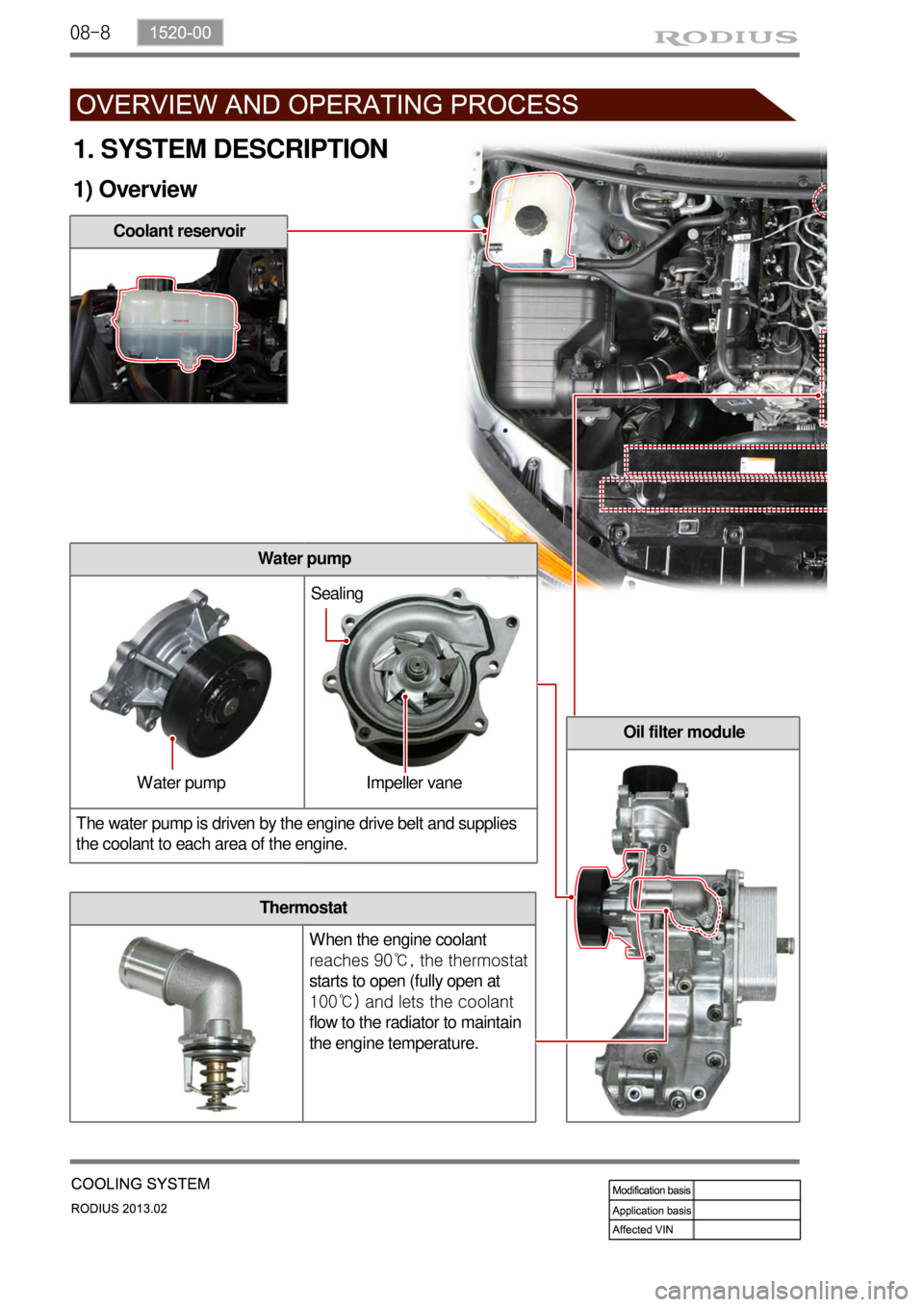
Coolant reservoir
Oil filter module
Thermostat
When the engine coolant
reaches 90℃, the thermostat
starts to open (fully open at
100℃) and lets the coolant
flow to the radiator to maintain
the engine temperature.
Water pump
The water pump is driven by the engine drive belt and supplies
the coolant to each area of the engine.
1. SYSTEM DESCRIPTION
1) Overview
Water pump Impeller vaneSealing
Page 281 of 796
09-51451-01
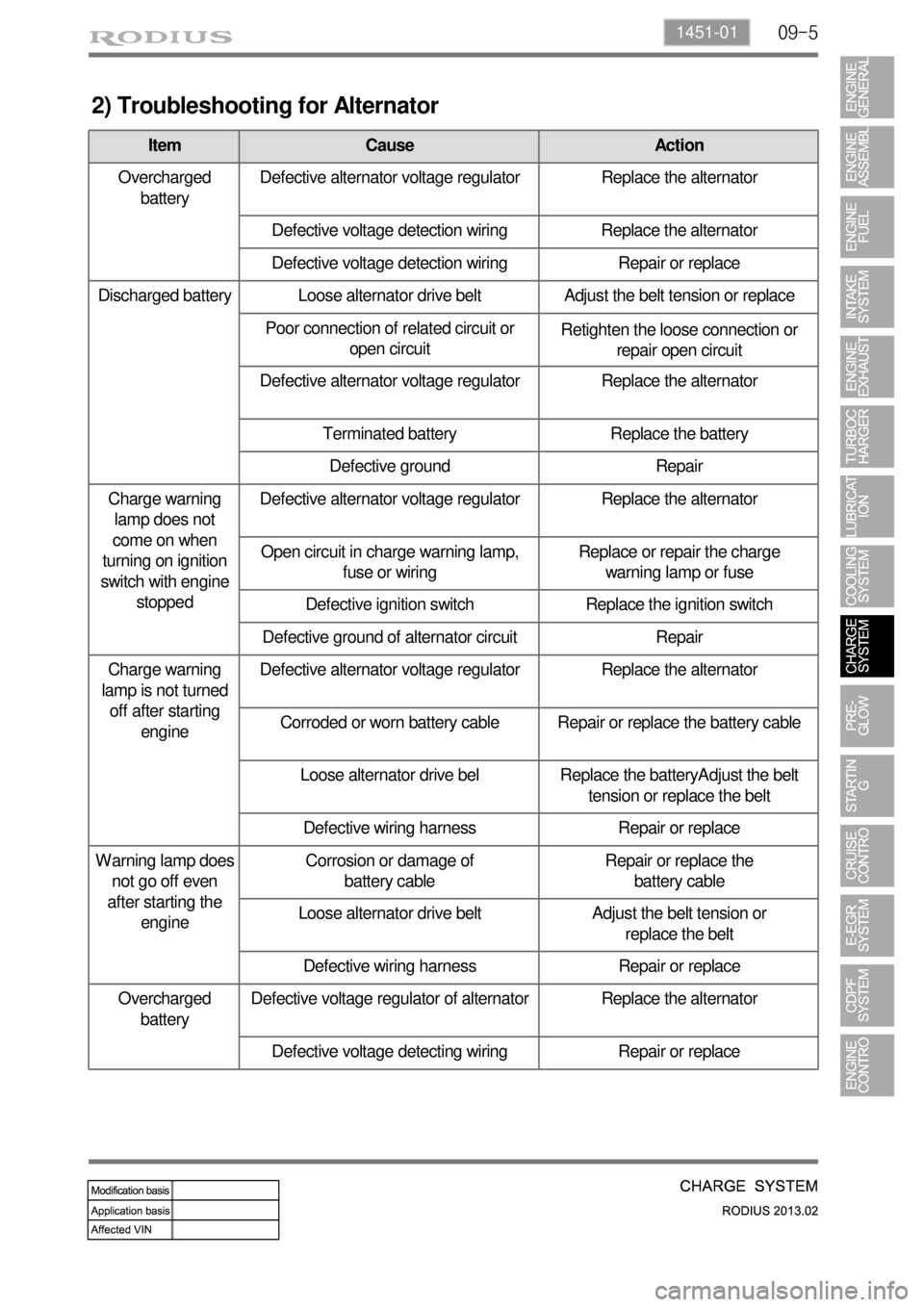
2) Troubleshooting for Alternator
Item Cause Action
Overcharged
batteryDefective alternator voltage regulator Replace the alternator
Defective voltage detection wiring Replace the alternator
Defective voltage detection wiring Repair or replace
Discharged battery Loose alternator drive belt Adjust the belt tension or replace
Poor connection of related circuit or
open circuitRetighten the loose connection or
repair open circuit
Defective alternator voltage regulator Replace the alternator
Terminated battery Replace the battery
Defective ground Repair
Charge warning
lamp does not
come on when
turning on ignition
switch with engine
stoppedDefective alternator voltage regulator Replace the alternator
Open circuit in charge warning lamp,
fuse or wiringReplace or repair the charge
warning lamp or fuse
Defective ignition switch Replace the ignition switch
Defective ground of alternator circuit Repair
Charge warning
lamp is not turned
off after starting
engineDefective alternator voltage regulator Replace the alternator
Corroded or worn battery cable Repair or replace the battery cable
Loose alternator drive bel Replace the batteryAdjust the belt
tension or replace the belt
Defective wiring harness Repair or replace
Warning lamp does
not go off even
after starting the
engineCorrosion or damage of
battery cableRepair or replace the
battery cable
Loose alternator drive belt Adjust the belt tension or
replace the belt
Defective wiring harness Repair or replace
Overcharged
batteryDefective voltage regulator of alternator Replace the alternator
Defective voltage detecting wiring Repair or replace
Page 398 of 796
07-6
1. GENERAL DESCRIPTION
The cooling system maintains the engine temperature at an efficient level during all engine operating
conditions. When the engine is cold, the cooling system cools the engine slowly or not at all. This slo
w
cooling of the engine allows the engine to warm up quickly. The cooling system includes a radiator and
recovery subsystem, cooling fans, a thermostat and housing, a water pump, and a water pump drive
belt. The timing belt drives the water pump. All components must function properly for the cooling
system to operation. The water pump draws the coolant from the radiator.
The coolant then circulates through water jackets in the engine block, the intake manifold, and the
cylinder head. When the coolant reaches the operating temperature of the thermostat, the thermostat
opens. The coolant then goes back to the radiator where it cools. This system directs some coolant
through the hoses to the heat core. This provides for heating and defrosting. The coolant reservoir is
connected to the radiator to recover the coolant displaced by expansion from the high temperatures.
The coolant reservoir maintains the correct coolant level. The cooling system for this vehicle has no
radiator cap or filler neck. The coolant is added to the cooling system through the coolant reservoir.
Page 418 of 796

01-58410-02
2. CHECKING CABLES AND WIRES
Check for loose connection or rust.
Check terminals and wires for corrosion due to electrolyte leakage.
Check terminals and wires for open circuit.
Check the wire insulation and coat for damage, cracks or deterioration.
Check if the conductive parts of the terminals do not contact with vehicle body or other metal
parts.
Check that the grounding part has continuity with mounting bolts and vehicle body.
Check that wires are properly routed.
Make sure that wires are securely fixed to avoid contact with sharp body parts and hightemperature
parts, such as the exhaust manifold and exhaust pipes.
The rotating parts, such as fan pulley and fan belt, perturbative parts and wiring should be
secured tightly at regular intervals.
Secure the wiring between the fixed parts, such as the vehicle body, and vibrating parts, such
as the engine, after slackening it slightly to prevent it from being damaged. -
-
-
-
-
-
-
-
-