ECU SUBARU BRZ 2013 1.G Owner's Manual
[x] Cancel search | Manufacturer: SUBARU, Model Year: 2013, Model line: BRZ, Model: SUBARU BRZ 2013 1.GPages: 484, PDF Size: 6.46 MB
Page 83 of 484
83
1-6. Security system
1
Before driving
■System maintenance
The vehicle has a maintenance-free type alarm system.
■Items to check before locking the vehicle
To prevent unexpected triggering of the alarm and vehicle theft, make sure
of the following.
●Nobody is in the vehicle.
●The windows are closed before the alarm is set.
●No valuables or other personal items are left in the vehicle.
■Opening and closing the trunk lid
●If the alarm setting operations are performed with the trunk lid left open,
the alarm will not be set. After closing the trunk lid, the alarm is set after
30 seconds or more elapse.
●When the trunk lid is unlocked using the “keyless access” entry function
or remote keyless entry system while the alarm is set, the alarm goes
into standby mode. After closing the trunk lid, the alarm is set again after
30 seconds or more elapse.
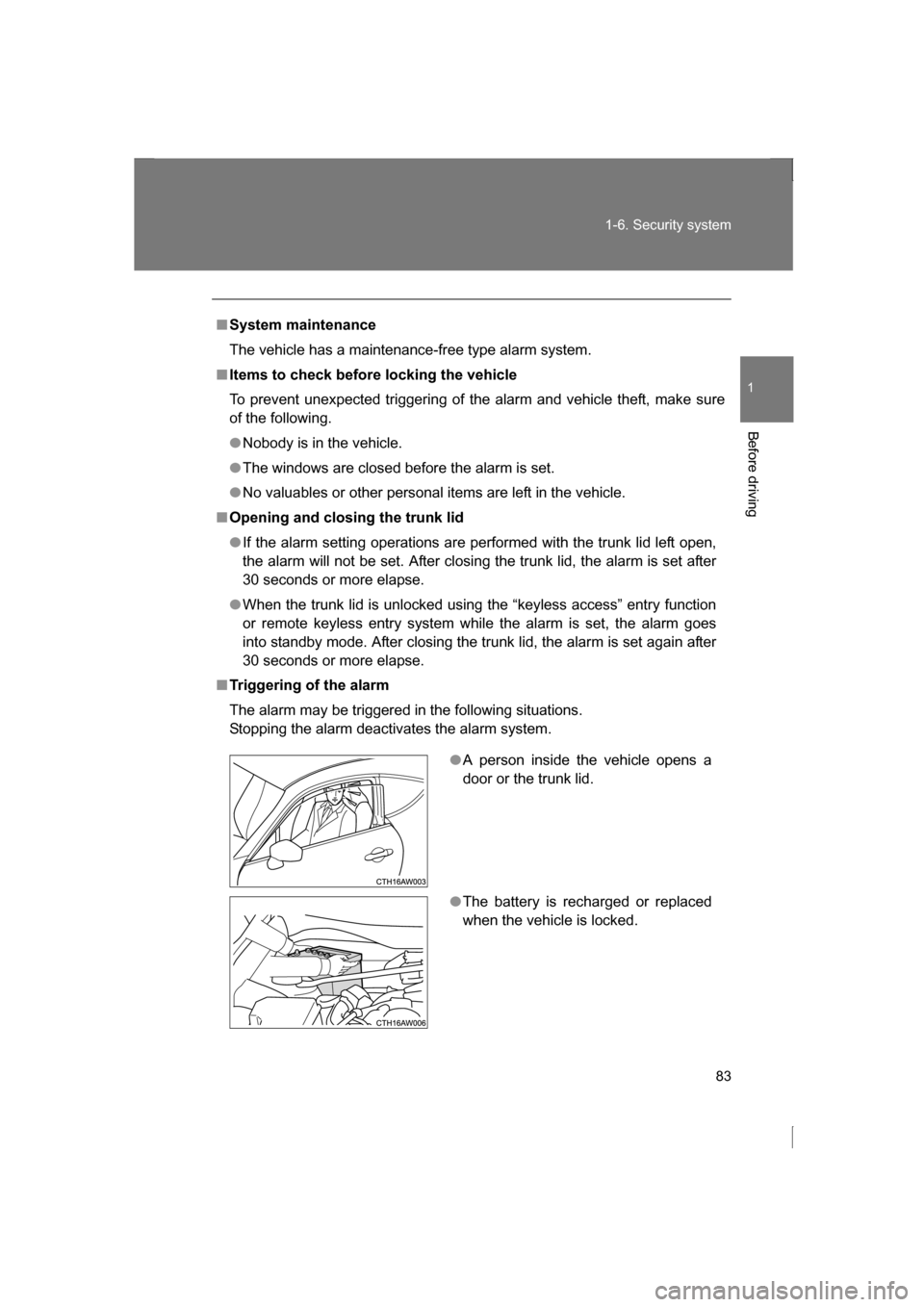
■Triggering of the alarm
The alarm may be triggered in the following situations.
Stopping the alarm deactivates the alarm system.
●A person inside the vehicle opens a
door or the trunk lid.
●The battery is recharged or replaced
when the vehicle is locked.
Page 84 of 484
84
1-6. Security system
■When the battery is disconnected
Be sure to deactivate the alarm system.
If the battery is disconnected before deactivating the alarm system, the
alarm may be triggered when the battery is reconnected.
■Customization that can be conf igured at your SUBARU dealer
Settings (e.g. alarm system) can be changed.
(Customizable features →P. 439)
CAUTION
■To ensure the system operates correctly
Do not modify or remove the system. If modified or removed, the proper
operation of the system cannot be guaranteed.
Page 90 of 484
90
1-7. Safety information
WARNING
■SRS airbag
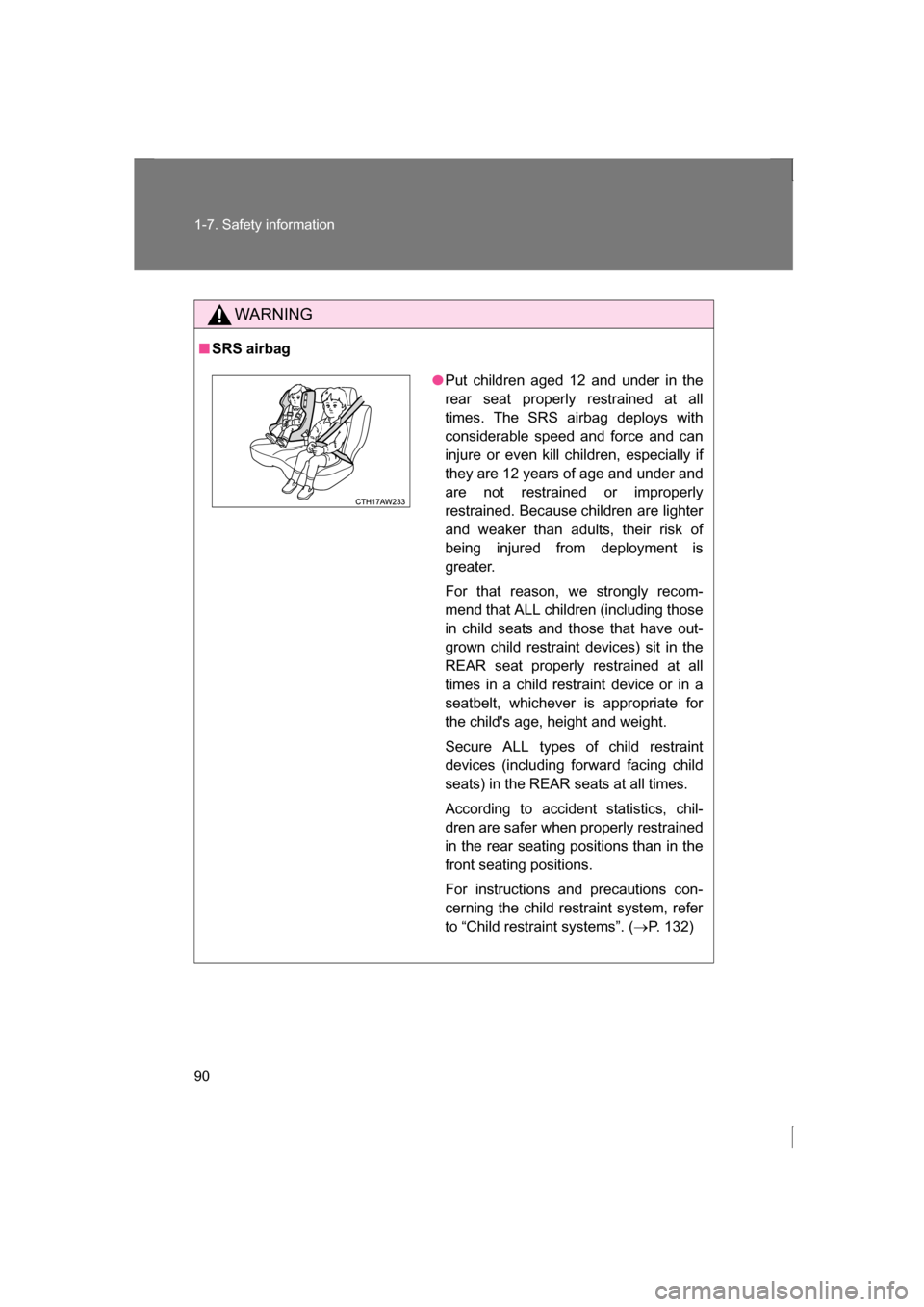
●Put children aged 12 and under in the
rear seat properly restrained at all
times. The SRS airbag deploys with
considerable speed and force and can
injure or even kill children, especially if
they are 12 years of age and under and
are not restrained or improperly
restrained. Because children are lighter
and weaker than adults, their risk of
being injured from deployment is
greater.
For that reason, we strongly recom-
mend that ALL children (including those
in child seats and those that have out-
grown child restraint devices) sit in the
REAR seat properly restrained at all
times in a child restraint device or in a
seatbelt, whichever is appropriate for
the child's age, height and weight.
Secure ALL types of child restraint
devices (including forward facing child
seats) in the REAR seats at all times.
According to accident statistics, chil-
dren are safer when properly restrained
in the rear seating positions than in the
front seating positions.
For instructions and precautions con-
cerning the child restraint system, refer
to “Child restraint systems”. (→P. 132)
Page 98 of 484
98
1-7. Safety information
■If the front passenger’s frontal airbag ON indicator illuminates and the
OFF indicator turns off even when an infant or a small child is in a child
restraint system (including booster seat)
Turn the ignition switch to the “LOCK” position (vehicles without a keyless
access with push button start system), or turn the push-button ignition switch
off (vehicles with a keyless access with push button start system) if the front
passenger’s frontal airbag ON indicator illuminates and the OFF indicator
turns off even when an infant or a small child is in a child restraint system
(including booster seat). Remove the child restraint system from the seat. By
referring to the child restraint manufacturer’s recommendations as well as
the child restraint system installation procedures in “Child restraint systems”( → P. 132), correctly install the child restraint system. Turn the ignition switch
to the “ON” position (vehicles without a keyless access with push button start
system), or turn the push-button ignition switch to the “ON” mode (vehicles
with a keyless access with push button start system) and make sure that the
front passenger’s frontal airbag ON indicator turns off and the OFF indicator
illuminates.
If still the ON indicator remains illuminated while the OFF indicator turns off,
take the following actions.
●Ensure that no article is placed on the seat other than the child restraint
system and the child occupant.
●Ensure that the backward-forward position and seatback of front passen-
ger’s seat are locked into place securely by moving the seat back andforth.
If the ON indicator still remains illuminated while the OFF indicator turns off
after taking relevant corrective actions described above, relocate the child
restraint system to the rear seat and immediately contact your SUBARU
dealer for an inspection.
NOTE
When a child who has outgrown a child restraint system or a small adult is
seated in the front passenger’s seat, the SUBARU advanced frontal airbag
system may or may not activate the front passenger’s SRS frontal airbag
depending on the occupant’s seating posture. The child should always wear
the seatbelt when sitting in the seat irrespective of whether the airbag is
deactivated or activated. If the front passenger’s SRS frontal airbag is acti-
vated (the ON indicator remains illuminated while the OFF indicator turns
off), take the following actions.
Page 117 of 484
117
1-7. Safety information
1
Before driving
WARNING
■SRS airbag precautions
●The SRS front passenger airbag also deploys with considerable force, and
can cause death or serious injury especially if the front passenger is very
close to the airbag. The front passenger seat should be as far from the air-
bag as possible with the seatback adjusted, so the front passenger sits
upright.
●Improperly seated and/or restrained infants and children can be killed or
seriously injured by a deploying airbag. An infant or child who is too small
to use a seatbelt should be properly secured using a child restraint sys-
tem. SUBARU strongly recommends that all infants and children be placed
in the rear seats of the vehicle and pr operly restrained. The rear seats are
safer for infants and children than the front passenger seat. ( →P. 132)
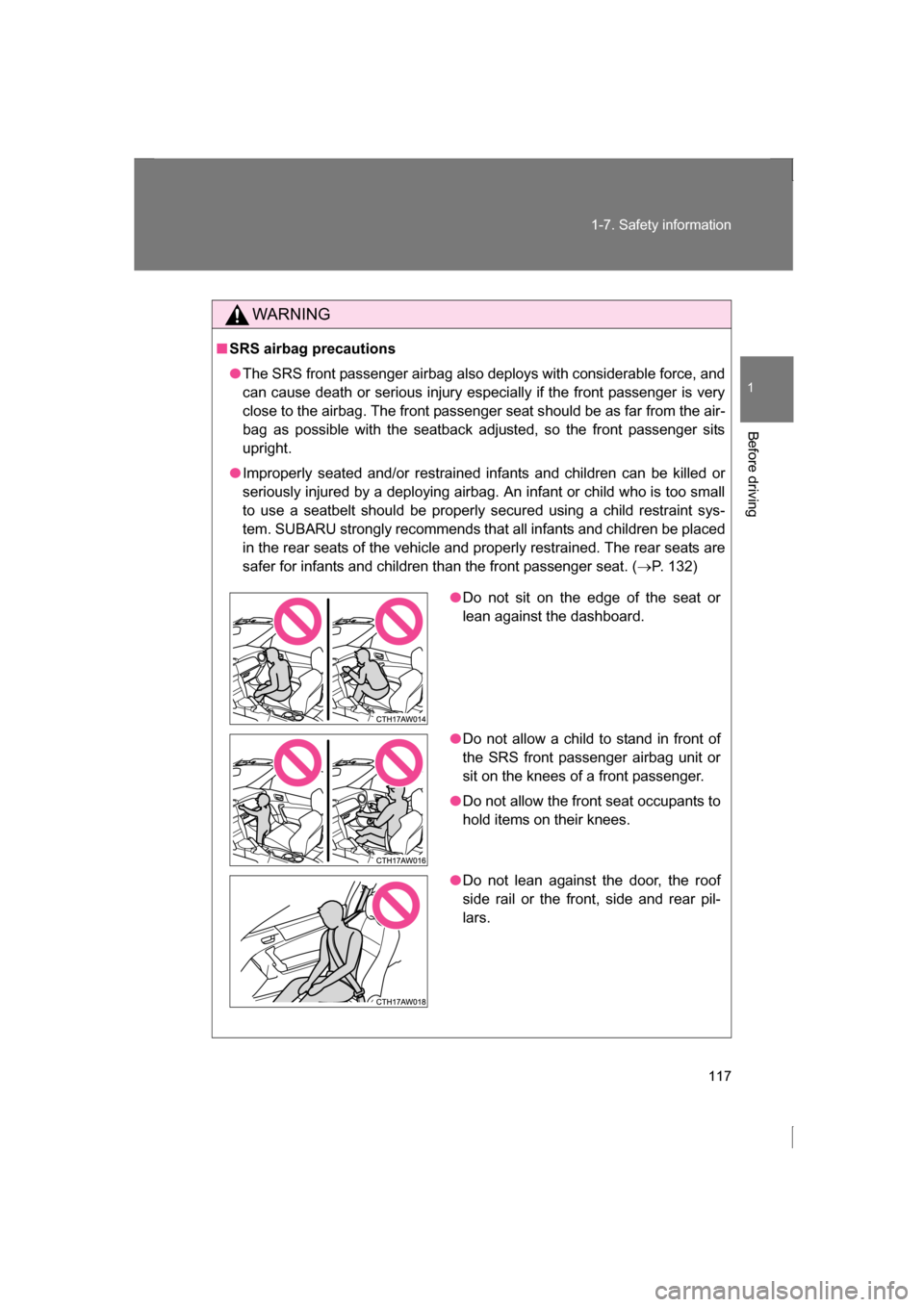
●Do not sit on the edge of the seat or
lean against the dashboard.
●Do not allow a child to stand in front of
the SRS front passenger airbag unit or
sit on the knees of a front passenger.
●Do not allow the front seat occupants to
hold items on their knees.
●Do not lean against the door, the roof
side rail or the front, side and rear pil-
lars.
Page 135 of 484
135
1-7. Safety information
1
Before driving
WARNING
■Child restraint precautions
●Do not allow the child to lean his/her head or any part of his/her body
against the door or the area of the seat, front and rear pillars or roof side
rails from which the SRS side airbags or SRS curtain airbags deploy even
if the child is seated in the child restraint system. It is dangerous if the SRS
side airbags and curtain airbags inflate, and the impact could cause death
or serious injury to the child.
●Make sure you have complied with all installation instructions provided by
the child restraint manufacturer and that the system is properly secured. If
it is not secured properly, it may cause death or serious injury to the child
in the event of a sudden stop, sudden swerve or an accident.
■When children are in the vehicle
Do not allow children to play with the seatbelt. If the seatbelt becomes
twisted around a child’s neck, it may lead to choking or other serious injuries
that could result in death.
If this occurs and the buckle cannot be unfastened, scissors should be used
to cut the belt.
■When the child restraint system is not in use
●Keep the child restraint system properly secured on the seat even if it is
not in use. Do not store the restraint unsecured in the passenger compart-ment.
●If it is necessary to detach the child restraint system, remove it from the
vehicle or store it securely in the trunk. This will prevent it from injuring
passengers in the event of a sudden stop, sudden swerve or accident.
Page 136 of 484
136
1-7. Safety information
Installing child restraints
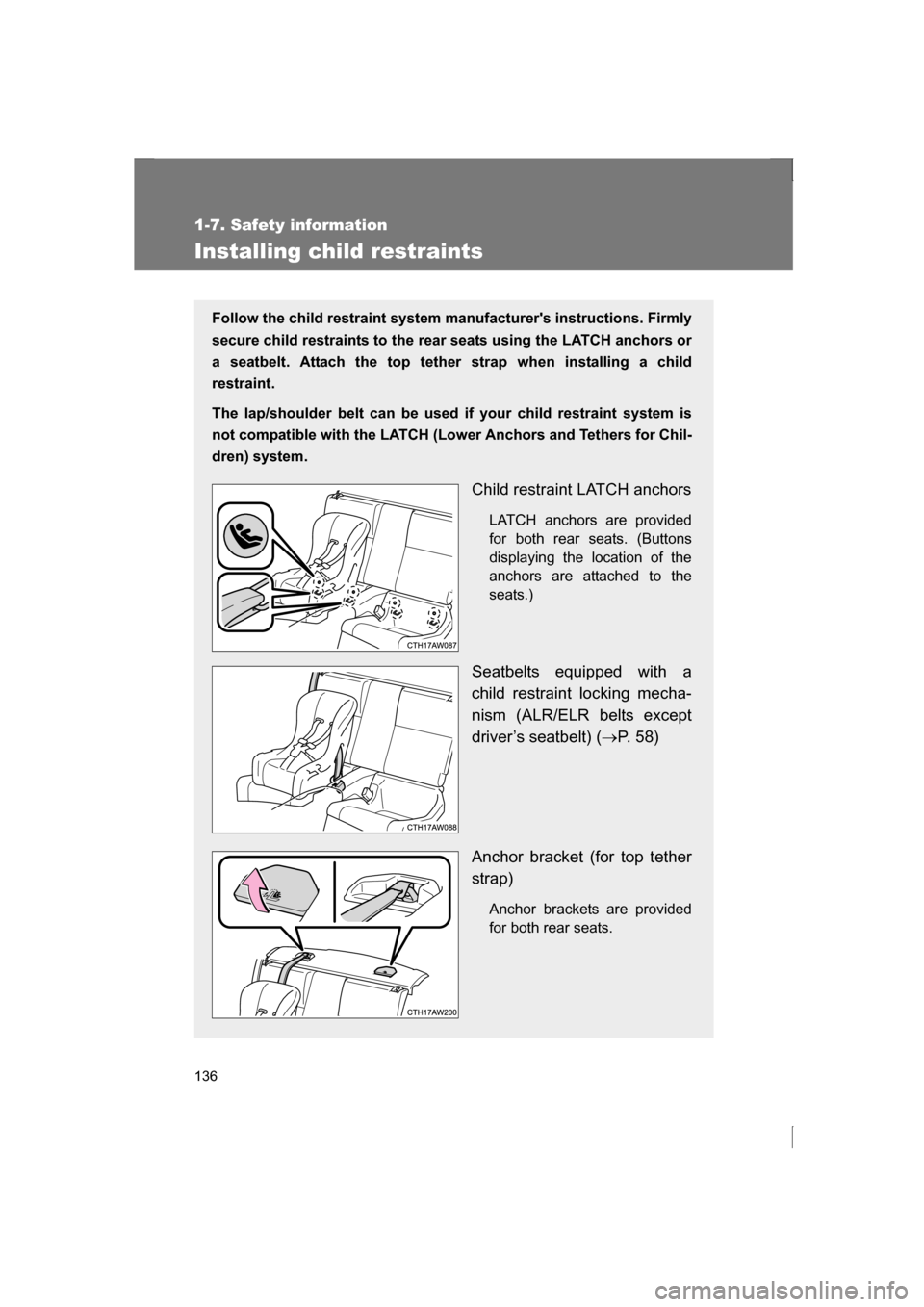
Follow the child restraint system manufacturer's instructions. Firmly
secure child restraints to the rear seats using the LATCH anchors or
a seatbelt. Attach the top tether strap when installing a child
restraint.
The lap/shoulder belt can be used if your child restraint system is
not compatible with the LATCH (Lower Anchors and Tethers for Chil-
dren) system.
Child restraint LATCH anchorsLATCH anchors are provided
for both rear seats. (Buttons
displaying the location of the
anchors are attached to the
seats.)
Seatbelts equipped with a
child restraint locking mecha-
nism (ALR/ELR belts except
driver’s seatbelt) ( →P. 5 8 )
Anchor bracket (for top tether
strap) Anchor brackets are provided
for both rear seats.
Page 140 of 484
140
1-7. Safety information
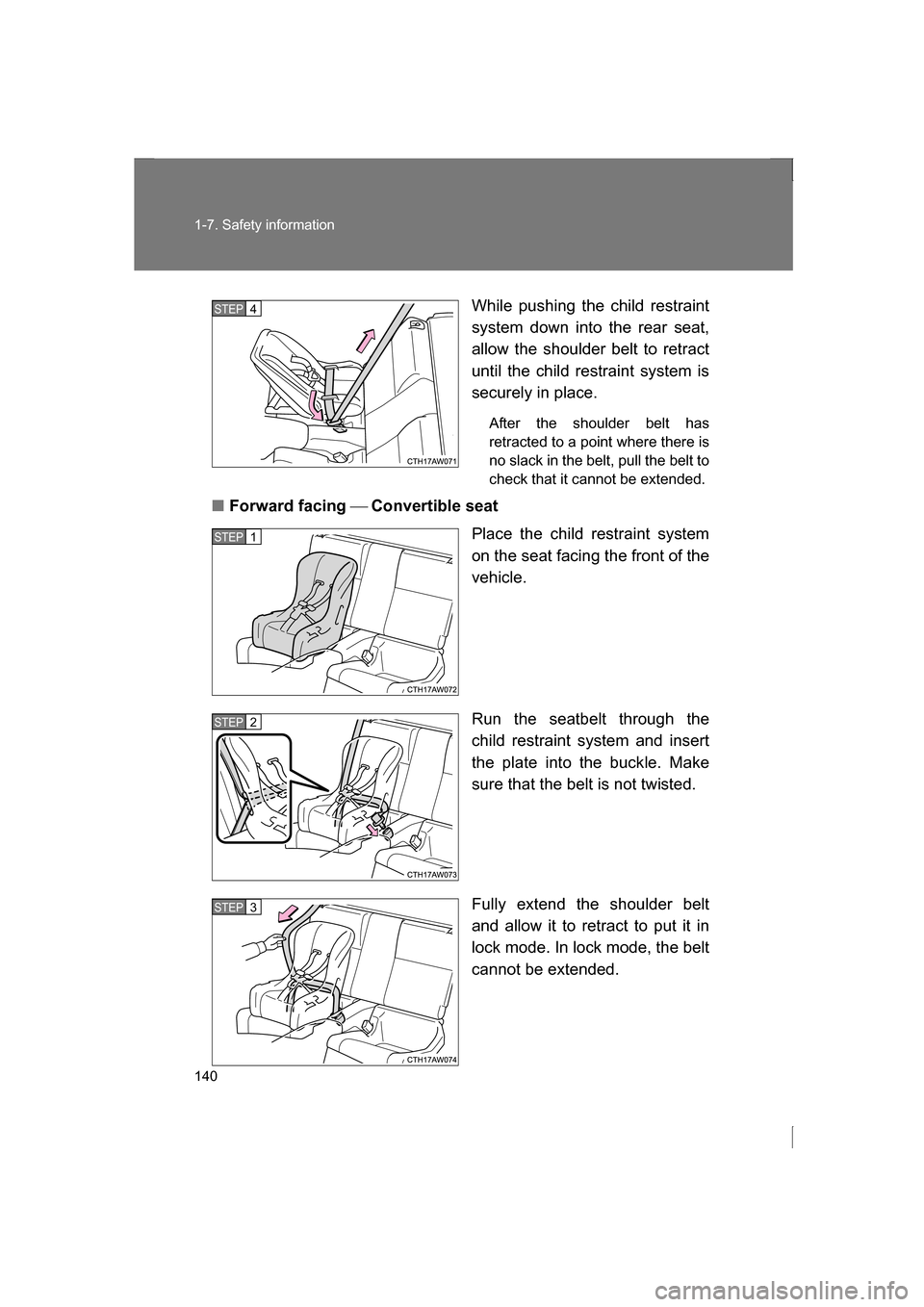
While pushing the child restraint
system down into the rear seat,
allow the shoulder belt to retract
until the child restraint system is
securely in place.After the shoulder belt has
retracted to a point where there is
no slack in the belt, pull the belt to
check that it cannot be extended.
■Forward facing Convertible seat
Place the child restraint system
on the seat facing the front of the
vehicle.
Run the seatbelt through the
child restraint system and insert
the plate into the buckle. Make
sure that the belt is not twisted.
Fully extend the shoulder belt
and allow it to retract to put it in
lock mode. In lock mode, the belt
cannot be extended.
STEP 4
STEP 1
STEP 2
STEP 3
Page 141 of 484
141
1-7. Safety information
1
Before driving
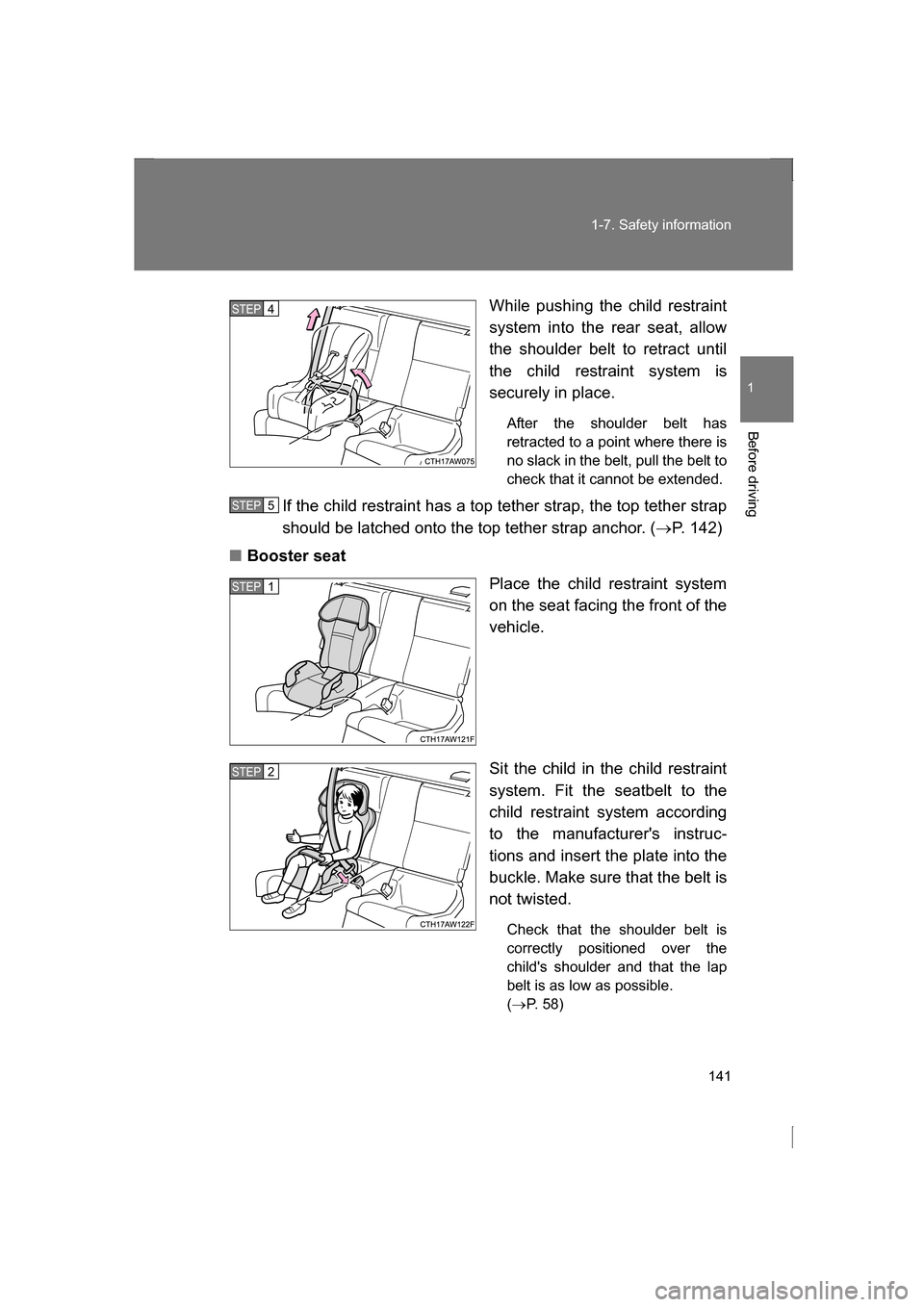
While pushing the child restraint
system into the rear seat, allow
the shoulder belt to retract until
the child restraint system is
securely in place.After the shoulder belt has
retracted to a point where there is
no slack in the belt, pull the belt to
check that it cannot be extended.
If the child restraint has a top tether strap, the top tether strap
should be latched onto the top tether strap anchor. ( →P. 142)
■Booster seat
Place the child restraint system
on the seat facing the front of the
vehicle.
Sit the child in the child restraint
system. Fit the seatbelt to the
child restraint system according
to the manufacturer's instruc-
tions and insert the plate into the
buckle. Make sure that the belt is
not twisted.
Check that the shoulder belt is
correctly positioned over the
child's shoulder and that the lap
belt is as low as possible. (→ P. 5 8 )
STEP 4
STEP 5
STEP 1
STEP 2
Page 142 of 484
142
1-7. Safety information
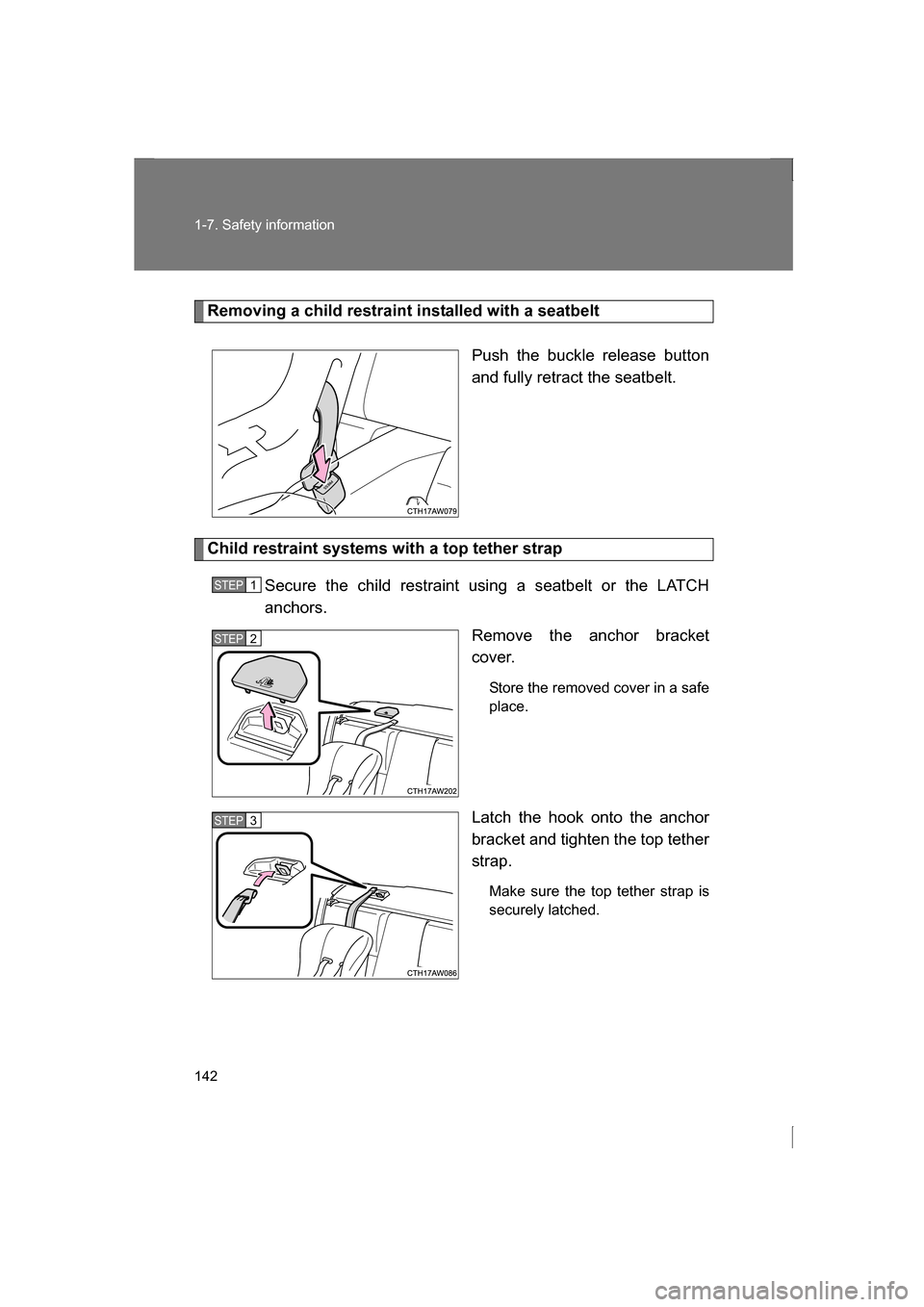
Removing a child restraint installed with a seatbeltPush the buckle release button
and fully retract the seatbelt.
Child restraint systems with a top tether strapSecure the child restraint using a seatbelt or the LATCH
anchors. Remove the anchor bracket
cover.
Store the removed cover in a safe
place.
Latch the hook onto the anchor
bracket and tighten the top tether
strap. Make sure the top tether strap is
securely latched.
STEP 1
STEP 2
STEP 3