warning SUBARU BRZ 2016 1.G Owners Manual
[x] Cancel search | Manufacturer: SUBARU, Model Year: 2016, Model line: BRZ, Model: SUBARU BRZ 2016 1.GPages: 490, PDF Size: 6.01 MB
Page 312 of 490
311 4-3. Do-it-yourself maintenance
4
Maintenance and care
WARNING
■When adding washer fluid
Do not add washer fluid when the engine is hot or running, as washer fluid
contains alcohol and may catch fire if spilled on the engine etc.
CAUTION
■Washer fluid
Do not use soapy water or engine antifreeze instead of washer fluid.
Doing so may cause streaking on the vehicle’s painted surfaces.
■Diluting washer fluid
Dilute washer fluid with water as necessary.
Refer to the freezing temperatures listed on the label of the washer fluid bot-
tle.
Page 313 of 490
312
4-3. Do-it-yourself maintenance
Tires
Replace or rotate tires in accordance with maintenance sched-
ules and treadwear.
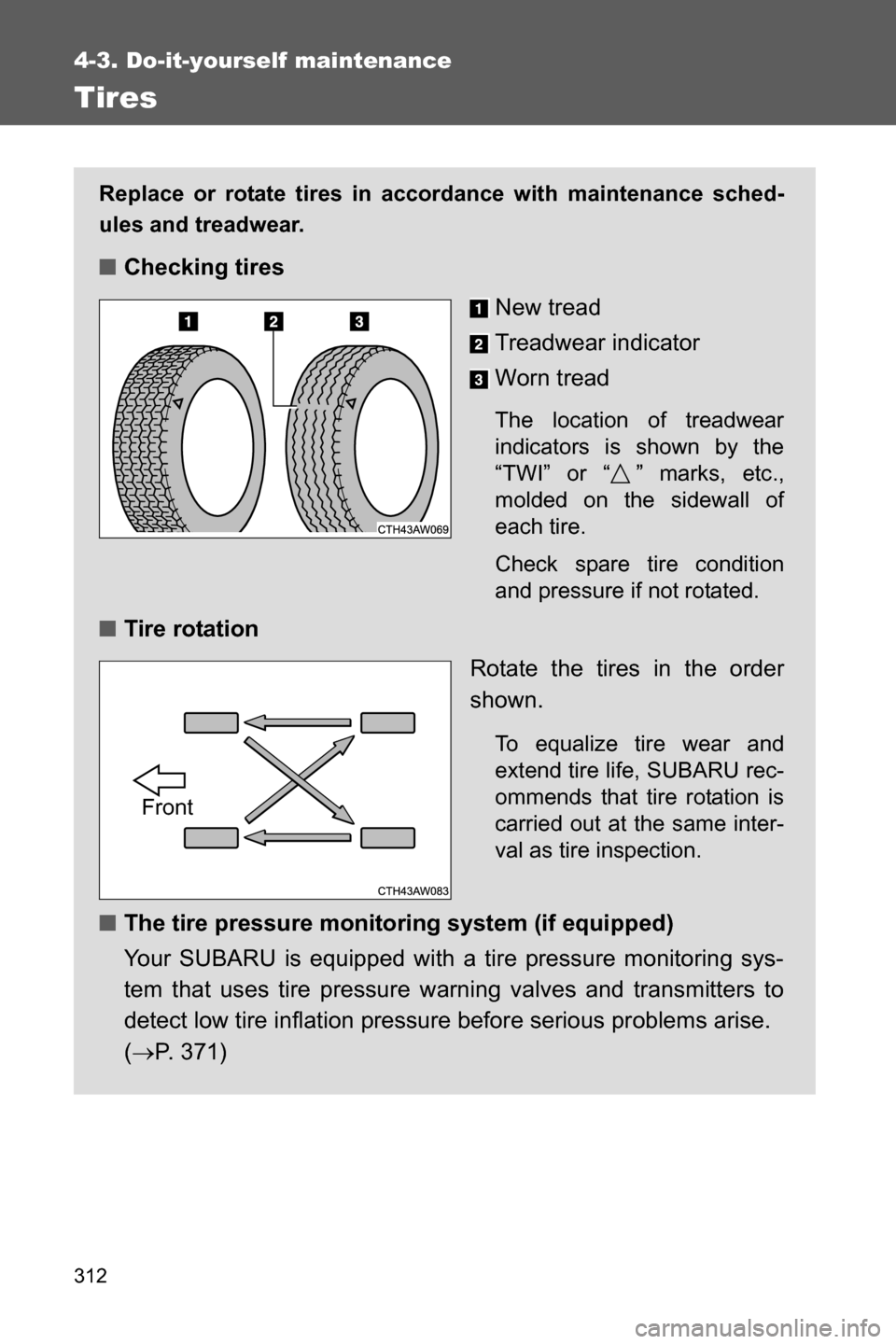
■Checking tires
New tread
Treadwear indicator
Worn tread
The location of treadwear
indicators is shown by the
“TWI” or “ ” marks, etc.,
molded on the sidewall of
each tire.
Check spare tire condition
and pressure if not rotated.
■Tire rotation
Rotate the tires in the order
shown.
To equalize tire wear and
extend tire life, SUBARU rec-
ommends that tire rotation is
carried out at the same inter-
val as tire inspection.
■The tire pressure monitoring system (if equipped)
Your SUBARU is equipped with a tire pressure monitoring sys-
tem that uses tire pressure warning valves and transmitters to
detect low tire inflation pressure before serious problems arise.
(oP. 371)
Front
Page 314 of 490

313 4-3. Do-it-yourself maintenance
4
Maintenance and care
Installing tire pressure warning valves and transmitters (vehicles
with a tire pressure monitoring system)
When replacing tires or wheels, tire pressure warning valves and
transmitters must also be installed.
When new tire pressure warning valves and transmitters are
installed, new tire pressure warning valve and transmitter ID codes
must be registered in the tire pressure warning computer and tire
pressure monitoring system must be initialized. Have tire pressure
warning valve and transmitter ID codes registered by your SUBARU
dealer. (oP. 314)
Page 315 of 490

314 4-3. Do-it-yourself maintenance
Registering ID codes (vehicles with a tire pressure monitoring
system)
The tire pressure warning valve and transmitter is equipped with a
unique ID code. When replacing a tire pressure warning valve and
transmitter, it is necessary to register the ID code. Have the ID code
registered by your SUBARU dealer.
■When to replace your vehicle’s tires
Tires should be replaced if:
●You have tire damage such as cuts, splits, cracks deep enough to
expose the fabric or bulges indicating internal damage
●A tire goes flat repeatedly or cannot be properly repaired due to the
size or location of a cut or other damage
If you are not sure, consult with your SUBARU dealer.
■Replacing tires and wheels (vehicles with a tire pressure monitor-
ing system)
If the ID code of the tire pressure warning valve and transmitter is not
registered, the tire pressure monitoring system will not work properly.
After driving for about 20 minutes, the tire pressure warning light comes
on after blinking for 1 minute to indicate a system malfunction.
■Tire life
Any tire over 6 years old must be checked by a qualified technician even
if they have seldom or never been used or damage is not obvious.
■If the tread wears down below 0.16 in. (4 mm) on snow tires
The effectiveness of snow tires is lost.
■Low profile tires
Generally, low profile tires will wear more rapidly and tire grip perfor-
mance will be reduced on snowy and/or icy roads when compared to
standard tires. Be sure to use snow tires or tire chains on snowy and/or
icy roads and drive carefully at a speed appropriate for road and weather
conditions.
Page 317 of 490

316 4-3. Do-it-yourself maintenance
■Initializing the tire pressure monitoring system (if equipped)
Initialize the system with the tire inflation pressure adjusted to the speci-
fied level.
■Routine tire inflation pressure checks (vehicles with a tire pressure
monitoring system)
The tire pressure monitoring system does not replace routine tire infla-
tion pressure checks. Make sure to check tire inflation pressure as part
of your routine of daily vehicle checks.
■Tire pressure monitoring system certification (if equipped)
MODEL/FCC IDs:
Transmitter: PAXPMVC010
Receiver: HYQ23AAA (vehicles without a keyless access with push
button start system)
HYQ23AAE (vehicles with a keyless access with push but-
ton start system)
NOTE:
This device complies with part 15 of the FCC Rules. Operation is subject
to the following two conditions: (1) This device may not cause harmful
interference, and (2) this device must accept any interference received,
including interference that may cause undesired operation.
FCC WARNING:
Changes or modifications not expressly approved by the party responsi-
ble for compliance could void the user's authority to operate the equip-
ment.
Page 318 of 490
317 4-3. Do-it-yourself maintenance
4
Maintenance and care
WARNING
■Tire pressure monitoring system operation (if equipped)
The tire pressure monitoring system may not provide warning immedi-
ately if a tire bursts or if sudden air leakage occurs.
■When inspecting or replacing tires
Observe the following precautions to prevent accidents.
Failure to do so may cause damage to parts of the drive train, as well as
dangerous handling characteristics, which may lead to an accident
resulting in death or serious injury.
●Make sure to install 4 tires that are of the specified size, and that all 4
tires are the same for the following items:
•Size
• Circumference
• Speed symbol
• Load index
• Construction
• Manufacturer
• Brand (tread pattern)
• Degrees of wear
You must obey the specification printed on the tire placard. The tire plac-
ard is located on the driver's door pillar.
If all four tires are not the same in items listed above, there is a possibil-
ity that it may lead to serious mechanical damage to the drive train of
your car and affect the following.
•Ride
• Handling
•Braking
• Speedometer/Odometer calibration
• Clearance between the body and the tires
It also may be dangerous and lead to loss of vehicle control as well as an
accident.
●Only use radial tires.
●Do not mix summer, all season and snow tires.
●Do not use tires that have been used on another vehicle.
Do not use tires if you do not know how they were used previously.
Page 319 of 490

318 4-3. Do-it-yourself maintenance
CAUTION
■Repairing or replacing tires, wheels, tire pressure warning valves,
transmitters and tire valve caps (vehicles with a tire pressure moni-
toring system)
●When removing or fitting the wheels, tires or the tire pressure warning
valves and transmitters, contact your SUBARU dealer as the tire pres-
sure warning valves and transmitters may be damaged if not handled
correctly.
●When replacing tire valve caps, do not use tire valve caps other than
those specified. The cap may become stuck.
■Driving on rough roads
Take particular care when driving on roads with loose surfaces or pot
holes.
These conditions may cause losses in tire inflation pressure, reducing
the cushioning ability of the tires. In addition, driving on rough roads may
cause damage to the tires themselves, as well as the vehicle’s wheels
and body.
■Low profile tires and wheels
Low profile tires may cause greater damage than usual to the wheel
when receiving impact from the road surface. Therefore pay attention to
the following:
●Be sure to use proper tire inflation pressure. If tires are under-inflated,
they may be damaged more severely.
●Avoid pot holes, uneven pavement, curbs and other road hazards.
Failure to do so may lead to severe tire and wheel damage.
■If tire inflation pressures become low while driving
Do not continue driving, or your tires and/or wheels may be ruined.
Page 323 of 490
322 4-3. Do-it-yourself maintenance
WARNING
■Proper inflation is critical to save tire performance
Keep your tires properly inflated.
If the tires are not properly inflated, the following conditions may occur
which could lead to an accident resulting in death or serious injury:
●Excessive wear
●Uneven wear
●Poor handling
●Possibility of blowouts resulting from overheated tires
●Air leaking from between tire and wheel
●Wheel deformation and/or tire damage
●Greater possibility of tire damage while driving (due to road hazards,
expansion joints, sharp edges in the road, etc.)
CAUTION
■When inspecting and adjusting tire inflation pressure
Be sure to reinstall the tire valve caps.
If a valve cap is not installed, dirt or moisture may get into the valve and
cause an air leak, resulting in decreased tire inflation pressure.
Page 325 of 490
324 4-3. Do-it-yourself maintenance
■When replacing wheels (vehicles with a tire pressure monitoring
system)
The wheels of your SUBARU are equipped with tire pressure warning
valves and transmitters that allow the tire pressure monitoring system to
provide advanced warning in the event of a loss in tire inflation pressure.
Whenever wheels are replaced, the tire pressure warning valves and
transmitters must be installed. (oP. 3 1 3 )
WARNING
■When replacing wheels
●Do not use wheels that are a different size from those recommended in
the Owner’s Manual, as this may result in loss of handling control.
●Never use an inner tube in a leaking wheel which is designed for a
tubeless tire. Doing so may result in an accident, causing death or seri-
ous injury.
■When installing the wheel nuts
●Never use oil or grease on the wheel bolts or wheel nuts.
Oil and grease may cause the wheel nuts to be excessively tightened,
leading to bolt or disc wheel damage. In addition, the oil or grease can
cause the wheel nuts to loosen and the wheel may fall off, causing an
accident and resulting in death or serious injury. Remove any oil or
grease from the wheel bolts or wheel nuts.
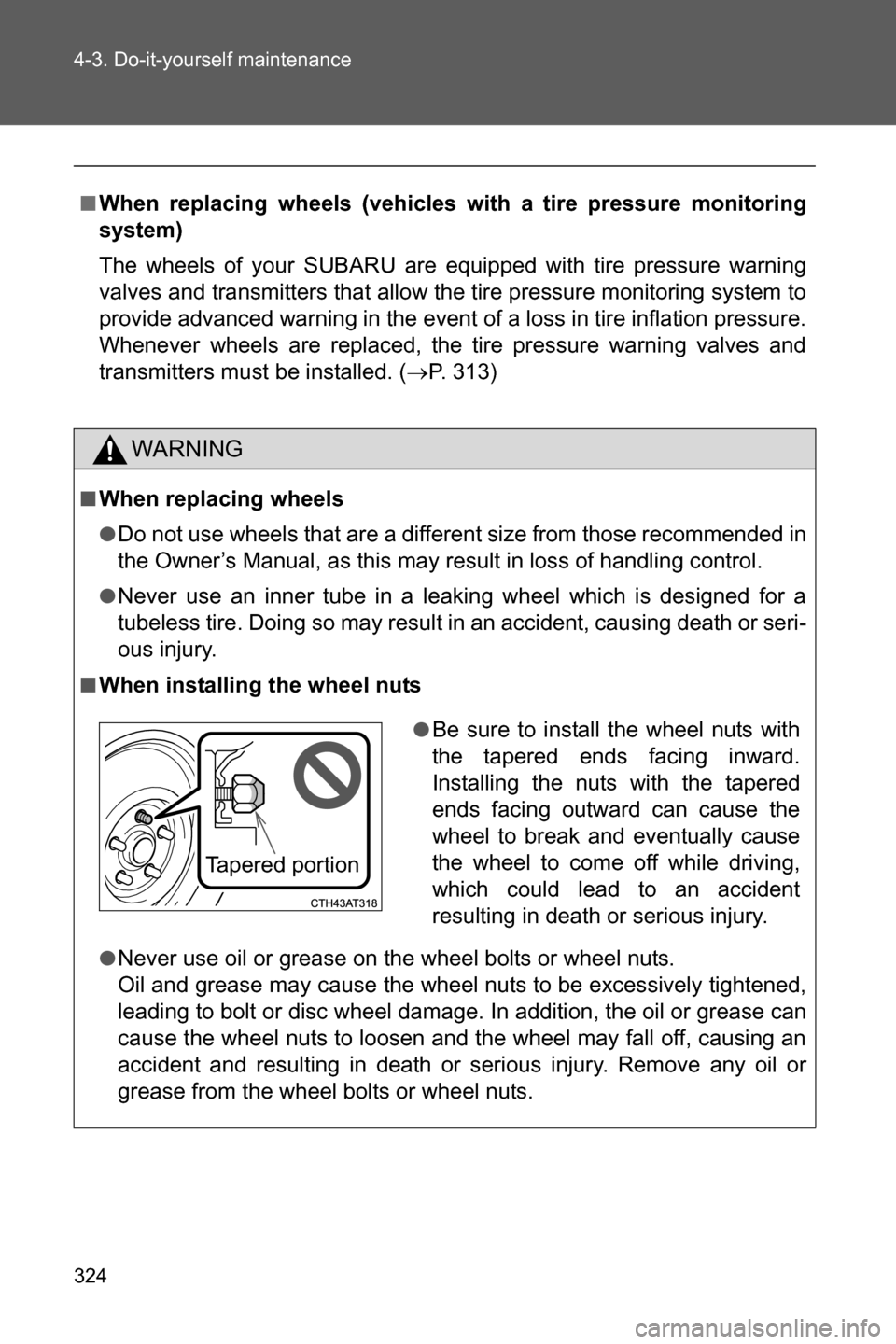
●Be sure to install the wheel nuts with
the tapered ends facing inward.
Installing the nuts with the tapered
ends facing outward can cause the
wheel to break and eventually cause
the wheel to come off while driving,
which could lead to an accident
resulting in death or serious injury.
Tapered portion
Page 326 of 490

325 4-3. Do-it-yourself maintenance
4
Maintenance and care
CAUTION
■Replacing tire inflation pressure warning valves and transmitters
(vehicles with a tire pressure monitoring system)
●Because tire repair or replacement may affect the tire pressure warn-
ing valves and transmitters, make sure to have tires serviced by your
SUBARU dealer or other qualified service shop. In addition, make sure
to purchase your tire pressure warning valves and transmitters at your
SUBARU dealer.
●Ensure that only genuine SUBARU wheels are used on your vehicle.
Tire pressure warning valves and transmitters may not work properly
with non-genuine wheels.