warning SUBARU BRZ 2016 1.G Owners Manual
[x] Cancel search | Manufacturer: SUBARU, Model Year: 2016, Model line: BRZ, Model: SUBARU BRZ 2016 1.GPages: 490, PDF Size: 6.01 MB
Page 409 of 490
408 5-2. Steps to take in an emergency
■Overheating
If you observe the following, your vehicle may be overheating.
●The engine coolant temperature gauge enters the red zone or a loss of
power is experienced.
●Steam is coming from under the engine hood.
WARNING
■To prevent an accident or injury when inspecting under the engine
hood of your vehicle
●If steam is seen coming from under the engine hood, do not open the
engine hood until the steam has subsided. The engine compartment may
be very hot, causing serious injury such as burns.
●Keep hands and clothing away from the fan and other belts while the
engine is running.
●Do not loosen the radiator cap while the engine and radiator are hot.
Serious injury, such as burns, may result from hot coolant and steam
released under pressure.
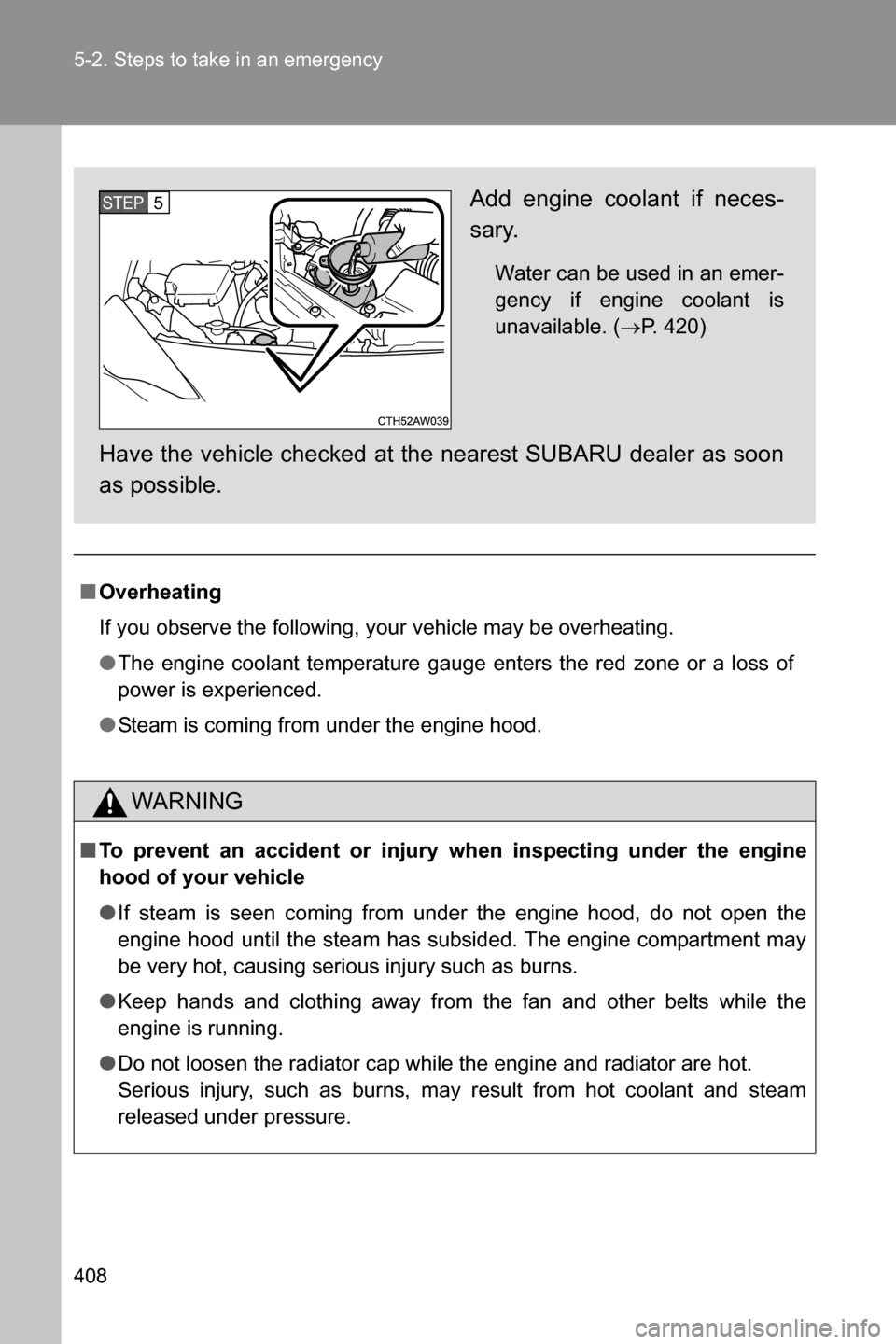
Add engine coolant if neces-
sary.
Water can be used in an emer-
gency if engine coolant is
unavailable. (oP. 420)
Have the vehicle checked at the nearest SUBARU dealer as soon
as possible.
STEP 5
Page 412 of 490
5
When trouble arises
411 5-2. Steps to take in an emergency
WARNING
■When attempting to free a stuck vehicle
If you choose to push the vehicle back and forth to free it, make sure the sur-
rounding area is clear to avoid striking other vehicles, objects or people. The
vehicle may also lunge forward or lunge back suddenly as it becomes free.
Use extreme caution.
■When shifting the select lever
For vehicles with an automatic transmission, be careful not to shift the select
lever with the accelerator pedal depressed.
This may lead to unexpected rapid acceleration of the vehicle that may
cause an accident resulting in death or serious injury.
CAUTION
■To avoid damage to the transmission and other components
●Avoid spinning the rear wheels and depressing the accelerator pedal more
than necessary.
●If the vehicle remains stuck even after these procedures are performed,
the vehicle may require towing to be freed.
Page 436 of 490

435 6-1. Specifications
6
Vehicle specifications
■Treadwear
The treadwear grade is a comparative rating based on the wear
rate of the tire when tested under controlled conditions on a speci-
fied government test course.
For example, a tire graded 150 would wear one and a half (1 - 1/2)
times as well on the government course as a tire graded 100.
The relative performance of tires depends upon the actual conditions
of their use. Performance may differ significantly from the norm due
to variations in driving habits, service practices and differences in
road characteristics and climate.
■Traction AA, A, B, C
The traction grades, from highest to lowest, are AA, A, B and C,
and they represent the tire’s ability to stop on wet pavement as
measured under controlled conditions on specified government
test surfaces of asphalt and concrete.
A tire marked C may have poor traction performance.
Warning: The traction grade assigned to this tire is based on braking
(straight ahead) traction tests and does not include cornering (turn-
ing) traction.
■Temperature A, B, C
The temperature grades are A (the highest), B, and C, represent-
ing the tire’s resistance to the generation of heat and its ability to
dissipate heat when tested under controlled conditions on a speci-
fied indoor laboratory test wheel.
Sustained high temperature can cause the material of the tire to
degenerate and reduce tire life, and excessive temperature can lead
to sudden tire failure.
Grade C corresponds to a level of performance which all passenger
car tires must meet under the Federal Motor Vehicle Safety Standard
No. 109.
Grades B and A represent higher levels of performance on the labo-
ratory test wheel than the minimum required by law.
Page 437 of 490

436 6-1. Specifications
Warning: The temperature grades of a tire assume that it is properly
inflated and not overloaded.
Excessive speed, underinflation, or excessive loading, either sepa-
rately or in combination, can cause heat buildup and possible tire fail-
ure.
Glossary of tire terminology
Tire related termMeaning
Cold tire inflation
pressureTire pressure when the vehicle has been
parked for three hours or more, or has not
been driven more than 1 mile or 1.5 km under
that condition
Maximum inflation
pressureThe maximum cold inflated pressure to which a
tire may be inflated, shown on the sidewall of
the tire
Recommended
inflation pressureCold tire inflation pressure recommended by a
manufacturer.
Accessory weightThe combined weight (in excess of those stan-
dard items which may be replaced) of auto-
matic transmission, power steering, power
brakes, power windows, power seats, radio
and heater, to the extent that these items are
available as factory-installed equipment
(whether installed or not)
Curb weightThe weight of a motor vehicle with standard
equipment, including the maximum capacity of
fuel, oil and coolant, and if so equipped, air
conditioning and additional weight optional
engine
Maximum loaded
vehicle weightThe sum of:
(a) Curb weight
(b) Accessory weight
(c) Vehicle capacity weight
(d) Production options weight
Page 444 of 490
443
6
Vehicle specifications
6-2. Customization
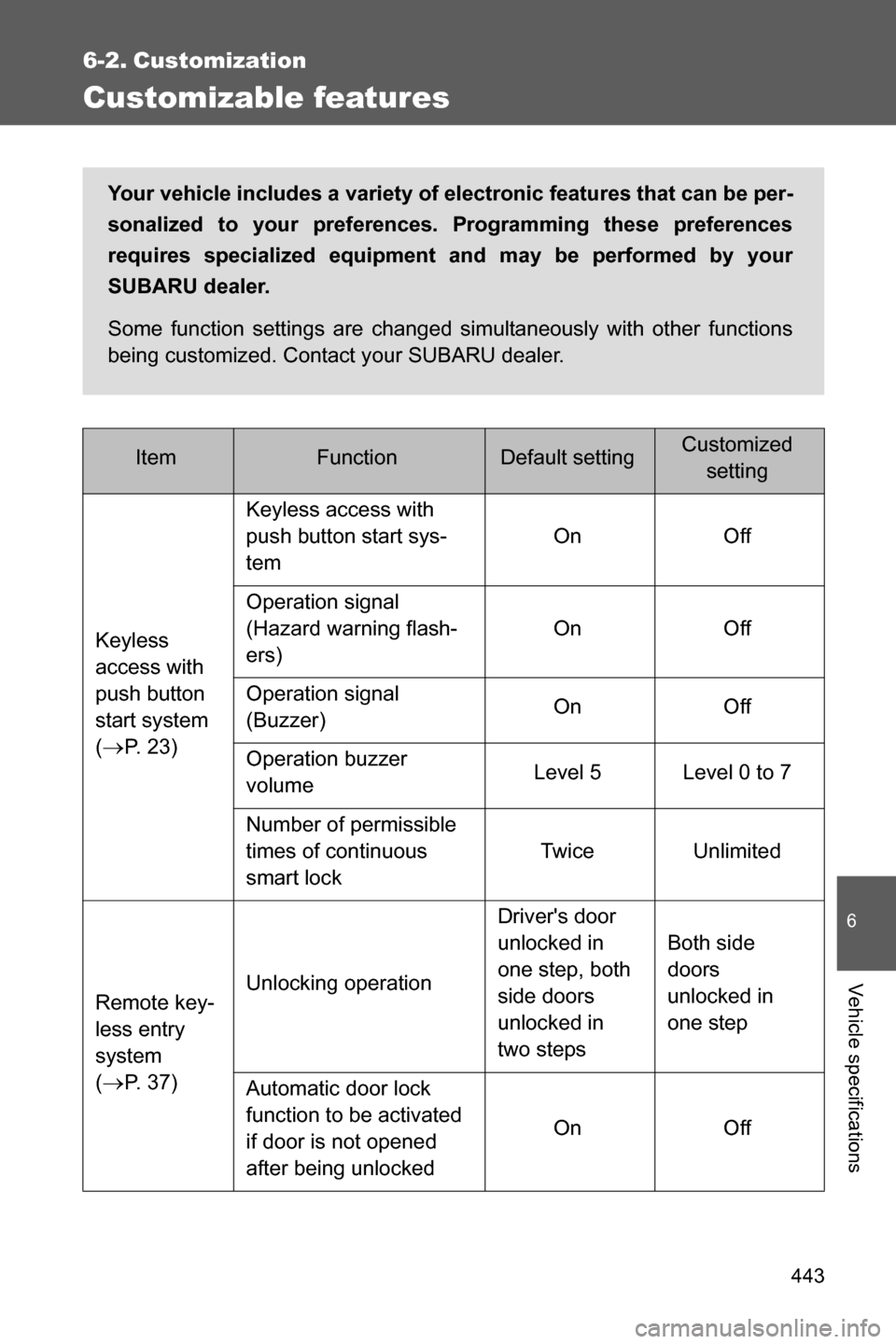
Customizable features
ItemFunctionDefault settingCustomized
setting
Keyless
access with
push button
start system
(
oP. 23)Keyless access with
push button start sys-
temOn Off
Operation signal
(Hazard warning flash-
ers) On Off
Operation signal
(Buzzer)On Off
Operation buzzer
volumeLevel 5 Level 0 to 7
Number of permissible
times of continuous
smart lockTwice Unlimited
Remote key-
less entry
system
(
oP. 37)Unlocking operationDriver's door
unlocked in
one step, both
side doors
unlocked in
two stepsBoth side
doors
unlocked in
one step
Automatic door lock
function to be activated
if door is not opened
after being unlockedOn Off
Your vehicle includes a variety of electronic features that can be per-
sonalized to your preferences. Programming these preferences
requires specialized equipment and may be performed by your
SUBARU dealer.
Some function settings are changed simultaneously with other functions
being customized. Contact your SUBARU dealer.
Page 445 of 490

444 6-2. Customization
Remote key-
less entry
system
(
oP. 37)Time elapsed before
automatic door lock
function is activated if
door is not opened after
being unlocked60 seconds30 seconds
120 seconds
Operation signal
(Hazard warning flash-
ers) On Off
Operation signal
(Buzzer)On Off
Operation buzzer
volumeLevel 5 Level 0 to 7
Door lock buzzer On Off
Trunk lid unlocking
functionOn Off
Trunk lid unlocking
operationPush and hold
(short)Push and hold
(long)
One short push
Two short
pushes
Panic function On Off
Vehicle finder function On Off
Alarm
(
oP. 83)
(vehicles
with a key-
less access
with push
button start
system)Operation when doors
are unlocked using the
mechanical keyOff On
ItemFunctionDefault settingCustomized
setting
Page 476 of 490

475
Alphabetical index
Alphabetical index
A/C .................................... 238, 245
ABS........................................... 217
Access key
If the access key does
not operate properly........... 398
Air conditioning filter.............. 326
Air conditioning system
Air conditioning filter ............. 326
Automatic air conditioning
system................................ 245
Manual air conditioning
system................................ 238
Airbags
Airbag operating
conditions................... 104, 112
Airbag precautions for
your child............................ 118
Airbag warning light .............. 369
Curtain airbag
operating conditions........... 112
Curtain airbag
precautions ........................ 118
Front passenger occupant
detection system ................ 124
General airbag
precautions ........................ 118
Locations of airbags ............... 89
Modification and
disposal of airbags ............. 121
Proper driving
posture ......................... 87, 118
Side airbag operating
conditions........................... 112
Side airbag
precautions ........................ 118
Side and curtain airbags
operating conditions........... 112
Side and curtain airbags
precautions ........................ 118
SRS airbags ........................... 89
Alarm .......................................... 83Anti-lock brake system............217
Audio input ...............................256
Audio system
Audio input ............................256
AUX port................................256
iPod .......................................256
Portable music player............256
USB memory .........................256
USB port................................256
Automatic air conditioning
system ....................................245
Automatic light
control system .......................202
Automatic transmission
Automatic transmission .........174
If the select lever cannot be
shifted from P......................396
Manual mode ........................177
Mode select switch ................176
AUX port ...................................256
Back-up lights
Replacing light bulbs .............342
Wattage .................................425
Battery
Checking ...............................306
If the vehicle has a
discharged battery ..............402
Preparing and checking
before winter .......................229
Bottle holders ...........................262
Brake
Fluid ......................................304
Parking brake ........................185
Brake assist..............................217
Break-in tips .............................151
Brightness control
Instrument panel light
control .................................191A
B
Page 478 of 490

477 Alphabetical index
Daytime running light
system ................................... 205
Defogger
Rear window......................... 254
Side mirror ............................ 254
Dimension ................................ 414
Dinghy towing ......................... 235
Display
Multi-information display....... 197
Trip information .................... 198
Do-it-yourself maintenance .... 293
Door courtesy lights
Door courtesy lights.............. 258
Wattage ................................ 425
Doors
Door lock .................... 23, 37, 42
Door windows ......................... 70
Side mirrors ............................ 67
Driver's seatbelt
reminder light ........................ 371
Driving
Break-in tips ......................... 151
Correct posture....................... 87
Procedures ........................... 148
Winter drive tips.................... 229Electric power steering ...........217
Emergency, in case of
If the access key does
not operate properly............398
If the engine will not start ......393
If the select lever cannot
be shifted from P.................396
If the vehicle has a
discharged battery ..............402
If the warning buzzer
sounds ................................368
If the warning light
turns on ...............................368
If you have a flat tire .............382
If you lose your keys .............397
If you think something is
wrong ..................................366
If your vehicle becomes
stuck ...................................410
If your vehicle needs to
be towed .............................359
If your vehicle overheats ....... 407DE
Page 480 of 490

479 Alphabetical index
Gauges ..................................... 187
Glove box................................. 261
Hazard lights
Switch ................................... 358
Hazard warning flashers
Switch ................................... 358
Head restraints
Adjusting ................................ 56
Headlights
Discharge headlight
precautions ........................ 356
Replacing light bulbs ............ 342
Switch ................................... 202
Wattage ................................ 425
Heaters
Seat heaters ......................... 271
Side mirror ............................ 254
Horn .......................................... 186I/M test.......................................292
Identification
Engine ...................................415
Vehicle ..................................415
Ignition switch ..................162, 171
Ignition switch light
Ignition switch light ................258
Illuminated entry system .........258
Immobilizer system....................78
Indicator lights .........................192
Inside rear view mirror ..............66
Interior light
Interior light ...........................259
Switch....................................259
Wattage .................................425
Jack
Vehicle-equipped
jack .....................................382
Jack handle ..............................382G
H
I
J
Page 481 of 490

480 Alphabetical index
Keyless access with
push button start system
Antenna location .....................25
“Keyless access” entry
function .................................23
Starting the engine ................ 162
Keyless entry..............................37
Keys
Access key ..............................20
Engine switch ................162, 171
If you lose your keys ............. 397
If your access key
battery is discharged........... 398
Key number.............................20
Keyless entry...........................37
Keys ........................................20
Mechanical key .......................21
Transmitter ..............................37
License plate lights
Replacing light bulbs ............. 342
Wattage.................................425
Light bulbs
Replacing ..............................342
Wattage.................................425
Lights
Door courtesy lights ..............258
Engine switch light ................ 258
Fog light switch ..................... 208
Hazard light switch ................ 358
Hazard warning flasher
switch .................................. 358
Headlights switch .................. 202
Interior light switch ................ 259
Replacing light bulbs ............. 342
Turn signal lever.................... 184
Vanity lights........................... 266
Wattage.................................425
Load capacity ........................... 228Maintenance
Do-it-yourself
maintenance ....................... 293
General maintenance............ 289
Maintenance data ................. 414
Maintenance requirements ... 286
Manual air conditioning
system .................................... 238
Manual transmission ............... 181
Meter
Instrument panel
light control ......................... 191
Meters ................................... 187
Mirrors
Inside rear view mirror ............ 66
Side mirror heater ................. 254
Side mirrors............................. 67
Vanity mirrors........................ 266
Multi-information display ........ 197
Noise from under vehicle .......... 15K
L
M
N