wheel SUBARU BRZ 2016 1.G Workshop Manual
[x] Cancel search | Manufacturer: SUBARU, Model Year: 2016, Model line: BRZ, Model: SUBARU BRZ 2016 1.GPages: 490, PDF Size: 6.01 MB
Page 224 of 490

223 2-4. Using other driving systems
2
When driving
WARNING
■TRAC may not operate effectively when
Directional control and power may not be achievable while driving on slip-
pery road surfaces, even if the TRAC system is operating.
Do not drive the vehicle in conditions where stability and power may be lost.
■When the Vehicle stability control (VSC) and/or brake LSD function is
activated
The slip indicator light flashes. Always drive carefully. Reckless driving may
cause an accident. Exercise particular care when the indicator light flashes.
■When the TRAC/Vehicle stability control (VSC) systems are turned off
Be especially careful and drive at a speed appropriate to the road condi-
tions. As these are the systems to help ensure vehicle stability and driving
force, do not turn the TRAC/Vehicle stability control (VSC) systems off
unless necessary.
■Replacing tires
Make sure that all tires are of the specified size, brand, tread pattern and
total load capacity. In addition, make sure that the tires are inflated to the
recommended tire inflation pressure level.
The ABS, TRAC and Vehicle stability control (VSC) systems will not function
correctly if different tires are installed on the vehicle.
Contact your SUBARU dealer for further information when replacing tires or
wheels.
■Handling of tires and suspension
Using tires with any kind of problem or modifying the suspension will affect
the driving assist systems, and may cause a system to malfunction.
Page 231 of 490
230 2-5. Driving information
●Check for and remove any excess ice or snow that may have
accumulated on the exterior lights, vehicle's roof, chassis,
around the tires or on the brakes.
●Remove any snow or mud from the bottom of your shoes
before getting in the vehicle.
●If a door is opened and closed when its side window is frozen,
the window safety device will operate and the side window
open/close function linked to door operation may not operate
correctly. If this occurs, perform the following after the ice has
melted.
Open the side window until it is approximately halfway open
with the door closed.
Fully close the window by pulling the switch up to the one-
touch closing position and continue holding the switch for 1
second or more after the window fully closes.
The window position is reset and the safety device operations will
be released.
■When driving the vehicle
Accelerate the vehicle slowly, keep a safe distance between you
and the vehicle ahead, and drive at a reduced speed suitable to
road conditions.
■When parking the vehicle (in the winter time or in the cold
latitudes)
Park the vehicle and move the select lever to P (automatic trans-
mission) or shift lever to 1 or R (manual transmission) without
setting the parking brake. The parking brake may freeze up, pre-
venting it from being released. If necessary, block the wheels to
prevent inadvertent sliding or creeping.
STEP 1
STEP 2
Page 232 of 490

231 2-5. Driving information
2
When driving
Tire chains
Tire chains cannot be used on your vehicle because of the lack of
clearance between the tires and vehicle body.
When tire chains cannot be used, use of another type of traction
device (such as spring chains) may be acceptable if use on your vehi-
cle is recommended by the device manufacturer, taking into account
tire size and road conditions.
Follow the device manufacturer's instructions, especially regarding
maximum vehicle speed.
To help avoid damage to your vehicle, drive slowly, readjust or
remove the device if it is contacting your vehicle, and do not spin your
wheels. Damage caused to your vehicle by use of a traction device is
not covered under warranty.
Make certain that any traction device you use is an SAE class “S”
device, and use it on the rear wheels only.
Always use the utmost care when driving with a traction device. Over-
confidence because you are using a traction device could easily lead
to a serious accident.
Selecting tire chains
We recommend that you consult your SUBARU dealer for information
about the chains that you can use.
Page 233 of 490
232 2-5. Driving information
■Refueling in cold weather
To help prevent moisture from forming in the fuel system and the risk of its
freezing, use of an antifreeze additive in the fuel tank is recommended dur-
ing cold weather.
Use only additives that are specifically designed for this purpose. When an
antifreeze additive is used, its effect lasts longer if the tank is refilled when-
ever the fuel level reaches half empty.
WARNING
■Driving with snow tires
Observe the following precautions to reduce the risk of accidents.
Failure to do so may result in a loss of vehicle control and cause death or
serious injury.
●Use tires of the specified size, and that are the same for the following
items:
•Size
• Circumference
• Speed symbol
• Load index
• Construction
• Manufacturer
• Brand (tread pattern)
• Degrees of wear
●Maintain the recommended level of air pressure.
●Use snow tires on all, not just some wheels.
Page 236 of 490
235
2-5. Driving information
2
When driving
Dinghy towing
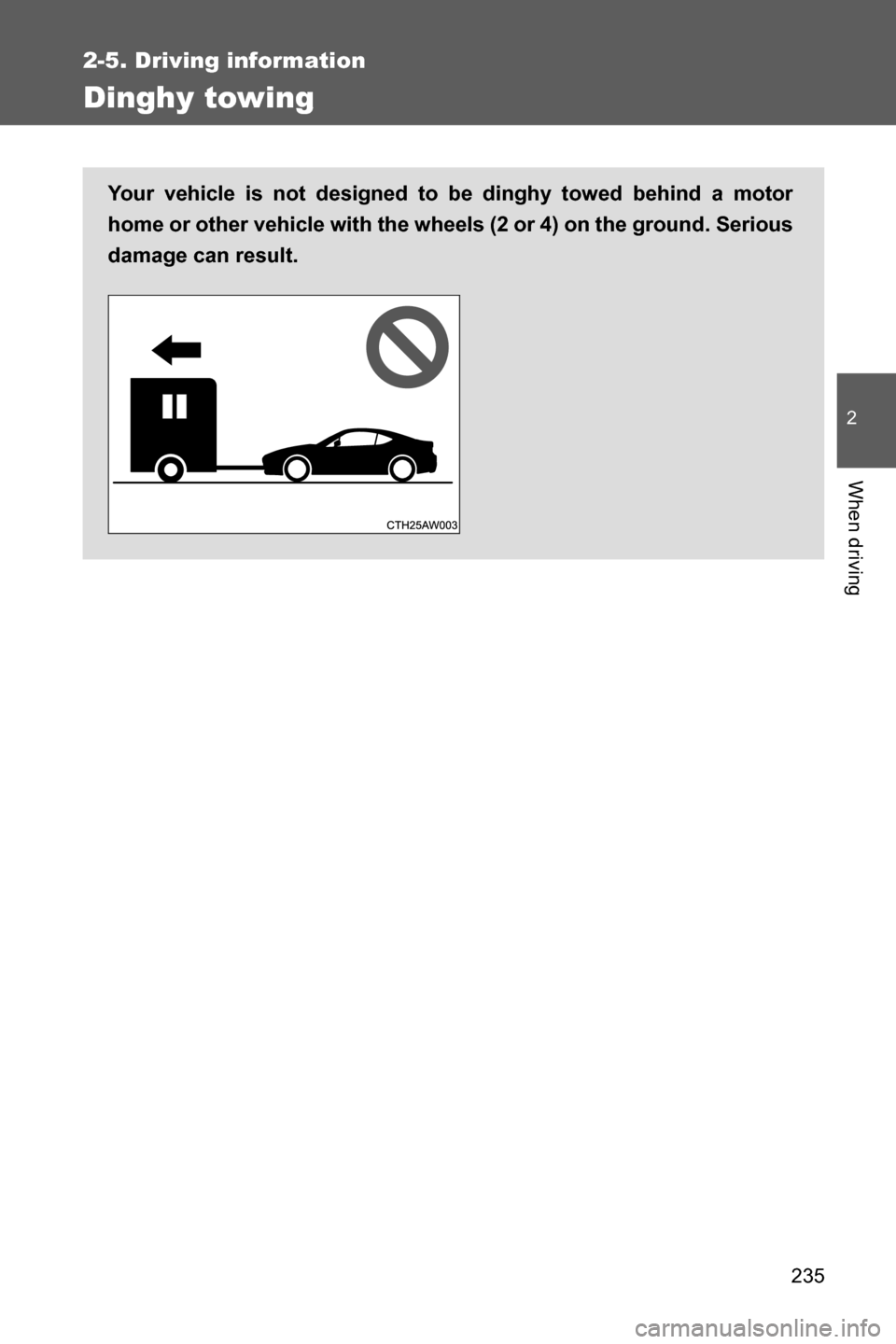
Your vehicle is not designed to be dinghy towed behind a motor
home or other vehicle with the wheels (2 or 4) on the ground. Serious
damage can result.
Page 276 of 490
Maintenance and care4
275
4-1. Maintenance and care
Cleaning and protecting
the vehicle exterior......... 276
Cleaning and protecting
the vehicle interior.......... 280
Cleaning and protecting
the Alcantara
® area ....... 284
4-2. Maintenance
Maintenance
requirements .................. 286
General maintenance....... 289
Emission inspection and
maintenance (I/M)
programs........................ 2924-3. Do-it-yourself
maintenance
Do-it-yourself service
precautions .................... 293
Engine hood ..................... 296
Engine compartment ........ 298
Tires ................................. 312
Tire inflation pressure ...... 319
Wheels ............................. 323
Air conditioning filter......... 326
Transmitter/access key
battery ............................ 329
Checking and replacing
fuses .............................. 334
Light bulbs........................ 342
Page 277 of 490
276
4-1. Maintenance and care
Cleaning and protecting the vehicle exterior
Perform the following to protect the vehicle and maintain it in prime
condition.
●Working from top to bottom, liberally apply water to the vehicle
body, wheel wells and underside of the vehicle to remove any
dirt and dust.
●Wash the vehicle body using a sponge or soft cloth, such as a
chamois.
●For hard-to-remove marks, use car wash soap and rinse thor-
oughly with water.
●Wipe away any water.
●Wax the vehicle when the waterproof coating deteriorates.
If water does not bead on a clean surface, apply wax when the vehicle
body is cool.
Page 278 of 490

277 4-1. Maintenance and care
4
Maintenance and care
■Automatic car washes
●Fold the mirrors before washing the vehicle. Start washing from the front
of the vehicle. Make sure to and extend the mirrors before driving.
●When having your vehicle washed in an automatic car wash, make sure
beforehand that the car wash is of suitable type to avoid scratches to the
vehicle surface and harm to your vehicle’s paint.
●Vehicles with a rear spoiler: In certain automatic car washes, the rear
spoiler may interfere with machine operation. This may prevent the vehi-
cle from being cleaned properly or result in damage to the rear spoiler.
■High pressure car washes
●Do not allow the nozzles of the car wash to come within close proximity
of the windows and door frames as water may enter the cabin.
●Before car wash, check that the fuel filler lid on your vehicle is closed
properly.
■Aluminum wheels
●Remove any dirt immediately by using a neutral detergent. Do not use
hard brushes or abrasive cleaners. Do not use strong or harsh chemical
cleaners. Use the same mild detergent and wax as used on the paint.
●Do not use detergent on the wheels when they are hot, for example after
driving for long distance in the hot weather.
●Wash detergent from the wheels immediately after use.
■Parts containing resin such as the bumper
Do not scrub with abrasive cleaners.
Page 279 of 490

278 4-1. Maintenance and care
WARNING
■When washing the vehicle
●Do not wash the engine compartment and area adjacent to it. If water
enters the engine air intake or electrical parts it will cause engine trouble or
a malfunction of the power steering.
●When washing the vehicle, the brakes may get wet. As a result, the brake
stopping distance will be longer. To dry the brakes, drive the vehicle at a
safe speed while lightly depressing the brake pedal to heat up the brakes.
■Precautions regarding the exhaust pipes
Exhaust gasses cause the exhaust pipes and rear bumper diffusers to
become quite hot.
When washing the vehicle, be careful not to touch the pipes and diffusers
until they have cooled sufficiently, as touching hot exhaust pipes and rear
bumper diffusers can cause burns.
CAUTION
■To prevent paint deterioration and corrosion on the body and compo-
nents (aluminum wheels etc.)
●Wash the vehicle immediately in the following cases:
• After driving near the sea coast
• After driving on salted roads
• If you see coal tar or tree sap on the paint surface
• If you see dead insects, insect droppings or bird droppings on the paint
• After driving in an area contaminated with soot, oily smoke, mine dust,
iron powder or chemical substances
• If the vehicle becomes heavily soiled in dust or mud
• If liquids such as benzene and gasoline are spilled on the paint surface
●If the paint is chipped or scratched, have it repaired immediately.
●To prevent the wheels from corroding, remove any dirt and store in a place
with low humidity when storing the wheels.
■Protective film for side sill plates
Make sure to remove the protective film. Failure to do so may cause rust,
depending on conditions.
Page 291 of 490

290 4-2. Maintenance
Vehicle interior
ItemsCheck points
Accelerator pedal• Moves smoothly (without uneven
pedal effort or catching)?
Automatic transmission “Park”
mechanism• Can the vehicle be held securely
on an incline with the select lever
in P?
Brake pedal• Moves smoothly?
• Does it have appropriate clear-
ance and correct amount of free
play?
Brakes• Not pull to one side when
applied?
• Loss of brake effectiveness?
• Spongy feeling brake pedal?
• Pedal almost touches floor?
Clutch pedal • Moves smoothly?
Head restraints• Move smoothly and lock
securely?
Indicators/buzzers • Function properly?
Lights • Do all the lights come on?
Parking brake• Moves smoothly?
• Can hold the vehicle securely on
an incline?
Seatbelts• Does the seatbelt system oper-
ate smoothly?
• Are the belts undamaged?
Seats• Do the seat controls operate
properly?
Steering wheel• Moves smoothly?
• Has correct free play?
• No strange noises?