wheel SUBARU BRZ 2016 1.G Manual PDF
[x] Cancel search | Manufacturer: SUBARU, Model Year: 2016, Model line: BRZ, Model: SUBARU BRZ 2016 1.GPages: 490, PDF Size: 6.01 MB
Page 347 of 490
346 4-3. Do-it-yourself maintenance
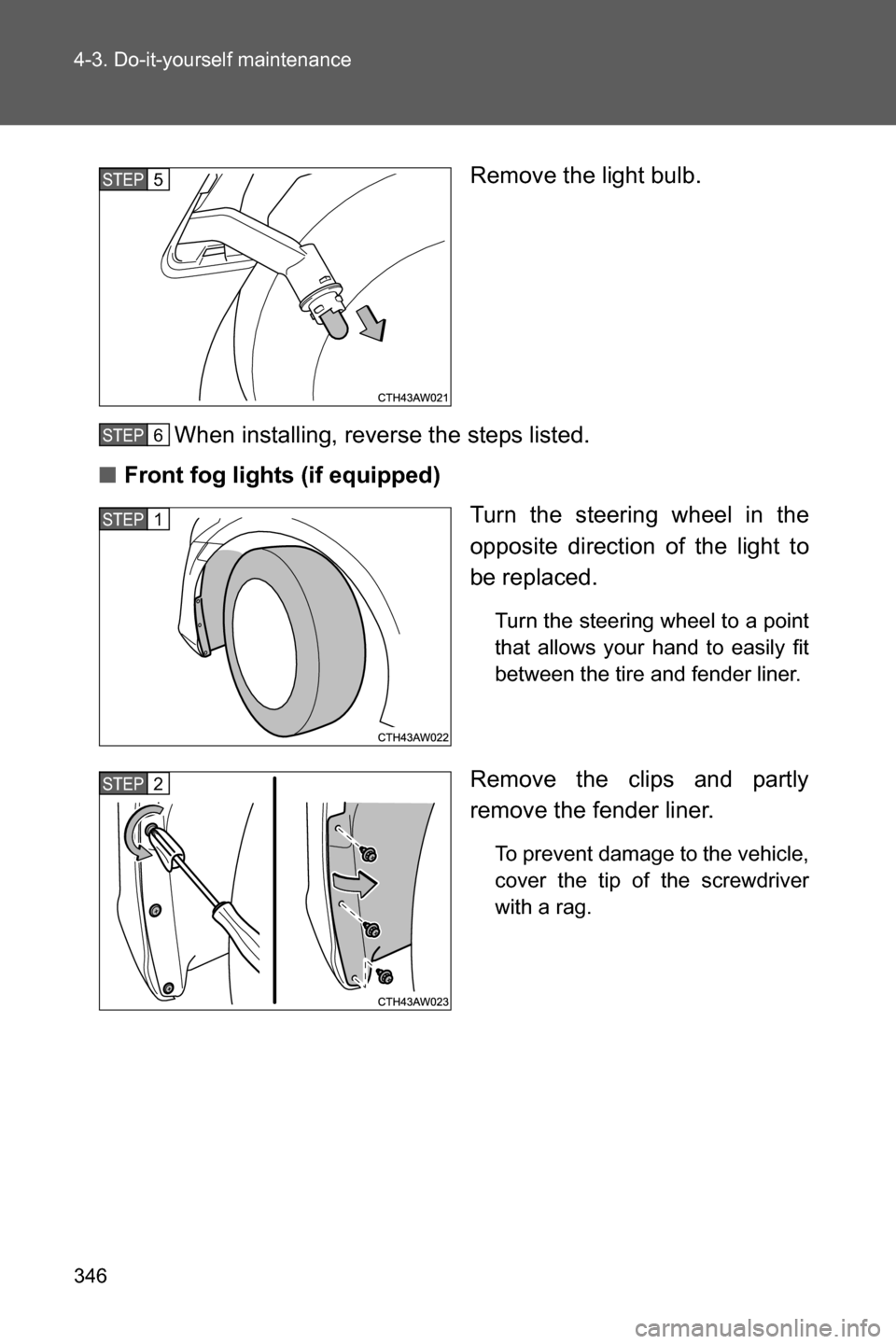
Remove the light bulb.
When installing, reverse the steps listed.
■Front fog lights (if equipped)
Turn the steering wheel in the
opposite direction of the light to
be replaced.
Turn the steering wheel to a point
that allows your hand to easily fit
between the tire and fender liner.
Remove the clips and partly
remove the fender liner.
To prevent damage to the vehicle,
cover the tip of the screwdriver
with a rag.
STEP 5
STEP 6
STEP 1
STEP 2
Page 360 of 490
5
When trouble arises
359
5-1. Essential information
If your vehicle needs to be towed
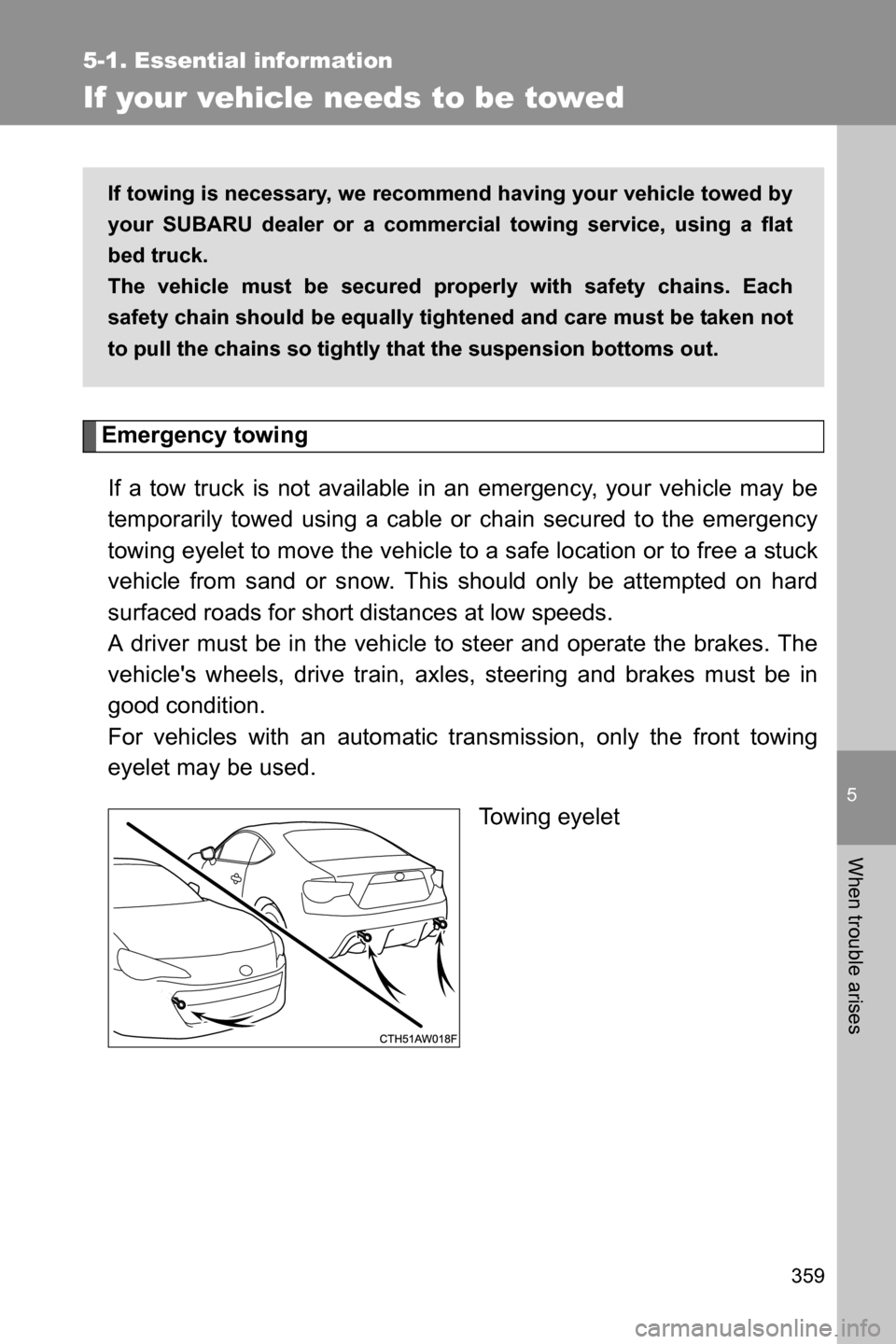
Emergency towing
If a tow truck is not available in an emergency, your vehicle may be
temporarily towed using a cable or chain secured to the emergency
towing eyelet to move the vehicle to a safe location or to free a stuck
vehicle from sand or snow. This should only be attempted on hard
surfaced roads for short distances at low speeds.
A driver must be in the vehicle to steer and operate the brakes. The
vehicle's wheels, drive train, axles, steering and brakes must be in
good condition.
For vehicles with an automatic transmission, only the front towing
eyelet may be used.
Towing eyelet
If towing is necessary, we recommend having your vehicle towed by
your SUBARU dealer or a commercial towing service, using a flat
bed truck.
The vehicle must be secured properly with safety chains. Each
safety chain should be equally tightened and care must be taken not
to pull the chains so tightly that the suspension bottoms out.
Page 362 of 490
5
When trouble arises
361 5-1. Essential information
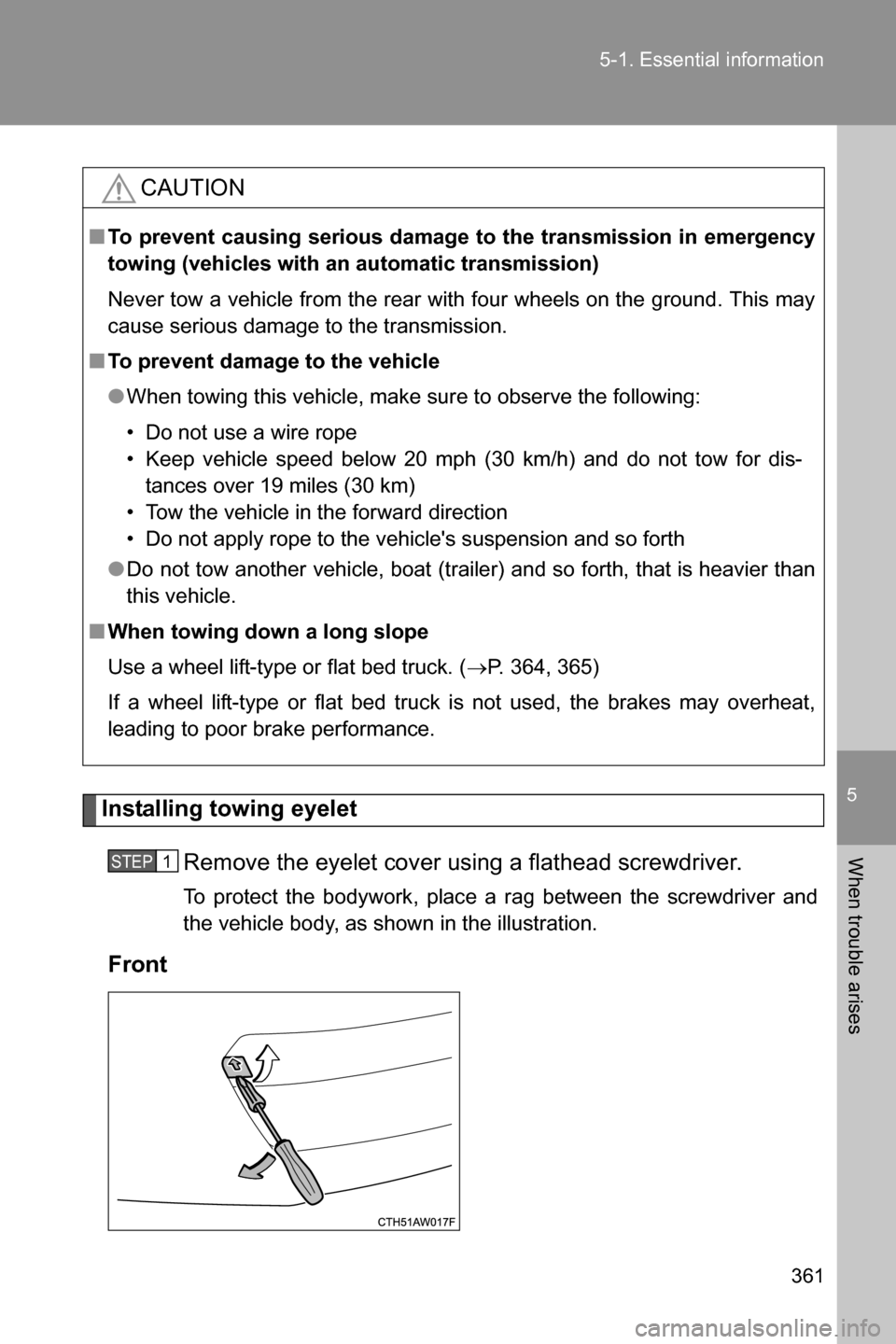
Installing towing eyelet
Remove the eyelet cover using a flathead screwdriver.
To protect the bodywork, place a rag between the screwdriver and
the vehicle body, as shown in the illustration.
Front
CAUTION
■To prevent causing serious damage to the transmission in emergency
towing (vehicles with an automatic transmission)
Never tow a vehicle from the rear with four wheels on the ground. This may
cause serious damage to the transmission.
■To prevent damage to the vehicle
●When towing this vehicle, make sure to observe the following:
• Do not use a wire rope
• Keep vehicle speed below 20 mph (30 km/h) and do not tow for dis-
tances over 19 miles (30 km)
• Tow the vehicle in the forward direction
• Do not apply rope to the vehicle's suspension and so forth
●Do not tow another vehicle, boat (trailer) and so forth, that is heavier than
this vehicle.
■When towing down a long slope
Use a wheel lift-type or flat bed truck. (oP. 364, 365)
If a wheel lift-type or flat bed truck is not used, the brakes may overheat,
leading to poor brake performance.
STEP 1
Page 363 of 490
362 5-1. Essential information
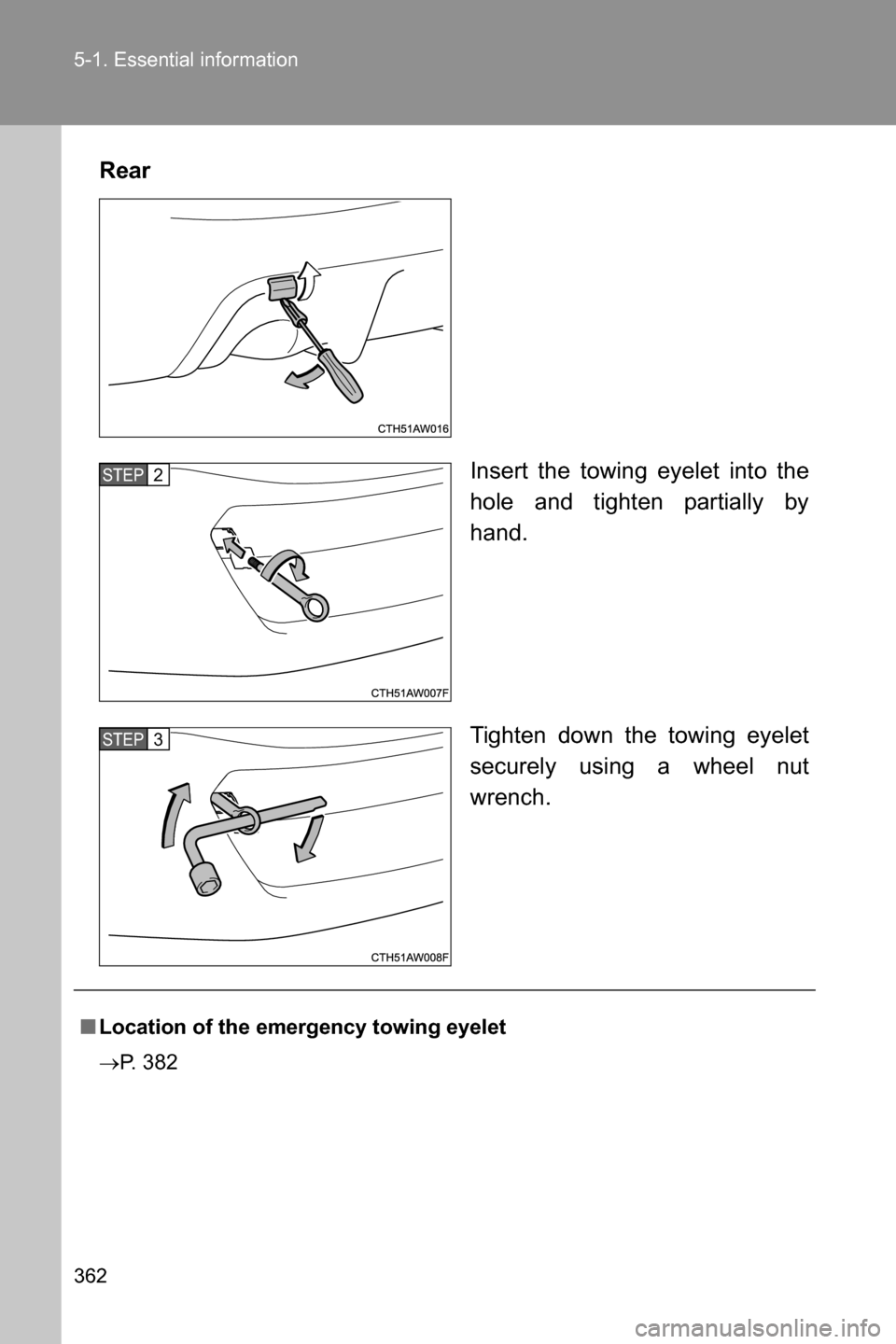
Rear
Insert the towing eyelet into the
hole and tighten partially by
hand.
Tighten down the towing eyelet
securely using a wheel nut
wrench.
STEP 2
STEP 3
■Location of the emergency towing eyelet
oP. 382
Page 365 of 490
364 5-1. Essential information
CAUTION
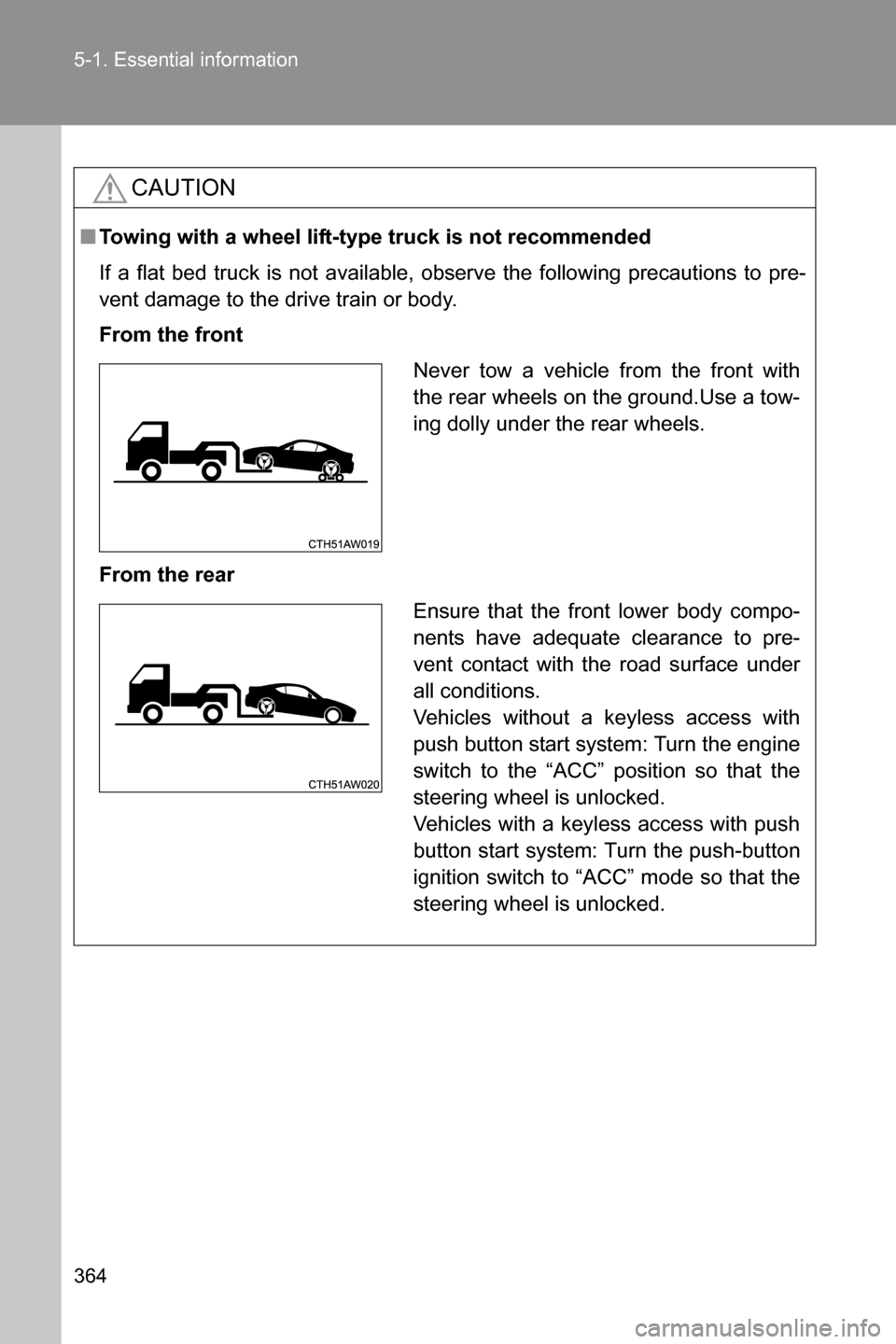
■Towing with a wheel lift-type truck is not recommended
If a flat bed truck is not available, observe the following precautions to pre-
vent damage to the drive train or body.
From the front
From the rear
Never tow a vehicle from the front with
the rear wheels on the ground.Use a tow-
ing dolly under the rear wheels.
Ensure that the front lower body compo-
nents have adequate clearance to pre-
vent contact with the road surface under
all conditions.
Vehicles without a keyless access with
push button start system: Turn the engine
switch to the “ACC” position so that the
steering wheel is unlocked.
Vehicles with a keyless access with push
button start system: Turn the push-button
ignition switch to “ACC” mode so that the
steering wheel is unlocked.
Page 371 of 490
370 5-2. Steps to take in an emergency
(Comes on in
yellow)Cruise control indicator light
Indicates a malfunction in the cruise control system.
■If the malfunction indicator lamp comes on while driving
First check the following:
●Is the fuel tank empty?
If it is, fill the fuel tank immediately.
●Is the fuel tank cap loose?
If it is, tighten it securely.
The malfunction indicator lamp will go off after several driving trips.
If the malfunction indicator lamp does not go off even after several trips, con-
tact your SUBARU dealer as soon as possible.
■SRS airbag system warning light
oP. 122
■Electric power steering warning light (warning buzzer)
The electric power steering warning light may come on and the warning
buzzer may sound when the voltage is low or the voltage drops.
WARNING
■When the electric power steering warning light comes on
The steering wheel may become extremely heavy.
If the steering wheel becomes heavier than usual when operating, hold
firmly and operate using more force than usual.
Warning lightWarning light/Details
Page 375 of 490
374 5-2. Steps to take in an emergency
■When a tire is replaced with a spare tire (vehicles with a tire pres-
sure monitoring system)
The compact spare tire is not equipped with a tire pressure warning
valve and transmitter. If a tire goes flat, the tire pressure warning light will
not turn off even though the flat tire has been replaced with the spare
tire. Replace the spare tire with the repaired tire and adjust the tire infla-
tion pressure. The tire pressure warning light will go off after a few min-
utes.
■If the tire pressure monitoring system is inoperative (if equipped)
The tire pressure monitoring system will be disabled in the following con-
ditions:
(When the condition becomes normal, the system will work properly.)
●If tires not equipped with tire pressure warning valves and transmit-
ters are used.
●If the ID code on the tire pressure warning valves and transmitters is
not registered in the tire pressure warning computer.
●If the tire inflation pressure is 55 psi (380 kPa, 3.87 kgf/cm2 or bar) or
higher.
The tire pressure monitoring system may be disabled in the following
conditions:
(When the condition becomes normal, the system will work properly.)
●If electronic devices or facilities using similar radio wave frequencies
are nearby.
●If a radio set at similar frequencies is in use in the vehicle.
●If a window tint that affects the radio wave signals is installed.
●If there is a lot of snow or ice on the vehicle, in particular around the
wheels or wheel housings.
●If non-genuine SUBARU wheels are used. (Even if you use SUBARU
wheels, the tire pressure monitoring system may not work properly
with some types of tires.)
●If tire chains are used.
●If a large metallic object which can interfere with signal reception is
put in the trunk.
Page 376 of 490
5
When trouble arises
375 5-2. Steps to take in an emergency
■If the tire pressure warning light frequently comes on after blinking
for approximately one minute (if equipped)
If the tire pressure warning light frequently comes on after blinking for
approximately one minute when the push-button ignition switch is turned
to “ON” mode (vehicles with a keyless access with push button start sys-
tem) or the engine switch is turned to the “ON” position (vehicles without
a keyless access with push button start system), have it checked your
SUBARU dealer.
WARNING
■If the tire pressure warning light comes on (if equipped)
Be sure to observe the following precautions. Failure to do so could
cause loss of vehicle control and result in death or serious injury.
●Stop your vehicle in a safe place as soon as possible. Adjust the tire
inflation pressure immediately.
●If the tire pressure warning light comes on even after tire inflation pres-
sure adjustment, it is probable that you have a flat tire. Check the tires.
If the tire is flat, change to the spare tire and have the flat tire repaired
by the nearest SUBARU dealer.
●Avoid abrupt maneuvering and braking. If the vehicle tires deteriorate,
you could lose control of the steering wheel or the brakes.
■If a blowout or sudden air leakage should occur (vehicles with a tire
pressure monitoring system)
The tire pressure monitoring system may not activate immediately.
Page 378 of 490
5
When trouble arises
377 5-2. Steps to take in an emergency
WARNING
TPMS malfunctions may occur for a variety of reasons, including the
installation of replacement or alternate tires or wheels on the vehicle that
prevent the TPMS from functioning properly. Always check the TPMS
malfunction telltale after replacing one or more tires or wheels on your
vehicle to ensure that the replacement or alternate tires and wheels
allow the TPMS to continue to function properly.
CAUTION
■To ensure the tire pressure monitoring system operates properly
(vehicles with a tire pressure monitoring system)
Do not install tires with different specifications or makers, as the tire
pressure monitoring system may not operate properly.
Page 383 of 490
382
5-2. Steps to take in an emergency
If you have a flat tire
Your vehicle is equipped with a spare tire. The flat tire can be
replaced with the spare tire.
■Before jacking up the vehicle
●Stop the vehicle on a hard, flat surface.
●Set the parking brake.
●Shift the select lever to P (vehicles with an automatic trans-
mission) or shift lever to R (vehicles with a manual transmis-
sion).
●Stop the engine.
●Turn on the hazard warning flashers.
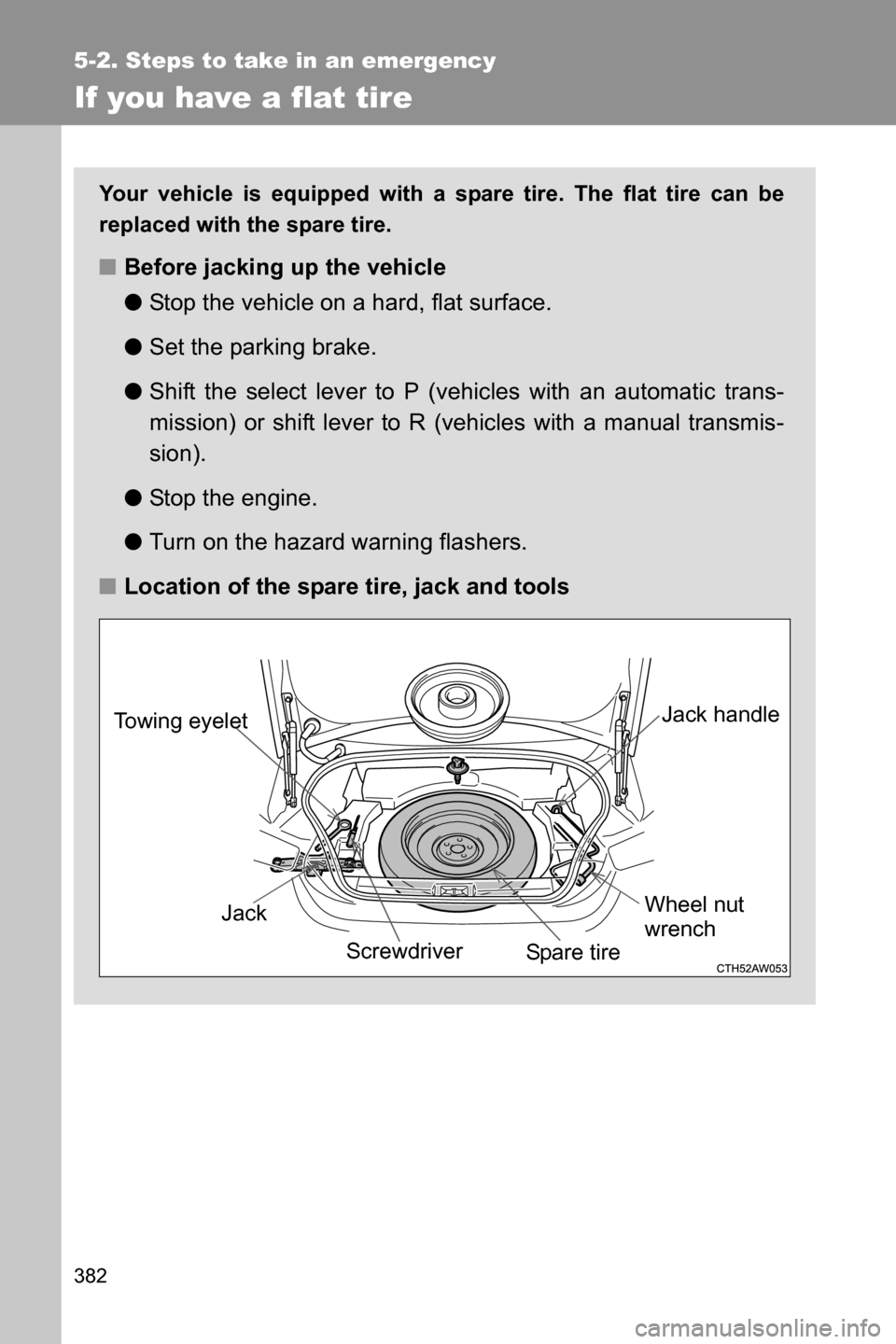
■Location of the spare tire, jack and tools
JackJack handle
Spare tire Towing eyelet
ScrewdriverWheel nut
wrench