air condition SUBARU BRZ 2016 1.G Owners Manual
[x] Cancel search | Manufacturer: SUBARU, Model Year: 2016, Model line: BRZ, Model: SUBARU BRZ 2016 1.GPages: 490, PDF Size: 6.01 MB
Page 2 of 490

TABLE OF CONTENTS
1
1Before drivingAdjusting and operating features such as door locks,
mirrors, and steering column.
2When drivingDriving, stopping and safe-driving information.
3Interior fea-
turesAir conditioning and audio systems, as well as other in-
terior features for a comfortable driving experience.
4Maintenance
and careCleaning and protecting your vehicle, performing do-it-
yourself maintenance, and maintenance information.
5When trouble
arisesWhat to do if the vehicle needs to be towed, gets a flat
tire, or is involved in an accident.
6Vehicle
specificationsDetailed vehicle information.
7For ownersReporting safety defects for US owners, and seatbelt
and SRS airbag instructions for Canadian owners
IndexAlphabetical listing of information contained in this
manual.
Page 4 of 490

1
2
3
4
5
6
7
3
2-2. Instrument cluster
Gauges and meters ............ 187
Indicators and
warning lights .................... 192
Multi-information
display............................... 197
2-3. Operating the lights and
windshield wipers
Headlight switch .................. 202
Fog light switch ................... 208
Windshield wipers and
washer .............................. 209
2-4. Using other driving
systems
Cruise control ...................... 212
Driving assist systems ........ 217
2-5. Driving information
Cargo and luggage ............. 224
Vehicle load limits ............... 228
Winter driving tips ............... 229
Trailer towing ...................... 234
Dinghy towing ..................... 2353-1. Using the air conditioning
system and defogger
Manual air conditioning
system .............................. 238
Automatic air conditioning
system .............................. 245
Rear window and outside
rear view mirror
defoggers ......................... 254
3-2. Using the audio system
Using the AUX/USB
port ................................... 256
Using the microphone ........ 257
3-3. Using the interior lights
Interior lights list ................. 258
• Interior light ...................... 259
3-4. Using the storage features
List of storage features ....... 260
• Glove box ......................... 261
• Bottle holders ................... 262
• Cup holders/
console tray ...................... 263
3-5. Other interior features
Sun visors........................... 265
Vanity mirrors ..................... 266
Clock .................................. 267
Outside temperature
display .............................. 268
Power outlets...................... 269
Seat heaters ....................... 271
Floor mat ............................ 273
3Interior features
Page 5 of 490

TABLE OF CONTENTSIndex
4
4-1. Maintenance and care
Cleaning and protecting
the vehicle exterior ........... 276
Cleaning and protecting
the vehicle interior ............ 280
Cleaning and protecting
the Alcantara
® area.......... 284
4-2. Maintenance
Maintenance
requirements .................... 286
General maintenance ......... 289
Emission inspection and
maintenance (I/M)
programs .......................... 292
4-3. Do-it-yourself
maintenance
Do-it-yourself service
precautions ...................... 293
Engine hood ....................... 296
Engine compartment .......... 298
Tires ................................... 312
Tire inflation pressure......... 319
Wheels ............................... 323
Air conditioning filter ........... 326
Transmitter/
access key battery ........... 329
Checking and
replacing fuses ................. 334
Light bulbs .......................... 3425-1. Essential information
Hazard warning flashers ..... 358
If your vehicle needs to
be towed ........................... 359
If you think something
is wrong ............................ 366
Fuel pump shut off
system .............................. 367
5-2. Steps to take in an
emergency
If a warning light turns
on or a warning buzzer
sounds... .......................... 368
If you have a flat tire ........... 382
If the engine will not
start .................................. 393
If the select lever cannot be
shifted from P ................... 396
If you lose your keys ........... 397
If the access key does not
operate properly ............... 398
If the battery is
discharged ........................ 402
If your vehicle
overheats .......................... 407
If the vehicle becomes
stuck ................................. 410
4Maintenance and care5When trouble arises
Page 13 of 490
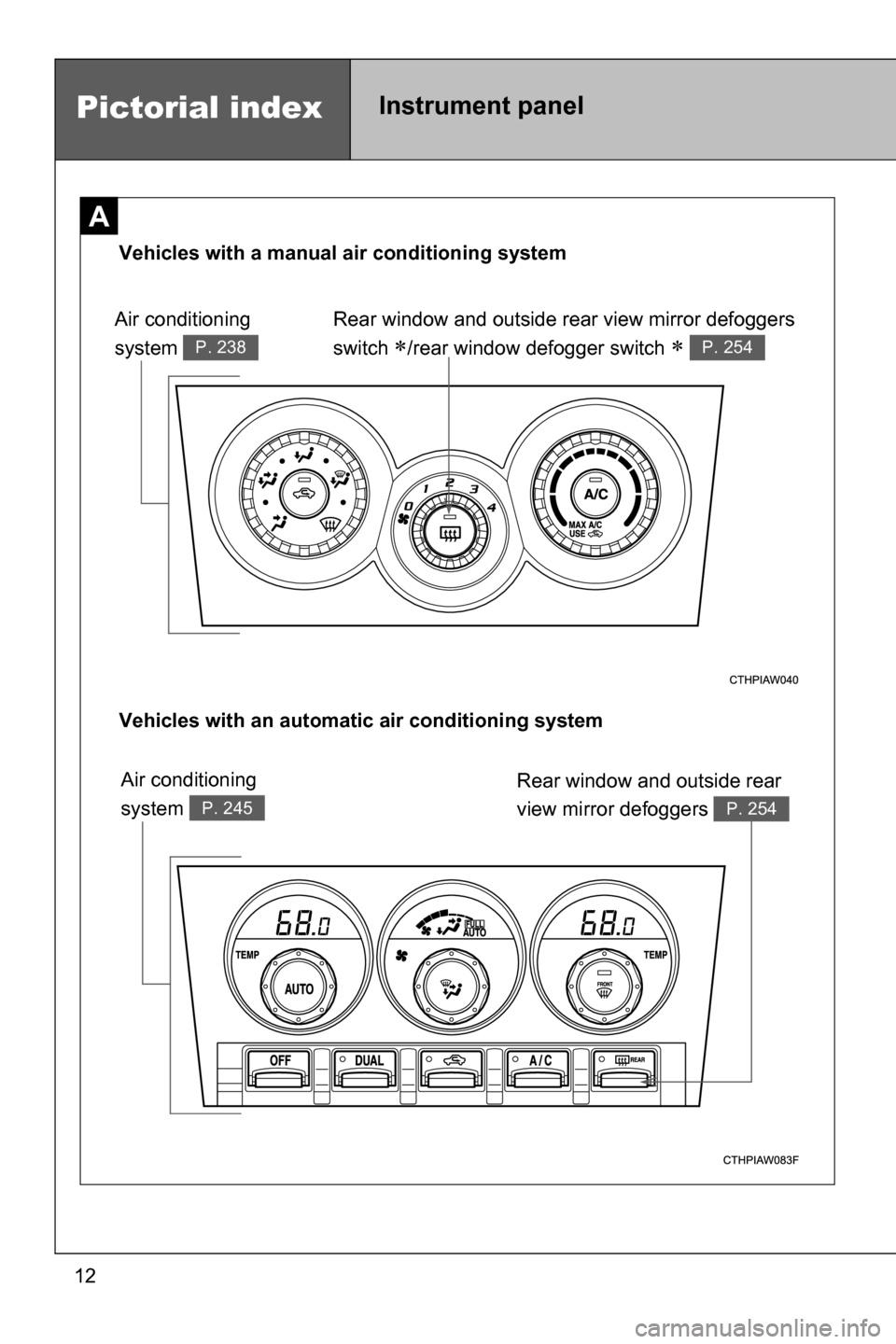
12
A
Vehicles with a manual air conditioning system
Air conditioning
system
P. 238
Vehicles with an automatic air conditioning system
Rear window and outside rear
view mirror defoggers
P. 254
Air conditioning
system
P. 245
Rear window and outside rear view mirror defoggers
switch
/rear window defogger switch
P. 254
Pictorial indexInstrument panel
Page 31 of 490

30 1-2. Opening, closing and locking the doors and trunk lid
■Conditions affecting operation
The keyless access with push button start system uses weak radio waves. In
the following situations, the communication between the access key and the
vehicle may be affected, preventing the keyless access with push button
start system, remote keyless entry system and engine immobilizer system
from operating properly. (Way of coping oP. 398)
●When the access key battery is depleted
●Near a TV tower, electric power plant, gas station, radio station, large dis-
play, airport or other facility that generates strong radio waves or electri-
cal noise
●When the access key is in contact with, or is covered by the following
metallic objects
• Cards to which aluminum foil is attached
• Cigarette boxes that have aluminum foil inside
• Metallic wallets or bags
• Coins
• Hand warmers made of metal
• Media such as CDs and DVDs
●When another transmitters (that emit radio waves) are being used nearby
●When carrying the access key together with the following devices that
emit radio waves
• A portable radio, cellular phone, cordless phone or other wireless com-
munication device
• Another vehicle's access key or a transmitter that emits radio waves
• Personal computers or personal digital assistants (PDAs)
• Digital audio players
• Portable game systems
●If window tint with a metallic content or metallic objects are attached to
the rear window
●When the access key is placed near a battery charger or electronic
devices
Page 41 of 490

40 1-2. Opening, closing and locking the doors and trunk lid
■Conditions affecting operation
Vehicles without a keyless access with push button start system
The remote keyless entry system may not operate normally in the following
situations:
●When the transmitter battery is depleted
●Near a TV tower, electric power plant, gas station, radio station, large dis-
play, airport or other facility that generates strong radio waves or electri-
cal noise
●When carrying a portable radio, cellular phone or other wireless commu-
nication devices
●When the transmitter is in contact with, or is covered by a metallic object
●When other transmitters (that emit radio waves) are being used nearby
●If window tint with a metallic content or metallic objects are attached to
the rear window
Vehicles with a keyless access with push button start system
oP. 3 0
■If the remote keyless entry system does not operate properly (vehicles
with a keyless access with push button start system)
Locking and unlocking the doors, unlocking the trunk lid: Use the mechanical
key. (oP. 398)
■Key battery depletion
Vehicles without a keyless access with push button start system
If the remote keyless entry system does not operate, the battery may be
depleted. Replace the battery when necessary. (oP. 329)
Vehicles with a keyless access with push button start system
oP. 3 4
■When the access key battery is fully depleted
oP. 329
■Confirmation of the registered key number
The number of keys already registered to the vehicle can be confirmed. Ask
your SUBARU dealer for details.
■Customization that can be configured at your SUBARU dealer
Settings (e.g. remote keyless entry system) can be changed.
(Customizable features oP. 443)
Page 64 of 490

63 1-3. Adjustable components (seats, mirrors, steering wheel)
1
Before driving
WARNING
■People with a medical condition
Obtain medical advice and wear the seatbelt in the proper way.
■When children are in the vehicle
Do not allow children to play with the seatbelt. If the seatbelt becomes
twisted around a child’s neck, it may lead to choking or other serious injuries
that could result in death.
If this occurs and the buckle cannot be unfastened, scissors should be used
to cut the belt.
■Seatbelt pretensioners
If the pretensioner has activated, the SRS airbag system warning light will
come on. In that case, the seatbelt cannot be used again and must be
replaced at your SUBARU dealer.
Page 100 of 490

99 1-7. Safety information
1
Before driving
Also, if luggage or electronic devices are placed on the front passenger’s
seat, this may adversely affect the ability of the system to determine deploy-
ment. This may prevent the front passenger’s frontal airbag ON and OFF
indicators from working properly. Check that the indicators work properly.
When the OFF indicator turns off and the ON indicator illuminates, the front
passenger’s frontal airbag may deploy during a collision. Remove luggage
and electronic devices from the front passenger’s seat.
NOTE
This device complies with Part 18 of the FCC Rules. This device may cause
interference. If this device causes interference, consult the nearest SUBARU
dealer. Also, for maintenance of the system, consult the nearest SUBARU
dealer.
■Conditions in which front passenger’s SRS frontal airbag is not acti-
vated
The front passenger’s SRS frontal airbag will not be activated when any of
the following conditions are met regarding the front passenger’s seat:
●The seat is empty.
●The seat is equipped with an appropriate child restraint system and an
infant is restrained in it.
●The occupant changed their posture after the occupant load is judged.
●The front passenger’s occupant detection system is malfunctioning.
WARNING
When the front passenger’s seat is occupied by an infant in an appropriate
child restraint system, observe the following precautions. Failure to do so may
interfere with the proper operation of the occupant detection system, activating
the front passenger’s SRS frontal airbag even though that seat is occupied by
the infant in the child restraint system.
●Do not place any article (including electronic devices) on the seat other than
the infant in the child restraint system.
●Do not place more than one infant in the child restraint system.
Page 102 of 490

101 1-7. Safety information
1
Before driving
●Ensure that no article is placed on the seat other than the occupant.
If the ON indicator still remains illuminated while the OFF indicator turns off
despite the fact that the actions noted above have been taken, seat the
child/small adult in the rear seat and immediately contact your SUBARU
dealer for an inspection. Even if the system has passed the dealer inspec-
tion, it is recommended that on subsequent trips the child/small adult always
take the rear seat.
Children who have outgrown a child restraint system should always wear the
seatbelt irrespective of whether the airbag is deactivated or activated.
■Conditions in which front passenger’s SRS frontal airbag is activated
The front passenger’s SRS frontal airbag will be activated for deployment
upon impact when any of the following conditions are met regarding the front
passenger’s seat.
●When the seat is occupied by an adult.
●When a certain item(s) (e.g. jug of water) is placed on the seat.
Page 106 of 490

105 1-7. Safety information
1
Before driving
The SRS airbag can function only when the ignition switch is in the “ON”
position.
The SUBARU advanced frontal airbag system is designed to determine the
activation or deactivation condition of the front passenger’s SRS frontal air-
bag depending on the characteristic of the item(s) or person on the front
passenger’s seat monitored by the front passenger’s occupant detection
system sensor. For this reason, only the driver’s SRS frontal airbag may
deploy in the event of a collision, but this does not mean failure of the sys-
tem.
If the front sub sensors and the impact sensors in the airbag control module
detect a predetermined amount of force during a frontal collision, the control
module sends signals to the airbag module(s) (only driver’s module or both
driver’s and front passenger’s modules) instructing the module(s) to inflate
the SRS frontal airbag(s).
The driver’s and front passenger’s SRS frontal airbags use dual stage infla-
tors. The two inflators of each airbag are triggered either sequentially or
simultaneously, depending on the severity of impact, in the case of the
driver’s SRS frontal airbag and depending on the severity of impact and the
characteristic of the item(s) or person on the seat in the case of the front
passenger’s SRS frontal airbag.
After deployment, the SRS airbag immediately starts to deflate so that the
driver’s vision is not obstructed. The time required from detecting impact to
the deflation of the SRS airbag after deployment is shorter than the blink of
an eye.
Both when only the driver’s SRS frontal airbag deploys and the driver’s and
front passenger’s SRS frontal airbags deploy, the driver’s and front passen-
ger’s seatbelt pretensioners operate at the same time.
Although it is highly unlikely that the SRS airbag would activate in a non-
accident situation, should it occur, the SRS airbag will deflate quickly, not
obscuring vision and will not interfere with the driver's ability to maintain con-
trol of the vehicle.
When the SRS airbag deploys, a sudden, fairly loud inflation noise will be
heard and some smoke will be released. These occurrences are a normal
result of the deployment. This smoke does not indicate a fire in the vehicle.