Battery SUBARU CROSSTREK 2017 1.G Owners Manual
[x] Cancel search | Manufacturer: SUBARU, Model Year: 2017, Model line: CROSSTREK, Model: SUBARU CROSSTREK 2017 1.GPages: 572, PDF Size: 41.52 MB
Page 10 of 572
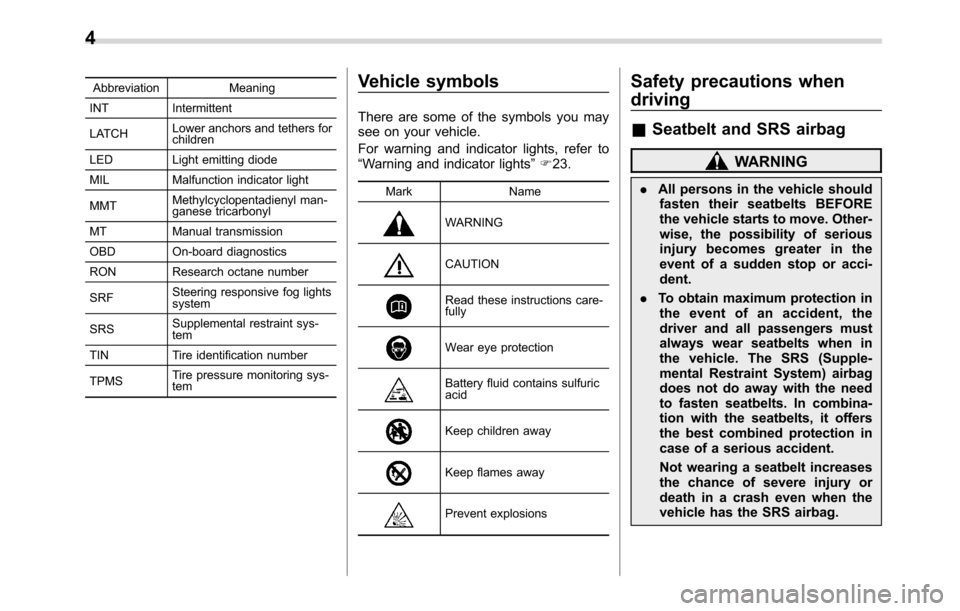
Abbreviation Meaning
INT Intermittent
LATCHLower anchors and tethers for
children
LED Light emitting diode
MIL Malfunction indicator light
MMTMethylcyclopentadienyl man-
ganese tricarbonyl
MT Manual transmission
OBD On-board diagnostics
RON Research octane number
SRFSteering responsive fog lights
system
SRSSupplemental restraint sys-
tem
TIN Tire identification number
TPMSTire pressure monitoring sys-
temVehicle symbols
There are some of the symbols you may
see on your vehicle.
For warning and indicator lights, refer to
“Warning and indicator lights”F23.
Mark Name
WARNING
CAUTION
Read these instructions care-
fully
Wear eye protection
Battery fluid contains sulfuric
acid
Keep children away
Keep flames away
Prevent explosions
Safety precautions when
driving
&Seatbelt and SRS airbag
WARNING
.All persons in the vehicle should
fasten their seatbelts BEFORE
the vehicle starts to move. Other-
wise, the possibility of serious
injury becomes greater in the
event of a sudden stop or acci-
dent.
.To obtain maximum protection in
the event of an accident, the
driver and all passengers must
always wear seatbelts when in
the vehicle. The SRS (Supple-
mental Restraint System) airbag
does not do away with the need
to fasten seatbelts. In combina-
tion with the seatbelts, it offers
the best combined protection in
case of a serious accident.
Not wearing a seatbelt increases
the chance of severe injury or
death in a crash even when the
vehicle has the SRS airbag.
4
Page 32 of 572
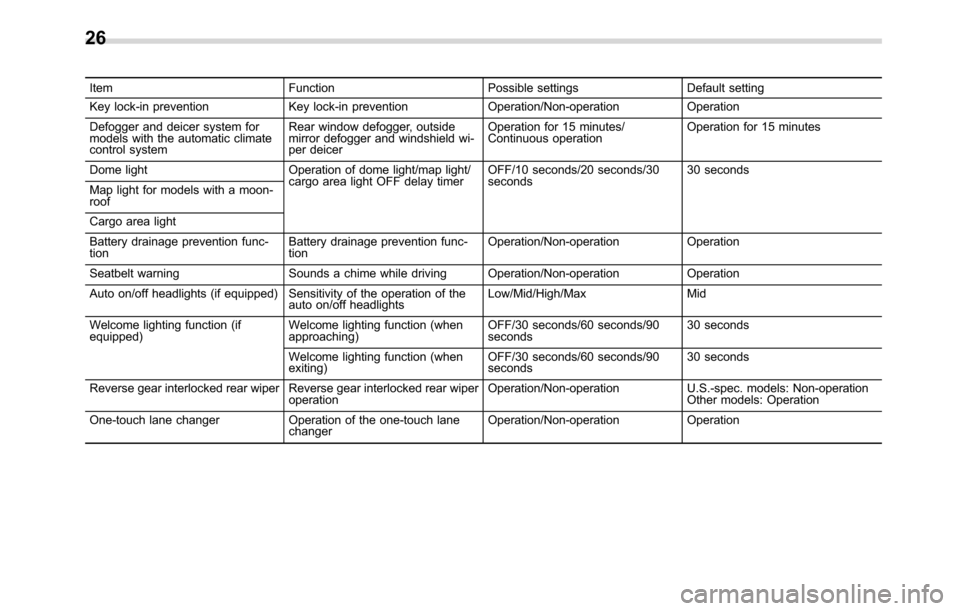
Item Function Possible settings Default setting
Key lock-in prevention Key lock-in prevention Operation/Non-operation Operation
Defogger and deicer system for
models with the automatic climate
control systemRear window defogger, outside
mirror defogger and windshield wi-
per deicerOperation for 15 minutes/
Continuous operationOperation for 15 minutes
Dome light Operation of dome light/map light/
cargo area light OFF delay timerOFF/10 seconds/20 seconds/30
seconds30 seconds
Map light for models with a moon-
roof
Cargo area light
Battery drainage prevention func-
tionBattery drainage prevention func-
tionOperation/Non-operation Operation
Seatbelt warning Sounds a chime while driving Operation/Non-operation Operation
Auto on/off headlights (if equipped) Sensitivity of the operation of the
auto on/off headlightsLow/Mid/High/Max Mid
Welcome lighting function (if
equipped)Welcome lighting function (when
approaching)OFF/30 seconds/60 seconds/90
seconds30 seconds
Welcome lighting function (when
exiting)OFF/30 seconds/60 seconds/90
seconds30 seconds
Reverse gear interlocked rear wiper Reverse gear interlocked rear wiper
operationOperation/Non-operation U.S.-spec. models: Non-operation
Other models: Operation
One-touch lane changer Operation of the one-touch lane
changerOperation/Non-operation Operation
26
Page 38 of 572
Seat, seatbelt and SRS airbags/Seat heater
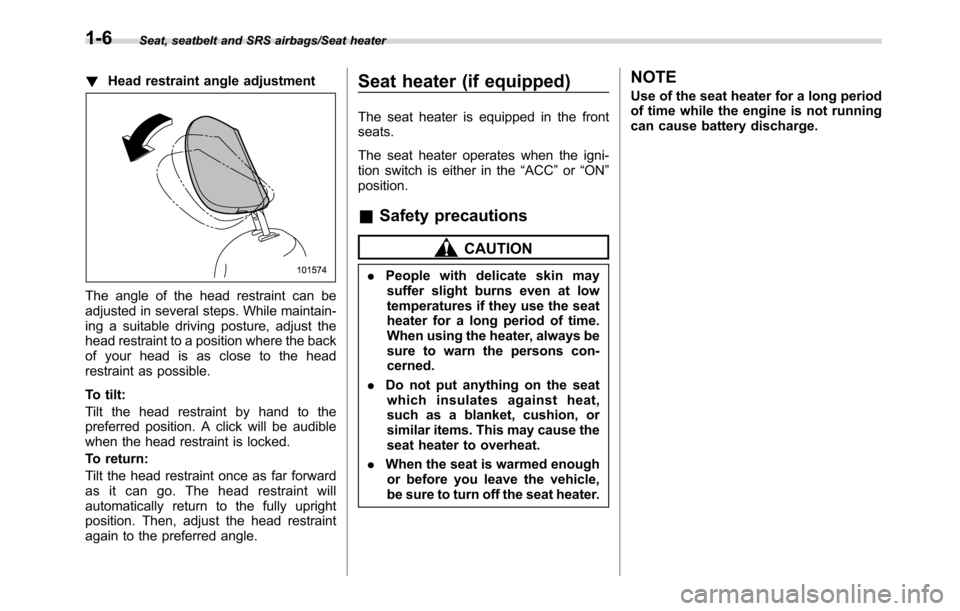
!Head restraint angle adjustment
The angle of the head restraint can be
adjusted in several steps. While maintain-
ing a suitable driving posture, adjust the
head restraint to a position where the back
of your head is as close to the head
restraint as possible.
To tilt:
Tilt the head restraint by hand to the
preferred position. A click will be audible
when the head restraint is locked.
To return:
Tilt the head restraint once as far forward
as it can go. The head restraint will
automatically return to the fully upright
position. Then, adjust the head restraint
again to the preferred angle.
Seat heater (if equipped)
The seat heater is equipped in the front
seats.
The seat heater operates when the igni-
tion switch is either in the“ACC”or“ON”
position.
&Safety precautions
CAUTION
.People with delicate skin may
suffer slight burns even at low
temperatures if they use the seat
heater for a long period of time.
When using the heater, always be
sure to warn the persons con-
cerned.
.Do not put anything on the seat
which insulates against heat,
such as a blanket, cushion, or
similar items. This may cause the
seat heater to overheat.
.When the seat is warmed enough
or before you leave the vehicle,
be sure to turn off the seat heater.
NOTE
Use of the seat heater for a long period
of time while the engine is not running
can cause battery discharge.
1-6
Page 52 of 572
Seat, seatbelt and SRS airbags/Front seatbelt pretensioners
&Seatbelt maintenance
To clean the seatbelts, use a mild soap
and lukewarm water. Never bleach or dye
the belts because this could seriously
affect their strength.
Inspect the seatbelts and attachments
including the webbing and all hardware
periodically for cracks, cuts, gashes,
tears, damage, loose bolts or worn areas.
Replace the seatbelts even if only minor
damage is found.
CAUTION
.Keep the belts free of polishes,
oils, chemicals and particularly
battery acid.
.Never attempt to make modifica-
tions or changes that will prevent
the seatbelt from operating prop-
erly.
Front seatbelt pretensioners
The driver’s and front passenger’s seat-
belts have a seatbelt pretensioner. The
seatbelt pretensioners are designed to be
activated in the event of an accident
involving a moderate to severe frontal
and side collision and rollover accident.
&Driver’s seatbelt
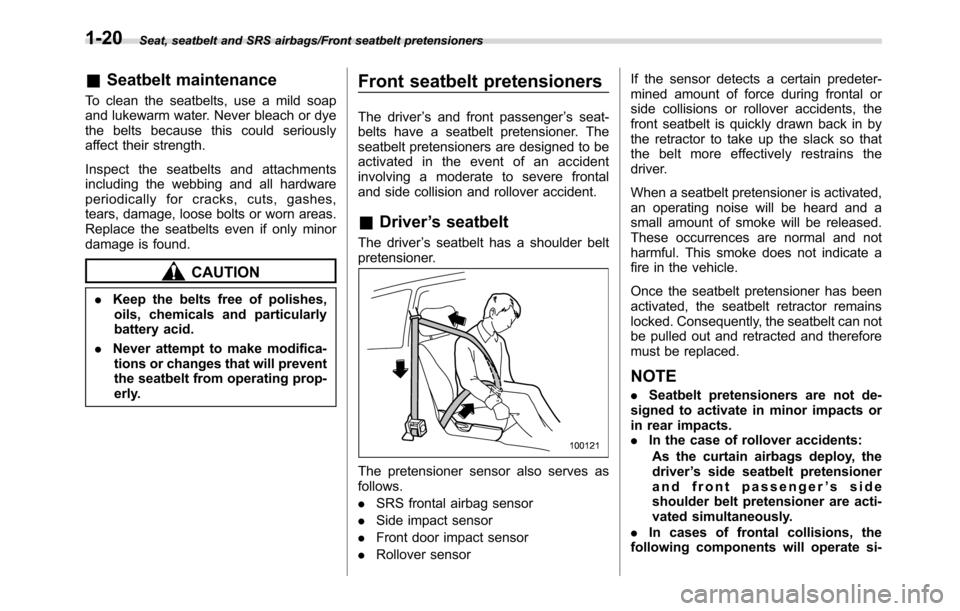
The driver’s seatbelt has a shoulder belt
pretensioner.
The pretensioner sensor also serves as
follows.
.SRS frontal airbag sensor
.Side impact sensor
.Front door impact sensor
.Rollover sensorIf the sensor detects a certain predeter-
mined amount of force during frontal or
side collisions or rollover accidents, the
front seatbelt is quickly drawn back in by
the retractor to take up the slack so that
the belt more effectively restrains the
driver.
When a seatbelt pretensioner is activated,
an operating noise will be heard and a
small amount of smoke will be released.
These occurrences are normal and not
harmful. This smoke does not indicate a
fire in the vehicle.
Once the seatbelt pretensioner has been
activated, the seatbelt retractor remains
locked. Consequently, the seatbelt can not
be pulled out and retracted and therefore
must be replaced.
NOTE
.Seatbelt pretensioners are not de-
signed to activate in minor impacts or
in rear impacts.
.In the case of rollover accidents:
As the curtain airbags deploy, the
driver’s side seatbelt pretensioner
and front passenger’sside
shoulder belt pretensioner are acti-
vated simultaneously.
.In cases of frontal collisions, the
following components will operate si-
1-20
Page 99 of 572
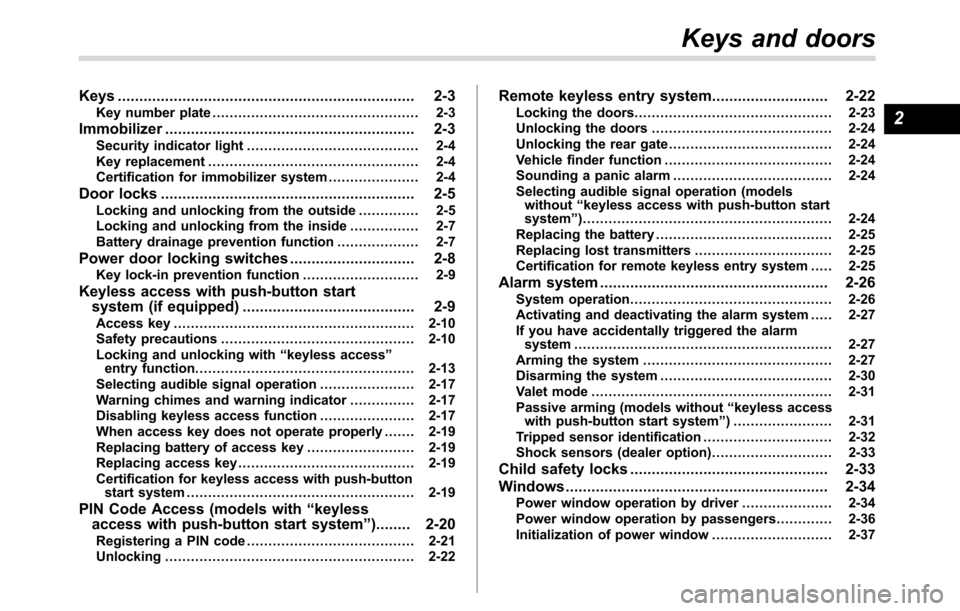
Keys..................................................................... 2-3
Key number plate................................................ 2-3
Immobilizer.......................................................... 2-3Security indicator light........................................ 2-4
Key replacement................................................. 2-4
Certification for immobilizer system..................... 2-4
Door locks........................................................... 2-5Locking and unlocking from the outside .............. 2-5
Locking and unlocking from the inside................ 2-7
Battery drainage prevention function................... 2-7
Power door locking switches............................. 2-8Key lock-in prevention function........................... 2-9
Keyless access with push-button start
system (if equipped)........................................ 2-9
Access key........................................................ 2-10
Safety precautions............................................. 2-10
Locking and unlocking with“keyless access”
entry function................................................... 2-13
Selecting audible signal operation...................... 2-17
Warning chimes and warning indicator............... 2-17
Disabling keyless access function...................... 2-17
When access key does not operate properly....... 2-19
Replacing battery of access key......................... 2-19
Replacing access key......................................... 2-19
Certification for keyless access with push-button
start system..................................................... 2-19
PIN Code Access (models with“keyless
access with push-button start system”)........ 2-20
Registering a PIN code....................................... 2-21
Unlocking.......................................................... 2-22
Remote keyless entry system........................... 2-22
Locking the doors.............................................. 2-23
Unlocking the doors.......................................... 2-24
Unlocking the rear gate...................................... 2-24
Vehicle finder function....................................... 2-24
Sounding a panic alarm..................................... 2-24
Selecting audible signal operation (models
without“keyless access with push-button start
system”).......................................................... 2-24
Replacing the battery......................................... 2-25
Replacing lost transmitters................................ 2-25
Certification for remote keyless entry system..... 2-25
Alarm system..................................................... 2-26System operation............................................... 2-26
Activating and deactivating the alarm system..... 2-27
If you have accidentally triggered the alarm
system............................................................ 2-27
Arming the system............................................ 2-27
Disarming the system........................................ 2-30
Valet mode........................................................ 2-31
Passive arming (models without“keyless access
with push-button start system”) ....................... 2-31
Tripped sensor identification.............................. 2-32
Shock sensors (dealer option)............................ 2-33
Child safety locks.............................................. 2-33
Windows............................................................. 2-34
Power window operation by driver..................... 2-34
Power window operation by passengers............. 2-36
Initialization of power window ............................ 2-37
Keys and doors
2
Page 103 of 572
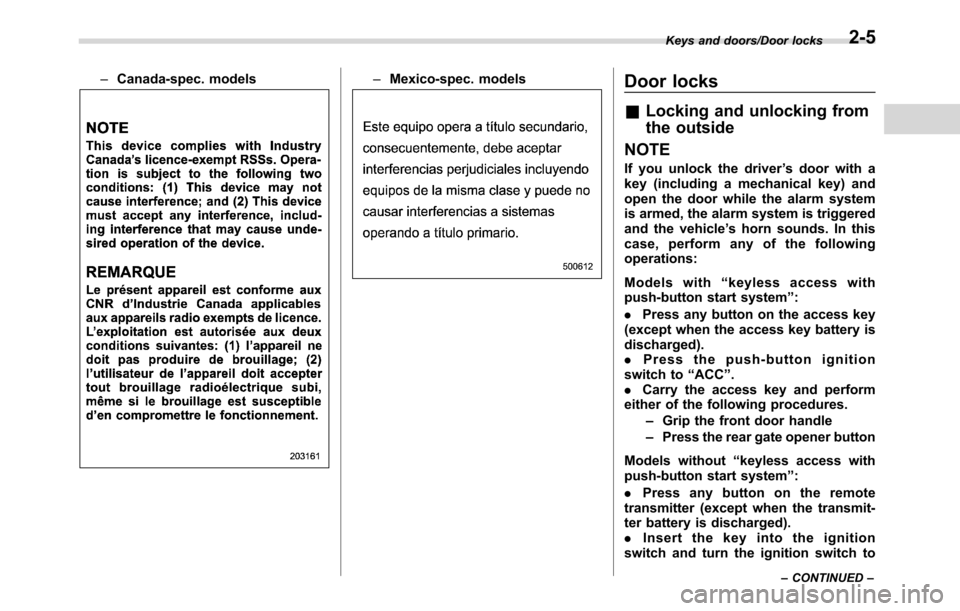
–Canada-spec. models–Mexico-spec. modelsDoor locks
&Locking and unlocking from
the outside
NOTE
If you unlock the driver’s door with a
key (including a mechanical key) and
open the door while the alarm system
is armed, the alarm system is triggered
and the vehicle’s horn sounds. In this
case, perform any of the following
operations:
Models with“keyless access with
push-button start system”:
.Press any button on the access key
(except when the access key battery is
discharged).
.Press the push-button ignition
switch to“ACC”.
.Carry the access key and perform
either of the following procedures.
–Grip the front door handle
–Press the rear gate opener button
Models without“keyless access with
push-button start system”:
.Press any button on the remote
transmitter (except when the transmit-
ter battery is discharged).
.Insert the key into the ignition
switch and turn the ignition switch to
Keys and doors/Door locks
–CONTINUED–2-5
Page 105 of 572
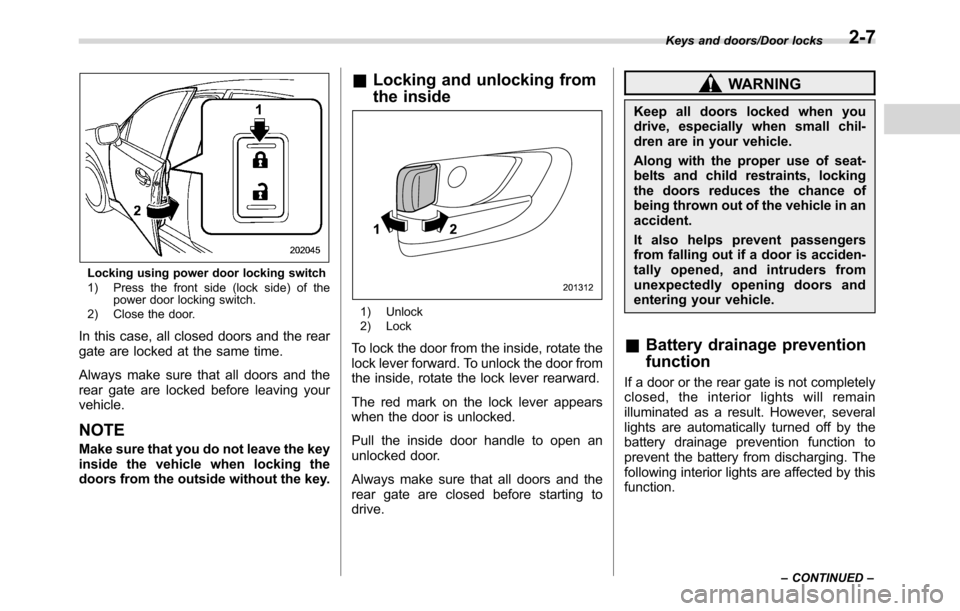
Locking using power door locking switch
1) Press the front side (lock side) of the
power door locking switch.
2) Close the door.
In this case, all closed doors and the rear
gate are locked at the same time.
Always make sure that all doors and the
rear gate are locked before leaving your
vehicle.
NOTE
Make sure that you do not leave the key
inside the vehicle when locking the
doors from the outside without the key.
&Locking and unlocking from
the inside
1) Unlock
2) Lock
To lock the door from the inside, rotate the
lock lever forward. To unlock the door from
the inside, rotate the lock lever rearward.
The red mark on the lock lever appears
when the door is unlocked.
Pull the inside door handle to open an
unlocked door.
Always make sure that all doors and the
rear gate are closed before starting to
drive.
WARNING
Keep all doors locked when you
drive, especially when small chil-
dren are in your vehicle.
Along with the proper use of seat-
belts and child restraints, locking
the doors reduces the chance of
being thrown out of the vehicle in an
accident.
It also helps prevent passengers
from falling out if a door is acciden-
tally opened, and intruders from
unexpectedly opening doors and
entering your vehicle.
&Battery drainage prevention
function
If a door or the rear gate is not completely
closed, the interior lights will remain
illuminated as a result. However, several
lights are automatically turned off by the
battery drainage prevention function to
prevent the battery from discharging. The
following interior lights are affected by this
function.
Keys and doors/Door locks
–CONTINUED–2-7
Page 106 of 572
Keys and doors/Power door locking switches
ItemSwitch
positionAutomatically turning
off
Map
lights
*1OFF*1Approximately 20
minutes later
Dome light DOORApproximately 20
minutes later
Ignition
switch light—Approximately 20
minutes later
Cargo area
lightDOORApproximately 20
minutes later
*1: The battery drainage prevention function
affects only the map lights on models with the
moonroof, and only when the map light
switches are in the OFF position. The map
lights on models without the moonroof do not
turn off automatically, so push the light switches
manually to turn them off.
The operational/non-operational setting of
this function can be changed by a
SUBARU dealer. Contact your SUBARU
dealer to change the setting.
NOTE
.The factory setting (default setting)
for this function is set as“operational”.
.When leaving the vehicle, please
make sure that all doors and the rear
gate are completely closed.
.The battery drainage prevention
function does not operate while the
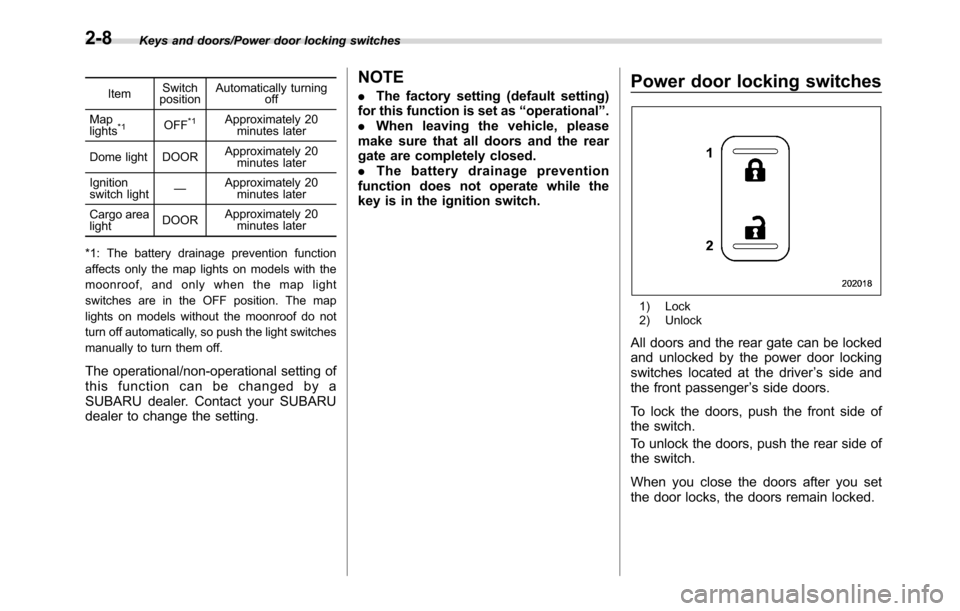
key is in the ignition switch.Power door locking switches
1) Lock
2) Unlock
All doors and the rear gate can be locked
and unlocked by the power door locking
switches located at the driver’s side and
the front passenger’s side doors.
To lock the doors, push the front side of
the switch.
To unlock the doors, push the rear side of
the switch.
When you close the doors after you set
the door locks, the doors remain locked.
2-8
Page 109 of 572
CAUTION
When you carry the access key on
an airplane, do not press the button
of the access key while in the
airplane. When any button of the
access key is pressed, radio waves
are sent and may affect the opera-
tion of the airplane. When you carry
the access key in a bag on an
airplane, take measures to prevent
the buttons of the access key from
being pressed.
NOTE
The status of the access key and
environmental conditions may interfere
with the communication between the
access key and the vehicle under the
following conditions.
.When operating near a source of
strong radio waves or other interfer-
ence, such as a broadcast station or
power transmission lines
.When products that transmit radio
waves are used, such as an access key
or a remote transmitter key of another
vehicle
.When carrying the access key of
your vehicle together with an access
key or a remote transmitter of anothervehicle
.When the access key is placed near
wireless communication equipment
such as a cell phone, or near a metallic
object
.When metallic accessories are at-
tached to the access key
.When carrying the access key with
electronic appliances such as a laptop
computer
.When the battery of the access key
is discharged
In such cases, it may not be possible to
lock or unlock the doors or start the
engine.
!Regarding malfunction
CAUTION
.Never leave or store the access
key inside the vehicle or within
6.6 ft (2 m) around the vehicle
(e.g., in the garage). The access
key may be locked inside the
vehicle, or the battery may dis-
charge rapidly. Note that the
push-button ignition switch may
not turn on in some cases de-
pending on the location of the
access key..The access key contains electro-
nic components. Observe the
following precautions to prevent
malfunctions or battery dis-
charge.
–Although you can replace the
battery of the access key by
yourself, it is recommended
that the battery be replaced by
a SUBARU dealer to avoid the
risk of damage at the time of
replacement.
–Do not get the access key wet.
If the access key gets wet,
wipe it off immediately and let
it dry completely.
–Do not apply strong impacts
to the access key.
–Keep the access key away
from magnetic sources.
–Never leave the access key in
direct sunlight or anywhere
that may become hot, such
as on the dashboard. It may
damage the battery or cause
circuit malfunctions.
–Do not wash the access key in
an ultrasonic washer.
–Do not leave the access key in
humid or dusty locations, or
Keys and doors/Keyless access with push–button start system
–CONTINUED–2-11
Page 110 of 572
Keys and doors/Keyless access with push–button start system
near personal computers or
home electric appliances.
NOTE
After the vehicle battery is discharged
or replaced, initialization of the steering
lock system may be required to start
the engine. In this case, perform the
following procedure to initialize the
steering lock.
1) Turn the push-button ignition
switch to the“OFF”position. For de-
tails, refer to“Switching power status”
F3-7.
2) Open and close the driver’s door.
3) Wait for approximately 10 seconds.
When the steering is locked, the initi-
alization is completed.
!Regarding access key
CAUTION
If the access key is dropped, the
integrated mechanical key inside
may become loose. Be careful not
to lose the mechanical key.
NOTE
.The access key is always commu-
nicating with the vehicle and is con-
tinuously using the battery. Although
the life of the battery varies depending
on the operating conditions, it is ap-
proximately 1 to 2 years. If the battery
becomes fully discharged, replace it
with a new one.
.If an access key is lost, it is
recommended that all of the remaining
access keys be reregistered. For rere-
gistration of an access key, contact a
SUBARU dealer.
.Up to 7 access keys can be regis-
tered for one vehicle. For a spare
access key, contact a SUBARU dealer.
.Carefully store the key number plate
supplied with the access key. It is
necessary for vehicle repair and addi-
tional registration of access keys.
.Do not leave the access key in the
storage spaces inside the vehicle.
Vibrations may damage the key or turn
on the switch, possibly resulting in a
lockout.
.Do not leave the access key in the
following places.
–On the instrument panel
–On the floor
–Inside the glove box
–Inside the door trim pocket–On the rear seat
–In the cargo area
If you do, the following situations
may occur.
–The access key is mistakenly
locked inside the vehicle.
–A false warning is issued
although no malfunction actually
occurs.
–No warning is issued even when
any malfunction occurs.
!Regarding setting
NOTE
.The operational/non-operational
setting for the keyless access function
can be changed. For the setting proce-
dure, refer to“Disabling keyless ac-
cess function”F2-17. The setting can
also be changed by a SUBARU dealer.
For more details, contact a SUBARU
dealer.
.For detailed information about the
operation method for the push-button
ignition switch while the keyless ac-
cess function is switched to the non-
operational mode, refer to“Access key
–if access key does not operate
properly”F9-17.
2-12