door lock SUBARU CROSSTREK 2017 1.G Owners Manual
[x] Cancel search | Manufacturer: SUBARU, Model Year: 2017, Model line: CROSSTREK, Model: SUBARU CROSSTREK 2017 1.GPages: 572, PDF Size: 41.52 MB
Page 8 of 572
How to use this Owner’s
Manual
&Using your Owner’s Manual
Before you operate your vehicle, carefully
read this manual. To protect yourself and
extend the service life of your vehicle,
follow the instructions in this manual.
Failure to observe these instructions may
result in serious injury and damage to your
vehicle.
This manual is composed of fourteen
chapters. Each chapter begins with a brief
table of contents, so you can usually tell at
a glance if that chapter contains the
information you want.
Chapter 1: Seat, seatbelt and SRS
airbags
This chapter informs you how to use the
seat and seatbelt and contains precau-
tions for the SRS airbags.
Chapter 2: Keys and doors
This chapter informs you how to operate
the keys, locks and windows.
Chapter 3: Instruments and controls
This chapter informs you about the opera-
tion of instrument panel indicators and
how to use the instruments and other
switches.Chapter 4: Climate control
This chapter informs you how to operate
the climate control.
Chapter 5: Audio
This chapter informs you how to operate
your audio system.
Chapter 6: Interior equipment
This chapter informs you how to operate
interior equipment.
Chapter 7: Starting and operating
This chapter informs you how to start and
operate your SUBARU.
Chapter 8: Driving tips
This chapter informs you how to drive your
SUBARU in various conditions and ex-
plains some safety tips on driving.
Chapter 9: In case of emergency
This chapter informs you what to do if you
have a problem, such as a flat tire or
engine overheating.
Chapter 10: Appearance care
This chapter informs you how to keep your
SUBARU looking good.
Chapter 11: Maintenance and service
This chapter informs you when you need
to take your SUBARU to the dealer for
scheduled maintenance and informs you
how to keep your SUBARU running
properly.Chapter 12: Specifications
This chapter informs you about dimen-
sions and capacities of your SUBARU.
Chapter 13: Consumer information and
Reporting safety defects
This chapter informs you about Uniform
tire quality grading standards and Report-
ing safety defects.
Chapter 14: Index
This is an alphabetical listing of all that’sin
this manual. You can use it to quickly find
something you want to read.
For models with EyeSight system:
For details about the EyeSight system,
refer to the Owner’s Manual supplement
for the EyeSight system.
&Safety warnings
You will find a number of WARNINGs,
CAUTIONs and NOTEs in this manual.
These safety warnings alert you to poten-
tial hazards that could result in injury to
you or others.
Please read these safety warnings as well
as all other portions of this manual care-
fully in order to gain a better understand-
ing of how to use your SUBARU vehicle
safely.
2
Page 11 of 572
.The SRS airbags deploy with
considerable speed and force.
Occupants who are out of proper
position when the SRS airbag
deploys could suffer very serious
injuries. Because the SRS airbag
needs enough space for deploy-
ment, the driver should always
sit upright and well back in the
seat as far from the steering
wheel as practical while still
maintaining full vehicle control
and the front passenger should
move the seat as far back as
possible and sit upright and well
back in the seat.
For instructions and precautions, carefully
read the following sections.
.For the seatbelt system, refer to“Seat-
belts”F1-11.
.For the SRS airbag system, refer to
“*SRS airbag (Supplemental Restraint
System airbag)”F1-37.&Child safety
WARNING
.Never hold a child on your lap or
in your arms while the vehicle is
moving. The passenger cannot
protect the child from injury in a
collision, because the child will
be caught between the passen-
ger and objects inside the vehi-
cle.
.While riding in the vehicle, in-
fants and small children should
always be placed in the REAR
seat in an infant or child restraint
system which is appropriate for
the child’s age, height and
weight. If a child is too big for a
child restraint system, the child
should sit in the REAR seat and
be restrained using the seatbelts.
According to accident statistics,
children are safer when properly
restrained in the rear seating
positions than in the front seat-
ing positions. Never allow a child
to stand up or kneel on the seat.
.Place children in the REAR seat
properly restrained at all times in
a child restraint device or in a
seatbelt. The SRS airbag deployswith considerable speed and
force and can injure or even kill
children, especially if they are
not restrained or improperly re-
strained. Because children are
lighter and weaker than adults,
their risk of being injured from
deployment is greater.
.NEVER INSTALL A FORWARD
OR REARWARD FACING CHILD
SEAT IN THE FRONT SEAT.
DOING SO RISKS SERIOUS IN-
JURY OR DEATH TO THE CHILD
BY PLACING THE CHILD’S HEAD
TOO CLOSE TO THE SRS AIR-
BAG.
.Always turn the child safety locks
to the“LOCK”position when
children sit in the rear seat.
Serious injury could result if a
child accidentally opens the door
and falls out. Refer to“Child
safety locks”F2-33.
.Always lock the passenger’s win-
dows using the lock switch when
children are riding in the vehicle.
Failure to follow this procedure
could result in injury to a child
operating the power window. Re-
fer to“Windows”F2-34.
.Never leave unattended children,
–CONTINUED–
5
Page 12 of 572
adults or animals in the vehicle.
They could accidentally injure
themselves or others through
inadvertent operation of the ve-
hicle. Also, on hot or sunny days,
temperature in a closed vehicle
could quickly become high en-
ough to cause severe or possibly
fatal injuries to them.
.When leaving the vehicle, close
all windows and lock all doors.
For instructions and precautions, carefully
read the following sections.
.For the seatbelt system, refer to“Seat-
belts”F1-11.
.For the child restraint system, refer to
“Child restraint systems”F1-24.
.For the SRS airbag system, refer to
“*SRS airbag (Supplemental Restraint
System airbag)”F1-37.
&Engine exhaust gas (carbon
monoxide)
WARNING
.Never inhale engine exhaust gas.
Engine exhaust gas contains
carbon monoxide, a colorless
and odorless gas which is dan-
gerous, or even lethal, if inhaled..Always properly maintain the en-
gine exhaust system to prevent
engine exhaust gas from enter-
ing the vehicle.
.Never run the engine in a closed
space, such as a garage, except
for the brief time needed to drive
the vehicle in or out of it.
.Avoid remaining in a parked
vehicle for a lengthy time while
the engine is running. If that is
unavoidable, then use the venti-
lation fan to force fresh air into
the vehicle.
.Always keep the front ventilator
inlet grille free from snow, leaves
or other obstructions to ensure
that the ventilation system al-
ways works properly.
.If at any time you suspect that
exhaust fumes are entering the
vehicle, have the problem
checked and corrected as soon
as possible. If you must drive
under these conditions, drive
only with all windows fully open.
.Keep the rear gate closed while
driving to prevent exhaust gas
from entering the vehicle.
&Drinking and driving
WARNING
Drinking and then driving is very
dangerous. Alcohol in the blood-
stream delays your reaction time
and impairs your perception, judg-
ment and attentiveness. If you drive
after drinking–even if you drink just
a little–it will increase the risk of
being involved in a serious or fatal
accident, injuring or killing yourself,
your passengers and others. In
addition, if you are injured in the
accident, alcohol may increase the
severity of that injury.
Please don’t drink and drive.
Drunken driving is one of the most
frequent causes of accidents. Since alco-
hol affects all people differently, you may
have consumed too much alcohol to drive
safely even if the level of alcohol in your
blood is below the legal limit. The safest
thing you can do is never drink and drive.
However if you have no choice but to
drive, stop drinking and sober up comple-
tely before getting behind the wheel.
6
Page 18 of 572
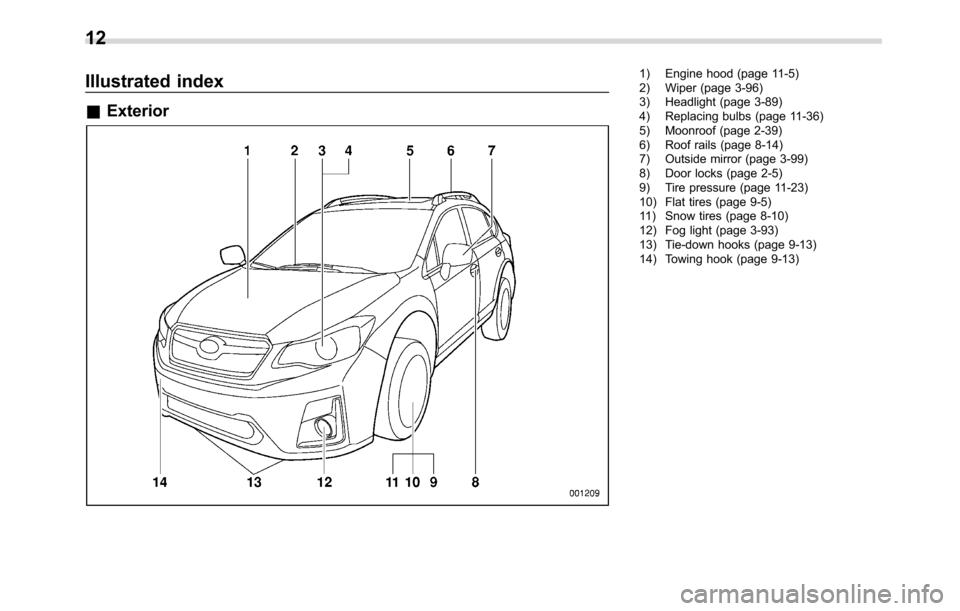
Illustrated index
&Exterior
1) Engine hood (page 11-5)
2) Wiper (page 3-96)
3) Headlight (page 3-89)
4) Replacing bulbs (page 11-36)
5) Moonroof (page 2-39)
6) Roof rails (page 8-14)
7) Outside mirror (page 3-99)
8) Door locks (page 2-5)
9) Tire pressure (page 11-23)
10) Flat tires (page 9-5)
11) Snow tires (page 8-10)
12) Fog light (page 3-93)
13) Tie-down hooks (page 9-13)
14) Towing hook (page 9-13)
12
Page 21 of 572
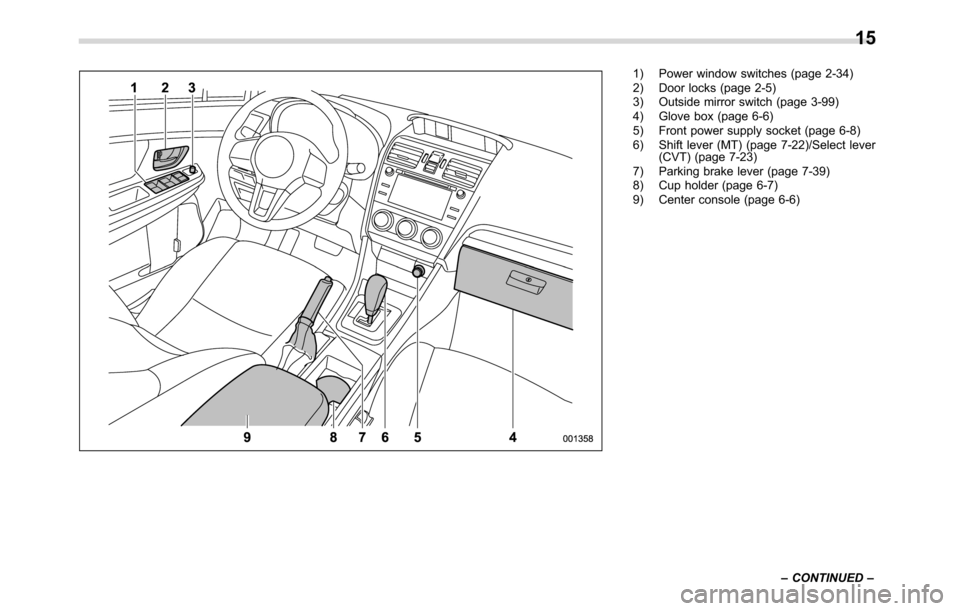
1) Power window switches (page 2-34)
2) Door locks (page 2-5)
3) Outside mirror switch (page 3-99)
4) Glove box (page 6-6)
5) Front power supply socket (page 6-8)
6) Shift lever (MT) (page 7-22)/Select lever
(CVT) (page 7-23)
7) Parking brake lever (page 7-39)
8) Cup holder (page 6-7)
9) Center console (page 6-6)
–CONTINUED–
15
Page 31 of 572
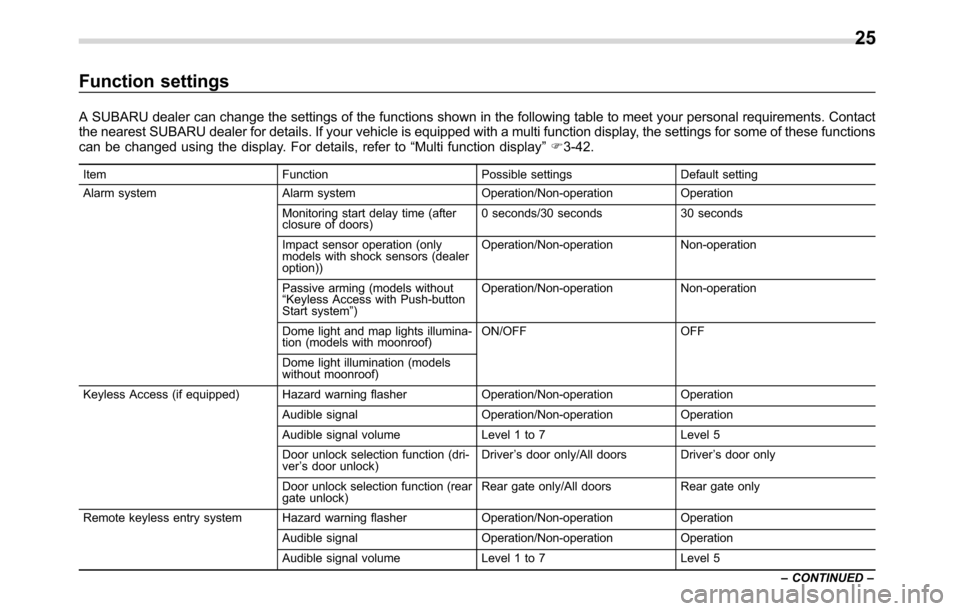
Function settings
A SUBARU dealer can change the settings of the functions shown in the following table to meet your personal requirements. Contact
the nearest SUBARU dealer for details. If your vehicle is equipped with a multi function display, the settings for some of these functions
can be changed using the display. For details, refer to“Multi function display”F3-42.
Item Function Possible settings Default setting
Alarm system Alarm system Operation/Non-operation Operation
Monitoring start delay time (after
closure of doors)0 seconds/30 seconds 30 seconds
Impact sensor operation (only
models with shock sensors (dealer
option))Operation/Non-operation Non-operation
Passive arming (models without
“Keyless Access with Push-button
Start system”)Operation/Non-operation Non-operation
Dome light and map lights illumina-
tion (models with moonroof)ON/OFF OFF
Dome light illumination (models
without moonroof)
Keyless Access (if equipped) Hazard warning flasher Operation/Non-operation Operation
Audible signal Operation/Non-operation Operation
Audible signal volume Level 1 to 7 Level 5
Door unlock selection function (dri-
ver’s door unlock)Driver’s door only/All doors Driver’s door only
Door unlock selection function (rear
gate unlock)Rear gate only/All doors Rear gate only
Remote keyless entry system Hazard warning flasher Operation/Non-operation Operation
Audible signal Operation/Non-operation Operation
Audible signal volume Level 1 to 7 Level 5
–CONTINUED–
25
Page 47 of 572
WARNING
When wearing the seatbelts, make
sure the shoulder portion of the
webbing does not pass over your
neck. If it does, adjust the seatbelt
anchor to a lower position. Placing
the shoulder belt over the neck may
result in neck injury during sudden
braking or in a collision.
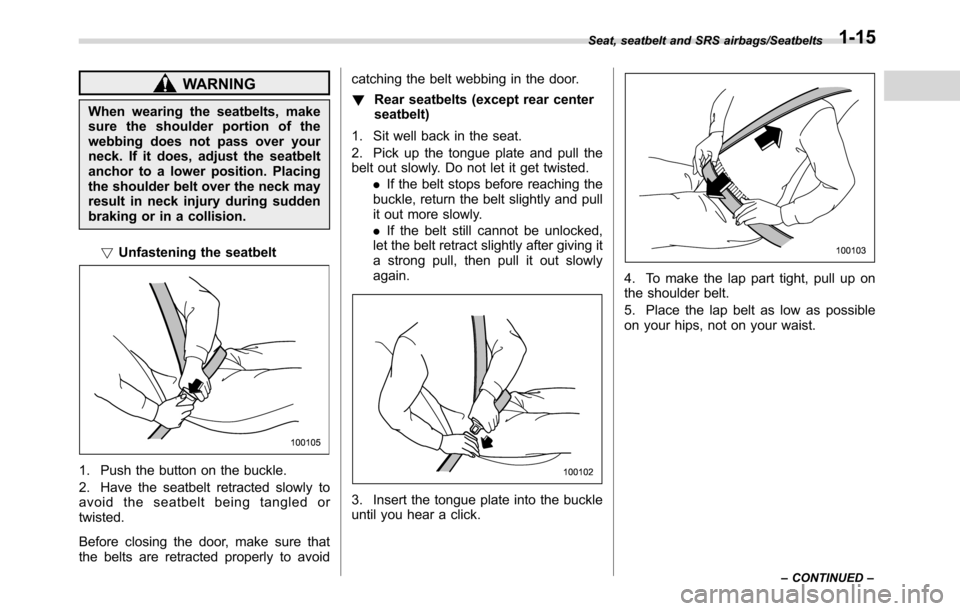
!Unfastening the seatbelt
1. Push the button on the buckle.
2. Have the seatbelt retracted slowly to
avoid the seatbelt being tangled or
twisted.
Before closing the door, make sure that
the belts are retracted properly to avoidcatching the belt webbing in the door.
!Rear seatbelts (except rear center
seatbelt)
1. Sit well back in the seat.
2. Pick up the tongue plate and pull the
belt out slowly. Do not let it get twisted.
.If the belt stops before reaching the
buckle, return the belt slightly and pull
it out more slowly.
.If the belt still cannot be unlocked,
let the belt retract slightly after giving it
a strong pull, then pull it out slowly
again.
3. Insert the tongue plate into the buckle
until you hear a click.
4. To make the lap part tight, pull up on
the shoulder belt.
5. Place the lap belt as low as possible
on your hips, not on your waist.
Seat, seatbelt and SRS airbags/Seatbelts
–CONTINUED–1-15
Page 52 of 572
Seat, seatbelt and SRS airbags/Front seatbelt pretensioners
&Seatbelt maintenance
To clean the seatbelts, use a mild soap
and lukewarm water. Never bleach or dye
the belts because this could seriously
affect their strength.
Inspect the seatbelts and attachments
including the webbing and all hardware
periodically for cracks, cuts, gashes,
tears, damage, loose bolts or worn areas.
Replace the seatbelts even if only minor
damage is found.
CAUTION
.Keep the belts free of polishes,
oils, chemicals and particularly
battery acid.
.Never attempt to make modifica-
tions or changes that will prevent
the seatbelt from operating prop-
erly.
Front seatbelt pretensioners
The driver’s and front passenger’s seat-
belts have a seatbelt pretensioner. The
seatbelt pretensioners are designed to be
activated in the event of an accident
involving a moderate to severe frontal
and side collision and rollover accident.
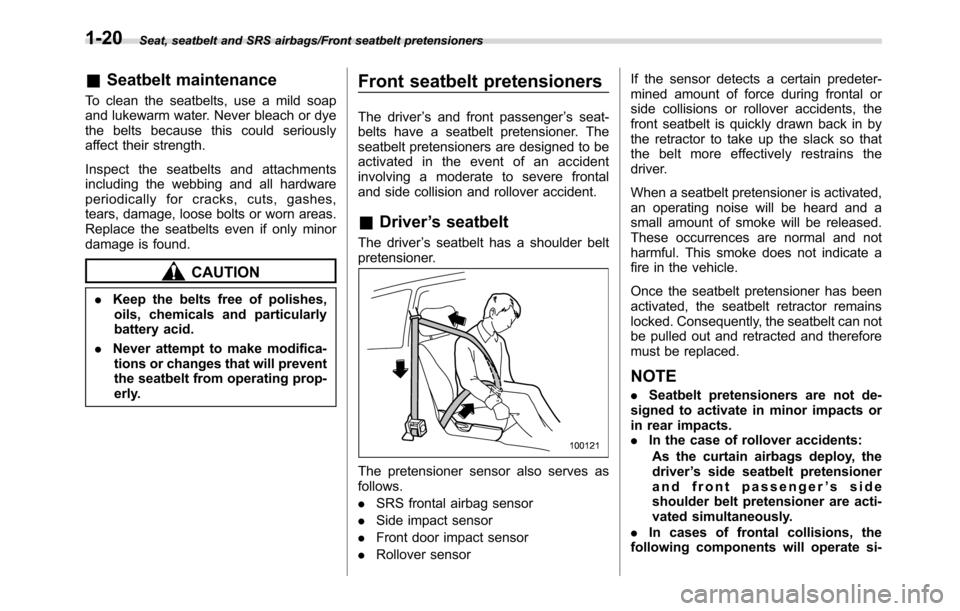
&Driver’s seatbelt
The driver’s seatbelt has a shoulder belt
pretensioner.
The pretensioner sensor also serves as
follows.
.SRS frontal airbag sensor
.Side impact sensor
.Front door impact sensor
.Rollover sensorIf the sensor detects a certain predeter-
mined amount of force during frontal or
side collisions or rollover accidents, the
front seatbelt is quickly drawn back in by
the retractor to take up the slack so that
the belt more effectively restrains the
driver.
When a seatbelt pretensioner is activated,
an operating noise will be heard and a
small amount of smoke will be released.
These occurrences are normal and not
harmful. This smoke does not indicate a
fire in the vehicle.
Once the seatbelt pretensioner has been
activated, the seatbelt retractor remains
locked. Consequently, the seatbelt can not
be pulled out and retracted and therefore
must be replaced.
NOTE
.Seatbelt pretensioners are not de-
signed to activate in minor impacts or
in rear impacts.
.In the case of rollover accidents:
As the curtain airbags deploy, the
driver’s side seatbelt pretensioner
and front passenger’sside
shoulder belt pretensioner are acti-
vated simultaneously.
.In cases of frontal collisions, the
following components will operate si-
1-20
Page 54 of 572
Seat, seatbelt and SRS airbags/Front seatbelt pretensioners
dealer.
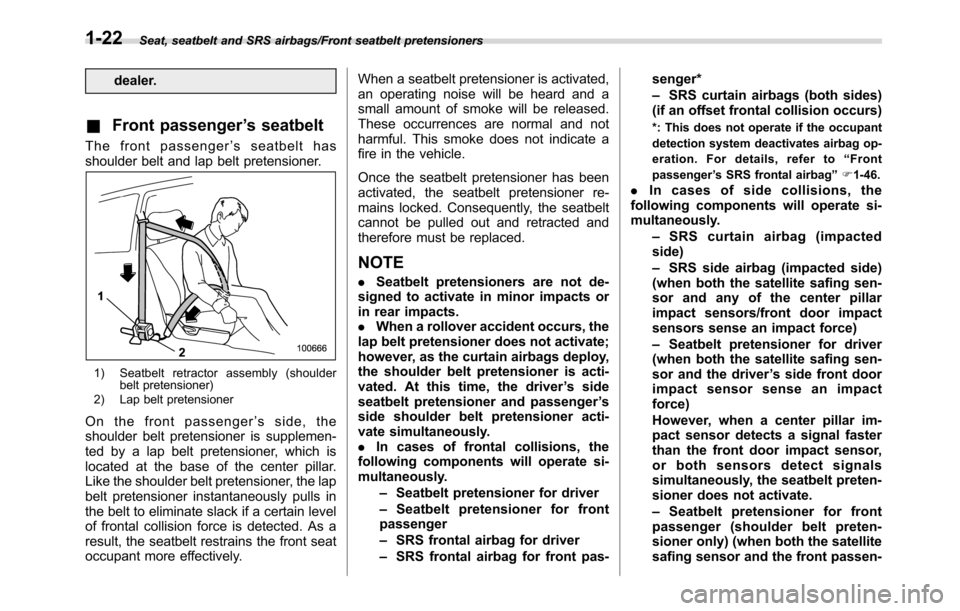
&Front passenger’s seatbelt
The front passenger’s seatbelt has
shoulder belt and lap belt pretensioner.
1) Seatbelt retractor assembly (shoulder
belt pretensioner)
2) Lap belt pretensioner
On the front passenger’s side, the
shoulder belt pretensioner is supplemen-
ted by a lap belt pretensioner, which is
located at the base of the center pillar.
Like the shoulder belt pretensioner, the lap
belt pretensioner instantaneously pulls in
the belt to eliminate slack if a certain level
of frontal collision force is detected. As a
result, the seatbelt restrains the front seat
occupant more effectively.When a seatbelt pretensioner is activated,
an operating noise will be heard and a
small amount of smoke will be released.
These occurrences are normal and not
harmful. This smoke does not indicate a
fire in the vehicle.
Once the seatbelt pretensioner has been
activated, the seatbelt pretensioner re-
mains locked. Consequently, the seatbelt
cannot be pulled out and retracted and
therefore must be replaced.
NOTE
.Seatbelt pretensioners are not de-
signed to activate in minor impacts or
in rear impacts.
.When a rollover accident occurs, the
lap belt pretensioner does not activate;
however, as the curtain airbags deploy,
the shoulder belt pretensioner is acti-
vated. At this time, the driver’s side
seatbelt pretensioner and passenger’s
side shoulder belt pretensioner acti-
vate simultaneously.
.In cases of frontal collisions, the
following components will operate si-
multaneously.
–Seatbelt pretensioner for driver
–Seatbelt pretensioner for front
passenger
–SRS frontal airbag for driver
–SRS frontal airbag for front pas-senger*
–SRS curtain airbags (both sides)
(if an offset frontal collision occurs)
*: This does not operate if the occupant
detection system deactivates airbag op-
eration. For details, refer to“Front
passenger’s SRS frontal airbag”F1-46.
.In cases of side collisions, the
following components will operate si-
multaneously.
–SRS curtain airbag (impacted
side)
–SRS side airbag (impacted side)
(when both the satellite safing sen-
sor and any of the center pillar
impact sensors/front door impact
sensors sense an impact force)
–Seatbelt pretensioner for driver
(when both the satellite safing sen-
sor and the driver’s side front door
impact sensor sense an impact
force)
However, when a center pillar im-
pact sensor detects a signal faster
than the front door impact sensor,
or both sensors detect signals
simultaneously, the seatbelt preten-
sioner does not activate.
–Seatbelt pretensioner for front
passenger (shoulder belt preten-
sioner only) (when both the satellite
safing sensor and the front passen-
1-22
Page 99 of 572
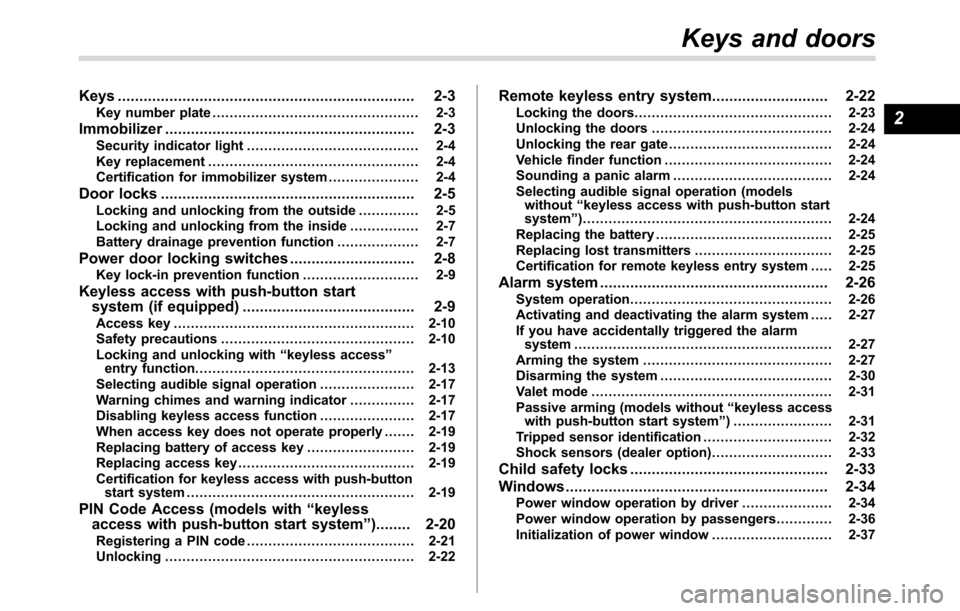
Keys..................................................................... 2-3
Key number plate................................................ 2-3
Immobilizer.......................................................... 2-3Security indicator light........................................ 2-4
Key replacement................................................. 2-4
Certification for immobilizer system..................... 2-4
Door locks........................................................... 2-5Locking and unlocking from the outside .............. 2-5
Locking and unlocking from the inside................ 2-7
Battery drainage prevention function................... 2-7
Power door locking switches............................. 2-8Key lock-in prevention function........................... 2-9
Keyless access with push-button start
system (if equipped)........................................ 2-9
Access key........................................................ 2-10
Safety precautions............................................. 2-10
Locking and unlocking with“keyless access”
entry function................................................... 2-13
Selecting audible signal operation...................... 2-17
Warning chimes and warning indicator............... 2-17
Disabling keyless access function...................... 2-17
When access key does not operate properly....... 2-19
Replacing battery of access key......................... 2-19
Replacing access key......................................... 2-19
Certification for keyless access with push-button
start system..................................................... 2-19
PIN Code Access (models with“keyless
access with push-button start system”)........ 2-20
Registering a PIN code....................................... 2-21
Unlocking.......................................................... 2-22
Remote keyless entry system........................... 2-22
Locking the doors.............................................. 2-23
Unlocking the doors.......................................... 2-24
Unlocking the rear gate...................................... 2-24
Vehicle finder function....................................... 2-24
Sounding a panic alarm..................................... 2-24
Selecting audible signal operation (models
without“keyless access with push-button start
system”).......................................................... 2-24
Replacing the battery......................................... 2-25
Replacing lost transmitters................................ 2-25
Certification for remote keyless entry system..... 2-25
Alarm system..................................................... 2-26System operation............................................... 2-26
Activating and deactivating the alarm system..... 2-27
If you have accidentally triggered the alarm
system............................................................ 2-27
Arming the system............................................ 2-27
Disarming the system........................................ 2-30
Valet mode........................................................ 2-31
Passive arming (models without“keyless access
with push-button start system”) ....................... 2-31
Tripped sensor identification.............................. 2-32
Shock sensors (dealer option)............................ 2-33
Child safety locks.............................................. 2-33
Windows............................................................. 2-34
Power window operation by driver..................... 2-34
Power window operation by passengers............. 2-36
Initialization of power window ............................ 2-37
Keys and doors
2