bumper SUBARU CROSSTREK 2018 User Guide
[x] Cancel search | Manufacturer: SUBARU, Model Year: 2018, Model line: CROSSTREK, Model: SUBARU CROSSTREK 2018Pages: 474, PDF Size: 20.76 MB
Page 342 of 474
(353,1)
北米Model "A1320BE-C" EDITED: 2017/ 10/ 10
the original.
.Safety performance is decreased
and there is increased risk of
injury to passengers in the case
of an accident if the trailer hitch
or a standard bumper beam is not
installed. One of them must al-
ways be installed on the vehicle.
.If a trailer hitch is installed, it is
not possible to install the rear
towing hook.
The maximum gross trailer weight and
maximum gross tongue weight are indi-
cated in the following table.
Maximum gross trai-
ler weightMaximum gross ton-
gue weight
1,500 lbs (680 kg)200 lbs
(90 kg)When towing a trailer, refer to“Trailer
towing”F8-16.
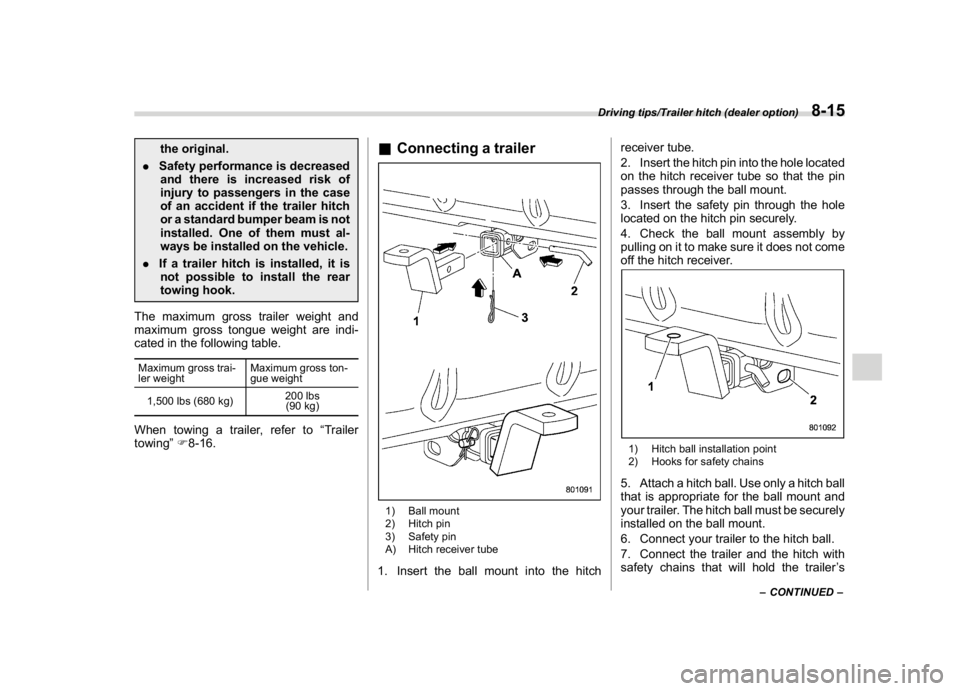
&Connecting a trailer1) Ball mount
2) Hitch pin
3) Safety pin
A) Hitch receiver tube1. Insert the ball mount into the hitchreceiver tube.
2. Insert the hitch pin into the hole located
on the hitch receiver tube so that the pin
passes through the ball mount.
3. Insert the safety pin through the hole
located on the hitch pin securely.
4. Check the ball mount assembly by
pulling on it to make sure it does not come
off the hitch receiver.
1) Hitch ball installation point
2) Hooks for safety chains5. Attach a hitch ball. Use only a hitch ball
that is appropriate for the ball mount and
your trailer. The hitch ball must be securely
installed on the ball mount.
6. Connect your trailer to the hitch ball.
7. Connect the trailer and the hitch with
safety chains that will hold the trailer’s
–CONTINUED–
Driving tips/Trailer hitch (dealer option)
8-15
8
Page 366 of 474
(377,1)
北米Model "A1320BE-C" EDITED: 2017/ 10/ 10
TowingIf towing is necessary, it is best done by
your SUBARU dealer or a commercial
towing service. Observe the following
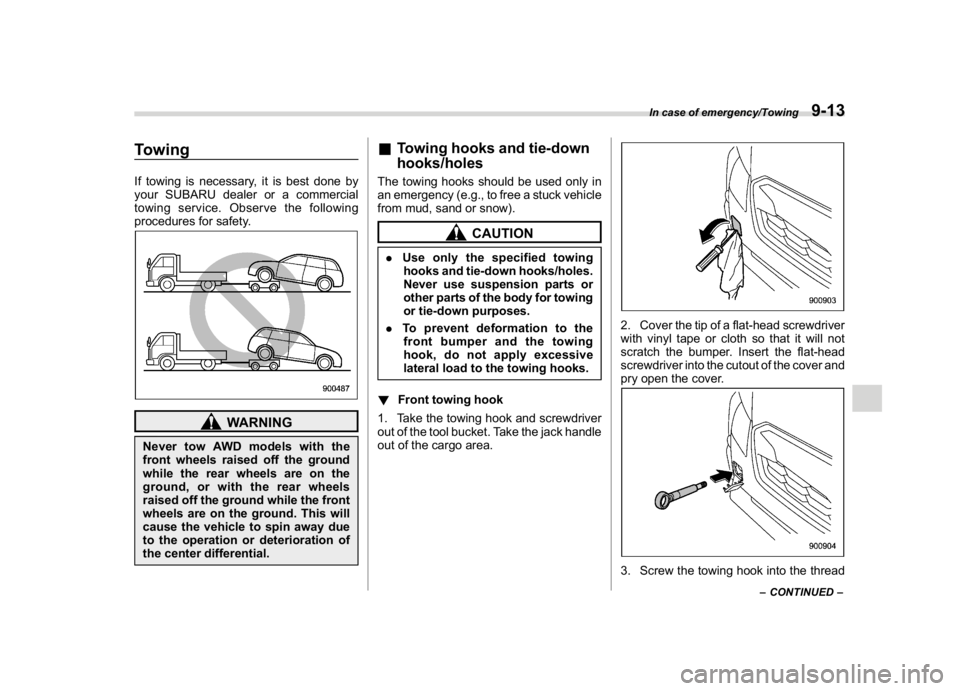
procedures for safety.
WARNING
Never tow AWD models with the
front wheels raised off the ground
while the rear wheels are on the
ground, or with the rear wheels
raised off the ground while the front
wheels are on the ground. This will
cause the vehicle to spin away due
to the operation or deterioration of
the center differential.
&Towing hooks and tie-down
hooks/holesThe towing hooks should be used only in
an emergency (e.g., to free a stuck vehicle
from mud, sand or snow).
CAUTION
.Use only the specified towing
hooks and tie-down hooks/holes.
Never use suspension parts or
other parts of the body for towing
or tie-down purposes.
.To prevent deformation to the
front bumper and the towing
hook, do not apply excessive
lateral load to the towing hooks.
!Front towing hook
1. Take the towing hook and screwdriver
out of the tool bucket. Take the jack handle
out of the cargo area.
2. Cover the tip of a flat-head screwdriver
with vinyl tape or cloth so that it will not
scratch the bumper. Insert the flat-head
screwdriver into the cutout of the cover and
pry open the cover.3. Screw the towing hook into the thread
–CONTINUED–
In case of emergency/Towing
9-13
9
Page 367 of 474
(378,1)
北米Model "A1320BE-C" EDITED: 2017/ 10/ 10
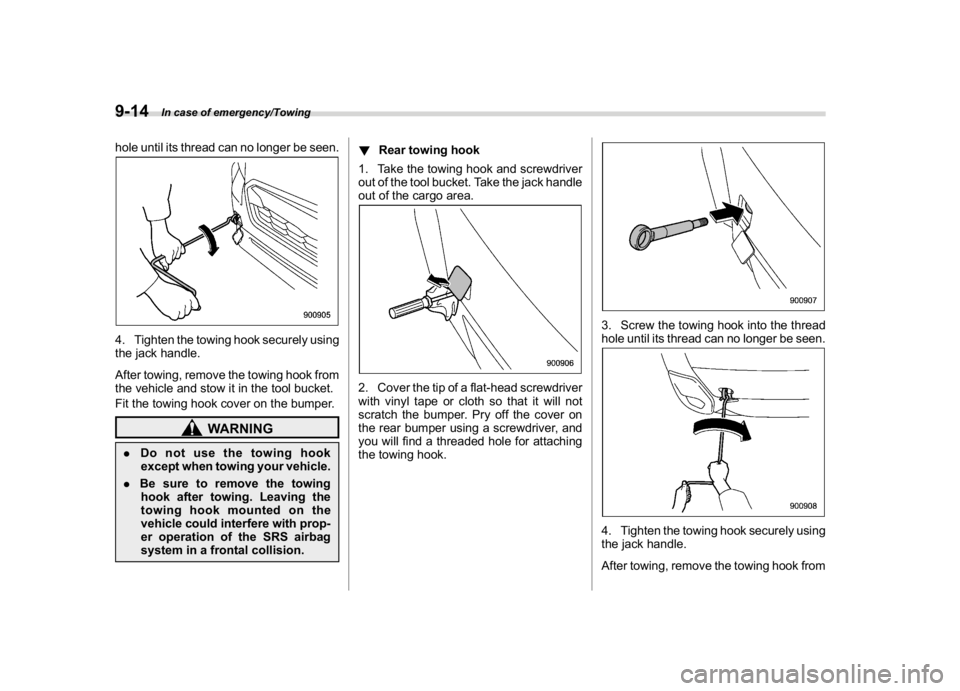
hole until its thread can no longer be seen.4. Tighten the towing hook securely using
the jack handle.
After towing, remove the towing hook from
the vehicle and stow it in the tool bucket.
Fit the towing hook cover on the bumper.
WARNING
.Do not use the towing hook
except when towing your vehicle.
.Be sure to remove the towing
hook after towing. Leaving the
towing hook mounted on the
vehicle could interfere with prop-
er operation of the SRS airbag
system in a frontal collision.!Rear towing hook
1. Take the towing hook and screwdriver
out of the tool bucket. Take the jack handle
out of the cargo area.
2. Cover the tip of a flat-head screwdriver
with vinyl tape or cloth so that it will not
scratch the bumper. Pry off the cover on
the rear bumper using a screwdriver, and
you will find a threaded hole for attaching
the towing hook.
3. Screw the towing hook into the thread
hole until its thread can no longer be seen.4. Tighten the towing hook securely using
the jack handle.
After towing, remove the towing hook from
In case of emergency/Towing
9-14
Page 368 of 474
(379,1)
北米Model "A1320BE-C" EDITED: 2017/ 10/ 10
the vehicle and stow it in the tool bucket.
Fit the towing hook cover on the bumper.
WARNING
.Do not use the towing hook
except when towing your vehicle.
.Be sure to remove the towing
hook after towing. Leaving the
towing hook mounted on the
vehicle could interfere with prop-
er operation of the fuel pump
shut off function when the vehi-
cle is struck from behind.
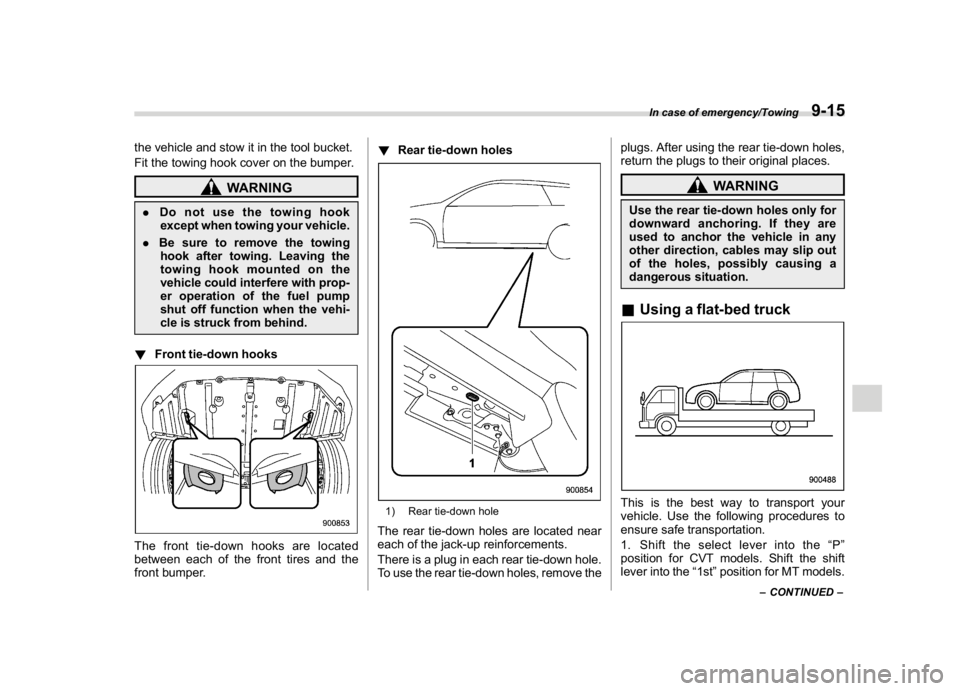
!Front tie-down hooksThe front tie-down hooks are located
between each of the front tires and the
front bumper.!Rear tie-down holes
1) Rear tie-down holeThe rear tie-down holes are located near
each of the jack-up reinforcements.
There is a plug in each rear tie-down hole.
To use the rear tie-down holes, remove theplugs. After using the rear tie-down holes,
return the plugs to their original places.
WARNING
Use the rear tie-down holes only for
downward anchoring. If they are
used to anchor the vehicle in any
other direction, cables may slip out
of the holes, possibly causing a
dangerous situation.&Using a flat-bed truckThis is the best way to transport your
vehicle. Use the following procedures to
ensure safe transportation.
1. Shift the select lever into the“P”
position for CVT models. Shift the shift
lever into the“1st”position for MT models.
–CONTINUED–
In case of emergency/Towing
9-15
9
Page 369 of 474
(380,1)
北米Model "A1320BE-C" EDITED: 2017/ 10/ 10
2. Pull up the parking brake lever firmly.
3. Secure the vehicle onto the carrier
properly with safety chains. Each safety
chain should be equally tightened and care
must be taken not to pull the chains so
tightly that the suspension bottoms out.
CAUTION
If your vehicle has a bumper under
guard (optional), be careful not to
scrape it when placing the vehicle
on the carrier and when removing
the vehicle from the carrier.
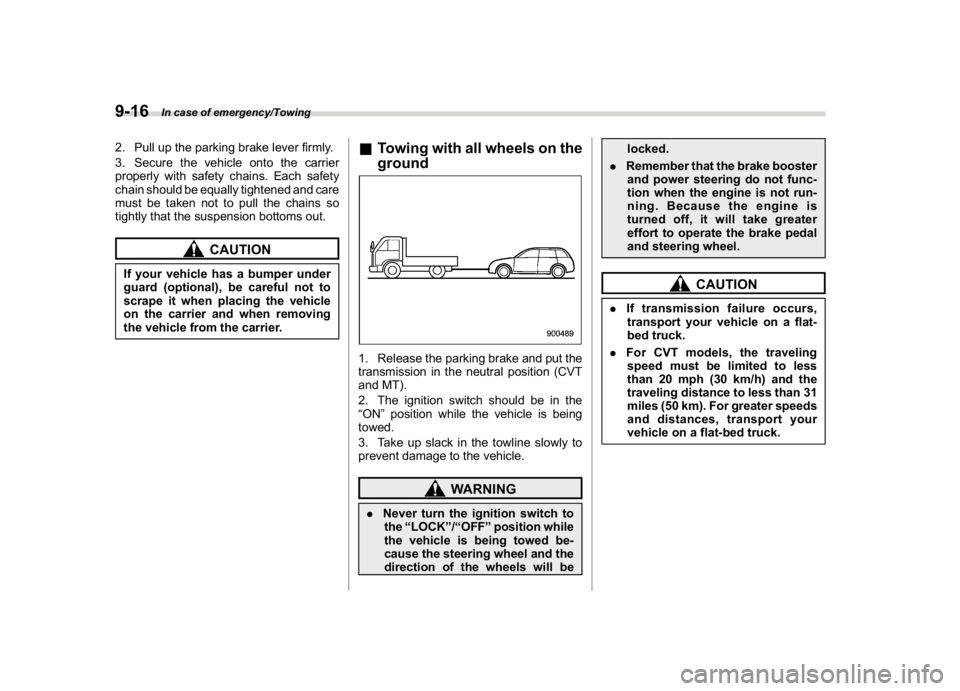
&Towing with all wheels on the
ground1. Release the parking brake and put the
transmission in the neutral position (CVT
and MT).
2. The ignition switch should be in the
“ON”position while the vehicle is being
towed.
3. Take up slack in the towline slowly to
prevent damage to the vehicle.
WARNING
.Never turn the ignition switch to
the“LOCK”/“OFF”position while
the vehicle is being towed be-
cause the steering wheel and the
direction of the wheels will belocked.
.Remember that the brake booster
and power steering do not func-
tion when the engine is not run-
ning. Because the engine is
turned off, it will take greater
effort to operate the brake pedal
and steering wheel.
CAUTION
.If transmission failure occurs,
transport your vehicle on a flat-
bed truck.
.For CVT models, the traveling
speed must be limited to less
than 20 mph (30 km/h) and the
traveling distance to less than 31
miles (50 km). For greater speeds
and distances, transport your
vehicle on a flat-bed truck.
In case of emergency/Towing
9-16
Page 375 of 474

(388,1)
北米Model "A1320BE-C" EDITED: 2017/ 10/ 10
Exterior care&Washing
CAUTION
.When washing the vehicle, the
brakes may get wet. As a result,
the brake stopping distance will
be longer. To dry the brakes, drive
the vehicle at a safe speed while
lightly depressing the brake ped-
al to heat up the brakes.
.Do not wash the engine compart-
ment and area adjacent to it. If
water enters the engine air intake
or electrical parts, it will cause
engine trouble or a malfunction
of electrical equipment.
.When washing inner fenders, un-
derbody, bumpers and protrud-
ing objects such as exhaust
pipes and exhaust finishers, be
careful to prevent injuries from
contacting sharp ends.
.Do not use any organic solvents
when washing the surface of the
bulb assembly cover. However, if
a detergent with organic solvents
is used to wash the cover sur-
face, completely rinse off the
detergent with water. Otherwise,the cover surface may be da-
maged.
.Since your vehicle is equipped
with a rear wiper, automatic car-
wash brushes could become
tangled around it, damaging the
wiper arm and other compo-
nents. Ask the automatic car-
wash operator not to let the
brushes touch the wiper arm or
to fix the wiper arm on the rear
window glass with adhesive tape
before operating the machine.
.For models with a rod-type roof
antenna, remove the antenna rod
before washing your car at a car
wash. If the antenna rod remains
attached, it may scratch the roof.
When reinstalling the removed
antenna rod, be sure to fully
tighten it.
NOTE.When having your vehicle washed in
an automatic car wash, make sure
beforehand that the car wash is of
suitable type.
.The rear view camera lens has a hard
coating to help prevent scratches.
However, when washing the vehicle or
cleaning the camera lens, be careful notto scratch the camera lens. Do not use a
washing brush directly on the camera
lens. The image quality of the rear view
camera may deteriorate.
The best way to preserve your vehicle’s
beauty is frequent washing. Wash the
vehicle at least once a month to avoid
contamination by road grime.
Wash dirt off with a wet sponge and plenty
of lukewarm or cold water. Do not wash the
vehicle with hot water and in direct sun-
light.
Salt, chemicals, insects, tar, soot, tree sap,
and bird droppings should be washed off
by using a light detergent, as required. If
you use a light detergent, make certain
that it is a neutral detergent. Do not use
strong soap or chemical detergents. All
cleaning agents should be promptly
flushed from the surface and not allowed
to dry there. Rinse the vehicle thoroughly
with plenty of lukewarm water. Wipe the
remaining water off with a chamois or soft
cloth. Wear rubber gloves and use a hand
brush when washing down underbody,
inner fenders and suspension to effec-
tively remove mud and dirt off.
Appearance care/Exterior care
10-2