engine SUBARU FORESTER 1999 Service Owner's Manual
[x] Cancel search | Manufacturer: SUBARU, Model Year: 1999, Model line: FORESTER, Model: SUBARU FORESTER 1999Pages: 345, PDF Size: 5.6 MB
Page 124 of 345
4F113 : CHECK DOOR SWITCH FUNCTION.
1) Close the rear left door.
2) Open the rear right door.
:Does the room light turn on?
: Go to step4F114.
: Go to step4F41.
4F114 : PERFORM PROGRAMMING.
NOTE:
Finish operation from step 1) through 4) within 45
seconds.
1) Sit on the driver's seat and close all doors and
the rear gate.
2) Open the driver's door.
3) Close the driver's door.
4) Turn the ignition switch from ON to LOCK ten
times in rapid succession (within 15 seconds).
NOTE:
Do not start the engine at this time.
5) The horn chirps one time to indicate that the
system has been in the programming mode.
6) Open the driver's door.
7) Close the driver's door.
8) Press any button on the transmitter that you
wish to program into the system.
9) Horn will chirp two times to indicate that the
transmitter has been programmed.
NOTE:
Any additional transmitter can also be pro-
grammed at this time. Repeat steps 6) through 9)
for an additional transmitter.
10) Remove the ignition key from the ignition
switch.
11) The horn will chirp three times to indicate that
the system has exited the programming mode.
12) Check the keyless entry system properly oper-
ates by operating each transmitter.
:Does the transmitter operate nor-
mally?
: Go to step4F115.
: Go to step4F51.4F115 : CHECK IGNITION KEY SWITCH.
1) Insert the ignition key to the ignition switch (at
LOCK position).
2) Perform lock and unlock with transmitter.
:Does the power door lock function
normally?
: Go to step4F61.
: End of basic diagnostics procedure.
62
6-2[T4F1]DIAGNOSTICS
4. Keyless Entry System
Page 146 of 345
5. DIAGNOSTICS ITEM 4
5F51 : CHECK INPUT SIGNAL FOR
STARTER MOTOR.
1) Disconnect connector from starter motor.
2) Turn ignition switch to START.
3) Measure voltage between starter motor con-
nector (B14) and engine ground.
Connector & terminal
(B14) No. 1 (+) Ð Engine ground (þ):
OBD0100A
NOTE:
IOn AT vehicles, place the select lever in the P
or N position.
IOn MT vehicles, depress the clutch pedal.
:Is the voltage more than 10 V?
: Go to step5F52.
: Go to step5F53.
5F52 : CHECK GROUND CIRCUIT OF
STARTER MOTOR.
1) Turn ignition switch to OFF.
2) Disconnect terminal from starter motor.
3) Measure resistance between ground cable ter-
minal and engine ground.
:Is the resistance less than 5W?
: Check starter motor.
: Repair or replace ground cable.
5F53 : CHECK FUSE.
Remove and visually check the fuse SBF-1 (in
main fuse box).
:Is fuse SBF-1 blown?
: Replace SBF fuse (80 A).
: Go to step5F54.5F54 : CHECK FUSE.
Remove and visually check the fuse SBF-4 (in
main fuse box).
:Is fuse SBF-4 blown?
: Replace SBF fuse (50 A).
: Go to step5F55.
5F55 : CHECK INTERRUPT RELAY.
1) Turn ignition switch to OFF.
2) Remove interrupt relay (behind the fuse box).
S6M0469
3) Check continuity between interrupt relay termi-
nals.
Terminals
No. 1 Ð No. 4:
B6M0992
:Does continuity exist?
: Go to step5F56.
: Replace interrupt relay.
84
6-2[T5F5]DIAGNOSTICS
5. Security System
Page 157 of 345
1. Precaution
A: SUPPLEMENTAL RESTRAINT
SYSTEM ªAIRBAGº
Airbag system wiring harness is routed on and
along body panels.
CAUTION:
IAll airbag system wiring harness and con-
nectors are yellow. Do not use electrical test
equipment on these circuit.
IBe careful not to damage airbag system wir-
ing harness when repairing the body panel.
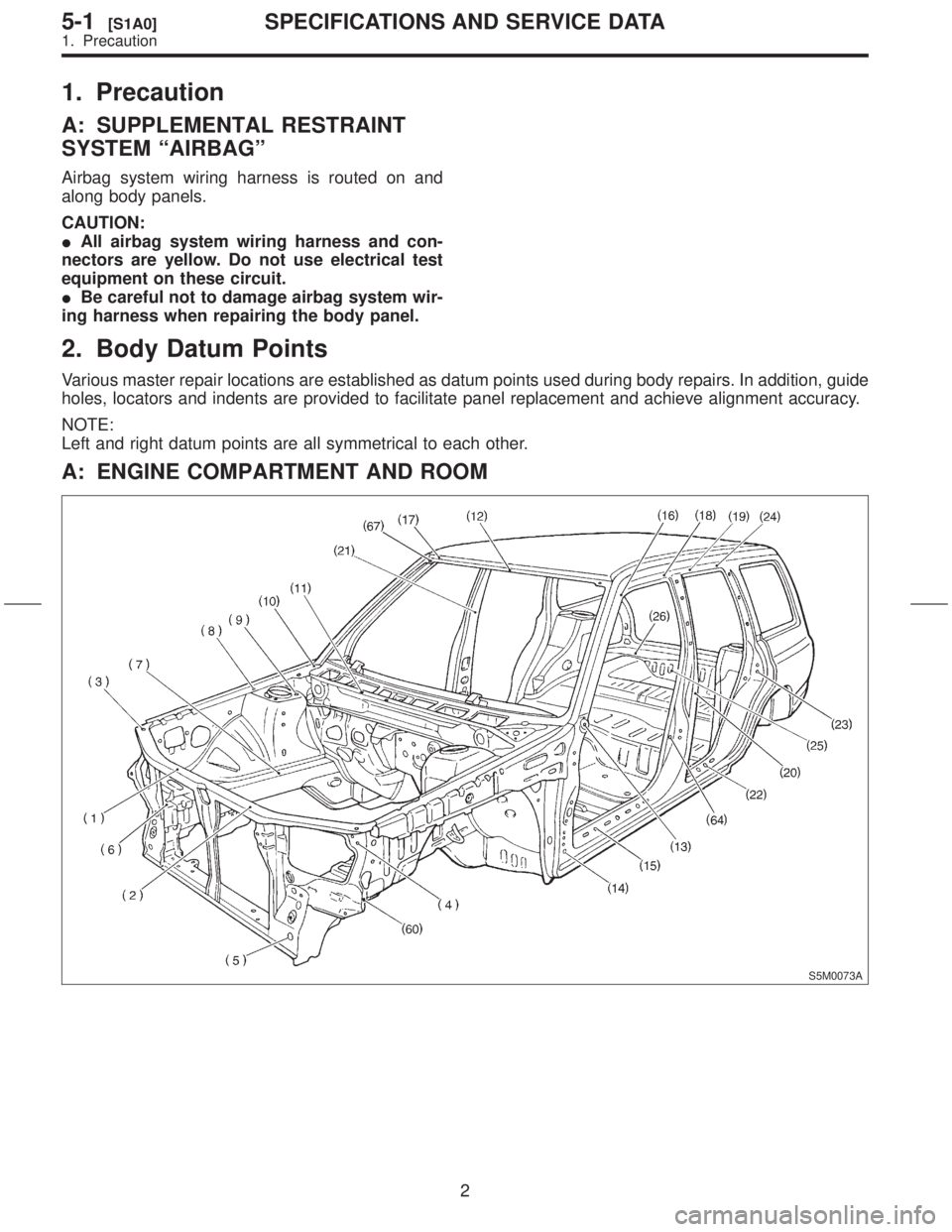
2. Body Datum Points
Various master repair locations are established as datum points used during body repairs. In addition, guide
holes, locators and indents are provided to facilitate panel replacement and achieve alignment accuracy.
NOTE:
Left and right datum points are all symmetrical to each other.
A: ENGINE COMPARTMENT AND ROOM
S5M0073A
2
5-1[S1A0]SPECIFICATIONS AND SERVICE DATA
1. Precaution
Page 158 of 345
1. Precaution
A: SUPPLEMENTAL RESTRAINT
SYSTEM ªAIRBAGº
Airbag system wiring harness is routed on and
along body panels.
CAUTION:
IAll airbag system wiring harness and con-
nectors are yellow. Do not use electrical test
equipment on these circuit.
IBe careful not to damage airbag system wir-
ing harness when repairing the body panel.
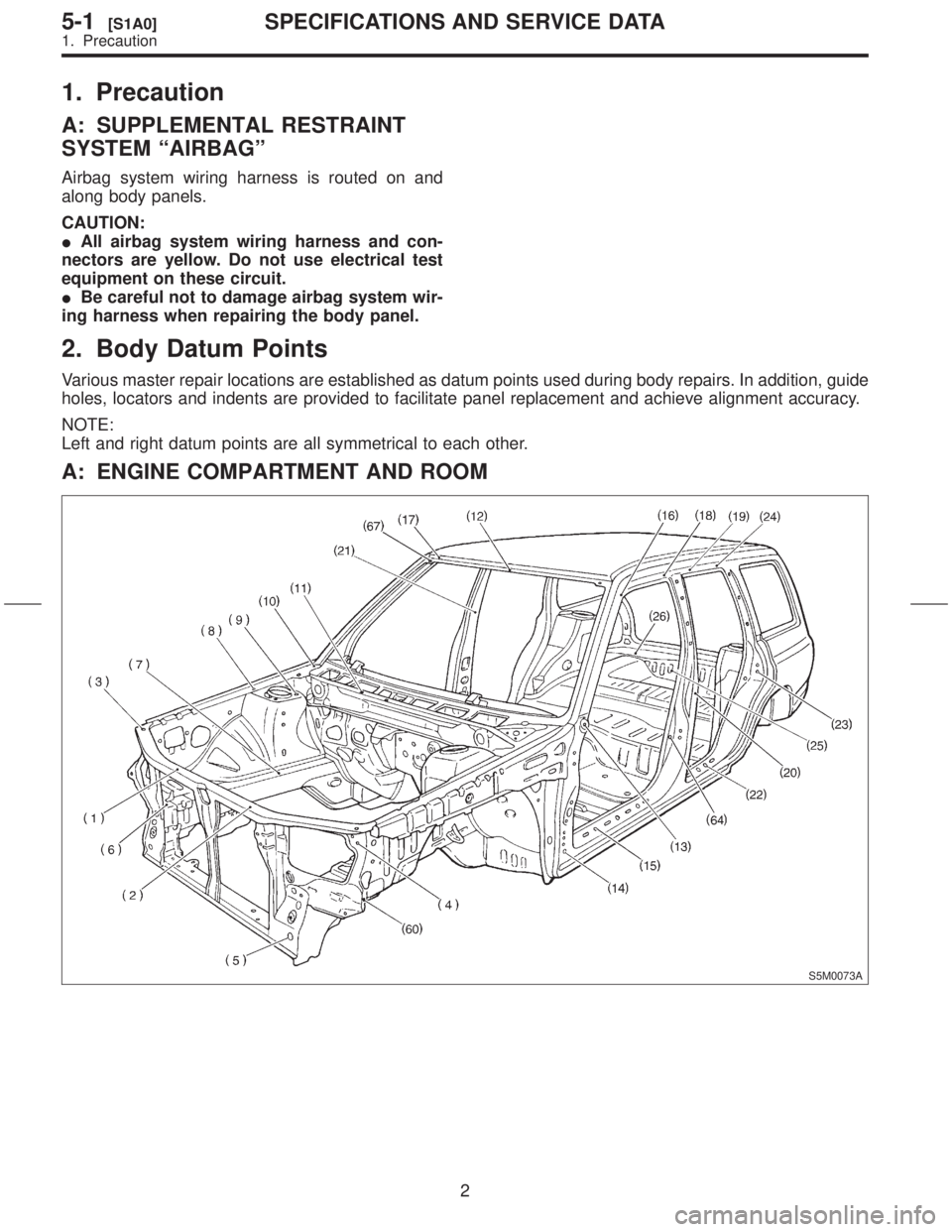
2. Body Datum Points
Various master repair locations are established as datum points used during body repairs. In addition, guide
holes, locators and indents are provided to facilitate panel replacement and achieve alignment accuracy.
NOTE:
Left and right datum points are all symmetrical to each other.
A: ENGINE COMPARTMENT AND ROOM
S5M0073A
2
5-1[S1A0]SPECIFICATIONS AND SERVICE DATA
1. Precaution
Page 186 of 345
![SUBARU FORESTER 1999 Service Owners Manual 3. RELEASE CABLE
1) Remove front grille. <Ref. to 5-1 [W12A0].>
2) Remove release cable from lock assembly.
<Ref. to 5-1 [W1A2].>
3) Remove cable clip from engine compartment.
4) While disengaging cab](/img/17/57427/w960_57427-185.png "SUBARU FORESTER 1999 Service Owners Manual 3. RELEASE CABLE
1) Remove front grille. <Ref. to 5-1 [W12A0].>
2) Remove release cable from lock assembly.
<Ref. to 5-1 [W1A2].>
3) Remove cable clip from engine compartment.
4) While disengaging cab")
3. RELEASE CABLE
1) Remove front grille.
2) Remove release cable from lock assembly.
3) Remove cable clip from engine compartment.
4) While disengaging cable from opener lever,
remove opener lever from front pillar.
S5M0149
5) Remove release cable.
6) Install in the reverse order of removal.
B: POINTS TO CHECK
1) Check striker for bending or abnormal wear.
2) Check safety lever for improper movement.
3) Check other levers and spring for rust formation
and rough movement.
G5M0140
C: ADJUSTMENT
1) Fore-aft and left-right adjustments
Loosen striker mounting bolts and adjust fore-and-
aft position of striker.
CAUTION:
Do not adjust striker position using the lock.
Doing so may result in a misaligned front grille.
G5M0143
2) Up-down adjustment
Make up-and-down adjustment of striker only
when hood does not properly contact buffer or
hood is not flush with fender, or when release cable
does not properly operate. Adjustment can be
made by adjusting the stroke length of the striker
after lock assembly mounting screws are removed.
30
5-1[W1A3]SERVICE PROCEDURE
1. Hood
Page 296 of 345

2) Disconnect connector from terminal M, and
connect positive terminal of battery and terminal M
using a lead wire and ground terminal to starter
body.
In this test set up, pinion should return to its origi-
nal position even when it is pulled out with a screw-
driver.
S6M0393A
(A) Terminal S
(B) Terminal M
2. PINION GAP
1) With pinion forced endwise on shaft, as outlined
in step 1) before
pinion gap.
Pinion gap:
0.5 Ð 2.0 mm (0.020 Ð 0.079 in)
S6M0394A
(A) Pinion
(B) Gap
(C) Stopper
If motor is running with the pinion forced endwise
on the shaft, disconnect connector from terminal M
of switch assembly and connect terminal M to
ground terminal (þ) of battery with a lead wire.
Next, gently push pinion back with your fingertips
and measure pinion gap.
2) If pinion gap is outside specified range, remove
or add number of adjustment washers used on the
mounting surface of switch assembly until correct
pinion gap is obtained.
3. PERFORMANCE TEST
The starter should be submitted to performance
tests whenever it has been overhauled, to assure
its satisfactory performance when installed on the
engine.
Three performance tests, no-load test, load test,
and lock test, are presented here; however, if the
load test and lock test cannot be performed, carry
out at least the no-load test.
For these performance tests, use the circuit shown
in figure.
S6M0395A
(A) Variable resistance
(B) Magnetic switch
(C) Starter body
1) No-load test
With switch on, adjust the variable resistance to
obtain 11 V, take the ammeter reading and mea-
sure the starter speed. Compare these values with
the specifications.
No-load test (Standard):
Voltage / Current
11V/90Amax.
Rotating speed
MT vehicles
2,800 rpm or more
AT vehicles
2,400 rpm or more
2) Load test
Apply the specified braking torque to starter. The
condition is satisfactory if the current draw and
starter speed are within specifications.
Load test (Standard):
Voltage / Load
MT vehicles
7.5 V/8.7 N´m (0.89 kg-m, 6.4 ft-lb)
AT vehicles
7.7 V/16.0 N´m (1.63 kg-m, 11.8 ft-lb)
Current / Speed
MT vehicles
300 A/890 rpm or more
AT vehicles
400 A/740 rpm or more
7
[W1B3]6-1SERVICE PROCEDURE
1. Starter
Page 305 of 345

(3) Set a new bearing and closely install a fit
tool on the bearing outer race. Press the bear-
ing down into place with a hand press or vise.
A socket wrench can serve as the tool.
(4) Install front bearing retainer.
S6M0410A
(A) Bearing
(B) Socket wrench
(C) Front bracket
D: ASSEMBLY
Assemble in the reverse order of disassembly.
1) Pulling up brush
Before assembling, press the brush down into the
brush holder with your finger and secure in that
position by passing a [2 mm (0.08 in) dia. length 4
to 5 cm (1.6 to 2.0 in)] wire (A) through the hole
shown in the figure.
CAUTION:
Be sure to remove the wire after reassembly.
S6M0411A
2) Heat the bearing box in the rear bracket [50 to
60ÉC (122 to 140ÉF)] and press the rear bearing
into the rear bracket.
CAUTION:
Grease should not be applied for the rear bear-
ing. Remove oil completely if it is found on the
bearing box.
3) After reassembly, turn the pulley by hand to
check that the rotor turns smoothly.
3. Spark Plug
A: REMOVAL AND INSTALLATION
CAUTION:
All spark plugs installed on an engine, must be
of the same heat range.
Spark plug:
CHAMPION: RC10YC4
(Alternate)
CHAMPION: RC8YC4
NGK: BKR6E-11
NIPPONDENSO: K20PR-U11
1. #1 SPARK PLUG
1) Disconnect battery ground cable.
G6M0095
2) Remove air intake duct and resonator chamber.
(1) Remove bolt which installs air intake duct
on the front side of body.
S6M0708
(2) Remove bolt which installs air intake duct
on body.
B2M2284
16
6-1[W2D0]SERVICE PROCEDURE
3. Spark Plug
Page 306 of 345

(3) Set a new bearing and closely install a fit
tool on the bearing outer race. Press the bear-
ing down into place with a hand press or vise.
A socket wrench can serve as the tool.
(4) Install front bearing retainer.
S6M0410A
(A) Bearing
(B) Socket wrench
(C) Front bracket
D: ASSEMBLY
Assemble in the reverse order of disassembly.
1) Pulling up brush
Before assembling, press the brush down into the
brush holder with your finger and secure in that
position by passing a [2 mm (0.08 in) dia. length 4
to 5 cm (1.6 to 2.0 in)] wire (A) through the hole
shown in the figure.
CAUTION:
Be sure to remove the wire after reassembly.
S6M0411A
2) Heat the bearing box in the rear bracket [50 to
60ÉC (122 to 140ÉF)] and press the rear bearing
into the rear bracket.
CAUTION:
Grease should not be applied for the rear bear-
ing. Remove oil completely if it is found on the
bearing box.
3) After reassembly, turn the pulley by hand to
check that the rotor turns smoothly.
3. Spark Plug
A: REMOVAL AND INSTALLATION
CAUTION:
All spark plugs installed on an engine, must be
of the same heat range.
Spark plug:
CHAMPION: RC10YC4
(Alternate)
CHAMPION: RC8YC4
NGK: BKR6E-11
NIPPONDENSO: K20PR-U11
1. #1 SPARK PLUG
1) Disconnect battery ground cable.
G6M0095
2) Remove air intake duct and resonator chamber.
(1) Remove bolt which installs air intake duct
on the front side of body.
S6M0708
(2) Remove bolt which installs air intake duct
on body.
B2M2284
16
6-1[W2D0]SERVICE PROCEDURE
3. Spark Plug
Page 310 of 345
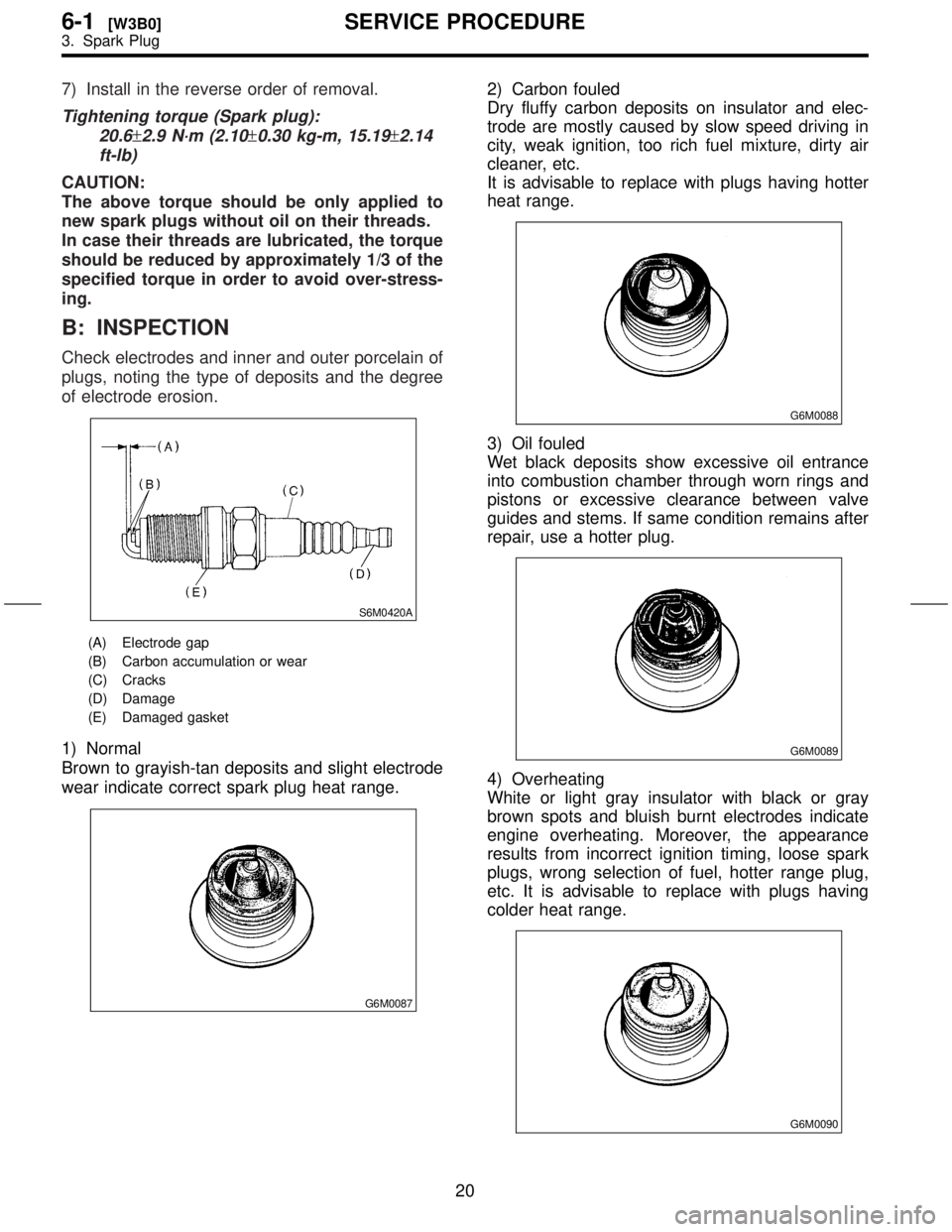
7) Install in the reverse order of removal.
Tightening torque (Spark plug):
20.6
±2.9 N´m (2.10±0.30 kg-m, 15.19±2.14
ft-lb)
CAUTION:
The above torque should be only applied to
new spark plugs without oil on their threads.
In case their threads are lubricated, the torque
should be reduced by approximately 1/3 of the
specified torque in order to avoid over-stress-
ing.
B: INSPECTION
Check electrodes and inner and outer porcelain of
plugs, noting the type of deposits and the degree
of electrode erosion.
S6M0420A
(A) Electrode gap
(B) Carbon accumulation or wear
(C) Cracks
(D) Damage
(E) Damaged gasket
1) Normal
Brown to grayish-tan deposits and slight electrode
wear indicate correct spark plug heat range.
G6M0087
2) Carbon fouled
Dry fluffy carbon deposits on insulator and elec-
trode are mostly caused by slow speed driving in
city, weak ignition, too rich fuel mixture, dirty air
cleaner, etc.
It is advisable to replace with plugs having hotter
heat range.
G6M0088
3) Oil fouled
Wet black deposits show excessive oil entrance
into combustion chamber through worn rings and
pistons or excessive clearance between valve
guides and stems. If same condition remains after
repair, use a hotter plug.
G6M0089
4) Overheating
White or light gray insulator with black or gray
brown spots and bluish burnt electrodes indicate
engine overheating. Moreover, the appearance
results from incorrect ignition timing, loose spark
plugs, wrong selection of fuel, hotter range plug,
etc. It is advisable to replace with plugs having
colder heat range.
G6M0090
20
6-1[W3B0]SERVICE PROCEDURE
3. Spark Plug
Page 315 of 345
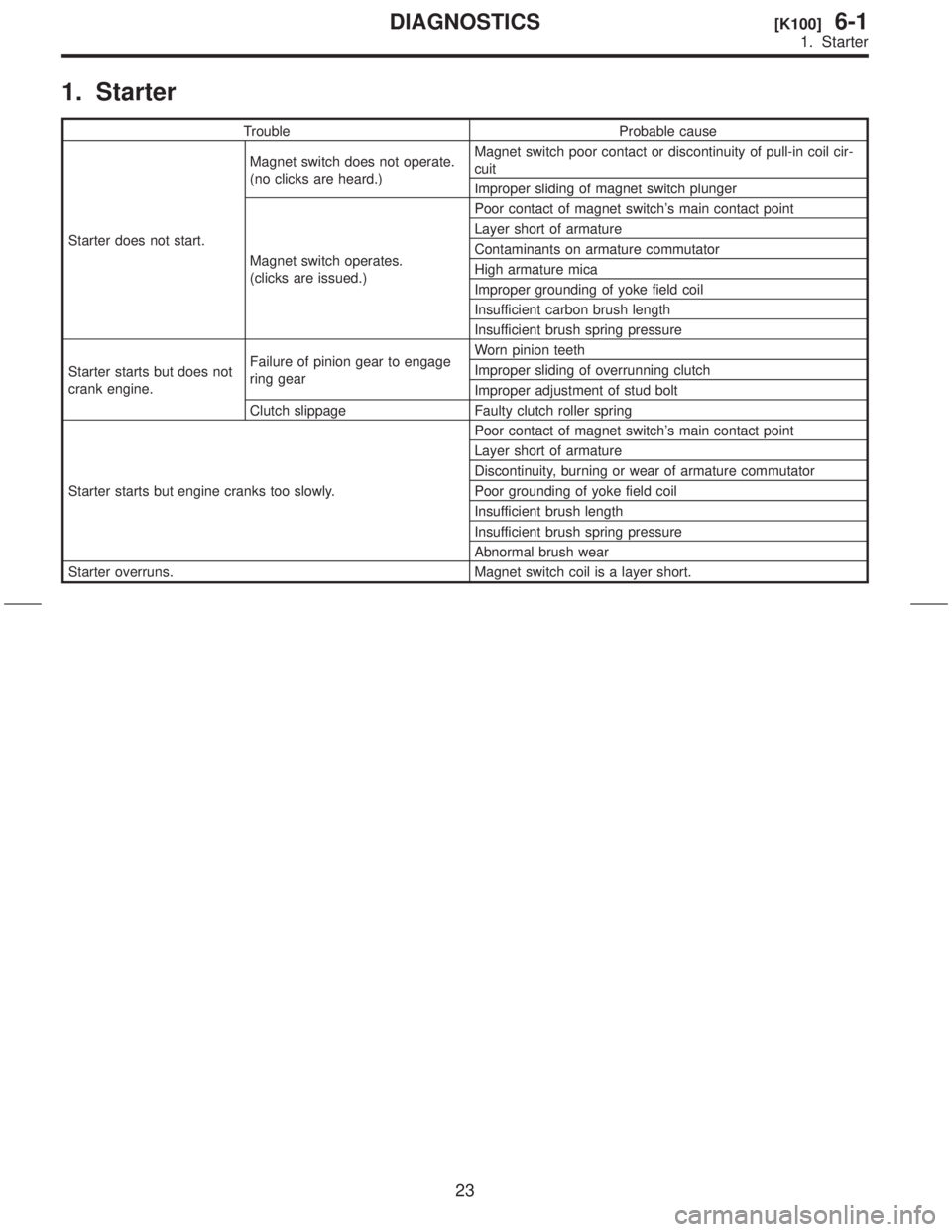
1. Starter
Trouble Probable cause
Starter does not start.Magnet switch does not operate.
(no clicks are heard.)Magnet switch poor contact or discontinuity of pull-in coil cir-
cuit
Improper sliding of magnet switch plunger
Magnet switch operates.
(clicks are issued.)Poor contact of magnet switch's main contact point
Layer short of armature
Contaminants on armature commutator
High armature mica
Improper grounding of yoke field coil
Insufficient carbon brush length
Insufficient brush spring pressure
Starter starts but does not
crank engine.Failure of pinion gear to engage
ring gearWorn pinion teeth
Improper sliding of overrunning clutch
Improper adjustment of stud bolt
Clutch slippage Faulty clutch roller spring
Starter starts but engine cranks too slowly.Poor contact of magnet switch's main contact point
Layer short of armature
Discontinuity, burning or wear of armature commutator
Poor grounding of yoke field coil
Insufficient brush length
Insufficient brush spring pressure
Abnormal brush wear
Starter overruns. Magnet switch coil is a layer short.
23
[K100]6-1DIAGNOSTICS
1. Starter