sensor SUBARU FORESTER 2004 Service Owners Manual
[x] Cancel search | Manufacturer: SUBARU, Model Year: 2004, Model line: FORESTER, Model: SUBARU FORESTER 2004Pages: 2870, PDF Size: 38.67 MB
Page 516 of 2870
EI-40
EXTERIOR/INTERIOR TRIM
Instrument Panel Assembly
16.Instrument Panel Assembly
A: REMOVAL
CAUTION:
All airbag system wiring harness and connec-
tors are colored yellow. Do not use electrical test
equipment on these circuits.
Be careful not to damage the airbag system
harness when servicing the instrument panel.
1. REMOVAL OF INSTRUMENT PANEL
ONLY
1) Disconnect the ground cable from battery.
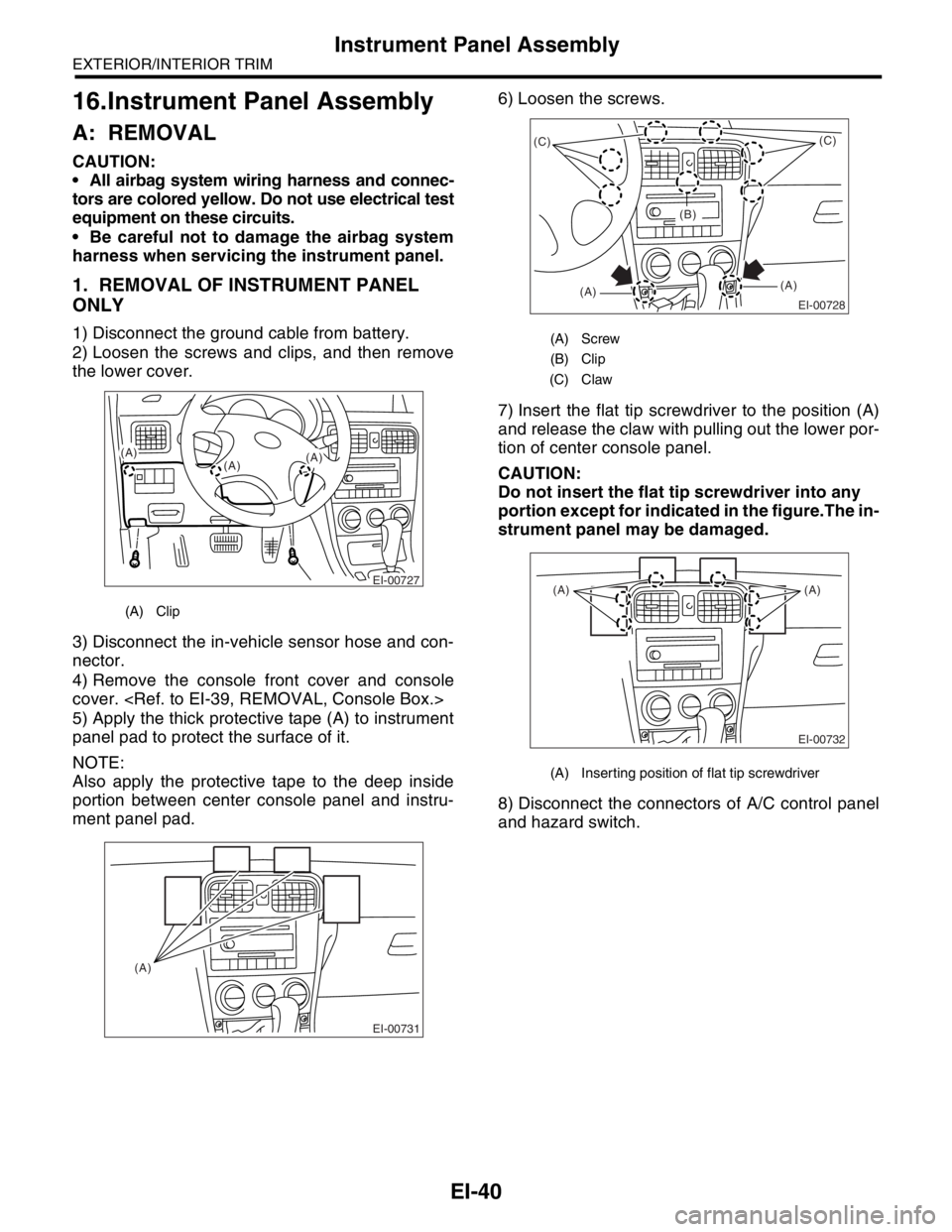
2) Loosen the screws and clips, and then remove
the lower cover.
3) Disconnect the in-vehicle sensor hose and con-
nector.
4) Remove the console front cover and console
cover.
5) Apply the thick protective tape (A) to instrument
panel pad to protect the surface of it.
NOTE:
Also apply the protective tape to the deep inside
portion between center console panel and instru-
ment panel pad.6) Loosen the screws.
7) Insert the flat tip screwdriver to the position (A)
and release the claw with pulling out the lower por-
tion of center console panel.
CAUTION:
Do not insert the flat tip screwdriver into any
portion except for indicated in the figure.The in-
strument panel may be damaged.
8) Disconnect the connectors of A/C control panel
and hazard switch.
(A) Clip
EI-00727
(A)
(A)(A)
EI-00731
(A)
(A) Screw
(B) Clip
(C) Claw
(A) Inserting position of flat tip screwdriver
EI-00728
(C)
(A)(A)(C)
(B)
EI-00732
(A) (A)
Page 576 of 2870

CC(H4SO)-8
CRUISE CONTROL SYSTEM (DIAGNOSTIC)
Cruise Control Module I/O Signal
B: WIRING DIAGRAM
Brake switch/Clutch switch
(MT model)16 Leave clutch pedal released (MT model), while cruise control main switch is
turned ON.
Then check that;
Battery voltage is present when brake pedal is released.
“0” volt is present when brake pedal is depressed.
Additionally only in MT model, keep the cruise control main switch to ON and
leave brake pedal released.
Then check that;
Battery voltage is present when clutch pedal is released.
“0” volt is present when clutch pedal is depressed.
Data link connector 17 —
Data link connector 18 —
Vehicle speed sensor (MT
model)
TCM (AT model)19 Lift-up the vehicle until all four wheels are raised off ground, and then rotate any
wheel manually.
Approx. “5” and “0” volt pulse signals are alternately input to cruise control mod-
ule.
Stop light switch 20 Turn ignition switch to OFF.
Then check that;
Battery voltage is present when brake pedal is depressed.
“0” volt is present when brake pedal is released.
NOTE:
Voltage at terminals 5, 7, 13 and 14 cannot be checked unless vehicle is driving by cruise control operation.Content Terminal No. Measuring conditions and I/O signals (ignition switch ON and engine idling)
Page 577 of 2870
CC(H4SO)-9
CRUISE CONTROL SYSTEM (DIAGNOSTIC)
Subaru Select Monitor
5. Subaru Select Monitor
A: OPERATION
1. GENERAL
The on-board diagnosis function of the cruise control
system uses an external Subaru Select Monitor.
The on-board diagnosis function operates in two cat-
egories, which are used depending on the type of
problems;
1) Cruise cancel conditions diagnosis:
(1) This category of diagnosis requires actual
vehicle driving in order to determine the cause,
(as when cruise speed is cancelled during driv-
ing although cruise cancel condition is not en-
tered).
(2) Cruise control module memory stores the
cancel condition (Code No.) which occurred dur-
ing driving. When there are plural cancel condi-
tions (Code No.), they are shown on the Subaru
Select Monitor.
CAUTION:
The cruise control memory stores not only the
cruise “cancel” which occurred (although “can-
cel” operation is not entered by the driver), but
also the “cancel” condition input by the driver.
The content of memory is cleared when igni-
tion switch or cruise main switch is turned OFF.
2) Real-time diagnosis:
The real-time diagnosis function is used to deter-
mine whether or not the input signal system is in
good order, according to signal emitted from
switches, sensors, etc.
(1) Vehicle cannot be driven at cruise speed be-
cause problem occurs in the cruise control sys-
tem or its associated circuits.
(2) Monitor the signal conditions from switches
and sensors.
2. CRUISE CANCEL CONDITIONS DIAG-
NOSIS
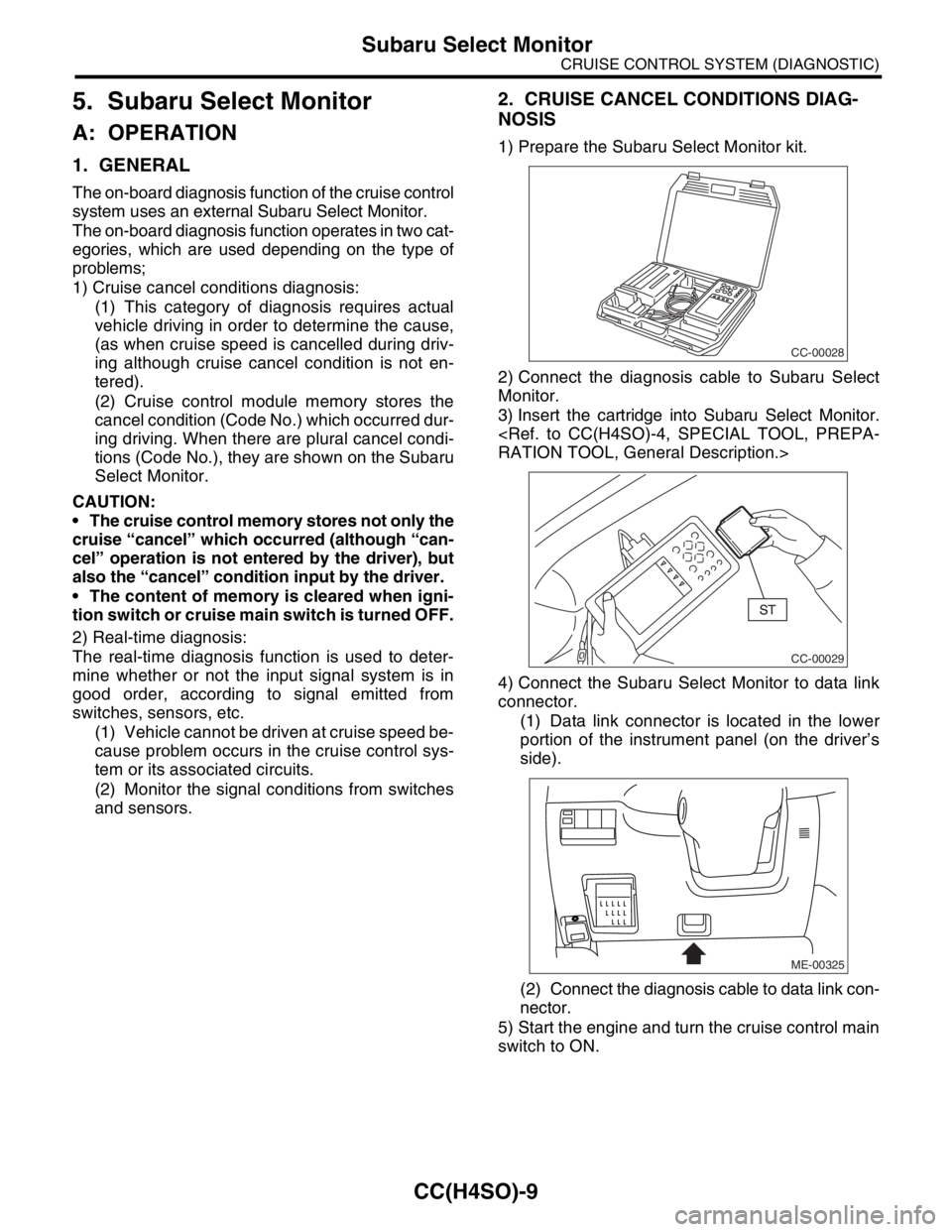
1) Prepare the Subaru Select Monitor kit.
2) Connect the diagnosis cable to Subaru Select
Monitor.
3) Insert the cartridge into Subaru Select Monitor.
4) Connect the Subaru Select Monitor to data link
connector.
(1) Data link connector is located in the lower
portion of the instrument panel (on the driver’s
side).
(2) Connect the diagnosis cable to data link con-
nector.
5) Start the engine and turn the cruise control main
switch to ON.
CC-00028
CC-00029
ME-00325
Page 579 of 2870

CC(H4SO)-11
CRUISE CONTROL SYSTEM (DIAGNOSTIC)
Diagnostic Procedure with Symptom
6. Diagnostic Procedure with Symptom
A: SYMPTOM CHART
Symptom Repair area Reference
1Cruise control main switch is
not turned ON. (1) Check the power supply.
(2) Check the cruise control
main switch.
2Cruise indicator light does not
illuminate.Check the cruise indicator
light.
3Cruise control cannot be set. (1) Check the SET/COAST
switch.
tom.>
(2) Check the stop light switch
and brake switch.
tom.>
(3) Check the clutch switch
(MT model).
(4) Check the inhibitor switch
(AT model).
(5) Check the vehicle speed
sensor.
Code (DTC).>
(6) Check the motor drive
system.
Code (DTC).>
(7) Check the motor clutch
drive system.
Code (DTC).>
4Vehicle speed is not held
within set speed ±3 km/h (±2
MPH). (1) Check the vehicle speed
sensor.
Code (DTC).>
(2) Check the motor drive
system.
Code (DTC).>
(3) Check the motor clutch
drive system.
Code (DTC).>
5Vehicle speed does not
increase or does not return to
set speed after RESUME/
ACCEL switch has been
pressed.(1) Check the RESUME/
AC CEL switch.
tom.>
(2) Check the motor drive
system.
Code (DTC).>
(3) Check the motor clutch
drive system.
Code (DTC).>
6Vehicle speed does not
decrease after SET/COAST
switch has been pressed. (1) Check the SET/COAST
switch.
tom.>
(2) Check the motor drive
system.
Code (DTC).>
(3) Check the motor clutch
drive system.
Code (DTC).>
Page 595 of 2870

CC(H4SO)-27
CRUISE CONTROL SYSTEM (DIAGNOSTIC)
List of Diagnostic Trouble Code (DTC)
7. List of Diagnostic Trouble Code (DTC)
A: LIST
DTC Item Contents of diagnosis Reference
21 Inner relay is seized. Cruise control module inner relay is seized when main
switch is OFF.
CRUISE CONTROL
MODULE BUILT-IN
RELAY, CPU RAM, Diag-
nostic Procedure with
Diagnostic Trouble Code
(DTC).>
22 Vehicle speed sensor Vehicle speed signal changes more than 10 km/h (6
MPH) within 350 ms.
SENSOR, Diagnostic Pro-
cedure with Diagnostic
Trouble Code (DTC).>
24 Cruise control module is
abnormal.Two vehicle speed values stored in cruise control module
memory are not the same.
CRUISE CONTROL
MODULE BUILT-IN
RELAY, CPU RAM, Diag-
nostic Procedure with
Diagnostic Trouble Code
(DTC).>
25 Cruise control module is
abnormal.Two output values stored in cruise control module mem-
ory are not the same.
CRUISE CONTROL
MODULE BUILT-IN
RELAY, CPU RAM, Diag-
nostic Procedure with
Diagnostic Trouble Code
(DTC).>
28 Wiring harness opened. Open wiring harness circuit is detected via control mod-
ule relay when main switch is ON.
NESS OPENED., Diag-
nostic Procedure with
Diagnostic Trouble Code
(DTC).>
35 Motor drive system is
abnormal. Motor output circuit is open or shorted.
Motor drive circuit is open or shorted.
TOR MOTOR, Diagnostic
Procedure with Diagnos-
tic Trouble Code (DTC).>
36 Trouble of motor turning
speedMotor turning speed is low.
TOR MOTOR, Diagnostic
Procedure with Diagnos-
tic Trouble Code (DTC).>
37 Motor clutch drive system
is abnormal. Motor clutch output circuit is open or shorted.
Motor clutch drive circuit is open or shorted.
MOTOR CLUTCH, Diag-
nostic Procedure with
Diagnostic Trouble Code
(DTC).>
Page 598 of 2870
CC(H4SO)-30
CRUISE CONTROL SYSTEM (DIAGNOSTIC)
Diagnostic Procedure with Diagnostic Trouble Code (DTC)
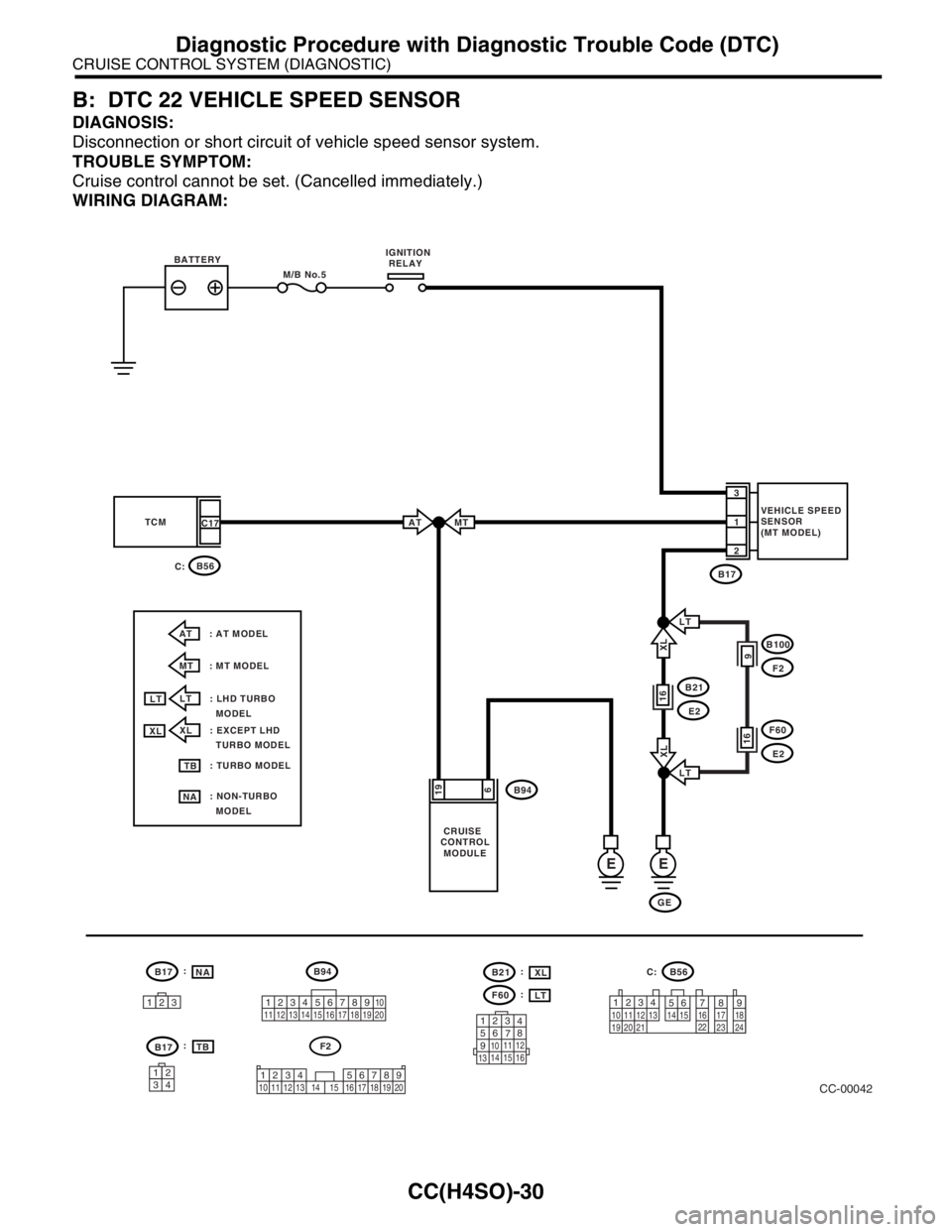
B: DTC 22 VEHICLE SPEED SENSOR
DIAGNOSIS:
Disconnection or short circuit of vehicle speed sensor system.
TROUBLE SYMPTOM:
Cruise control cannot be set. (Cancelled immediately.)
WIRING DIAGRAM:
CC-00042
BATTERY
CRUISE
CONTROL
MODULE
M/B No.5IGNITION
RELAY
B17 TCM
E
C17
B17
B21
B94E2
B56
B56 C:
GEVEHICLE SPEED
SENSOR
(MT MODEL) 1
2
3
619
B94
E
16
MT
AT : AT MODEL C:
MT : MT MODELAT
12312345678910
11 12 13 14 15 16 17 18 19 20
123
4
56
78
9
1011 12
1314 15 16
12
789 56 3410 11 12
19 20 2113 14 15 16 17 18
22
23
24
F60
E216
B100
F29
LT
LT
XLXL
LT : LHD TURBO
MODEL
XL : EXCEPT LHD
TURBO MODEL
: TURBO MODEL
: NON-TURBO
MODELXL
LT
TB
NA
B17
3412
F2
1234 5678910 11 12 13 14 15 16 17 18 19 20
NA
TB :
:
F60LT :
B21XL :
Page 599 of 2870

CC(H4SO)-31
CRUISE CONTROL SYSTEM (DIAGNOSTIC)
Diagnostic Procedure with Diagnostic Trouble Code (DTC)
Step Check Yes No
1 CHECK TRANSMISSION TYPE.Is the target MT model? Go to step 2.Go to step 6.
2 CHECK HARNESS BETWEEN BATTERY
AND VEHICLE SPEED SENSOR.
1) Turn the ignition switch to OFF.
2) Disconnect the harness connector from
vehicle speed sensor.
3) Turn the ignition switch to ON.
4) Measure the voltage between vehicle
speed sensor harness connector terminal and
chassis ground.
Connector & terminal
(B17) No. 3 (+) — Chassis ground (
−):Is the voltage more than 10 V? Go to step 3.Check the harness
for open or short
between fuse relay
and vehicle speed
sensor.
3 CHECK HARNESS BETWEEN CRUISE CON-
TROL MODULE AND VEHICLE SPEED SEN-
SOR.
1) Turn the ignition switch to OFF.
2) Disconnect the harness connector from
cruise control module.
3) Measure the resistance between vehicle
speed sensor harness connector terminal and
cruise control module harness connector ter-
minal.
Connector & terminal
(B17) No. 1 — (B94) No. 19:Is the resistance less than 10
Ω?Go to step 4.Repair the har-
ness.
4 CHECK HARNESS BETWEEN VEHICLE
SPEED SENSOR AND ENGINE GROUND.
1) Turn the ignition switch to OFF.
2) Measure the resistance between vehicle
speed sensor harness connector terminal and
engine ground.
Connector & terminal
(B17) No. 2 — Engine ground:Is the resistance less than 10
Ω?Go to step 5.Repair the har-
ness.
5 CHECK VEHICLE SPEED SENSOR.
1) Connect the harness connector to vehicle
speed sensor.
2) Lift-up the vehicle and support with rigid
racks.
3) Drive the vehicle at speed greater than 20
km/h (12 MPH).
Warning:
Be careful not to be caught up by the run-
ning wheels.
4) Measure the voltage between cruise control
module harness connector terminal and chas-
sis ground.
Connector & terminal
(B94) No. 19 (+) — Chassis ground (
−):Is the voltage less than 0 V ←
→ more than 5 V?Replace the cruise
control module.
Module.>Replace the vehi-
cle speed sensor.
6 CHECK HARNESS BETWEEN CRUISE CON-
TROL MODULE AND TCM.
1) Turn the ignition switch to OFF.
2) Disconnect the harness connector from
TCM and cruise control module.
3) Measure the resistance between cruise
control module harness connector terminal
and TCM harness connector terminal.
Connector & terminal
(B94) No. 19 — (B56) No. 17:Is the resistance less than 10
Ω?Go to step 7.Repair the har-
ness.
Page 620 of 2870
CC(H4DOTC 2.5)-8
CRUISE CONTROL SYSTEM (DIAGNOSTIC)
Subaru Select Monitor
5. Subaru Select Monitor
A: OPERATION
1. GENERAL
The on-board diagnosis function of the cruise con-
trol system uses the Subaru Select Monitor.
The on-board diagnosis function operates in two
categories, which are used depending on the type
of problems;
1) Cruise cancel conditions diagnosis:
(1) This category of diagnosis requires actual ve-
hicle driving in order to determine the cause, (as
when cruise speed is cancelled during driving al-
though cruise cancel condition is not entered).
(2) Cruise control memory of ECM stores the
cancel condition (Code No.) which occurred dur-
ing driving. When there are plural cancel condi-
tions (Code No.), they are shown on the Subaru
Select Monitor.
CAUTION:
The cruise control memory stores not only the
cruise “cancel” which occurred (although “can-
cel” operation is not entered by the driver), but
also the “cancel” condition input by the driver.
The content of memory is cleared when igni-
tion switch or cruise main switch is turned OFF.
2) Real-time diagnosis:
The real-time diagnosis function is used to deter-
mine whether or not the input signal system is in
good order, according to signal emitted from
switches, sensors, etc.
(1) Vehicle cannot be driven at cruise speed be-
cause problem occurs in the cruise control sys-
tem or its associated circuits.
(2) Monitor the signal conditions from switches
and sensors.
2. CRUISE CANCEL CONDITIONS DIAG-
NOSIS
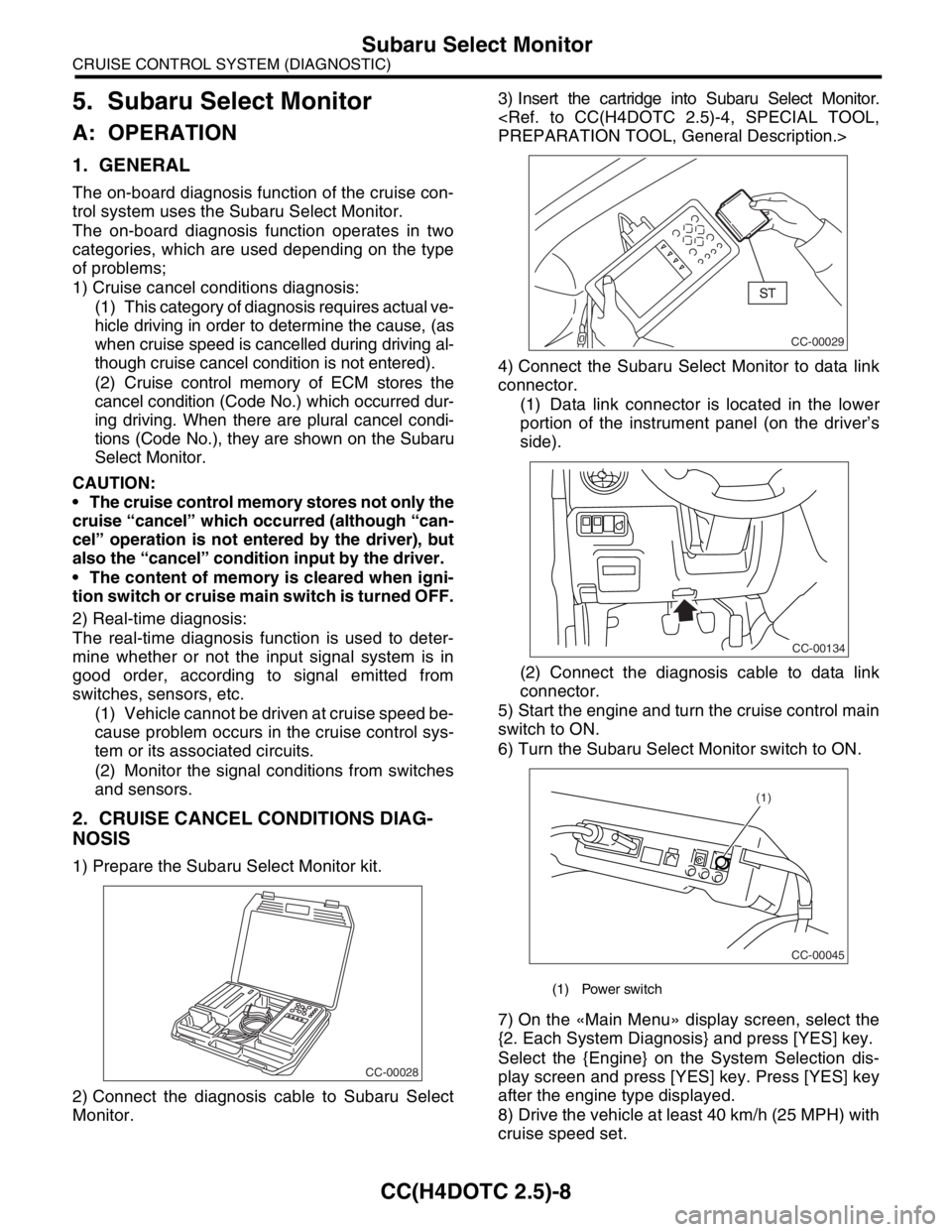
1) Prepare the Subaru Select Monitor kit.
2) Connect the diagnosis cable to Subaru Select
Monitor.3) Insert the cartridge into Subaru Select Monitor.
4) Connect the Subaru Select Monitor to data link
connector.
(1) Data link connector is located in the lower
portion of the instrument panel (on the driver’s
side).
(2) Connect the diagnosis cable to data link
connector.
5) Start the engine and turn the cruise control main
switch to ON.
6) Turn the Subaru Select Monitor switch to ON.
7) On the «Main Menu» display screen, select the
{2. Each System Diagnosis} and press [YES] key.
Select the {Engine} on the System Selection dis-
play screen and press [YES] key. Press [YES] key
after the engine type displayed.
8) Drive the vehicle at least 40 km/h (25 MPH) with
cruise speed set.
CC-00028
(1) Power switch
CC-00029
CC-00134
CC-00045
(1)
Page 622 of 2870

CC(H4DOTC 2.5)-10
CRUISE CONTROL SYSTEM (DIAGNOSTIC)
Diagnostic Procedure with Symptom
6. Diagnostic Procedure with Symptom
A: SYMPTOM CHART
Symptom Repair area Reference
1Cruise control main switch is
not turned to ON. (Cruise
indicator light does not illumi-
nate)(1) Check the cruise indicator
light.
(2) Check the cruise control
command switch.
Procedure with Diagnostic Trouble Code (DTC).>
2 Cruise control cannot be set. (1) Check the cruise control
command switch
Procedure with Diagnostic Trouble Code (DTC).>
(2) Check the stop light switch
and brake switch.
cedure with Diagnostic Trouble Code (DTC).>
(3) Check the clutch switch.
Code (DTC).>
(4) Check the neutral switch.
Trouble Code (DTC).>
(5) Check the vehicle speed
sensor.
Trouble Code (DTC).>
3Vehicle speed is not held
within set speed ±3 km/h (±2
MPH). Check the vehicle speed sen-
sor.
Trouble Code (DTC).>
4Vehicle speed does not
increase or does not return to
set speed after RESUME/
ACCEL switch has been
pressed.Check the RESUME/ACCEL
switch.
Procedure with Diagnostic Trouble Code (DTC).>
5Vehicle speed does not
decrease after SET/COAST
switch has been pressed. Check the SET/COAST
switch.
Procedure with Diagnostic Trouble Code (DTC).>
6Cruise control is not released
after CANCEL switch has
been pressed.Check the CANCEL switch.
Procedure with Diagnostic Trouble Code (DTC).>
7Cruise control is not released
after the brake pedal has
been depressed. Check the stop light switch
and brake switch.
cedure with Diagnostic Trouble Code (DTC).>
8Cruise control is not released
after the clutch pedal has
been depressed.Check the clutch switch.
Code (DTC).>
9Cruise control is not released
after shifting to neutral posi-
tion.Check the neutral switch.
Trouble Code (DTC).>
Page 626 of 2870

CC(H4DOTC 2.5)-14
CRUISE CONTROL SYSTEM (DIAGNOSTIC)
List of Diagnostic Trouble Code (DTC)
21 Cruise control switch is
abnormal when the igni-
tion switch is turned to ON.Each switch of cruise control command switch has
already been ON when the ignition switch is turned to
ON.This DTC is indicated
without operating the main
switch.
DTC 11, 15, 21 AND 24
CRUISE CONTROL
COMMAND SWITCH,
Diagnostic Procedure with
Diagnostic Trouble Code
(DTC).>
22 Vehicle speed variation is
abnormal.Abnormality of vehicle speed variation is detected.
VEHICLE SPEED SEN-
SOR, Diagnostic Proce-
dure with Diagnostic
Trouble Code (DTC).>
23 Engine-related sensor is
abnormal.Abnormality related to engine is detected.
Procedure.>
24 Cruise control-related
switch is abnormal.Abnormality of command switch is detected. (Open cir-
cuit is detected when continuing to be ON for an
extremely long time [approx. two minutes].)This DTC is indicated with
normal operation.
DTC 11, 15, 21 AND 24
CRUISE CONTROL
COMMAND SWITCH,
Diagnostic Procedure with
Diagnostic Trouble Code
(DTC).>
25 Brake switch input circuit
is abnormal.Abnormality of brake switch input circuit in ECM is
detected.
STOP LIGHT SWITCH
AND BRAKE SWITCH,
Diagnostic Procedure with
Diagnostic Trouble Code
(DTC).>
26 Engine speed signal. Abnormal increase of engine speed is detected.
Gear is shifted to neutral, 1st or reverse position.Cruise with more than 2nd
shift position.
32 Out of vehicle speed range
of cruise control operation. Vehicle speed becomes under the control limit during
cruise driving.
Set operation is conducted out of vehicle speed range
for setting
RESUME operation is conducted without vehicle
speed memory.This DTC is also indicated
when increasing the
speed to the cruise set
available vehicle speed
and conducting the set
operation again.
DTC 22 AND 32 VEHICLE
SPEED SENSOR, Diag-
nostic Procedure with
Diagnostic Trouble Code
(DTC).>
33 Prohibition of WAIT after
acceleration operation.Vehicle speed becomes over the control limit during
cruise driving.This DTC is indicated
when running at the high
speed which is not suit-
able for cruise control. In
this case, conduct the
cruise set operation again
after decreasing the
speed to the cruise set
available vehicle speed. DTC Item Contents of diagnosis Reference