sensor SUBARU FORESTER 2004 Service Repair Manual
[x] Cancel search | Manufacturer: SUBARU, Model Year: 2004, Model line: FORESTER, Model: SUBARU FORESTER 2004Pages: 2870, PDF Size: 38.67 MB
Page 814 of 2870
FU(H4SO)-32
FUEL INJECTION (FUEL SYSTEM)
Intake Air Temperature Sensor
10.Intake Air Temperature Sen-
sor
A: REMOVAL
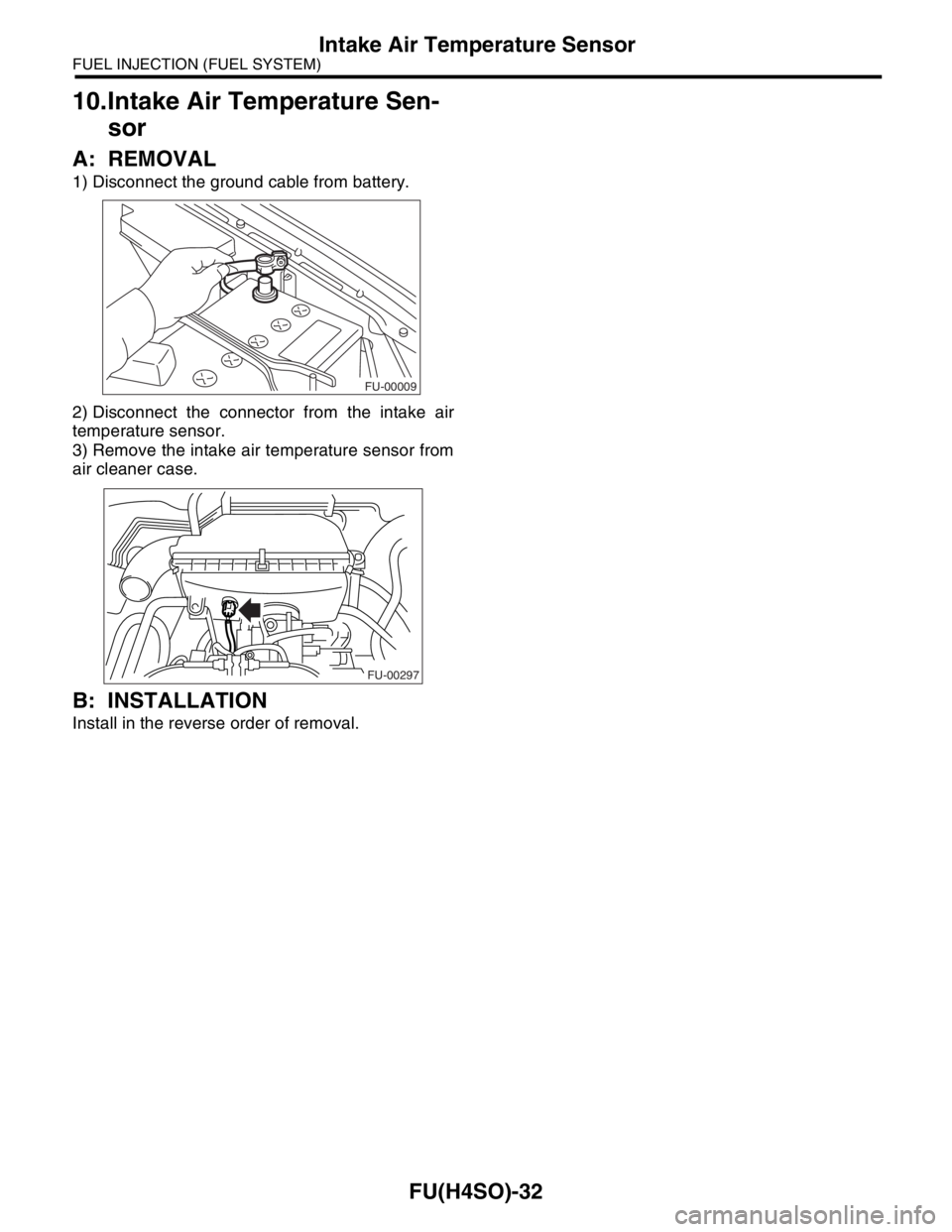
1) Disconnect the ground cable from battery.
2) Disconnect the connector from the intake air
temperature sensor.
3) Remove the intake air temperature sensor from
air cleaner case.
B: INSTALLATION
Install in the reverse order of removal.
FU-00009
FU-00297
Page 822 of 2870
FU(H4SO)-40
FUEL INJECTION (FUEL SYSTEM)
Front Oxygen (A/F) Sensor
14.Front Oxygen (A/F) Sensor
A: REMOVAL
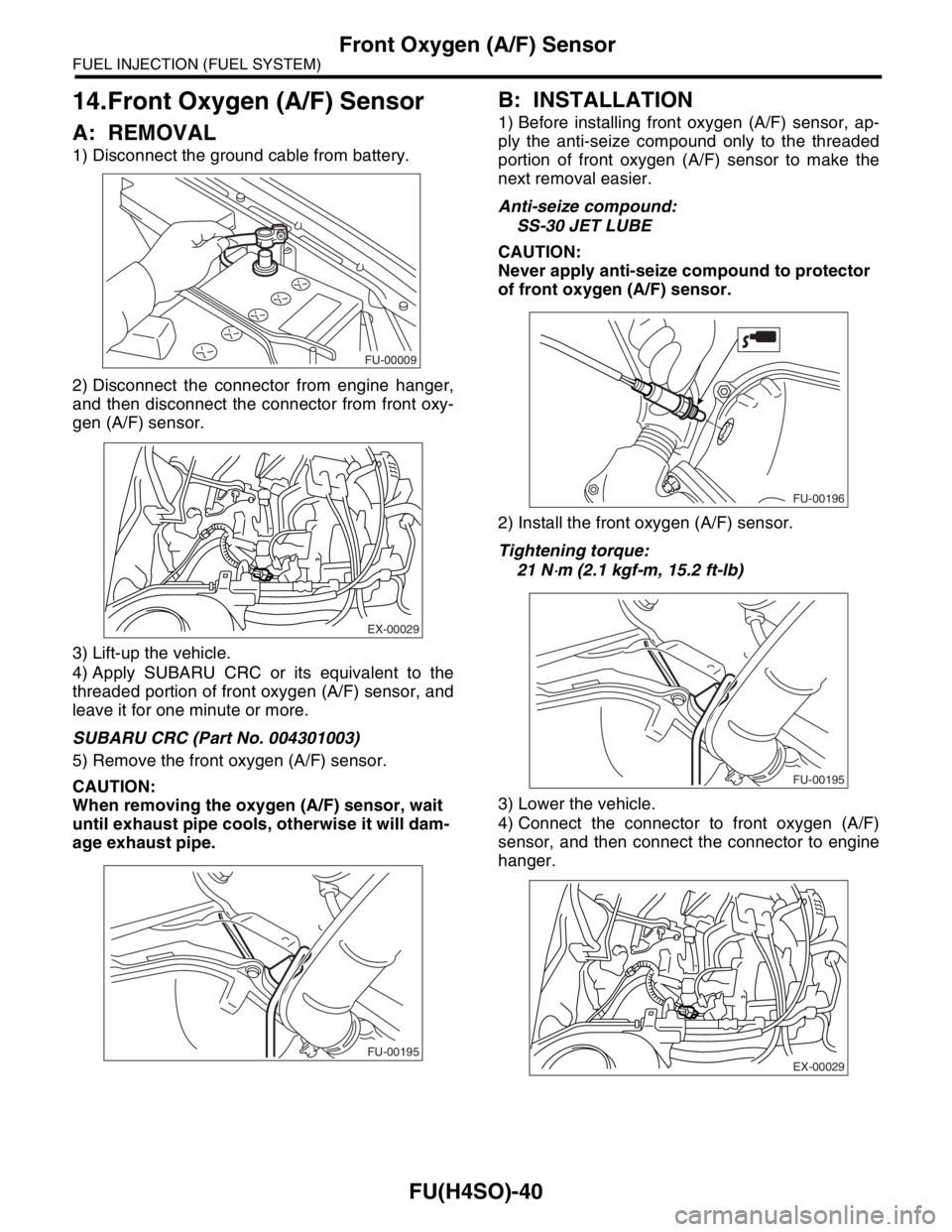
1) Disconnect the ground cable from battery.
2) Disconnect the connector from engine hanger,
and then disconnect the connector from front oxy-
gen (A/F) sensor.
3) Lift-up the vehicle.
4) Apply SUBARU CRC or its equivalent to the
threaded portion of front oxygen (A/F) sensor, and
leave it for one minute or more.
SUBARU CRC (Part No. 004301003)
5) Remove the front oxygen (A/F) sensor.
CAUTION:
When removing the oxygen (A/F) sensor, wait
until exhaust pipe cools, otherwise it will dam-
age exhaust pipe.
B: INSTALLATION
1) Before installing front oxygen (A/F) sensor, ap-
ply the anti-seize compound only to the threaded
portion of front oxygen (A/F) sensor to make the
next removal easier.
Anti-seize compound:
SS-30 JET LUBE
CAUTION:
Never apply anti-seize compound to protector
of front oxygen (A/F) sensor.
2) Install the front oxygen (A/F) sensor.
Tightening torque:
21 N
⋅m (2.1 kgf-m, 15.2 ft-lb)
3) Lower the vehicle.
4) Connect the connector to front oxygen (A/F)
sensor, and then connect the connector to engine
hanger.
FU-00009
EX-00029
FU-00195
FU-00196
FU-00195
EX-00029
Page 823 of 2870

FU(H4SO)-41
FUEL INJECTION (FUEL SYSTEM)
Front Oxygen (A/F) Sensor
5) Connect the battery ground cable to battery.
FU-00009
Page 824 of 2870
FU(H4SO)-42
FUEL INJECTION (FUEL SYSTEM)
Rear Oxygen Sensor
15.Rear Oxygen Sensor
A: REMOVAL
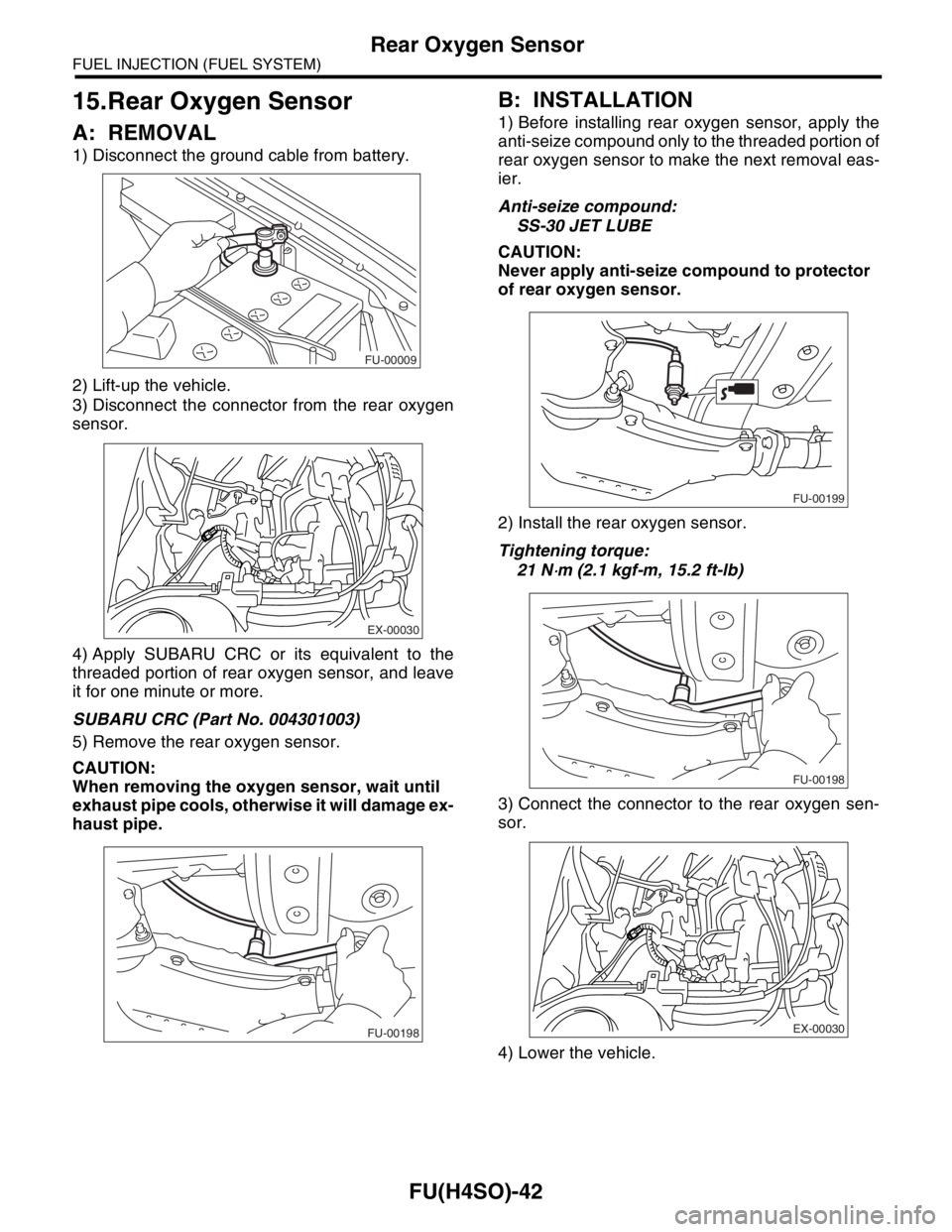
1) Disconnect the ground cable from battery.
2) Lift-up the vehicle.
3) Disconnect the connector from the rear oxygen
sensor.
4) Apply SUBARU CRC or its equivalent to the
threaded portion of rear oxygen sensor, and leave
it for one minute or more.
SUBARU CRC (Part No. 004301003)
5) Remove the rear oxygen sensor.
CAUTION:
When removing the oxygen sensor, wait until
exhaust pipe cools, otherwise it will damage ex-
haust pipe.
B: INSTALLATION
1) Before installing rear oxygen sensor, apply the
anti-seize compound only to the threaded portion of
rear oxygen sensor to make the next removal eas-
ier.
Anti-seize compound:
SS-30 JET LUBE
CAUTION:
Never apply anti-seize compound to protector
of rear oxygen sensor.
2) Install the rear oxygen sensor.
Tightening torque:
21 N
⋅m (2.1 kgf-m, 15.2 ft-lb)
3) Connect the connector to the rear oxygen sen-
sor.
4) Lower the vehicle.
FU-00009
EX-00030
FU-00198
FU-00199
FU-00198
EX-00030
Page 825 of 2870

FU(H4SO)-43
FUEL INJECTION (FUEL SYSTEM)
Rear Oxygen Sensor
5) Connect the battery ground cable to battery.
FU-00009
Page 837 of 2870
FU(H4SO)-55
FUEL INJECTION (FUEL SYSTEM)
Fuel Pump
22.Fuel Pump
A: REMOVAL
WARNING:
Place “NO FIRE” signs near the working area.
Be careful not to spill fuel.
NOTE:
Fuel pump assembly consists of fuel pump and fuel
level sensor.
1) Release the fuel pressure.
TION, Fuel.>
2) Open the fuel filler flap lid and remove fuel filler
cap.
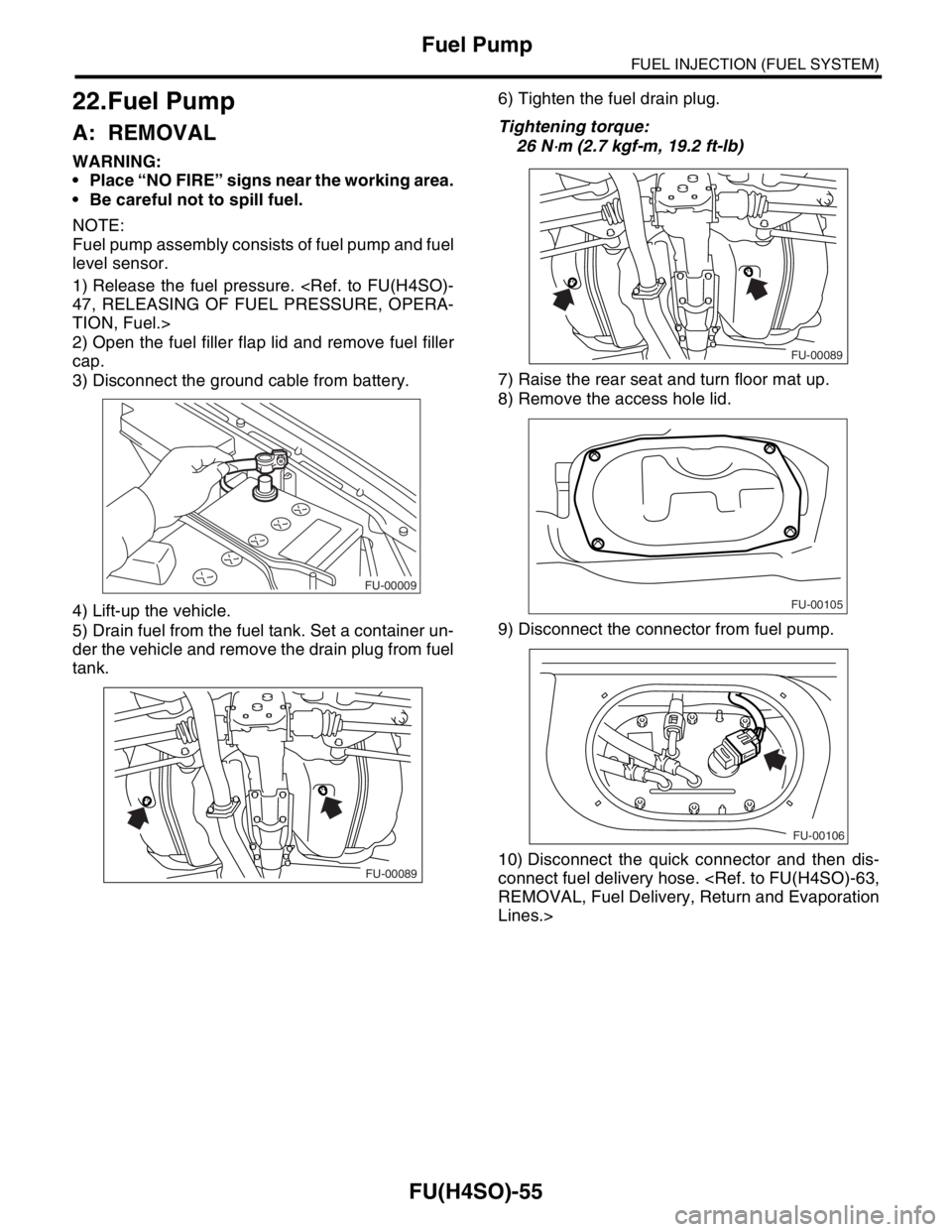
3) Disconnect the ground cable from battery.
4) Lift-up the vehicle.
5) Drain fuel from the fuel tank. Set a container un-
der the vehicle and remove the drain plug from fuel
tank.6) Tighten the fuel drain plug.
Tightening torque:
26 N
⋅m (2.7 kgf-m, 19.2 ft-lb)
7) Raise the rear seat and turn floor mat up.
8) Remove the access hole lid.
9) Disconnect the connector from fuel pump.
10) Disconnect the quick connector and then dis-
connect fuel delivery hose.
Lines.>
FU-00009
FU-00089
FU-00089
FU-00105
FU-00106
Page 839 of 2870
FU(H4SO)-57
FUEL INJECTION (FUEL SYSTEM)
Fuel Level Sensor
23.Fuel Level Sensor
A: REMOVAL
WARNING:
Place “NO FIRE” signs near the working area.
Be careful not to spill fuel.
NOTE:
Fuel level sensor is built in fuel pump assembly.
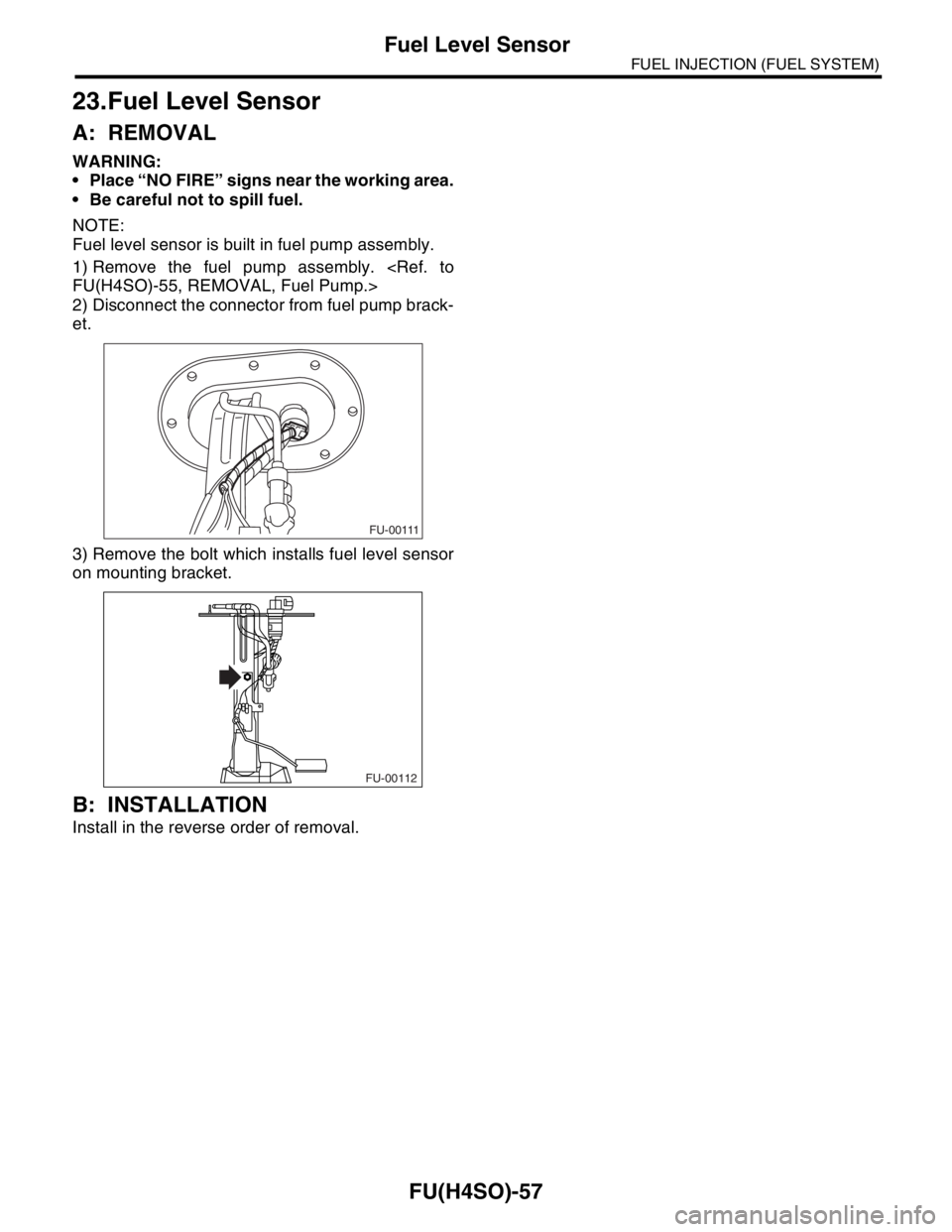
1) Remove the fuel pump assembly.
2) Disconnect the connector from fuel pump brack-
et.
3) Remove the bolt which installs fuel level sensor
on mounting bracket.
B: INSTALLATION
Install in the reverse order of removal.
FU-00111
FU-00112
Page 840 of 2870
FU(H4SO)-58
FUEL INJECTION (FUEL SYSTEM)
Fuel Sub Level Sensor
24.Fuel Sub Level Sensor
A: REMOVAL
WARNING:
Place “NO FIRE” signs near the working area.
Be careful not to spill fuel.
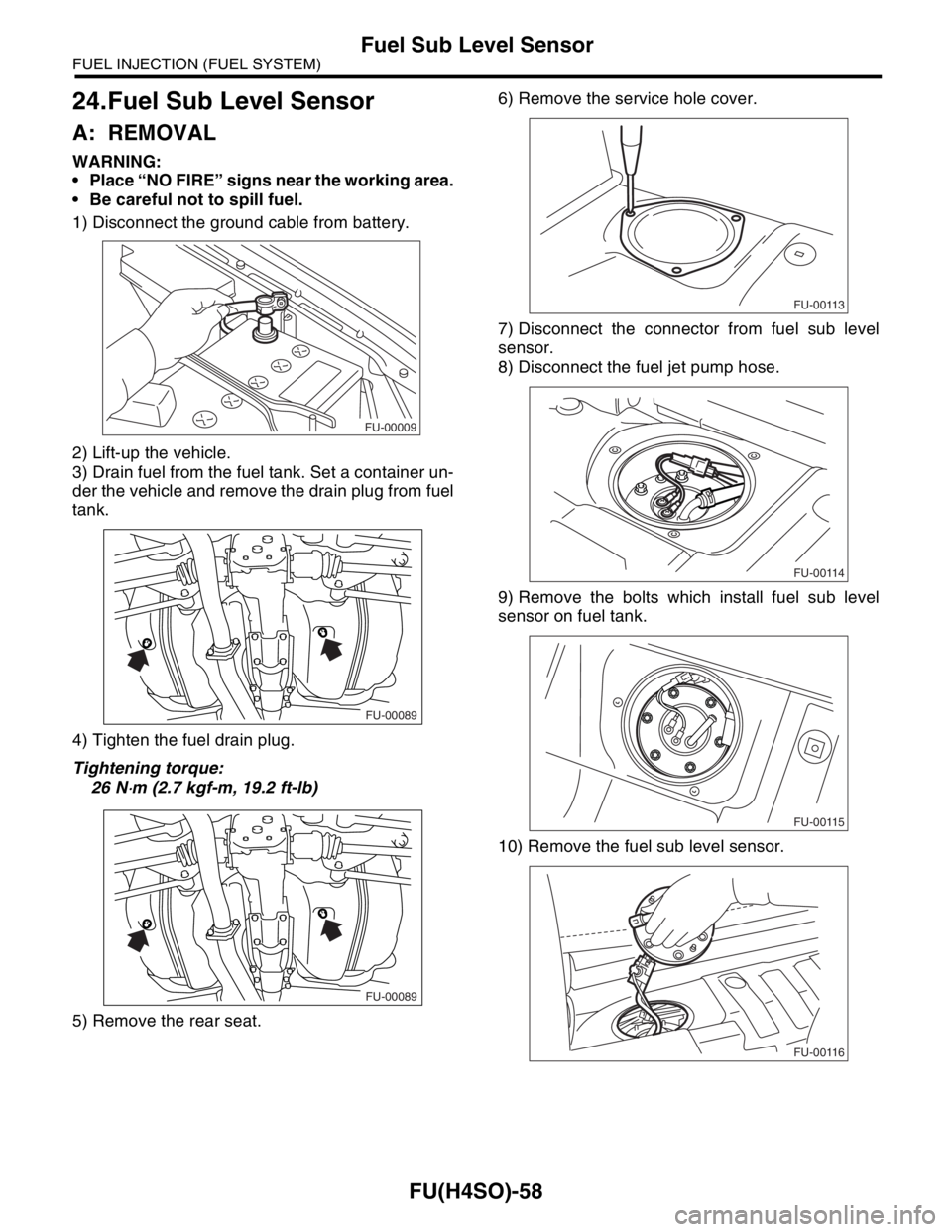
1) Disconnect the ground cable from battery.
2) Lift-up the vehicle.
3) Drain fuel from the fuel tank. Set a container un-
der the vehicle and remove the drain plug from fuel
tank.
4) Tighten the fuel drain plug.
Tightening torque:
26 N
⋅m (2.7 kgf-m, 19.2 ft-lb)
5) Remove the rear seat.6) Remove the service hole cover.
7) Disconnect the connector from fuel sub level
sensor.
8) Disconnect the fuel jet pump hose.
9) Remove the bolts which install fuel sub level
sensor on fuel tank.
10) Remove the fuel sub level sensor.
FU-00009
FU-00089
FU-00089
FU-00113
FU-00114
FU-00115
FU-00116
Page 841 of 2870

FU(H4SO)-59
FUEL INJECTION (FUEL SYSTEM)
Fuel Sub Level Sensor
B: INSTALLATION
Install in the reverse order of removal.
Tightening torque:
4.4 N
⋅m (0.45 kgf-m, 3.3 ft-lb)
FU-00115
Page 848 of 2870

FU(H4SO)-66
FUEL INJECTION (FUEL SYSTEM)
Fuel System Trouble in General
29.Fuel System Trouble in General
A: INSPECTION
NOTE:
When the vehicle is left unattended for an ex-
tended period of time, water may accumulate in the
fuel tank.
To prevent water condensation.
(1) Top off the fuel tank or drain the fuel com-
pletely.
(2) Drain the water condensation from the fuel
filter.
Refilling the fuel tank.
Refill the fuel tank while there is still some fuel left in
the tank.
Protecting the fuel system against freezing and
water condensation.
(3) Cold areas :
In snow-covered areas, mountainous areas, ski-
ing areas, etc. where ambient temperatures
drop below 0°C (32°F) throughout the winter
season, use an anti-freeze solution in the fuel
tank. Refueling will also complement the effect
of anti-freeze solution each time the fuel leveldrops to about one-half. After the winter season,
drain the water which may have accumulated in
the fuel filter and fuel tank in the manner same
as that described under “Affected areas” below.
(4) Affected areas :
When the water condensation is notched in the
fuel filter, drain the water from both the fuel filter
and fuel tank or use a water removing agent (or
anti-freeze solution) in the fuel tank.
Observe the instructions, notes, etc., indicated
on the label affixed to the anti-freeze solution (wa-
ter removing agent) container before use.
Trouble and possible cause Corrective action
1. Insufficient fuel supply to the injector
1) Fuel pump will not operate.
❍Defective terminal contact.Inspect connections, especially ground, and tighten
securely.
❍Trouble in electromagnetic or electronic circuit parts. Replace fuel pump.
2) Lowering of fuel pump function. Replace fuel pump.
3) Clogged dust or water in the fuel filter. Replace fuel filter, clean or replace fuel tank.
4) Clogged or bent fuel pipe or hose. Clean, correct or replace fuel pipe or hose.
5) Air is mixed in the fuel system. Inspect or retighten each connection part.
6) Clogged or bent breather tube or pipe. Clean, correct or replace air breather tube or pipe.
7) Damaged diaphragm of pressure regulator. Replace.
2. Leakage or blow out fuel
1) Loosened joints of the fuel pipe. Retightening.
2) Cracked fuel pipe, hose and fuel tank. Replace.
3) Defective welding part on the fuel tank. Replace.
4) Defective drain packing of the fuel tank. Replace.
5) Clogged or bent air breather tube or air vent tube.Clean, correct or replace air breather tube or air vent
tube.
3. Gasoline smell inside of compartment
1)Loose joints at air breather tube, air vent tube and fuel filler
pipe.Retightening.
2) Defective packing air tightness on the fuel saucer. Correct or replace packing.
3) Cracked fuel separator. Replace separator.
4) Inoperative fuel pump modulator or circuit. Replace.
4. Defective fuel meter indicator
1) Defective operation of fuel level sensor. Replace.
2) Defective operation of fuel meter. Replace.
5. Noise
1) Large operation noise or vibration of fuel pump. Replace.