engine coolant SUBARU FORESTER 2004 Service Repair Manual
[x] Cancel search | Manufacturer: SUBARU, Model Year: 2004, Model line: FORESTER, Model: SUBARU FORESTER 2004Pages: 2870, PDF Size: 38.67 MB
Page 1775 of 2870

EN(H4DOTC)-142
ENGINE (DIAGNOSTIC)
Diagnostic Procedure with Diagnostic Trouble Code (DTC)
Step Check Yes No
1 CHECK ANY OTHER DTC ON DISPLAY.Is any other DTC displayed? Inspect the DTC
using “List of Diag-
nostic Trouble
Code (DTC)”.
List of Diagnostic
Trouble Code
(DTC).>Go to step 2.
2 CHECK REAR OXYGEN SENSOR DATA.
1) Warm-up the engine until engine coolant
temperature is above 70°C (158°F), and keep
the engine speed at 2,000 rpm to 3,000 rpm for
two minutes.
2) Read the data of rear oxygen (A/F) sensor
signal using Subaru Select Monitor or OBD-II
general scan tool.
N
OTE:
Subaru Select Monitor
For detailed operation procedure, refer to
“READ CURRENT DATA SHOWN ON DIS-
PLAY FOR ENGINE”.
OBD-II general scan tool
For detailed operation procedures, refer to the
OBD-II General Scan Tool Operation Manual.Does the value fluctuate? Go to step 6.Go to step 3.
3 CHECK REAR OXYGEN SENSOR DATA.
Read the data of rear oxygen (A/F) sensor sig-
nal using Subaru Select Monitor or OBD-II
general scan tool.Is the voltage 0.2 — 0.4 V? Go to step 4.Replace the rear
oxygen sensor.
Rear Oxygen Sen-
sor.>
4 CHECK HARNESS BETWEEN ECM AND
REAR OXYGEN SENSOR CONNECTOR.
1) Turn the ignition switch to OFF.
2) Disconnect the connector from ECM and
rear oxygen sensor.
3) Measure the resistance in harness
between ECM and rear oxygen sensor con-
nector.
Connector & terminal
(B137) No. 25 — (T6) No. 4:Is the resistance more than 3
Ω?Repair battery
short circuit in har-
ness between
ECM and rear oxy-
gen sensor con-
nector.Go to step 5.
5 CHECK HARNESS BETWEEN REAR OXY-
GEN SENSOR and ECM CONNECTOR.
1) Turn the ignition switch to OFF.
2) Disconnect the connector from rear oxygen
sensor.
3) Turn the ignition switch to ON.
4) Measure the voltage between rear oxygen
sensor harness connector and engine ground
or chassis ground.
Connector & terminal
(T6) No. 4 (+) — Engine ground (
−):Is the voltage more than 0.2 V? Replace the rear
oxygen sensor.
Rear Oxygen Sen-
sor.>Repair the har-
ness and connec-
tor.
N
OTE:
In this case repair
the following:
Open circuit in
harness between
rear oxygen sen-
sor and ECM con-
nector
Poor contact in
rear oxygen sen-
sor connector
Poor contact in
ECM connector.
Page 1778 of 2870

EN(H4DOTC)-145
ENGINE (DIAGNOSTIC)
Diagnostic Procedure with Diagnostic Trouble Code (DTC)
Step Check Yes No
1 CHECK ANY OTHER DTC ON DISPLAY.Is any other DTC displayed? Inspect the DTC
using “List of Diag-
nostic Trouble
Code (DTC)”.
List of Diagnostic
Trouble Code
(DTC).>Go to step 2.
2 CHECK REAR OXYGEN SENSOR DATA.
1) Warm-up the engine until engine coolant
temperature is above 70°C (158°F), and keep
the engine speed at 2,000 rpm to 3,000 rpm for
two minutes.
2) Read the data of rear oxygen (A/F) sensor
signal using Subaru Select Monitor or OBD-II
general scan tool.
N
OTE:
Subaru Select Monitor
For detailed operation procedure, refer to
“READ CURRENT DATA SHOWN ON DIS-
PLAY FOR ENGINE”.
OBD-II general scan tool
For detailed operation procedures, refer to the
OBD-II General Scan Tool Operation Manual.Does the value fluctuate? Go to step 6.Go to step 3.
3 CHECK REAR OXYGEN SENSOR DATA.
Read the data of rear oxygen (A/F) sensor sig-
nal using Subaru Select Monitor or OBD-II
general scan tool.Is the voltage 0.2 — 0.4 V? Go to step 4.Replace the rear
oxygen sensor.
Rear Oxygen Sen-
sor.>
4 CHECK HARNESS BETWEEN ECM AND
REAR OXYGEN SENSOR CONNECTOR.
1) Turn the ignition switch to OFF.
2) Disconnect the connector from ECM and
rear oxygen sensor.
3) Measure the resistance in harness
between ECM and rear oxygen sensor con-
nector.
Connector & terminal
(B137) No. 25 — (T6) No. 4:Is the resistance more than 3
Ω?Repair battery
short circuit in har-
ness between
ECM and rear oxy-
gen sensor con-
nector.Go to step 5.
5 CHECK HARNESS BETWEEN REAR OXY-
GEN SENSOR and ECM CONNECTOR.
1) Turn the ignition switch to OFF.
2) Disconnect the connector from rear oxygen
sensor.
3) Turn the ignition switch to ON.
4) Measure the voltage between rear oxygen
sensor harness connector and engine ground
or chassis ground.
Connector & terminal
(T6) No. 4 (+) — Engine ground (
−):Is the voltage more than 0.2 V? Replace the rear
oxygen sensor.
Rear Oxygen Sen-
sor.>Repair the har-
ness and connec-
tor.
N
OTE:
In this case repair
the following:
Open circuit in
harness between
rear oxygen sen-
sor and ECM con-
nector
Poor contact in
rear oxygen sen-
sor connector
Poor contact in
ECM connector
Page 1783 of 2870

EN(H4DOTC)-150
ENGINE (DIAGNOSTIC)
Diagnostic Procedure with Diagnostic Trouble Code (DTC)
4 CHECK FUEL PRESSURE.
After connecting the pressure regulator vac-
uum hose, measure fuel pressure.
Warning:
Release fuel pressure before removing the
fuel pressure gauge.
N
OTE:
If fuel pressure does not increase, squeeze
fuel return hose 2 to 3 times, then measure
fuel pressure again.
If out of specification as measured at this
step, check or replace pressure regulator and
pressure regulator vacuum hose.Is measured value 206 — 235
kPa (2.1 — 2.4 kg/cm
2, 30 —
34 psi)?Go to step 5.Repair the follow-
ing items.
Fuel pressure is
too high:
Faulty pres-
sure regulator
Clogged fuel
return line or
bent hose
Fuel pressure is
too low:
Faulty pres-
sure regulator
Improper fuel
pump discharge
Clogged fuel
supply line
5 CHECK ENGINE COOLANT TEMPERATURE
SENSOR.
1) Start the engine and warm-up completely.
2) Read the data of engine coolant tempera-
ture sensor signal using Subaru Select Monitor
or the OBD-II general scan tool.
NOTE:
Subaru Select Monitor
For detailed operation procedure, refer to
“READ CURRENT DATA SHOWN ON DIS-
PLAY FOR ENGINE”.
OBD-II general scan tool
For detailed operation procedures, refer to the
OBD-II General Scan Tool Operation Manual.Is engine coolant temperature
more than 60°C (140°F)?Go to step 6.Replace the
engine coolant
temperature sen-
sor.
Engine Coolant
Temperature Sen-
sor.>
6 CHECK MASS AIR FLOW AND INTAKE AIR
TEMPERATURE SENSOR.
1) Start and warm-up the engine until engine
coolant temperature is greater than 60°C
(140°F).
2) Place the shift lever in neutral position.
3) Turn the A/C switch to OFF.
4) Turn all accessory switches to OFF.
5) Read the data of mass air flow and intake
air temperature sensor signal using Subaru
Select Monitor or the OBD-II general scan tool.
N
OTE:
Subaru Select Monitor
For detailed operation procedure, refer to
“READ CURRENT DATA SHOWN ON DIS-
PLAY FOR ENGINE”.
OBD-II general scan tool
For detailed operation procedures, refer to the
OBD-II General Scan Tool Operation Manual.Is the measured value within
the following?
Ignition ON: 73.3 — 106.6 kPa
(550 — 800 mmHg, 21.65 —
31.50 inHg)
Idling: 24.0 — 41.3 kPa (180 —
310 mmHg, 7.09 — 12.20
inHg)Go to step 7.Replace the mass
air flow and intake
air temperature
sensor.
Mass Air Flow and
Intake Air Temper-
ature Sensor.> Step Check Yes No
Page 1784 of 2870

EN(H4DOTC)-151
ENGINE (DIAGNOSTIC)
Diagnostic Procedure with Diagnostic Trouble Code (DTC)
7 CHECK MASS AIR FLOW AND INTAKE AIR
TEMPERATURE SENSOR.
1) Start and warm-up the engine until engine
coolant temperature is greater than 60°C
(140°F).
2) Place the shift lever in neutral position.
3) Turn the A/C switch to OFF.
4) Turn all accessory switches to OFF.
5) Open the hood.
6) Measure the ambient temperature.
7) Read the data of mass air flow and intake
air temperature sensor signal using Subaru
Select Monitor or the OBD-II general scan tool.
N
OTE:
Subaru Select Monitor
For detailed operation procedure, refer to
“READ CURRENT DATA SHOWN ON DIS-
PLAY FOR ENGINE”.
OBD-II general scan tool
For detailed operation procedures, refer to the
OBD-II General Scan Tool Operation Manual.Subtract the ambient tempera-
ture from intake air tempera-
ture, and is the value from
−10°C (14°F) to 50°C (122°F)?Contact the SUB-
ARU dealer.
N
OTE:
Inspection by DTM
is required, be-
cause probable
cause is deteriora-
tion of multiple
parts.Check mass air
flow and intake air
temperature sen-
sor.
Mass Air Flow and
Intake Air Temper-
ature Sensor.> Step Check Yes No
Page 1855 of 2870

EN(H4DOTC)-222
ENGINE (DIAGNOSTIC)
Diagnostic Procedure with Diagnostic Trouble Code (DTC)
Step Check Yes No
1 CHECK CURRENT DATA.
1) Start the engine.
2) Read the data of exhaust temperature sen-
sor signal using Subaru Select Monitor or
OBD-II general scan tool.
N
OTE:
Subaru Select Monitor
For detailed operation procedure, refer to
“READ CURRENT DATA SHOWN ON DIS-
PLAY FOR ENGINE”.
OBD-II general scan tool
For detailed operation procedures, refer to the
OBD-II General Scan Tool Operation Manual.Is engine coolant temperature
more than 1200°C (2192°F)?Go to step 2.Repair the poor
contact.
N
OTE:
In this case repair
the following:
Poor contact of
exhaust tempera-
ture sensor
Poor contact in
ECM
Poor contact in
joint connector
2 CHECK HARNESS BETWEEN EXHAUST
TEMPERATURE SENSOR AND ECM CON-
NECTOR.
1) Turn the ignition switch to OFF.
2) Disconnect the connector from exhaust
temperature sensor.
3) Turn the ignition switch to ON.
4) Read the data of exhaust temperature sen-
sor signal using Subaru Select Monitor or
OBD-II general scan tool.
N
OTE:
Subaru Select Monitor
For detailed operation procedure, refer to
“READ CURRENT DATA SHOWN ON DIS-
PLAY FOR ENGINE”.
OBD-II general scan tool
For detailed operation procedures, refer to the
OBD-II General Scan Tool Operation Manual.Is the temperature less than
372°C (702°F)?Replace the
exhaust tempera-
ture sensor.
49, Exhaust Tem-
perature Sensor.>Repair ground
short circuit in har-
ness between
exhaust tempera-
ture sensor and
ECM connector.
Page 1928 of 2870

EN(H4DOTC)-295
ENGINE (DIAGNOSTIC)
General Diagnostic Table
20.General Diagnostic Table
A: INSPECTION
1. ENGINE
NOTE:
Malfunction of parts other than those listed is also possible.
Symptom Problem parts
1. Engine stalls during idling.1) Idle air control solenoid valve
2) Manifold absolute pressure sensor
3) Mass air flow and intake air temperature sensor
4) Ignition parts (*1)
5) Engine coolant temperature sensor (*2)
6) Crankshaft position sensor (*3)
7) Camshaft position sensor (*3)
8) Fuel injection parts (*4)
2. Rough idling1) Idle air control solenoid valve
2) Manifold absolute pressure sensor
3) Mass air flow and intake air temperature sensor
4) Engine coolant temperature sensor (*2)
5) Ignition parts (*1)
6) Air intake system (*5)
7) Fuel injection parts (*4)
8) Throttle position sensor
9) Crankshaft position sensor (*3)
10) Camshaft position sensor (*3)
11) Oxygen sensor
12) Fuel pump and fuel pump relay
3. Engine does not return to idle.1) Idle air control solenoid valve
2) Engine coolant temperature sensor
3) Accelerator cable (*6)
4) Throttle position sensor
5) Manifold absolute pressure sensor
6) Mass air flow sensor
4. Poor acceleration1) Manifold absolute pressure sensor
2) Mass air flow and intake air temperature sensor
3) Throttle position sensor
4) Fuel injection parts (*4)
5) Fuel pump and fuel pump relay
6) Engine coolant temperature sensor (*2)
7) Crankshaft position sensor (*3)
8) Camshaft position sensor (*3)
9) A/C switch and A/C cut relay
10) Engine torque control signal circuit
11) Ignition parts (*1)
5. Engine stalls or engine sags or hesitates at
acceleration.1) Manifold absolute pressure sensor
2) Mass air flow and intake air temperature sensor
3) Engine coolant temperature sensor (*2)
4) Crankshaft position sensor (*3)
5) Camshaft position sensor (*3)
6) Purge control solenoid valve
7) Fuel injection parts (*4)
8) Throttle position sensor
9) Fuel pump and fuel pump relay
Page 1929 of 2870

EN(H4DOTC)-296
ENGINE (DIAGNOSTIC)
General Diagnostic Table
*1: Check ignition coil & ignitor ASSY and spark plug.
*2: Indicate the symptom occurring only in cold temperatures.
*3: Ensure the secure installation.
*4: Check fuel injector, fuel pressure regulator and fuel filter.
*5: Inspect air leak in air intake system.
*6: Adjust accelerator cable. 6. Surging1) Manifold absolute pressure sensor
2) Mass air flow and intake air temperature sensor
3) Engine coolant temperature sensor (*2)
4) Crankshaft position sensor (*3)
5) Camshaft position sensor (*3)
6) Fuel injection parts (*4)
7) Throttle position sensor
8) Fuel pump and fuel pump relay
7. Spark knock1) Manifold absolute pressure sensor
2) Mass air flow and intake air temperature sensor
3) Engine coolant temperature sensor
4) Knock sensor
5) Fuel injection parts (*4)
6) Fuel pump and fuel pump relay
8. After burning in exhaust system1) Manifold absolute pressure sensor
2) Mass air flow and intake air temperature sensor
3) Engine coolant temperature sensor (*2)
4) Fuel injection parts (*4)
5) Fuel pump and fuel pump relay Symptom Problem parts
Page 1931 of 2870

FUEL INJECTION (FUEL SYSTEM)
FU(H4DOTC 2.5)
Page
1. General Description ....................................................................................2
2. Throttle Body .............................................................................................13
3. Intake Manifold ..........................................................................................14
4. Engine Coolant Temperature Sensor........................................................26
5. Crankshaft Position Sensor.......................................................................27
6. Camshaft Position Sensor.........................................................................28
7. Knock Sensor ............................................................................................29
8. Mass Air Flow and Intake Air Temperature Sensor ..................................30
9. Manifold Absolute Pressure Sensor ..........................................................31
10. Fuel Injector ..............................................................................................32
11. Tumble Generator Valve Assembly ..........................................................33
12. Tumble Generator Valve Actuator.............................................................34
13. Wastegate Control Solenoid Valve ...........................................................35
14. Front Oxygen (A/F) Sensor .......................................................................36
15. Rear Oxygen Sensor.................................................................................38
16. Exhaust Temperature Sensor ...................................................................40
17. Engine Control Module (ECM) ..................................................................41
18. Main Relay ................................................................................................42
19. Fuel Pump Relay.......................................................................................43
20. Fuel Pump Control Unit .............................................................................44
21. Fuel ...........................................................................................................45
22. Fuel Tank ..................................................................................................46
23. Fuel Filler Pipe ..........................................................................................48
24. Fuel Pump .................................................................................................52
25. Fuel Level Sensor .....................................................................................54
26. Fuel Sub Level Sensor ..............................................................................55
27. Fuel Filter ..................................................................................................57
28. Fuel Cut Valve...........................................................................................58
29. Fuel Damper Valve ...................................................................................59
30. Fuel Delivery, Return and Evaporation Lines............................................60
31. Fuel System Trouble in General ...............................................................63
Page 1943 of 2870
FU(H4DOTC 2.5)-13
FUEL INJECTION (FUEL SYSTEM)
Throttle Body
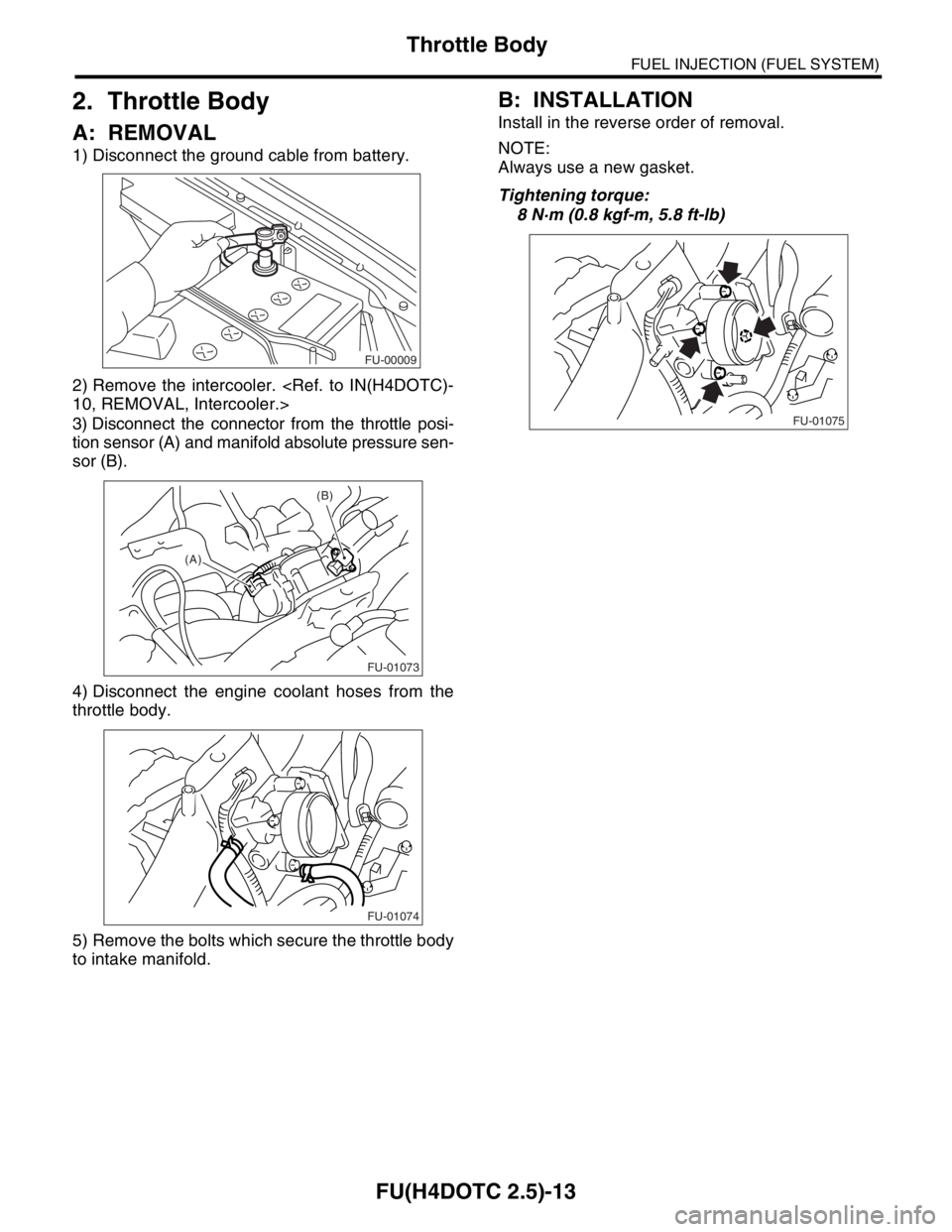
2. Throttle Body
A: REMOVAL
1) Disconnect the ground cable from battery.
2) Remove the intercooler.
3) Disconnect the connector from the throttle posi-
tion sensor (A) and manifold absolute pressure sen-
sor (B).
4) Disconnect the engine coolant hoses from the
throttle body.
5) Remove the bolts which secure the throttle body
to intake manifold.
B: INSTALLATION
Install in the reverse order of removal.
NOTE:
Always use a new gasket.
Tightening torque:
8 N·m (0.8 kgf-m, 5.8 ft-lb)
FU-00009
FU-01073
(A)
(B)
FU-01074
FU-01075
Page 1944 of 2870
FU(H4DOTC 2.5)-14
FUEL INJECTION (FUEL SYSTEM)
Intake Manifold
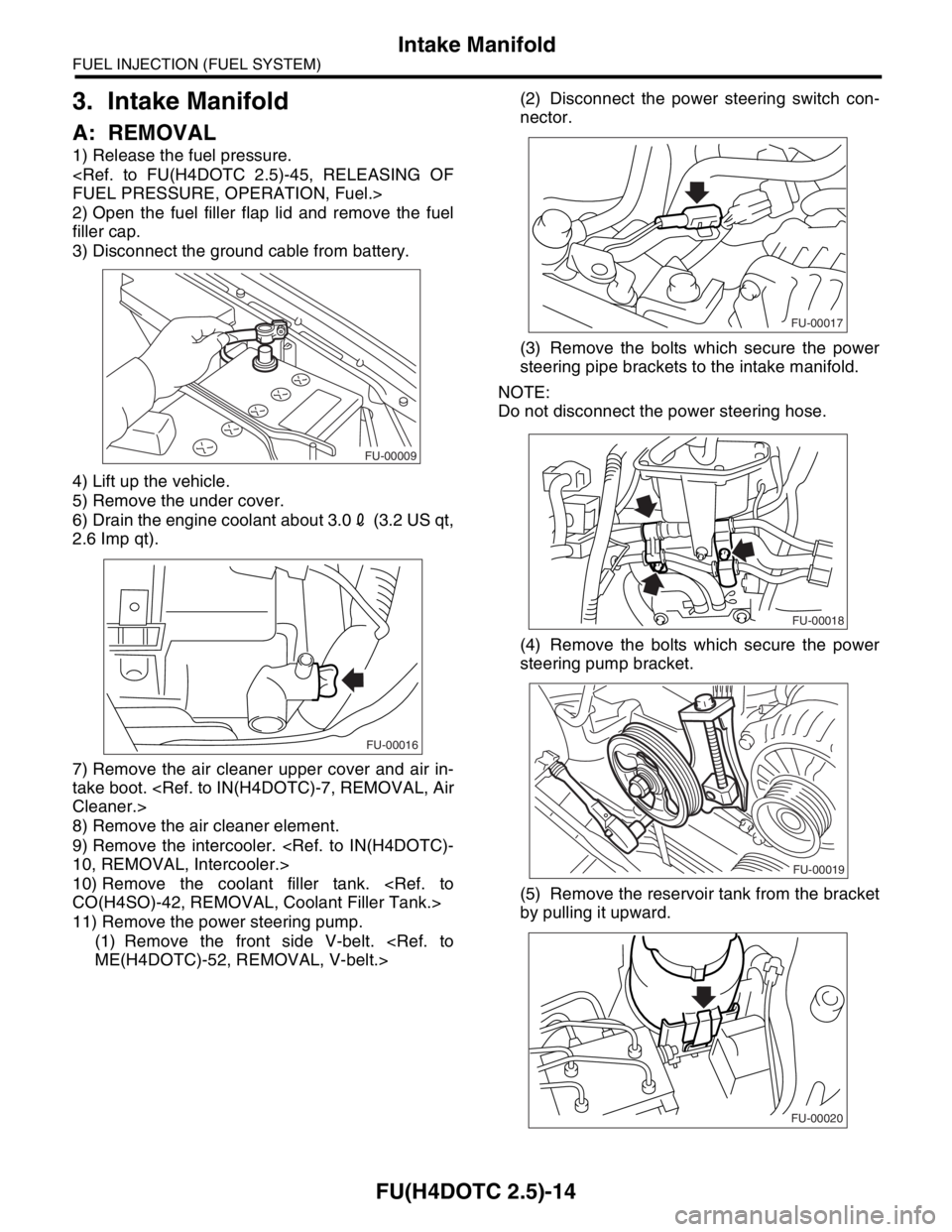
3. Intake Manifold
A: REMOVAL
1) Release the fuel pressure.
2) Open the fuel filler flap lid and remove the fuel
filler cap.
3) Disconnect the ground cable from battery.
4) Lift up the vehicle.
5) Remove the under cover.
6) Drain the engine coolant about 3.02 (3.2 US qt,
2.6 Imp qt).
7) Remove the air cleaner upper cover and air in-
take boot.
8) Remove the air cleaner element.
9) Remove the intercooler.
10) Remove the coolant filler tank.
11) Remove the power steering pump.
(1) Remove the front side V-belt.
nector.
(3) Remove the bolts which secure the power
steering pipe brackets to the intake manifold.
NOTE:
Do not disconnect the power steering hose.
(4) Remove the bolts which secure the power
steering pump bracket.
(5) Remove the reservoir tank from the bracket
by pulling it upward.
FU-00009
FU-00016
FU-00017
FU-00018
FU-00019
FU-00020