engine coolant SUBARU FORESTER 2004 Service Repair Manual
[x] Cancel search | Manufacturer: SUBARU, Model Year: 2004, Model line: FORESTER, Model: SUBARU FORESTER 2004Pages: 2870, PDF Size: 38.67 MB
Page 2398 of 2870
4AT-85
AUTOMATIC TRANSMISSION
ATF Cooler (With Warmer Function)
B: INSTALLATION
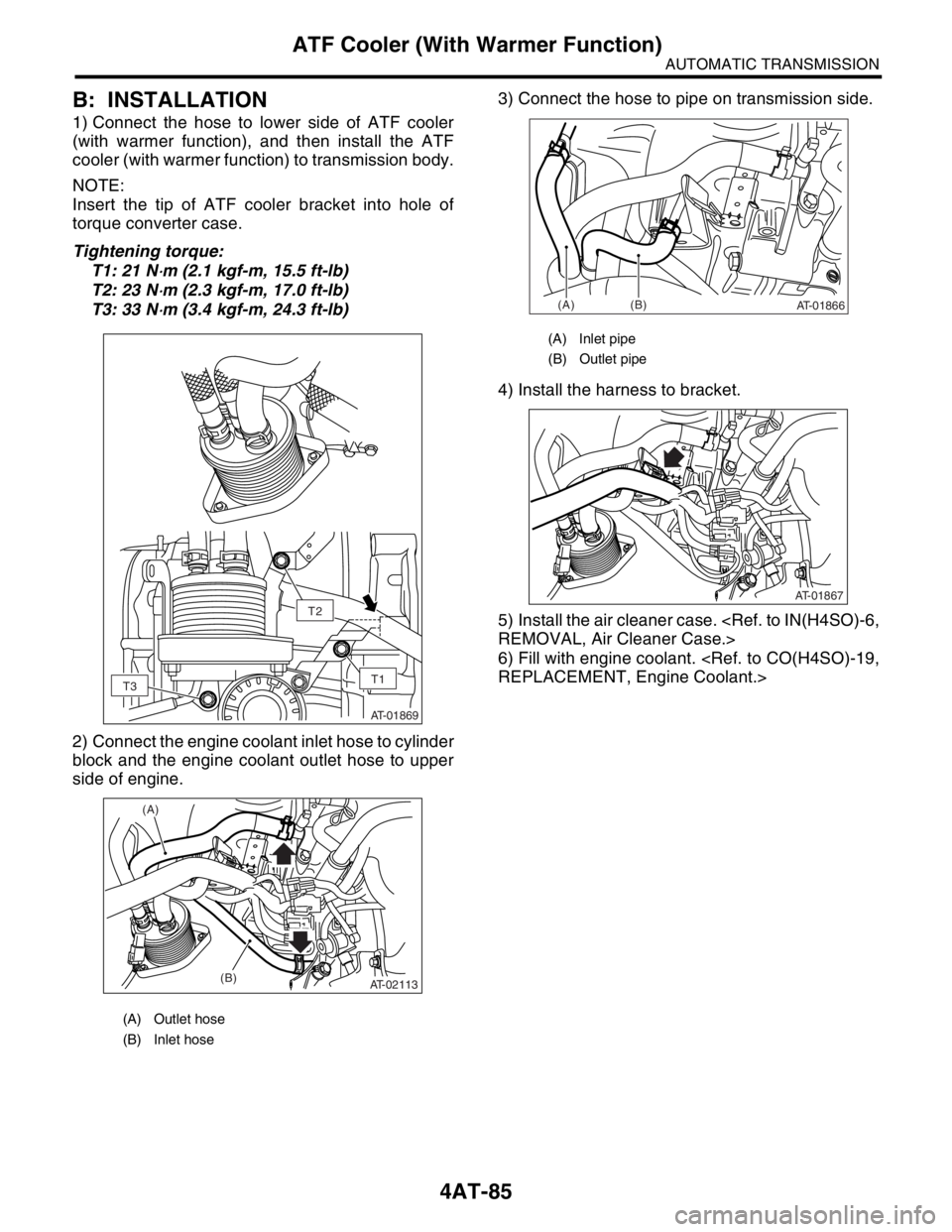
1) Connect the hose to lower side of ATF cooler
(with warmer function), and then install the ATF
cooler (with warmer function) to transmission body.
NOTE:
Insert the tip of ATF cooler bracket into hole of
torque converter case.
Tightening torque:
T1: 21 N
⋅m (2.1 kgf-m, 15.5 ft-lb)
T2: 23 N
⋅m (2.3 kgf-m, 17.0 ft-lb)
T3: 33 N
⋅m (3.4 kgf-m, 24.3 ft-lb)
2) Connect the engine coolant inlet hose to cylinder
block and the engine coolant outlet hose to upper
side of engine.3) Connect the hose to pipe on transmission side.
4) Install the harness to bracket.
5) Install the air cleaner case.
6) Fill with engine coolant.
(A) Outlet hose
(B) Inlet hose
AT-01869
T2
T1T3
AT-02113
(A)
(B)
(A) Inlet pipe
(B) Outlet pipe
AT-01866(A)(B)
AT-01867
Page 2399 of 2870
4AT-86
AUTOMATIC TRANSMISSION
ATF Cooler (With Warmer Function)
C: DISASSEMBLY
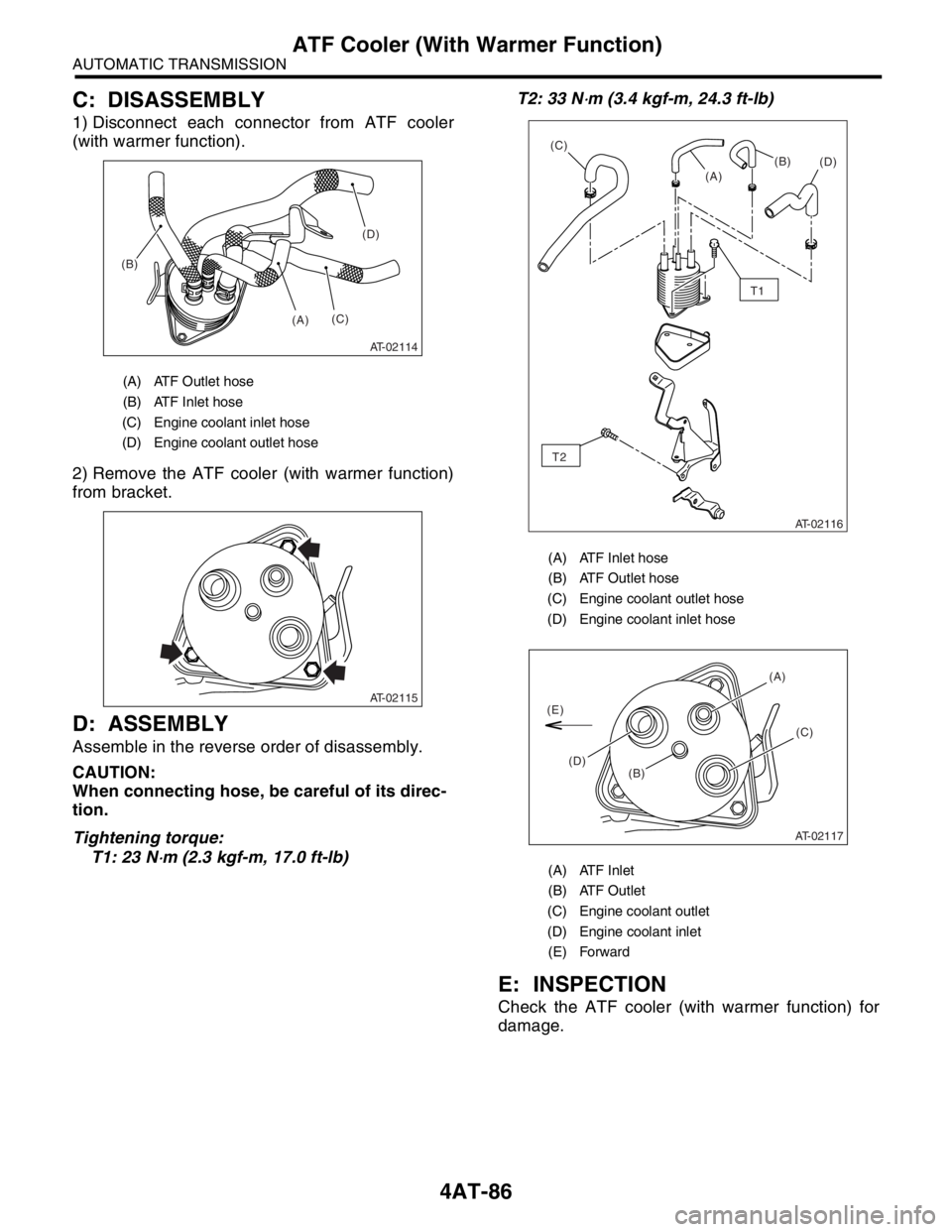
1) Disconnect each connector from ATF cooler
(with warmer function).
2) Remove the ATF cooler (with warmer function)
from bracket.
D: ASSEMBLY
Assemble in the reverse order of disassembly.
CAUTION:
When connecting hose, be careful of its direc-
tion.
Tightening torque:
T1: 23 N
⋅m (2.3 kgf-m, 17.0 ft-lb)T2: 33 N
⋅m (3.4 kgf-m, 24.3 ft-lb)
E: INSPECTION
Check the ATF cooler (with warmer function) for
damage.
(A) ATF Outlet hose
(B) ATF Inlet hose
(C) Engine coolant inlet hose
(D) Engine coolant outlet hose
AT-02114
(A) (B)(C)
(D)
AT-02115
(A) ATF Inlet hose
(B) ATF Outlet hose
(C) Engine coolant outlet hose
(D) Engine coolant inlet hose
(A) ATF Inlet
(B) ATF Outlet
(C) Engine coolant outlet
(D) Engine coolant inlet
(E) Forward
AT-02116
T1
T2
(B)
(D) (C)
(A)
AT-02117
(D)(B)(A)
(C)
(E)
Page 2496 of 2870

4AT(H4SO)-37
AUTOMATIC TRANSMISSION (DIAGNOSTIC)
Diagnostic Procedure with Diagnostic Trouble Code (DTC)
Step Check Yes No
1 CHECK HARNESS CONNECTOR BETWEEN
TCM AND ECM.
1) Turn the ignition switch to OFF.
2) Disconnect the connectors from TCM and
ECM.
3) Measure the resistance of harness
between TCM and ECM connector.
Connector & terminal
(B55) No. 17 — (B134) No. 10:Is the resistance less than 1
Ω?Go to step 2.Repair the open
circuit in harness
between TCM and
ECM connector.
2 CHECK HARNESS CONNECTOR BETWEEN
TCM AND ECM.
Measure the resistance of harness between
TCM connector and chassis ground.
Connector & terminal
(B55) No. 17 — Chassis ground:Is the resistance more than 1
MΩ?Go to step 3.Repair the short
circuit in harness
between TCM and
ECM connector.
3 PREPARE SUBARU SELECT MONITOR.Do you have a Subaru Select
Monitor?Go to step 5.Go to step 4.
4 CHECK INPUT SIGNAL FOR TCM.
1) Connect the connectors to TCM and ECM.
2) Turn the ignition switch to ON (engine
OFF).
3) Measure the voltage between TCM con-
nector and chassis ground.
Connector & terminal
(B55) No. 17 (+) — Chassis ground (
−):Is the voltage more than 10.5
V?Even if the
POWER indicator
light was blinking,
the circuit has
returned to a nor-
mal condition at
this time. A tempo-
rary poor contact
of the connector or
harness may be
the cause. Repair
the harness or
connector in TCM
and ECM.Go to step 6.
5 CHECK INPUT SIGNAL FOR TCM USING
SUBARU SELECT MONITOR.
1) Connect the connectors to TCM and ECM.
2) Connect the Subaru Select Monitor to data
link connector.
3) Start the engine and turn Subaru Select
Monitor switch to ON.
4) Warm-up the engine until engine coolant
temperature is above 80°C (176°F).
5) Idle the engine.
6) Read the data of engine speed using Sub-
aru Select Monitor.
Display shows the engine speed signal value
sent from ECM.Is the revolution value same as
tachometer reading shown on
combination meter?Even if the
POWER indicator
light was blinking,
the circuit has
returned to a nor-
mal condition at
this time. A tempo-
rary poor contact
of the connector or
harness may be
the cause. Repair
the harness or
connector in TCM
and ECM.Go to step 6.
6 CHECK POOR CONTACT.Is there poor contact in engine
speed signal circuit?Repair the poor
contact.Go to step 7.
7 CONFIRM DTC 11.Replace the ECM with a new
one. Does the DTC 11 appear
again, after memory has been
cleared?Replace the TCM.
trol Module
(TCM).>Replace the ECM.
Engine Control
Module (ECM).>
Page 2514 of 2870

4AT(H4SO)-55
AUTOMATIC TRANSMISSION (DIAGNOSTIC)
Diagnostic Procedure with Diagnostic Trouble Code (DTC)
5 CHECK INPUT SIGNAL FOR TCM.
1) Connect the connectors to TCM and ECM.
2) Start the engine, and warm-up the trans-
mission until ATF temperature is above 80°C
(176°F).
N
OTE:
If ambient temperature is below 0°C (32°F),
drive the vehicle until ATF reaches its operating
temperature.
3) Idle the engine.
4) Measure the voltage between TCM con-
nector and chassis ground.
Connector & terminal
(B54) No. 1 (+) — Chassis ground (
−):Is the voltage 0.4 — 1.6 V? Even if the
POWER indicator
light was blinking,
the circuit has
returned to a nor-
mal condition at
this time. A tempo-
rary poor contact
of the connector or
harness may be
the cause. Repair
the harness or
connector in TCM
and ECM.Go to step 7.
6 CHECK INPUT SIGNAL FOR TCM USING
SUBARU SELECT MONITOR.
1) Connect the connectors to TCM and ECM.
2) Connect the Subaru Select Monitor to data
link connector.
3) Start the engine, and turn Subaru Select
Monitor switch to ON.
4) Warm-up the engine until engine coolant
temperature is above 80°C (176°F).
5) Idle the engine.
6) Read the data of intake manifold pressure
signal using Subaru Select Monitor.
Display shows the intake manifold pressure
signal value sent from ECM.Is the voltage 0.4 — 1.6 V? Even if the
POWER indicator
light was blinking,
the circuit has
returned to a nor-
mal condition at
this time. A tempo-
rary poor contact
of the connector or
harness may be
the cause. Repair
the harness or
connector in TCM
and ECM.Go to step 7.
7 CHECK POOR CONTACT.Is there poor contact in intake
manifold pressure signal cir-
cuit?Repair the poor
contact.Replace the TCM.
trol Module
(TCM).> Step Check Yes No